


1 Timothy 5:15
Bible text: King James Version (1769 Blayney text) · Public domain
Bible text: Berean Standard Bible · Public domain
Bible text: American Standard Version (1901) · Public domain
Bible text: World English Bible, Messianic edition · Public domain
Bible text: Geneva Bible (1599) · Public domain
Bible text: Young's Literal Translation · Public domain
- ἤδηēdēAlreadyG2235ADVAdverb
- γάρgarforG1063CONJConjunction
- τινεςtinessomeG5100X-NPFIndefinite pronoun Nominative Plural Feminine
- ἐξετράπησανexetrapēsanhave turned asideG1624V-2API-3PVerb 2nd Aorist Passive Indicative 3rd Plural
- ὀπίσωopisōafterG3694PREPPreposition
- τοῦtou<the>G3588T-GSMDefinite article Genitive Singular Masculine
- σατανᾶsatanaSatanG4567N-GSM-TNoun Genitive Singular Masculine Title
English is a literal word-by-word gloss of the Greek, not the KJV's wording. Why?
This is the original text the KJV's translators worked from — each Greek word with its own literal English meaning in this verse, prepared by scholars at Tyndale House, Cambridge. The KJV translates whole sentences, not word by word, so its wording differs: one Greek word can become several English words, and the KJV may choose “charity” where the gloss reads “love”. Both are faithful — they answer different questions. For the KJV's own rendering, switch to the KJV text.
Details
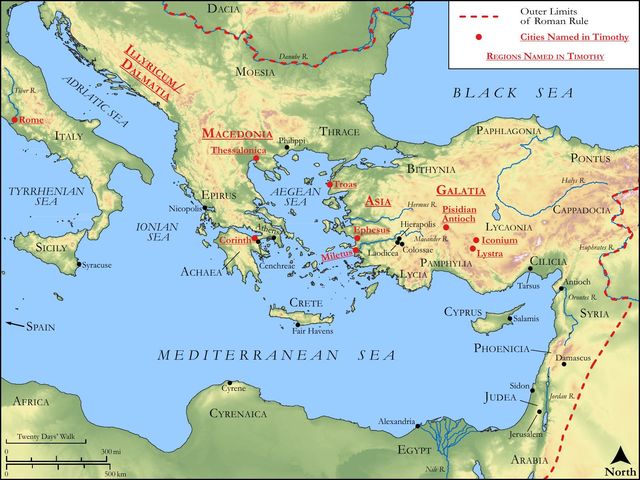
See on the biblical-era maps

Study this verse
Public-domain commentary
Matthew Henry
From his Commentary on the Whole Bible. Henry comments on passages, not single verses — this entry covers 1 Timothy 5:3–16. His two-level outline is real structure in the source text, so it is rendered as structure.
Directions are here given concerning the taking of widows into the number of those who were employed by the church and had maintenance from the church: Honour widows that are widows indeed. Honour them, that is, maintain them, admit them into office. There was in those times an office in the church in which widows were employed, and that was to tend the sick and the aged, to look to them by the direction of the deacons. We read of the care taken of widows immediately upon the first forming of the Christian church (Act 6:1), where the Grecians thought their widows were neglected in the daily ministration and provision made for poor widows. The general rule is to honour widows that are widows indeed, to maintain them, to relieve them with respect and tenderness.
I.It is appointed that those widows only should be relieved by the charity of the church who were pious and devout, and not wanton widows that lived in pleasure, Ti1 5:5, Ti1 5:6. She is to be reckoned a widow indeed, and it to be maintained at the church's charge, who, being desolate, trusteth in God. Observe, It is the duty and comfort of those who are desolate to trust in God. Therefore God sometimes brings his people into such straits that they have nothing else to trust to, that they may with more confidence trust in him. Widowhood is a desolate estate; but let the widows trust in me (Jer 49:11), and rejoice that they have a God to trust to. Again, Those who trust in God must continue in prayer. If by faith we confide in God, by prayer we must give glory to God and commit ourselves to his guidance. Anna was a widow indeed, who departed not from the temple (Luk 2:37), but served God with fasting and prayer night and day. But she is not a widow indeed that lives in pleasure (Ti1 5:6), or who lives licentiously. A jovial widow is not a widow indeed, not fit to be taken under the care of the church. She that lives in pleasure is dead while she lives, is no living member of the church, but as a carcase in it, or a mortified member. We may apply it more generally; those who live in pleasure are dead while they live, spiritually dead, dead in trespasses and sins; they are in the world to no purpose, buried alive as to the great ends of living.
II.Another rule he gives is that the church should not be charged with the maintenance of those widows who had relations of their own that were able to maintain them. This is mentioned several times (Ti1 5:4): If any widow have children or nephews, that is grandchildren or near relations, let them maintain them, and let not the church be burdened. So Ti1 5:16. This is called showing piety at home (Ti1 5:4), or showing piety towards their own families. Observe, The respect of children to their parents, with their care of them, is fitly called piety. This is requiting their parents. Children can never sufficiently requite their parents for the care they have taken of them, and the pains they have taken with them; but they must endeavour to do it. It is the indispensable duty of children, if their parents be in necessity, and they in ability to relieve them, to do it to the utmost of their power, for this is good and acceptable before God. The Pharisees taught that a gift to the altar was more acceptable to God than relieving a poor parent, Mat 15:5. But here we are told that this is better than all burnt-offerings and sacrifices; this is good and acceptable, etc. He speaks of this again (Ti1 5:8), If any provide not for his own, etc. If any men or women do not maintain their own poor relations who belong to them, they do in effect deny the faith; for the design of Christ was to confirm the law of Moses, and particularly the law of the fifth commandment, which is, Honour thy father and mother; so that those deny the faith who disobey that law, much more if they provide not for their wives and children, who are parts of themselves; if they spend that upon their lusts which should maintain their families, they have denied the faith and are worse than infidels. One reason why this care must be taken that those who are rich should maintain their poor relations, and not burden the church with them is (Ti1 5:16) that it may relieve those who are widows indeed. Observe, Charity misplaced is a great hindrance to true charity; there should be prudence in the choice of the objects of charity, that it may not be thrown away upon those who are not properly so, that there may be the more for those who are real objects of charity.
III.He gives directions concerning the characters of the widows that were to be taken into the number to receive the church's charity:
not under sixty years old, nor any who have divorced their husbands or been divorced from them and have married again; she must have been the wife of one man, such as had been a housekeeper, had a good name for hospitality and charity, well reported of for good works. Observe, Particular care ought to be taken to relieve those, when they fall into decay, who, when they had wherewithal, were ready to every good work. Here are instances of such good works as are proper to be done by good wives: If she have brought up children: he does not say, If she have borne children (children are a heritage of the Lord), that depends on the will of God; but, if she had not children of her own, yet if she had brought up children. If she have lodged strangers, and washed the saints' feet; if she have been ready to give entertainment to good Christians and good ministers, when they were in their travels for the spreading of the gospel. Washing of the feet o their friends was a part of their entertainments. If she have relieved the afflicted when she had ability, let her be relieved now. Observe, Those who would find mercy when they are in distress must show mercy when they are in prosperity.
IV.He cautions them to take heed of admitting into the number those who are likely to be no credit to them (Ti1 5:11):
The younger widows refuse: they will be weary of their employments in the church, and of living by rule, as they must do; so they will marry, and cast off their first faith. You read of a first love (Rev 2:4), and here of a first faith, that is, the engagements they gave to the church to behave well, and as became the trust reposed in them: it does not appear that by their first faith is meant their vow not to marry, for the scripture is very silent on that head; besides the apostle here advises the younger widows to marry (Ti1 5:14), which he would not if hereby they must have broken their vows. Dr. Whitby well observes, "If this faith referred to a promise made to the church not to marry, it could not be called their first faith." Withal they learn to be idle, and not only idle, but tattlers, etc., Ti1 5:13. Observe, It is seldom that those who are idle are idle only, they learn to be tattlers and busy-bodies, and to make mischief among neighbours, and sow discord among brethren. Those who had not attained to such a gravity of mind as was fit for the deaconesses (or the widows who were taken among the church's poor), let them marry, bear children, etc., Ti1 5:14. Observe, If housekeepers do not mind their business, but are tattlers, they give occasion to the adversaries of Christianity to reproach the Christian name, which, it seems, there were some instances of, Ti1 5:15. We learn hence,
1.In the primitive church there was care taken of poor widows, and provision made for them; and the churches of Christ in these days should follow so good an example, as far as they are able.
2.In the distribution of the church's charity, or alms, great care is to be taken that those share in the public bounty who most want it and best deserve it. A widow was not to be taken into the primitive church that had relations who were able to maintain her, or who was not well reported of for good works, but lived in pleasure: But the younger widows refuse, for, when they have begun to wax wanton against Christ, they will marry.
3.The credit of religion, and the reputation of Christian churches, are very much concerned in the character and behaviour of those that are taken into any employment in the church, though of a lower nature (such as the business of deaconesses), or that receive alms of the church; if they do not behave well, but are tatlers and busy-bodies, they will give occasion to the adversary to speak reproachfully.
4.Christianity obliges its professors to relieve their indigent friends, particularly poor widows, that the church may not be charged with them, that it may relieve those that are widows indeed: rich people should be ashamed to burden the church with their poor relations, when it is with difficulty that those are supplied who have no children or nephews, that is, grand-children, who are in a capacity to relieve them.
Historical interpretation
Six Centuries of Reception
2 surviving comments on this verse. Each one is dated, so this reads as a timeline rather than a list.
Select a marker to jump to its quote. Markers stagger vertically where authors wrote within a few decades of each other.
"For some are already turned aside after Satan." Such widows as these then he would have refused, not meaning that there should be no younger widows, but that there should be no adulteresses, that none should be idle, busy-bodies, speaking things that they ought not, that no occasion should be given to the adversary. Had nothing of this kind taken place, he would not have forbidden them.
Therefore, I wish the younger women to marry, bear children, manage the household, and give no opportunity to the adversary to have a cause for slander. For already some have turned aside after Satan.
The good aspect was that, once the widows were instructed, they should not abandon Christ nor reject their initial faith. But since they do this, let them marry, and let them not pledge themselves to Christ, and so let them marry. The former is blameless, the latter is unholy. For their arrogance and looseness of conduct are thus restrained, at least by greater affliction and concern.
and give no opportunity to the adversary. For if they marry correctly, not engaged to Christ beforehand, they will not expose themselves to the occasion of being slandered. Paul did not command them to live without fear in marrying, but that, pressed by cares, they should look to live modestly.
For already some have turned aside after Satan. But why then did you pay such great attention to these things, and even more to those concerning the virgins? Because they, Paul says, gave occasion, turning away after Satan. For he says this not that there are no younger widows, but because he feared lest he might reject Christ.
Continue studying 1 Timothy 5:15 across the web’s major study libraries — every link below opens this exact verse, chapter, or book on the destination site.
Read & Compare
 BibleGatewayThis verse in more than 200 translations and 70 languages.
 Bible.comThe YouVersion reader — hundreds of translations, reading plans, and highlights.
 ESV.orgCrossway's official English Standard Version reader.
 NET BibleThe NET translation with 60,000+ translators' notes on every rendering decision.
 STEP BibleTyndale House's free study tool — original text, vocabulary, and scholarly resources.
 BibliaLogos Bible Software's free web reader.
 USCCBThe New American Bible (Revised Edition) with the U.S. bishops' study notes.
Commentaries
 BibleHub CommentariesDozens of classic commentaries on this verse, gathered on one page.
 StudyLightMore than 100 commentary sets — the largest collection on the web.
 BibleRefPlain-English commentary on what this verse means, verse by verse.
 Enduring WordDavid Guzik's free commentary on this chapter, widely used by Bible teachers.
 Bible Study ToolsVerse commentary alongside Greek and Hebrew study aids.
Original Language & Research
- BibleHub InterlinearThe verse word by word — original language, transliteration, and English.
- BibleHub LexiconEvery word's original-language definition and Strong's entry.
 Blue Letter BibleDeep-study tools — Strong's numbers, concordance, and word studies.
 CNTR CollationThe earliest Greek manuscripts of this verse, collated letter by letter.
Sermons, Hymns & Audio


TrulyRandomVerse is not affiliated with these sites and doesn’t control their content. They’re linked because they’re genuinely useful.
Summary
This verse serves as a stark warning within Paul's pastoral instructions to Timothy concerning the care and conduct of widows in the early church. This verse reveals that some individuals, previously committed to Christian service or faith, had already deviated from their spiritual path, aligning themselves, perhaps unknowingly, with the purposes of Satan. It underscores the ever-present danger of spiritual drift and the adversary's influence, particularly when coupled with idleness or a lack of spiritual discipline.
Context
ShowHideLiterary Context
This verse is situated within a larger section of Paul's letter to Timothy (specifically 1 Timothy 5) that provides detailed instructions on various groups within the Ephesian church, including elders, younger men and women, and particularly, widows. Paul delineates specific criteria for enrolling older widows for church support, emphasizing their proven godliness and service to others. However, he strongly advises against enrolling younger widows for this formal support, expressing concern that their natural desire to remarry, coupled with potential idleness, could lead them into temptation. He warns that such idleness might cause them to become "gossips and busybodies, saying things they ought not to say" (1 Timothy 5:13). The preceding verses (1 Timothy 5:11-14) explain Paul's rationale, concluding with the direct justification in 1 Timothy 5:15: "For some are already turned aside after Satan," indicating that this was not a hypothetical concern but an observed reality.
Historical & Cultural Context
Under Rome, widows often faced significant social and economic vulnerability, making the church's provision for them a vital act of charity and practical theology. The early church, as it grew, developed structures to care for its members, including a formal "order of widows" who might have served in various capacities, such as prayer, hospitality, or teaching younger women. However, this structure also presented challenges. Younger widows, unlike older ones, might find it difficult to maintain a life of celibacy and dedicated service, especially if they lacked the maturity or spiritual grounding. The cultural expectation for women to marry and have children was strong. Furthermore, Ephesus, where Timothy was ministering, was a bustling metropolitan center known for its diverse religious practices, philosophical schools, and moral laxity. This environment presented numerous temptations and false teachings, making spiritual vigilance crucial. The early church was constantly battling external pressures and internal weaknesses, and Paul's instructions reflect a concern for maintaining purity, order, and spiritual integrity amidst these challenges.
Key Themes
ShowHide1 Timothy 5:15 contributes to several key themes prevalent in 1 Timothy and the broader Pauline epistles. One prominent theme is the importance of sound doctrine and guarding against false teaching. While not directly about heresy, turning "after Satan" implies a departure from truth and godly living, which can be influenced by or lead to doctrinal error. Another theme is spiritual vigilance and discipline. Paul's concern for the younger widows highlights that idleness and a lack of purposeful engagement can create fertile ground for temptation and spiritual decline, as seen in 1 Timothy 5:13. The verse also underscores the reality of spiritual warfare, emphasizing that deviation from God's path is not merely human failing but can involve the active influence of the adversary, a concept Paul elaborates on in passages like Ephesians 6:11-12. Finally, it touches upon the theme of church order and practical theology, as Paul's instructions are designed to maintain the integrity and witness of the Christian community by preventing behaviors that bring reproach upon the faith.
Exposition and Analysis
ShowHideKey Word Analysis
ShowHideThis indefinite pronoun refers to an unspecified number of individuals, indicating that the problem was not universal but significant enough to warrant Paul's strong caution. It suggests that actual instances of spiritual deviation had occurred among those who might have been considered for church support or who were already within the Christian community.
Derived from ek (out of) and trepō (to turn), this verb literally means "to turn out of the way," "to deviate," or "to go astray." In a figurative sense, as used here, it denotes a departure from a correct course, whether morally, doctrinally, or spiritually. It implies a deliberate or gradual departure from the path of faith and godly conduct, rather than a mere stumble.
This term, of Chaldean origin, means "the accuser" or "adversary." It refers to the devil, the chief antagonist of God and humanity. To "turn aside after Satan" means to follow his purposes, to align with his agenda, or to become his instrument, even if unknowingly. It signifies a spiritual allegiance to the forces of evil, contrasting sharply with allegiance to Christ.
Verse Breakdown
ShowHide"For some are already turned aside"
This clause reveals the immediate justification for Paul's preceding counsel regarding younger widows. The word "already" (Greek: ḗdē) emphasizes the present reality and urgency of the situation; this was not a hypothetical danger but an observable problem within the Ephesian church. The phrase "turned aside" signifies a deviation from the path of faith, commitment, or godly living that these individuals were expected to uphold. It implies a significant spiritual departure.
"after Satan"
This phrase clarifies the ultimate direction and allegiance of those who have "turned aside." It indicates that their deviation is not merely a personal failing but a movement towards the adversary. This does not necessarily imply conscious allegiance or demonic possession, but rather that their actions, attitudes, or choices (perhaps born of idleness, gossip, or worldly desires as implied in the preceding verses) inadvertently or directly serve the purposes of the devil, who seeks to undermine faith and disrupt the church.
Literary Devices
ShowHide1 Timothy 5:15 primarily functions as a Warning, serving to justify Paul's stringent advice regarding younger widows. The phrase "turned aside after Satan" employs Metaphor, portraying spiritual deviation as a physical journey where one leaves the right path and begins to follow an adverse leader. Satan is Personified as a figure one can follow, implying an active, insidious influence rather than a mere abstract force of evil. This also utilizes Hyperbole to some extent, as "after Satan" is a strong, dramatic statement designed to emphasize the gravity of spiritual drift, even if the individuals themselves do not consciously pledge allegiance to the devil. The starkness of the language serves to shock and impress upon Timothy (and the church) the severe consequences of spiritual laxity and idleness.
Theological and Thematic Connections
ShowHideThe profound warning in 1 Timothy 5:15 resonates deeply with core biblical themes of spiritual warfare, the reality of temptation, and the necessity of perseverance in faith. It highlights that the Christian life is not passive but an active engagement against forces that seek to draw believers away from Christ. The phrase "turned aside after Satan" underscores the theological truth that there are only two ultimate allegiances: to God or to His adversary. Any deviation from God's path, whether through idleness, worldly desires, or false teaching, ultimately serves the purposes of the enemy, even if the individual is unaware of this spiritual reality. This verse reminds us that the devil is a real, active foe who seeks to "devour" believers (1 Peter 5:8). Therefore, vigilance, spiritual discipline, and a steadfast commitment to Christ are paramount to avoid such a tragic spiritual trajectory.
Reflection and Application
ShowHide1 Timothy 5:15 serves as a timeless and potent reminder for believers today about the subtle yet profound dangers of spiritual complacency and drift. It urges us to recognize that idleness, whether physical or spiritual, can create an open door for temptation and distraction, gradually pulling one away from their initial commitment to Christ. The phrase "after Satan" is a sobering call to acknowledge the reality of spiritual warfare and the adversary's insidious influence, which often operates not through overt rebellion but through a gradual turning away from truth, discipline, and godly pursuits. This verse challenges us to examine our own lives: Are there areas where we have become lax, allowing worldly desires or distractions to subtly redirect our allegiance? It underscores the critical importance of remaining watchful, rooted in faith, and actively engaged in meaningful service and spiritual disciplines to guard against the tragic outcome of unknowingly serving the purposes of the enemy. Our commitment to Christ must be active, vigilant, and constantly renewed through prayer, study of God's Word, and fellowship with other believers.
Questions for Reflection
ShowHideFAQ
ShowHideWhat does it mean to "turn aside after Satan"? Does it imply demon possession or overt satanic worship?
ShowHideTo "turn aside after Satan" in 1 Timothy 5:15 does not necessarily imply demon possession or conscious, overt satanic worship. Instead, it signifies a spiritual deviation where an individual's actions, attitudes, or lifestyle choices, even if seemingly mundane, align with or serve the purposes of the adversary. In the immediate context, Paul links this "turning aside" to idleness, gossip, and a desire for worldly pleasures (1 Timothy 5:13). These behaviors, while not overtly demonic, are contrary to godly living and can lead one away from Christ, effectively making them instruments of Satan's disruptive agenda within the church. It's a warning about the subtle, insidious ways the enemy can influence believers to stray from their faith and commitment.
Christ-Centered Fulfillment
ShowHideWhile 1 Timothy 5:15 presents a stark warning about turning aside after Satan, its ultimate fulfillment and hope are found in the person and work of Jesus Christ. Christ is the Good Shepherd who lays down His life for His sheep, promising that "no one will snatch them out of my hand" (John 10:28). His victory on the cross disarmed the spiritual powers and authorities, triumphing over them (Colossians 2:15). For the believer, turning aside "after Satan" represents a tragic departure from the safety and provision found in Christ. However, Christ's work provides the means to resist the devil, for He Himself "destroyed the one who has the power of death, that is, the devil" (Hebrews 2:14). Through His indwelling Holy Spirit, believers are empowered to stand firm against temptation and the wiles of the enemy, enabling them to "resist the devil, and he will flee from you" (James 4:7). Thus, while the warning is real, the ultimate security and power to overcome the adversary are rooted in the finished work of Christ and the ongoing ministry of the Spirit within us, calling us to remain steadfast in Him.