


Genesis 50:11
Bible text: King James Version (1769 Blayney text) · Public domain
Bible text: King James Version with Strong's numbers · Public domain
Bible text: Berean Standard Bible · Public domain
Bible text: American Standard Version (1901) · Public domain
Bible text: World English Bible, Messianic edition · Public domain
Bible text: Geneva Bible (1599) · Public domain
Bible text: Young's Literal Translation · Public domain
- וַיַּרְאvai·Yar'and he sawH7200Conj-w ¦ V-Qal-ConsecImperf-3msVerb Qal Consecutive Imperfect 3rd Singular Masculineוַandיַּרְאhe saw
- יוֹשֵׁבyo·Shev[the] inhabitant[s] ofH3427V-Qal-Prtcpl-msVerb Qal Participle Singular Masculine Construct
- הָאָרֶץha·'A·retzthe landH776Art ¦ N-fsNoun Singular Feminine Absoluteהָtheאָרֶץland
- הַכְּנַעֲנִיha·ke·na·'a·Nithe Canaanite[s]H3669Art ¦ N-msNoun Gentilic Singular Masculine AbsoluteהַtheכְּנַעֲנִיCanaanite[s]
- אֶת'et<obj.>H853DirObjMParticle Object Indicator
- הָאֵבֶלha·'E·velthe mourningH60Art ¦ N-msNoun Singular Masculine Absoluteהָtheאֵבֶלmourning
- בְּגֹרֶןbe·Go·renat [the] threshing floor ofH1637Prep-b ¦ N-fscNoun Singular Feminine Constructבְּatגֹרֶן[the] threshing floor of
- הָאָטָדha·'a·Tad<the> AtadH329Art ¦ N-properNoun Proper Locationהָ<the>אָטָדAtad
- וַיֹּאמְרוּvai·Yo·me·Ruand they saidH559Conj-w ¦ V-Qal-ConsecImperf-3mpVerb Qal Consecutive Imperfect 3rd Plural Masculineוַandיֹּאמְרוּthey said
- אֵבֶל'e·vel[is] mourningH60N-msNoun Singular Masculine Absolute
- כָּבֵדka·VedheavyH3515Adj-msAdjective Singular Masculine Absolute
- זֶהzehthisH2088PrtParticle Demonstrative
- לְמִצְרָיִםle·mitz·Ra·yimfor EgyptH4714Prep-l ¦ N-properNoun Proper LocationלְforמִצְרָיִםEgypt
- עַל'althere-H5921PrepPreposition
- כֵּןken-foreH3651AdvAdverb
- קָרָאka·Ra'someone calledH7121V-Qal-Perf-3msVerb Qal Perfect 3rd Singular Masculine
- שְׁמָהּshe·Mahits nameH8034N-msc ¦ 3fsNoun Singular Masculine Constructשְׁמָnameהּits
- אָבֵל'a·VelAbelH67N-properNoun Proper Location
- מִצְרַיִםmitz·Ra·yimMizraimH67N-properNoun Proper Location
- אֲשֶׁר'a·SherwhichH834RelParticle Relative
- בְּעֵבֶרbe·'E·ver[is] on [the] other side ofH5676Prep-b ¦ N-mscNoun Singular Masculine Constructבְּ[is] onעֵבֶר[the] other side of
- הַיַּרְדֵּןhai·yar·Denthe JordanH3383Art ¦ N-properNoun Proper LocationהַtheיַּרְדֵּןJordan
English is a literal word-by-word gloss of the Hebrew, not the KJV's wording. Why?
This is the original text the KJV's translators worked from — each Hebrew word with its own literal English meaning in this verse, prepared by scholars at Tyndale House, Cambridge. The KJV translates whole sentences, not word by word, so its wording differs: one Hebrew word can become several English words, and the KJV may choose “the LORD” where the gloss reads “Yahweh”. Both are faithful — they answer different questions. For the KJV's own rendering, switch to the KJV text.
Details
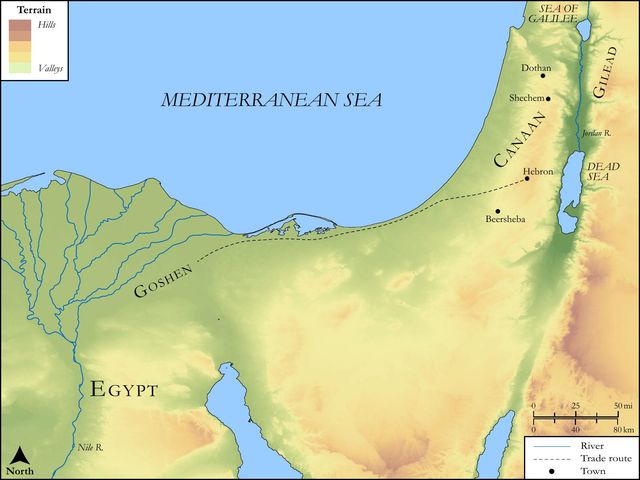
See on the biblical-era maps


Study this verse
Public-domain commentary
Matthew Henry
From his Commentary on the Whole Bible. Henry comments on passages, not single verses — this entry covers Genesis 50:7–14.
We have here an account of Jacob's funeral. Of the funerals of the kings of Judah, usually, no more is said than this, They were buried with their fathers in the city of David: but the funeral of the patriarch Jacob is more largely and fully described, to show how much better God was to him than he expected (he had spoken more than once of dying for grief, and going to the grave bereaved of his children, but, behold, he dies in honour, and is followed to the grave by all his children), and also because his orders concerning his burial were given and observed in faith, and in expectation both of the earthly and of the heavenly Canaan. Now, 1. It was a stately funeral. He was attended to the grave, not only by his own family, but by the courtiers, and all the great men of the kingdom, who, in token of their gratitude to Joseph, showed this respect to his father for his sake, and did him honour at his death. Though the Egyptians had had an antipathy to the Hebrews, and had looked upon them with disdain (Gen 43:32), yet now, that they were better acquainted with them, they began to have a respect for them. Good old Jacob had conducted himself so well among them as to gain universal esteem. Note, Professors of religion should endeavour, by wisdom and love, to remove the prejudices which many may have conceived against them because they do not know them. There went abundance of chariots and horsemen, not only to attend them a little way, but to go through with them. Note, The decent solemnities of funerals, according to a man's situation, are very commendable; and we must not say of them, To what purpose is this waste? See Act 8:2; Luk 7:12. 2. It was a sorrowful funeral (Gen 50:10, Gen 50:11); standers-by took notice of it as a grievous mourning. Note, The death of good men is a great loss to any place, and ought to be greatly lamented. Stephen dies a martyr, and yet devout men make great lamentations for him. The solemn mourning for Jacob gave a name to the place, Abel-Mizraim, the mourning of the Egyptians, which served for a testimony against the next generation of the Egyptians, who oppressed the posterity of this Jacob to whom their ancestors showed such respect.
Continue studying Genesis 50:11 across the web’s major study libraries — every link below opens this exact verse, chapter, or book on the destination site.
Read & Compare
 BibleGatewayThis verse in more than 200 translations and 70 languages.
 Bible.comThe YouVersion reader — hundreds of translations, reading plans, and highlights.
 ESV.orgCrossway's official English Standard Version reader.
 NET BibleThe NET translation with 60,000+ translators' notes on every rendering decision.
 STEP BibleTyndale House's free study tool — original text, vocabulary, and scholarly resources.
 BibliaLogos Bible Software's free web reader.
 USCCBThe New American Bible (Revised Edition) with the U.S. bishops' study notes.
Commentaries
 BibleHub CommentariesDozens of classic commentaries on this verse, gathered on one page.
 StudyLightMore than 100 commentary sets — the largest collection on the web.
 BibleRefPlain-English commentary on what this verse means, verse by verse.
 Enduring WordDavid Guzik's free commentary on this chapter, widely used by Bible teachers.
 Bible Study ToolsVerse commentary alongside Greek and Hebrew study aids.
Original Language & Research
- BibleHub InterlinearThe verse word by word — original language, transliteration, and English.
- BibleHub LexiconEvery word's original-language definition and Strong's entry.
 Blue Letter BibleDeep-study tools — Strong's numbers, concordance, and word studies.
 SefariaThe Hebrew text with Rashi and centuries of Jewish commentary.
Sermons, Hymns & Audio


TrulyRandomVerse is not affiliated with these sites and doesn’t control their content. They’re linked because they’re genuinely useful.
Summary
Genesis 50:11 describes a poignant moment during Jacob's elaborate funeral procession, where the profound grief displayed by Joseph and his large retinue at the "floor of Atad" was so overwhelming that it captivated the attention of the local Canaanite inhabitants. Witnessing this intense lamentation, they remarked on its severity, identifying it as a "grievous mourning to the Egyptians," leading to the renaming of the site as "Abelmizraim," a lasting geographical marker commemorating the deep respect and sorrow shown for Jacob and the powerful impression made upon those outside the covenant community.
Context
ShowHideLiterary Context
This verse is situated at the climax of the book of Genesis, specifically within the final chapter detailing the death and burial of Jacob. Following Jacob's solemn request to Joseph to be buried in Canaan with his ancestors (Genesis 47:29-31), and his final blessings and prophecies to his sons in Genesis 49, the narrative shifts to the fulfillment of Joseph's promise. The grandeur of the funeral procession, involving a significant Egyptian delegation alongside Jacob's family, underscores Jacob's elevated status and the deep respect accorded to Joseph within the Egyptian court. This specific verse highlights a pause in the journey, emphasizing the public nature and impact of the mourning before the final interment in the cave of Machpelah, as recorded in Genesis 50:13.
Historical & Cultural Context
Egyptian funeral practices, especially for high-status individuals, often involved elaborate processions, public displays of grief, and extended periods of mourning. The involvement of "elders of his house" and "all the elders of the land of Egypt" (Genesis 50:7) signifies a state funeral, reflecting the honor Joseph held as Pharaoh's prime minister. Threshing floors (gôren) were common, large, open, circular areas typically located outside a village, making them ideal public spaces for gatherings, particularly for a large funeral procession to halt and perform rituals. The act of renaming a place based on a significant event was also a common practice in Scripture, as when Jacob called Luz Bethel, serving as a mnemonic device and a historical marker. The "Canaanites" were the indigenous inhabitants of the land, and their observation provides an external, unbiased perspective on the magnitude of the event.
Key Themes
ShowHideGenesis 50:11 contributes to several overarching themes in the book. It powerfully illustrates filial piety and faithfulness, as Joseph meticulously fulfills his father's dying wish to be buried in the promised land, despite the logistical challenges of transporting a body from Egypt to Canaan (Genesis 47:29-31). The public and "grievous mourning" also emphasizes the theme of lamentation and human sorrow in the face of death, a universal experience. Furthermore, the Canaanites' observation and the renaming of the place highlight the theme of witness to outsiders, demonstrating how the actions and values of God's people can make a profound impression on those outside the covenant community. Finally, Jacob's burial in Canaan, rather than Egypt, subtly reinforces the theme of God's faithfulness to His covenant promises regarding the land, even as the Israelite family is still a minority group within it, anticipating the future return and inheritance of the land as promised in Genesis 15:18-21.
Exposition and Analysis
ShowHideKey Word Analysis
ShowHideFrom the root אָבַל (abal), meaning "lamentation; mourning." This word specifically denotes the deep, outward expression of grief, often accompanied by wailing, weeping, and other customary signs of sorrow. Its repeated use in this verse ("the mourning," "a grievous mourning") underscores the profound and visible nature of the sorrow displayed by Joseph's procession, making it unmistakable to onlookers.
Derived from an unused root signifying "to smooth," this term refers to "a threshing-floor (as made even); by analogy, any open area." A threshing floor was typically a large, flat, open-air space, often paved or hardened, used for threshing grain. Its selection as a stopping point for such a large procession indicates its suitability as a spacious public area, allowing the full magnitude of the mourning rituals to be observed by the local inhabitants.
From the root כָּבַד (kabad), meaning "heavy." Figuratively, it can mean "numerous" (in a good sense) or "severe, difficult, stupid" (in a bad sense). In this context, it conveys the intense, burdensome, and overwhelming nature of the mourning. The Canaanites perceived the lamentation as "heavy" or "severe," indicating its exceptional depth and duration, far beyond ordinary expressions of sorrow.
Verse Breakdown
ShowHide"And when the inhabitants of the land, the Canaanites, saw the mourning in the floor of Atad"
This clause sets the scene, identifying the observers as the local, non-Israelite population of Canaan. The specific mention of "Canaanites" emphasizes an external, objective perspective. Their observation of "the mourning" at "the floor of Atad" highlights the public and conspicuous nature of the funeral procession's display of grief.
"they said, This [is] a grievous mourning to the Egyptians"
The Canaanites' immediate reaction and declaration underscore the profound impact of what they witnessed. They attributed the intensity of the lamentation to "the Egyptians," likely due to the large Egyptian contingent in the procession and the high status of Joseph, who was prominently identified with Egypt. This statement emphasizes the extraordinary depth and severity of the grief, so much so that it was seen as characteristic of a powerful nation.
"wherefore the name of it was called Abelmizraim, which [is] beyond Jordan"
This final clause explains the consequence of the Canaanites' observation: the renaming of the location. "Abelmizraim" (אבל מצרים) literally means "mourning of Egypt," a permanent memorial to the event. The phrase "beyond Jordan" (מעבר לירדן) provides a geographical marker, indicating the site's location, likely east of the Jordan River from the perspective of the narrative's later audience, or from the perspective of those approaching from the west, further solidifying the event's place in the land's geography.
Literary Devices
ShowHideThe verse employs several literary devices to convey its meaning and impact. Etymology is prominent, as the narrative explains the origin of the place name "Abelmizraim" directly from the observed event, embedding the story within the very geography of the land. This act of naming serves as a memorial, ensuring the profound nature of Jacob's funeral is remembered. The Canaanites' remark, "This is a grievous mourning to the Egyptians," can be seen as a form of hyperbole, emphasizing the extraordinary and overwhelming nature of the grief. While the primary mourners were Jacob's family, the Canaanites' attribution of the mourning to the powerful Egyptian nation highlights the sheer scale and intensity of the lamentation, making a profound impression on outsiders. Furthermore, the entire scene functions as a powerful witness, demonstrating how the conduct of God's people, even in sorrow, can make a significant impression on those outside the covenant community.
Theological and Thematic Connections
ShowHideGenesis 50:11 serves as a powerful testament to the themes of filial piety, the public witness of faith, and the enduring nature of God's covenant promises. Joseph's unwavering commitment to fulfilling his father's dying wish, even undertaking a logistically complex journey from Egypt to Canaan, highlights the profound value of honoring parents and keeping solemn promises. The Canaanites' observation of the "grievous mourning" underscores the visible and impactful nature of the grief, demonstrating how the actions and expressions of God's people can bear witness to their values and even to God's presence, leaving a lasting impression on those outside the covenant community. This event also subtly reinforces the theme of God's faithfulness, as Jacob, though having lived long in Egypt, is ultimately laid to rest in the promised land, a symbolic act affirming the divine covenant regarding the land that would one day belong to his descendants.
Reflection and Application
ShowHideGenesis 50:11 offers profound insights into the human experience of loss, the importance of honoring commitments, and the subtle yet powerful impact of our lives on those around us. Joseph's dedication to fulfilling Jacob's dying wish, despite the immense effort involved, stands as a timeless model of filial piety and integrity. It reminds us of the sacred trust involved in honoring our parents and fulfilling our promises, even when they demand significant sacrifice. Moreover, the Canaanites' observation of the "grievous mourning" serves as a powerful reminder that our lives, our values, and even our expressions of sorrow are observed by the world. How we grieve, how we honor our commitments, and how we live out our faith can bear a powerful witness, drawing attention to the God we serve. This passage invites us to consider the legacy we are building and the impression we are leaving on those who watch us, encouraging us to live lives of integrity and faithfulness that reflect the character of God. The journey to the promised land, even in death, points to a greater hope—the ultimate rest and inheritance awaiting believers, where God himself will wipe away every tear and sorrow will be no more, as promised in Revelation 21:4.
Questions for Reflection
ShowHideFAQ
ShowHideWhat was the "floor of Atad"?
ShowHideThe "floor of Atad" (Hebrew: gôren ʼâṭâd) was likely a large, open threshing floor, a common feature in ancient agricultural communities. These areas were typically flat, hardened spaces used for separating grain from chaff, and were often located outside villages. Their spaciousness made them suitable for accommodating large gatherings, such as Jacob's extensive funeral procession, allowing for the public display of mourning described in Genesis 50:10.
Why did the Canaanites call the place "Abelmizraim"?
ShowHideThe Canaanites named the place "Abelmizraim" (Hebrew: ʼÂbêl Mitsrayim) because they were profoundly impressed by the intensity and scale of the mourning displayed by Jacob's funeral procession. "Abelmizraim" translates to "mourning of Egypt" or "lamentation of the Egyptians." The Canaanites attributed such a "grievous mourning" to the powerful Egyptian nation because of the large Egyptian contingent accompanying Joseph and Jacob's family, signifying the immense respect and sorrow associated with this event, as noted in Genesis 50:9.
Why was Jacob buried in Canaan and not in Egypt?
ShowHideJacob was buried in Canaan because he had made Joseph swear a solemn oath to inter him with his ancestors in the land of Canaan, specifically in the cave of Machpelah, which Abraham had purchased (Genesis 47:29-31 and Genesis 49:29-32). This desire reflected Jacob's faith in God's covenant promise that the land of Canaan would belong to his descendants (e.g., Genesis 15:18), and his wish to be identified with that promised inheritance rather than with Egypt, despite his long sojourn there.
Christ-Centered Fulfillment
ShowHideThe solemn journey of Jacob's body to the promised land, marked by profound mourning and witnessed by outsiders, finds its ultimate fulfillment in the person and work of Jesus Christ. Jacob's desire to be buried in Canaan, the land of promise, foreshadows the ultimate inheritance of the faithful in the heavenly Canaan, the eternal dwelling promised by God to His people (Hebrews 11:16). The "grievous mourning" observed by the Canaanites, while a testament to human grief and filial devotion, points to the infinitely deeper sorrow that Christ bore on the cross, taking upon Himself the weight of the world's sin and suffering (Isaiah 53:4-5). Just as Joseph faithfully fulfilled his father's dying wish, Christ perfectly fulfilled the Father's will, ensuring the spiritual inheritance for all who believe in Him (John 6:38-40). His death and resurrection overcome the ultimate sorrow of sin and death, leading His people to the true promised land, where there will be no more mourning, crying, or pain, and where God Himself will dwell with them forever, wiping away every tear (Revelation 21:4).