


Genesis 24:6
Bible text: King James Version (1769 Blayney text) · Public domain
Bible text: Berean Standard Bible · Public domain
Bible text: American Standard Version (1901) · Public domain
Bible text: World English Bible, Messianic edition · Public domain
Bible text: Geneva Bible (1599) · Public domain
Bible text: Young's Literal Translation · Public domain
- וַיֹּאמֶרvai·Yo·merand he saidH559Conj-w ¦ V-Qal-ConsecImperf-3msVerb Qal Consecutive Imperfect 3rd Singular Masculineוַandיֹּאמֶרhe said
- אֵלָיו'e·Lavto himH413Prep ¦ 3msPreposition Definiteאֵלָיtoוhim
- אַבְרָהָם'av·ra·HamAbrahamH85N-proper-mNoun Proper Masculine
- הִשָּׁמֶרhi·Sha·mertake heedH8104V-Niphal-Imp-2msVerb Niphal Imperative 2nd Singular Masculine
- לְךָle·Khato <the> yourselfPrep-l ¦ 2msSuffix Personal 2nd Singular Masculineלְto <the>ךָyourself
- פֶּןpenlestH6435PrtParticle Conditional
- תָּשִׁיבta·Shivyou should take backH7725V-Hiphil-Imperf-2msVerb Hiphil Imperfect 2nd Singular Masculine
- אֶת'et<obj.>H853DirObjMParticle Object Indicator
- בְּנִיbe·Nimy sonH1121N-msc ¦ 1csNoun Singular Masculine Constructבְּנִsonיmy
- שָׁמָּהSha·mahthere towardsH8033Adv ¦ SfxAdverbשָׁמָּthereהtowards
English is a literal word-by-word gloss of the Hebrew, not the KJV's wording. Why?
This is the original text the KJV's translators worked from — each Hebrew word with its own literal English meaning in this verse, prepared by scholars at Tyndale House, Cambridge. The KJV translates whole sentences, not word by word, so its wording differs: one Hebrew word can become several English words, and the KJV may choose “the LORD” where the gloss reads “Yahweh”. Both are faithful — they answer different questions. For the KJV's own rendering, switch to the KJV text.
Details
See on the biblical-era maps


Study this verse
Public-domain commentary
Matthew Henry
From his Commentary on the Whole Bible. Henry comments on passages, not single verses — this entry covers Genesis 24:1–9. His two-level outline is real structure in the source text, so it is rendered as structure.
Three things we may observe here concerning Abraham: -
I.The care he took of a good son, to get him married, well married.
It was high time to think of it now, for Isaac was about forty years old, and it had been customary with his ancestors to marry at thirty, or sooner, Gen 11:14, Gen 11:18, Gen 11:22, Gen 11:24. Abraham believed the promise of the building up of his family, and therefore did not make haste; not more haste than good speed. Two considerations moved him to think of it now (Gen 24:1): - 1. That he himself was likely to leave the world quickly, for he was old, and well-stricken in age, and it would be a satisfaction to him to see his son settled before he died; and, 2. That he had a good estate to leave behind him, for the Lord had blessed him in all things; and the blessing of the Lord makes rich. See how much religion and piety befriend outward prosperity. Now Abraham's pious care concerning his son was, (1.) That he should not marry a daughter of Canaan, but one of his kindred. He saw that the Canaanites were degenerating into great wickedness, and knew by revelation that they were designed for ruin, and therefore he would not marry his son among them, lest they should be either a snare to his soul, or at least a blot to his name. (2.) That yet he should not leave the land of Canaan, to go himself among his kindred, not even for the purpose of choosing a wife, lest he should be tempted to settle there. This caution is given Gen 24:6, and repeated, Gen 24:8. "Bring not my son thither again, whatever comes of it. Let him rather want a wife than expose himself to that temptation." Note, Parents in disposing of their children, should carefully consult the welfare of their souls, and their furtherance in the way to heaven. Those who through grace have escaped the corruption that is in the world through lust, and have brought up their children accordingly, should take heed of doing any thing by which they may be again entangled therein and overcome, Pe2 2:20. Beware that you bring them not thither again, Heb 11:15.
II.The charge he gave to a good servant, probably Eliezer of Damascus, one of whose conduct, fidelity, and affection to him and his family, he had had long experience. He trusted him with this great affair, and not Isaac himself, because he would not have Isaac go at all into that country, but marry there by proxy; and no proxy so fit as this steward of his house. This matter is settled between the master and the servant with a great deal of care and solemnity.
1.The servant must be bound by an oath to do his utmost to get a wife for Isaac from among his relations, Gen 24:2-4. Abraham swears him to it, both for his own satisfaction and for the engagement of his servant to all possible care and diligence in this matter. Thus God swears his servants to their work, that, having sworn, they may perform it. Honour is here done to the eternal God; for he it is that is sworn by, to whom alone these appeals ought to be made. And some think honour is done to the covenant of circumcision by the ceremony here used of putting his hand under his thigh. Note, Swearing being an ordinance not peculiar to the church, but common to mankind, is to be performed by such signs as are the appointments and common usages of our country, for binding the person sworn.
2.He must be clear of this oath if, when he had done his utmost, he could not prevail. This proviso the servant prudently inserted (Gen 24:5), putting the case that the woman would not follow him; and Abraham allowed the exception, Gen 24:8. Note, Oaths are to be taken with great caution, and the matter sworn to should be rightly understood and limited, because it is a snare to devour that which is holy, and, after vows, to make the enquiry which should have been made before.
III.The confidence he put in a good God, who, he doubts not, will give his servant success in this undertaking, Gen 24:7.
He remembers that God had wonderfully brought him out of the land of his nativity, by the effectual call of his grace; and therefore doubts not but he will succeed him in his care not to bring his son thither again. He remembers also the promise God had made and confirmed to him that he would give Canaan to his seed, and thence infers that God would own him in his endeavours to match his son, not among those devoted nations, but to one that was fit to be the mother of such a seed. "Fear not therefore; he shall send his angel before thee to make thy way prosperous." Note,
1.Those that carefully keep in the way of duty, and govern themselves by the principles of their religion in their designs and undertakings, have good reason to expect prosperity and success in them. God will cause that to issue in our comfort in which we sincerely aim at his glory.
2.God's promises, and our own experiences, are sufficient to encourage our dependence upon God, and our expectations from him, in all the affairs of this life.
3.God's angels are ministering spirits, sent forth, not only for the protection, but for the guidance, of the heirs of promise, Heb 1:14. "He shall send his angel before thee, and then thou wilt speed well."
Historical interpretation
Historical reception
1 surviving comment on this verse from the historical church.
The patriarch, on the other hand, delivered an adequate direction to his servant and put him under oath. But let us now see the servant’s sense of duty in imitating his master’s godliness; when he saw the good man directing him with great earnestness, he said to him, “If the woman does not want to accompany me, do you want me to take your son back to the country you came from?” In case some problem arises, he is saying, and I seem to overstep your commands, I would consequently like to know what rules I should observe and whether it is your will that Isaac should go there, take his wife and then return here if she does not agree to accompany me, as you commanded? So what did the good man reply? He rejected this alternative, saying, “Be sure not to take my son back there.” There is no need for you to do it, he says. The One who made the promise to me and guaranteed that his descendants would be increased to such an extent will also bring this to a happy end.
Continue studying Genesis 24:6 across the web’s major study libraries — every link below opens this exact verse, chapter, or book on the destination site.
Read & Compare
 BibleGatewayThis verse in more than 200 translations and 70 languages.
 Bible.comThe YouVersion reader — hundreds of translations, reading plans, and highlights.
 ESV.orgCrossway's official English Standard Version reader.
 NET BibleThe NET translation with 60,000+ translators' notes on every rendering decision.
 STEP BibleTyndale House's free study tool — original text, vocabulary, and scholarly resources.
 BibliaLogos Bible Software's free web reader.
 USCCBThe New American Bible (Revised Edition) with the U.S. bishops' study notes.
Commentaries
 BibleHub CommentariesDozens of classic commentaries on this verse, gathered on one page.
 StudyLightMore than 100 commentary sets — the largest collection on the web.
 BibleRefPlain-English commentary on what this verse means, verse by verse.
 Enduring WordDavid Guzik's free commentary on this chapter, widely used by Bible teachers.
 Bible Study ToolsVerse commentary alongside Greek and Hebrew study aids.
Original Language & Research
- BibleHub InterlinearThe verse word by word — original language, transliteration, and English.
- BibleHub LexiconEvery word's original-language definition and Strong's entry.
 Blue Letter BibleDeep-study tools — Strong's numbers, concordance, and word studies.
 SefariaThe Hebrew text with Rashi and centuries of Jewish commentary.
Sermons, Hymns & Audio


TrulyRandomVerse is not affiliated with these sites and doesn’t control their content. They’re linked because they’re genuinely useful.
Summary
In Genesis 24:6, Abraham issues a solemn and emphatic command to his chief servant, strictly prohibiting him from taking Isaac back to Mesopotamia. This directive underscores Abraham's unwavering faith in God's covenant promise that the land of Canaan was the divinely appointed and permanent inheritance for his descendants, ensuring the purity and continuity of the messianic line within the promised land.
Context
ShowHideLiterary Context
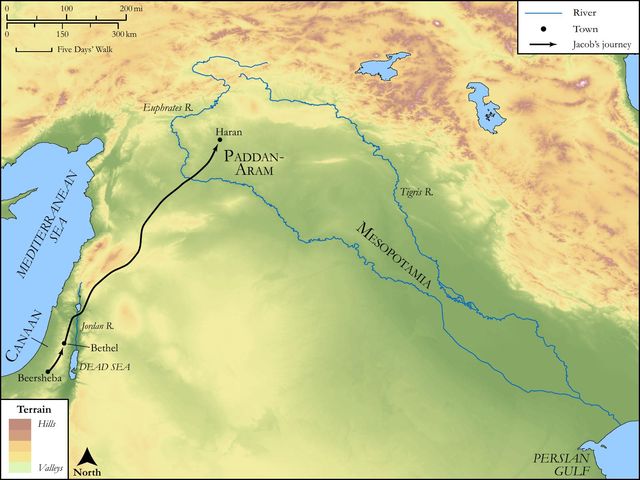
Genesis chapter 24 meticulously details Abraham's critical mission to secure a wife for his son, Isaac. Recognizing his own advanced age and Isaac's forty years, Abraham was deeply concerned that Isaac marry someone from his own kindred, rather than a woman from the idolatrous Canaanite tribes among whom they resided. He dispatches his most trusted servant, traditionally identified as Eliezer, on a pivotal journey to Mesopotamia, the land of Abraham's birth and family, to find a suitable bride. This particular verse contains Abraham's crucial and non-negotiable instruction to his servant regarding Isaac's absolute necessity to remain in the land of promise, setting a foundational condition for the success of the entire mission before the servant even departs.
Historical & Cultural Context
In Abraham's kindred, marriage was not merely a personal affair but a strategic alliance, often arranged by parents to secure lineage, property, and tribal continuity. Marrying within one's own kin group was paramount to preserve cultural and religious identity, especially for a family like Abraham's, who were distinct monotheists in a polytheistic world. The land of Canaan, though promised to Abraham, was inhabited by various pagan peoples whose practices were anathema to the worship of Yahweh. Returning to Mesopotamia, specifically Haran or Ur of the Chaldees, would mean going back to a land steeped in idolatry, from which God had explicitly called Abraham to depart (as seen in Genesis 12:1-3).
Key Themes
ShowHideThis verse powerfully contributes to several overarching themes in Genesis and the broader biblical narrative. It highlights the theme of God's Covenant Faithfulness, as Abraham's command is rooted in his trust that God will fulfill His promise regarding the land and the seed. It also emphasizes the Significance of the Promised Land as the divinely designated place for the covenant people, reinforcing its theological importance beyond mere geography (see Genesis 13:14-17). Furthermore, the directive underscores the theme of Separation and Purity, as Abraham seeks to protect the covenant line from the corrupting influences of the nations round about and even his ancestral home, ensuring that the heir of the promise remains distinct and devoted to God. This echoes the earlier call for Abraham to leave his past behind and move forward in faith to the place God designated.
Exposition and Analysis
ShowHideKey Word Analysis
ShowHideA primitive root; to say (used with great latitude); answer, appoint, avouch, bid, boast self, call, certify, challenge, charge, [phrase] (at the, give) command(-ment), commune, consider, declare, demand, [idiom] desire, determine, [idiom] expressly, [idiom] indeed, [idiom] intend, name, [idiom] plainly, promise, publish, report, require, say, speak (against, of), [idiom] still, [idiom] suppose, talk, tell, term, [idiom] that is, [idiom] think, use (speech), utter, [idiom] verily, [idiom] yet. Here, it signifies a direct and authoritative utterance, more than a casual remark, conveying a binding instruction.
A primitive root; properly, to hedge about (as with thorns), i.e. guard; generally, to protect, attend to, etc.; beward, be circumspect, take heed (to self), keep(-er, self), mark, look narrowly, observe, preserve, regard, reserve, save (self), sure, (that lay) wait (for), watch(-man). This word carries a strong sense of vigilance and protection, indicating that the servant must be extremely careful to guard against the forbidden action, treating it as a grave danger to the covenant.
A primitive root; to turn back (hence, away) transitively or intransitively, literally or figuratively (not necessarily with the idea of return to the starting point); generally to retreat; often adverbial, again; ((break, build, circumcise, dig, do anything, do evil, feed, lay down, lie down, lodge, make, rejoice, send, take, weep)) [idiom] again, (cause to) answer ([phrase] again), [idiom] in any case (wise), [idiom] at all, averse, bring (again, back, home again), call (to mind), carry again (back), cease, [idiom] certainly, come again (back), [idiom] consider, [phrase] continually, convert, deliver (again), [phrase] deny, draw back, fetch home again, [idiom] fro, get (oneself) (back) again, [idiom] give (again), go again (back, home), (go) out, hinder, let, (see) more, [idiom] needs, be past, [idiom] pay, pervert, pull in again, put (again, up again), recall, recompense, recover, refresh, relieve, render (again), requite, rescue, restore, retrieve, (cause to, make to) return, reverse, reward, [phrase] say nay, send back, set again, slide back, still, [idiom] surely, take back (off), (cause to, make to) turn (again, self again, away, back, back again, backward, from, off), withdraw. The double use of this root (implied by "bring" and "again") emphasizes the absolute prohibition against any form of return or reversal of Isaac's location.
Verse Breakdown
ShowHide"And Abraham said unto him"
This opening clause establishes the speaker's authority and the recipient of the command. Abraham, as the patriarch and the one with whom God has made the covenant, issues a direct and binding instruction to his chief servant, highlighting the gravity of the ensuing directive.
"Beware thou that thou bring not my son thither again"
This is the core of Abraham's command, a powerful negative imperative. The word "beware" (from shamar) conveys a solemn warning, indicating that the servant must exercise extreme caution and diligence to prevent Isaac from being taken back to Mesopotamia. The phrase "thither again" explicitly refers to the land from which Abraham was called to depart, emphasizing that Isaac, as the heir of the promise, must not return to the idolatrous environment of his ancestral home. This command underscores Abraham's unwavering conviction that the covenant promises are inextricably linked to the land of Canaan and that Isaac's presence there is non-negotiable for the divine plan's fulfillment.
Literary Devices
ShowHideThe verse employs several literary devices to convey its profound significance. Emphasis is achieved through the strong imperative "Beware" (Hebrew shamar), which implies a solemn warning and a call to extreme vigilance. This is further heightened by the phrase "thither again," which uses a form of Repetition (implied by the Hebrew root shuwb for both "bring" and "again") to underscore the absolute prohibition against returning. The entire command functions as a Foreshadowing of the importance of the promised land for Israel's future, establishing a precedent that the covenant people must dwell in the land God has appointed. Furthermore, the land of Canaan itself acts as Symbolism, representing God's faithfulness, His chosen dwelling place, and the sphere within which His redemptive plan for humanity would unfold, making Isaac's presence there essential for the continuity of the messianic line.
Theological and Thematic Connections
ShowHideAbraham's steadfast insistence that Isaac remain in Canaan reveals a profound theological understanding of God's covenant and the sanctity of the promised land. It is not merely a geographical preference but an act of deep faith in God's sovereign plan, recognizing that the fulfillment of the divine promises—including the lineage leading to the Messiah—is intrinsically tied to the specific territory God designated. This command serves as a powerful testament to Abraham's unwavering belief that God would provide for Isaac within the boundaries of His promise, demonstrating a complete reliance on divine provision rather than human ingenuity or a return to the familiar but spiritually compromising past. It underscores the principle that God's blessings are often found in obedience to His specific instructions and remaining in the place of His choosing.
Reflection and Application
ShowHideAbraham's directive in Genesis 24:6 offers profound lessons for believers today, emphasizing the importance of steadfast commitment to God's calling and purposes. Just as Abraham was committed to God's promise regarding the land, we are called to remain resolute in our spiritual walk, trusting in the specific path God has laid out for us. This verse serves as a powerful reminder to avoid retreating to old habits, environments, or spiritual conditions that God has called us to leave behind. Our spiritual inheritance is found in pressing forward in faith, not looking back to what we have been delivered from. Ultimately, Abraham's unwavering faith that God would bring the right wife to Isaac in Canaan, rather than requiring Isaac to go to her, encourages us to trust God's provision and guidance in all major life decisions, knowing He will bring about His perfect will in His appointed way and place. We are to live with a forward-looking faith, confident that God will meet our needs and fulfill His purposes for us in the "land" of His choosing.
Questions for Reflection
ShowHideFAQ
ShowHideWhy was Abraham so insistent that Isaac remain in Canaan?
ShowHideAbraham's insistence stemmed from his deep faith in God's covenant promises, which explicitly tied the future of his descendants and the fulfillment of the messianic line to the land of Canaan. God had called Abraham out of Mesopotamia (as detailed in Genesis 12:1), and returning Isaac there would have symbolized a retreat from God's specific command and risked exposing the covenant heir to the idolatrous practices of his ancestral home, potentially compromising the purity of the lineage and the divine plan. It was an act of profound obedience and trust that God would provide for Isaac within the boundaries of His promise, demonstrating that the spiritual inheritance was tied to the divinely appointed place, not to the familiar past.
Christ-Centered Fulfillment
ShowHideAbraham's unwavering commitment to keeping Isaac in the promised land prefigures the ultimate "place" of blessing and inheritance found in Christ. Just as Isaac was the heir tied to a specific geographical promise, believers are heirs of a spiritual, eternal promise fulfilled in Jesus Christ. We are called not to return to the "Egypt" of sin or the "Mesopotamia" of our old lives, but to remain in Christ, who is our true "Promised Land" and the source of all spiritual blessings. Through His sacrifice, Christ has secured for us an inheritance in a "better country, that is, a heavenly one" (Hebrews 11:16), and our fulfillment is found in abiding in Him and His finished work, rather than seeking provision or security in the world we have been called out of. As believers, we are "in Christ" (Ephesians 1:3), and this spiritual dwelling place is where all of God's promises find their "Yes" and "Amen" (2 Corinthians 1:20). Abraham's command to keep Isaac in the land points to the New Testament exhortation to "abide in me" (John 15:4) and to "seek those things which are above, where Christ is" (Colossians 3:1), recognizing that our true life and inheritance are hidden with Christ in God.