


Genesis 24:5
Bible text: King James Version (1769 Blayney text) · Public domain
Bible text: King James Version with Strong's numbers · Public domain
Bible text: Berean Standard Bible · Public domain
Bible text: American Standard Version (1901) · Public domain
Bible text: World English Bible, Messianic edition · Public domain
Bible text: Geneva Bible (1599) · Public domain
Bible text: Young's Literal Translation · Public domain
- וַיֹּאמֶרvai·Yo·merand he saidH559Conj-w ¦ V-Qal-ConsecImperf-3msVerb Qal Consecutive Imperfect 3rd Singular Masculineוַandיֹּאמֶרhe said
- אֵלָיו'e·Lavto himH413Prep ¦ 3msPreposition Definiteאֵלָיtoוhim
- הָעֶבֶדha·'E·vedthe servantH5650Art ¦ N-msNoun Singular Masculine Absoluteהָtheעֶבֶדservant
- אוּלַי'u·LaiperhapsH194AdvAdverb
- לֹאlo'notH3808NegParticle Negative
- תֹאבֶהto·Vehshe will be willingH14V-Qal-Imperf-3fsVerb Qal Imperfect 3rd Singular Feminine
- הָאִשָּׁהha·'i·Shahthe womanH802Art ¦ N-fsNoun Singular Feminine Absoluteהָtheאִשָּׁהwoman
- לָלֶכֶתla·Le·khetto goH1980Prep-l ¦ V-Qal-InfVerb Qal Infinitive Constructלָtoלֶכֶתgo
- אַחֲרַי'a·cha·Raiafter meH310Adj-mpc ¦ 1csAdjective Numerical Plural Masculine Constructאַחֲרַafterיme
- אֶל'eltoH413PrepPreposition
- הָאָרֶץha·'A·retzthe landH776Art ¦ N-fsNoun Singular Feminine Absoluteהָtheאָרֶץland
- הַזֹּאתha·Zot<the> thisH2063Art ¦ PrtParticle Demonstrativeהַ<the>זֹּאתthis
- הֶהָשֵׁבhe·ha·Shev¿ really <to take back>H7725Interrog ¦ V-Hiphil-InfAbsVerb Hiphil Infinitive Absoluteהֶ¿הָשֵׁבreally <to take back>
- אָשִׁיב'a·Shivwill I take backH7725V-Hiphil-Imperf-1csVerb Hiphil Imperfect 1st Singular common gender
- אֶת'et<obj.>H853DirObjMParticle Object Indicator
- בִּנְךָbin·Khayour sonH1121N-msc ¦ 2msNoun Singular Masculine Constructבִּנְsonךָyour
- אֶל'eltoH413PrepPreposition
- הָאָרֶץha·'A·retzthe landH776Art ¦ N-fsNoun Singular Feminine Absoluteהָtheאָרֶץland
- אֲשֶׁר'a·SherwhereH834RelParticle Relative
- יָצָאתָya·Tza·tayou came outH3318V-Qal-Perf-2msVerb Qal Perfect 2nd Singular Masculine
- מִשָּׁםmi·Shamfrom thereH8033Prep-m ¦ AdvAdverbמִfromשָּׁםthere
English is a literal word-by-word gloss of the Hebrew, not the KJV's wording. Why?
This is the original text the KJV's translators worked from — each Hebrew word with its own literal English meaning in this verse, prepared by scholars at Tyndale House, Cambridge. The KJV translates whole sentences, not word by word, so its wording differs: one Hebrew word can become several English words, and the KJV may choose “the LORD” where the gloss reads “Yahweh”. Both are faithful — they answer different questions. For the KJV's own rendering, switch to the KJV text.
Details
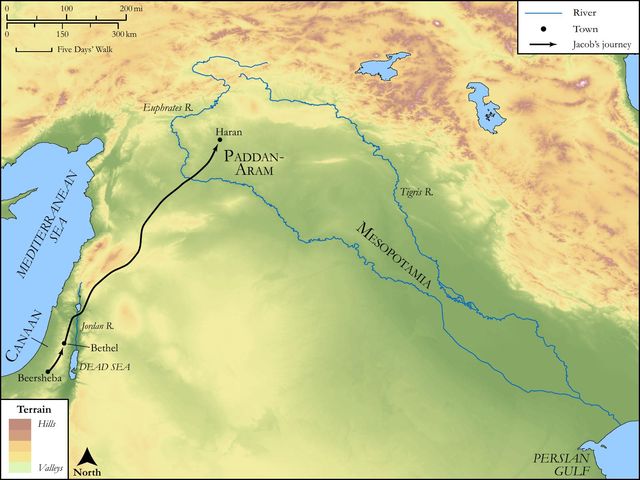
See on the biblical-era maps


Study this verse
Public-domain commentary
Matthew Henry
From his Commentary on the Whole Bible. Henry comments on passages, not single verses — this entry covers Genesis 24:1–9. His two-level outline is real structure in the source text, so it is rendered as structure.
Three things we may observe here concerning Abraham: -
I.The care he took of a good son, to get him married, well married.
It was high time to think of it now, for Isaac was about forty years old, and it had been customary with his ancestors to marry at thirty, or sooner, Gen 11:14, Gen 11:18, Gen 11:22, Gen 11:24. Abraham believed the promise of the building up of his family, and therefore did not make haste; not more haste than good speed. Two considerations moved him to think of it now (Gen 24:1): - 1. That he himself was likely to leave the world quickly, for he was old, and well-stricken in age, and it would be a satisfaction to him to see his son settled before he died; and, 2. That he had a good estate to leave behind him, for the Lord had blessed him in all things; and the blessing of the Lord makes rich. See how much religion and piety befriend outward prosperity. Now Abraham's pious care concerning his son was, (1.) That he should not marry a daughter of Canaan, but one of his kindred. He saw that the Canaanites were degenerating into great wickedness, and knew by revelation that they were designed for ruin, and therefore he would not marry his son among them, lest they should be either a snare to his soul, or at least a blot to his name. (2.) That yet he should not leave the land of Canaan, to go himself among his kindred, not even for the purpose of choosing a wife, lest he should be tempted to settle there. This caution is given Gen 24:6, and repeated, Gen 24:8. "Bring not my son thither again, whatever comes of it. Let him rather want a wife than expose himself to that temptation." Note, Parents in disposing of their children, should carefully consult the welfare of their souls, and their furtherance in the way to heaven. Those who through grace have escaped the corruption that is in the world through lust, and have brought up their children accordingly, should take heed of doing any thing by which they may be again entangled therein and overcome, Pe2 2:20. Beware that you bring them not thither again, Heb 11:15.
II.The charge he gave to a good servant, probably Eliezer of Damascus, one of whose conduct, fidelity, and affection to him and his family, he had had long experience. He trusted him with this great affair, and not Isaac himself, because he would not have Isaac go at all into that country, but marry there by proxy; and no proxy so fit as this steward of his house. This matter is settled between the master and the servant with a great deal of care and solemnity.
1.The servant must be bound by an oath to do his utmost to get a wife for Isaac from among his relations, Gen 24:2-4. Abraham swears him to it, both for his own satisfaction and for the engagement of his servant to all possible care and diligence in this matter. Thus God swears his servants to their work, that, having sworn, they may perform it. Honour is here done to the eternal God; for he it is that is sworn by, to whom alone these appeals ought to be made. And some think honour is done to the covenant of circumcision by the ceremony here used of putting his hand under his thigh. Note, Swearing being an ordinance not peculiar to the church, but common to mankind, is to be performed by such signs as are the appointments and common usages of our country, for binding the person sworn.
2.He must be clear of this oath if, when he had done his utmost, he could not prevail. This proviso the servant prudently inserted (Gen 24:5), putting the case that the woman would not follow him; and Abraham allowed the exception, Gen 24:8. Note, Oaths are to be taken with great caution, and the matter sworn to should be rightly understood and limited, because it is a snare to devour that which is holy, and, after vows, to make the enquiry which should have been made before.
III.The confidence he put in a good God, who, he doubts not, will give his servant success in this undertaking, Gen 24:7.
He remembers that God had wonderfully brought him out of the land of his nativity, by the effectual call of his grace; and therefore doubts not but he will succeed him in his care not to bring his son thither again. He remembers also the promise God had made and confirmed to him that he would give Canaan to his seed, and thence infers that God would own him in his endeavours to match his son, not among those devoted nations, but to one that was fit to be the mother of such a seed. "Fear not therefore; he shall send his angel before thee to make thy way prosperous." Note,
1.Those that carefully keep in the way of duty, and govern themselves by the principles of their religion in their designs and undertakings, have good reason to expect prosperity and success in them. God will cause that to issue in our comfort in which we sincerely aim at his glory.
2.God's promises, and our own experiences, are sufficient to encourage our dependence upon God, and our expectations from him, in all the affairs of this life.
3.God's angels are ministering spirits, sent forth, not only for the protection, but for the guidance, of the heirs of promise, Heb 1:14. "He shall send his angel before thee, and then thou wilt speed well."
Continue studying Genesis 24:5 across the web’s major study libraries — every link below opens this exact verse, chapter, or book on the destination site.
Read & Compare
 BibleGatewayThis verse in more than 200 translations and 70 languages.
 Bible.comThe YouVersion reader — hundreds of translations, reading plans, and highlights.
 ESV.orgCrossway's official English Standard Version reader.
 NET BibleThe NET translation with 60,000+ translators' notes on every rendering decision.
 STEP BibleTyndale House's free study tool — original text, vocabulary, and scholarly resources.
 BibliaLogos Bible Software's free web reader.
 USCCBThe New American Bible (Revised Edition) with the U.S. bishops' study notes.
Commentaries
 BibleHub CommentariesDozens of classic commentaries on this verse, gathered on one page.
 StudyLightMore than 100 commentary sets — the largest collection on the web.
 BibleRefPlain-English commentary on what this verse means, verse by verse.
 Enduring WordDavid Guzik's free commentary on this chapter, widely used by Bible teachers.
 Bible Study ToolsVerse commentary alongside Greek and Hebrew study aids.
Original Language & Research
- BibleHub InterlinearThe verse word by word — original language, transliteration, and English.
- BibleHub LexiconEvery word's original-language definition and Strong's entry.
 Blue Letter BibleDeep-study tools — Strong's numbers, concordance, and word studies.
 SefariaThe Hebrew text with Rashi and centuries of Jewish commentary.
Sermons, Hymns & Audio


TrulyRandomVerse is not affiliated with these sites and doesn’t control their content. They’re linked because they’re genuinely useful.
Summary
Genesis 24:5 captures the diligent servant's crucial inquiry to Abraham: what if the woman chosen for Isaac's bride proves unwilling to leave her homeland and journey to Canaan? This question underscores the servant's foresight and commitment to the mission, anticipating a potential obstacle to securing a wife from Abraham's own kindred, a vital step in preserving the divinely ordained covenant lineage.
Context
ShowHideLiterary Context
Genesis 24 stands as the longest chapter in the book, singularly dedicated to the momentous task of finding a wife for Isaac, Abraham's promised son and the heir to the covenant. Abraham, now advanced in years, solemnly charges his most trusted servant (traditionally identified as Eliezer of Damascus) with an unbreakable oath, established in Genesis 24:3, that Isaac must not marry a woman from the idolatrous Canaanites. Instead, the bride must come from Abraham's own extended family in Mesopotamia. The servant's question in Genesis 24:5 arises from a deep sense of responsibility and practicality, seeking clarity on a critical contingency: if the divinely designated woman is unwilling to relocate to Canaan, should Isaac then return to the land from which Abraham himself had departed? This query sets the stage for Abraham's emphatic refusal for Isaac to ever leave the Promised Land.
Historical & Cultural Context
Among the patriarchs, marriage was primarily a family affair, often arranged to preserve lineage, property, and cultural identity. Endogamy—marriage within one's own kin group—was a deeply ingrained practice, particularly crucial for Abraham's family given their unique covenant relationship with Yahweh. Marrying a Canaanite woman would have meant assimilation into a culture rife with polytheism, fertility cults, and morally corrupt practices, directly threatening the distinctiveness and spiritual purity of Abraham's descendants. The land of Canaan, though promised by God, was still inhabited by these peoples, making the servant's mission to a distant homeland a necessary and culturally appropriate measure to ensure the spiritual integrity of the patriarchal line.
Key Themes
ShowHideThis verse contributes significantly to several overarching themes in Genesis and the broader biblical narrative. It highlights the paramount importance of covenant preservation, as the continuation of God's promises to Abraham regarding a great nation and land hinged entirely on Isaac having a legitimate heir from a pure lineage, as outlined in Genesis 12:2-3. The narrative also powerfully illustrates divine guidance and providence, showing God's active hand in orchestrating seemingly human events to fulfill His purposes, even amidst practical human concerns. Furthermore, it underscores the theme of faith versus prudence, as Abraham's unwavering faith in God's provision (as seen in Genesis 24:7) is juxtaposed with the servant's commendable practicality and foresight, demonstrating that faith does not negate the need for diligent planning and wisdom. The servant's journey and the eventual discovery of Rebekah exemplify God's faithfulness in guiding His people in major life decisions, particularly marriage.
Exposition and Analysis
ShowHideThe servant's query in Genesis 24:5, "Peradventure the woman will not be willing to follow me unto this land: must I needs bring thy son again unto the land from whence thou camest?", is a pivotal moment that reveals his profound sense of responsibility and strategic foresight. It is not a question of doubt in Abraham's command, but a responsible inquiry into a critical contingency.
Key Word Analysis
ShowHideThis primitive root (H14) signifies "to breathe after," and figuratively, "to be acquiescent" or "to consent." In this context, it speaks to the woman's personal volition and agreement to the proposed marriage and, crucially, to the journey itself. The servant understands that her willingness is not to be presumed but is a necessary condition for the success of his mission.
Derived from a primitive root (H3212) meaning "to walk," this word here carries the causative sense, "to carry" or "to cause to go." In the servant's question, it refers to the woman's act of accompanying him on the long and arduous journey from Mesopotamia to Canaan, signifying her commitment to leave her home and join Isaac in a foreign land.
This primitive root (H7725) means "to turn back" or "to return." The servant's use of "bring again" (specifically the Hiphil form, meaning "to cause to return") highlights his understanding of Abraham's absolute prohibition against Isaac ever leaving the Promised Land. His question is a direct challenge to this prohibition, seeking to confirm whether any circumstance, even the woman's unwillingness, could justify Isaac's return to Mesopotamia.
Verse Breakdown
ShowHide"And the servant said unto him"
This simple introductory phrase establishes the direct communication between Abraham and his chief servant, emphasizing the servant's trusted position and the seriousness of the conversation. It highlights the servant's initiative in raising a crucial practical concern.
"Peradventure the woman will not be willing to follow me unto this land"
The term "Peradventure" (Hebrew 'ulay) conveys a genuine possibility or a "what if" scenario. The servant, with practical wisdom, foresees a potential obstacle: the woman he finds might not be personally inclined to leave her familiar surroundings and kindred to embark on a long journey to a foreign land, despite the promise of marriage to Isaac. This clause underscores the human element in God's plan.
"must I needs bring thy son again unto the land from whence thou camest?"
This is the core of the servant's dilemma. He understands Abraham's strict command that Isaac must not return to Mesopotamia. His question is a direct challenge to this prohibition, asking if the woman's refusal would necessitate Isaac's return, thereby violating the oath and potentially jeopardizing the entire covenant mission. It reveals his desire for clear instructions regarding this critical contingency.
Literary Devices
ShowHideThe verse primarily employs Dialogue to advance the plot and reveal character. The servant's question is a crucial piece of Foreshadowing, hinting at the challenges and divine orchestration that will be necessary to secure Rebekah's consent and journey. It also establishes a subtle Contrast between Abraham's unwavering faith in God's direct intervention and the servant's pragmatic, human apprehension regarding the mission's logistics. The use of a Rhetorical Question ("must I needs bring thy son again...") emphasizes the servant's deep concern and his understanding of the gravity of Isaac's staying in the Promised Land.
Theological and Thematic Connections
ShowHideGenesis 24:5 beautifully illustrates the dynamic interplay between divine sovereignty and human responsibility. While God's plan for Isaac's marriage is ultimately sovereignly guided, the servant's diligent questioning and practical foresight are not only permitted but are commendable and necessary components of the process. This highlights that faith in God's overarching purpose does not negate the need for prudence, careful planning, and addressing potential obstacles. The meticulous care taken in selecting Isaac's wife underscores the immense theological importance of preserving the purity of the covenant lineage, through whom God's promises would be fulfilled. This narrative serves as a foundational example of seeking God's guidance in significant life decisions, particularly marriage, emphasizing the importance of aligning such choices with divine will and principles, ensuring the continuation of a spiritual heritage.
Reflection and Application
ShowHideThe interaction in Genesis 24:5 offers timeless lessons for believers navigating significant responsibilities and life decisions today. The servant's diligence in anticipating potential difficulties and seeking clear instructions, rather than blindly proceeding, models a crucial aspect of godly wisdom. It teaches us the importance of asking clarifying questions and thinking through contingencies, even when operating under a divine mandate. While the narrative powerfully illustrates Abraham's unwavering faith in God's provision, the servant's question reminds us that faith does not negate the need for practical planning, diligence, and consideration of possible challenges; we are called to trust God while also using the wisdom and discernment He provides. Furthermore, the story underscores the biblical emphasis on choosing a spouse who aligns with one's faith and values, crucial for building a family that honors God and continues a spiritual legacy, a principle vital for forming godly partnerships. Even when faced with "peradventure" or uncertainty in our own lives, the unfolding of Isaac and Rebekah's story ultimately teaches us to trust in God's sovereign hand to guide and accomplish His purposes, often in ways that exceed our foresight and planning.
Questions for Reflection
ShowHideFAQ
ShowHideWhy was the servant so concerned about the woman's willingness?
ShowHideThe servant's concern stemmed from his profound diligence and the critical nature of his mission. Abraham had imposed an absolute prohibition: Isaac was not to return to Mesopotamia under any circumstances, as this would mean leaving the Promised Land and potentially jeopardizing the covenant. If the woman was unwilling to come to Canaan, the servant needed clear instructions on how to proceed, as bringing Isaac back would directly violate Abraham's solemn oath and the divine mandate to remain in the land God had given. His question was a responsible query about a foreseeable logistical challenge, not a lack of faith.
What does "Peradventure" mean in this context?
ShowHide"Peradventure" in the King James Version translates the Hebrew word 'ulay (אולי), which means "perhaps," "it may be," or "if perhaps." It signifies a genuine possibility or a practical contingency that the servant foresaw. It was not an expression of doubt in God's ability or Abraham's command, but a responsible and prudent query about a foreseeable logistical challenge that could impact the mission's success and Abraham's strict instructions regarding Isaac's presence in the land of Canaan.
Why was it so important for Isaac not to marry a Canaanite woman?
ShowHideMarrying a Canaanite woman was strictly forbidden because it would have introduced idolatrous practices, pagan beliefs, and immoral customs into Abraham's lineage, directly threatening the purity and distinctiveness of the covenant people. God had called Abraham to be separate and to raise a nation set apart for Him. The preservation of this spiritual heritage was paramount for the fulfillment of God's promises concerning a great nation, the land, and ultimately, the coming Messiah. This command underscored the importance of spiritual integrity and avoiding assimilation into the surrounding pagan nations, a principle foundational to God's covenant with Israel.
Christ-Centered Fulfillment
ShowHideThe meticulous care taken to secure a bride for Isaac, ensuring the preservation of the covenant lineage free from idolatrous influences, profoundly points to the ultimate fulfillment of God's promises in Jesus Christ. Isaac was the son of promise, through whom the covenant line would continue, leading eventually to the birth of the Messiah. The servant's diligent mission, guided by divine providence to find a suitable bride, foreshadows God's own careful orchestration of history to bring forth His Son, Jesus, who is the true seed of Abraham (as affirmed in Galatians 3:16) and the ultimate inheritor of all covenant blessings. Christ, as the perfect Bridegroom, seeks and prepares His Church, His bride, drawing her out of the world's idolatry and into a holy union with Himself. Just as Rebekah left her homeland to join Isaac, the Church is called to leave the world's ways and follow Christ, becoming His pure and spotless bride (Ephesians 5:25-27). This divine marriage culminates in the New Jerusalem, the bride coming down from heaven (Revelation 21:2), signifying the eternal union of Christ with His redeemed people, thereby fulfilling the ultimate purpose of God's redemptive plan established through Abraham's lineage.