


Genesis 36:2
Bible text: King James Version (1769 Blayney text) · Public domain
Bible text: King James Version with Strong's numbers · Public domain
Bible text: Berean Standard Bible · Public domain
Bible text: American Standard Version (1901) · Public domain
Bible text: World English Bible, Messianic edition · Public domain
Bible text: Geneva Bible (1599) · Public domain
Bible text: Young's Literal Translation · Public domain
- עֵשָׂו'e·SavEsauH6215N-proper-mNoun Proper Masculine
- לָקַחla·Kachhe tookH3947V-Qal-Perf-3msVerb Qal Perfect 3rd Singular Masculine
- אֶת'et<obj.>H853DirObjMParticle Object Indicator
- נָשָׁיוna·Shavhis wivesH802N-mpc ¦ 3msNoun Plural Masculine Constructנָשָׁיwivesוhis
- מִבְּנוֹתmi·be·Notfrom [the] daughters ofH1323Prep-m ¦ N-fpcNoun Plural Feminine Constructמִfromבְּנוֹת[the] daughters of
- כְּנָעַןke·Na·'anCanaanH3667N-properNoun Proper Location
- אֶת'et<obj.>H853DirObjMParticle Object Indicator
- עָדָה'a·DahAdahH5711N-proper-fNoun Proper Feminine
- בַּתbat[the] daughter ofH1323N-fscNoun Singular Feminine Construct
- אֵילוֹן'ei·lOnElonH356N-proper-mNoun Proper Masculine
- הַחִתִּיha·chi·Tithe HittiteH2850Art ¦ N-msNoun Gentilic Singular Masculine AbsoluteהַtheחִתִּיHittite
- וְאֶתve·'Etand <obj.>H853Conj-w ¦ DirObjMParticle Object Indicatorוְandאֶת<obj.>
- אָהֳלִיבָמָה'o·ho·li·va·MahOholibamahH173N-proper-fNoun Proper Feminine
- בַּתbat[the] daughter ofH1323N-fscNoun Singular Feminine Construct
- עֲנָה'a·NahAnahH6034N-proper-mNoun Proper Masculine
- בַּתbat[the] daughter ofH1323N-fscNoun Singular Feminine Construct
- צִבְעוֹןtziv·'onZibeonH6649N-proper-mNoun Proper Masculine
- הַחִוִּיHa·chi·Vithe HiviteH2340Art ¦ N-msNoun Gentilic Singular Masculine AbsoluteהַtheחִוִּיHivite
English is a literal word-by-word gloss of the Hebrew, not the KJV's wording. Why?
This is the original text the KJV's translators worked from — each Hebrew word with its own literal English meaning in this verse, prepared by scholars at Tyndale House, Cambridge. The KJV translates whole sentences, not word by word, so its wording differs: one Hebrew word can become several English words, and the KJV may choose “the LORD” where the gloss reads “Yahweh”. Both are faithful — they answer different questions. For the KJV's own rendering, switch to the KJV text.
Details
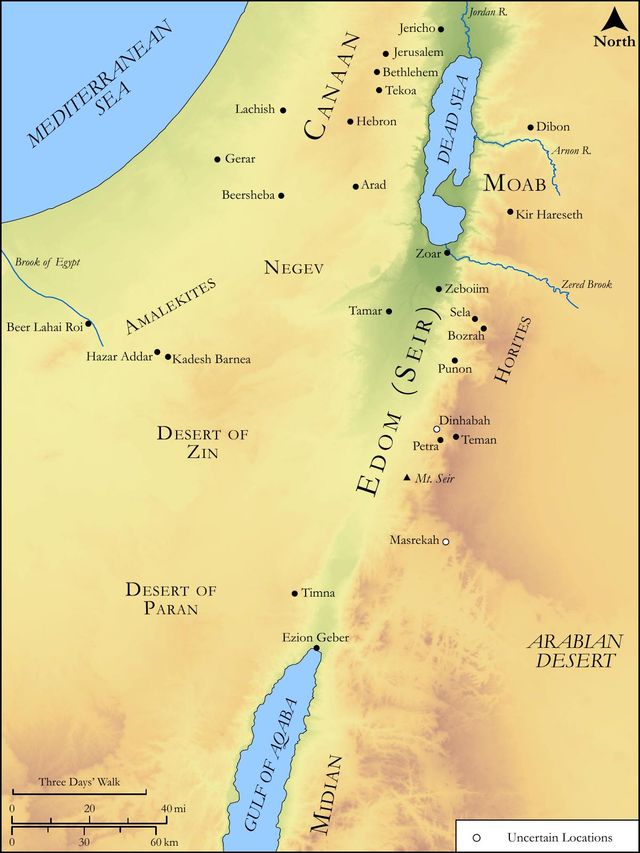
See on the biblical-era maps


Study this verse
Public-domain commentary
Matthew Henry
From his Commentary on the Whole Bible. Henry comments on passages, not single verses — this entry covers Genesis 36:1–8.
Observe here, 1. Concerning Esau himself, Gen 36:1. He is called Edom (and again, Gen 36:8), that name by which was perpetuated the remembrance of the foolish bargain he made, when he sold his birthright for that red, that red pottage. The very mention of that name is enough to intimate the reason why his family is turned off with such a short account. Note, If men do a wrong thing they must thank themselves, when it is, long afterwards, remembered against them to their reproach. 2. Concerning his wives, and the children they bore him in the land of Canaan. He had three wives, and, by them all, but five sons: many a one has more by one wife. God in his providence often disappoints those who take indirect courses to build up a family; yet here the promise prevailed, and Esau's family was built up. 3. Concerning his removal to mount Seir, which was the country God had given him for a possession, when he reserved Canaan for the seed of Jacob. God owns it, long afterwards: I gave to Esau mount Seir (Deu 2:5; Jos 24:4), which was the reason why the Edomites must not be disturbed in their possession. Those that have not a right by promise, such as Jacob had, to Canaan, may have a very good title by providence to their estates, such as Esau had to mount Seir. Esau had begun to settle among his wives' relations, in Seir, before Jacob came from Padan-aram, Gen 32:3. Isaac, it is likely, had sent him thither (as Abraham in his life-time had sent the sons of the concubines from Isaac his son into the east country, Gen 25:6), that Jacob might have the clearer way made for him to the possession of the promised land. During the life of Isaac, however, Esau had probably still some effects remaining in Canaan; but, after his death, he wholly withdrew to mount Seir, took with him what came to his share of his father's personal estate, and left Canaan to Jacob, not only because he had the promise of it, but because Esau perceived that if they should continue to thrive as they had begun there would not be room for both. Thus dwelt Esau in Mount Seir, Gen 36:8. Note, Whatever opposition may be made, God's word will be accomplished, and even those that have opposed it will see themselves, some time or other, under a necessity of yielding to it, and acquiescing in it. Esau had struggled for Canaan, but now he tamely retires to mount Seir; for God's counsels shall certainly stand, concerning the times before appointed, and the bounds of our habitation.
Continue studying Genesis 36:2 across the web’s major study libraries — every link below opens this exact verse, chapter, or book on the destination site.
Read & Compare
 BibleGatewayThis verse in more than 200 translations and 70 languages.
 Bible.comThe YouVersion reader — hundreds of translations, reading plans, and highlights.
 ESV.orgCrossway's official English Standard Version reader.
 NET BibleThe NET translation with 60,000+ translators' notes on every rendering decision.
 STEP BibleTyndale House's free study tool — original text, vocabulary, and scholarly resources.
 BibliaLogos Bible Software's free web reader.
 USCCBThe New American Bible (Revised Edition) with the U.S. bishops' study notes.
Commentaries
 BibleHub CommentariesDozens of classic commentaries on this verse, gathered on one page.
 StudyLightMore than 100 commentary sets — the largest collection on the web.
 BibleRefPlain-English commentary on what this verse means, verse by verse.
 Enduring WordDavid Guzik's free commentary on this chapter, widely used by Bible teachers.
 Bible Study ToolsVerse commentary alongside Greek and Hebrew study aids.
Original Language & Research
- BibleHub InterlinearThe verse word by word — original language, transliteration, and English.
- BibleHub LexiconEvery word's original-language definition and Strong's entry.
 Blue Letter BibleDeep-study tools — Strong's numbers, concordance, and word studies.
 SefariaThe Hebrew text with Rashi and centuries of Jewish commentary.
Sermons, Hymns & Audio


TrulyRandomVerse is not affiliated with these sites and doesn’t control their content. They’re linked because they’re genuinely useful.
Summary
Genesis 36:2 initiates the detailed genealogy of Esau, identifying two of his principal wives: Adah, a Hittite, and Aholibamah, a Hivite. This verse is pivotal in establishing the foundational lineage and cultural identity of the Edomites, a people distinct from and often in opposition to the descendants of Jacob. It underscores Esau's consistent pattern of marital choices, which significantly shaped the character and destiny of his posterity, contrasting sharply with the covenantal path pursued by Abraham, Isaac, and Jacob.
Context
ShowHideLiterary Context
Genesis 36 serves as a significant genealogical interlude, often referred to as a "toledot" (generations) section, specifically "the generations of Esau" Genesis 36:1. This chapter provides a comprehensive account of Esau's descendants, establishing the origins of the nation of Edom before the narrative returns to the detailed history of Jacob's family in Genesis 37. Verse 2, in particular, reiterates and expands upon Esau's marital choices previously mentioned in Genesis 26:34-35, where his earlier marriages to "daughters of Heth" (Hittites) were explicitly stated to have caused "grief of mind unto Isaac and to Rebekah." The repetition here, with additional detail, underscores the lasting significance of these unions in shaping Esau's lineage and its divergence from the covenant line.
Historical & Cultural Context
Esau's marriages to "daughters of Canaan" — specifically Adah the Hittite and Aholibamah the Hivite — place his family firmly within the indigenous cultural landscape of the land that God promised to Abraham's descendants. The Hittites (from Heth, son of Canaan) and Hivites were prominent Canaanite tribes inhabiting the region during the patriarchal period. These groups were known for their polytheistic religions, idolatrous practices, and distinct social customs, which stood in stark contrast to the nascent monotheistic worship of Yahweh practiced by Abraham's family. In the days of the patriarchs, marriage was not merely a personal affair but a strategic alliance that cemented social, economic, and religious ties. Esau's choices, therefore, represented a profound cultural and spiritual integration with the very peoples whom God would later command Israel to dispossess, highlighting his disregard for the spiritual purity of his family line.
Key Themes
ShowHideThis verse contributes to several overarching themes in Genesis. Primarily, it highlights the theme of covenant fidelity versus worldly compromise. While Abraham and Isaac diligently sought wives from their own kindred to preserve the spiritual integrity of the covenant line (as seen in Genesis 24 and Genesis 28:1-2), Esau consistently chose partners from the local, idolatrous Canaanite population, prioritizing immediate gratification over spiritual alignment. This choice sets the stage for the divergent destinies of two nations, Israel and Edom, whose future relationship would often be marked by conflict. The verse also subtly introduces the theme of consequences of choices, demonstrating how individual decisions, particularly in foundational areas like marriage, can have profound and lasting impacts on future generations and their relationship to God's redemptive plan.
Exposition and Analysis
ShowHideKey Word Analysis
ShowHideA primitive root meaning "to take (in the widest variety of applications); accept, bring, buy, carry away, drawn, fetch, get, infold, [idiom] many, mingle, place, receive(-ing), reserve, seize, send for, take (away, -ing, up), use, win." In this context, "took" signifies Esau's active and deliberate choice in acquiring his wives. It emphasizes his agency in forming these unions, which were contrary to the patriarchal practice of seeking wives from within the family's spiritual heritage, thus highlighting his personal responsibility for these decisions.
Feminine of אִישׁ or אֱנוֹשׁ, meaning "a woman; wife." This term simply denotes the women Esau married. However, within the narrative of Genesis, the identity and origin of wives are profoundly significant, particularly for the covenant lineage. The fact that these "wives" were "daughters of Canaan" immediately flags them as outside the covenant community, setting them apart from the wives of Abraham, Isaac, and Jacob, who were chosen to maintain spiritual and familial purity.
From כָּנַע, meaning "humiliated; Kenaan, a son a Ham; also the country inhabited by him; Canaan, merchant, traffick." This term is crucial as it identifies the geographical and cultural origin of Esau's wives. The "daughters of Canaan" were descendants of Ham through Canaan, and their land was specifically designated by God as the inheritance for Abraham's seed. Marrying from this group represented an integration with the very people Israel would later be commanded to dispossess and avoid intermarrying with, thus underscoring Esau's disregard for the divine plan and the spiritual implications of his choices.
Verse Breakdown
ShowHide"Esau took his wives of the daughters of Canaan;"
This opening clause immediately establishes the central theme of the verse: Esau's marital choices. The phrase "daughters of Canaan" is a concise yet loaded descriptor, indicating that Esau chose wives from the indigenous, non-covenantal peoples inhabiting the promised land. This choice stands in stark contrast to the patriarchal tradition of endogamy (marrying within one's own kin) to preserve spiritual purity and the covenant line, as exemplified by Abraham's directive for Isaac Genesis 24:3-4 and Isaac's instruction to Jacob Genesis 28:1-2.
"Adah the daughter of Elon the Hittite, and Aholibamah the daughter of Anah the daughter of Zibeon the Hivite;"
This part of the verse provides specific genealogical details for two of Esau's wives. Adah is identified as the daughter of Elon the Hittite, and Aholibamah as the daughter of Anah, who was herself the daughter of Zibeon the Hivite. The explicit naming of their fathers and tribal affiliations (Hittite, Hivite) further emphasizes their Canaanite origin. This detailed naming serves to solidify the genealogical foundation of the Edomite nation, linking them directly to these specific Canaanite groups and highlighting the mixed, non-covenantal heritage of Esau's descendants. The mention of "daughter of Anah the daughter of Zibeon" for Aholibamah provides a maternal lineage, which is less common in patriarchal genealogies but here serves to underscore her deep roots within the Hivite community.
Literary Devices
ShowHideThe verse employs several significant literary devices. Repetition is evident in the recurring theme of Esau's marriages to Canaanite women, building upon earlier mentions in Genesis and reinforcing the narrative's emphasis on this particular aspect of his life. The detailed naming of the wives and their specific tribal affiliations (Hittite, Hivite) serves as a form of Exposition or Elaboration, providing concrete details that solidify the genealogical record and underscore the foreign origin of Esau's lineage. Furthermore, the verse functions as Foreshadowing, subtly hinting at the future adversarial relationship between the Edomites (descendants of Esau) and the Israelites (descendants of Jacob). Esau's choices, rooted in cultural assimilation rather than covenantal distinctiveness, lay the groundwork for a nation whose identity would be fundamentally opposed to that of God's chosen people. This also creates a Contrast with Jacob's obedience to parental instruction regarding marriage, highlighting the divergent paths of the two brothers and their respective descendants.
Theological and Thematic Connections
ShowHideGenesis 36:2, though a seemingly simple genealogical entry, carries profound theological weight by detailing Esau's marital choices. These choices highlight a consistent pattern in Esau's life: a prioritization of immediate gratification and cultural assimilation over covenantal obedience and spiritual distinctiveness. Unlike the patriarchs who diligently sought wives from their own kindred to preserve the purity of the promised lineage, Esau repeatedly chose "daughters of Canaan," thereby intertwining his destiny and that of his descendants with the very peoples God intended to dispossess. This decision not only brought "grief of mind" to his parents but also fundamentally shaped the identity of the Edomite nation, establishing a distinct cultural and spiritual heritage that would often stand in opposition to Israel, the people of God's covenant. The verse thus underscores the enduring biblical principle that foundational life choices, particularly in marriage, have far-reaching spiritual and generational consequences, impacting one's relationship with God's redemptive plan.
Reflection and Application
ShowHideGenesis 36:2, while a concise genealogical record, serves as a powerful reminder of the enduring impact of personal choices, particularly in foundational life decisions such as marriage. Esau's repeated choice to marry outside the covenant community, prioritizing personal desire over spiritual alignment, offers a timeless lesson for believers today. It underscores the profound importance of seeking a spouse who shares one's deepest spiritual convictions and commitment to God's purposes. Such decisions profoundly influence not only individuals but also the spiritual trajectory of future generations and their relationship with the Lord. Aligning one's life choices with divine wisdom and the spiritual heritage of faith, rather than solely immediate gratification or cultural convenience, is crucial for maintaining a clear spiritual path and preventing future complications. This verse calls us to consider the long-term implications of our choices, recognizing that faithfulness in seemingly personal matters can have far-reaching effects on our spiritual legacy and the advancement of God's kingdom.
Questions for Reflection
ShowHideFAQ
ShowHideWhy does Genesis 36:2 provide such specific details about Esau's wives, including their tribal affiliations?
ShowHideGenesis 36:2 provides these specific details to meticulously establish the genealogical and cultural origins of the Edomite nation. While Esau's earlier marriages are briefly mentioned in Genesis 26:34-35, this verse within the "generations of Esau" Genesis 36:1 offers a comprehensive and formal record. The explicit naming of Adah the Hittite and Aholibamah the Hivite emphasizes their Canaanite heritage, which was crucial for understanding the distinct identity of the Edomites. This detail highlights that Esau's descendants would be inextricably linked to the indigenous peoples of the land, contrasting sharply with the covenant line of Jacob, whose descendants were to remain distinct and separated from these idolatrous nations.
What was the spiritual significance of Esau marrying Canaanite women, given the later prohibitions in the Law?
ShowHideEsau's choice to marry "daughters of Canaan" was profoundly significant because it demonstrated a disregard for the covenantal practices and spiritual purity that characterized his family's lineage. The patriarchs, particularly Abraham and Isaac, had gone to great lengths to ensure their sons married within their own kindred to preserve the spiritual integrity of the promised seed, avoiding the idolatrous practices of the Canaanites. Esau's decision to integrate with these peoples, who were explicitly marked for judgment and separation from God's chosen people, foreshadowed the later Mosaic Law's prohibitions against intermarriage with Canaanite nations Deuteronomy 7:3-4. Spiritually, it signified Esau's divergence from the path of faith and his preference for worldly alliances over covenant fidelity, contributing to the distinct, often adversarial, identity of the nation of Edom in contrast to Israel, the people of God's covenant.
Christ-Centered Fulfillment
ShowHideEsau's choices in Genesis 36:2, marked by a preference for worldly alliances and a disregard for covenantal purity, underscore humanity's inherent tendency to deviate from God's intended path. His decision to marry "daughters of Canaan" led to a lineage outside the direct line of the covenant promise, highlighting the spiritual compromises that can arise from prioritizing immediate gratification over divine guidance. This narrative ultimately points to the profound need for a divine intervention that transcends human failure and worldly entanglements. Christ, as the ultimate Son of Abraham and Isaac, fulfills the true covenant lineage, not through physical descent or worldly choices, but through His perfect obedience and redemptive work. He establishes a new, spiritual family—the Church—whose identity is rooted not in earthly origins or mixed alliances, but in His atoning sacrifice and the power of the Holy Spirit. Through Christ, all who believe, regardless of their earthly lineage, are brought into the true inheritance of God's promises, becoming part of a new creation where the divisions and spiritual compromises exemplified by Esau's choices are overcome by the unity and purity found in Him Galatians 3:28-29 and Ephesians 2:19-22. He is the one who perfectly embodies covenant fidelity, providing the way for all to be reconciled to God and inherit the blessings of Abraham through faith in Him Romans 8:17.