


Genesis 28:9
- וַיֵּלֶךְvai·Ye·lekhand he wentH1980Conj-w ¦ V-Qal-ConsecImperf-3msVerb Qal Consecutive Imperfect 3rd Singular Masculineוַandיֵּלֶךְhe went
- עֵשָׂו'e·SavEsauH6215N-proper-mNoun Proper Masculine
- אֶל'eltoH413PrepPreposition
- יִשְׁמָעֵאלyish·ma·'ElIshmaelH3458N-proper-mNoun Proper Masculine
- וַיִּקַּחvai·yi·Kachand he tookH3947Conj-w ¦ V-Qal-ConsecImperf-3msVerb Qal Consecutive Imperfect 3rd Singular Masculineוַandיִּקַּחhe took
- אֶת'et<obj.>H853DirObjMParticle Object Indicator
- מָחֲלַתma·cha·LatMahalathH4258N-proper-fNoun Proper Feminine
- בַּתbat[the] daughter ofH1323N-fscNoun Singular Feminine Construct
- יִשְׁמָעֵאלyish·ma·'ElIshmaelH3458N-proper-mNoun Proper Masculine
- בֶּןben[the] son ofH1121N-mscNoun Singular Masculine Construct
- אַבְרָהָם'av·ra·HamAbrahamH85N-proper-mNoun Proper Masculine
- אֲחוֹת'a·Chot[the] sister ofH269N-fscNoun Singular Feminine Construct
- נְבָיוֹתne·va·YotNebaiothH5032N-proper-mNoun Proper Masculine
- עַל'altoH5921PrepPreposition
- נָשָׁיוna·Shavhis wivesH802N-mpc ¦ 3msNoun Plural Masculine Constructנָשָׁיwivesוhis
- לוֹlofor <the> himselfPrep-l ¦ 3msSuffix Personal 3rd Singular Masculineלfor <the>וֹhimself
- לְאִשָּׁהle·'i·Shahto a wifeH802Prep-l ¦ N-fsNoun Singular Feminine Absoluteלְtoאִשָּׁהa wife
English is a literal word-by-word gloss of the Hebrew, not the KJV's wording. Why?
This is the original text the KJV's translators worked from — each Hebrew word with its own literal English meaning in this verse, prepared by scholars at Tyndale House, Cambridge. The KJV translates whole sentences, not word by word, so its wording differs: one Hebrew word can become several English words, and the KJV may choose “the LORD” where the gloss reads “Yahweh”. Both are faithful — they answer different questions. For the KJV's own rendering, switch to the KJV text.
Details
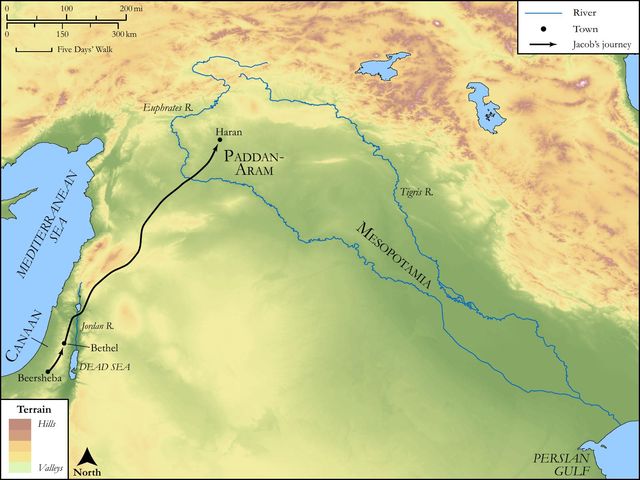
See on the biblical-era maps


Study this verse
Public-domain commentary
Matthew Henry
From his Commentary on the Whole Bible. Henry comments on passages, not single verses — this entry covers Genesis 28:6–9.
This passage concerning Esau comes in in the midst of Jacob's story, either, 1. To show the influence of a good example. Esau, though the greater man, now begins to think Jacob the better man, and disdains not to take him for his pattern in this particular instance of marrying with a daughter of Abraham. The elder children should give to the younger an example of tractableness and obedience; it is bad if they do not: but it is some alleviation if they take the example of it from them, as Esau here did from Jacob. Or, 2. To show the folly of an after-wit. Esau did well, but he did it when it was too late, He saw that the daughters of Canaan pleased not his father, and he might have seen that long ago if he had consulted his father's judgment as much as he did his palate. And how did he now mend the matter? Why, truly, so as to make bad worse. (1.) He married a daughter of Ishmael, the son of the bond-woman, who was cast out, and was not to inherit with Isaac and his seed, thus joining with a family which God had rejected, and seeking to strengthen his own pretensions by the aid of another pretender. (2.) He took a third wife, while, for aught that appears, his other two were neither dead nor divorced. (3.) He did it only to please his father, not to please God. Now that Jacob was sent into a far country Esau would be all in all at home, and he hoped so to humour his father as to prevail with him to make a new will, and entail the promise upon him, revoking the settlement lately made upon Jacob. And thus, [1.] He was wise when it was too late, like Israel that would venture when the decree had gone forth against them (Num 14:40), and the foolish virgins, Mat 25:11. [2.] He rested in a partial reformation, and thought, by pleasing his parents in one thing, to atone for all his other miscarriages. It is not said that when he saw how obedient Jacob was, and how willing to please his parents, he repented of his malicious design against him: no, it appeared afterwards that he persisted in that, and retained his malice. Note, Carnal hearts are apt to think themselves as good as they should be, because perhaps, in some one particular instance, they are not so bad as they have been. Thus Micah retains his idols, but thinks himself happy in having a Levite to be his priest, Jdg 17:13.
Continue studying Genesis 28:9 across the web’s major study libraries — every link below opens this exact verse, chapter, or book on the destination site.
Read & Compare
 BibleGatewayThis verse in more than 200 translations and 70 languages.
 Bible.comThe YouVersion reader — hundreds of translations, reading plans, and highlights.
 ESV.orgCrossway's official English Standard Version reader.
 NET BibleThe NET translation with 60,000+ translators' notes on every rendering decision.
 STEP BibleTyndale House's free study tool — original text, vocabulary, and scholarly resources.
 BibliaLogos Bible Software's free web reader.
 USCCBThe New American Bible (Revised Edition) with the U.S. bishops' study notes.
Commentaries
 BibleHub CommentariesDozens of classic commentaries on this verse, gathered on one page.
 StudyLightMore than 100 commentary sets — the largest collection on the web.
 BibleRefPlain-English commentary on what this verse means, verse by verse.
 Enduring WordDavid Guzik's free commentary on this chapter, widely used by Bible teachers.
 Bible Study ToolsVerse commentary alongside Greek and Hebrew study aids.
Original Language & Research
- BibleHub InterlinearThe verse word by word — original language, transliteration, and English.
- BibleHub LexiconEvery word's original-language definition and Strong's entry.
 Blue Letter BibleDeep-study tools — Strong's numbers, concordance, and word studies.
 SefariaThe Hebrew text with Rashi and centuries of Jewish commentary.
Sermons, Hymns & Audio


TrulyRandomVerse is not affiliated with these sites and doesn’t control their content. They’re linked because they’re genuinely useful.
Summary
This verse meticulously records Esau's strategic decision to marry Mahalath, the daughter of Ishmael, Abraham's son, and sister of Nebajoth. This marital choice represents Esau's attempt to appease his parents, Isaac and Rebekah, who had expressed profound displeasure over his earlier marriages to Canaanite women, yet it simultaneously underscores his persistent superficiality regarding the profound spiritual implications of the Abrahamic covenant, further delineating his path from the divinely chosen lineage of Jacob.
Context
ShowHideLiterary Context
Genesis 28:9 is strategically placed within the narrative flow of Isaac's family. It immediately follows Isaac's blessing of Jacob and his explicit instruction for Jacob to journey to Paddan Aram to secure a wife from Rebekah's kin, specifically from Laban's household, as detailed in Genesis 28:1-2. This divine directive for Jacob regarding covenantal marriage stands in stark contrast to Esau's previous choices. The preceding verse, Genesis 28:8, explicitly states Esau's realization that "the daughters of Canaan pleased not Isaac his father." This realization, coupled with Jacob's departure, prompts Esau's subsequent action, demonstrating his attempt to rectify his standing with his parents, albeit through a choice that still misses the true spiritual mark of the covenant. The verse thus serves as a narrative counterpoint, highlighting Esau's continued divergence from the specific path of the Abrahamic promise.
Historical & Cultural Context
In the ancient Near East, marriage was not merely a personal affair but a deeply significant social and economic institution, often involving alliances between families and tribes. The choice of a spouse carried immense weight, particularly for patriarchal figures, as it impacted lineage, inheritance, and the preservation of cultural and religious identity. For the patriarchs, marrying within their extended family, or at least avoiding unions with the indigenous Canaanite peoples, was a crucial practice to maintain their distinct identity and prevent assimilation into pagan practices. The Canaanites, with their polytheistic worship and idolatrous customs, were viewed as a corrupting influence. Abraham's insistence that Isaac not take a wife from the daughters of Canaan (Genesis 24:3-4) set a precedent that Isaac and Rebekah clearly upheld. Esau's initial marriages to Hittite women (Genesis 26:34) were therefore a significant source of "grief of mind" to his parents, as they represented a deviation from this established cultural and covenantal norm.
Key Themes
ShowHideGenesis 28:9 contributes to several overarching themes within the book of Genesis. Foremost is the theme of Covenant Preservation and Lineage, emphasizing the critical importance of maintaining a pure lineage through which God's promises to Abraham, Isaac, and Jacob would be fulfilled. Esau's marital choices consistently highlight his disregard for this divine imperative, contrasting sharply with Jacob's obedience. Another prominent theme is Spiritual Discernment vs. Superficiality. Esau's actions, though perhaps well-intentioned from a human perspective to please his parents, betray a lack of deeper spiritual understanding regarding the true nature of the covenant and the significance of his birthright. This verse also touches upon the theme of Divine Sovereignty, as God's plan for the chosen line through Jacob remains unhindered despite Esau's divergent choices, demonstrating that His purposes will prevail regardless of human actions.
Exposition and Analysis
ShowHideKey Word Analysis
ShowHideThis verb (H3212), often translated as "to go" or "to walk," indicates Esau's deliberate action. It's not a passive occurrence but an intentional movement, suggesting a conscious decision on his part to seek out Ishmael's family. The root implies a journey or a course of action.
Meaning "to take," "to receive," or "to acquire" (H3947), this verb highlights the act of Esau acquiring Mahalath as a wife. It emphasizes the active role he played in arranging this marriage, not merely accepting a pre-arranged union.
This term (H1323), the feminine of bên ("son"), specifies Mahalath's relationship to Ishmael. It underscores her direct lineage from Abraham through Ishmael, a detail that Esau likely considered significant in his attempt to appease his parents, as it connected her to the broader Abrahamic family, even if not the specific covenant line.
Verse Breakdown
ShowHide"Then went Esau unto Ishmael"
This opening clause establishes Esau's deliberate action and destination. "Went" (H3212, yâlak') signifies a purposeful journey, not a casual encounter. Esau actively sought out Ishmael (H3458, Yishmâʻêʼl), indicating a specific intent to connect with this branch of his extended family. This action follows his realization that his Canaanite wives displeased his parents, suggesting a calculated move to rectify his marital situation.
"and took unto the wives which he had Mahalath the daughter of Ishmael Abraham's son"
This phrase details the specific action Esau took: he "took" (H3947, lâqach') Mahalath (H4258, Machălath) as an additional wife (H802, ʼishshâh), joining his existing wives. The identification of Mahalath as "the daughter (H1323, bath') of Ishmael (H3458, Yishmâʻêʼl) Abraham's (H85, ʼAbrâhâm) son (H1121, bên)" is crucial. It emphasizes her direct descent from Abraham, albeit through Ishmael, the son born of Hagar. This lineage would have been seen by Esau as a more acceptable, Abrahamic connection compared to his previous Canaanite wives, though it conspicuously bypasses the specific covenant line through Isaac.
"the sister of Nebajoth, to be his wife"
The further identification of Mahalath as "the sister (H269, ʼâchôwth) of Nebajoth (H5032, Nᵉbâyôwth)" adds another layer of genealogical precision. Nebajoth, one of Ishmael's twelve sons, was a significant figure among Ishmael's descendants, often associated with a prominent tribe. This detail reinforces Mahalath's established lineage within Ishmael's family, confirming her tribal standing and making her a suitable, if not covenantally ideal, choice in Esau's eyes for a new wife (H802, ʼishshâh).
Literary Devices
ShowHideThe narrative employs several literary devices to convey its meaning. Contrast is a primary device, starkly juxtaposing Esau's marital choices with Jacob's divinely guided pursuit of a wife from Paddan Aram. While Jacob obeys Isaac's instruction to marry within the chosen lineage, Esau, despite his apparent attempt to please his parents, still chooses a path that deviates from the specific covenantal requirements, highlighting his lack of spiritual discernment. The detailed genealogical identification of Mahalath as "the daughter of Ishmael Abraham's son, the sister of Nebajoth" serves as Emphasis and Specificity, underscoring the precise, yet ultimately non-covenantal, nature of this union. This meticulous naming reinforces the patriarchal emphasis on lineage and its importance for the unfolding of God's plan. Furthermore, the narrative uses Irony in Esau's attempt to gain parental approval by marrying another relative of Abraham, yet still missing the mark of the true covenant line, demonstrating his superficial understanding of what truly pleased his parents in a spiritual sense.
Theological and Thematic Connections
ShowHideGenesis 28:9 is rich with theological implications, primarily highlighting the critical distinction between human expediency and divine covenantal fidelity. Esau's decision, while seemingly a pragmatic attempt to reconcile with his parents and align with a broader Abrahamic lineage, fundamentally misses the spiritual depth of the Abrahamic covenant. It underscores that not all descendants of Abraham were equally heirs to the specific promises of lineage and land that would culminate in the Messiah. This narrative reinforces the theme of God's sovereign election and the meticulous preservation of the chosen line through Isaac and Jacob, demonstrating that God's redemptive plan is fulfilled according to His specific design, not human logic or well-intentioned but ultimately misdirected efforts. It serves as a powerful reminder that outward conformity or familial connection does not equate to genuine spiritual alignment with God's purposes.
Reflection and Application
ShowHideGenesis 28:9 offers profound insights for contemporary believers, serving as a powerful illustration of the distinction between outward compliance and genuine spiritual discernment. Esau's decision, though seemingly a step towards parental approval and familial reconciliation, ultimately reveals his enduring spiritual blindness. He sought a solution that appeared acceptable on the surface – marrying a relative of Abraham – but failed to grasp the deeper, covenantal significance that his parents prioritized. This narrative challenges us to examine our own motivations and choices: are we seeking superficial fixes or truly aligning our lives with God's specific will and purposes? In an age where expediency often trumps fidelity, Esau's story reminds us that true blessing and alignment come from discerning and adhering to God's unique path for our lives, rather than merely settling for what is "good enough" or socially palatable. It emphasizes the critical need for spiritual insight, especially in significant life decisions like marriage, ensuring that our choices are rooted in God's wisdom rather than human logic or the desire for external validation.
Questions for Reflection
ShowHideFAQ
ShowHideWhy did Esau marry Ishmael's daughter?
ShowHideEsau married Mahalath, the daughter of Ishmael, primarily as a calculated attempt to gain his parents' approval. He had previously married Canaanite women, which caused "grief of mind" to Isaac and Rebekah, as noted in Genesis 26:34-35. Upon realizing their displeasure, and observing Jacob's departure to seek a wife from Rebekah's family as instructed by Isaac (Genesis 28:1-2), Esau chose Mahalath. He likely believed that marrying a descendant of Abraham, even through Ishmael's line, would be more acceptable to his parents than his previous choices, demonstrating a superficial understanding of the specific covenantal lineage.
Is Mahalath the same person as Bashemath mentioned in Genesis 36:3?
ShowHideYes, many biblical scholars and commentators believe that Mahalath, mentioned in Genesis 28:9, is indeed the same individual as Bashemath, mentioned in Genesis 36:3. This apparent discrepancy is often attributed to the common ancient Near Eastern practice of individuals having multiple names, or it could reflect different genealogical traditions being preserved within the biblical text. The text of Genesis 36 provides a comprehensive list of Esau's wives and descendants, and the identification of Mahalath with Bashemath helps to reconcile the various accounts.
What is the theological significance of Esau marrying outside the covenant line?
ShowHideEsau's consistent choice to marry outside the specific covenant line established through Isaac (first Canaanites, then Ishmael's daughter) carries significant theological weight. It underscores his lack of spiritual discernment and his devaluation of the birthright and the profound covenant promises that were to be fulfilled through Isaac's lineage. This pattern of marital choices highlights a crucial contrast with Jacob, who, despite his flaws, ultimately obeyed his father's instruction to seek a wife from Rebekah's family (Genesis 28:1-2), thereby preserving the designated lineage for God's redemptive plan. Esau's choices illustrate that while he was a descendant of Abraham, he was not the chosen heir through whom the specific promises of the covenant would be passed, emphasizing the theme of divine election and the particularity of God's redemptive purposes.
Christ-Centered Fulfillment
ShowHideGenesis 28:9, while detailing a seemingly peripheral marital choice, profoundly underscores the meticulous and divinely ordained nature of God's redemptive plan, ultimately pointing to Christ. Esau's decision to marry Mahalath, a descendant of Ishmael, highlights a crucial theological distinction: while Ishmael's lineage was also blessed by God (Genesis 21:13), it was not the specific covenantal line through which the promised "seed" would come. This stands in stark contrast to Jacob's obedience in seeking a wife from Rebekah's family, preserving the lineage of promise. This narrative foreshadows the ultimate precision of God's plan for salvation, revealing that the Messiah would not come through a broad, general Abrahamic descent, nor through human attempts at expediency, but through a specific, chosen lineage, as affirmed in the New Testament genealogies that trace Jesus's ancestry through Abraham, Isaac, and Jacob (Matthew 1:1-17; Luke 3:23-38). Esau's choice, therefore, serves as a backdrop against which God's unwavering faithfulness to His covenant promises, culminating in the singular person of Jesus Christ, the true Lamb of God who takes away the sin of the world, is powerfully illuminated. He is the ultimate fulfillment of the covenant, bringing blessing not just to one family, but to all nations (Galatians 3:16).