


Genesis 36:13
Bible text: King James Version (1769 Blayney text) · Public domain
Bible text: Berean Standard Bible · Public domain
Bible text: American Standard Version (1901) · Public domain
Bible text: World English Bible, Messianic edition · Public domain
Bible text: Geneva Bible (1599) · Public domain
Bible text: Young's Literal Translation · Public domain
- וְאֵלֶּהve·'E·lehand theseH428Conj-w ¦ PrtParticle Demonstrativeוְandאֵלֶּהthese
- בְּנֵיbe·Nei[were] [the] sons ofH1121N-mpcNoun Plural Masculine Construct
- רְעוּאֵלre·'u·'ElReuelH7467N-proper-mNoun Proper Masculine
- נַחַתNa·chatNahathH5184N-proper-mNoun Proper Masculine
- וָזֶרַחva·Ze·rachand ZerahH2226Conj-w ¦ N-proper-mNoun Proper MasculineוָandזֶרַחZerah
- שַׁמָּהsha·MahShammahH8048N-proper-mNoun Proper Masculine
- וּמִזָּהu·mi·Zahand MizzahH4199Conj-w ¦ N-proper-mNoun Proper MasculineוּandמִזָּהMizzah
- אֵלֶּה'e·LehtheseH428PrtParticle Demonstrative
- הָיוּha·Yuthey wereH1961V-Qal-Perf-3cpVerb Qal Perfect 3rd Plural common gender
- בְּנֵיbe·Nei[the] sons ofH1121N-mpcNoun Plural Masculine Construct
- בָשְׂמַתva·se·MatBasemathH1315N-proper-fNoun Proper Feminine
- אֵשֶׁת'E·shet[the] wife ofH802N-fscNoun Singular Feminine Construct
- עֵשָׂו'e·SavEsauH6215N-proper-mNoun Proper Masculine
English is a literal word-by-word gloss of the Hebrew, not the KJV's wording. Why?
This is the original text the KJV's translators worked from — each Hebrew word with its own literal English meaning in this verse, prepared by scholars at Tyndale House, Cambridge. The KJV translates whole sentences, not word by word, so its wording differs: one Hebrew word can become several English words, and the KJV may choose “the LORD” where the gloss reads “Yahweh”. Both are faithful — they answer different questions. For the KJV's own rendering, switch to the KJV text.
Details
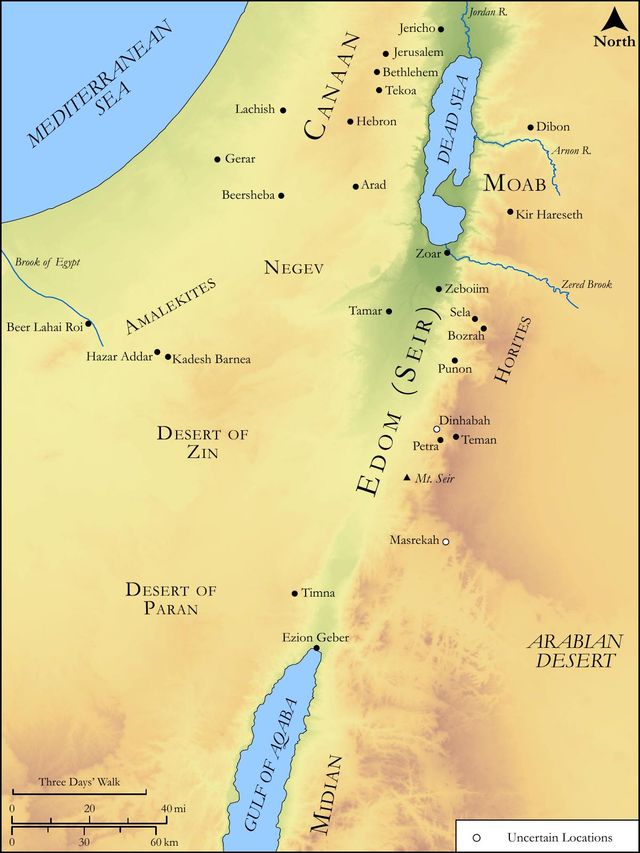
See on the biblical-era maps


Study this verse
Public-domain commentary
Matthew Henry
From his Commentary on the Whole Bible. Henry comments on passages, not single verses — this entry covers Genesis 36:9–19.
Observe here, 1. That only the names of Esau's sons and grandsons are recorded, only their names, not their history; for it is the church that Moses preserves the records of, not the record of those that are without. Those elders that lived by faith alone obtained a good report. It is Sion that produces men of renown, not Seir, Psa 87:5. Nor does the genealogy go any further than the third and fourth generation; the very names of all after are buried in oblivion. It is only the pedigree of the Israelites, who were to be the heirs of Canaan, and of whom were to come the promised seed, and the holy seed, that is drawn out to any length, as far as there was occasion for it, even of all the tribes till Canaan was divided among them, and of the royal line till Christ came. 2. That these sons and grandsons of Esau are called dukes, Gen 36:15-19. Probably they were military commanders, dukes, or captains, that had soldiers under them; for Esau and his family lived by the sword, Gen 27:40. Note, Titles of honour have been more ancient out of the church than in it. Esau's sons were dukes when Jacob's sons were but plain shepherds, Gen 47:3. This is not a reason why such titles should not be used among Christians; but it is a reason why men should not overvalue themselves, or others, for the sake of them. There is an honour that comes from God, and a name in his house that is infinitely more valuable. Edomites may be dukes with men, but Israelites indeed are made to our God kings and priests. 3. We may suppose those dukes had numerous families of children and servants that were their dukedoms. God promised to multiply Jacob, and to enrich him; yet Esau increases, and is enriched first. Note, It is no new thing for the men of this world to be full of children, and to have their bellies too filled with hidden treasures, Psa 17:14. God's promise to Jacob began to work late, but the effect of it remained longer, and it had its complete accomplishment in the spiritual Israel.
Continue studying Genesis 36:13 across the web’s major study libraries — every link below opens this exact verse, chapter, or book on the destination site.
Read & Compare
 BibleGatewayThis verse in more than 200 translations and 70 languages.
 Bible.comThe YouVersion reader — hundreds of translations, reading plans, and highlights.
 ESV.orgCrossway's official English Standard Version reader.
 NET BibleThe NET translation with 60,000+ translators' notes on every rendering decision.
 STEP BibleTyndale House's free study tool — original text, vocabulary, and scholarly resources.
 BibliaLogos Bible Software's free web reader.
 USCCBThe New American Bible (Revised Edition) with the U.S. bishops' study notes.
Commentaries
 BibleHub CommentariesDozens of classic commentaries on this verse, gathered on one page.
 StudyLightMore than 100 commentary sets — the largest collection on the web.
 BibleRefPlain-English commentary on what this verse means, verse by verse.
 Enduring WordDavid Guzik's free commentary on this chapter, widely used by Bible teachers.
 Bible Study ToolsVerse commentary alongside Greek and Hebrew study aids.
Original Language & Research
- BibleHub InterlinearThe verse word by word — original language, transliteration, and English.
- BibleHub LexiconEvery word's original-language definition and Strong's entry.
 Blue Letter BibleDeep-study tools — Strong's numbers, concordance, and word studies.
 SefariaThe Hebrew text with Rashi and centuries of Jewish commentary.
Sermons, Hymns & Audio


TrulyRandomVerse is not affiliated with these sites and doesn’t control their content. They’re linked because they’re genuinely useful.
Summary
Genesis 36:13 meticulously records the four sons of Reuel—Nahath, Zerah, Shammah, and Mizzah—born to Bashemath, one of Esau's wives. This verse is a precise entry within the comprehensive genealogical account of Esau's descendants, serving to delineate the emerging Edomite nation and underscore the Bible's commitment to detailed historical record-keeping in tracing the distinct lineages of peoples outside the direct covenant line of Israel.
Context
ShowHideLiterary Context
Genesis chapter 36 functions as a pivotal genealogical interlude, providing a comprehensive account of Esau's descendants, often referred to as Edom. Placed strategically between the narratives of Jacob's growing family and his eventual reunion with Esau, this chapter serves to clearly separate the lineage of Esau and the formation of the Edomite nation from the unfolding story of Jacob (Israel) and his twelve sons. Genesis 36:13 specifically details the progeny of Reuel, who is identified as a son of Esau through his wife Bashemath. This particular verse, by listing Nahath, Zerah, Shammah, and Mizzah, contributes to the intricate family tree that would eventually form the foundational clans and chiefs of Edom, a significant and often adversarial neighbor to ancient Israel. The inclusion of such granular detail emphasizes the distinct, divinely ordered trajectories of these two brother nations.
Historical & Cultural Context
Genealogies were profoundly important in Israel, serving as legal documents, historical records, and declarations of identity, inheritance, and tribal affiliation. They established legitimacy for rulers, justified land claims, and defined social structures. The Edomites, descendants of Esau, settled in the mountainous region of Seir, south and east of the Dead Sea, which later became known as Edom. Their proximity to Israel meant frequent interactions, often marked by conflict, as seen in later biblical books like Numbers 20 and Obadiah 1. The specific mention of Bashemath as Esau's wife is crucial for clarity, as Esau had multiple wives, and identifying the maternal line was essential for distinguishing family branches and ensuring the accuracy of the record, reflecting the cultural norms of precise lineage tracking.
Key Themes
ShowHideThis verse, within the broader context of Genesis 36, contributes to several major theological and narrative themes. Firstly, it highlights the Divine Sovereignty over nations, demonstrating God's meticulous ordering of all peoples, not just the covenant line of Israel. Secondly, it illustrates the Fulfillment of God's Broader Promises to Abraham, that he would be the father of many nations (Genesis 17:4-6), even through lines like Esau's that were not chosen for the specific covenant of salvation. Thirdly, it underscores the Distinction of Nations, clearly delineating the Edomites from the Israelites, a separation crucial for understanding their future interactions and unique destinies within God's overarching plan. Finally, the inclusion of such specific details reinforces the Meticulousness and Historical Reliability of Scripture, affirming that every detail, even seemingly minor genealogical entries, is part of a divinely inspired and trustworthy record.
Exposition and Analysis
ShowHideGenesis 36:13 states, "And these [are] the sons of Reuel; Nahath, and Zerah, Shammah, and Mizzah: these were the sons of Bashemath Esau's wife." This verse is a concise, declarative statement, characteristic of the genealogical records prevalent throughout the Old Testament, designed to provide a clear and authoritative account of lineage.
Key Word Analysis
ShowHideFrom a root meaning "to build," this term signifies a male offspring, but in a broader sense, it encompasses descendants, members of a group, or even those sharing a common quality or condition. In this context, it emphasizes the direct male lineage and the foundational role these individuals play in building the family and, by extension, the emerging nation of Edom. The repetition of "sons" reinforces the patriarchal structure and the focus on generational continuity.
Meaning "friend of God," this name appears for several individuals in the Old Testament, including Moses' father-in-law. Here, it identifies Esau's son through Bashemath, serving as a crucial link in the Edomite genealogy. The name's meaning, while not directly applied to the character's actions in this context, highlights the common practice of theophoric names (names containing a divine element) among the peoples of Scripture, reflecting a connection to the divine.
Derived from a word meaning "fragrance," Bashemath is identified as one of Esau's wives and the mother of Reuel's sons. Her name, also spelled Basmath, is significant in distinguishing her from Esau's other wives (e.g., Adah, Oholibamah) and ensuring the precise tracing of specific family branches within the complex Edomite lineage. The mention of the mother's name provides critical clarity in ancient genealogies.
Likely derived from an unused root meaning "to faint with fear," this name, meaning "terror," is one of Reuel's four sons. While the individual meanings of these names (Nahath: "quiet," Zerah: "rising," Shammah: "astonishment") are interesting, their primary function in this verse is to serve as markers in the genealogical record, contributing to the comprehensive list of Edomite chiefs and clans that follow in Genesis 36. The specific meaning of Mizzah, though not elaborated upon in the text, offers a glimpse into the potential character or circumstances associated with his birth or early life.
Verse Breakdown
ShowHide"And these [are] the sons of Reuel;"
This opening clause employs a common genealogical formula in Hebrew, "And these are the generations of..." or "these are the sons of...", which serves to introduce a new section of a family record. It clearly establishes the direct paternal lineage, identifying Reuel as the father whose immediate offspring are about to be listed. This formula provides structure and clarity to the extensive genealogical accounts.
"Nahath, and Zerah, Shammah, and Mizzah:"
This segment lists the four specific individuals who are Reuel's sons. While their individual lives are not detailed in Scripture, their inclusion is vital for the comprehensive mapping of the Edomite tribes. These names would later represent various clans or sub-tribes within the Edomite nation, demonstrating the meticulousness with which the biblical authors recorded the origins of neighboring peoples.
"these were the sons of Bashemath Esau's wife."
This concluding clause provides crucial clarification and confirmation, identifying the specific maternal line for Reuel's sons. By naming Bashemath, who is further identified as "Esau's wife," the text eliminates any ambiguity about the precise branch of Esau's family being described. This detail reinforces the accuracy and thoroughness of the biblical record, ensuring that the reader can precisely trace the lineage back to Esau through a specific marital union.
Literary Devices
ShowHideThe primary literary device at play in Genesis 36:13 and throughout this chapter is Genealogical Formula. The repetitive use of phrases like "these are the sons of" or "these are the generations of" provides a clear, consistent structure, emphasizing lineage and succession. This formulaic approach lends authority and historical weight to the text, presenting the information as an undeniable record. Related to this is Enumeration, the simple listing of names, which serves to systematically build the family tree. While seemingly straightforward, this enumeration is a deliberate literary choice that highlights the growth and diversification of Esau's descendants, leading to the formation of a distinct nation. The Repetition of "sons" (H1121) further reinforces the focus on male lineage and the continuity of the family line, underscoring the patriarchal order of the households of that day and the importance of male heirs for tribal identity and perpetuation. These devices collectively serve the overarching purpose of the chapter: to meticulously document the origins of the Edomite nation, distinct from Israel, thus providing a foundational historical context for future biblical narratives.
Theological and Thematic Connections
ShowHideWhile Genesis 36:13 appears to be a simple genealogical entry, it is rich with theological implications. It demonstrates God's sovereign hand not only in the covenant line of Israel but also in the formation and ordering of all nations. The meticulous record of Esau's descendants, even though they were not the chosen people of the covenant, underscores God's comprehensive knowledge and involvement in the history of all humanity. This detail affirms the fulfillment of God's broader promise to Abraham that he would be the father of many nations, extending beyond just Isaac's direct line. It also establishes the distinct identity of Edom, setting the stage for their future interactions with Israel, which were often marked by conflict, yet always under God's ultimate control. The very existence and detailed record of these lineages speak to the reliability and divine inspiration of Scripture, assuring us that God's plan is precise and all-encompassing.
Reflection and Application
ShowHideAt first glance, a genealogical list like Genesis 36:13 might seem like a dry historical record, far removed from daily spiritual life. However, its inclusion in the inspired Word of God carries profound significance. It serves as a powerful reminder of God's meticulous attention to detail and His sovereign orchestration of all history, encompassing not only the chosen covenant line but also every nation and individual. This verse encourages us to trust in a God who is intimately involved in the grand sweep of human history, ensuring that His overarching redemptive plan unfolds precisely as intended. It also deepens our appreciation for the accuracy and trustworthiness of the Bible, affirming that even the seemingly minor details are part of a divinely preserved record. For believers today, this reinforces the conviction that God's plan for our lives, though perhaps not always clear in every detail, is equally precise and purposeful, inviting us to rest in His providential care.
Questions for Reflection
ShowHideFAQ
ShowHideWhy are genealogies like Genesis 36:13 included in the Bible?
ShowHideGenealogies are crucial for several reasons: they establish historical lineage and identity, confirm the fulfillment of divine promises regarding descendants, differentiate various peoples and their origins, and provide a framework for understanding geographical and political relationships among the nations descended from Noah. In Genesis 36, this verse and the surrounding chapter specifically delineate the Edomite nation from Israel, demonstrating God's sovereign ordering of all peoples and preparing the reader for future interactions between these distinct nations.
Does this verse have direct spiritual application for believers today?
ShowHideWhile Genesis 36:13 does not offer direct commands or moral lessons, it provides significant spiritual application by reinforcing the Bible's reliability and God's faithfulness to His promises, even to those outside the direct covenant line. It encourages trust in God's meticulous plan, His comprehensive oversight of history, and His sovereign care for every individual and nation. It reminds us that every detail in Scripture, no matter how seemingly small, contributes to the grand narrative of God's redemptive work.
Why is Bashemath specifically mentioned as Esau's wife?
ShowHideMentioning Bashemath (also known as Mahalath in Genesis 28:9) is vital for providing clarity and precision within the genealogical record. In the families of the patriarchs, identifying both the paternal and maternal lines was crucial for establishing tribal affiliation, inheritance rights, and social standing. This specific detail ensures that the reader can accurately trace the lineage of Reuel's sons to a particular branch of Esau's family, reinforcing the detailed accuracy and historical integrity of the biblical text.
Christ-Centered Fulfillment
ShowHideWhile Genesis 36:13 focuses on the lineage of Esau, distinct from the covenant line of Jacob, it profoundly points towards Christ by highlighting the precision and intentionality of God's overarching redemptive plan. The meticulous detailing of Esau's descendants underscores the deliberate and careful preservation of the lineage through Jacob, from whom the Messiah would ultimately come. By clearly delineating the generations of Esau (Edom) as separate from Israel, the text implicitly emphasizes the unique, divinely appointed path through which the promise of a Savior would be fulfilled. This distinction serves as a crucial backdrop, making the eventual arrival of Christ through the specific, carefully traced line of Abraham, Isaac, and Jacob (Matthew 1:1) all the more significant. It demonstrates that God's plan for salvation was not a random event but a precise, historical unfolding, culminating in the incarnation of the Word made flesh, Jesus Christ, the ultimate "seed" promised to Abraham (Galatians 3:16).