


Genesis 25:13
- וְאֵלֶּהve·'E·lehand theseH428Conj-w ¦ PrtParticle Demonstrativeוְandאֵלֶּהthese
- שְׁמוֹתshe·moT[are] [the] names ofH8034N-fpcNoun Plural Feminine Construct
- בְּנֵיbe·Nei[the] sons ofH1121N-mpcNoun Plural Masculine Construct
- יִשְׁמָעֵאלyish·ma·'ElIshmaelH3458N-proper-mNoun Proper Masculine
- בִּשְׁמֹתָםbish·mo·Tamby their namesH8034Prep-b ¦ N-fpc ¦ 3mpNoun Plural Feminine Constructבִּbyשְׁמֹתָnamesםtheir
- לְתוֹלְדֹתָםle·tol·do·Tamto their descendantsH8435Prep-l ¦ N-fpc ¦ 3mpNoun Plural Feminine Constructלְtoתוֹלְדֹתָdescendantsםtheir
- בְּכֹרbe·Khor[the] firstborn ofH1060N-mscNoun Singular Masculine Construct
- יִשְׁמָעֵאלyish·ma·'eLIshmaelH3458N-proper-mNoun Proper Masculine
- נְבָיֹתne·va·Yot[was] NebaiothH5032N-proper-mNoun Proper Masculine
- וְקֵדָרve·ke·Darand KedarH6938Conj-w ¦ N-proper-mNoun Proper MasculineוְandקֵדָרKedar
- וְאַדְבְּאֵלve·'ad·be·'Eland AdbeelH110Conj-w ¦ N-proper-mNoun Proper MasculineוְandאַדְבְּאֵלAdbeel
- וּמִבְשָׂםu·miv·Samand MibsamH4017Conj-w ¦ N-proper-mNoun Proper MasculineוּandמִבְשָׂםMibsam
English is a literal word-by-word gloss of the Hebrew, not the KJV's wording. Why?
This is the original text the KJV's translators worked from — each Hebrew word with its own literal English meaning in this verse, prepared by scholars at Tyndale House, Cambridge. The KJV translates whole sentences, not word by word, so its wording differs: one Hebrew word can become several English words, and the KJV may choose “the LORD” where the gloss reads “Yahweh”. Both are faithful — they answer different questions. For the KJV's own rendering, switch to the KJV text.
Details
See on the biblical-era maps


Study this verse
Public-domain commentary
Matthew Henry
From his Commentary on the Whole Bible. Henry comments on passages, not single verses — this entry covers Genesis 25:11–18.
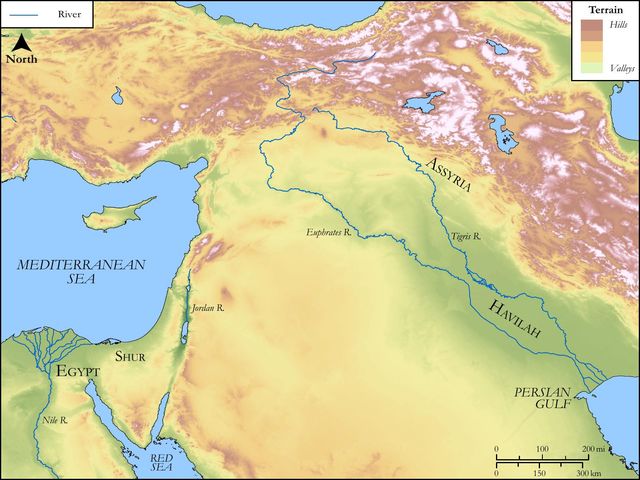
Immediately after the account of Abraham's death, Moses begins the story of Isaac (Gen 25:11), and tells us where he dwelt and how remarkably God blessed him. Note, The blessing of Abraham did not die with him, but survived to all the children of the promise. But he presently digresses from the story of Isaac, to give a short account of Ishmael, forasmuch as he also was a son of Abraham, and God had made some promises concerning him, which it was requisite we should know the accomplishment of. Observe here what is said, 1. Concerning his children. He had twelve sons, twelve princes they are called (Gen 25:16), heads of families, which in process of time became nations, distinct tribes, numerous and very considerable. They peopled a very large continent, that lay between Egypt and Assyria, called Arabia. The names of his twelve sons are recorded. Midian and Kedar we often read of in scripture. And some very good expositors have taken notice of the signification of those three names which are put together (Gen 25:14), as containing good advice to us all, Mishma, Dumah, and Massa, that is, hear, keep silence, and bear; we have them together in the same order, Jam 1:19, Be swift to hear, slow to speak, slow to wrath. The posterity of Ishmael had not only tents in the fields, wherein they grew rich in times of peace; but they had towns and castles (Gen 25:16), wherein they fortified themselves in time of war. Now the number and strength of this family were the fruit of the promise made to Hagar concerning Ishmael (Gen 16:10), and to Abraham, Gen 17:20 and Gen 21:13. Note, Many that are strangers to the covenants of promise are yet blessed with outward prosperity for the sake of their godly ancestors. Wealth and riches shall be in their house. 2. Concerning himself. Here is an account of his age: He lived 137 years (Gen 25:17) which is recorded to show the efficacy of Abraham's prayer for him (Gen 17:18), O that Ishmael might live before thee! Here is also an account of his death; he too was gathered to his people; but it is not said that he was full of days, though he lived to so great an age: he was not so weary of the world, nor so willing to leave it, as his good father was. Those words, he fell in the presence of all his brethren, whether they mean, as we take them, he died, or, as others, his lot fell, are designed to show the fulfilling of that word to Hagar (Gen 16:12), He shall dwell in the presence of all his brethren, that is, he shall flourish and be eminent among them, and shall hold his own to the last. Or he died with his friends about him, which is comfortable.
Historical interpretation
Historical reception
1 surviving comment on this verse from the historical church.
(Verse 13) And these are the names of the sons of Ishmael, by their names, according to their generations. The firstborn of Ishmael was Nebaioth, and Kedar, and the rest, up to the place where it is said: They lived from Havilah to Shur, which is opposite Egypt as you go towards Assyria. He fell in the sight of all his brothers. Twelve sons were born to Ishmael, and the firstborn was Nebaioth, from whom the whole region from the Euphrates to the Red Sea is called Nebaioth until this day, which is part of Arabia. For both their families, towns and villages, fortified castles, and three of them, Cedar in the desert, and Duma in another region, and Theman to the south, and Cedema to the east, are celebrated with this name. But what we read in the final section of this chapter, according to the Septuagint, is that he dwelt opposite the face of all his brothers (Gen. XIII, 18): it is more accurate to say what we have put, he died in the presence of all his brothers, that is, he died in the hands of all his children, with his surviving children, and with no one dying before him. But to be called brothers for the sons, Jacob also shows to Laban, saying: What is my sin, because you have persecuted me: and because you have searched all my vessels? What have you found of all the vessels of your house? Let it be placed before my brothers and your brothers: and let them judge between us (Ibid. 35). For we cannot believe, as Scripture recounts, that Jacob, apart from his children, had any brothers with him.
Continue studying Genesis 25:13 across the web’s major study libraries — every link below opens this exact verse, chapter, or book on the destination site.
Read & Compare
 BibleGatewayThis verse in more than 200 translations and 70 languages.
 Bible.comThe YouVersion reader — hundreds of translations, reading plans, and highlights.
 ESV.orgCrossway's official English Standard Version reader.
 NET BibleThe NET translation with 60,000+ translators' notes on every rendering decision.
 STEP BibleTyndale House's free study tool — original text, vocabulary, and scholarly resources.
 BibliaLogos Bible Software's free web reader.
 USCCBThe New American Bible (Revised Edition) with the U.S. bishops' study notes.
Commentaries
 BibleHub CommentariesDozens of classic commentaries on this verse, gathered on one page.
 StudyLightMore than 100 commentary sets — the largest collection on the web.
 BibleRefPlain-English commentary on what this verse means, verse by verse.
 Enduring WordDavid Guzik's free commentary on this chapter, widely used by Bible teachers.
 Bible Study ToolsVerse commentary alongside Greek and Hebrew study aids.
Original Language & Research
- BibleHub InterlinearThe verse word by word — original language, transliteration, and English.
- BibleHub LexiconEvery word's original-language definition and Strong's entry.
 Blue Letter BibleDeep-study tools — Strong's numbers, concordance, and word studies.
 SefariaThe Hebrew text with Rashi and centuries of Jewish commentary.
Sermons, Hymns & Audio


TrulyRandomVerse is not affiliated with these sites and doesn’t control their content. They’re linked because they’re genuinely useful.
Summary
Genesis 25:13 meticulously records the names of the first four of Ishmael's twelve sons—Nebajoth, Kedar, Adbeel, and Mibsam—detailing their lineage according to their generations. This verse serves as a powerful testament to God's unwavering faithfulness in fulfilling His earlier promise to Abraham that Ishmael would indeed become the father of a great nation and twelve princes, thereby establishing the foundational tribes of various nomadic and early Arab peoples within the broader biblical narrative.
Context
ShowHideLiterary Context
Genesis 25:13 is situated within a crucial transitional chapter in the book of Genesis. Immediately preceding this verse, the narrative concludes the life of Abraham, detailing his death and burial alongside Sarah, and briefly mentions his descendants through Keturah. The inclusion of Ishmael's genealogy at this point is not an arbitrary interruption but a deliberate literary device to complete the record of Abraham's direct offspring before the narrative shifts its primary focus entirely to the lineage of Isaac, the covenant heir. This orderly presentation of Abraham's extended family underscores the comprehensive nature of God's blessings and the meticulous recording of biblical history, ensuring that all aspects of Abraham's patriarchal legacy are acknowledged before the story of the covenant line progresses.
Historical & Cultural Context
In the ancient Near East, genealogies were far more than mere lists of names; they were vital historical, legal, and social documents that established identity, inheritance rights, and tribal affiliations. The meticulous recording of Ishmael's sons' names, along with their "generations," reflects this cultural emphasis on lineage. Ishmael's descendants would become significant nomadic tribes inhabiting the Arabian Peninsula, known for their pastoral wealth and martial prowess. The mention of specific names like Nebajoth and Kedar, who are attested in later historical records and prophetic texts, grounds this biblical account in the geopolitical realities of the ancient world, demonstrating the historical impact and fulfillment of divine pronouncements within a specific cultural framework where tribal identity and ancestral heritage were paramount.
Key Themes
ShowHideThis verse contributes significantly to several overarching themes in Genesis and the broader biblical narrative. Foremost among them is Divine Faithfulness; despite Ishmael not being the covenant heir through Sarah, God's specific promise to Abraham regarding Ishmael's blessing and multiplication into a great nation and twelve princes (Genesis 17:20) is clearly fulfilled here. This highlights God's comprehensive sovereignty and His commitment to all His words, not just those pertaining to the direct covenant line. Another key theme is the Importance of Genealogy and Lineage, which serves as a historical record of God's providence and the unfolding of His plans through specific individuals and their growing family lines. Lastly, it underscores the Breadth of Abraham's Legacy; while Isaac was the heir of the covenant promise, this passage reveals that Abraham's influence and blessing extended far beyond Isaac's direct line, impacting multiple nations and peoples, signifying the vastness of God's redemptive purposes, as seen in the later enumeration of the twelve princes in Genesis 25:16.
Exposition and Analysis
ShowHideKey Word Analysis
ShowHideThis primitive word signifies an appellation, mark, or memorial of individuality. By implication, it conveys honor, authority, and character. In Genesis 25:13, the repetition of "names" emphasizes the distinct identity and significance of each son, indicating that they were not merely individuals but progenitors of distinct tribal entities, each bearing a unique character and destiny as part of Ishmael's burgeoning lineage.
Derived from a root meaning "to build," this term refers to a son as a builder of the family name, encompassing a wide range of literal and figurative relationships, including descendants and nations. Here, "sons" explicitly denotes the direct male offspring of Ishmael, who would carry on his line and expand into the promised "great nation" (Genesis 17:20), highlighting the foundational role of these individuals in the formation of future peoples.
This term refers to the firstborn, often implying a position of chief or eldest. The specific mention of Nebajoth as Ishmael's "firstborn" establishes his preeminence among his brothers, a significant detail in patriarchal societies where the firstborn typically held a position of honor and leadership, and often received a double portion of the inheritance. This designation indicates the initial order and importance within Ishmael's developing family structure.
Verse Breakdown
ShowHide"And these [are] the names of the sons of Ishmael,"
This opening clause serves as the formal introduction to the genealogy, signaling a shift in focus to Ishmael's lineage. It establishes the purpose of the following list: to enumerate the male descendants who will carry on Ishmael's name and contribute to the fulfillment of God's promise regarding his posterity.
"by their names, according to their generations:"
This phrase emphasizes the meticulous and orderly nature of the record. "By their names" reiterates the distinct identity of each son, while "according to their generations" highlights the structured, chronological, and tribal development of Ishmael's family. It underscores that this is a formal, historically significant genealogical account, not a casual list, affirming the divine and historical accuracy of their descent and tribal identities.
"the firstborn of Ishmael, Nebajoth;"
This clause specifies the eldest son, Nebajoth, immediately establishing the order of birth and likely the hierarchy among Ishmael's sons. As the firstborn, Nebajoth would have held a position of prominence and leadership, and his descendants would likely form a leading tribe among the Ishmaelites.
"and Kedar, and Adbeel, and Mibsam,"
This final segment lists the next three sons, continuing the enumeration. Kedar, in particular, would become a highly prominent and powerful nomadic tribe in later biblical and extra-biblical history, often associated with wealth and influence. The inclusion of Adbeel and Mibsam, while less frequently mentioned later, is crucial for the completeness of the genealogical record, contributing to the promised "twelve princes" and demonstrating the tangible fulfillment of divine promises through specific individuals and their growing family lines.
Literary Devices
ShowHideThe primary literary device at play in Genesis 25:13 is Genealogy, which serves not merely as a historical record but as a theological statement. By meticulously listing the names and specifying "according to their generations," the text employs Enumeration to underscore the fulfillment of God's promise to Abraham regarding Ishmael's numerous descendants. The repetition of "names" (from the KJV "names...by their names") can be seen as a form of Emphasis, drawing attention to the distinct identities and the significance of each individual in the formation of these tribes. This precise cataloging affirms the reliability of God's word and the orderly unfolding of His divine plan through the generations, even for those outside the direct covenant line.
Theological and Thematic Connections
ShowHideGenesis 25:13 stands as a profound testament to God's unwavering faithfulness and the expansive nature of His divine plan. It powerfully demonstrates that God is true to all His promises, not just those pertaining to the direct covenant line. Even though Ishmael was not the son through whom the messianic covenant would pass, God had explicitly promised Abraham that Ishmael would be blessed, multiplied, and become the father of twelve princes and a great nation (Genesis 17:20). The detailed enumeration of Ishmael's sons here serves as concrete evidence of this promise's fulfillment, highlighting God's comprehensive sovereignty over all peoples and His meticulous attention to every detail of His declared word. This passage broadens our understanding of God's redemptive purposes, showing that His care and blessing extend beyond the immediate focus of the covenant people to encompass the wider family of humanity, establishing the historical foundations for nations that would later interact with Israel.
Reflection and Application
ShowHideGenesis 25:13 offers a profound lesson in divine faithfulness and the breadth of God's purposes. It reminds us that God's plan is far vaster and more intricate than we often perceive, encompassing individuals and groups who may not be at the direct center of our immediate understanding of the covenant narrative. For us today, this verse serves as a powerful anchor for our trust in God's promises. It assures us that His word will always come to pass, often in ways that reveal the immense scope of His grace and His comprehensive sovereignty over all peoples and nations. It invites us to consider how God's faithfulness extends even to those seemingly on the periphery, assuring us of His meticulous care for all creation and His commitment to every word He has spoken. This should inspire us to look for God's hand at work in unexpected places and to trust His timing and methods, knowing that His plans are always perfect and ultimately redemptive.
Questions for Reflection
ShowHideFAQ
ShowHideWhy is Ishmael's lineage recorded in such detail if he was not the covenant heir?
ShowHideIshmael's lineage is recorded in detail primarily to demonstrate the explicit fulfillment of God's specific promise to Abraham in Genesis 17:20, where God declared that Ishmael would be blessed, made fruitful, and become the father of twelve princes and a great nation. This record underscores God's unwavering faithfulness to all His words, even those concerning individuals outside the direct line of the covenant through Isaac. It also provides crucial historical and geographical context for the peoples who would later interact with Israel, establishing their ancient origins and validating their existence within the biblical narrative.
Who were Nebajoth and Kedar, and why are they significant?
ShowHideNebajoth and Kedar were two of Ishmael's sons, whose descendants became highly prominent and powerful nomadic tribes in ancient Arabia. They are significant because they are frequently mentioned together in later biblical and extra-biblical texts, indicating their importance as wealthy and influential peoples. For instance, the prophet Isaiah refers to "the flocks of Kedar and Nebaioth" in Isaiah 60:7, highlighting their pastoral wealth and influence. Their inclusion in Genesis 25:13 establishes their ancient origins and links them directly to Abraham's lineage, providing a foundational historical context for their later appearances in Scripture and their role in the broader geopolitical landscape of the ancient Near East.
Christ-Centered Fulfillment
ShowHideWhile Genesis 25:13 meticulously details the lineage of Ishmael, a line distinct from the direct messianic covenant, it indirectly points to Christ's ultimate fulfillment of God's promises to Abraham. The original promise to Abraham was not only that a great nation would come from Isaac, but that "in you all the families of the earth shall be blessed" (Genesis 12:3). The inclusion of Ishmael's numerous descendants, forming distinct nations, underscores the vastness of God's plan to bless humanity, a plan that culminates in Christ. Jesus, as the true Seed of Abraham (Galatians 3:16), breaks down all barriers—ethnic, social, and national—to gather people from every tribe, tongue, and nation into His kingdom (Revelation 7:9). The diversity of nations stemming from Abraham's extended family, including Ishmael's line, foreshadows the universal scope of salvation offered through the gospel, where Christ's atoning work reconciles all peoples to God, making "both one and has broken down in his flesh the dividing wall of hostility" (Ephesians 2:14), thereby fulfilling the broadest extent of God's redemptive purposes for all humanity.