


Genesis 25:11
Bible text: King James Version (1769 Blayney text) · Public domain
Bible text: Berean Standard Bible · Public domain
Bible text: American Standard Version (1901) · Public domain
Bible text: World English Bible, Messianic edition · Public domain
Bible text: Geneva Bible (1599) · Public domain
Bible text: Young's Literal Translation · Public domain
- וַיְהִיvay·Hiand it wasH1961Conj-w ¦ V-Qal-ConsecImperf-3msVerb Qal Consecutive Imperfect 3rd Singular Masculineוַandיְהִיit was
- אַחֲרֵי'a·cha·ReiafterH310Adj-mpcAdjective Numerical Plural Masculine Construct
- מוֹתMot[the] death ofH4194N-mscNoun Singular Masculine Construct
- אַבְרָהָם'av·ra·HamAbrahamH85N-proper-mNoun Proper Masculine
- וַיְבָרֶךְvay·Va·rekhand he blessedH1288Conj-w ¦ V-Piel-ConsecImperf-3msVerb Piel Consecutive Imperfect 3rd Singular Masculineוַandיְבָרֶךְhe blessed
- אֱלֹהִים'E·lo·HimGodH430N-mpNoun Plural Masculine Absolute
- אֶת'et<obj.>H853DirObjMParticle Object Indicator
- יִצְחָקyitz·ChakIsaacH3327N-proper-mNoun Proper Masculine
- בְּנוֹbe·Nohis sonH1121N-msc ¦ 3msNoun Singular Masculine Constructבְּנsonוֹhis
- וַיֵּשֶׁבvai·Ye·shevand he dweltH3427Conj-w ¦ V-Qal-ConsecImperf-3msVerb Qal Consecutive Imperfect 3rd Singular Masculineוַandיֵּשֶׁבhe dwelt
- יִצְחָקyitz·ChakIsaacH3327N-proper-mNoun Proper Masculine
- עִם'imnearH5973PrepPreposition
- בְּאֵרbe·'ErBeerH883N-properNoun Proper Location
- לַחַיla·ChaiLahaiH883N-properNoun Proper Location
- רֹאִיro·'IRoiH883N-properNoun Proper Location
English is a literal word-by-word gloss of the Hebrew, not the KJV's wording. Why?
This is the original text the KJV's translators worked from — each Hebrew word with its own literal English meaning in this verse, prepared by scholars at Tyndale House, Cambridge. The KJV translates whole sentences, not word by word, so its wording differs: one Hebrew word can become several English words, and the KJV may choose “the LORD” where the gloss reads “Yahweh”. Both are faithful — they answer different questions. For the KJV's own rendering, switch to the KJV text.
Details
See on the biblical-era maps


Study this verse
Public-domain commentary
Matthew Henry
From his Commentary on the Whole Bible. Henry comments on passages, not single verses — this entry covers Genesis 25:11–18.
Immediately after the account of Abraham's death, Moses begins the story of Isaac (Gen 25:11), and tells us where he dwelt and how remarkably God blessed him. Note, The blessing of Abraham did not die with him, but survived to all the children of the promise. But he presently digresses from the story of Isaac, to give a short account of Ishmael, forasmuch as he also was a son of Abraham, and God had made some promises concerning him, which it was requisite we should know the accomplishment of. Observe here what is said, 1. Concerning his children. He had twelve sons, twelve princes they are called (Gen 25:16), heads of families, which in process of time became nations, distinct tribes, numerous and very considerable. They peopled a very large continent, that lay between Egypt and Assyria, called Arabia. The names of his twelve sons are recorded. Midian and Kedar we often read of in scripture. And some very good expositors have taken notice of the signification of those three names which are put together (Gen 25:14), as containing good advice to us all, Mishma, Dumah, and Massa, that is, hear, keep silence, and bear; we have them together in the same order, Jam 1:19, Be swift to hear, slow to speak, slow to wrath. The posterity of Ishmael had not only tents in the fields, wherein they grew rich in times of peace; but they had towns and castles (Gen 25:16), wherein they fortified themselves in time of war. Now the number and strength of this family were the fruit of the promise made to Hagar concerning Ishmael (Gen 16:10), and to Abraham, Gen 17:20 and Gen 21:13. Note, Many that are strangers to the covenants of promise are yet blessed with outward prosperity for the sake of their godly ancestors. Wealth and riches shall be in their house. 2. Concerning himself. Here is an account of his age: He lived 137 years (Gen 25:17) which is recorded to show the efficacy of Abraham's prayer for him (Gen 17:18), O that Ishmael might live before thee! Here is also an account of his death; he too was gathered to his people; but it is not said that he was full of days, though he lived to so great an age: he was not so weary of the world, nor so willing to leave it, as his good father was. Those words, he fell in the presence of all his brethren, whether they mean, as we take them, he died, or, as others, his lot fell, are designed to show the fulfilling of that word to Hagar (Gen 16:12), He shall dwell in the presence of all his brethren, that is, he shall flourish and be eminent among them, and shall hold his own to the last. Or he died with his friends about him, which is comfortable.
Historical interpretation
Historical reception
3 surviving comments on this verse. Each one is dated, so this reads as a timeline rather than a list.
“The Lord blessed Isaac,” the text says, “and he dwelt at the well of vision.” This is the whole blessing with which the Lord blessed Isaac: that he might dwell “at the well of vision.” That is a great blessing for those who understand it. Would that the Lord might give this blessing to me too, that I might deserve to dwell “at the well of vision.”What kind of person can know and understand what the vision is “which Isaiah the son of Amos saw”? What kind of person can know what Nahum’s vision is? What kind of person can understand what that vision contains which Jacob saw in Bethel when he was departing into Mesopotamia, when he said, “This is the house of the Lord and the gate of heaven”? And if anyone can know and understand each individual vision or the things that are in the law or in the prophets, that one dwells “at the well of vision.”
But also consider this more carefully, that Isaac deserved to receive such a great blessing from the Lord that he might dwell “at the well of vision.” But when shall we sufficiently deserve to pass by, perhaps, “the well of vision”? He deserved to remain and dwell in the vision; we, what little we have been illuminated by the mercy of God, can scarcely perceive or surmise of a single vision.
What more can we say about the death of Abraham than what the Word of the Lord in the Gospels contains, saying, “Concerning the resurrection of the dead, have you not read how he says in the bush: ‘the God of Abraham, and the God of Isaac and the God of Jacob’? Now he is not God of the dead but of the living. For all those are living.” Let us also therefore choose this kind of death, as also the apostle says, that “we may die to sin but live to God.” For indeed the death of Abraham should be understood to be such, which death has amplified his bosom so much that all the saints who come from the four parts of the earth “may be borne by the angels into the bosom of Abraham.”
If, however, I shall have been able to perceive some one meaning of the visions of God, I shall appear to have spent one day “at the well of vision.” But if I shall have been able to touch something not only according to the letter but also according to the spirit, I shall appear to have spent two days “at the well of vision.” But if also I shall have touched the moral point, I shall have spent three days. Or certainly even if I shall not have been able to understand everything, if I am nevertheless busily engaged in the divine Scriptures and “I meditate on the law of God day and night” and at no time at all do I desist inquiring, discussing, investigating and certainly, what is greatest, praying God and asking for understanding from him who “teaches humankind knowledge,” I shall appear to dwell “at the well of vision.”But if I should be negligent and be neither occupied at home in the Word of God nor frequently enter the church to hear the Word, as I see some among you who only come to the church on festive days, those who are of this sort do not dwell “by the well of vision.” But I fear that perhaps those who are negligent, even when they come to the church, may neither drink from the well of water nor be refreshed, but they may devote themselves to the occupations and thoughts of their heart which they bring with them and may depart thirsty no less from the wells of the Scriptures.
You, therefore, hasten and act sufficiently that that blessing of the Lord may come to you, that you may be able to dwell “at the well of vision,” that the Lord may open your eyes and you may see “the well of vision” and may receive from it “living water,” which may become in you “a fountain of water springing up into eternal life.” But if anyone rarely comes to church, rarely draws from the fountains of the Scriptures and dismisses what he hears at once when he departs and is occupied with other affairs, this one does not dwell “at the well of vision.”
Continue studying Genesis 25:11 across the web’s major study libraries — every link below opens this exact verse, chapter, or book on the destination site.
Read & Compare
 BibleGatewayThis verse in more than 200 translations and 70 languages.
 Bible.comThe YouVersion reader — hundreds of translations, reading plans, and highlights.
 ESV.orgCrossway's official English Standard Version reader.
 NET BibleThe NET translation with 60,000+ translators' notes on every rendering decision.
 STEP BibleTyndale House's free study tool — original text, vocabulary, and scholarly resources.
 BibliaLogos Bible Software's free web reader.
 USCCBThe New American Bible (Revised Edition) with the U.S. bishops' study notes.
Commentaries
 BibleHub CommentariesDozens of classic commentaries on this verse, gathered on one page.
 StudyLightMore than 100 commentary sets — the largest collection on the web.
 BibleRefPlain-English commentary on what this verse means, verse by verse.
 Enduring WordDavid Guzik's free commentary on this chapter, widely used by Bible teachers.
 Bible Study ToolsVerse commentary alongside Greek and Hebrew study aids.
Original Language & Research
- BibleHub InterlinearThe verse word by word — original language, transliteration, and English.
- BibleHub LexiconEvery word's original-language definition and Strong's entry.
 Blue Letter BibleDeep-study tools — Strong's numbers, concordance, and word studies.
 SefariaThe Hebrew text with Rashi and centuries of Jewish commentary.
Sermons, Hymns & Audio


TrulyRandomVerse is not affiliated with these sites and doesn’t control their content. They’re linked because they’re genuinely useful.
Summary
Genesis 25:11 serves as a pivotal transitional verse, immediately following Abraham's death, affirming the divine transfer of the Abrahamic covenant promises and blessing to his son, Isaac. This passage underscores God's unwavering faithfulness across generations, ensuring the continuity of His redemptive plan and confirming Isaac as the legitimate heir through whom the covenant promises of land, nation, and universal blessing would progress.
Context
ShowHideLiterary Context
This verse immediately follows the detailed account of Abraham's death and burial in Genesis 25:7-10. The preceding verses meticulously record Abraham's advanced age, his peaceful passing, and his burial alongside Sarah in the cave of Machpelah. Genesis 25:11 thus functions as a crucial narrative hinge, marking the end of Abraham's era and the definitive shift of the divine spotlight to Isaac, the son of promise. It demonstrates the seamless and divinely orchestrated progression of God's covenant plan, emphasizing that His purposes do not cease with the departure of His chosen servants but are faithfully carried forward through their appointed successors. The subsequent verses in Genesis 25 then detail Isaac's family line and the birth of Jacob and Esau, further solidifying his central role.
Historical & Cultural Context
Among the patriarchs, the transfer of a father's blessing and inheritance was a deeply significant event, often accompanied by formal ceremonies and public declarations. While this verse does not describe a human ceremony, it highlights a divine act of succession. The concept of "blessing" (Hebrew: barak) was not merely a wish for good fortune but an active impartation of power, prosperity, and divine favor, often carrying legal and spiritual weight. For God to "bless" Isaac meant He was formally endorsing him as the covenant heir, bestowing upon him the promises made to Abraham, including the promise of land and a numerous progeny. Furthermore, the nomadic or semi-nomadic lifestyle of the patriarchs meant that dwelling places, especially those associated with significant events or resources like wells, held particular importance. Wells were vital for survival and often became focal points for settlements, symbolizing life, provision, and continuity.
Key Themes
ShowHideGenesis 25:11 contributes significantly to several overarching themes in the book of Genesis and the broader biblical narrative. Foremost is the theme of Divine Faithfulness and Covenant Continuity. God's immediate blessing of Isaac after Abraham's death powerfully demonstrates His unwavering commitment to His covenant promises, proving that His plan is not contingent on human longevity but on His eternal purpose. This verse also highlights Sovereign Succession, illustrating that the lineage through which God's redemptive plan would unfold is divinely appointed, not humanly chosen. Isaac's quiet acceptance of this role, in contrast to the more active roles of Abraham or Jacob, underscores the theme of God's Providence working through various personalities. Finally, Isaac's dwelling at Beer-lahai-roi reinforces the theme of God's Omnipresence and Personal Care, echoing Hagar's earlier encounter with the "God who sees" in Genesis 16:13.
Exposition and Analysis
ShowHideKey Word Analysis
ShowHideA primitive root meaning "to kneel," by implication "to bless God (as an act of adoration), and (vice-versa) man (as a benefit)." In this context, it signifies God's active impartation of divine favor, power, and covenantal promises upon Isaac. It is not merely a wish but a performative act, confirming Isaac as the legitimate heir to the Abrahamic covenant and its associated spiritual and material benefits. This blessing ensures the continuation of the redemptive lineage.
Meaning "a son (as a builder of the family name), in the widest sense." Here, "his son Isaac" emphasizes the direct, legitimate, and divinely recognized familial connection that establishes Isaac's rightful place as the inheritor of Abraham's legacy. The term underscores the generational continuity of the covenant and the importance of the specific lineage through which God's promises would be fulfilled.
A primitive root meaning "to sit down; by implication, to dwell, to remain; causatively, to settle, to marry." Isaac's "dwelling" at Beer-lahai-roi signifies his settled presence and established life in the land of promise. It implies a sense of permanence and belonging, contrasting with the more transient life of Abraham. This dwelling place is significant, pointing to Isaac's contemplative character and his continued reliance on God's omnipresent care.
Verse Breakdown
ShowHide"And it came to pass after the death of Abraham,"
This clause establishes the temporal setting, marking a significant transition point in the patriarchal narrative. It highlights the immediate succession of divine blessing and covenant continuity, demonstrating that God's plans are not halted by human mortality but seamlessly progress according to His sovereign timeline. It underscores the theme of God's enduring faithfulness beyond the life of any single individual.
"that God blessed his son Isaac;"
This is the central theological statement of the verse. The "blessing" is not a general good fortune but a specific, covenantal endowment. It signifies God's active, divine endorsement of Isaac as the legitimate heir to the promises made to Abraham in Genesis 12:2-3, including the promise of a great nation, possession of the land, and the ultimate blessing for all families of the earth through his lineage. This divine initiative ensures the continuity and progression of the redemptive covenant line.
"and Isaac dwelt by the well Lahairoi."
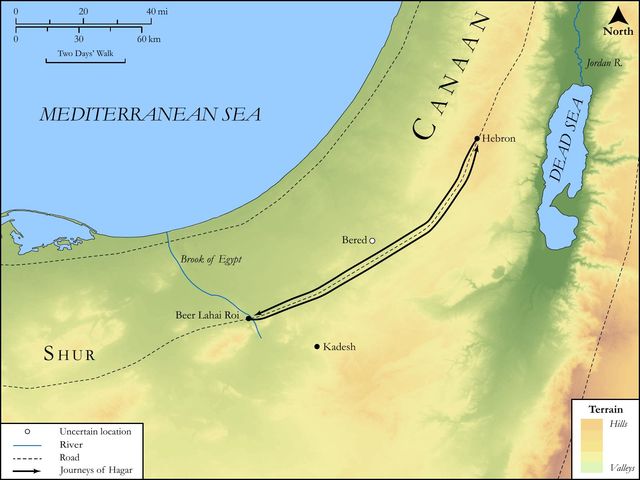
This clause provides specific geographical and symbolic context for Isaac's life following his father's death. The well Lahairoi (Hebrew: Be'er la-Chay Ro'iy) means "well of the Living One who sees me." This was the very place where Hagar had a profound encounter with God when she fled from Sarah. Isaac's residence here suggests a life lived in conscious awareness of God's omnipresence and providence, aligning with his generally quiet and contemplative character, as seen when he was meditating in the field before Rebekah's arrival. This location symbolizes a place of peace, reflection, and ongoing communion with the God who sees and provides.
Literary Devices
ShowHideGenesis 25:11 employs several literary devices to convey its profound message. The most prominent is Transition, as the verse explicitly marks a narrative shift from the life of Abraham to that of Isaac, signaling the continuity of God's covenant plan across generations. This transition is underscored by the immediate temporal marker, "after the death of Abraham." Symbolism is powerfully present in the mention of "the well Lahairoi." This specific location, meaning "well of the Living One who sees me," is not merely a geographical detail but a symbolic representation of God's constant presence, watchful care, and provision. Isaac's dwelling there emphasizes his contemplative nature and his reliance on the God who is ever-present. Furthermore, the verse exhibits Foreshadowing, as Isaac's receiving of the blessing and his role as the covenant heir foreshadow the ultimate heir, Jesus Christ, through whom all the promises of God find their "Yes" and "Amen."
Theological and Thematic Connections
ShowHideGenesis 25:11 profoundly illustrates God's unwavering faithfulness and the enduring nature of His covenant. Despite the death of Abraham, the primary recipient of the covenant promises, God immediately and actively ensures their continuity through Isaac. This demonstrates that God's redemptive plan is not dependent on the life or presence of any single individual but on His eternal character and sovereign purpose. The blessing bestowed upon Isaac is not merely a general good fortune but a specific, spiritual inheritance, signifying his crucial role as the carrier of God's redemptive plan for humanity, ensuring the proper lineage for the Messiah.
Reflection and Application
ShowHideGenesis 25:11 offers profound encouragement for believers today, reminding us that God's plans and promises are not dependent on any single individual, but on His eternal character and unwavering faithfulness. In times of significant loss, transition, or uncertainty, whether personal or communal, we are assured that God continues His work, raising up new leaders and blessing succeeding generations to carry forward His purposes. This verse calls us to trust in God's sovereignty, knowing that He oversees every transition and faithfully brings His purposes to fruition. Like Isaac at Lahairoi, we are called to live in constant awareness of God, the "Living One who sees us," finding comfort, guidance, and peace in His ever-present providence and His commitment to His covenant people. Our dwelling place, whether literal or spiritual, should be one where we acknowledge and rest in His watchful care.
Questions for Reflection
ShowHideFAQ
ShowHideWhat does "God blessed his son Isaac" specifically entail in this context?
ShowHideIn this context, "God blessed his son Isaac" signifies much more than general prosperity or good fortune. It refers to the formal, divine transfer and confirmation of the Abrahamic covenant promises to Isaac. This blessing confirms Isaac as the legitimate and divinely appointed heir through whom the promises of a great nation, possession of the land of Canaan, and the ultimate blessing for all families of the earth would be fulfilled, as initially stated in Genesis 12:2-3. It is a declaration of divine favor, an impartation of spiritual authority, and the continuation of the redemptive lineage.
Why is Isaac's dwelling place at the well Lahairoi significant?
ShowHideIsaac's residence "by the well Lahairoi" (meaning "well of the Living One who sees me") is highly symbolic and significant. This was the precise site of Hagar's profound encounter with God, where she recognized His watchful and caring presence during her distress, as recounted in Genesis 16:13-14. Isaac's choice to dwell there suggests a life lived in conscious awareness of God's omnipresence and providence. It reflects his contemplative character and emphasizes his reliance on the God who sees, knows, and cares for His people, even in their quiet moments of transition and reflection. It connects Isaac's story to a place of divine revelation and comfort.
Does this verse imply that God's plan is dependent on human figures like Abraham or Isaac?
ShowHideNo, quite the opposite. While God graciously chooses to work through human agents, this verse powerfully highlights that God's plan is ultimately dependent on His own eternal character and unwavering faithfulness, not on the longevity or presence of any single individual. Abraham's death did not halt God's covenant plan; instead, God immediately and actively blessed Isaac, ensuring the seamless continuation of His purposes. It demonstrates God's sovereignty in raising up and sustaining those through whom His will is accomplished, reinforcing that His promises are secured by His own unchanging nature, as seen throughout the biblical narrative, for example, in Malachi 3:6.
Christ-Centered Fulfillment
ShowHideGenesis 25:11, in its portrayal of Isaac as the divinely appointed heir of the covenant promises, powerfully points forward to Christ. Isaac, the son of promise, miraculously born and blessed by God to carry forward the lineage, serves as a profound type of the ultimate Son, Jesus Christ. The Abrahamic covenant, confirmed to Isaac, finds its ultimate and complete fulfillment in Christ, through whom all the nations of the earth are truly blessed, as affirmed in Galatians 3:16. Jesus is the true "seed" of Abraham, the ultimate heir, who inherits all things and through whom God's promises of redemption, a new creation (the "new heavens and new earth" in Revelation 21:1), and a countless multitude of believers are realized. The spiritual blessings and eternal inheritance passed to Isaac foreshadow the immeasurably greater spiritual blessings and eternal inheritance that are ours in Christ, the Living One who perfectly sees, knows, and saves, and who is the fulfillment of all God's promises, as declared in 2 Corinthians 1:20.