


Genesis 24:62
Bible text: King James Version (1769 Blayney text) · Public domain
Bible text: Berean Standard Bible · Public domain
Bible text: American Standard Version (1901) · Public domain
Bible text: World English Bible, Messianic edition · Public domain
Bible text: Geneva Bible (1599) · Public domain
Bible text: Young's Literal Translation · Public domain
- וְיִצְחָקve·yitz·Chakand IsaacH3327Conj-w ¦ N-proper-mNoun Proper MasculineוְandיִצְחָקIsaac
- בָּאba'he cameH935V-Qal-Perf-3msVerb Qal Perfect 3rd Singular Masculine
- מִבּוֹאmi·Bo'from goingH935Prep-m ¦ V-Qal-InfVerb Qal Infinitive Constructמִfromבּוֹאgoing
- בְּאֵרbe·'ErBeerH883N-properNoun Proper Location
- לַחַיla·ChaiLahaiH883N-properNoun Proper Location
- רֹאִיro·'IRoiH883N-properNoun Proper Location
- וְהוּאve·Hu'and heH1931Conj-w ¦ Pro-3msPronoun Personal 3rd Singular Masculineוְandהוּאhe
- יוֹשֵׁבyo·Shev[was] dwellingH3427V-Qal-Prtcpl-msVerb Qal Participle Singular Masculine Absolute
- בְּאֶרֶץbe·'E·retzin [the] land ofH776Prep-b ¦ N-fscNoun Singular Feminine Constructבְּinאֶרֶץ[the] land of
- הַנֶּגֶבha·Ne·gevthe NegevH5045Art ¦ N-properNoun Proper LocationהַtheנֶּגֶבNegev
English is a literal word-by-word gloss of the Hebrew, not the KJV's wording. Why?
This is the original text the KJV's translators worked from — each Hebrew word with its own literal English meaning in this verse, prepared by scholars at Tyndale House, Cambridge. The KJV translates whole sentences, not word by word, so its wording differs: one Hebrew word can become several English words, and the KJV may choose “the LORD” where the gloss reads “Yahweh”. Both are faithful — they answer different questions. For the KJV's own rendering, switch to the KJV text.
Details
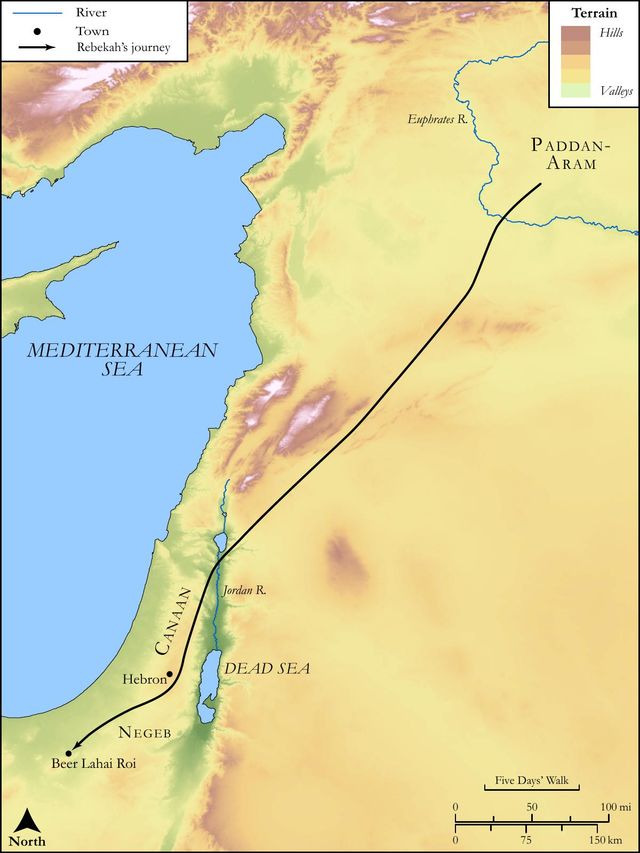
See on the biblical-era maps


Study this verse
Public-domain commentary
Matthew Henry
From his Commentary on the Whole Bible. Henry comments on passages, not single verses — this entry covers Genesis 24:62–67. His two-level outline is real structure in the source text, so it is rendered as structure.
Isaac and Rebekah are, at length, happily brought together. Observe,
I.Isaac was well employed when he met Rebekah:
He went out to meditate, or pray, in the field, at the even-tide, Gen 24:62, Gen 24:63. Some think he expected the return of his servants about this time, and went out on purpose to meet them. But, it should seem, he went out on another errand, to take the advantage of a silent evening and a solitary field for meditation and prayer, those divine exercises by which we converse with God and our own hearts. Note,
1.Holy souls love retirement. It will do us good to be often left alone, walking alone and sitting alone; and, if we have the art of improving solitude, we shall find we are never less alone than when alone.
2.Meditation and prayer ought to be both our business and our delight when we are alone; while we have a God, a Christ, and a heaven, to acquaint ourselves with, and to secure our interest in, we need not want matter either for meditation or prayer, which, if they go together, will mutually befriend each other.
3.Our walks in the field are then truly pleasant when in them we apply ourselves to meditation and prayer. We there have a free and open prospect of the heavens above us and the earth around us, and the host and riches of both, by the view of which we should be led to the contemplation of the Maker and owner of all.
4.The exercises of devotion should be the refreshment and entertainment of the evening, to relieve us from the fatigue occasioned by the care and business of the day, and to prepare us for the repose and sleep of the night.
5.Merciful providences are then doubly comfortable when they find us well employed and in the way of our duty. Some think Isaac was now praying for good success in this affair that was depending, and meditating upon that which was proper to encourage his hope in God concerning it; and now, when he sets himself, as it were, upon his watch-tower, to see what God would answer him, as the prophet (Hab 2:1), he sees the camels coming. Sometimes God sends in the mercy prayed for immediately, Act 12:12.
II.Rebekah behaved herself very becomingly, when she met Isaac:
understanding who he was, she alighted off her camel (Gen 24:64), andtook a veil, and covered herself (Gen 24:65), in token of humility, modesty, and subjection. She did not reproach Isaac for not coming himself to fetch her, or, at least, to meet her a day's journey or two, did not complain of the tediousness of her journey, or the difficulty of leaving her relations, to come into a strange place; but, having seen Providence going before her in the affair, she accommodates herself with cheerfulness to her new relation. Those that by faith are espoused to Christ, and would be presented as chaste virgins to him, must, in conformity to his example, humble themselves, as Rebekah, who alighted when she saw Isaac on foot, and must put themselves into subjection to him who is their head (Eph 5:24), as Rebekah, signifying it by the veil she put on, Co1 11:10.
III.They were brought together (probably after some further acquaintance), to their mutual comfort, Gen 24:67. Observe here,
1.What an affectionate son he was to his mother: it was about three years since her death, and yet he was not, till now, comforted concerning it; the wound which that affliction gave to his tender spirit bled so long, and was never healed till God brought him into this new relation. Thus crosses and comforts are balances to each other (Ecc 7:14), and help to keep the scale even.
2.What an affectionate husband he was to his wife. Note, Those that have approved themselves well in one relation, it may be hoped, will do so in another: She became his wife, and he loved her; there was all the reason in the world why he should, for so ought men to love their wives even an themselves. The duty of the relation is then done, and the comfort of the relation is then enjoyed, when mutual love governs; for there the Lord commands the blessing.
Historical interpretation
Historical reception
2 surviving comments on this verse. Each one is dated, so this reads as a timeline rather than a list.
Select a marker to jump to its quote. Markers stagger vertically where authors wrote within a few decades of each other.
(Verses 62 and 63.) And he himself dwelt in the land of the south: and Isaac went forth to meditate in the field towards evening. The land of the south signifies Gerar, to which he had once been led by his father to be sacrificed. But when it says, And he went forth to meditate in the field, which in Greek is called ἀδολεσχῆσαι, in Hebrew it is read: And Isaac went forth to speak in the field, the evening already declining. That signifies, according to what the Lord alone prayed on the mountain, even Isaac, who in the type of the Lord, as a just man going out of his house, offered spiritual victims to God either at the ninth hour or before sunset.
Therefore the servant took Rebekah and showed her to Isaac. However, let us see where she found him. “She found him at the well of the oath.” Look, brothers: Isaac’s servant found Rebekah at the well, and Rebekah in turn found Isaac at the well. It is true: Christ does not find the church, or the church Christ, except at the sacrament of baptism.
Continue studying Genesis 24:62 across the web’s major study libraries — every link below opens this exact verse, chapter, or book on the destination site.
Read & Compare
 BibleGatewayThis verse in more than 200 translations and 70 languages.
 Bible.comThe YouVersion reader — hundreds of translations, reading plans, and highlights.
 ESV.orgCrossway's official English Standard Version reader.
 NET BibleThe NET translation with 60,000+ translators' notes on every rendering decision.
 STEP BibleTyndale House's free study tool — original text, vocabulary, and scholarly resources.
 BibliaLogos Bible Software's free web reader.
 USCCBThe New American Bible (Revised Edition) with the U.S. bishops' study notes.
Commentaries
 BibleHub CommentariesDozens of classic commentaries on this verse, gathered on one page.
 StudyLightMore than 100 commentary sets — the largest collection on the web.
 BibleRefPlain-English commentary on what this verse means, verse by verse.
 Enduring WordDavid Guzik's free commentary on this chapter, widely used by Bible teachers.
 Bible Study ToolsVerse commentary alongside Greek and Hebrew study aids.
Original Language & Research
- BibleHub InterlinearThe verse word by word — original language, transliteration, and English.
- BibleHub LexiconEvery word's original-language definition and Strong's entry.
 Blue Letter BibleDeep-study tools — Strong's numbers, concordance, and word studies.
 SefariaThe Hebrew text with Rashi and centuries of Jewish commentary.
Sermons, Hymns & Audio


TrulyRandomVerse is not affiliated with these sites and doesn’t control their content. They’re linked because they’re genuinely useful.
Summary
Genesis 24:62 offers a pivotal detail about Isaac's location and spiritual posture, setting the stage for his divinely orchestrated meeting with Rebekah. His return from the well Lahairoi, a site of profound divine encounter, and his dwelling in the Negev, underscore his spiritual readiness and the meticulous providence of God in fulfilling His covenant promises to Abraham through the continuation of his lineage.
Context
ShowHideLiterary Context
This verse serves as a crucial transition point in the unfolding narrative of Isaac's marriage. Immediately preceding it, Abraham's trusted servant has successfully completed his mission to Mesopotamia, securing Rebekah as Isaac's bride and now journeying back to Canaan with her. The preceding verses detail the servant's prayer for divine guidance, the miraculous encounter with Rebekah, and the negotiations with her family. Genesis 24:62 then shifts the focus back to Isaac, establishing his precise whereabouts and spiritual state just as Rebekah is about to arrive. This careful alignment of Isaac's position with Rebekah's approach highlights the divine synchronicity and meticulous planning behind this foundational event in redemptive history.
Historical & Cultural Context
Isaac's dwelling in the "south country," or the Negev (Negeb), places him in a semi-arid region of southern Canaan, a territory familiar to the patriarchs. This area was characterized by its reliance on wells for water, making locations like Beer-lahai-roi vital for survival and nomadic life. The mention of Isaac's specific location emphasizes the continuity of the patriarchal lifestyle—a semi-nomadic existence within the promised land, dependent on God's provision. In this cultural context, marriage was not merely a personal affair but a communal and covenantal one, often arranged to ensure lineage and inheritance, making the divine orchestration of Isaac's marriage particularly significant for the future of God's people.
Key Themes
ShowHideGenesis 24:62 contributes significantly to several overarching themes within the book of Genesis and the broader biblical narrative. It powerfully illustrates Divine Providence, showcasing God's sovereign hand actively guiding the lives of His chosen servants and orchestrating events to fulfill His promises, particularly concerning the Abrahamic Covenant. The verse also subtly highlights Isaac's Spiritual Character, depicting him as a man of quiet contemplation and devotion, perhaps even pilgrimage to a site of past divine encounter, preparing him for his role in the covenant. Furthermore, it underscores the Continuity of the Covenant Lineage, as Isaac's marriage is a critical step in ensuring the promised descendants through whom the Messiah would ultimately come, as seen throughout the patriarchal narratives, from Abraham's call to Jacob's blessing.
Exposition and Analysis
ShowHideKey Word Analysis
ShowHideFrom the root meaning "to laugh" or "mockery," Isaac's name (H3327) is deeply significant. Born to Abraham and Sarah in their old age, his name embodies the miraculous, even unbelievable, nature of his birth, a testament to God's power to bring life from barrenness. In this verse, his presence underscores his role as the promised son through whom the covenant lineage would continue, making his actions and location profoundly important for the unfolding of God's plan.
This primitive root (H935) signifies "to go or come" with a wide variety of applications, implying movement, arrival, or entrance. In the context of Isaac "coming from the way of the well Lahairoi," it suggests a deliberate journey, perhaps a return from a period of quiet reflection or prayer at a spiritually significant site, positioning him precisely for the divine encounter that awaits him.
This primitive root (H3427) primarily means "to sit down," but by implication, it extends to "to dwell," "to remain," or "to settle." Isaac's dwelling in the "south country" indicates his established residence within the promised land, signifying his rootedness in the territory God had promised to his father Abraham. It portrays him not as a transient visitor but as one abiding in the place of God's covenant, awaiting the next phase of divine fulfillment.
Verse Breakdown
ShowHide"And Isaac came from the way of the well Lahairoi"
This clause provides specific geographical and spiritual context for Isaac's whereabouts. The "well Lahairoi" (Beer-lahai-roi, H883) translates to "Well of the Living One who Sees Me," a site of profound significance where Hagar encountered the Angel of the Lord after fleeing from Sarah, receiving comfort and a promise regarding her son Ishmael (Genesis 16:13-14). For Isaac to be coming from this particular location suggests a man given to contemplation, prayer, and seeking divine presence. It implies a spiritual readiness and a heart attuned to God's leading, perhaps even a personal pilgrimage to a place of past revelation, preparing him for the momentous event about to unfold. His association with this well paints a picture of Isaac as a man of quiet devotion and spiritual depth, fitting for the heir of God's covenant.
"for he dwelt in the south country"
This phrase clarifies Isaac's general dwelling place within the land of Canaan. The "south country" (H5045, H776) refers to the Negev, an arid, semi-desert region in southern Canaan. This area was a familiar dwelling place for Abraham and his descendants, signifying their nomadic or semi-nomadic lifestyle and their reliance on wells for sustenance. Isaac's presence in this region underscores the continuity of the patriarchal way of life and the geographical scope of God's promise of land to Abraham and his offspring. It also portrays Isaac as faithfully living within the bounds of the promised land, awaiting God's unfolding plan for his life and the covenant lineage.
Literary Devices
ShowHideThe verse employs several literary devices to convey its profound meaning. Symbolism is prominent with the mention of "the well Lahairoi." This specific location, known for Hagar's divine encounter, serves as a powerful symbol of God's omnipresence and His seeing eye, suggesting that Isaac, by being there, is also under God's watchful care and guidance. This sets a Thematic Tone of divine providence and spiritual sensitivity. The precise timing of Isaac's return, just as Rebekah is arriving, is an example of Dramatic Irony or Foreshadowing, where the audience is aware of the impending meeting, adding anticipation and highlighting the meticulous orchestration of events by God. The concise nature of the verse, despite its rich implications, also demonstrates Conciseness or Economy of Language, packing significant detail into a brief statement that profoundly impacts the narrative's direction.
Theological and Thematic Connections
ShowHideGenesis 24:62 profoundly illustrates God's meticulous providence, not only in orchestrating the precise timing and location for Isaac's encounter with Rebekah but also in shaping Isaac's spiritual character. Isaac's association with Beer-lahai-roi suggests a man of quiet devotion, prepared by God for his significant role in the covenant lineage. This divine oversight ensures the continuity of the Abrahamic covenant, demonstrating God's faithfulness to His promises across generations. The verse underscores that God is actively involved in the details of His people's lives, guiding them towards His ultimate redemptive purposes.
Reflection and Application
ShowHideGenesis 24:62 offers a powerful lesson on divine timing and the importance of personal spiritual readiness. Just as Isaac was found in a place of spiritual reflection, awaiting the Lord's provision, believers are called to cultivate a posture of waiting and trust in God's perfect plan. This verse reminds us that God is actively working behind the scenes, orchestrating circumstances and bringing people together according to His will. Our role is often to remain faithful, to seek Him in quiet contemplation, and to be prepared in spirit for the blessings and directions He brings into our lives, trusting in His sovereignty as encouraged in Proverbs 3:5-6. It prompts us to consider our own "places of dwelling" and "paths of coming," asking if they align with a life of spiritual attentiveness and readiness for God's unfolding purposes.
Questions for Reflection
ShowHideFAQ
ShowHideWhy is the well Lahairoi significant to Isaac in this context?
ShowHideThe well Lahairoi, meaning "Well of the Living One who Sees Me," is profoundly significant because it was the site of Hagar's divine encounter with the Angel of the Lord, where she experienced God's watchful care and provision (Genesis 16:13-14). For Isaac to be coming from this specific location suggests he was a man given to meditation, prayer, or seeking God's presence, indicating a spiritual readiness for the pivotal moment of meeting his divinely appointed bride. It connects him to a place of profound spiritual revelation and God's active presence.
Christ-Centered Fulfillment
ShowHideThe narrative of Isaac's divinely orchestrated marriage, critical for the continuation of Abraham's lineage, finds its ultimate fulfillment in Jesus Christ. Isaac, as the promised son through whom the covenant would pass, prefigures Christ, the ultimate Seed of Abraham, through whom all the nations of the earth are blessed (Galatians 3:16). Just as Isaac's bride was brought to him through a faithful servant, the church, as the bride of Christ (Ephesians 5:25-27), is gathered to Him through the work of the Holy Spirit, the divine Helper and "Servant" who testifies of Christ and draws believers to Him (John 16:13-14). This verse, therefore, is a small but vital thread in the grand tapestry of redemptive history, pointing towards the meticulous plan of God to bring forth the Savior of the world through a chosen lineage, culminating in the eternal union of Christ and His redeemed people.