


Genesis 25:14
Bible text: King James Version (1769 Blayney text) · Public domain
Bible text: American Standard Version (1901) · Public domain
Bible text: World English Bible, Messianic edition · Public domain
Bible text: Geneva Bible (1599) · Public domain
Bible text: Young's Literal Translation · Public domain
- וּמִשְׁמָעu·mish·Ma'and MishmaH4927Conj-w ¦ N-proper-mNoun Proper MasculineוּandמִשְׁמָעMishma
- וְדוּמָהve·du·Mahand DumahH1746Conj-w ¦ N-proper-mNoun Proper MasculineוְandדוּמָהDumah
- וּמַשָּׂאu·ma·Sa'and MassaH4854Conj-w ¦ N-proper-mNoun Proper MasculineוּandמַשָּׂאMassa
English is a literal word-by-word gloss of the Hebrew, not the KJV's wording. Why?
This is the original text the KJV's translators worked from — each Hebrew word with its own literal English meaning in this verse, prepared by scholars at Tyndale House, Cambridge. The KJV translates whole sentences, not word by word, so its wording differs: one Hebrew word can become several English words, and the KJV may choose “the LORD” where the gloss reads “Yahweh”. Both are faithful — they answer different questions. For the KJV's own rendering, switch to the KJV text.
Details
See on the biblical-era maps


Study this verse
Public-domain commentary
Matthew Henry
From his Commentary on the Whole Bible. Henry comments on passages, not single verses — this entry covers Genesis 25:11–18.
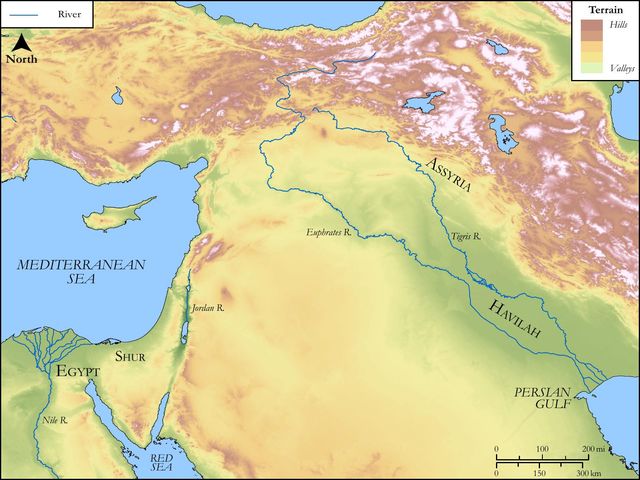
Immediately after the account of Abraham's death, Moses begins the story of Isaac (Gen 25:11), and tells us where he dwelt and how remarkably God blessed him. Note, The blessing of Abraham did not die with him, but survived to all the children of the promise. But he presently digresses from the story of Isaac, to give a short account of Ishmael, forasmuch as he also was a son of Abraham, and God had made some promises concerning him, which it was requisite we should know the accomplishment of. Observe here what is said, 1. Concerning his children. He had twelve sons, twelve princes they are called (Gen 25:16), heads of families, which in process of time became nations, distinct tribes, numerous and very considerable. They peopled a very large continent, that lay between Egypt and Assyria, called Arabia. The names of his twelve sons are recorded. Midian and Kedar we often read of in scripture. And some very good expositors have taken notice of the signification of those three names which are put together (Gen 25:14), as containing good advice to us all, Mishma, Dumah, and Massa, that is, hear, keep silence, and bear; we have them together in the same order, Jam 1:19, Be swift to hear, slow to speak, slow to wrath. The posterity of Ishmael had not only tents in the fields, wherein they grew rich in times of peace; but they had towns and castles (Gen 25:16), wherein they fortified themselves in time of war. Now the number and strength of this family were the fruit of the promise made to Hagar concerning Ishmael (Gen 16:10), and to Abraham, Gen 17:20 and Gen 21:13. Note, Many that are strangers to the covenants of promise are yet blessed with outward prosperity for the sake of their godly ancestors. Wealth and riches shall be in their house. 2. Concerning himself. Here is an account of his age: He lived 137 years (Gen 25:17) which is recorded to show the efficacy of Abraham's prayer for him (Gen 17:18), O that Ishmael might live before thee! Here is also an account of his death; he too was gathered to his people; but it is not said that he was full of days, though he lived to so great an age: he was not so weary of the world, nor so willing to leave it, as his good father was. Those words, he fell in the presence of all his brethren, whether they mean, as we take them, he died, or, as others, his lot fell, are designed to show the fulfilling of that word to Hagar (Gen 16:12), He shall dwell in the presence of all his brethren, that is, he shall flourish and be eminent among them, and shall hold his own to the last. Or he died with his friends about him, which is comfortable.
Continue studying Genesis 25:14 across the web’s major study libraries — every link below opens this exact verse, chapter, or book on the destination site.
Read & Compare
 BibleGatewayThis verse in more than 200 translations and 70 languages.
 Bible.comThe YouVersion reader — hundreds of translations, reading plans, and highlights.
 ESV.orgCrossway's official English Standard Version reader.
 NET BibleThe NET translation with 60,000+ translators' notes on every rendering decision.
 STEP BibleTyndale House's free study tool — original text, vocabulary, and scholarly resources.
 BibliaLogos Bible Software's free web reader.
 USCCBThe New American Bible (Revised Edition) with the U.S. bishops' study notes.
Commentaries
 BibleHub CommentariesDozens of classic commentaries on this verse, gathered on one page.
 StudyLightMore than 100 commentary sets — the largest collection on the web.
 BibleRefPlain-English commentary on what this verse means, verse by verse.
 Enduring WordDavid Guzik's free commentary on this chapter, widely used by Bible teachers.
 Bible Study ToolsVerse commentary alongside Greek and Hebrew study aids.
Original Language & Research
- BibleHub InterlinearThe verse word by word — original language, transliteration, and English.
- BibleHub LexiconEvery word's original-language definition and Strong's entry.
 Blue Letter BibleDeep-study tools — Strong's numbers, concordance, and word studies.
 SefariaThe Hebrew text with Rashi and centuries of Jewish commentary.
Sermons, Hymns & Audio


TrulyRandomVerse is not affiliated with these sites and doesn’t control their content. They’re linked because they’re genuinely useful.
Summary
Genesis 25:14 concisely names three of Ishmael's twelve sons—Mishma, Dumah, and Massa—as an integral part of a genealogical record. This seemingly simple list is profoundly significant, demonstrating God's meticulous faithfulness in fulfilling His promise to Abraham concerning Ishmael's numerous descendants, thereby underscoring the certainty of divine promises and the historical unfolding of nations within God's overarching redemptive plan.
Context
ShowHideLiterary Context
This verse is embedded within the enumeration of Ishmael's descendants, specifically his twelve sons, who are destined to become the progenitors of twelve princes and their respective tribes, as stated in Genesis 25:16. This detailed list serves to confirm the precise fulfillment of God's earlier promise to Abraham regarding Ishmael, that He would "make him fruitful, and will multiply him exceedingly; and he shall beget twelve princes, and I will make him a great nation" (Genesis 17:20). The preceding verses in Genesis 25 detail Ishmael's age and death, marking the conclusion of his life's narrative and setting the stage for the establishment of his lineage before the narrative shifts back to Isaac's descendants.
Historical & Cultural Context
Among the tribes of that day, genealogies were far more than mere lists of names; they were crucial for establishing identity, tribal lineage, land claims, and historical continuity. They served as legal and social documents, validating a person's or a group's place within the societal structure. The inclusion of Ishmael's sons, though not in the direct covenant line leading to the Messiah, highlights God's comprehensive oversight of all humanity and His unwavering commitment to every promise He makes. These names likely represent actual tribal groups that populated the Arabian Peninsula, illustrating the historical impact and geographical spread of Ishmael's lineage, which would later interact with Israel.
Key Themes
ShowHideThe primary theme underscored by this verse is Divine Faithfulness—God's unwavering commitment to His word, even concerning those outside the direct covenant line of promise. It also highlights the Significance of Genealogy in biblical narrative, not merely as historical record but as a theological affirmation of God's sovereign control over history and His preservation of lineages according to His plan. Furthermore, it subtly introduces the Scope of God's Plan, reminding readers that while God works through a specific chosen line for His redemptive purposes (Isaac, Jacob, Judah, David), His divine plan encompasses a vast array of peoples and nations, all of whom are ultimately within His providential oversight, as seen in the broader narrative of Genesis.
Exposition and Analysis
ShowHideKey Word Analysis
ShowHideThis name, derived from H4927, is the same as מִשְׁמָע, meaning "Mishma, the name of a son of Ishmael, and of an Israelite." While the root often relates to "hearing" or "obedience," its primary significance here is as a proper noun identifying one of Ishmael's sons, foundational to a tribal lineage.
This name is the same as דּוּמָה, meaning "Dumah, a tribe and region of Arabia." It suggests "silence" or "stillness." The name not only identifies a son but also foreshadows a specific geographical region and tribal entity that would emerge from Ishmael's descendants, later appearing in prophetic texts like Isaiah 21:11.
Derived from H4854, this name is the same as מַשָּׂא, meaning "burden" or "lifting up." It specifically refers to "Massa, a son of Ishmael." Like Dumah, Massa is also associated with a region or people in later biblical texts, sometimes linked to wisdom literature, as seen in Proverbs 30:1 and Proverbs 31:1, further attesting to the historical presence and influence of this lineage.
Verse Breakdown
ShowHide"And Mishma,"
This phrase introduces the first of three sons listed in this verse. Mishma, as a proper name, signifies an individual who became a progenitor of a distinct tribal group. Its inclusion here is a precise detail, confirming the specific descendants promised to Ishmael.
"and Dumah,"
Following Mishma, Dumah is listed, further extending the enumeration of Ishmael's progeny. The repetition of "and" creates a simple, additive structure, emphasizing the growing number of descendants. Dumah's name carries geographical significance, pointing to a future tribal region.
"and Massa,"
The final name in this verse, Massa, completes this segment of Ishmael's lineage. The cumulative effect of these names reinforces the fulfillment of God's promise for Ishmael to have numerous descendants, each contributing to the formation of distinct nations and tribes of Arabia.
Literary Devices
ShowHideThe primary literary device at play in Genesis 25:14 is Enumeration, specifically within a Genealogy. The simple listing of names serves to meticulously record the fulfillment of God's promise to Abraham regarding Ishmael's numerous descendants. This precise enumeration lends historical weight and theological certainty to the narrative. The repeated use of the conjunction "and" (polysyndeton) before each name creates a rhythmic, cumulative effect, emphasizing the steady and undeniable growth of Ishmael's lineage. Furthermore, the passage contributes to the larger Fulfillment Narrative that permeates Genesis, where divine promises, once spoken, are shown to be perfectly realized in historical events and the formation of peoples.
Theological and Thematic Connections
ShowHideThe meticulous listing of Ishmael's descendants, including Mishma, Dumah, and Massa, powerfully underscores God's unwavering faithfulness to His promises, even those outside the direct covenant line that leads to the Messiah. It demonstrates that God's word is entirely reliable, and His plans unfold with precise detail across all of humanity. This passage affirms that biblical genealogies are not mere historical records but theological statements affirming God's sovereign control over history, His preservation of lineages, and the fulfillment of His plans through specific families and nations, establishing identity and validating historical claims within His overarching redemptive narrative.
Reflection and Application
ShowHideThough a concise verse, Genesis 25:14 profoundly teaches us that every detail in God's Word matters, reflecting His meticulous care and precise oversight of history and humanity. It highlights that no person or lineage is insignificant in His grand design, even those seemingly peripheral to the main redemptive narrative. The certainty with which God fulfills His promises, even to Ishmael, should bolster our faith in His broader, more central promises, such as the promise of Christ's return or the promise of a new heaven and new earth. This verse encourages us to trust in God's unwavering character and the absolute reliability of His divine word, knowing that His faithfulness extends to every detail of our lives and His plan for all creation.
Questions for Reflection
ShowHideFAQ
ShowHideWhy is a seemingly simple list of names included in the biblical narrative?
ShowHideThe inclusion of names like Mishma, Dumah, and Massa serves several vital purposes. Firstly, it provides historical and genealogical accuracy, fulfilling God's promise to Abraham that Ishmael would become a great nation with twelve princes (Genesis 17:20). This demonstrates God's meticulous attention to detail and His faithfulness to all His covenants, even those not directly tied to the messianic line. Secondly, these names establish the origins of various tribes and peoples east of Canaan, providing crucial context for future interactions and prophecies involving these groups, such as the mention of Dumah in Isaiah 21:11 or Massa in Proverbs 30:1. Thus, these lists are not mere trivia but foundational elements of biblical history and theology.
Christ-Centered Fulfillment
ShowHideWhile Genesis 25:14 does not directly prophesy Christ, it contributes to the broader narrative of God's faithfulness and His comprehensive plan for humanity, which ultimately culminates in Christ. The demonstration of God's unwavering commitment to His promises, even to Ishmael's lineage, undergirds the greater certainty of His covenant promises to Abraham through Isaac, from whom the Messiah would come. This meticulous record of Ishmael's descendants serves as a testament to the trustworthiness of the God who orchestrates all history for His redemptive purposes, ensuring that all His promises find their "Yes" and "Amen" in Christ, as affirmed in 2 Corinthians 1:20. Christ's redemptive work, through His sacrificial death and glorious resurrection, extends salvation to all nations, including those descended from Ishmael, thereby fulfilling God's universal design to bring all peoples under His gracious dominion, as envisioned in passages like Revelation 7:9. The ultimate "seed" of Abraham, through whom all nations are blessed, is Christ Himself (Galatians 3:16), making even the seemingly peripheral genealogies part of the grand tapestry leading to Him.