


Genesis 25:15
Bible text: King James Version (1769 Blayney text) · Public domain
Bible text: Berean Standard Bible · Public domain
Bible text: American Standard Version (1901) · Public domain
Bible text: World English Bible, Messianic edition · Public domain
Bible text: Geneva Bible (1599) · Public domain
Bible text: Young's Literal Translation · Public domain
- חֲדַדcha·DadHadadH2301N-proper-mNoun Proper Masculine
- וְתֵימָאve·tei·Ma'and TemaH8485Conj-w ¦ N-proper-mNoun Proper MasculineוְandתֵימָאTema
- יְטוּרye·TurJeturH3195N-proper-mNoun Proper Masculine
- נָפִישׁna·FishNaphishH5305N-proper-mNoun Proper Masculine
- וָקֵדְמָהva·Ke·de·mahand KedemahH6929Conj-w ¦ N-proper-mNoun Proper MasculineוָandקֵדְמָהKedemah
English is a literal word-by-word gloss of the Hebrew, not the KJV's wording. Why?
This is the original text the KJV's translators worked from — each Hebrew word with its own literal English meaning in this verse, prepared by scholars at Tyndale House, Cambridge. The KJV translates whole sentences, not word by word, so its wording differs: one Hebrew word can become several English words, and the KJV may choose “the LORD” where the gloss reads “Yahweh”. Both are faithful — they answer different questions. For the KJV's own rendering, switch to the KJV text.
Details
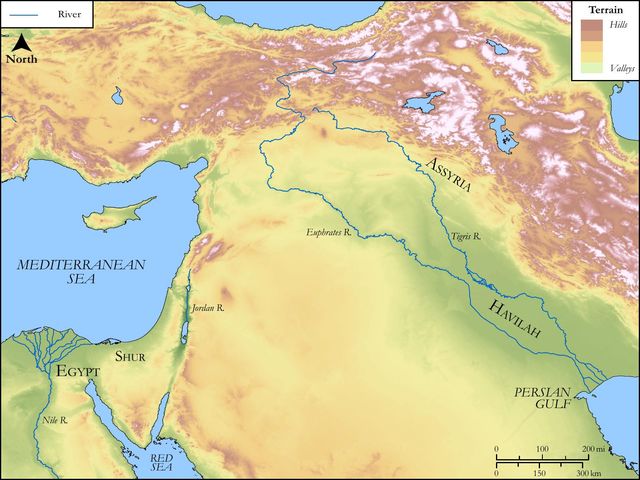
See on the biblical-era maps


Study this verse
Public-domain commentary
Matthew Henry
From his Commentary on the Whole Bible. Henry comments on passages, not single verses — this entry covers Genesis 25:11–18.
Immediately after the account of Abraham's death, Moses begins the story of Isaac (Gen 25:11), and tells us where he dwelt and how remarkably God blessed him. Note, The blessing of Abraham did not die with him, but survived to all the children of the promise. But he presently digresses from the story of Isaac, to give a short account of Ishmael, forasmuch as he also was a son of Abraham, and God had made some promises concerning him, which it was requisite we should know the accomplishment of. Observe here what is said, 1. Concerning his children. He had twelve sons, twelve princes they are called (Gen 25:16), heads of families, which in process of time became nations, distinct tribes, numerous and very considerable. They peopled a very large continent, that lay between Egypt and Assyria, called Arabia. The names of his twelve sons are recorded. Midian and Kedar we often read of in scripture. And some very good expositors have taken notice of the signification of those three names which are put together (Gen 25:14), as containing good advice to us all, Mishma, Dumah, and Massa, that is, hear, keep silence, and bear; we have them together in the same order, Jam 1:19, Be swift to hear, slow to speak, slow to wrath. The posterity of Ishmael had not only tents in the fields, wherein they grew rich in times of peace; but they had towns and castles (Gen 25:16), wherein they fortified themselves in time of war. Now the number and strength of this family were the fruit of the promise made to Hagar concerning Ishmael (Gen 16:10), and to Abraham, Gen 17:20 and Gen 21:13. Note, Many that are strangers to the covenants of promise are yet blessed with outward prosperity for the sake of their godly ancestors. Wealth and riches shall be in their house. 2. Concerning himself. Here is an account of his age: He lived 137 years (Gen 25:17) which is recorded to show the efficacy of Abraham's prayer for him (Gen 17:18), O that Ishmael might live before thee! Here is also an account of his death; he too was gathered to his people; but it is not said that he was full of days, though he lived to so great an age: he was not so weary of the world, nor so willing to leave it, as his good father was. Those words, he fell in the presence of all his brethren, whether they mean, as we take them, he died, or, as others, his lot fell, are designed to show the fulfilling of that word to Hagar (Gen 16:12), He shall dwell in the presence of all his brethren, that is, he shall flourish and be eminent among them, and shall hold his own to the last. Or he died with his friends about him, which is comfortable.
Continue studying Genesis 25:15 across the web’s major study libraries — every link below opens this exact verse, chapter, or book on the destination site.
Read & Compare
 BibleGatewayThis verse in more than 200 translations and 70 languages.
 Bible.comThe YouVersion reader — hundreds of translations, reading plans, and highlights.
 ESV.orgCrossway's official English Standard Version reader.
 NET BibleThe NET translation with 60,000+ translators' notes on every rendering decision.
 STEP BibleTyndale House's free study tool — original text, vocabulary, and scholarly resources.
 BibliaLogos Bible Software's free web reader.
 USCCBThe New American Bible (Revised Edition) with the U.S. bishops' study notes.
Commentaries
 BibleHub CommentariesDozens of classic commentaries on this verse, gathered on one page.
 StudyLightMore than 100 commentary sets — the largest collection on the web.
 BibleRefPlain-English commentary on what this verse means, verse by verse.
 Enduring WordDavid Guzik's free commentary on this chapter, widely used by Bible teachers.
 Bible Study ToolsVerse commentary alongside Greek and Hebrew study aids.
Original Language & Research
- BibleHub InterlinearThe verse word by word — original language, transliteration, and English.
- BibleHub LexiconEvery word's original-language definition and Strong's entry.
 Blue Letter BibleDeep-study tools — Strong's numbers, concordance, and word studies.
 SefariaThe Hebrew text with Rashi and centuries of Jewish commentary.
Sermons, Hymns & Audio


TrulyRandomVerse is not affiliated with these sites and doesn’t control their content. They’re linked because they’re genuinely useful.
Summary
Genesis 25:15 meticulously lists five of Ishmael's twelve sons—Hadar, Tema, Jetur, Naphish, and Kedemah—completing the enumeration of Abraham's firstborn son's lineage through Hagar. This seemingly simple genealogical entry is profoundly significant, serving as a tangible testament to God's unwavering faithfulness in fulfilling His specific promise to Abraham that Ishmael would indeed become the father of twelve princes and a great nation, even as the redemptive covenant line continued through Isaac.
Context
ShowHideLiterary Context
Genesis 25:15 is situated within the broader narrative of Genesis 25:12-18, a distinct section dedicated to the descendants of Ishmael. This segment immediately follows the account of Abraham's death and burial, providing a concluding summary of his first son's progeny before the narrative shifts entirely to the generations of Isaac and Jacob in Genesis 25:19. The inclusion of Ishmael's genealogy, mirroring the structure often used for significant patriarchal figures, underscores his importance in the broader divine plan, even though he is not the heir of the covenant promise. It functions as a fulfillment statement, demonstrating God's meticulous attention to all His declarations.
Historical & Cultural Context
In the line of Abraham, genealogies were far more than mere lists of names; they served as crucial documents establishing identity, lineage, inheritance rights, and tribal affiliations. For nomadic and semi-nomadic peoples like the early Ishmaelites, these lists provided a framework for understanding their origins, territorial claims, and relationships with neighboring groups. The concept of "twelve princes" (Hebrew: nesi'im) signifies the formation of distinct, organized tribal entities, each with its own leadership and sphere of influence. Historically, many of these Ishmaelite tribes, such as Tema and Jetur, are identifiable with later historical groups that inhabited the Arabian Peninsula, the Sinai, and parts of the Levant, interacting significantly with the nascent Israelite nation, as seen in passages like 1 Chronicles 5:19.
Key Themes
ShowHideThis verse, as part of Ishmael's genealogy, contributes to several overarching themes in Genesis. Foremost is the theme of Divine Faithfulness, demonstrating God's unwavering commitment to His word, even to promises made outside the primary covenant line, such as His declaration concerning Ishmael in Genesis 17:20. It also highlights the Fulfillment of Prophecy, as the enumeration of twelve sons directly corresponds to God's promise of twelve princes. Furthermore, it subtly introduces the theme of God's Universal Providence, showing that while His redemptive plan is focused on a specific lineage, His care and blessing extend to all peoples and nations, acknowledging the diverse origins of humanity within His creation.
Exposition and Analysis
ShowHideGenesis 25:15 concludes the enumeration of Ishmael's twelve sons, specifically naming Hadar, Tema, Jetur, Naphish, and Kedemah. These names, along with the seven preceding them in Genesis 25:13-14, represent the progenitors of distinct tribal groups that would settle across the Arabian Peninsula, the Sinai, and parts of the Levant.
Key Word Analysis
ShowHideThis name is described as "probably of foreign derivation" and refers to "a son of Ishmael, and the region settled by him." This connection to a specific geographical region (modern Tayma in northern Arabia, a significant oasis city and trade route stop) underscores the historical reality and influence of Ishmael's descendants, indicating their establishment as identifiable peoples with settled territories.
Meaning "encircled (i.e. inclosed)," this name is often associated with the Ituraeans, a people known for their martial prowess, who inhabited the region of Iturea (modern Golan Heights and parts of Syria and Lebanon) during the Hellenistic and Roman periods. The meaning "encircled" could allude to their fortified settlements or their tribal boundaries.
Derived from a root meaning "precedence," this name suggests "eastern" or "ancient." It likely indicates a tribe that settled to the east of the primary Israelite territories or one with a venerable, perhaps "ancient," origin. This name, like the others, points to the establishment of distinct tribal identities and geographical dispersion.
Verse Breakdown
ShowHide"Hadar,"
The first name listed in this verse, Hadar (or Chadar), is one of the less historically identifiable Ishmaelite tribes, though some traditions link them to regions in the Arabian desert. Its inclusion completes the count of Ishmael's sons.
"and Tema,"
This name is strongly associated with the ancient oasis city of Tema (modern Tayma) in northern Arabia, a crucial hub on ancient trade routes. This connection highlights the historical and geographical reality of Ishmael's descendants, who established significant settlements and played a role in regional commerce and politics.
"Jetur,"
The descendants of Jetur are widely identified with the Ituraeans, a prominent people in the Hellenistic and Roman periods, known for their military strength and inhabiting areas northeast of Israel. Their mention here provides an ancestral link to a historically recognized group.
"Naphish,"
The Naphishites are mentioned elsewhere in the Old Testament, specifically in 1 Chronicles 5:19, where they are depicted in conflict with Israelite tribes. This direct biblical reference outside of Genesis further solidifies the historical reality of these Ishmaelite descendants.
"and Kedemah:"
The final son listed in this verse, Kedemah, whose name means "eastern" or "ancient," suggests a tribe that settled to the east of the promised land or had deep historical roots. Its placement concludes the list of Ishmael's twelve sons, fulfilling the divine promise.
Literary Devices
ShowHideThe primary literary device employed in Genesis 25:15, and indeed the broader passage, is Enumeration within a Genealogy. This meticulous listing of names serves not only to record lineage but also to emphasize the Fulfillment Narrative. The precise number of twelve sons directly corresponds to God's promise to Abraham that Ishmael would father "twelve princes," transforming a divine declaration into a historical reality. The very act of naming each son, even those who might seem peripheral to the main covenant line, highlights God's comprehensive knowledge and sovereign oversight over all peoples. Furthermore, the names themselves carry subtle Symbolism, often reflecting the character, location, or destiny of the tribes they represent, such as Tema's association with a prominent city or Kedemah's "eastern" orientation.
Theological and Thematic Connections
ShowHideGenesis 25:15, while a simple list of names, carries profound theological weight. It stands as a powerful testament to God's unwavering commitment to His promises, demonstrating that even declarations made outside the direct covenant line leading to Israel were meticulously brought to pass. This meticulous fulfillment underscores the reliability of God's word and His sovereign control over history, shaping the destinies of nations according to His divine declarations. It reminds us that God's plan is vast, encompassing not only the chosen people but also the broader tapestry of humanity, each lineage playing a role in the unfolding of His global purposes.
Reflection and Application
ShowHideThe meticulous recording of Ishmael's descendants in Genesis 25:15 offers profound lessons for contemporary believers. Just as God faithfully fulfilled His specific promises to Ishmael, even outside the direct covenant line, we can confidently trust that His promises to us—especially those concerning salvation, redemption, and future hope in Christ—are absolutely sure and will be brought to fruition. This passage also encourages us to recognize the breadth of God's providential care, which extends to all peoples and nations, fostering a perspective that values diversity and acknowledges the common human lineage under God's creative hand. It reminds us that every life, regardless of its perceived centrality to the grand narrative, is seen, known, and accounted for by God, emphasizing His comprehensive love and sovereign oversight. Our faith is grounded in a God who keeps His word, even in the details.
Questions for Reflection
ShowHideFAQ
ShowHideWhy is a genealogy of Ishmael's sons included in the biblical narrative, which primarily focuses on the line of Isaac?
ShowHideThe inclusion of Ishmael's genealogy, including the names in Genesis 25:15, serves several crucial purposes. Primarily, it demonstrates God's unwavering faithfulness in fulfilling His specific promise to Abraham concerning Ishmael in Genesis 17:20, where God declared that Ishmael would become the father of twelve princes and a great nation. This section thus acts as a divine "report card," confirming that God's word is always true. It also provides essential historical context for the origins of various peoples of Arabia and the lands round about, many of whom would interact with the Israelites, sometimes as adversaries (e.g., 1 Chronicles 5:19) and sometimes as trading partners. Furthermore, it highlights the breadth of God's plan, which, while focused on the covenant through Isaac, still encompasses and blesses other nations, showing His universal sovereignty.
Does the mention of "princes" for Ishmael's sons imply they were of equal status or importance to the Israelite tribes?
ShowHideThe term "princes" (Hebrew: nesi'im) indicates that Ishmael's sons founded significant tribal groups or nations, each with its own leadership and territory, fulfilling God's promise of their prominence and distinct identity. While they were indeed significant and powerful in their own right, their role was distinct from the covenant line that led to the nation of Israel and, ultimately, to Christ. The biblical narrative clearly distinguishes between the unique covenant blessings and redemptive purposes passed through Isaac and the general blessings and national formations extended to Ishmael. The "twelve princes" of Ishmael parallel the "twelve tribes" of Israel, indicating a similar structure of tribal organization and significance, but not an equivalent spiritual or covenantal status within salvation history.
What is the significance of the specific names listed in Genesis 25:15?
ShowHideThe names listed in Genesis 25:15 (Hadar, Tema, Jetur, Naphish, and Kedemah), like the other sons of Ishmael, are significant because they represent the progenitors of distinct tribal groups that became identifiable nations or peoples east and south of Canaan. Some of these names, such as Tema, are strongly associated with known historical cities or regions (modern Tayma in northern Arabia), while others, like Jetur, are linked to historical peoples (the Ituraeans) who interacted with Israel. Naphish is explicitly mentioned in 1 Chronicles 5:19 as a tribe that fought against the Israelites. Their mention underscores the historical reality of these descendants and the precise fulfillment of God's promise to Ishmael, providing tangible evidence of the biblical narrative's historical grounding and God's faithfulness to His word.
Christ-Centered Fulfillment
ShowHideWhile Genesis 25:15 details the genealogy of Ishmael's sons, a lineage distinct from the direct messianic line, it indirectly points to Christ by demonstrating the overarching faithfulness of God to all His promises. God's meticulous fulfillment of His word concerning Ishmael, even outside the primary covenant line, serves as a powerful foreshadowing of His ultimate and perfect faithfulness in bringing forth the Messiah through the line of Isaac, Judah, and David. This passage reminds us that the God who keeps His word to Ishmael is the same God who sent His Son, Jesus Christ, to fulfill the greater promise made to Abraham that "all the families of the earth shall be blessed" through his Seed (Genesis 12:3). Christ's redemptive work extends beyond any single lineage or nation, ultimately encompassing all peoples—including the spiritual descendants of Ishmael and every other nation—who come to Him by faith, breaking down the dividing wall of hostility and creating one new humanity in Himself (Ephesians 2:14-16). Thus, even in a seemingly peripheral genealogy, we glimpse the steadfast character of the God whose plan of salvation is universally expansive, drawing people "from every nation, tribe, people and language" into His eternal kingdom (Revelation 7:9).