


Isaiah 42:11
Bible text: King James Version (1769 Blayney text) · Public domain
Bible text: King James Version with Strong's numbers · Public domain
Bible text: Berean Standard Bible · Public domain
Bible text: American Standard Version (1901) · Public domain
Bible text: World English Bible, Messianic edition · Public domain
Bible text: Geneva Bible (1599) · Public domain
Bible text: Young's Literal Translation · Public domain
- יִשְׂאוּyis·'Ulet them lift upH5375V-Qal-Imperf-3mpVerb Qal Imperfect 3rd Plural Masculine
- מִדְבָּרmid·Bar[the] wildernessH4057N-msNoun Singular Masculine Absolute
- וְעָרָיוve·'a·Ravand its citiesH5892Conj-w ¦ N-mpc ¦ 3msNoun Plural Masculine Constructוְandעָרָיcitiesוits
- חֲצֵרִיםcha·tze·Rim[the] villagesH2691N-mpNoun Plural Masculine Absolute
- תֵּשֵׁבte·Shev[where] it dwellsH3427V-Qal-Imperf-3fsVerb Qal Imperfect 3rd Singular Feminine
- קֵדָרke·DarKedarH6938N-proper-mNoun Proper Masculine
- יָרֹנּוּya·Ro·nulet them shout for joyH7442V-Qal-Imperf-3mpVerb Qal Imperfect 3rd Plural Masculine
- יֹשְׁבֵיYo·she·vei[the] inhabitants ofH3427V-Qal-Prtcpl-mpVerb Qal Participle Plural Masculine Construct
- סֶלַעSe·la'SelaH5554N-msNoun Singular Masculine Absolute
- מֵרֹאשׁme·Roshfrom [the] top ofH7218Prep-m ¦ N-mscNoun Singular Masculine Constructמֵfromרֹאשׁ[the] top of
- הָרִיםha·Rim[the] mountainsH2022N-mpNoun Plural Masculine Absolute
- יִצְוָחוּyitz·Va·chulet them cry aloudH6681V-Qal-Imperf-3mpVerb Qal Imperfect 3rd Plural Masculine
English is a literal word-by-word gloss of the Hebrew, not the KJV's wording. Why?
This is the original text the KJV's translators worked from — each Hebrew word with its own literal English meaning in this verse, prepared by scholars at Tyndale House, Cambridge. The KJV translates whole sentences, not word by word, so its wording differs: one Hebrew word can become several English words, and the KJV may choose “the LORD” where the gloss reads “Yahweh”. Both are faithful — they answer different questions. For the KJV's own rendering, switch to the KJV text.
Details
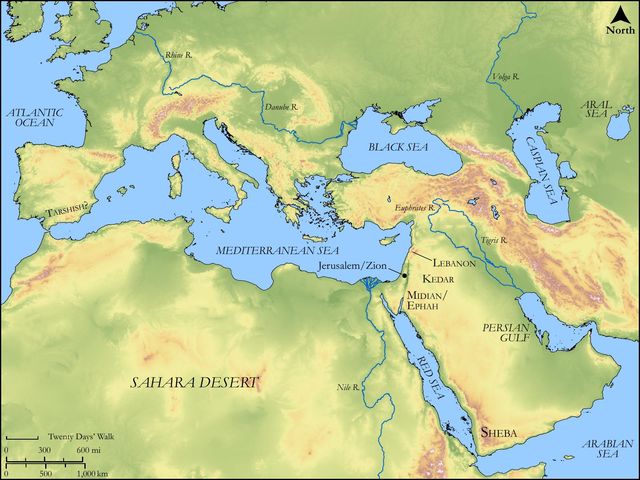
See on the biblical-era map
Study this verse
Public-domain commentary
Matthew Henry
From his Commentary on the Whole Bible. Henry comments on passages, not single verses — this entry covers Isaiah 42:5–12. His three-level outline is real structure in the source text, so it is rendered as structure.
Here is I. The covenant God made with and the commission he gave to the Messiah, Isa 42:5-7, which are an exposition of Isa 42:1, Behold my servant, whom I uphold.
1.The royal titles by which the great God here makes himself known, and distinguishes himself from all pretenders, speak very much his glory (Isa 42:5): Thus saith God the Lord. And who are thou, Lord? Why, he is the fountain of all being and therefore the fountain of all power. He is the fountain of being, 1. In the upper world; for he created the heavens and stretched them out (Isa 40:22), and keeps the vast expanse still upon the stretch. 2. In the lower world: for he spread forth the earth, and made it a capacious habitation, and that which comes out of it is produced by his power. 3. In the world of mankind: He gives breath to the people upon it, not only air to breathe in, but the breath of life itself and organs to breathe with; nay, he gives spirit, the powers and faculties of a rational soul, to those that walk therein. Now this is prefixed to God's covenant with the Messiah, and the commission given him, not only to show that he has authority to make such a covenant and give such a commission, and had power sufficient to bear him out, but that the design of the work of redemption was to maintain the honour of the Creator, and to restore man to the allegiance he owes to God as his Maker.
2.The assurances which he gives to the Messiah of his presence with him in all he did pursuant to his undertaking speak much encouragement to him, Isa 42:6.
(1.)God owns that the Messiah did not take the honour of being Mediator to himself, but was called of God, that he was no intruder, no usurper, but was fairly brought to it (Heb 5:4): I have called thee in righteousness. God not only did him no wrong in calling him to this hard service, he having voluntarily offered himself to it, but did himself right in providing for his own honour and performing the word which he had spoken.
(2.)He promises to stand by him and strengthen him in it, to hold his hand, not only to his work, but in it, to hold his hand, that it might not shake, that it might not fail, and so to keep him. When an angel was sent from heaven to strengthen him in his agonies, and the Father himself was with him, then this promise was fulfilled. Note, Those whom God calls he will own and help, and will hold their hands.
3.The great intentions of this commission speak abundance of comfort to the children of men. He was given for a covenant of the people, for a mediator, or guarantee, of the covenant of grace, which is all summed up in him. God, in giving us Christ, has with him freely given us all the blessings of the new covenant. Two glorious blessings Christ, in his gospel, brings with him to the Gentile world - light and liberty.
(1.)He is given for a light to the Gentiles, not only to reveal to them what they were concerned to know, and which otherwise they could not have known, but to open the blind eyes, that they might know it. By his Spirit in the word he presents the object; by his Spirit in the heart he prepared the organ. When the gospel came light came, a great light, to those that sat in darkness, Mat 4:16; Joh 3:19. And St. Paul was sent to the Gentiles to open their eyes, Act 26:18. Christ is the light of the world.
(2.)He is sent to proclaim liberty to the captives, as Cyrus did, to bring out the prisoners; not only to open the prison-doors, and give them leave to go out, which was all that Cyrus could do, but to bring them out, to induce and enable them to make use of their liberty, which none did but those whose spirits God stirred up. This Christ does by his grace.
II.The ratification and confirmation of this grant. That we may be assured of the validity of it consider,
1.The authority of him that makes the promise (Isa 42:8): I am the Lord, Jehovah, that is my name, and that was the name by which he made himself known when he began to perform the promise made to the patriarchs; whereas, before, he manifested himself by the name of God Almighty, Exo 6:3. If he is the Lord that gives being and birth to all things, he will give being and birth to this promise. If his name be Jehovah, which speaks him God alone, we may be sure his name is jealous, and he will not give his glory to another, whoever it is that stands in competition with him, especially not to graven images. He will send the Messiah to open men's eyes, that so he may turn them from the service of dumb idols to serve the living God, because, though he has long winked at the times of ignorance, he will now maintain his prerogative, and will not give his glory to graven images. He will perform his word because he will not lose the honour of being true to it, nor be ever charged with falsehood by the worshippers of false gods. He will deliver his people from under the power of idolaters because it looks as if he had given his praise to graven images when he gives up his own worshippers to be worshippers of images.
2.The accomplishment of the promises he had formerly made concerning his church, which are proofs of the truth of his word and the kindness he bears to his people (Isa 42:9): "Behold, the former things have come to pass; hitherto the Lord has helped his church, has supported her under former burdens, relieved her in former staits; and this in performance of the promises made to the fathers. There has not failed one word, Kg1 8:56. And now new things do I declare. Now I will make new promises, which shall as certainly be fulfilled in their season as old ones were; now I will bestow new favours, such as have not been conferred formerly. Old Testament blessings you have had abundantly; now I declare New Testament blessings, not a fruitful country and dominion over your neighbours, but spiritual blessings in heavenly things. Before they spring forth in the preaching of the gospel I tell you of them, under the type and figure of the former things." Note, The receipt of former mercies may encourage us to hope for further mercies; for God is constant in his care for his people, and his compassions are still new.
III.The song of joy and praise which should be sung hereupon to the glory of God (Isa 42:10):
Sing unto the Lord a new song, a New Testament song. The giving of Christ for a light to the Gentiles (Isa 42:6) was a new thing, and very surprising. The apostle speaks of it as a mystery which, in other ages, was not made known, as it is now revealed, that the Gentiles should be fellow-heirs, Eph 3:5, Eph 3:6. Now, this being the new thing which God declares, the newness of the song which is to be sung on this occasion is this, that whereas, before, the songs of the Lord were very much confined to the temple at Jerusalem (David's psalms were in the language of the Jews only, and sung by them in their own country only; for, when they were in a strange land, they hung their harps on the willow-trees and could not sing the Lord's song, as we find, Psa 137:2-4), now the songs of holy joy and praise shall be sung all the world over. The Gentile nations shall share equally with the Jews in New Testament blessings, and therefore shall join in New Testament praises and acts of worship. There shall be churches set up in Gentile nations and they shall sing a new song. The conversion of the Gentiles is often foretold under this notion, as appears, Rom 15:9-11. It is here promised that the praises of God's grace shall be sung with joy and thankfulness,
1.By those that live in the end of the earth, in countries that lie most remote from Jerusalem. From the uttermost parts of the earth have we heard songs, Isa 24:16. This was fulfilled when Christianity was planted in our land.
2.By mariners and merchants, and those that go down to the sea, that do business in great waters, and suck the riches of the sea, and so make themselves masters of the fulness thereof and all that is therein, with which they shall praise God, and justly, for it is his, Psa 24:1; Psa 95:5. The Jews traded little at sea; if therefore God's praises be sung by those that go down to the sea, it must be by Gentiles. Sea-faring men are called upon to praise God, Psa 107:23.
3.By the islands and the inhabitants thereof, Isa 42:10, and again, Isa 42:12. Let them declare his praise in the islands, the isles of the Gentiles, probably referring to the islands of Greece.
4.By the wilderness and the cities thereof, and the villages of Kedar. These lay east from Jerusalem, as the islands lay west, so that the gospel songs should be sung from the rising of the sun to the going down of the same. The whole Gentile world had been like an island, cut off from communication with God's church, and like a wilderness, uncultivated and bringing forth no fruit to God; but now the islands and the wilderness shall praise God.
5.By the inhabitants of the rock, and those that dwell on the tops of the mountains, not only the Gentiles, but the poorest and meanest and most despicable, those that dwell in cottages, as well as those that inhabit cities and villages. The rude and most barbarous, as the mountaineers commonly are, shall be civilized by the gospel. Or by the inhabitants of the rock may be meant the inhabitants of that part of Arabia which is called Petraea - the rocky. Perhaps the neighbouring countries shared in the joy of the Israelites when they returned out of Babylon and some of them came and joined with them in their praises; but we find not that it was to any such degree as might fully answer this illustrious prophecy, and must conclude that it reaches further, and was fulfilled in that which many other prophecies of the joy of the nations are said in the New Testament to be fulfilled in, the conversion of the Gentiles to the faith of Christ. When they are brought into the church they are brought to give glory to the Lord; then they are to him for a name and a praise, and they make it their business to praise him. He is glorified in them and by them.
Historical interpretation
Historical reception
1 surviving comment on this verse from the historical church.
(Verse 10, 11 and following) Sing to God a new song: his praise from the ends of the earth: you who descend into the sea, and its fullness; islands and their inhabitants. Let the desert and its cities lift up: in the houses shall Cedar dwell, praise you inhabitants of Petra, they shall shout from the top of the mountains. They shall give glory to the Lord, and his praise in the islands they shall declare. The Lord shall go forth as a mighty man, as a warrior he shall stir up zeal: he shall shout and cry out: he shall strengthen himself against his enemies. I have always kept silent, I have been quiet, I have been patient: like a woman in labor, I will speak. I will scatter and devour together. I will make mountains and hills desolate, and I will dry up all their vegetation, and I will turn rivers into islands, and I will dry up ponds. And I will lead the blind on a path they do not know, and I will make them walk on paths they have not known. I will turn darkness into light in front of them, and I will make crooked paths straight. These are the things I will do for them, and I will not abandon them. They have turned back: let them be confounded with confusion, that trust in idols, that say to molten things: You are our gods. Sing ye to the Lord a new canticle: his praise is in the church of the saints. Let Israel rejoice in him that made him: and let the children of Sion be joyful in their king. Let them praise his name in choir: let them sing to him with the timbrel and the psaltery. For the Lord is well pleased with his people: and he will exalt the meek unto salvation. The saints shall rejoice in glory: they shall be joyful in their beds. The high praises of God shall be in their mouth: and two-edged swords in their hands. To execute vengeance upon the nations, chastisements among the people. To bind their kings with fetters, and their nobles with manacles of iron. To execute upon them the judgment that is written: this glory is to all his saints. Alleluia. They will give glory to God, his virtues will be proclaimed in the islands. The Lord God of hosts will go forth and crush the battle, he will stir up zeal, and he will cry out against his enemies with strength. Have I been silent from the beginning, will I always be silent and endure? As one in labor, I have acted with patience; I will burst forth and dry up together, I will lay waste the mountains and hills, and I will dry up all their grass. And I will turn rivers into islands, and I will dry up marshes. And I will lead the blind along a way they do not know, and I will make their paths uneven; I will turn darkness into light for them, and crooked things into straight paths. I will speak these words to them, and I will not abandon them, but they have turned backward; you will be confused with confusion, you who trust in idols, who say that they are gods. He who had said: what was first, behold, it has come; I also announce new things: before they arise, I will make them heard to you; and he had promised that he would say what they did not know: what are those new things, he states in the following discourse, commanding the Apostles and the Apostolic men to sing a new song, not in the antiquity of the letter; but in the novelty of the spirit. Not only in the old Instrument, but also in the new; and His praise reaches to the ends of the earth. For He has come forth from the highest heaven and His circuit is to the highest point of it (Psalm XIX). The sound of the Apostles has gone out into all the earth, and their words to the ends of the world. Or according to the Septuagint: Glorify His name in the ends of the earth, that the name of Christ may be announced to the nations in the whole world. But who are those who should sing a new song, the following words declare: You who go down to the sea and sail upon it, or the fullness of the sea. For seeing the apostles, Jesus by the sea of Galilee, mending their nets, called and sent them into the great sea (Luke 5); to make fishermen of fish, who preached the Gospel from Jerusalem to Illyria and Spain: taking the power of the Roman city itself in a short time. Or certainly they descended into the sea and sailed it; enduring the storms and persecutions of this age. Also the islands and their inhabitants, whether understanding the diversity of nations or the multitude of churches. Let the desert and its cities raise their voices, as we mentioned earlier. Whether the desert and its villages rejoice, and Cedar, which was once an uninhabitable region beyond Arabia of the Saracens. And the inhabitants of Petra, which is also a city of Palestine. But this signifies that the deserted people of the nations, previously bound by the ignorance of God and the errors of idolatry, should be converted to the praises of the Lord. Whether because Cedar is interpreted as darkness, and according to the Apostle (I Cor. X) Christ is the rock, it is commanded to all believers, that those who were previously in darkness, and now believe in the Lord Savior, shout from the top of the mountains, and openly proclaim Christ, to whom it is also said above (Ad cap. XL, 9): Ascend to the high mountain, you who proclaim the good news to Zion. Lift up your voice with strength, you who proclaim good news to Jerusalem. And I will set his glory among the islands, of which we have spoken before. And the prophetic discourse describes the glorious advent of the Savior, about which even the Apostle Paul speaks: According to the illumination of the glory of the great God and our Savior Jesus Christ (2 Corinthians 4; 2 Timothy 1:10); and he compares him to a mighty man who will fight against his adversaries, arousing zeal. Of whom it is also prophesied in the Song of Deuteronomy: They have made me jealous with what is not a god; they have provoked me with their idols. So I will make them jealous with those who are not a nation; I will provoke them with a foolish nation (Deuteronomy 32:21). He will also shout and cry out against his enemies, openly condemning their faithlessness, and with loud voice proclaiming: I have been silent, I have always kept silent, I have been patient, or as the Septuagint translated: I have been silent, will I always be silent? (Ecclesiastes 3:7) That which is said through Solomon may be fulfilled: A time to keep silent, and a time to speak. And the meaning is: I have often borne with you as you have transgressed for a long time; but because I remained silent before, I will by no means keep silent any longer. And just as a woman giving birth brings forth a child into the light and makes what was previously hidden in the depths of her womb open and visible, so too I will reveal my pain and the deceit that I have always harbored regarding your crimes, and I will expose your plans. And at once I will devour the entire nation and all the pride of your mountains and the swelling of your hills. And the grass, of which it was said: Truly the grass is the people, that is, both the leaders and the common people, I will reduce to a desert. What is added in the edition of Theodotion of the Septuagint, who had omitted these words (See above, Chapter IV, 7). And when I have dried you up from head to toe and wiped you out, then I will make the rivers of my teaching flow in the islands of the nations, and I will turn your lakes or marshes into dry land, so that there may be knowledge of the Scriptures among the nations and dryness of teaching among you. And I will lead the blind along a path they did not know, of whom we have also read above: I have made you a covenant of the people, a light of the nations, to open the eyes of the blind. They will be led along the way by which Christ speaks. I am the way, that is, the way of the knowledge of God, and I will make them walk on the prophetical paths. Then their darkness will be changed into light, and their faults will be turned into righteousness, so that they may understand what they read and with the eyes of their hearts may gaze upon the clear light of Christ in the Old Testament. At the same time, he adds: These words that I have spoken or will speak to them do not promise anything further in the future, but fulfill what I promised before. But when this was said, the Jewish people turned backward so as not to believe the promise, and in their errors they were confused and neglected the pledge of God, whom they had believed in before idols. Or when the fullness of the Gentiles has come in, then also the people of Israel will be converted (Rom. II), and they will repent of their error, by which they had served idols before. Or certainly after the calling of the Gentiles, they will return to the beginning: so that it may be said, all the Gentiles who did not want to believe in the Gospel will be confounded in their idols.
Continue studying Isaiah 42:11 across the web’s major study libraries — every link below opens this exact verse, chapter, or book on the destination site.
Read & Compare
 BibleGatewayThis verse in more than 200 translations and 70 languages.
 Bible.comThe YouVersion reader — hundreds of translations, reading plans, and highlights.
 ESV.orgCrossway's official English Standard Version reader.
 NET BibleThe NET translation with 60,000+ translators' notes on every rendering decision.
 STEP BibleTyndale House's free study tool — original text, vocabulary, and scholarly resources.
 BibliaLogos Bible Software's free web reader.
 USCCBThe New American Bible (Revised Edition) with the U.S. bishops' study notes.
Commentaries
 BibleHub CommentariesDozens of classic commentaries on this verse, gathered on one page.
 StudyLightMore than 100 commentary sets — the largest collection on the web.
 BibleRefPlain-English commentary on what this verse means, verse by verse.
 Enduring WordDavid Guzik's free commentary on this chapter, widely used by Bible teachers.
 Bible Study ToolsVerse commentary alongside Greek and Hebrew study aids.
Original Language & Research
- BibleHub InterlinearThe verse word by word — original language, transliteration, and English.
- BibleHub LexiconEvery word's original-language definition and Strong's entry.
 Blue Letter BibleDeep-study tools — Strong's numbers, concordance, and word studies.
 SefariaThe Hebrew text with Rashi and centuries of Jewish commentary.
Sermons, Hymns & Audio


TrulyRandomVerse is not affiliated with these sites and doesn’t control their content. They’re linked because they’re genuinely useful.
Summary
Isaiah 42:11 serves as a vibrant poetic expansion of the universal call to praise initiated in the preceding verse, dramatically extending the invitation to adoration to the most unexpected and remote corners of the earth. It envisions a global chorus of worship for the Lord, specifically highlighting those dwelling in desolate regions, nomadic encampments, and fortified mountainous areas, thereby underscoring the boundless reach of God's redemptive plan and the far-reaching impact of His Servant's work. This verse powerfully declares that no place or people group is beyond the scope of divine salvation and the subsequent outpouring of spontaneous, joyful praise.
Context
ShowHideLiterary Context
This verse is an integral part of the first of Isaiah's four "Servant Songs" (specifically, Isaiah 42:1-9), which introduces the Lord's chosen Servant. This Servant is depicted as one endowed with the Spirit, whose mission is to bring justice and light not only to Israel but also to the nations, the Gentiles. Following the Servant's commission and the declaration of God's unique glory (as seen in Isaiah 42:8), Isaiah 42:10 issues a grand command to "sing unto the Lord a new song, and his praise from the end of the earth." Verse 11 then concretizes this global call to worship, identifying specific, geographically and culturally diverse groups who will participate in this unprecedented chorus of praise. It functions as a powerful crescendo, emphasizing the comprehensive scope and universal impact of God's redemptive work through His Servant.
Historical & Cultural Context
The mention of "Kedar" is particularly significant. Kedar (H6938) refers to a prominent nomadic Arab tribe, descendants of Ishmael (Genesis 25:13), known for their black tents and dwelling in the Arabian desert. They were often associated with trade and warfare, representing peoples outside the traditional covenant community of Israel. Their inclusion signifies that God's redemptive plan extends beyond the settled nations to the nomadic, often independent, peoples of the desert. The "inhabitants of the rock" (H5553) likely refers to those dwelling in rugged, fortified mountainous regions, such as Edom (Petra) or other mountain strongholds. These groups, often perceived as isolated or hostile, are also summoned to praise, reinforcing the universal and inclusive nature of God's sovereignty and salvation, reaching even the most geographically and culturally distinct communities.
Key Themes
ShowHideThe primary theme resonating throughout Isaiah 42 and powerfully encapsulated in verse 11 is Universal Praise and Universal reach. The prophecy boldly declares that God's salvation and glory are not exclusive to Israel but are destined to encompass all peoples, even those in remote or seemingly inhospitable regions. This underscores the profound truth that God desires praise from every nation, tribe, people, and language, a vision that culminates in the New Testament's portrayal of the redeemed multitude before the throne (Revelation 7:9-10). Another key theme is God's Global Sovereignty, as the command for the "wilderness" and "mountains" to participate in worship illustrates God's ultimate authority over all creation and all humanity, emphasizing that His dominion knows no bounds. Finally, the verse speaks to the Transformative Impact of the Servant's Work, anticipating a future where the knowledge of the Lord's glory will cover the earth, prompting spontaneous and joyous celebration as a direct result of the Servant's mission to bring justice and salvation to the ends of the earth (Isaiah 49:6).
Exposition and Analysis
ShowHideKey Word Analysis
ShowHideMeaning a pasture (i.e. open field, whither cattle are driven); by implication, a desert. In this context, it refers to desolate, uncultivated, and often uninhabited regions. Its inclusion in the call to praise is striking, as it represents places typically devoid of human settlement and, by extension, human worship. The "cities thereof" suggests that even the sparse settlements within these wild regions are to participate.
Referring to a son of Ishmael; also (collectively) Bedouin (as his descendants or representatives). This term specifically names a non-Israelite, often independent, and geographically distant nomadic people group. Their mention signifies the truly global and inclusive nature of the divine call to worship, extending God's redemptive reach beyond the traditional covenant community.
A primitive root; properly, to creak (or emit a stridulous sound), i.e. to shout (usually for joy); to be joyful (greatly, make to) rejoice, (cause to) shout (for joy), (cause to) sing (aloud, for joy, out), triumph. This verb conveys an unbridled, exuberant, and joyful expression of worship, indicating a spontaneous and heartfelt response to God's redemptive work.
Verse Breakdown
ShowHide"Let the wilderness and the cities thereof lift up [their voice]"
This clause personifies the desolate and sparsely populated regions, commanding them to join the chorus of praise. The "cities thereof" indicates that even the scattered settlements within these wild areas are included, emphasizing the comprehensive nature of the call. "Lift up [their voice]" signifies a loud, public, and uninhibited declaration of praise, as if the very landscape and its sparse inhabitants are joining in adoration.
"the villages [that] Kedar doth inhabit"
This specifies a particular nomadic people group, the Kedarites, known for dwelling in tents and villages in the Arabian desert. Their inclusion explicitly extends the call to those outside the traditional Israelite sphere, highlighting God's desire for all peoples, regardless of their cultural or geographical distinctiveness, to worship Him.
"let the inhabitants of the rock sing"
This phrase likely refers to people dwelling in craggy, fortified mountainous regions, perhaps like Edom (Petra) or other rugged areas. The command to "sing" reiterates the joyful and vocal nature of the worship expected from these geographically isolated or seemingly inaccessible peoples, who might typically be perceived as resistant or unreachable.
"let them shout from the top of the mountains"
This final clause intensifies the call to praise, commanding these inhabitants to "shout" from the highest points of the mountains. The image of shouting from mountaintops signifies an uncontainable, far-reaching, and public declaration of God's glory, visible and audible to all. It conveys an overwhelming and unrestrained outpouring of praise that cannot be contained by human-made boundaries or geographical barriers.
Literary Devices
ShowHideIsaiah 42:11 is rich in Personification, where the "wilderness" and its "cities" are given the human capacity to "lift up their voice," as if the very landscape is joining the chorus of praise. This device vividly portrays the comprehensive nature of God's sovereignty, extending even to the inanimate world. Hyperbole is also evident in the expansive scope of the command, suggesting an almost unimaginable, all-encompassing worship that transcends geographical and cultural boundaries. The verse employs powerful Imagery, painting a picture of remote deserts, nomadic encampments, and rugged mountain peaks erupting in joyous song and shouts. This vivid imagery underscores the universality of God's redemptive plan and the profound impact of the Servant's mission. Furthermore, the Parallelism between "sing" and "shout," and between "wilderness" and "Kedar," reinforces the central message of widespread, enthusiastic praise from diverse and unexpected sources, creating a rhythmic and emphatic call to worship.
Theological and Thematic Connections
ShowHideIsaiah 42:11 stands as a profound theological statement on the expansive nature of God's redemptive plan, revealing His heart for all humanity, not just Israel. It anticipates a future where the knowledge of the Lord's glory will not be confined to a single nation but will extend to the "ends of the earth," prompting a spontaneous and joyous response from every corner. This vision of universal praise is a direct consequence of the Servant's mission to bring justice and light to the Gentiles, demonstrating that God's covenant promises ultimately encompass all peoples. The inclusion of the "wilderness," "Kedar," and "inhabitants of the rock" highlights God's sovereign authority over all creation and His desire to reconcile even the most estranged or isolated communities to Himself, inviting them into a relationship of worship and adoration. This prophetic declaration lays the groundwork for the New Testament's emphasis on the Great Commission and the global reach of the Gospel, affirming that God's salvation is for all who will receive it, regardless of their background or location.
Reflection and Application
ShowHideIsaiah 42:11 calls us to expand our vision of God's kingdom beyond our immediate communities and cultural comfort zones. It challenges us to embrace a global perspective on God's redemptive work, recognizing that His desire is for every people group, from the most populated cities to the most remote wildernesses, to come to know Him and offer Him praise. This verse should ignite within us a passion for missions and evangelism, compelling us to participate in God's grand plan to gather worshippers from every nation. It also reminds us that true worship is not confined to sacred spaces or formal liturgies but can erupt spontaneously and joyfully from any heart touched by God's grace, even from those we might consider "unlikely" or "outsiders." Embracing this universal reach means actively seeking to welcome and integrate people from all backgrounds into the body of Christ, celebrating the diverse expressions of worship that reflect the multifaceted glory of God and contribute to the magnificent global chorus.
Questions for Reflection
ShowHideFAQ
ShowHideWhy does Isaiah specifically mention "Kedar" and "inhabitants of the rock" in this prophecy?
ShowHideThe specific mention of "Kedar" (H6938) and "inhabitants of the rock" (H5553) is highly significant because it emphasizes the truly universal and inclusive nature of God's redemptive plan. Kedar refers to a nomadic Arab tribe, descendants of Ishmael, known for dwelling in the Arabian desert. They represent peoples outside the traditional covenant community of Israel, often seen as distant or even hostile. Similarly, "inhabitants of the rock" likely refers to those dwelling in rugged, fortified mountainous regions, such as Edom (Petra) or other seemingly inaccessible strongholds. By including these groups, Isaiah underscores that God's salvation and call to worship are not limited to a single nation or geographical area but extend to all peoples, even those considered remote, wild, or historically estranged from Israel. This highlights the boundless reach of the Servant's mission to bring light to the Gentiles (Isaiah 49:6) and the ultimate desire of God for all creation to offer Him praise (Psalm 67:1-3).
Christ-Centered Fulfillment
ShowHideIsaiah 42:11 finds its ultimate and glorious fulfillment in the person and work of Jesus Christ, the Servant of the Lord. The prophetic call for the "wilderness," "Kedar," and "inhabitants of the rock" to lift their voices in praise is realized through the global expansion of the Gospel, initiated by Christ's life, death, and resurrection. Jesus, as the true light to the Gentiles (Luke 2:32), broke down the dividing wall of hostility between Jew and Gentile (Ephesians 2:14). His Great Commission to His disciples—to "go and make disciples of all nations" (Matthew 28:19)—directly translates this ancient prophecy into a living reality. The "new song" of Isaiah 42:10 becomes the song of redemption sung by a multitude from every tribe, tongue, people, and nation, as envisioned in Revelation 7:9-10. Through Christ, the once-estranged and isolated peoples, symbolized by the "wilderness" and "Kedar," are brought near and empowered by the Holy Spirit to join the universal chorus, shouting His praises from the "top of the mountains," declaring His glory to the ends of the earth (Acts 1:8).