


Isaiah 40:22
Bible text: King James Version (1769 Blayney text) · Public domain
Bible text: King James Version with Strong's numbers · Public domain
Bible text: Berean Standard Bible · Public domain
Bible text: American Standard Version (1901) · Public domain
Bible text: World English Bible, Messianic edition · Public domain
Bible text: Geneva Bible (1599) · Public domain
Bible text: Young's Literal Translation · Public domain
- הַיֹּשֵׁבhai·yo·Shevthe [one who] sitsH3427Art ¦ V-Qal-Prtcpl-msVerb Qal Participle Singular Masculine Absoluteהַtheיֹּשֵׁב[one who] sits
- עַל'alaboveH5921PrepPreposition
- חוּגchug[the] circle ofH2329N-mscNoun Singular Masculine Construct
- הָאָרֶץha·'A·retzthe earthH776Art ¦ N-fsNoun Singular Feminine Absoluteהָtheאָרֶץearth
- וְיֹשְׁבֶיהָve·yo·she·Vei·haand its inhabitantsH3427Conj-w ¦ V-Qal-Prtcpl-mp ¦ 3fsVerb Qal Participle Plural Masculine Constructוְandיֹשְׁבֶיinhabitantsהָits
- כַּחֲגָבִיםka·cha·ga·Vim[are] like grasshoppersH2284Prep-k ¦ N-mpNoun Plural Masculine Absoluteכַּ[are] likeחֲגָבִיםgrasshoppers
- הַנּוֹטֶהha·no·Tehthe [one who] stretched outH5186Art ¦ V-Qal-Prtcpl-msVerb Qal Participle Singular Masculine Absoluteהַtheנּוֹטֶה[one who] stretched out
- כַדֹּקkha·Doklike <the> curtainH1852Prep-k ¦ N-msNoun Singular Masculine Absoluteכַlike <the>דֹּקcurtain
- שָׁמַיִםsha·Ma·yim[the] heavensH8064N-mpNoun Plural Masculine Absolute
- וַיִּמְתָּחֵםvai·yim·ta·Chemand he spread out themH4969Conj-w ¦ V-Qal-ConsecImperf-3ms ¦ 3mpVerb Qal Consecutive Imperfect 3rd Singular Masculineוַandיִּמְתָּחֵhe spread outםthem
- כָּאֹהֶלka·'O·hellike <the> tentH168Prep-k ¦ N-msNoun Singular Masculine Absoluteכָּlike <the>אֹהֶלtent
- לָשָׁבֶתla·Sha·vetto dwell inH3427Prep-l ¦ V-Qal-InfVerb Qal Infinitive Constructלָtoשָׁבֶתdwell in
English is a literal word-by-word gloss of the Hebrew, not the KJV's wording. Why?
This is the original text the KJV's translators worked from — each Hebrew word with its own literal English meaning in this verse, prepared by scholars at Tyndale House, Cambridge. The KJV translates whole sentences, not word by word, so its wording differs: one Hebrew word can become several English words, and the KJV may choose “the LORD” where the gloss reads “Yahweh”. Both are faithful — they answer different questions. For the KJV's own rendering, switch to the KJV text.
Details
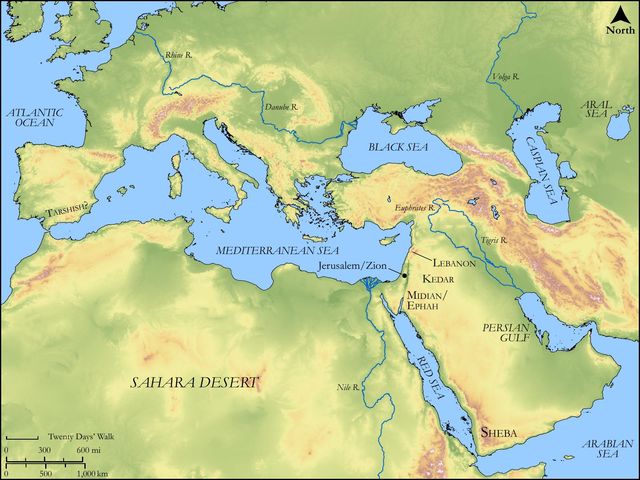
See on the biblical-era map
Study this verse
Public-domain commentary
Matthew Henry
From his Commentary on the Whole Bible. Henry comments on passages, not single verses — this entry covers Isaiah 40:18–26. His four-level outline is real structure in the source text, so it is rendered as structure.
The prophet here reproves those, 1. Who represented God by creatures, and so changed his truth into a lie and his glory into shame, who made images and then said that they resembled God, and paid their homage to them accordingly. 2. Who put creatures in the place of God, who feared them more than God, as if they were a match for him, or loved them more than God, as if they were fit to be rivals with him. Twice the challenge is here made, To whom will you liken God? Isa 40:18, and again Isa 40:25. The Holy One himself says, To whom will you liken me? This shows the folly and absurdity, (1.) Of corporal idolatry, making visible images of him who is invisible, imagining the image to be animated by the deity, and the deity to be presentiated by the image, which, as it was an instance of the corruption of the human nature, so it was an intolerable injury to the honour of the divine nature. (2.) Of spiritual idolatry, making creatures equal with God in our affections. Proud people make themselves equal with God; covetous people make their money equal with God; and whatever we esteem or love, fear or hope in, more than God, that creature we equal with God, which is the highest affront imaginable to him who is God over all. Now, to show the absurdity of this,
I.The prophet describes idols as despicable things and worthy of the greatest contempt (Isa 40:19, Isa 40:20):
"Look upon the better sort of them, which rich people set up, and worship; they are made of some base metal, cast into what shape the founder pleases, and that is gilded, or overlaid with plates of gold, that it may pass for a golden image. It is a creature; for the workman made it; therefore it is not God, Hos 8:6. It depended upon his will whether it should be a god at all, and of what shape it should be. It is a cheat; for it is gold on the outside, but within it is lead or copper, in this indeed representing the deities, that they were not what they seemed to be, and deceived their admirers. How despicable then are the worst sort of them - the poor men's gods! He that is so impoverished that he has scarcely a sacrifice to offer to his god when he has made him will yet not be without an enshrined deity of his own; and, though he cannot procure one of brass or stone, he will have a wooden one rather than none, and for that purpose chooses a tree that will not soon rot, and of that he will have his graven image made. Both agree to have their image well fastened, that they may not be robbed of it. The better sort have silver chains to fix theirs with; and, though it be but a wooden image, care is taken that it shall not be moved." Let us pause a little and see,
1.How these idolaters shame themselves, and what a reproach they put upon their own reason, in dreaming that gods of their own making (Nehushtans, pieces of brass or logs of wood) should be able to do them any kindness. Thus vain were they in their imaginations; and how was their foolish heart darkened!
2.See how these idolaters shame us, who worship the only living and true God. They spared no cost upon their idols; we grudge that as waste which is spent in the service of our God. They took care that their idols should not be moved; we wilfully provoke our God to depart from us.
II.He describes God as infinitely great, and worthy of the highest veneration; so that between him and idols, whatever competition there may be, there is no comparison. To prove the greatness of God he appeals,
1.To what they had heard of him by the hearing of the ear, and the consent of all ages and nations concerning him (Isa 40:21): "Have you not known by the very light of nature? Has it not been told you by your fathers and teachers, according to the constant tradition received from their ancestors and predecessors, even from the beginning?" (Those notices of God are as ancient as the world.) "Have you not understood it as always acknowledged from the foundation of the earth, that God is a great God, and a great King above all gods?" It has been a truth universally admitted that there is an infinite Being who is the fountain of all being. This is understood not only ever since the beginning of the world, but from and by the origin of the universe. It is founded upon the foundation of the earth. The invisible things of God are clearly seen from the creation of the world, Rom 1:20. Thou mayest not only ask thy father, and he shall tell thee this, and thy elders (Deu 32:7); but ask those that go by the way (Job 21:29), ask the first man you meet, and he will say the same. Some read it, Will you not know? Will you not hear it? For those that are ignorant of this are willingly ignorant; the light shines in their faces, but they shut their eyes against it. Now that which is here said of God is,
(1.)That he has the command of all the creatures. The heaven and the earth themselves are under his management: He sits upon the circle, or globe, of the earth, Isa 40:22. He that has the special residence of his glory in the upper world maintains a dominion over this lower world, gives law to it, and directs all the motions of it to his own glory. He sits undisturbed upon the earth, and so establishes it. He is still stretching out the heavens, his power and providence keep them still stretched out, and will do so till the day comes that they shall be rolled together like a scroll. He spreads them out as easily as we draw a curtain to and fro, opening these curtains in the morning and drawing them close again at night. And the heaven is to this earth as a tent to dwell in; it is a canopy drawn over our heads, et quod tegit omnia coelum - and it encircles all. - Ovid. See Psa 104:2.
(2.)That the children of men, even the greatest and mightiest, are as nothing before him. The numerous inhabitants of this earth are in his eye as grasshoppers in ours, so little and inconsiderable, of such small value, of such little use, and so easily crushed. Proud men's lifting up themselves is but like the grasshopper's leap; in an instant they must stoop down to the earth again. If the spies thought themselves grasshoppers before the sons of Anak (Num 13:33), what are we before the great God? Grasshoppers live but awhile, and live carelessly, not like the ant; so do the most of men.
(3.)That those who appear and act against him, how formidable soever they may be to their fellow-creatures, will certainly be humble and brought down by the mighty hand of God, Isa 40:23, Isa 40:24. Princes and judges, who have great authority, and abuse it to the support of oppression and injustice, make nothing of those about them; as for all their enemies they puff at them (Psa 10:5; Psa 12:5); but, when the great God takes them to task, he brings them to nothing; he humbles them, and tames them, and makes them as vanity, little regarded, neither feared nor loved. He makes them utterly unable to stand before his judgments, which shall either,
[1.]Prevent their settlement in their authority: They shall not be planted; they shall not be sown; and those are the two ways of propagating plants, either by seed or slips. Nay, if they should gain a little interest, and so be planted or sown, yet their stock shall not take root in the earth, they shall not continue long in power. Eliphaz saw the foolish taking root, but suddenly cursed their habitation. And then how soon is the fig-tree withered away! Or,
[2.]He will blast them when they think they are settled. He does but blow upon them, and then they shall wither, and come to nothing, and the whirlwind shall take them away as stubble. For God's wrath, though it seem at first to blow slightly upon them, will soon become a mighty whirlwind. When God judges he will overcome. Those that will not bow before him cannot stand before him.
2.He appeals to what their eyes saw of him (Isa 40:26): "Lift up your eyes on high; be not always poring on this earth" (O curvae in terras animae et coelestium inanes! - Degenerate minds, that can bend so towards the earth, having nothing celestial in them!), "but sometimes look up" (Os homini sublime dedit, coelumque tueri jussit - Heaven gave to man an erect countenance, and bade him gaze on the stars); "behold the glorious lights of heaven, consider who has created them. They neither made nor marshalled themselves; doubtless, therefore, there is a God that gave them their being, power, and motion." What we see of the creature should lead us to the Creator. The idolaters, when they lifted up their eyes and beheld the hosts of heaven, being wholly immerged in sense, looked no further, but worshipped them, Deu 4:19; Job 31:26. Therefore the prophet here directs us to make use of our reason as well as our senses, and to consider who created them, and to pay our homage to him. Give him the glory of his sovereignty over them - He brings out their host by number, as a general draws out the squadrons and battalions of his army; of the knowledge he has of them - He calls them all by names, proper names, according as their place and influence are (Psa 147:4); and of the use he makes of them; when he calls them out to any service, so obsequious are they that, by the greatness of his might, not one of them fails, but, as when the stars in their courses fought against Sisera, every one does that to which he is appointed. To make these creatures therefore rivals with God, which are such ready servants to him, is an injury to them as well as an affront to him.
Historical interpretation
Historical reception
5 surviving comments on this verse. Each one is dated, so this reads as a timeline rather than a list.
Select a marker to jump to its quote. Markers stagger vertically where authors wrote within a few decades of each other.
“He that stretches out the heavens as a vaulted ceiling.” These same thoughts, let us also recommend to ourselves concerning the earth, not to be curious about what its substance is; or to wear ourselves out by reasoning, seeking its very foundation; or to search for some nature destitute of qualities, existing without quality of itself; but to realize well that all that is seen around it is related to the reason of its existence, forming an essential part of its substance.
When he spoke of the heavens, Isaiah said, “It is he who set up the heaven as a vaulted chamber and stretched it out as a tent over the earth.” And he said of the earth, “It is he that comprehends the circle of the earth and made the earth as if it were nothing,” even though the earth is so great and vast.… Despite the fact that the earth is so great and so vast, God made it with such ease that the prophet could find no fitting example. So he said that God made the earth “as if it were nothing.”
(Vers. 21 seqq.) Do you not know? Do you not hear? Has it not been announced to you from the beginning? Have you not understood the foundations of the earth? He sits above the circle of the earth, and its inhabitants are like locusts. He spreads out the heavens like nothing, and expands them as a tent to dwell in. He makes secret things known as if they were not. He has made the rulers of the earth as nothing. They are not planted, nor are they sown, nor do their roots take hold in the earth. He blows on them and they wither, and the whirlwind carries them away like stubble. And to whom have you compared me and made me equal? says the Lord. Lift up your eyes on high and see who has created these things: he who brings out their host by number, and calls them all by name. Because of his great power and strength, and because his power has no end. LXX: Do you not know? Have you not heard? Has it not been told to you from the beginning? Have you not understood the foundation of the earth? He who sits above the circle of the earth, and its inhabitants are like grasshoppers. He who sets the heavens like a tent and stretches them like a dwelling place. He who makes princes rule for nothing, and reduces the earth to nothing. For they shall not be planted, nor shall they be sown, nor shall their root be established in the earth. He blows upon them, and they wither, and the storm carries them away like straw. So now to whom will you compare me? Or how am I equal? says the Holy One. Lift up your eyes on high and see: who created these? He who leads according to his ordered number, he will call all by name, from much glory and in the strength of fortitude: nothing escapes you. From the beginning, he said, I have taught you by the natural law, and afterwards I have testified through the written law of Moses, what idols are nothing, and that the Creator of the world himself is God, who has founded such a great mass of land upon the seas, and has placed it upon the rivers: so that the heaviest element hangs by the will of God upon the thin waters, who sits as a king upon the circumference of the earth: from which some contend that it is like a dot and a globe, and its inhabitants like locusts. For if we consider the various nations in the whole world, from the Ocean to the Ocean, that is, from the Indian sea to the British, and from the Atlantic to the harshness of the North, where the waters freeze and beautiful amber grows, we see that the entire human race dwells in the middle like locusts. So why does the earth and ash boast? Because the heavens, indeed, as I will use the authority of the Scriptures, are stretched out like a chamber; or, as it is contained in Hebrew, like a tent, of which we have spoken above: for which the LXX interpreted it as saliva there: and one word now translated as spit, now as chamber, that is, a vault; and its width extends above them like a tent and a canopy, so as to cover people like a roof and make them dwell as if in a very large house. Why should we be surprised if the small bodies of humans are considered like locusts and tiny creatures? Again, in this place, they argue that the semicircle is close to the earth (or rather, the heavens), and they claim that the sky is similar to a sphere. They use the term 'arch' because the middle part of the sphere covers the earth: when in Hebrew, we read not 'arch' but 'dust', that is, very fine powder. For the saliva that is thrown onto the ground and mixes with the dust and disappears, shows that the magnitude of all bodies should be regarded as nothing. But he who stretched out the heavens and spread them out, so that either above could dwell the multitude of angels, or below could dwell human beings, and as if he created a great house for reasonable creatures, he himself established princes according to the quality of the times, whether as secret scrutineers, so that they may be as if they are not; and he made judges of the earth as if they were nothing. For this reason, the Seventy translated it, but they translated the earth as if it were nothing; indeed, in the beginning of Genesis where it is written, 'But the earth was invisible and unfinished' (Gen. 1:1), others translated it as, 'But the earth was empty and nothing.' How many kings, both Greek and Barbarian, does Roman history narrate! Where is that countless army of Xerxes? Where is the multitude of Israel in the desert? Where is the incredible power of kings? What about the ancient ones? Let present examples teach us, that princes are considered as nothing, and rulers of the earth as empty. Those princes and rulers of the earth (or, as others suspect, of heaven) are neither satisfied, nor established, nor firmly rooted, and by the sudden command of God they are taken away and perish, as straw is carried away by the whirlwind and storm; according to what is written: 'I passed by, and he was not there; I sought him, and his place was not found' (Ps. XXXVI, 36). So with such great power and majesty of the Creator, how can you compare God to the likeness of a creature? And do you not rather understand the Creator from the magnitude of the creatures? If you do not believe in words, believe at least in your own eyes; and consider the power of the Lord from the service of the heavens and all the elements. He summons their army, that is, the heavens, in number; and he calls them all by name, and it is understood, the stars. Of which it is also sung in the Psalms: He counts the multitude of the stars: and he calls them all by name (Ps. 46:4). Whether we interpret the hosts of heaven as the army of angels and all the heavenly hosts of which Daniel speaks: Thousands of thousands ministered to Him, and ten thousand times ten thousand stood before Him (Dan. VII, 10). Hence the Lord of hosts is called, which in our language is called the Lord of armies and forces, or powers. He brings forth his host according to the number of the heavens: so that the sun, and the moon, and the other stars, which Abraham could not number, are numbered by Him, and serve the assigned function (Gen. XV): while the same course of the heavens is completed by the sun in one year, by the morning star and the evening star in two years, by the moon in each month, and all the stars follow their appointed times, and some of them are called wandering, and we see their movements with our eyes, not with our minds, nor do we understand them as much as we marvel at them. For the magnitude of God's strength makes all things serve in its own order. Whether according to the Seventy, by the multitude of his glory and the power of his virtue, nothing can escape him; but he knows all the ways, plans, and courses of the Creator by his majesty.
It is he, [Isaiah] says, who has caused the earth to appear; it is he who holds it in his hand and who directs it. As for human beings, they are no different from grasshoppers if one compares them with divine power. Then [Isaiah] teaches that God is not only the Maker of the earth but also the Creator of the heavens: “He that set up the heaven as a chamber and stretched it out as a tent to dwell in.” For since the earth is like the ground floor of a house and the sky simulates a roof in the form of an arch and dome, [Isaiah] has aptly compared it with a tent. And after having shown us the God of the universe as Creator, the prophetic text indicates to us his ineffable providence.
It is thus he has brought down Sennacherib, Nebuchadnezzar and thousands of others. “And has made the earth as nothing.” For the power of the Creator does not even have the object of his creation as a measure, but only his will: “Our God has done in heaven and on earth whatsoever he has pleased,” not all that he has the power [to do] but all he pleases: for he would be capable [of accomplishing] works many times greater, but God has accomplished what he judges to be best.
Continue studying Isaiah 40:22 across the web’s major study libraries — every link below opens this exact verse, chapter, or book on the destination site.
Read & Compare
 BibleGatewayThis verse in more than 200 translations and 70 languages.
 Bible.comThe YouVersion reader — hundreds of translations, reading plans, and highlights.
 ESV.orgCrossway's official English Standard Version reader.
 NET BibleThe NET translation with 60,000+ translators' notes on every rendering decision.
 STEP BibleTyndale House's free study tool — original text, vocabulary, and scholarly resources.
 BibliaLogos Bible Software's free web reader.
 USCCBThe New American Bible (Revised Edition) with the U.S. bishops' study notes.
Commentaries
 BibleHub CommentariesDozens of classic commentaries on this verse, gathered on one page.
 StudyLightMore than 100 commentary sets — the largest collection on the web.
 BibleRefPlain-English commentary on what this verse means, verse by verse.
 Enduring WordDavid Guzik's free commentary on this chapter, widely used by Bible teachers.
 Bible Study ToolsVerse commentary alongside Greek and Hebrew study aids.
Original Language & Research
- BibleHub InterlinearThe verse word by word — original language, transliteration, and English.
- BibleHub LexiconEvery word's original-language definition and Strong's entry.
 Blue Letter BibleDeep-study tools — Strong's numbers, concordance, and word studies.
 SefariaThe Hebrew text with Rashi and centuries of Jewish commentary.
Sermons, Hymns & Audio


TrulyRandomVerse is not affiliated with these sites and doesn’t control their content. They’re linked because they’re genuinely useful.
Summary
Isaiah 40:22 presents a breathtaking vision of God's transcendent majesty and absolute sovereignty over creation, starkly contrasting His immeasurable greatness with the fleeting insignificance of humanity. The verse vividly portrays God as enthroned above the entire globe, effortlessly unfurling the vast heavens like a delicate curtain and spreading them out as a protective tent, thereby underscoring His unparalleled power, infinite wisdom, and comprehensive control over all creation and its inhabitants. This profound imagery serves as a powerful source of comfort and assurance for a dispirited people, reminding them of God's unwavering faithfulness and omnipotence amidst their deepest trials.
Context
ShowHideLiterary Context
Isaiah 40 marks a pivotal shift in the book of Isaiah, initiating the "Book of Comfort" (chapters 40-66) following the preceding chapters' focus on judgment and rebuke. This chapter opens with the tender command, "Comfort, comfort my people," as found in Isaiah 40:1, immediately setting a tone of hope, restoration, and divine consolation. Verses 12-31 form a magnificent poetic exposition that systematically extols God's incomparable greatness, wisdom, and power, dismantling any notion that human rulers, nations, or even the vastness of creation could rival Him. Verse 22 is strategically embedded within this larger theological argument, serving as a powerful declaration of God's dominion over all things, which then provides the unshakeable theological foundation for the glorious promise that those who wait on the Lord will renew their strength, as beautifully articulated in Isaiah 40:31. The verse reinforces the idea that the God who effortlessly controls the universe is more than capable of sustaining His weary people.
Historical & Cultural Context
The prophecies contained within Isaiah 40 are primarily addressed to the Israelites in anticipation of, or during, their Babylonian exile. This period was characterized by profound national humiliation, widespread despair, and agonizing questions concerning God's faithfulness and His apparent powerlessness against their oppressors. The people had witnessed the devastating destruction of Jerusalem and the Temple, and many were living in a foreign land under oppressive foreign rule. In such a context of existential crisis, the imagery of God "sitteth upon the circle of the earth" and effortlessly managing the heavens directly challenged the polytheistic beliefs of Babylon and the perceived might of its numerous gods. It served as a vital reassurance to a dispirited nation that their God was not confined, defeated, or absent, but remained the sovereign Lord over all nations and creation, fully capable of delivering His people and fulfilling His promises, regardless of their present circumstances.
Key Themes
ShowHideThis verse powerfully contributes to several overarching themes prevalent throughout the book of Isaiah. Foremost is the theme of God's Transcendence and Absolute Sovereignty, emphasizing His elevated position above all creation and His unchallengeable control over all things. It starkly contrasts Human Finitude and Insignificance with God's infinite power, portraying humanity as mere "grasshoppers" from a divine perspective, thereby fostering profound humility and absolute dependence upon Him. The imagery of stretching out the heavens highlights God's role as the Ultimate Creator and Sustainer, effortlessly orchestrating the universe with divine ease. This passage also reinforces the theme of Divine Wisdom and Unfathomable Knowledge, implying that God not only brought the universe into being but fully comprehends and meticulously governs its every detail, from the grandeur of the heavens to the smallest of its inhabitants, providing a firm basis for trust in His perfect plan, even when human understanding fails, as further explored in Isaiah 40:13-14.
Exposition and Analysis
ShowHideKey Word Analysis
ShowHideMeaning "a circle; circuit, compass." In the context of "the circle of the earth," this term conveys God's comprehensive view and encompassing dominion over the entire globe. It speaks to the earth's full extent or the horizon from a divine, elevated perspective, emphasizing the totality of God's domain and His all-encompassing oversight rather than a specific scientific shape.
Meaning "a locust; locust." This vivid metaphor highlights the extreme smallness, fragility, and transient nature of human beings and their perceived powers when compared to the infinite and eternal God. It underscores humanity's utter dependence and profound insignificance from the Creator's boundless vantage point.
A primitive root meaning "to stretch or spread out; by implication, to bend away." This word emphasizes the effortless and expansive nature of God's creative power. It suggests a deliberate, unhindered, and vast act of extending the heavens, portraying God as the master architect who unfurls the canopy of the heavens with sublime ease and authority.
Verse Breakdown
ShowHide"It is he that sitteth upon the circle of the earth"
This foundational clause establishes God's supreme authority and transcendent position. The act of "sitteth" implies being enthroned as a sovereign ruler, overseeing His entire domain with calm authority. The "circle of the earth" signifies His comprehensive view and absolute control over the whole world, emphasizing His elevated, universal dominion that encompasses all boundaries and inhabitants.
"and the inhabitants thereof are as grasshoppers"
This phrase sharply contrasts God's immensity with human frailty and limited power. Humanity, despite its perceived achievements, empires, or self-importance, is reduced to the size and fleeting existence of "grasshoppers" in God's sight, underscoring human insignificance, dependence, and the brevity of life before the eternal Creator.
"that stretcheth out the heavens as a curtain"
This imagery portrays God's effortless and grand act of creation and ongoing sustenance. The heavens, vast and seemingly infinite, are unfurled by God with the same ease as one might spread a thin, delicate "curtain." This highlights His boundless power, the simplicity with which He brought the heavens and the earth into being, and His continuous, unburdened management of it.
"and spreadeth them out as a tent to dwell in"
Building on the previous image, this clause suggests that the heavens are not merely a decorative backdrop but a purposeful, ordered dwelling place. Like a "tent" that provides shelter, structure, and a place for habitation, God has meticulously arranged the celestial expanse to accommodate life, indicating His meticulous design, providential care, and ongoing sustenance of creation for His purposes.
Literary Devices
ShowHideIsaiah 40:22 is exceptionally rich with Imagery, painting vivid and majestic pictures of God's unparalleled power and dominion over all things. The verse masterfully employs powerful Similes, comparing the earth's inhabitants to "grasshoppers," the heavens to a "curtain," and then to a "tent to dwell in." These comparisons effectively convey the vast disparity between God's infinite scale and humanity's finite nature, and the effortless ease of God's creative and sustaining acts. Anthropomorphism is present in the depiction of God "sitteth" and "stretcheth out," attributing human-like actions to God to make His transcendent power and active involvement comprehensible to human understanding. The use of Hyperbole in describing humans as "grasshoppers" emphasizes their extreme insignificance from a divine perspective, serving to humble humanity and profoundly magnify God's incomparable greatness.
Theological and Thematic Connections
ShowHideIsaiah 40:22 profoundly articulates the biblical doctrine of God's absolute sovereignty and transcendence. It asserts that God is not merely a powerful deity among others, but the singular, incomparable Creator who reigns supreme over all existence, from the macrocosm of the heavens to the microcosm of human life. This truth cultivates a proper understanding of human humility and dependence, reminding us that all human endeavors, perceived strengths, and earthly powers are fleeting and inconsequential before the eternal and omnipotent God. It provides immense comfort and profound security, assuring believers that the God who effortlessly manages the vast heavens is fully capable of overseeing their individual lives, fulfilling His purposes, and delivering them, even amidst overwhelming circumstances. The meticulous design implied by the "tent to dwell in" speaks to God's providential care and His purposeful ordering of creation for the flourishing of life.
Reflection and Application
ShowHideIsaiah 40:22 serves as a powerful antidote to human pride and anxiety, offering both a humbling perspective and profound comfort. When we contemplate the vastness of the universe and our seemingly small place within it, this verse reminds us that the same God who effortlessly orchestrates galaxies and holds the stars in place also holds our individual lives in His sovereign, loving hand. It challenges us to relinquish our futile attempts to control what is beyond our grasp and instead to trust wholeheartedly in the One who sits enthroned above all. In moments of personal struggle, national crisis, or global uncertainty, remembering God's immense power and comprehensive oversight can quiet our fears, fostering a deep sense of peace and security that transcends circumstances. This truth calls us to worship, inspiring awe and profound reverence for the incomparable Creator, and encouraging us to live lives of humble dependence and faithful obedience, knowing that our ultimate hope rests securely in His unwavering power and unfailing love.
Questions for Reflection
ShowHideFAQ
ShowHideDoes "circle of the earth" in Isaiah 40:22 imply a spherical earth?
ShowHideThe Hebrew word for "circle" (chûwg) refers to a compass, circuit, or arc, denoting completeness or the entire horizon as viewed from an elevated perspective. While it doesn't explicitly describe a sphere in modern scientific terms, it certainly doesn't suggest a flat earth. Rather, it emphasizes God's comprehensive view and dominion over the entire expanse of the earth, encompassing all its boundaries and inhabitants. The primary theological point is God's transcendence and His ability to see and control everything, not a scientific description of the earth's shape. This aligns with other biblical passages that speak of God's universal reach and creative wisdom, such as Proverbs 8:27 where wisdom is present when God "drew a circle on the face of the deep."
What is the significance of comparing humans to "grasshoppers"?
ShowHideThe comparison of humans to "grasshoppers" (châgâb) is a powerful simile used to highlight the extreme contrast between God's infinite majesty and humanity's finite, fragile, and temporary existence. It is not meant to demean humanity's inherent value as created in God's image, but rather to provide a proper, humbling perspective on our place in creation relative to the Creator. It underscores our absolute dependence on God and should cultivate profound humility, reminding us that human power, wisdom, and achievements are fleeting and minuscule compared to His eternal and boundless might. This theme is echoed in passages like Psalm 144:3-4 which asks, "Lord, what is man, that you care for him, the son of man, that you think of him? Man is like a breath; his days are like a fleeting shadow."
Christ-Centered Fulfillment
ShowHideIsaiah 40:22, with its majestic portrayal of God as the sovereign Creator enthroned above the circle of the earth, finds its ultimate fulfillment and clearest revelation in the person and work of Jesus Christ. The God who "stretcheth out the heavens as a curtain" is the same God who, through His Son, brought all things into existence, for the New Testament explicitly declares that "all things were created through him and for him" (Colossians 1:16) and that "without him nothing was made that has been made" (John 1:3). The transcendent God, before whom the inhabitants of the earth are as "grasshoppers," is revealed in Christ as the One who humbly "made himself nothing, taking the very nature of a servant" (Philippians 2:7) to dwell among us, thereby fulfilling the imagery of the heavens spread out "as a tent to dwell in," as beautifully captured in John 1:14, where the Word became flesh and "tabernacled" among us. Ultimately, the One who sits upon the circle of the earth is the resurrected Christ, who has been "seated at his right hand in the heavenly realms, far above all rule and authority, power and dominion" (Ephesians 1:20-21), demonstrating that all creation is indeed under His sovereign sway and that in Him, God's power is perfectly united with His redemptive love.