


Isaiah 42:6
Bible text: King James Version (1769 Blayney text) · Public domain
Bible text: King James Version with Strong's numbers · Public domain
Bible text: Berean Standard Bible · Public domain
Bible text: American Standard Version (1901) · Public domain
Bible text: World English Bible, Messianic edition · Public domain
Bible text: Geneva Bible (1599) · Public domain
Bible text: Young's Literal Translation · Public domain
- אֲנִי'a·NiIH589Pro-1csPronoun Personal 1st Singular common gender
- יְהוָהYah·wehYahwehH3068N-properNoun Proper Title
- קְרָאתִיךָke·ra·Ti·chaI have called youH7121V-Qal-Perf-1cs ¦ 2msVerb Qal Perfect 1st Singular common genderקְרָאתִיI have calledךָyou
- בְצֶדֶקve·Tze·dekin righteousnessH6664Prep-b ¦ N-msNoun Singular Masculine Absoluteבְinצֶדֶקrighteousness
- וְאַחְזֵקve·'ach·Zekand I may take holdH2388Conj-w ¦ V-Hiphil-Imperf-1csVerb Hiphil Imperfect 1st Singular common genderוְandאַחְזֵקI may take hold
- בְּיָדֶךָbe·ya·De·khaon your handH3027Prep-b ¦ N-csc ¦ 2msNoun Singular common gender Constructבְּonיָדֶhandךָyour
- וְאֶצָּרְךָve·'e·tza·re·Khaand I may watch over youH5341Conj-w ¦ V-Qal-ConjImperf-1cs ¦ 2msVerb Qal Conjunction+Imperfect 1st Singular common genderוְandאֶצָּרְI may watch overךָyou
- וְאֶתֶּנְךָve·'e·ten·Khaand I may make youH5414Conj-w ¦ V-Qal-ConjImperf-1cs ¦ 2msVerb Qal Conjunction+Imperfect 1st Singular common genderוְandאֶתֶּנְI may makeךָyou
- לִבְרִיתliv·Rit<into> a covenant ofH1285Prep-l ¦ N-fscNoun Singular Feminine Constructלִ<into>בְרִיתa covenant of
- עָם'am[the] peopleH5971N-msNoun Singular Masculine Absolute
- לְאוֹרle·'or<into> a light ofH216Prep-l ¦ N-fscNoun Singular Feminine Constructלְ<into>אוֹרa light of
- גּוֹיִםgo·Yim[the] nationsH1471N-mpNoun Plural Masculine Absolute
English is a literal word-by-word gloss of the Hebrew, not the KJV's wording. Why?
This is the original text the KJV's translators worked from — each Hebrew word with its own literal English meaning in this verse, prepared by scholars at Tyndale House, Cambridge. The KJV translates whole sentences, not word by word, so its wording differs: one Hebrew word can become several English words, and the KJV may choose “the LORD” where the gloss reads “Yahweh”. Both are faithful — they answer different questions. For the KJV's own rendering, switch to the KJV text.
Details
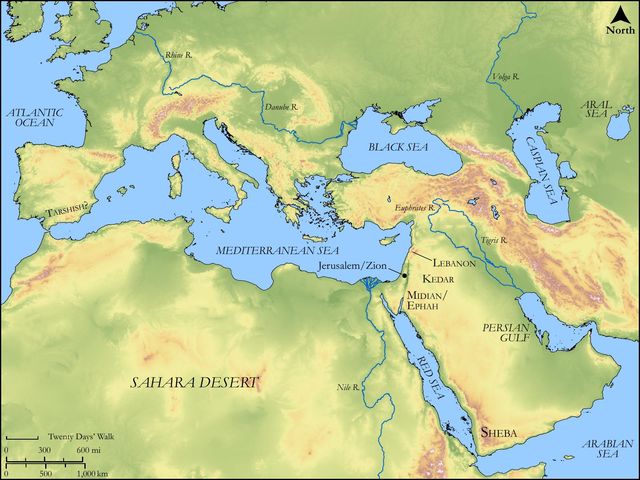
See on the biblical-era map
Study this verse
Public-domain commentary
Matthew Henry
From his Commentary on the Whole Bible. Henry comments on passages, not single verses — this entry covers Isaiah 42:5–12. His three-level outline is real structure in the source text, so it is rendered as structure.
Here is I. The covenant God made with and the commission he gave to the Messiah, Isa 42:5-7, which are an exposition of Isa 42:1, Behold my servant, whom I uphold.
1.The royal titles by which the great God here makes himself known, and distinguishes himself from all pretenders, speak very much his glory (Isa 42:5): Thus saith God the Lord. And who are thou, Lord? Why, he is the fountain of all being and therefore the fountain of all power. He is the fountain of being, 1. In the upper world; for he created the heavens and stretched them out (Isa 40:22), and keeps the vast expanse still upon the stretch. 2. In the lower world: for he spread forth the earth, and made it a capacious habitation, and that which comes out of it is produced by his power. 3. In the world of mankind: He gives breath to the people upon it, not only air to breathe in, but the breath of life itself and organs to breathe with; nay, he gives spirit, the powers and faculties of a rational soul, to those that walk therein. Now this is prefixed to God's covenant with the Messiah, and the commission given him, not only to show that he has authority to make such a covenant and give such a commission, and had power sufficient to bear him out, but that the design of the work of redemption was to maintain the honour of the Creator, and to restore man to the allegiance he owes to God as his Maker.
2.The assurances which he gives to the Messiah of his presence with him in all he did pursuant to his undertaking speak much encouragement to him, Isa 42:6.
(1.)God owns that the Messiah did not take the honour of being Mediator to himself, but was called of God, that he was no intruder, no usurper, but was fairly brought to it (Heb 5:4): I have called thee in righteousness. God not only did him no wrong in calling him to this hard service, he having voluntarily offered himself to it, but did himself right in providing for his own honour and performing the word which he had spoken.
(2.)He promises to stand by him and strengthen him in it, to hold his hand, not only to his work, but in it, to hold his hand, that it might not shake, that it might not fail, and so to keep him. When an angel was sent from heaven to strengthen him in his agonies, and the Father himself was with him, then this promise was fulfilled. Note, Those whom God calls he will own and help, and will hold their hands.
3.The great intentions of this commission speak abundance of comfort to the children of men. He was given for a covenant of the people, for a mediator, or guarantee, of the covenant of grace, which is all summed up in him. God, in giving us Christ, has with him freely given us all the blessings of the new covenant. Two glorious blessings Christ, in his gospel, brings with him to the Gentile world - light and liberty.
(1.)He is given for a light to the Gentiles, not only to reveal to them what they were concerned to know, and which otherwise they could not have known, but to open the blind eyes, that they might know it. By his Spirit in the word he presents the object; by his Spirit in the heart he prepared the organ. When the gospel came light came, a great light, to those that sat in darkness, Mat 4:16; Joh 3:19. And St. Paul was sent to the Gentiles to open their eyes, Act 26:18. Christ is the light of the world.
(2.)He is sent to proclaim liberty to the captives, as Cyrus did, to bring out the prisoners; not only to open the prison-doors, and give them leave to go out, which was all that Cyrus could do, but to bring them out, to induce and enable them to make use of their liberty, which none did but those whose spirits God stirred up. This Christ does by his grace.
II.The ratification and confirmation of this grant. That we may be assured of the validity of it consider,
1.The authority of him that makes the promise (Isa 42:8): I am the Lord, Jehovah, that is my name, and that was the name by which he made himself known when he began to perform the promise made to the patriarchs; whereas, before, he manifested himself by the name of God Almighty, Exo 6:3. If he is the Lord that gives being and birth to all things, he will give being and birth to this promise. If his name be Jehovah, which speaks him God alone, we may be sure his name is jealous, and he will not give his glory to another, whoever it is that stands in competition with him, especially not to graven images. He will send the Messiah to open men's eyes, that so he may turn them from the service of dumb idols to serve the living God, because, though he has long winked at the times of ignorance, he will now maintain his prerogative, and will not give his glory to graven images. He will perform his word because he will not lose the honour of being true to it, nor be ever charged with falsehood by the worshippers of false gods. He will deliver his people from under the power of idolaters because it looks as if he had given his praise to graven images when he gives up his own worshippers to be worshippers of images.
2.The accomplishment of the promises he had formerly made concerning his church, which are proofs of the truth of his word and the kindness he bears to his people (Isa 42:9): "Behold, the former things have come to pass; hitherto the Lord has helped his church, has supported her under former burdens, relieved her in former staits; and this in performance of the promises made to the fathers. There has not failed one word, Kg1 8:56. And now new things do I declare. Now I will make new promises, which shall as certainly be fulfilled in their season as old ones were; now I will bestow new favours, such as have not been conferred formerly. Old Testament blessings you have had abundantly; now I declare New Testament blessings, not a fruitful country and dominion over your neighbours, but spiritual blessings in heavenly things. Before they spring forth in the preaching of the gospel I tell you of them, under the type and figure of the former things." Note, The receipt of former mercies may encourage us to hope for further mercies; for God is constant in his care for his people, and his compassions are still new.
III.The song of joy and praise which should be sung hereupon to the glory of God (Isa 42:10):
Sing unto the Lord a new song, a New Testament song. The giving of Christ for a light to the Gentiles (Isa 42:6) was a new thing, and very surprising. The apostle speaks of it as a mystery which, in other ages, was not made known, as it is now revealed, that the Gentiles should be fellow-heirs, Eph 3:5, Eph 3:6. Now, this being the new thing which God declares, the newness of the song which is to be sung on this occasion is this, that whereas, before, the songs of the Lord were very much confined to the temple at Jerusalem (David's psalms were in the language of the Jews only, and sung by them in their own country only; for, when they were in a strange land, they hung their harps on the willow-trees and could not sing the Lord's song, as we find, Psa 137:2-4), now the songs of holy joy and praise shall be sung all the world over. The Gentile nations shall share equally with the Jews in New Testament blessings, and therefore shall join in New Testament praises and acts of worship. There shall be churches set up in Gentile nations and they shall sing a new song. The conversion of the Gentiles is often foretold under this notion, as appears, Rom 15:9-11. It is here promised that the praises of God's grace shall be sung with joy and thankfulness,
1.By those that live in the end of the earth, in countries that lie most remote from Jerusalem. From the uttermost parts of the earth have we heard songs, Isa 24:16. This was fulfilled when Christianity was planted in our land.
2.By mariners and merchants, and those that go down to the sea, that do business in great waters, and suck the riches of the sea, and so make themselves masters of the fulness thereof and all that is therein, with which they shall praise God, and justly, for it is his, Psa 24:1; Psa 95:5. The Jews traded little at sea; if therefore God's praises be sung by those that go down to the sea, it must be by Gentiles. Sea-faring men are called upon to praise God, Psa 107:23.
3.By the islands and the inhabitants thereof, Isa 42:10, and again, Isa 42:12. Let them declare his praise in the islands, the isles of the Gentiles, probably referring to the islands of Greece.
4.By the wilderness and the cities thereof, and the villages of Kedar. These lay east from Jerusalem, as the islands lay west, so that the gospel songs should be sung from the rising of the sun to the going down of the same. The whole Gentile world had been like an island, cut off from communication with God's church, and like a wilderness, uncultivated and bringing forth no fruit to God; but now the islands and the wilderness shall praise God.
5.By the inhabitants of the rock, and those that dwell on the tops of the mountains, not only the Gentiles, but the poorest and meanest and most despicable, those that dwell in cottages, as well as those that inhabit cities and villages. The rude and most barbarous, as the mountaineers commonly are, shall be civilized by the gospel. Or by the inhabitants of the rock may be meant the inhabitants of that part of Arabia which is called Petraea - the rocky. Perhaps the neighbouring countries shared in the joy of the Israelites when they returned out of Babylon and some of them came and joined with them in their praises; but we find not that it was to any such degree as might fully answer this illustrious prophecy, and must conclude that it reaches further, and was fulfilled in that which many other prophecies of the joy of the nations are said in the New Testament to be fulfilled in, the conversion of the Gentiles to the faith of Christ. When they are brought into the church they are brought to give glory to the Lord; then they are to him for a name and a praise, and they make it their business to praise him. He is glorified in them and by them.
Historical interpretation
Four Centuries of Reception
4 surviving comments on this verse. Each one is dated, so this reads as a timeline rather than a list.
Select a marker to jump to its quote. Markers stagger vertically where authors wrote within a few decades of each other.
And the next sabbath day came almost the whole city together to hear the word of God. But when the Jews saw the multitudes, they were filled with envy, and spake against those things which were spoken by Paul, contradicting and blaspheming. Then Paul and Barnabas waxed bold, and said, It was necessary that the word of God should first have been spoken to you: but seeing ye put it from you, and judge yourselves unworthy of everlasting life, lo, we turn to the Gentiles. For so hath the Lord commanded us, saying, I have set thee to be a light of the Gentiles, that thou shouldest be for salvation unto the ends of the earth. [Isaiah 42:6] And when the Gentiles heard this, they were glad, and glorified the word of the Lord: and as many as were ordained to eternal life believed. And the word of the Lord was published throughout all the region. But the Jews stirred up the devout and honourable women, and the chief men of the city, and raised persecution against Paul and Barnabas, and expelled them out of their coasts.
Moses then received it, but they proved themselves unworthy. Learn now how we have received it. Moses, as a servant, received it; but the Lord himself, having suffered in our behalf, hath given it to us, that we should be the people of inheritance. But He was manifested, in order that they might be perfected in their iniquities, and that we, being constituted heirs through Him, might receive the testament of the Lord Jesus, who was prepared for this end, that by His personal manifestation, redeeming our hearts (which were already wasted by death, and given over to the iniquity of error) from darkness, He might by His word enter into a covenant with us. For it is written how the Father, about to redeem us from darkness, commanded Him to prepare a holy people for Himself. The prophet therefore declares, "I, the Lord Thy God, have called Thee in righteousness, and will hold Thy hand, and will strengthen Thee; and I have given Thee for a covenant to the people, for a light to the nations, to open the eyes of the blind, and to bring forth from fetters them that are bound, and those that sit in darkness out of the prison-house." Ye perceive, then, whence we have been redeemed.
Since, therefore, we were as though blind before, and when we sat as though enclosed by the prison house of foolishness in the darkness, not knowing God and his truth, we were enlightened by him who adopted us by his gracious treatment (his will in our favor). And when he had freed us as from evils and bonds and brought us into the light of wisdom, he recognized us as the heirs of his heavenly kingdom.
(Verse 5, 6 and following) Thus says the Lord God: He who creates the heavens and stretches them out, who spreads out the earth with all that springs from it, who gives breath to its people, and life to those who walk on it: I, the Lord, have called you in righteousness; I will take hold of your hand. I will keep you and will make you to be a covenant for the people and a light for the Gentiles, to open eyes that are blind, to free captives from prison and to release from the dungeon those who sit in darkness. I am the Lord, this is my name; I will not give my glory to another, nor my praise to idols. The things that were first, behold they have come, and new things I declare; before they spring forth, I tell you of them: It was uncertain who has said before: Behold my servant, I will take him: my chosen, my soul has pleased him. I have put my spirit upon him: he shall bring forth judgment to the Gentiles. After the condemnation of idols, a sudden speech had burst forth. Behold my servant, and the rest, which we have interpreted from the Father's perspective on Christ. Therefore, to not leave it ambiguous who said the previous things, he adds and says: Thus says the Lord God, creating the heavens and stretching them out. Or as the Septuagint translated: He made the heaven and fixed it. Therefore, the Creator and Lord of the universe himself promised the coming of his Christ, who not only stretched out and fixed the heavens, but also established the earth with its lofty mass, and everything that springs forth from it, so that the invisible things of him may be understood and seen from the things that are made (Rom. I); as well as his everlasting power and divinity. He who gave breath to all who dwell on earth, the first law of mortals. For God breathed into the face of Adam the breath of life, and he became a living soul (Gen. II). But the Spirit properly belongs to those who tread upon the earth; and the wisdom of the flesh subjects itself to its own power. Therefore, he to whom such great praises are sung has spoken these words to him, whose law the islands await and the nations: I am the Lord who called you in righteousness; of whom he himself speaks in the Gospel, Father, the world does not know you (John XVII, 25); so that he may be not only the God of the Jews, but also of the Gentiles. And I took hold of your hand, for whatever the Son does, the Father does also. And I saved you, who preserves all things yourself. And I gave you into a covenant with the people of Israel, to whom I had promised that you would come. And into the light of the Gentiles, who were sitting in darkness and in the shadow of death, so that you would open the eyes of the blind who had not seen God before. And you would bring out those who were bound in confinement (Prov. 2:16); for each one is bound by the cords of their own sins. And in the Gospel, which Satan had bound, the Lord set free (Matt. VIII). Those sitting in the darkness of the prison house, who were dwelling in the night of error and darkness. And He declares: I am the Lord, this is my name; I will not give my glory to another, nor does He exclude the Son, to whom He said in the Gospel: Father, glorify me with the glory which I had with You before the world was (John XVII, 5), He Himself answered; And I have glorified, and will glorify. For He did not say, 'I will not give My glory to anyone,' for if He had said this, He would have excluded the Son as well, but He said, 'I will not give My glory to another, except to You, to whom I have given it, and to whom I am going to give it.' Therefore, I greatly admire the uniqueness of the holy Scripture, that the phrase 'another' all interpreters have translated consistently, unlike the many other instances where they differ. And so that we may know that the Son is not excluded by this statement, but rather idols are, the following words testify: 'And My praise to carved images.' Pro quo LXX: nec virtutes meas simulacris. Cum enim Christus Dei virtus sit, Deique sapientia, omnes in se virtutes continet Patris. Sequitur, Quae prima fuerunt, ecce venerunt. Et est sensus: Quae locutus sum, quae per Moysen, Prophetasque pollicitus sum, universa completa sunt. Nunc autem annuntio vobis Evangelium, vocationem gentium, passionem Christi, novitatem fidei: ut quomodo priora cernitis rebus expleta, sic et ea quae nunc polliceor, credatis esse ventura.
Continue studying Isaiah 42:6 across the web’s major study libraries — every link below opens this exact verse, chapter, or book on the destination site.
Read & Compare
 BibleGatewayThis verse in more than 200 translations and 70 languages.
 Bible.comThe YouVersion reader — hundreds of translations, reading plans, and highlights.
 ESV.orgCrossway's official English Standard Version reader.
 NET BibleThe NET translation with 60,000+ translators' notes on every rendering decision.
 STEP BibleTyndale House's free study tool — original text, vocabulary, and scholarly resources.
 BibliaLogos Bible Software's free web reader.
 USCCBThe New American Bible (Revised Edition) with the U.S. bishops' study notes.
Commentaries
 BibleHub CommentariesDozens of classic commentaries on this verse, gathered on one page.
 StudyLightMore than 100 commentary sets — the largest collection on the web.
 BibleRefPlain-English commentary on what this verse means, verse by verse.
 Enduring WordDavid Guzik's free commentary on this chapter, widely used by Bible teachers.
 Bible Study ToolsVerse commentary alongside Greek and Hebrew study aids.
Original Language & Research
- BibleHub InterlinearThe verse word by word — original language, transliteration, and English.
- BibleHub LexiconEvery word's original-language definition and Strong's entry.
 Blue Letter BibleDeep-study tools — Strong's numbers, concordance, and word studies.
 SefariaThe Hebrew text with Rashi and centuries of Jewish commentary.
Sermons, Hymns & Audio


TrulyRandomVerse is not affiliated with these sites and doesn’t control their content. They’re linked because they’re genuinely useful.
Summary
Isaiah 42:6 introduces the first of the "Servant Songs," presenting a profound divine commission to the LORD's chosen Servant. This verse unveils God's sovereign initiative in calling the Servant in perfect righteousness, promising unwavering divine support and protection throughout His mission. It then articulates the Servant's dual, expansive purpose: to establish or embody a covenant for the people of Israel, thereby renewing their relationship with God, and to serve as a universal light, bringing salvation, truth, and spiritual illumination to the Gentile nations, thus extending God's redemptive grace beyond Israel's borders.
Context
ShowHideLiterary Context
Isaiah 42:6 is a pivotal verse within the "Servant Songs," specifically marking the divine introduction of the Servant in the first song (Isaiah 42:1-9). These songs are central to the latter half of the book of Isaiah, often referred to as the "Book of Comfort" (chapters 40-66), which addresses the exiled people of Judah with messages of hope, restoration, and God's ultimate sovereignty. Following chapters that emphasize God's incomparable power and His role as the only true God (e.g., the divine majesty proclaimed in Isaiah 40), this verse shifts focus to the instrument through whom God will accomplish His redemptive purposes. The preceding verses (Isaiah 42:1-4) describe the Servant's gentle yet unwavering character and His mission to bring justice, while the subsequent verses (Isaiah 42:7-9) elaborate on the impact of His work, including opening blind eyes and releasing prisoners, culminating in a declaration of new things.
Historical & Cultural Context
The book of Isaiah spans a significant period of Israelite history, from the Assyrian threat in the 8th century BCE to the Babylonian exile and the promise of return in the 6th century BCE. Chapters 40-55, where this verse is found, are primarily addressed to a people in exile, struggling with despair and questioning God's faithfulness. The concept of a "covenant" was foundational to Israel's identity, rooted in God's promises to Abraham (the Abrahamic Covenant in Genesis 12:1-3) and Moses (the Mosaic Covenant in Exodus 24:8). The idea of a "light to the Gentiles" was revolutionary, challenging the prevailing ethnocentric view that God's favor was exclusively for Israel. While Israel was called to be a "light" (e.g., Isaiah 49:6), this verse introduces a specific Servant who embodies and extends this universal mission, indicating a broader scope for God's redemptive plan beyond national boundaries.
Key Themes
ShowHideThis verse powerfully encapsulates several overarching themes within Isaiah and biblical theology. The theme of Divine Calling and Election is prominent, emphasizing that the Servant's mission is not self-initiated but divinely appointed and rooted in God's perfect righteousness. This divine initiative underscores God's sovereign plan for salvation. The theme of God's Sustaining Presence is highlighted by the promise of God holding the Servant's hand and keeping Him, signifying intimate guidance, empowerment, and protection amidst a challenging mission, echoing God's faithfulness to His people throughout their history (e.g., Deuteronomy 31:6). Furthermore, the verse introduces the crucial theme of Universal Redemption, expanding the scope of God's saving work beyond Israel to include all nations. The Servant's role as a "covenant of the people" speaks to the renewal and fulfillment of God's promises to Israel, while being a "light of the Gentiles" reveals God's inclusive love for humanity, foreshadowing the global reach of salvation (as seen in Isaiah 60:3).
Exposition and Analysis
ShowHideKey Word Analysis
ShowHideFrom בָּרָה (in the sense of cutting (like בָּרָא)); a compact (because made by passing between pieces of flesh); confederacy, (con-) feder(-ate), covenant, league. In this context, the Servant is not merely a mediator of a covenant, but is given as a covenant. This suggests the Servant Himself embodies the means by which God's promises are fulfilled and a new relationship is established. It points to a living embodiment of God's faithful commitment to His people, signifying a profound, personal connection to the divine agreement.
From אוֹר; illumination or (concrete) luminary (in every sense, including lightning, happiness, etc.); bright, clear, [phrase] day, light (-ning), morning, sun. Here, "light" is a powerful metaphor for salvation, truth, guidance, and spiritual revelation. The Servant brings spiritual illumination to those dwelling in darkness, dispelling the ignorance, sin, and despair that plague humanity, and leading them into the life-giving knowledge of God.
Rarely (shortened) גֹּי; apparently from the same root as גֵּוָה (in the sense of massing); a foreign nation; hence, a Gentile; also (figuratively) a troop of animals, or a flight of locusts; Gentile, heathen, nation, people. This term explicitly refers to the non-Israelite nations. Its inclusion here underscores the universal scope of the Servant's mission, indicating that God's redemptive plan extends beyond the chosen nation of Israel to encompass all humanity, demonstrating His inclusive love for every tribe and tongue.
Verse Breakdown
ShowHide"I the LORD have called thee in righteousness,"
This opening clause establishes the divine initiative and the Servant's righteous character. The LORD (Yahweh, H3068) is the one who calls, signifying His sovereign election and purpose. The calling is "in righteousness" (H6664), implying that God's choice is just, perfectly aligned with His holy character, and that the Servant Himself is characterized by integrity and conformity to God's standards. This sets the foundation for the Servant's unimpeachable authority and mission, assuring its divine origin and moral purity.
"and will hold thine hand, and will keep thee,"
These phrases promise intimate divine support and protection. "Will hold thine hand" (H2388, H3027) signifies active guidance, strength, and intimate fellowship, suggesting God's constant presence and active assistance in the Servant's work, empowering Him for the task. "Will keep thee" (H5341) implies preservation and guarding, assuring the Servant of divine protection against all obstacles and adversaries, enabling the successful completion of the arduous task against all opposition.
"and give thee for a covenant of the people,"
This clause defines a primary aspect of the Servant's mission concerning Israel ("the people," H5971). The Servant is not merely to announce a covenant but to be given as a covenant (H1285). This suggests that the Servant Himself embodies the terms and fulfillment of God's promises to His people, establishing a renewed or new relationship between God and Israel through His person and work, making Him the living embodiment of God's faithfulness.
"for a light of the Gentiles;"
This final clause expands the Servant's mission to a global scale. The Servant is to be a "light" (H216) for the "Gentiles" (H1471), the non-Jewish nations. This signifies that the Servant will bring spiritual illumination, truth, and salvation to those outside the covenant community of Israel, dispelling their spiritual darkness and extending God's redemptive grace universally to all humanity.
Literary Devices
ShowHideIsaiah 42:6 employs several powerful literary devices that enhance its prophetic message. Divine Oracle is evident in the direct address from the LORD ("I the LORD have called thee"), establishing the authoritative and prophetic nature of the declaration and emphasizing God's sovereign initiation of the Servant's mission. Metaphor is prominently used with "light of the Gentiles," where "light" symbolizes truth, salvation, spiritual understanding, and divine revelation, contrasting sharply with the darkness of ignorance, sin, and spiritual blindness. This metaphor is deeply rooted in biblical imagery, often representing God's presence and guidance. There is also a subtle Anthropomorphism in "will hold thine hand," attributing a human action to God to convey His intimate care, personal guidance, and unwavering support for the Servant, making His divine commitment relatable. The verse also exhibits a form of Parallelism in its final two clauses, "for a covenant of the people, for a light of the Gentiles," which juxtaposes the Servant's specific role for Israel with His universal role for the nations, highlighting the comprehensive and dual scope of His redemptive mission.
Theological and Thematic Connections
ShowHideIsaiah 42:6 is a foundational text for understanding God's expansive redemptive plan, revealing a divine commitment that transcends national boundaries. It underscores the truth that God's ultimate purpose has always been to bless all nations, not just Israel. The Servant's dual role as "covenant of the people" and "light of the Gentiles" speaks to the continuity and expansion of God's covenant promises. For Israel, the Servant represents the means by which the covenant relationship will be renewed and fulfilled, moving beyond the old Mosaic covenant to a deeper, more profound spiritual reality. For the Gentiles, the Servant is the source of spiritual illumination, bringing them out of darkness into God's marvelous light. This verse sets the stage for the universal gospel message, demonstrating that salvation is not limited by ethnicity or geography, but is freely offered to all who respond to God's call through His chosen Servant.
Reflection and Application
ShowHideThis profound declaration in Isaiah 42:6 invites us to marvel at the breadth and depth of God's redemptive love. It reminds us that God's plan for salvation was never limited to one people group but was always intended to encompass the entire world. For believers, this verse serves as a powerful reminder of our own calling to participate in this global mission. Just as the Servant was called, held, and kept by God, we too are assured of God's unwavering support and guidance as we seek to live out our faith. Our lives, individually and corporately as the Church, are meant to reflect the light of Christ to a world still in darkness. This involves not only sharing the good news of salvation but also embodying righteousness, justice, and compassion in our communities, demonstrating the tangible reality of God's covenant love. Understanding the Servant's mission inspires us to embrace a missional posture, recognizing that we are recipients of this light and are now called to be its bearers, extending God's truth and grace to all people, near and far.
Questions for Reflection
ShowHideFAQ
ShowHideWho is the "Servant" referred to in Isaiah 42:6?
ShowHideWhile the identity of the "Servant" in Isaiah has been debated among scholars, with some interpretations suggesting Israel or a righteous remnant, Christian theology overwhelmingly understands the Servant, particularly in passages like Isaiah 42:6, as a prophetic foretelling of Jesus Christ. The New Testament explicitly applies these Servant prophecies to Jesus, seeing Him as the ultimate fulfillment of this divine commission to be both the covenant for Israel and the light for all nations. He alone perfectly embodies the character and mission described.
What does it mean for the Servant to be "given for a covenant of the people"?
ShowHideThis phrase is highly significant, indicating a profound and active role for the Servant. It suggests that the Servant Himself embodies or establishes the new covenant, rather than merely mediating it. In the Old Testament, covenants were often established through a sacrifice and a cutting (as implied by the Hebrew root of H1285, bᵉrîyth'). For the Servant to be the covenant means that through His life, death, and resurrection, God's promises to His people are fulfilled, and a new, unbreakable relationship is forged. This points directly to the New Covenant established through Jesus Christ, as described in Jeremiah 31:31-34 and inaugurated by His blood at the Last Supper (Luke 22:20).
How does this verse relate to the Great Commission?
ShowHideIsaiah 42:6 provides a profound Old Testament foundation for the Great Commission found in the New Testament (Matthew 28:18-20). The Servant's mission to be a "light of the Gentiles" clearly anticipates the universal reach of the gospel. Just as the Servant was sent to bring light to all nations, Jesus, the fulfillment of the Servant, commands His followers to go and make disciples of "all nations," carrying forward this divine mandate to extend God's redemptive light to every corner of the earth. This verse demonstrates that global mission is not a New Testament innovation but part of God's eternal plan.
Christ-Centered Fulfillment
ShowHideIsaiah 42:6 finds its ultimate and glorious fulfillment in the person and work of Jesus Christ. He is the preeminent Servant of the LORD, uniquely called "in righteousness" by God the Father from eternity, as revealed in the divine Word becoming flesh (John 1:1-14). The promise, "will hold thine hand, and will keep thee," perfectly describes God's intimate relationship and sustaining power with Jesus throughout His earthly ministry, from the divine affirmation at His baptism (Matthew 3:17) to His resurrection, where God did not allow His Holy One to see decay (Acts 2:24-27). Most profoundly, Jesus is "given for a covenant of the people," not merely mediating a covenant, but embodying the New Covenant itself through His sacrificial death on the cross (Hebrews 8:6-13). His blood inaugurated this new and living way, establishing a relationship with God based on grace and forgiveness, fulfilling all the promises made to Israel (Romans 15:8). Furthermore, Jesus is the definitive "light of the Gentiles," illuminating the spiritual darkness of the world. Simeon's prophecy at Jesus' dedication explicitly declared Him to be "a light for revelation to the Gentiles" (Luke 2:32). The apostles, particularly Paul and Barnabas, understood their mission to the non-Jewish world as a direct fulfillment of this very prophecy from Isaiah (Acts 13:47). Thus, Isaiah 42:6 stands as a powerful prophetic portrait of Christ's identity, divine empowerment, and His universal redemptive mission, demonstrating God's sovereign plan for the salvation of all humanity through His Son.