


Acts 26:18
Bible text: King James Version (1769 Blayney text) · Public domain
Bible text: King James Version with Strong's numbers · Public domain
Bible text: Berean Standard Bible · Public domain
Bible text: American Standard Version (1901) · Public domain
Bible text: World English Bible, Messianic edition · Public domain
Bible text: Geneva Bible (1599) · Public domain
Bible text: Young's Literal Translation · Public domain
- ἀνοῖξαιanoixaito openG455V-AANVerb Aorist Active Infinitive
- ὀφθαλμοὺςophthalmouseyesG3788N-APMNoun Accusative Plural Masculine
- αὐτῶνautōnof themG846P-GPMPersonal pronoun Genitive Plural Masculine
- τοῦtouthatG3588T-GSNDefinite article Genitive Singular Neuter
- ἐπιστρέψαιepistrepsaito turnG1994V-AANVerb Aorist Active Infinitive
- ἀπὸapofromG575PREPPreposition
- σκότουςskotousdarknessG4655N-GSNNoun Genitive Singular Neuter
- εἰςeistoG1519PREPPreposition
- φῶςphōslightG5457N-ASNNoun Accusative Singular Neuter
- καὶkaiandG2532CONJConjunction
- τῆςtēsfrom theG3588T-GSFDefinite article Genitive Singular Feminine
- ἐξουσίαςexousiaspowerG1849N-GSFNoun Genitive Singular Feminine
- τοῦtou<the>G3588T-GSMDefinite article Genitive Singular Masculine
- σατανᾶsatanaof SatanG4567N-GSM-TNoun Genitive Singular Masculine Title
- ἐπὶepitoG1909PREPPreposition
- τὸνton<the>G3588T-ASMDefinite article Accusative Singular Masculine
- θεόνtheonGodG2316N-ASM-TNoun Accusative Singular Masculine Title
- τοῦtou[that]G3588T-GSNDefinite article Genitive Singular Neuter
- λαβεῖνlabeinto receiveG2983V-2AANVerb 2nd Aorist Active Infinitive
- αὐτοὺςautoustheyG846P-APMPersonal pronoun Accusative Plural Masculine
- ἄφεσινaphesinforgivenessG859N-ASFNoun Accusative Singular Feminine
- ἁμαρτιῶνhamartiōnof sinsG266N-GPFNoun Genitive Plural Feminine
- καὶkaiandG2532CONJConjunction
- κλῆρονklēron[an] inheritanceG2819N-ASMNoun Accusative Singular Masculine
- ἐνenamongG1722PREPPreposition
- τοῖςtoisthoseG3588T-DPMDefinite article Dative Plural Masculine
- ἡγιασμένοιςhēgiasmenoissanctifiedG37V-RPP-DPMVerb Perfect Passive Participle Dative Plural Masculine
- πίστειpisteiby faithG4102N-DSFNoun Dative Singular Feminine
- τῇtēawhich [is]G3588T-DSFDefinite article Dative Singular Feminine
- εἰςeisinG1519PREPPreposition
- ἐμέemeMe myselfG1473P-1ASPersonal pronoun Accusative 1st Singular
English is a literal word-by-word gloss of the Greek, not the KJV's wording. Why?
This is the original text the KJV's translators worked from — each Greek word with its own literal English meaning in this verse, prepared by scholars at Tyndale House, Cambridge. The KJV translates whole sentences, not word by word, so its wording differs: one Greek word can become several English words, and the KJV may choose “charity” where the gloss reads “love”. Both are faithful — they answer different questions. For the KJV's own rendering, switch to the KJV text.
Details
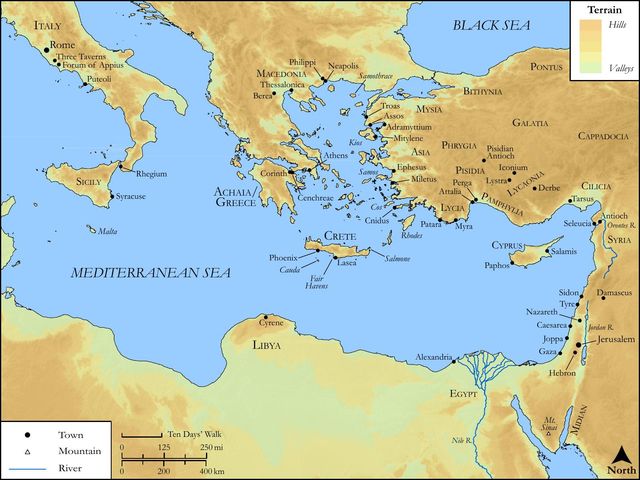
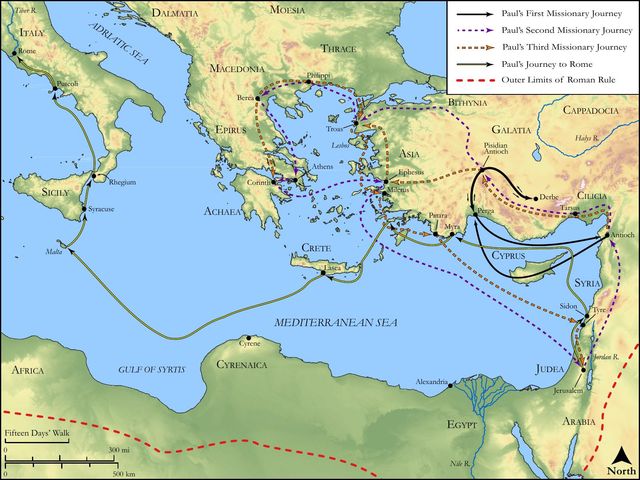
See on the biblical-era maps
Study this verse
Public-domain commentary
Matthew Henry
From his Commentary on the Whole Bible. Henry comments on passages, not single verses — this entry covers Acts 26:12–23. His four-level outline is real structure in the source text, so it is rendered as structure.
All who believe a God, and have a reverence for his sovereignty, must acknowledge that those who speak and act by his direction, and by warrant from him, are not to be opposed; for that is fighting against God. Now Paul here, by a plain and faithful narrative of matters of fact, makes it out to this august assembly that he had an immediate call from heaven to preach the gospel of Christ to the Gentile world, which was the thing that exasperated the Jews against him. He here shows,
I.That he was made a Christian by a divine power, notwithstanding all his prejudices against that way.
He was brought into it on a sudden by the hand of heaven; not compelled to confess Christ by outward force, as he had compelled others to blaspheme him, but by a divine and spiritual energy, by a revelation of Christ from above, both to him and in him: and this when he was in the full career of his sin, going to Damascus, to suppress Christianity by persecuting the Christians there, as hot as ever in the cause, his persecuting fury not in the least spent nor tired, nor was he tempted to give it up by the failing of his friends, for he had at this time as ample an authority and commission from the chief priests to persecute Christianity as ever he had, when he was obliged by a superior power to give up that, and accept another commission to preach up Christianity. Two things bring about this surprising change, a vision from heaven and a voice from heaven, which conveyed the knowledge of Christ to him by the two learning senses of seeing and hearing.
1.He saw a heavenly vision, the circumstances of which were such that it could not be a delusion - deciptio visus, but it was without doubt a divine appearance.
(1.)He saw a great light, a light from heaven, such as could not be produced by any art, for it was not in the night, but at mid day; it was not in a house where tricks might have been played with him, but it was in the way, in the open air; it was such a light as was above the brightness of the sun, outshone and eclipsed that (Isa 24:23), and this could not be the product of Paul's own fancy, for it shone round about those that journeyed with him: they were all sensible of their being surrounded with this inundation of light, which made the sun itself to be in their eyes a less light. The force and power of this light appeared in the effects of it; they all fell to the earth upon the sight of it, such a mighty consternation did it put them into; this light was lightning for its force, yet did not pass away as lightning, but continued to shine round about them. In Old Testament times God commonly manifested himself in the thick darkness, and made that his pavilion, Ch2 6:1. He spoke to Abraham in a great darkness (Gen 15:12), for that was a dispensation of darkness; but now that life and immortality were brought to light by the gospel Christ appeared in a great light. In the creation of grace, as of the world, the first thing created is light, Co2 4:6.
(2.)Christ himself appeared to him (Act 26:16): I have appeared to thee for this purpose. Christ was in this light, though those that travelled with Paul saw the light only, and not Christ in the light. It is not every knowledge that will serve to make us Christians, but it must be the knowledge of Christ.
2.He heard a heavenly voice, an articulate one, speaking to him; it is here said to be in the Hebrew tongue (which was not taken notice of before), his native language, the language of his religion, to intimate to him that though he must be sent among the Gentiles, yet he must not forget that he was a Hebrew, nor make himself a stranger to the Hebrew language. In what Christ said to him we may observe,
(1.)That he called him by his name, and repeated it (Saul, Saul), which would surprise and startle him; and the more because he was now in a strange place, where he thought nobody knew him.
(2.)That he convinced him of sin, of that great sin which he was now in the commission of, the sin of persecuting the Christians, and showed him the absurdity of it.
(3.)That he interested himself in the sufferings of his followers: Thou persecutest me (Act 26:14), and again, It is Jesus whom thou persecutest, Act 26:15. Little did Paul think, when he was trampling upon those that he looked upon as the burdens and blemishes of this earth, that he was insulting one that was so much the glory of heaven.
(4.)That he checked him for his wilful resistance of those convictions: It is hard for thee to kick against the pricks, or goads, as a bullock unaccustomed to the yoke. Paul's spirit at first perhaps began to rise, but he is told it is at his peril, and then he yields. Or, it was spoken by way of caution: "Take heed lest thou resist these convictions, for they are designed to affect thee, not to affront thee." (5.) That, upon his enquiry, Christ made himself known to him. Paul asked (Act 26:15), "Who art thou, Lord? Let me know who it is that speaks to me from heaven, that I may answer him accordingly?" And he said, "I am Jesus; he whom thou hast despised, and hated, and vilified; I bear that name which thou hast made so odious, and the naming of it criminal." Paul thought Jesus was buried in the earth, and, though stolen out of his own sepulchre, yet laid in some other. All the Jews were taught to say so, and therefore he is amazed to hear him speak from heaven, to see him surrounded with all this glory whom he had loaded with all possible ignominy. This convinced him that the doctrine of Jesus was divine and heavenly, and not only not to be opposed, but to be cordially embraced: That Jesus is the Messiah, for he has not only risen from the dead, but he has received from God the Father honour and glory; and this is enough to make him a Christian immediately, to quit the society of the persecutors, whom the Lord from heaven thus appears against, and to join himself with the society of the persecuted, whom the Lord from heaven thus appears for.
II.That he was made a minister by a divine authority:
That the same Jesus that appeared to him in that glorious light ordered him to go and preach the gospel to the Gentiles; he did not run without sending, nor was he sent by men like himself, but by him whom the Father sent, Joh 20:21. What is said of his being an apostle is here joined immediately to that which was said to him by the way, but it appears by Act 9:15, and Act 22:15, Act 22:17, etc., that it was spoken to him afterwards; but he puts the two together for brevity-sake: Rise, and stand upon thy feet. Those whom Christ, by the light of his gospel, casts down in humiliation for sin, shall find that it is in order to their rising and standing upon their feet, in spiritual grace, strength, and comfort. If Christ has torn, it is that he may heal; if he has cast down, it is that he may raise up. Rise then, and shake thyself from the dust (Isa 52:2), help thyself, and Christ shall help thee. He must stand up, for Christ shall help thee. He must stand up, for Christ has work for him to do - has an errand, and a very great errand, to send him upon: I have appeared to thee to make thee a minister. Christ has the making of his own ministers; they have both their qualifications and their commissions from him. Paul thanks Christ Jesus who put him into the ministry, Ti1 1:12. Christ appeared to him to make him a minister. One way or other, Christ will manifest himself to all those whom he makes his ministers; for how can those preach him who do not know him? And how can those know him to whom he does not by his spirit make himself known? Observe,
1.The office to which Paul is appointed: he is made a minister, to attend on Christ, and act for him, as a witness - to give evidence in his cause, and attest the truth of his doctrine. He must testify the gospel of the grace of God; Christ appeared to him that he might appear for Christ before men.
2.The matter of Paul's testimony: he must give an account to the world,
(1.)Of the things which he had seen, now at this time, must tell people of Christ's manifesting himself to him by the way, and what he said to him. He saw these things that he might publish them, and he did take all occasions to publish them, as here, and before, ch. 22.
(2.)Of those things in which he would appear to him. Christ now settled a correspondence with Paul, which he designed afterwards to keep up, and only told him now that he should hear further from him. Paul at first had but confused notions of the gospel, till Christ appeared to him and gave him fuller instructions. The gospel he preached he received from Christ immediately (Gal 1:12); but he received it gradually, some at one time and some at another, as there was occasion. Christ often appeared to Paul, oftener, it is likely, than is recorded, and still taught him, that he might still teach the people knowledge.
3.The spiritual protection he was taken under, while he was thus employed as Christ's witness: all the powers of darkness could not prevail against him till he had finished his testimony (Act 26:17), delivering thee from the people of the Jews and from the Gentiles. Note, Christ's witnesses are under his special care, and, though they may fall into the hands of the enemies, yet he will take care to deliver them out of their hands, and he knows how to do it. Christ had shown Paul at this time what great things he must suffer (Act 9:16), and yet tells him here he will deliver him from the people. Note, Great sufferings are reconcilable to the promise of the deliverance of God's people, for it is not promised that they shall be kept from trouble, but kept through it; and sometimes God delivers them into the hands of their persecutors that he may have the honour of delivering them out of their hands.
4.The special commission given him to go among the Gentiles, and the errand upon which he is sent to them; it was some years after Paul's conversion before he was sent to the Gentiles, or (for aught that appears) knew any thing of his being designed for that purpose (see Act 22:21); but at length he is ordered to steer his course that way.
(1.)There is great work to be done among the Gentiles, and Paul must be instrumental in doing it. Two things must be done, which their case calls for the doing of: - [1.] A world that sits in darkness must be enlightened; those must be brought to know the things that belong to their everlasting peace who are yet ignorant of them, to know God as their end, and Christ as their way, who as yet know nothing of either. He is sent to open their eyes, and to turn them from darkness to light. His preaching shall not only make known to them those things which they had not before heard of, but shall be the vehicle of that divine grace and power by which their understandings shall be enlightened to receive those things, and bid them welcome. Thus he shall open their eyes, which before were shut against the light, and they shall be willing to understand themselves, their own case and interest. Christ opens the heart by opening the eyes, does not lead men blindfold, but gives them to see their own way. He is sent not only to open their eyes for the present, but to keep them open, to turn them from darkness to light, that is, from following false and blind guides, their oracles, divinations, and superstitious usages, received by tradition from their fathers, and the corrupt notions and ideas they had of their gods, to follow a divine revelation of unquestionable certainty and truth. This was turning them from darkness to light, from the ways of darkness to those on which the light shines. The great design of the gospel is to instruct the ignorant, and to rectify the mistakes of those who are in error, that things may be set and seen in a true light. [2.] A world that lies in wickedness, in the wicked one, must be sanctified and reformed; it is not enough for them to have their eyes opened, they must have their hearts renewed; not enough to be turned from darkness to light, but they must be turned from the power of Satan unto God, which will follow of course; for Satan rules by the power of darkness, and God by the convincing evidence of light. Sinners are under the power of Satan; idolaters were so in a special manner, they paid their homage to devils. All sinners are under the influence of his temptations, yield themselves captives to him, are at his beck; converting grace turns them from under the dominion of Satan, and brings them into subjection to God, to conform to the rules of his word and comply with the dictates and directions of his Spirit, translates them out of the kingdom of darkness into the kingdom of his dear Son. When gracious dispositions are strong in the soul (as corrupt and sinful dispositions had been), it is then turned from the power of Satan unto God.
(2.)There is a great happiness designed for the Gentiles by this work - that they may receive forgiveness of sins, and inheritance among those who are sanctified; they are turned from the darkness of sin to the light of holiness, from the slavery of Satan to the service of God; not that God may be a gainer by them, but that they may be gainers by him.
[1.]That they may be restored to his favour, which by sin they have forfeited and thrown themselves out of: That they may receive forgiveness of sins. They are delivered from the dominion of sin, that they may be saved from that death which is the wages of sin. Not that they may merit forgiveness as a debt of reward, but that they may receive it as a free gift, that they may be qualified to receive the comfort of it. They are persuaded to lay down their arms, and return to their allegiance, that they may have the benefit of the act of indemnity, and may plead it in arrest of the judgment to be given against them.
[2.]That they may be happy in the fruition of him; not only that they may have their sins pardoned, but that they may have an inheritance among those who are sanctified by faith that is in me. Note, First, Heaven is an inheritance, it descends to all the children of God; for, if children, then heirs. That they may have, klēron - a lot (so it might be read), alluding to the inheritances of Canaan, which were appointed by lot, and that also is the act of God, the disposal thereof is of the Lord. That they may have a right, so some read it; not by merit, but purely by grace. Secondly, All that are effectually turned from sin to God are not only pardoned, but preferred - have not only their attainder reversed, but a patent of honour given to them, and a grant of a rich inheritance. And the forgiveness of sins makes way for this inheritance, by taking that out of the way which alone hindered. Thirdly, All that shall be saved hereafter are sanctified now; those that have the heavenly inheritance must have it in this way, they must be prepared and made meet for it. None can be happy that are not holy; nor shall any be saints in heaven that are not first saints on earth. Fourthly, We need no more to make us happy than to have our lot among those that are sanctified, to fare as they fare; this is having our lot among the chosen, for they are chosen to salvation through sanctification. Those who are sanctified shall be glorified. Let us therefore now cast in our lot among them, by coming into the communion of saints, and be willing to take our lot with them, and share with them in their afflictions, which (how grievous soever) our lot with them in the inheritance will abundantly make amends for. Fifthly, We are sanctified and saved by faith in Christ. Some refer it to the word next before, sanctified by faith, for faith purifies the heart, and applies to the soul those precious promises, and subjects the soul to the influence of that grace, by which we partake of a divine nature. Others refer it to the receiving of both pardon and the inheritance; it is by faith accepting the grant: it comes all to one; for it is by faith that we are justified, sanctified, and glorified. By faith, tē eis eme - that faith which is in me; it is emphatically expressed. That faith which not only receives divine revelation in general, but which in a particular manner fastens upon Jesus Christ and his mediation, by which we rely upon Christ as the Lord our righteousness, and resign ourselves to him as the Lord our ruler. This is that by which we receive the remission of sins, the gift of the Holy Ghost, and eternal life.
III.That he had discharged his ministry, pursuant to his commission, by divine aid, and under divine direction and protection.
God, who called him to be an apostle, owned him in his apostolical work, and carried him on in it with enlargement and success.
1.God gave him a heart to comply with the call (Act 26:19): I was not disobedient to the heavenly vision, for any one would say he ought to be obedient to it. Heavenly visions have a commanding power over earthly counsels, and it is at our peril if we be disobedient to them; yet if Paul had conferred with flesh and blood, and been swayed by his secular interest, he would have done as Jonah did, gone any where rather than upon this errand; but God opened his ear, and he was not rebellious. He accepted the commission, and, having with it received his instructions, he applied himself to act accordingly.
2.God enabled him to go through a great deal of work, though in it he grappled with a great deal of difficulty, Act 26:20. He applied himself to the preaching of the gospel with all vigour.
(1.)He began at Damascus, where he was converted, for he resolved to lose no time, Act 9:20.
(2.)When he came to Jerusalem, where he had his education, he there witnessed for Christ, where he had most furiously set himself against him, Act 9:29.
(3.)He preached throughout all the coasts of Judea, in the country towns and villages, as Christ had done; he made the first offer of the gospel to the Jews, as Christ had appointed, and did not leave them till they had wilfully thrust the gospel from them; and laid out himself for the good of their souls, labouring more abundantly than any of the apostles, nay perhaps then all put together.
3.His preaching was all practical. He did not go about to fill people's heads with airy notions, did not amuse them with nice speculations, nor set them together by the ears with matters of doubtful disputation, but he showed them, declared it, demonstrated it, that they ought,
(1.)To repent of their sins, to be sorry for them and to confess them, and enter into covenant against them; they ought to bethink themselves, so the word metanoein properly signifies; they ought to change their mind and change their way, and undo what they had done amiss.
(2.)To turn to God. They must not only conceive an antipathy to sin, but they must come into a conformity to God - must not only turn from that which is evil, but turn to that which is good; they must turn to God, in love and affection, and return to God in duty and obedience, and turn and return from the world and the flesh; this is that which is required from the whole revolted degenerate race of mankind, both Jews and Gentiles; epistrephein epi ton Theon - to turn back to God, even to him: to turn to him as our chief good and highest end, as our ruler and portion, turn our eye to him, turn our heart to him, and turn our feet unto his testimonies.
(3.)To do works meet for repentance. This was what John preached, who was the first gospel preacher, Mat 3:8. Those that profess repentance must practise it, must live a life of repentance, must in every thing carry it as becomes penitents. It is not enough to speak penitent words, but we must do works agreeable to those words. As true faith, so true repentance, will work. Now what fault could be found with such preaching as this? Had it not a direct tendency to reform the world, and to redress its grievances, and to revive natural religion?
4.The Jews had no quarrel with him but upon this account, that he did all he could to persuade people to be religious, and to bring them to God by bringing them to Christ (Act 26:21): It was for these causes, and no other, that the Jews caught me in the temple, and went about to kill me; and let any one judge whether these were crimes worthy of death or of bonds. He suffered ill, not only for doing well himself, but for doing good to others. They attempted to kill him; it was his precious life that they hunted for, and hated, because it was a useful life; they caught him in the temple worshipping God, and there they set upon him, as if the better place the better deed
5.He had no help but from heaven; supported and carried on by that, he went on in this great work (Act 26:22): "Having therefore obtained help of God, I continue unto this day; hestēka - I have stood, my life has been preserved, and my work continued; I have stood my ground, and have not been beaten off; I have stood to what I said, and have not been afraid nor ashamed to persist in it." It was now above twenty years since Paul was converted, and all that time he had been very busy preaching the gospel in the midst of hazards; and what was it that bore him up? Not any strength of his own resolutions, but having obtained help of God; for therefore, because the work was so great and he had so much opposition, he could not otherwise have gone on in it, but by help obtained of God. Note, Those who are employed in work for God shall obtain help from God; for he will not be wanting in necessary assistances to his servants. And our continuance to this day must be attributed to help obtained of God; we had sunk, if he had not borne us up - had fallen off, if he had not carried us on; and it must be acknowledged with thankfulness to his praise. Paul mentions it as an evidence that he had his commission from God that from him he had ability to execute it. The preachers of the gospel could never have done, and suffered, and prospered, as they did, if they had not had immediate help from heaven, which they would not have had if it had not been the cause of God that they were now pleading.
6.He preached no doctrine but what agreed with the scriptures of the Old Testament: He witnessed both to small and great, to young and old, rich and poor, learned and unlearned, obscure and illustrious, all being concerned in it. It was an evidence of the condescending grace of the gospel that it was witnessed to the meanest, and the poor were welcome to the knowledge of it; and of the incontestable truth and power of it that it was neither afraid nor ashamed to show itself to the greatest. The enemies of Paul objected against him that he preached something more than that men should repent, and turn to God, and do works meet for repentance. These indeed were but what the prophets of the old Testament had preached; but, besides these, he had preached Christ, and his death, and his resurrection, and this was what they quarrelled with him for, as appears by Act 25:19, that he affirmed Jesus to be alive: "And so I did," says Paul, "and so I do, but therein also I say no other than that which Moses and the prophets said should come; and what greater honour can be done to them than to show that what they foretold is accomplished, and in the appointed season too - that what they said should come is come, and at the time they prefixed?" Three things they prophesied, and Paul preached: - (1.) That Christ should suffer, that the Messiah should be a sufferer - pathētos; not only a man, and capable of suffering, but that, as Messiah, he should be appointed to sufferings; that his ignominious death should be not only consistent with, but pursuant of, his undertaking. The cross of Christ was a stumbling-block to the Jews, and Paul's preaching it was the great thing that exasperated them; but Paul stands to it that, in preaching that, he preached the fulfilling of the Old Testament predictions, and therefore they ought not only not to be offended at what he preached, but to embrace it, and subscribe to it. (2.) That he should be the first that should rise from the dead; not the first in time, but the first in influence - that he should be the chief of the resurrection, the head, or principal one, prōtos ex anastaseōs, in the same sense that he is called the first-begotten from the dead (Rev 1:5), and the first-born from the dead, Col 1:18. He opened the womb of the grave, as the first-born are said to do, and made way for our resurrection; and he is said to be the first-fruits of those that slept (Co1 15:20), for he sanctified the harvest. He was the first that rose from the dead to die no more; and, to show that the resurrection of all believers is in virtue of his, just when he arose many dead bodies of saints arose, and went into the holy city, Mat 27:52, Mat 27:53. (3.) That he should show light unto the people, and to the Gentiles, to the people of the Jews in the first place, for he was to be the glory of his people Israel. To them he showed light by himself, and then to the Gentiles by the ministry of his apostles, for he was to be a light to enlighten those who sat in darkness. In this Paul refers to his commission (Act 26:18), To turn them from darkness to light. He rose from the dead on purpose that he might show light to the people, that he might give a convincing proof of the truth of his doctrine, and might send it with so much the greater power, both among Jews and Gentiles. This also was foretold by the Old Testament prophets, that the Gentiles should be brought to the knowledge of God by the Messiah; and what was there in all this that the Jews could justly be displeased at?
Historical interpretation
Two Centuries of Reception
3 surviving comments on this verse. Each one is dated, so this reads as a timeline rather than a list.
Select a marker to jump to its quote. Markers stagger vertically where authors wrote within a few decades of each other.
Whence, again, David said that "the Lord would reign from the tree: " for elsewhere, too, the prophet predicts the fruit of this "tree," saying "The earth hath given her blessings," -of course that virgin-earth, not yet irrigated with rains, nor fertilized by showers, out of which man was of yore first formed, out of which now Christ through the flesh has been born of a virgin; "and the tree," he says, "hath brought his fruit," -not that "tree" in paradise which yielded death to the protoplasts, but the "tree" of the passion of Christ, whence life, hanging, was by you not believed! For this "tree" in a mystery, it was of yore wherewith Moses sweetened the bitter water; whence the People, which was perishing of thirst in the desert, drank and revived; just as we do, who, drawn out from the calamities of the heathendom in which we were tarrying perishing with thirst (that is, deprived of the divine word), drinking, "by the faith which is on Him," the baptismal water of the "tree" of the passion of Christ, have revived,-a faith from which Israel has fallen away, (as foretold) through Jeremiah, who says, "Send, and ask exceedingly whether such things have been done, whether nations will change their gods (and these are not gods!).
Observe how mildly he discourses-God, he says, said this to me, "that they may receive forgiveness of sins, and inheritance among them which are-sanctified by faith that is in Me." By these things, says he, I was persuaded, by this vision He drew me to Himself, and so persuaded me, that I made no delay.
Since he has mentioned the vision, he then without fear goes on to speak also of the good wrought by it. "To turn them from darkness to light, and from the power of Satan unto God. For to this end have I appeared unto thee," not to punish, but to make thee an Apostle. He shows the evils which possess unbelievers, "Satan, darkness;" the good things belonging to believers, light, God, "the inheritance of the saints."
Continue studying Acts 26:18 across the web’s major study libraries — every link below opens this exact verse, chapter, or book on the destination site.
Read & Compare
 BibleGatewayThis verse in more than 200 translations and 70 languages.
 Bible.comThe YouVersion reader — hundreds of translations, reading plans, and highlights.
 ESV.orgCrossway's official English Standard Version reader.
 NET BibleThe NET translation with 60,000+ translators' notes on every rendering decision.
 STEP BibleTyndale House's free study tool — original text, vocabulary, and scholarly resources.
 BibliaLogos Bible Software's free web reader.
 USCCBThe New American Bible (Revised Edition) with the U.S. bishops' study notes.
Commentaries
 BibleHub CommentariesDozens of classic commentaries on this verse, gathered on one page.
 StudyLightMore than 100 commentary sets — the largest collection on the web.
 BibleRefPlain-English commentary on what this verse means, verse by verse.
 Enduring WordDavid Guzik's free commentary on this chapter, widely used by Bible teachers.
 Bible Study ToolsVerse commentary alongside Greek and Hebrew study aids.
Original Language & Research
- BibleHub InterlinearThe verse word by word — original language, transliteration, and English.
- BibleHub LexiconEvery word's original-language definition and Strong's entry.
 Blue Letter BibleDeep-study tools — Strong's numbers, concordance, and word studies.
 CNTR CollationThe earliest Greek manuscripts of this verse, collated letter by letter.
Sermons, Hymns & Audio


TrulyRandomVerse is not affiliated with these sites and doesn’t control their content. They’re linked because they’re genuinely useful.
Summary
Acts 26:18 encapsulates the divine commission given to the Apostle Paul by the resurrected Jesus Christ, outlining the transformative purpose of his ministry to the Gentiles. This pivotal verse reveals that Paul's mission is to spiritually enlighten people, liberating them from the dominion of darkness and Satan's power, so they may turn to God, receive the forgiveness of sins, and inherit eternal blessings as those set apart by faith in Christ. It articulates the profound spiritual benefits and new identity available through the Gospel message.
Context
ShowHideLiterary Context
This verse is situated within Paul's eloquent defense before King Agrippa II, Bernice, and Governor Festus in Caesarea, as recorded in Acts 26. Paul, having been accused by Jewish leaders, is given the opportunity to explain his life and ministry. His speech is not merely a legal defense but a powerful personal testimony, recounting his dramatic conversion on the Damascus road and the subsequent divine mandate he received from Jesus Christ. Acts 26:18 specifically details the core components of that commission, serving as the theological justification for Paul's unwavering commitment to preaching the Gospel to both Jews and Gentiles, a mission that had led to his current imprisonment. It follows Paul's description of his encounter with the risen Christ and directly precedes his appeal for Agrippa to believe.
Historical & Cultural Context
Paul's appearance before Agrippa II and Festus occurred around A.D. 59-60. Festus, the new Roman procurator of Judea, inherited Paul's case from Felix and sought to resolve it, partly to appease the Jewish leaders in Jerusalem. King Agrippa II, a descendant of Herod the Great and ruler over various territories in the region, was well-versed in Jewish law and customs, making him an ideal, albeit politically motivated, audience for Paul's defense. The setting in Caesarea, a Roman administrative center, highlights the clash between Roman imperial authority, Jewish religious tradition, and the burgeoning Christian movement. Paul's message of spiritual transformation, forgiveness, and a new inheritance through faith in a crucified and resurrected Messiah would have been radical and potentially subversive in a culture deeply entrenched in legalistic and polytheistic systems, where "power" was often associated with earthly rulers or pagan deities.
Key Themes
ShowHideActs 26:18 contributes significantly to several overarching themes in the book of Acts and Paul's epistles. Firstly, it underscores the theme of Divine Commission and Apostolic Authority, demonstrating that Paul's ministry was not self-initiated but divinely ordained by the resurrected Christ, giving legitimacy to his controversial mission to the Gentiles (Acts 9:15). Secondly, the verse highlights the theme of Spiritual Transformation and Deliverance, emphasizing the radical shift from spiritual blindness and Satan's dominion to enlightenment and God's sovereignty (Colossians 1:13-14). Thirdly, it articulates the central Gospel themes of Forgiveness of Sins and Eternal Inheritance, which are foundational benefits of salvation through faith in Christ (Ephesians 1:7). Finally, the concept of Sanctification by Faith is prominent, asserting that believers are set apart for God's purposes not by works of the law, but solely through their trust in Jesus (Romans 3:28).
Exposition and Analysis
ShowHideKey Word Analysis
ShowHideFrom ἀνά and (to open), meaning to open up, literally or figuratively, in various applications. In this context, it signifies a spiritual unveiling or enlightenment, enabling those previously blind to perceive divine truth and reality. It implies a divine act that removes spiritual ignorance and allows for comprehension of the Gospel.
From ἔξεστι (in the sense of ability), denoting privilege, force, capacity, competency, freedom, or mastery, including delegated influence. Here, it refers to the dominion or authority of Satan over humanity, from which believers are delivered. It contrasts Satan's oppressive rule with God's liberating and benevolent authority.
From ἅγιος, meaning to make holy, purify, consecrate, or venerate. In Acts 26:18, it describes those who are set apart by God for His purposes, a state of holiness achieved not by human effort but as a result of God's work in those who place their faith in Christ. This is a positional sanctification that leads to progressive holiness.
Verse Breakdown
ShowHide"To open their eyes,"
This phrase refers to a spiritual awakening. Humanity, apart from Christ, is often depicted as spiritually blind, unable to perceive God's truth or their own need for salvation. Paul's mission, therefore, is to facilitate this divine opening of understanding, allowing people to see their sin, God's holiness, and the provision of salvation in Christ.
"and to turn them from darkness to light,"
This signifies a radical change in allegiance and spiritual state. "Darkness" represents spiritual ignorance, moral corruption, and the realm of sin and Satan's influence. "Light" symbolizes God's truth, holiness, and the illuminating presence of Christ. The turning implies a profound conversion, a reorientation of one's entire being from a life alienated from God to a life lived in His truth and presence.
"and from the power of Satan unto God,"
This clause emphasizes the liberation aspect of the Gospel. Before conversion, individuals are under the dominion and authority ("power") of Satan, manifesting in sin and spiritual bondage. The Gospel offers a decisive shift in lordship, transferring individuals from Satan's oppressive rule to the benevolent and sovereign reign of God.
"that they may receive forgiveness of sins,"
This highlights a core benefit of salvation. Forgiveness of sins addresses humanity's greatest need: reconciliation with a holy God. Through Christ's atoning sacrifice, the guilt and penalty of sin are removed, enabling a restored relationship with the Creator. This is a foundational and immediate blessing for those who believe.
"and inheritance among them which are sanctified by faith that is in me."
This final clause describes the ultimate outcome and identity of believers. "Inheritance" refers to the spiritual blessings, eternal life, and co-heirship with Christ that are the portion of God's children. "Sanctified" denotes being set apart or made holy by God. Crucially, this sanctification and the reception of the inheritance are "by faith that is in me" (referring to Christ), underscoring that these profound blessings are not earned by human merit but are gracious gifts received through trust in Jesus.
Literary Devices
ShowHideActs 26:18 is rich in Metaphor and Parallelism. The central metaphor is the transition "from darkness to light," which powerfully symbolizes the spiritual transformation from ignorance, sin, and Satan's dominion to divine truth, holiness, and God's liberating presence. This imagery is deeply rooted in biblical tradition, representing spiritual enlightenment and salvation. The verse also employs Parallelism in its structure: "to turn them from darkness to light, and from the power of Satan unto God." This balanced phrasing emphasizes the dual nature of conversion – a turning from a negative state (darkness, Satan's power) and a turning to a positive one (light, God). This rhetorical device enhances the clarity and impact of Paul's commission, highlighting the comprehensive nature of the salvation offered through Christ.
Theological and Thematic Connections
ShowHideActs 26:18 profoundly articulates the core theological truths of the Gospel, emphasizing that salvation is a comprehensive work of God that liberates individuals from spiritual bondage and grants them a new identity and destiny. It underscores the reality of humanity's fallen state, characterized by spiritual blindness and subjection to Satan's power, and presents the Gospel as God's powerful intervention to bring enlightenment, forgiveness, and a secure inheritance. This commission highlights the radical shift from a life alienated from God to one of intimate relationship and divine purpose, all made possible through faith in Jesus Christ. The verse thus serves as a foundational statement for understanding the nature of conversion, the benefits of salvation, and the ongoing mission of the church to proclaim this transformative message.
Reflection and Application
ShowHideActs 26:18 serves as a profound reminder of the Gospel's transformative power and our ongoing call to participate in God's mission. For those who have placed their faith in Christ, it celebrates the immense privilege of having our eyes opened, being delivered from spiritual darkness and Satan's grip, receiving the unfathomable gift of sin's forgiveness, and inheriting a glorious future among God's sanctified people. This verse compels us to gratitude for such a radical rescue and to live lives that reflect our new identity in Christ—lives set apart for God's purposes. Furthermore, it firmly establishes the enduring mission of the church: to continue Paul's work by proclaiming this same life-changing message to a world still in spiritual darkness, under the sway of sin and Satan. Our faith not only secures our salvation but also empowers us to be agents of God's light, truth, and liberation, testifying to His grace and inviting others into this same glorious inheritance.
Questions for Reflection
ShowHideFAQ
ShowHideWhat does "faith that is in me" specifically refer to in this verse?
ShowHideThe phrase "faith that is in me" (Greek: pístis hē en emoi) explicitly refers to faith in Jesus Christ, the speaker who commissioned Paul. This highlights that the forgiveness of sins and the inheritance among the sanctified are not achieved through adherence to the Law, human effort, or any other means, but solely through personal trust and reliance upon Jesus as the Messiah and Savior. It underscores the Christocentric nature of salvation, where Jesus Himself is both the object and the enabler of the saving faith. This emphasis on faith in Christ is a cornerstone of Paul's theology, consistently articulated throughout his epistles as the means by which humanity is justified and brought into a right relationship with God, as seen in passages like Romans 3:22 and Galatians 2:16.
Christ-Centered Fulfillment
ShowHideActs 26:18, though spoken by the resurrected Christ to Paul, finds its ultimate fulfillment in Jesus Himself and His redemptive work. The commission "to open their eyes, and to turn them from darkness to light" directly reflects Jesus' own ministry as the Light of the World, who came to illuminate those dwelling in spiritual obscurity, fulfilling ancient prophecies of a great light dawning on those in darkness (Isaiah 9:2, applied in Matthew 4:16). The deliverance "from the power of Satan unto God" is accomplished through Christ's decisive victory over sin and death on the cross, where He disarmed the spiritual rulers and authorities (Colossians 2:15) and through His resurrection, broke the power of the one who holds the power of death, that is, the devil (Hebrews 2:14). The "forgiveness of sins" is made possible solely by His atoning sacrifice, as His blood was shed for the remission of sins (Matthew 26:28, Ephesians 1:7). Finally, the "inheritance among them which are sanctified by faith that is in me" highlights that believers are sanctified and receive their inheritance in Christ, who is Himself our inheritance and the source of our holiness (Ephesians 1:11). Thus, every aspect of Paul's mission, as outlined in this verse, points to the person and finished work of Jesus Christ as the sole means of salvation and spiritual transformation.