


Genesis 26:34
- וַיְהִיvay·Hiand he wasH1961Conj-w ¦ V-Qal-ConsecImperf-3msVerb Qal Consecutive Imperfect 3rd Singular Masculineוַandיְהִיhe was
- עֵשָׂו'e·SavEsauH6215N-proper-mNoun Proper Masculine
- בֶּןbena son ofH1121N-mscNoun Singular Masculine Construct
- אַרְבָּעִים'ar·ba·'ImfortyH705Adj-mpAdjective Numerical Plural Masculine Absolute
- שָׁנָהsha·Nahyear[s]H8141N-fsNoun Singular Feminine Absolute
- וַיִּקַּחvai·yi·Kachand he tookH3947Conj-w ¦ V-Qal-ConsecImperf-3msVerb Qal Consecutive Imperfect 3rd Singular Masculineוַandיִּקַּחhe took
- אִשָּׁה'i·Shaha wifeH802N-fsNoun Singular Feminine Absolute
- אֶת'et<obj.>H853DirObjMParticle Object Indicator
- יְהוּדִיתye·hu·DitJudithH3067N-proper-fNoun Proper Feminine
- בַּתbat[the] daughter ofH1323N-fscNoun Singular Feminine Construct
- בְּאֵרִיbe·'e·RiBeeriH882N-proper-mNoun Proper Masculine
- הַחִתִּיha·chi·Tithe HittiteH2850Art ¦ N-msNoun Gentilic Singular Masculine AbsoluteהַtheחִתִּיHittite
- וְאֶתve·'Etand <obj.>H853Conj-w ¦ DirObjMParticle Object Indicatorוְandאֶת<obj.>
- בָּשְׂמַתba·se·MatBasemathH1315N-proper-fNoun Proper Feminine
- בַּתbat[the] daughter ofH1323N-fscNoun Singular Feminine Construct
- אֵילֹן'ei·LonElonH356N-proper-mNoun Proper Masculine
- הַחִתִּיHa·chi·Tithe HittiteH2850Art ¦ N-msNoun Gentilic Singular Masculine AbsoluteהַtheחִתִּיHittite
English is a literal word-by-word gloss of the Hebrew, not the KJV's wording. Why?
This is the original text the KJV's translators worked from — each Hebrew word with its own literal English meaning in this verse, prepared by scholars at Tyndale House, Cambridge. The KJV translates whole sentences, not word by word, so its wording differs: one Hebrew word can become several English words, and the KJV may choose “the LORD” where the gloss reads “Yahweh”. Both are faithful — they answer different questions. For the KJV's own rendering, switch to the KJV text.
Details
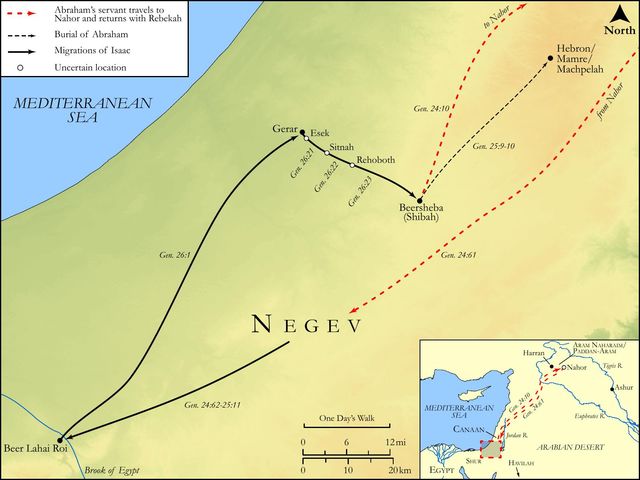
See on the biblical-era maps


Study this verse
Public-domain commentary
Matthew Henry
From his Commentary on the Whole Bible. Henry comments on passages, not single verses — this entry covers Genesis 26:34–35.
Here is, 1. Esau's foolish marriage - foolish, some think, in marrying two wives together, for which perhaps he is called a fornicator (Heb 12:16), or rather in marrying Canaanites, who were strangers to the blessing to Abraham, and subject to the curse of Noah, for which he is called profane; for hereby he intimated that he neither desired the blessing nor dreaded the curse of God. 2. The grief and trouble it created to his tender parents. (1.) It grieved them that he married without asking, or at least without taking, their advice and consent: see whose steps those children tread in who either contemn or contradict their parents in disposing of themselves. (2.) It grieved them that he married the daughters of Hittites, who had no religion among them; for Isaac remembered his father's care concerning him, that he should by no means marry a Canaanite. (3.) It should seem, the wives he married were provoking in their conduct towards Isaac and Rebekah; those children have little reason to expect the blessing of God who do that which is a grief of mind to their good parents.
Continue studying Genesis 26:34 across the web’s major study libraries — every link below opens this exact verse, chapter, or book on the destination site.
Read & Compare
 BibleGatewayThis verse in more than 200 translations and 70 languages.
 Bible.comThe YouVersion reader — hundreds of translations, reading plans, and highlights.
 ESV.orgCrossway's official English Standard Version reader.
 NET BibleThe NET translation with 60,000+ translators' notes on every rendering decision.
 STEP BibleTyndale House's free study tool — original text, vocabulary, and scholarly resources.
 BibliaLogos Bible Software's free web reader.
 USCCBThe New American Bible (Revised Edition) with the U.S. bishops' study notes.
Commentaries
 BibleHub CommentariesDozens of classic commentaries on this verse, gathered on one page.
 StudyLightMore than 100 commentary sets — the largest collection on the web.
 BibleRefPlain-English commentary on what this verse means, verse by verse.
 Enduring WordDavid Guzik's free commentary on this chapter, widely used by Bible teachers.
 Bible Study ToolsVerse commentary alongside Greek and Hebrew study aids.
Original Language & Research
- BibleHub InterlinearThe verse word by word — original language, transliteration, and English.
- BibleHub LexiconEvery word's original-language definition and Strong's entry.
 Blue Letter BibleDeep-study tools — Strong's numbers, concordance, and word studies.
 SefariaThe Hebrew text with Rashi and centuries of Jewish commentary.
Sermons, Hymns & Audio


TrulyRandomVerse is not affiliated with these sites and doesn’t control their content. They’re linked because they’re genuinely useful.
Summary
Genesis 26:34 records Esau's pivotal decision at forty years old to marry two Hittite women, Judith and Bashemath. This choice, made at an age signifying maturity, directly defied the established covenantal practice of endogamy within the Abrahamic lineage, which sought to preserve spiritual purity and distinctness from idolatrous Canaanite peoples. His actions immediately caused profound grief and bitterness to his parents, Isaac and Rebekah, serving as a stark indicator of Esau's ongoing disregard for his spiritual inheritance and foreshadowing the eventual divergence of the two brothers' paths.
Context
ShowHideLiterary Context
This verse serves as a crucial narrative pivot within the broader patriarchal history of Genesis, specifically following the account of Isaac's prosperity in Gerar and his interactions with Abimelech. It immediately precedes and sets the stage for the profound sorrow and bitterness Esau's marriages inflict upon Isaac and Rebekah, as explicitly stated in Genesis 26:35. The narrative then shifts to the intense sibling rivalry between Esau and Jacob, culminating in Jacob's deception to secure the blessing and his subsequent flight, largely motivated by Rebekah's desire to prevent Jacob from making similar marital mistakes (Genesis 27:46 and Genesis 28:1-2). Esau's choices here are intentionally contrasted with Abraham's meticulous efforts to secure a wife for Isaac from among his own kin, demonstrating a clear departure from the family's spiritual priorities (Genesis 24).
Historical & Cultural Context
The Hittites were a significant non-Israelite people group inhabiting Canaan during the patriarchal period, identified as one of the nations whose land God promised to Abraham's descendants. Their culture was distinct, often characterized by polytheistic worship and practices that stood in direct opposition to the monotheistic faith of Abraham and his descendants. For the patriarchs, intermarriage with Canaanite peoples was implicitly understood as a threat to the spiritual purity and distinct identity of the covenant community. While not yet codified as law, the narrative consistently portrays such unions as problematic, leading to spiritual compromise and familial distress. Esau's choice of two Hittite wives, therefore, was not merely a personal preference but a culturally and spiritually significant act that aligned him with the surrounding pagan world rather than the covenant community.
Key Themes
ShowHideThis verse contributes to several overarching themes in Genesis. It powerfully illustrates the theme of covenant fidelity versus worldly compromise, as Esau's actions stand in stark contrast to the spiritual lineage's commitment to distinctness. It highlights the significance of marital choices and their profound impact on family dynamics, spiritual heritage, and future generations, echoing the careful arrangements made for Isaac's marriage in Genesis 24. The narrative also underscores the theme of spiritual discernment, or lack thereof, on Esau's part, further developing his character as one who consistently prioritizes immediate gratification and worldly concerns over his spiritual inheritance, a trait previously seen in his despising of his birthright (Genesis 25:29-34).
Exposition and Analysis
ShowHideKey Word Analysis
ShowHideDerived from a root meaning "rough" or "hairy," reflecting his physical appearance at birth. This name, however, also subtly hints at his character—a man of the outdoors, impulsive, and perhaps unrefined in his spiritual sensibilities. His actions throughout Genesis consistently portray him as prioritizing the tangible and immediate over the spiritual and future, making his choice of wives consistent with this "rough" or worldly disposition.
A primitive root meaning "to take" in a wide variety of applications, including to acquire, buy, or receive. In this context, it signifies Esau's active decision to "take to wife," indicating a deliberate act of marriage. The use of this verb emphasizes that his marital choices were not accidental but a conscious decision made at a mature age, underscoring his personal responsibility for the consequences that followed.
A patronymic term referring to a descendant of Heth, one of the sons of Canaan. The Hittites were a prominent Canaanite people group, known for their idolatrous practices and distinct culture. Their identification here is crucial, as it immediately signals to the reader that Esau's wives were from outside the covenant community, representing a spiritual compromise and a deviation from the family's established pattern of endogamy.
Verse Breakdown
ShowHide"And Esau was forty years old"
This opening clause establishes the age of Esau at the time of his marriage. In biblical narratives, the age of forty often signifies a period of maturity, significant transition, or testing. For Esau, it highlights that this was not a youthful, impulsive decision but a choice made by a man considered to be in the prime of his life, capable of responsible judgment. This underscores the deliberate nature of his actions and their subsequent impact.
"when he took to wife Judith the daughter of Beeri the Hittite"
This introduces Esau's first wife, Judith, and her lineage. The explicit mention of her father, Beeri, and her ethnic identity as a "Hittite" is highly significant. It immediately signals that Esau has chosen a spouse from among the Canaanite peoples, who were outside the covenant community and known for their idolatrous practices. This choice stands in direct contrast to Abraham's careful arrangement for Isaac's marriage to Rebekah, who was from his own kin.
"and Bashemath the daughter of Elon the Hittite"
This second clause reveals that Esau took a second wife, Bashemath, also identified as a "Hittite" and the daughter of Elon. The fact that he took two wives, both from the same proscribed people group, further emphasizes his disregard for the spiritual and familial expectations of his heritage. This polygamous union with foreign women would become a source of great distress for his parents, as the subsequent verse details.
Literary Devices
ShowHideThe verse employs Foreshadowing, subtly hinting at the future discord and grief that Esau's choices will bring to his parents, which is explicitly stated in the very next verse (Genesis 26:35). There is also a strong element of Contrast, as Esau's casual and seemingly self-serving marital decisions are set against the meticulous and spiritually guided efforts of Abraham to secure a wife for Isaac from within their own kin (Genesis 24). This highlights Esau's spiritual insensitivity compared to the covenantal consciousness of his forefathers. Finally, the mention of "Hittite" serves as Symbolism, representing the worldly and idolatrous influences that threaten the purity and distinctness of the Abrahamic lineage.
Theological and Thematic Connections
ShowHideEsau's marriage to Hittite women at forty years old profoundly illustrates the tension between covenant fidelity and worldly compromise, a recurring theme throughout biblical history. His choice reflects a lack of spiritual discernment and a disregard for the distinct identity of God's chosen people, contrasting sharply with the careful preservation of the covenant line exemplified by Abraham and Isaac. This narrative underscores the theological principle that significant life decisions, particularly those concerning marriage, have profound spiritual implications, affecting not only the individuals involved but also the family unit and the broader spiritual heritage. It serves as a cautionary tale about the consequences of prioritizing immediate gratification or cultural assimilation over adherence to divine principles and familial wisdom.
Reflection and Application
ShowHideEsau's marital choices in Genesis 26:34 offer timeless wisdom for believers today, particularly regarding the profound impact of our most significant life decisions. His disregard for his family's spiritual heritage and the covenant principles serves as a poignant reminder that choices, especially in marriage, are not merely personal but carry far-reaching consequences for our spiritual walk, our families, and our legacy. For Christians, the principle of being "unequally yoked" with unbelievers, as articulated in 2 Corinthians 6:14, finds a powerful Old Testament illustration in Esau's actions. This narrative encourages us to seek God's wisdom and guidance in all major life decisions, particularly those that shape our closest relationships. It challenges us to consider whether our choices align with our core spiritual values and the pursuit of God's kingdom, or if they reflect a worldly mindset that prioritizes immediate gratification over long-term spiritual health and harmony within the family of faith. Ultimately, Esau's story calls us to cultivate spiritual discernment and prioritize covenant faithfulness in every aspect of our lives.
Questions for Reflection
ShowHideFAQ
ShowHideWhy was Esau's marriage choice problematic?
ShowHideEsau's choice was problematic because he married two Hittite women, Judith and Bashemath, who were part of the Canaanite peoples. These nations were known for their idolatrous practices and customs that were contrary to the worship of the one true God. The Abrahamic covenant, under which Isaac and Rebekah lived, implicitly discouraged intermarriage with these nations to preserve the spiritual purity and distinct identity of God's chosen lineage. This decision showed a clear disregard for his family's spiritual heritage and caused great grief to his parents, as noted in Genesis 26:35.
What is the significance of Esau being "forty years old"?
ShowHideIn biblical narratives, the age of forty often symbolizes maturity, a period of testing, or a significant life transition. For Esau, reaching forty years old highlights that his decision to marry these women was not an impulsive youthful act but a choice made at an age typically associated with responsibility and considered judgment. This underscores the deliberate nature of his disregard for his family's spiritual values and the covenantal expectations.
Who were the Hittites, and why were they significant here?
ShowHideThe Hittites were a prominent people group with a significant presence in Canaan during the patriarchal period, explicitly listed as one of the nations whose land God promised to Abraham's descendants. Their mention here is crucial because they were one of the indigenous Canaanite nations whose cultural and religious practices were idolatrous and contrary to the worship of the one true God. Intermarriage with such populations was generally discouraged by God's people to preserve their distinct identity and faith, making Esau's choice a direct affront to the covenant and a source of spiritual contamination for the family.
How did Esau's marriage choices reflect his character?
ShowHideEsau's decision to marry Hittite women further revealed his worldly and pragmatic nature, consistent with his character portrayal throughout Genesis. It demonstrated a lack of spiritual foresight and a tendency to prioritize immediate personal gratification or convenience over long-term spiritual implications and familial harmony. This aligns with his earlier action of casually selling his birthright for a meal (Genesis 25:29-34), indicating a consistent pattern of despising his spiritual inheritance and valuing the temporal over the eternal.
Christ-Centered Fulfillment
ShowHideEsau's worldly choices in marriage, which brought bitterness, division, and a clear departure from the covenantal path, stand in stark contrast to the perfect obedience and unifying work of Jesus Christ. While Esau pursued immediate gratification and familial compromise, aligning himself with the world, Christ perfectly fulfilled the covenant, not through an earthly lineage preserved by strict endogamy, but through His own sinless life, atoning death, and glorious resurrection. He established a new covenant, not based on physical descent or cultural purity, but on spiritual new birth, uniting believers from every tribe, tongue, and nation into one body, His Church (Ephesians 2:14-16). Christ is the ultimate "spouse" of the Church, calling His people to an exclusive and pure devotion, free from the entanglements and idolatries of the world (2 Corinthians 11:2). His sacrifice cleanses and purifies His bride, enabling His followers to make choices that honor God and build up the spiritual family, unlike Esau's choices that caused grief and foreshadowed separation. In Christ, the divisions caused by sin and worldly compromise are overcome, and true spiritual alignment, unity, and harmony are found, fulfilling the deepest longings for a pure and devoted people that Esau's actions so tragically failed to achieve.