


Genesis 13:11
- וַיִּבְחַרvai·yiv·charand he choseH977Conj-w ¦ V-Qal-ConsecImperf-3msVerb Qal Consecutive Imperfect 3rd Singular Masculineוַandיִּבְחַרhe chose
- לוֹlofor <the> himselfPrep-l ¦ 3msSuffix Personal 3rd Singular Masculineלfor <the>וֹhimself
- לוֹטLotLotH3876N-proper-mNoun Proper Masculine
- אֵת'et<obj.>H853DirObjMParticle Object Indicator
- כָּלkolallH3605N-mscNoun Singular Masculine Construct
- כִּכַּרki·Kar[the] valley ofH3603N-fscNoun Singular Feminine Construct
- הַיַּרְדֵּןhai·yar·Denthe JordanH3383Art ¦ N-properNoun Proper LocationהַtheיַּרְדֵּןJordan
- וַיִּסַּעvai·yi·Sa'and he set outH5265Conj-w ¦ V-Qal-ConsecImperf-3msVerb Qal Consecutive Imperfect 3rd Singular Masculineוַandיִּסַּעhe set out
- לוֹטLotLotH3876N-proper-mNoun Proper Masculine
- מִקֶּדֶםmi·Ke·demfrom [the] eastH6924Prep-m ¦ N-msNoun Singular Masculine Absoluteמִfromקֶּדֶם[the] east
- וַיִּפָּרְדוּvai·yi·Pa·re·Duand they separatedH6504Conj-w ¦ V-Niphal-ConsecImperf-3mpVerb Niphal Consecutive Imperfect 3rd Plural Masculineוַandיִּפָּרְדוּthey separated
- אִישׁ'isheachH376N-msNoun Singular Masculine Absolute
- מֵעַלme·'Alfrom withH5921Prep-m ¦ PrepPrepositionמֵfromעַלwith
- אָחִיו'a·Chivhis brotherH251N-msc ¦ 3msNoun Singular Masculine Constructאָחִיbrotherוhis
English is a literal word-by-word gloss of the Hebrew, not the KJV's wording. Why?
This is the original text the KJV's translators worked from — each Hebrew word with its own literal English meaning in this verse, prepared by scholars at Tyndale House, Cambridge. The KJV translates whole sentences, not word by word, so its wording differs: one Hebrew word can become several English words, and the KJV may choose “the LORD” where the gloss reads “Yahweh”. Both are faithful — they answer different questions. For the KJV's own rendering, switch to the KJV text.
Details
See on the biblical-era map


Study this verse
Public-domain commentary
Matthew Henry
From his Commentary on the Whole Bible. Henry comments on passages, not single verses — this entry covers Genesis 13:10–13. His three-level outline is real structure in the source text, so it is rendered as structure.
We have here the choice that Lot made when he parted from Abram. Upon this occasion, one would have expected, 1. That he should have expressed an unwillingness to part from Abram, and that, at least, he should have done it with reluctancy. 2. That he should have been so civil as to have remitted the choice back again to Abram. But we find not any instance of deference or respect to his uncle in the whole management. Abram having offered him the choice, without compliment he accepted it, and made his election. Passion and selfishness make men rude. Now, in the choice which Lot made, we may observe,
I.How much he had an eye to the goodness of the land.
He beheld all the plan of Jordan, the flat country in which Sodom stood, that it was admirably well watered every where (and perhaps the strife had been about water, which made him particularly fond of that convenience), and so Lot chose all that plain, Gen 13:10, Gen 13:11. That valley, which was like the garden of Eden itself, now yielded him a most pleasant prospect. It was, in his eye, beautiful for situation, the joy of the whole earth; and therefore he doubted not but that it would yield him a comfortable settlement, and that in such a fruitful soil he should certainly thrive, and grow very rich: and this was all he looked at. But what came of it? Why, the next news we hear of him is that he is in the briars among them, he and his carried captive. While he lived among them, he vexed his righteous soul with their conversation, and never had a good day with them, till, at last, God fired the town over his head, and forced him to the mountain for safety who chose the plain for wealth and pleasure. Note, Sensual choices are sinful choices, and seldom speed well. Those who in choosing relations, callings, dwellings, or settlements are guided and governed by the lusts of the flesh, the lusts of the eye, or the pride of life, and consult not the interests of their souls and their religion, cannot expect God's presence with them, nor his blessing upon them, but are commonly disappointed even in that which they principally aimed at, and miss of that which they promised themselves satisfaction in. In all our choices this principle should overrule us, That that is best for us which is best for our souls.
II.How little he considered the wickedness of the inhabitants: But the men of Sodom were wicked, Gen 13:13. Note,
1.Though all are sinners, yet some are greater sinners than others. The men of Sodom were sinners of the first magnitude, sinners before the Lord, that is, impudent daring sinners; they were so to a proverb. Hence we read of those that declare their sin as Sodom, they hide it not, Isa 3:9.
2.That some sinners are the worse for living in a good land. So the Sodomites were: for this was the iniquity of Sodom, pride, fulness of bread, and abundance of idleness; and all these were supported by the great plenty their country afforded, Eze 16:49. Thus the prosperity of fools destroys them.
3.That God often gives great plenty to great sinners. Filthy Sodomites dwell in a city, in a fruitful plain, while faithful Abram and his pious family dwell in tents upon the barren mountains.
4.When wickedness has come to the height, ruin is not far off. Abounding sins are sure presages of approaching judgments. Now Lot's coming to dwell among the Sodomites may be considered,
(1.)As a great mercy to them, and a likely means of bringing them to repentance; for now they had a prophet among them and a preacher of righteousness, and, if they had hearkened to him, they might have been reformed, and the ruin prevented. Note, God sends preachers, before he sends destroyers; for he is not willing that any should perish.
(2.)As a great affliction to Lot, who was not only grieved to see their wickedness (Pe2 2:7, Pe2 2:8), but was molested and persecuted by them, because he would not do as they did. Note, It has often been the vexatious lot of good men to live among wicked neighbours, to sojourn in Mesech (Psa 120:5), and it cannot but be the more grievous, if, as Lot here, they have brought it upon themselves by an unadvised choice.
Historical interpretation
Historical reception
1 surviving comment on this verse from the historical church.
How appropriately then Scripture says, “Lot,” that is, deviation, “chose for himself.” Indeed, God has placed before us good and evil, so that each may choose what he wishes. Let us not then choose that which is more pleasing at first sight but that which is truly better, so that, having been granted the ability to choose what is preferable, we lift up our eyes and be attracted by false beauty while we leave concealed the truth of nature, as one who looks the other way.
Continue studying Genesis 13:11 across the web’s major study libraries — every link below opens this exact verse, chapter, or book on the destination site.
Read & Compare
 BibleGatewayThis verse in more than 200 translations and 70 languages.
 Bible.comThe YouVersion reader — hundreds of translations, reading plans, and highlights.
 ESV.orgCrossway's official English Standard Version reader.
 NET BibleThe NET translation with 60,000+ translators' notes on every rendering decision.
 STEP BibleTyndale House's free study tool — original text, vocabulary, and scholarly resources.
 BibliaLogos Bible Software's free web reader.
 USCCBThe New American Bible (Revised Edition) with the U.S. bishops' study notes.
Commentaries
 BibleHub CommentariesDozens of classic commentaries on this verse, gathered on one page.
 StudyLightMore than 100 commentary sets — the largest collection on the web.
 BibleRefPlain-English commentary on what this verse means, verse by verse.
 Enduring WordDavid Guzik's free commentary on this chapter, widely used by Bible teachers.
 Bible Study ToolsVerse commentary alongside Greek and Hebrew study aids.
Original Language & Research
- BibleHub InterlinearThe verse word by word — original language, transliteration, and English.
- BibleHub LexiconEvery word's original-language definition and Strong's entry.
 Blue Letter BibleDeep-study tools — Strong's numbers, concordance, and word studies.
 SefariaThe Hebrew text with Rashi and centuries of Jewish commentary.
Sermons, Hymns & Audio


TrulyRandomVerse is not affiliated with these sites and doesn’t control their content. They’re linked because they’re genuinely useful.
Summary
Genesis 13:11 marks a defining moment in the narrative of Abram and Lot, depicting Lot's decisive choice of the fertile Plain of Jordan and the subsequent physical separation between the two patriarchs. This decision, driven by the immediate appeal of material prosperity, subtly foreshadows Lot's entanglement with the moral decay of Sodom and Gomorrah, contrasting sharply with Abram's path of faith and trust in divine provision. The verse underscores the profound consequences of choices rooted in worldly desire versus spiritual discernment.
Context
ShowHideLiterary Context
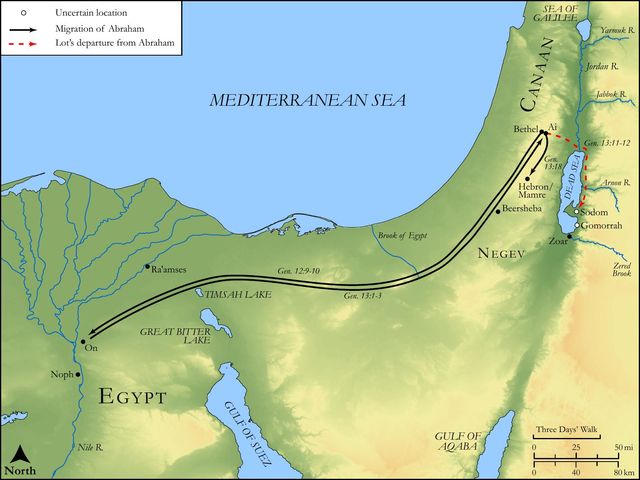
Genesis 13 opens with Abram and Lot returning from Egypt, having accumulated great wealth in livestock, silver, and gold. This prosperity, however, led to contention between their herdsmen, as the land could not sustain both their large flocks and herds living together. In a remarkable display of generosity and peacemaking, Abram offers Lot the first choice of land to avoid further strife, stating, "Let there be no strife, I pray thee, between me and thee, and between my herdmen and thy herdmen; for we be brethren. Is not the whole land before thee? separate thyself, I pray thee, from me: if thou wilt take the left hand, then I will go to the right; or if thou depart to the right hand, then I will go to the left" (Genesis 13:8-9). Lot's subsequent action in Genesis 13:10 involves surveying the land and choosing the well-watered Plain of Jordan, setting the stage for the separation described in verse 11 and the divergent destinies of the two families.
Historical & Cultural Context
In the ancient Near East, access to water and fertile pasturage was paramount for nomadic pastoralists like Abram and Lot. The "plain of Jordan" or "kikkâr" (circle) of Jordan, refers to the fertile valley of the Jordan River, particularly the southern end where the cities of Sodom and Gomorrah were located. This region was renowned for its lushness, likened to "the garden of the LORD" and "the land of Egypt" (Genesis 13:10), making it an extremely desirable area for grazing. However, this material abundance was juxtaposed with the moral depravity of its inhabitants, a fact that would become critically important later in the narrative. The decision to separate was a practical solution to resource competition, but Lot's specific choice reveals a prioritization of visible prosperity over potential moral hazards.
Key Themes
ShowHideThis verse contributes significantly to several key themes within Genesis. It highlights the theme of Choice and Consequence, as Lot's decision, seemingly pragmatic, leads him into the sphere of Sodom's wickedness. It further develops the contrast between Faith and Sight, where Lot chooses based on what he sees (the lushness of the plain), while Abram, by allowing Lot first choice, demonstrates trust in God's unseen provision. The theme of Worldliness versus Spiritual Discernment is also prominent; Lot's attraction to the "well watered" land, despite its proximity to morally corrupt cities, underscores a materialistic worldview. Conversely, Abram's subsequent blessing by God immediately after Lot's departure (Genesis 13:14-17) reinforces the theme of Divine Providence and God's faithfulness to those who prioritize His will.
Exposition and Analysis
ShowHideKey Word Analysis
ShowHideThis primitive root means "to try, i.e., (by implication) select." Lot's action here is a deliberate and active selection, indicating a conscious decision-making process. It implies a preference based on his assessment of the available options, highlighting his agency in determining his future path.
Derived from a word meaning "circle," this term refers to a circumjacent tract or region, specifically the fertile, circular valley of the Jordan River. Its use here emphasizes the geographical allure of the area Lot selected—a naturally abundant and well-watered region, appealing for its immediate material benefits for his flocks and herds.
This primitive root means "to break through, i.e., spread or separate (oneself)." It signifies a complete division or parting. In this context, it marks the physical and, more profoundly, the spiritual divergence between Abram and Lot, leading them down distinct paths with vastly different outcomes.
Verse Breakdown
ShowHide"Then Lot chose him all the plain of Jordan"
This clause describes Lot's decisive action. He surveys the land and, based on its visible fertility and abundance, makes a comprehensive choice of the entire Jordan plain for himself. This highlights his prioritization of material prosperity and immediate gain, which, while seemingly logical from a pastoral perspective, overlooks the moral climate of the region's inhabitants.
"and Lot journeyed east"
This phrase denotes Lot's physical movement. The eastward direction in biblical narratives often carries symbolic weight, frequently associated with departure from God's presence or a move towards judgment (e.g., the expulsion from the Garden of Eden or Cain's banishment to the land of Nod, east of Eden in Genesis 4:16). For Lot, this eastward journey literally positions him closer to the morally corrupt cities of Sodom and Gomorrah, foreshadowing his increasing entanglement with their wickedness.
"and they separated themselves the one from the other"
This final clause marks the culmination of the decision and movement. It signifies a complete and irreversible physical parting between Abram and Lot. More than a mere geographical division, it represents a profound divergence in their spiritual trajectories, with Abram continuing on a path of faith and Lot gravitating towards worldliness and its inherent dangers.
Literary Devices
ShowHideThe verse effectively employs several literary devices to convey its profound meaning. Symbolism is evident in Lot's choice of the "plain of Jordan," which, while materially appealing, symbolizes a worldly focus that prioritizes visible prosperity over spiritual discernment. The direction "east" also carries strong symbolic weight, historically representing a movement away from God's immediate presence or towards judgment, thus foreshadowing Lot's eventual entanglement with the wickedness of Sodom and Gomorrah. Furthermore, the narrative implicitly uses contrast by setting Lot's self-serving choice against Abram's earlier selfless generosity, highlighting their divergent spiritual priorities and setting the stage for their contrasting destinies.
Theological and Thematic Connections
ShowHideLot's choice in Genesis 13:11 serves as a foundational moment for understanding the biblical themes of discernment, the dangers of worldliness, and the consequences of prioritizing material gain over spiritual integrity. His decision, driven by what appeared to be the most advantageous land, ultimately led him into a morally compromised environment, highlighting how seemingly good choices can have devastating spiritual ramifications if not guided by divine wisdom. This narrative implicitly contrasts with Abram's subsequent experience of renewed divine promises, demonstrating God's faithfulness to those who trust Him and prioritize peace and righteousness.
Reflection and Application
ShowHideGenesis 13:11 offers a powerful and enduring lesson for believers today, challenging us to critically examine the motivations behind our own choices. Lot's story is a poignant reminder that what appears most appealing or advantageous from a worldly perspective may carry hidden spiritual dangers. Are our decisions primarily driven by material gain, social status, or immediate comfort, or are they rooted in a desire to honor God and align with His will? This verse calls us to cultivate spiritual discernment, seeking God's wisdom through prayer and His Word, rather than relying solely on our own sight or the world's allure. It encourages us to prioritize righteousness, peace, and spiritual integrity, trusting that God will provide for those who seek His kingdom first, just as He abundantly blessed Abram after Lot's departure. We are reminded that true prosperity is not merely material, but spiritual, found in faithful obedience and communion with God.
Questions for Reflection
ShowHideFAQ
ShowHideWhy did Lot choose the Plain of Jordan, knowing its proximity to wicked cities?
ShowHideLot's choice, as described in Genesis 13:10, was primarily driven by the land's apparent fertility and prosperity. It was "well watered everywhere, as the garden of the LORD, like the land of Egypt." While the wickedness of Sodom is explicitly mentioned later in Genesis 13:13, it is likely that Lot initially prioritized immediate material advantage and lush pasturage for his flocks over spiritual discernment regarding the moral environment. His decision highlights a worldly perspective where visible gain overshadows potential spiritual danger, demonstrating a lack of foresight or concern for the moral implications of his proximity to such depravity.
What is the significance of Lot journeying "east"?
ShowHideIn biblical narratives, the direction "east" often carries significant symbolic weight, frequently signifying a departure from God's presence or a move towards judgment. For instance, after the fall, Adam and Eve were expelled from the Garden of Eden to the east, and Cain was banished to the land of Nod, which was "east of Eden" (Genesis 4:16). For Lot, journeying "east" physically positioned him closer to the morally corrupt cities of Sodom and Gomorrah, symbolizing his spiritual divergence from Abram's path of faith and his increasing entanglement with worldliness. It represents a movement away from the spiritual center and towards a place of moral compromise and eventual judgment.
Christ-Centered Fulfillment
ShowHideThe narrative of Lot's choice and separation from Abram, driven by the allure of worldly prosperity, serves as a profound Old Testament type for the spiritual choices humanity faces in relation to God's kingdom and the person of Christ. Unlike Lot, who chose the fertile plain for himself, Christ, the ultimate example of humility and self-sacrifice, "made himself of no reputation, and took upon him the form of a servant, and was made in the likeness of men" (Philippians 2:7). He did not choose the path of worldly gain or comfort but rather the path of suffering and the cross, ultimately giving His life to redeem humanity from the dominion of sin and the world. His kingdom, as He declared, "is not of this world" (John 18:36). Believers are called to follow Christ's example, prioritizing eternal values over temporal prosperity, seeking first God's kingdom and His righteousness rather than accumulating earthly treasures. Lot's eastward journey towards Sodom foreshadows the dangers of worldly alignment, while Abram's subsequent divine blessing after Lot's departure points to God's faithfulness to those who trust Him and separate themselves from the world's corrupting influences, a separation fully realized in the call to live by the Spirit and not by the flesh, in Christ Jesus.