


Genesis 13:12
Bible text: King James Version (1769 Blayney text) · Public domain
Bible text: Berean Standard Bible · Public domain
Bible text: American Standard Version (1901) · Public domain
Bible text: World English Bible, Messianic edition · Public domain
Bible text: Geneva Bible (1599) · Public domain
Bible text: Young's Literal Translation · Public domain
- אַבְרָם'av·RamAbramH87N-proper-mNoun Proper Masculine
- יָשַׁבya·Shavhe dweltH3427V-Qal-Perf-3msVerb Qal Perfect 3rd Singular Masculine
- בְּאֶרֶץbe·'e·retzin [the] land ofH776Prep-b ¦ N-fscNoun Singular Feminine Constructבְּinאֶרֶץ[the] land of
- כְּנָעַןke·Na·'anCanaanH3667N-properNoun Proper Location
- וְלוֹטve·Lotand LotH3876Conj-w ¦ N-proper-mNoun Proper MasculineוְandלוֹטLot
- יָשַׁבya·Shavhe dweltH3427V-Qal-Perf-3msVerb Qal Perfect 3rd Singular Masculine
- בְּעָרֵיbe·'a·Reiin [the] cities ofH5892Prep-b ¦ N-mpcNoun Plural Masculine Constructבְּinעָרֵי[the] cities of
- הַכִּכָּרha·ki·Karthe valleyH3603Art ¦ N-fsNoun Singular Feminine Absoluteהַtheכִּכָּרvalley
- וַיֶּאֱהַלvai·ye·'e·Haland he moved tentH167Conj-w ¦ V-Qal-ConsecImperf-3msVerb Qal Consecutive Imperfect 3rd Singular Masculineוַandיֶּאֱהַלhe moved tent
- עַד'adtoH5704PrepPreposition
- סְדֹםse·DomSodomH5467N-properNoun Proper Location
English is a literal word-by-word gloss of the Hebrew, not the KJV's wording. Why?
This is the original text the KJV's translators worked from — each Hebrew word with its own literal English meaning in this verse, prepared by scholars at Tyndale House, Cambridge. The KJV translates whole sentences, not word by word, so its wording differs: one Hebrew word can become several English words, and the KJV may choose “the LORD” where the gloss reads “Yahweh”. Both are faithful — they answer different questions. For the KJV's own rendering, switch to the KJV text.
Details
See on the biblical-era maps


Study this verse
Public-domain commentary
Matthew Henry
From his Commentary on the Whole Bible. Henry comments on passages, not single verses — this entry covers Genesis 13:10–13. His three-level outline is real structure in the source text, so it is rendered as structure.
We have here the choice that Lot made when he parted from Abram. Upon this occasion, one would have expected, 1. That he should have expressed an unwillingness to part from Abram, and that, at least, he should have done it with reluctancy. 2. That he should have been so civil as to have remitted the choice back again to Abram. But we find not any instance of deference or respect to his uncle in the whole management. Abram having offered him the choice, without compliment he accepted it, and made his election. Passion and selfishness make men rude. Now, in the choice which Lot made, we may observe,
I.How much he had an eye to the goodness of the land.
He beheld all the plan of Jordan, the flat country in which Sodom stood, that it was admirably well watered every where (and perhaps the strife had been about water, which made him particularly fond of that convenience), and so Lot chose all that plain, Gen 13:10, Gen 13:11. That valley, which was like the garden of Eden itself, now yielded him a most pleasant prospect. It was, in his eye, beautiful for situation, the joy of the whole earth; and therefore he doubted not but that it would yield him a comfortable settlement, and that in such a fruitful soil he should certainly thrive, and grow very rich: and this was all he looked at. But what came of it? Why, the next news we hear of him is that he is in the briars among them, he and his carried captive. While he lived among them, he vexed his righteous soul with their conversation, and never had a good day with them, till, at last, God fired the town over his head, and forced him to the mountain for safety who chose the plain for wealth and pleasure. Note, Sensual choices are sinful choices, and seldom speed well. Those who in choosing relations, callings, dwellings, or settlements are guided and governed by the lusts of the flesh, the lusts of the eye, or the pride of life, and consult not the interests of their souls and their religion, cannot expect God's presence with them, nor his blessing upon them, but are commonly disappointed even in that which they principally aimed at, and miss of that which they promised themselves satisfaction in. In all our choices this principle should overrule us, That that is best for us which is best for our souls.
II.How little he considered the wickedness of the inhabitants: But the men of Sodom were wicked, Gen 13:13. Note,
1.Though all are sinners, yet some are greater sinners than others. The men of Sodom were sinners of the first magnitude, sinners before the Lord, that is, impudent daring sinners; they were so to a proverb. Hence we read of those that declare their sin as Sodom, they hide it not, Isa 3:9.
2.That some sinners are the worse for living in a good land. So the Sodomites were: for this was the iniquity of Sodom, pride, fulness of bread, and abundance of idleness; and all these were supported by the great plenty their country afforded, Eze 16:49. Thus the prosperity of fools destroys them.
3.That God often gives great plenty to great sinners. Filthy Sodomites dwell in a city, in a fruitful plain, while faithful Abram and his pious family dwell in tents upon the barren mountains.
4.When wickedness has come to the height, ruin is not far off. Abounding sins are sure presages of approaching judgments. Now Lot's coming to dwell among the Sodomites may be considered,
(1.)As a great mercy to them, and a likely means of bringing them to repentance; for now they had a prophet among them and a preacher of righteousness, and, if they had hearkened to him, they might have been reformed, and the ruin prevented. Note, God sends preachers, before he sends destroyers; for he is not willing that any should perish.
(2.)As a great affliction to Lot, who was not only grieved to see their wickedness (Pe2 2:7, Pe2 2:8), but was molested and persecuted by them, because he would not do as they did. Note, It has often been the vexatious lot of good men to live among wicked neighbours, to sojourn in Mesech (Psa 120:5), and it cannot but be the more grievous, if, as Lot here, they have brought it upon themselves by an unadvised choice.
Continue studying Genesis 13:12 across the web’s major study libraries — every link below opens this exact verse, chapter, or book on the destination site.
Read & Compare
 BibleGatewayThis verse in more than 200 translations and 70 languages.
 Bible.comThe YouVersion reader — hundreds of translations, reading plans, and highlights.
 ESV.orgCrossway's official English Standard Version reader.
 NET BibleThe NET translation with 60,000+ translators' notes on every rendering decision.
 STEP BibleTyndale House's free study tool — original text, vocabulary, and scholarly resources.
 BibliaLogos Bible Software's free web reader.
 USCCBThe New American Bible (Revised Edition) with the U.S. bishops' study notes.
Commentaries
 BibleHub CommentariesDozens of classic commentaries on this verse, gathered on one page.
 StudyLightMore than 100 commentary sets — the largest collection on the web.
 BibleRefPlain-English commentary on what this verse means, verse by verse.
 Enduring WordDavid Guzik's free commentary on this chapter, widely used by Bible teachers.
 Bible Study ToolsVerse commentary alongside Greek and Hebrew study aids.
Original Language & Research
- BibleHub InterlinearThe verse word by word — original language, transliteration, and English.
- BibleHub LexiconEvery word's original-language definition and Strong's entry.
 Blue Letter BibleDeep-study tools — Strong's numbers, concordance, and word studies.
 SefariaThe Hebrew text with Rashi and centuries of Jewish commentary.
Sermons, Hymns & Audio


TrulyRandomVerse is not affiliated with these sites and doesn’t control their content. They’re linked because they’re genuinely useful.
Summary
Genesis 13:12 meticulously chronicles the divergent paths chosen by Abram and Lot following their amicable separation. While Abram, the recipient of divine promises, continued his sojourn in the land of Canaan, Lot, swayed by the allure of material prosperity, settled among the cities of the fertile Jordan plain, notably orienting his dwelling "toward Sodom." This seemingly innocuous geographical decision subtly yet powerfully foreshadows Lot's gradual moral compromise and the perilous trajectory of his life, standing in stark contrast to Abram's steadfast obedience and faith in God's provision.
Context
ShowHideLiterary Context
This verse immediately follows the resolution of a conflict between Abram's and Lot's herdsmen, necessitating their separation due to the land's inability to sustain their combined flocks and herds (Genesis 13:6-7). Abram, demonstrating remarkable humility and faith, granted Lot the first choice of dwelling place (Genesis 13:8-9). Lot, surveying the well-watered Jordan Valley, described as "like the garden of the LORD" (Genesis 13:10), chose this seemingly prosperous region. Genesis 13:12 then serves as the direct outcome of Lot's choice, establishing the initial geographical and, by extension, moral and spiritual separation between the two patriarchs. It sets the stage for Lot's subsequent entanglement with the wicked cities of the plain, culminating in the dramatic events of Genesis 19, while Abram's continued presence in Canaan reinforces his covenant relationship with God.
Historical & Cultural Context
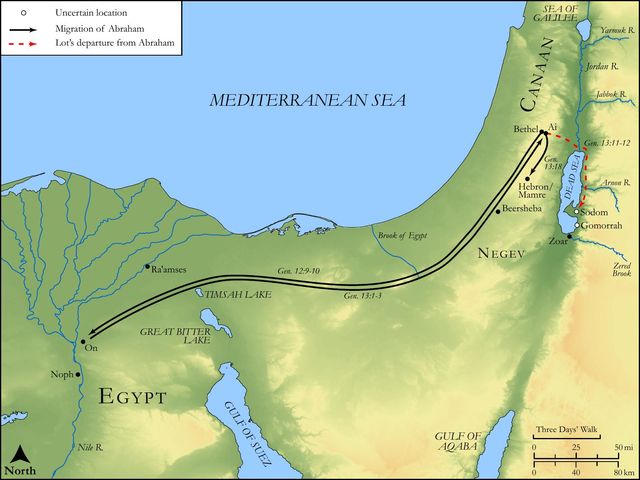
The setting is ancient Canaan, a land inhabited by various tribal groups. The "cities of the plain" (Sodom, Gomorrah, Admah, Zeboiim, and Bela/Zoar) were located in the fertile Jordan Valley, likely south of the Sea of Galilee, a region known for its agricultural richness due to the Jordan River's abundant water. These cities, however, were also notorious for their moral depravity, a fact highlighted later in the narrative (Genesis 13:13). Nomadic pastoralism, as practiced by Abram and Lot, required access to vast grazing lands and water sources. The decision to "pitch a tent toward" a city would have been a significant cultural indicator, signaling an intention to move from a purely nomadic lifestyle toward a more settled, perhaps even urban, existence, and thereby exposing oneself to the cultural and moral influences of that city. The contrast between the nomadic, faith-driven life of Abram and the settled, materially-driven life of Lot reflects a common tension between the pilgrim's tent and the cities of men.
Key Themes
ShowHideGenesis 13:12 contributes significantly to several overarching themes in the book of Genesis and the broader biblical narrative. Firstly, it underscores the theme of choices and consequences, demonstrating how seemingly practical decisions can have profound spiritual ramifications. Lot's choice, driven by sight rather than faith, contrasts sharply with Abram's continued trust in God's unseen promises. Secondly, it introduces the theme of separation and holiness, implicitly contrasting Abram's distinct dwelling in the promised land with Lot's gradual assimilation into a corrupt environment. This foreshadows the later biblical call for God's people to be set apart from the world's influences. Thirdly, it highlights the theme of divine provision versus human prudence. While Lot chose based on perceived prosperity, God immediately reaffirms and expands His promises to Abram after Lot's departure (Genesis 13:14-17), emphasizing that true blessing comes from faithful obedience to God's direction, not from worldly advantage.
Exposition and Analysis
ShowHideKey Word Analysis
ShowHideThis primitive root means "to sit down," but by implication, "to dwell," "to remain," or "to settle." Its repeated use for both Abram and Lot ("Abram dwelled... and Lot dwelled...") highlights their respective establishment of residence. For Abram, it signifies his continued, stable presence in the land of Canaan, a place of promise. For Lot, it indicates his settling in the plain, but the subsequent phrase "pitched his tent toward Sodom" adds a crucial nuance to his dwelling, suggesting a directional inclination rather than a firm, permanent settlement within the city itself at this initial stage.
Derived from the word for "tent" (ʼohel), this verb means "to tent" or "to pitch a tent." It describes the nomadic practice of setting up a dwelling. The phrase "pitched his tent toward Sodom" is highly significant. It implies a deliberate orientation and movement in that direction, rather than an immediate entry into the city. This initial positioning suggests a gradual yielding to the city's influence, a subtle yet dangerous proximity that would eventually lead to Lot's full integration into Sodom (Genesis 19:1).
From an unused root meaning "to scorch," this name literally implies a "burnt" or "volcanic/bituminous" district. While geographically descriptive, the name carries immense theological weight. Sodom was already notorious for its extreme wickedness, a fact explicitly stated in the subsequent verse (Genesis 13:13). Lot's decision to orient his dwelling "toward Sodom" immediately casts a shadow over his choice, signaling a dangerous disregard for the moral character of his chosen environment and foreshadowing the city's eventual fiery destruction.
Verse Breakdown
ShowHide"Abram dwelled in the land of Canaan"
This clause establishes Abram's continued presence in the territory explicitly promised to him by God (Genesis 12:1). His dwelling here signifies his ongoing faith, obedience, and commitment to the covenant relationship. It emphasizes his separation from Lot's chosen path and his reliance on divine guidance rather than perceived worldly advantage.
"and Lot dwelled in the cities of the plain"
In stark contrast to Abram, Lot chose to settle among the urban centers of the Jordan plain. This decision reflects his prioritization of material prosperity and the perceived advantages of a fertile, well-watered region over spiritual discernment. The "cities of the plain" were known for their opulence but also their profound moral corruption, setting Lot on a trajectory of increasing entanglement with ungodly influences.
"and pitched [his] tent toward Sodom"
This is the most crucial and ominous phrase in the verse. It indicates Lot's deliberate orientation towards Sodom, a city infamous for its wickedness. The act of "pitching his tent toward" signifies a directional inclination, a gradual approach, or a growing proximity to a morally corrupt environment, rather than an immediate dwelling within its walls. This subtle move foreshadows Lot's progressive moral compromise and eventual full integration into the city, highlighting the insidious nature of sin's allure and the danger of tolerating ungodly influences.
Literary Devices
ShowHideThe verse effectively employs several literary devices to convey its profound message. Contrast is central, immediately highlighting the divergent paths of Abram and Lot, setting Abram's faithful dwelling in Canaan against Lot's worldly choice of the plain. This contrast underscores the theme of spiritual discernment versus material allure. Foreshadowing is powerfully used through the phrase "pitched his tent toward Sodom." This seemingly minor detail subtly but ominously hints at Lot's future entanglement with the wicked city and the tragic consequences that will follow, culminating in the city's destruction and Lot's personal loss. The phrase itself functions as Symbolism, where the physical orientation "toward Sodom" symbolizes a moral and spiritual inclination towards sin and compromise. It represents the initial, often subtle, steps that lead to deeper entanglement, serving as a cautionary tale about the insidious nature of moral decline.
Theological and Thematic Connections
ShowHideGenesis 13:12 serves as a powerful illustration of the profound impact of choices, particularly regarding our environment and associations, on our spiritual trajectory. Lot's decision, driven by the allure of immediate material prosperity, subtly foreshadows the tragic spiritual and physical consequences that would befall him and his family due to their proximity to and eventual integration into a wicked society. This narrative underscores the insidious nature of moral compromise, suggesting that an initial tolerance or openness to ungodly influences can set a dangerous trajectory leading to deeper entanglement in sin. In stark contrast, Abram's faithful dwelling in the land of Canaan, trusting God's guidance over his own visual assessment, demonstrates the blessings that accompany faithful obedience over worldly wisdom, a truth immediately reiterated and expanded by God's promises to Abram after Lot's departure.
Reflection and Application
ShowHideThis verse serves as a potent cautionary tale for believers today, underscoring the profound impact of our choices regarding environment and association on our spiritual well-being. We, like Lot, may be tempted by seemingly advantageous opportunities—whether in career, residence, or relationships—that, upon closer inspection, draw us into dangerous proximity with ungodly influences. The subtle, progressive nature of Lot's compromise, beginning with merely "pitching his tent toward" Sodom, highlights that moral decline often starts not with an immediate plunge, but with a gradual inclination. This challenges us to vigilantly assess whether our life choices are drawing us closer to God's will and holiness, or subtly inclining us "toward Sodom," prioritizing material gain over spiritual integrity and the call to live a distinct, consecrated life. It compels us to consider not just the immediate benefits of our decisions, but their long-term spiritual trajectory and the company they invite into our lives.
Questions for Reflection
ShowHideFAQ
ShowHideWhat is the significance of Lot "pitching his tent toward Sodom" rather than directly in it?
ShowHideThe phrase "pitched his tent toward Sodom" (Hebrew: vayye'ehal 'ad-S'dom) is profoundly significant because it emphasizes a gradual, progressive movement towards moral compromise rather than an immediate, full immersion. It signifies an initial inclination, proximity, or openness to a sinful environment, setting a dangerous trajectory that would eventually lead to Lot dwelling within Sodom itself (Genesis 19:1). This highlights the insidious nature of yielding to ungodly influences, often beginning with small, seemingly innocuous steps that lead to deeper entanglement and spiritual decay. It's a warning that proximity to sin, even without full participation, can be a perilous first step.
How does Lot's choice contrast with Abram's in this verse?
ShowHideLot's choice was driven by immediate material prosperity, as he selected the seemingly fertile and well-watered Jordan Valley, described as "like the garden of the LORD" (Genesis 13:10), without apparent regard for the moral character of its inhabitants. Abram, conversely, remained in the land of Canaan, the territory explicitly promised to him by God, trusting in divine provision and guidance rather than his own visual assessment or worldly advantage. This contrast underscores the fundamental difference between worldly prudence, which often prioritizes immediate gain, and faith-based obedience, which trusts in God's unseen promises and long-term plan. God immediately reaffirmed His covenant with Abram after Lot's departure (Genesis 13:14-17), demonstrating the blessings that accompany faithful reliance on divine direction over human sight.
Christ-Centered Fulfillment
ShowHideWhile Genesis 13:12 primarily concerns choices and consequences in the Old Testament narrative, it points to Christ in several profound ways, illuminating the spiritual realities of the New Covenant. Abram's faithful dwelling in the land of promise, contrasted with Lot's worldly choice, foreshadows the spiritual separation believers are called to in Christ. Just as Abram trusted God's unseen promise over Lot's visible prosperity, so believers are called to live by faith in the unseen kingdom of God, rather than being drawn by the fleeting allure of the world (2 Corinthians 4:18). Christ himself is the ultimate "promised land" and the source of true spiritual prosperity, offering a dwelling place secure from the corrupting influences of sin. His call to "come out from among them and be separate, says the Lord, and touch no unclean thing" (2 Corinthians 6:17) echoes the implicit warning in Lot's trajectory, reminding us that true fulfillment, safety, and holiness are found only in Him, away from the "Sodoms" of this world. He is the one who delivers us from the present evil age (Galatians 1:4), and in Him, we are called to be a people set apart, living not by sight but by faith (2 Corinthians 5:7).