


Genesis 14:7
Bible text: King James Version (1769 Blayney text) · Public domain
Bible text: King James Version with Strong's numbers · Public domain
Bible text: Berean Standard Bible · Public domain
Bible text: American Standard Version (1901) · Public domain
Bible text: World English Bible, Messianic edition · Public domain
Bible text: Geneva Bible (1599) · Public domain
Bible text: Young's Literal Translation · Public domain
- וַיָּשֻׁבוּVai·ya·shu·vuand they turned backH7725Conj-w ¦ V-Qal-ConsecImperf-3mpVerb Qal Consecutive Imperfect 3rd Plural Masculineוַandיָּשֻׁבוּthey turned back
- וַיָּבֹאוּvai·ya·Vo·'uand they cameH935Conj-w ¦ V-Qal-ConsecImperf-3mpVerb Qal Consecutive Imperfect 3rd Plural Masculineוַandיָּבֹאוּthey came
- אֶל'eltoH413PrepPreposition
- עֵין'einEnH5880N-properNoun Proper Location
- מִשְׁפָּטmish·PatMishpatH5880N-properNoun Proper Location
- הִואhi'thatH1931Pro-3fsPronoun Personal 3rd Singular Feminine
- קָדֵשׁka·Desh[is] KadeshH6946N-properNoun Proper Location
- וַיַּכּוּvai·ya·Kuand they defeatedH5221Conj-w ¦ V-Hiphil-ConsecImperf-3mpVerb Hiphil Consecutive Imperfect 3rd Plural Masculineוַandיַּכּוּthey defeated
- אֶת'et<obj.>H853DirObjMParticle Object Indicator
- כָּלkolallH3605N-mscNoun Singular Masculine Construct
- שְׂדֵהse·Deh[the] region ofH7704N-mscNoun Singular Masculine Construct
- הָעֲמָלֵקִיha·'a·ma·lei·Kithe Amalekite[s]H6003Art ¦ N-msNoun Gentilic Singular Masculine AbsoluteהָtheעֲמָלֵקִיAmalekite[s]
- וְגַםve·Gamand alsoH1571Conj-w ¦ AdvAdverbוְandגַםalso
- אֶת'et<obj.>H853DirObjMParticle Object Indicator
- הָאֱמֹרִיha·'e·mo·Rithe Amorite[s]H567Art ¦ N-msNoun Gentilic Singular Masculine AbsoluteהָtheאֱמֹרִיAmorite[s]
- הַיֹּשֵׁבhai·yo·Shevwho was dwellingH3427Art ¦ V-Qal-Prtcpl-msVerb Qal Participle Singular Masculine Absoluteהַwhoיֹּשֵׁבwas dwelling
- בְּחַצְצֹןbe·cha·Tzonin HazezonH2688Prep-b ¦ N-properNoun Proper LocationבְּinחַצְצֹןHazezon
- תָּמָרta·MarTamarH2688N-properNoun Proper Location
English is a literal word-by-word gloss of the Hebrew, not the KJV's wording. Why?
This is the original text the KJV's translators worked from — each Hebrew word with its own literal English meaning in this verse, prepared by scholars at Tyndale House, Cambridge. The KJV translates whole sentences, not word by word, so its wording differs: one Hebrew word can become several English words, and the KJV may choose “the LORD” where the gloss reads “Yahweh”. Both are faithful — they answer different questions. For the KJV's own rendering, switch to the KJV text.
Details
See on the biblical-era maps


Study this verse
Public-domain commentary
Matthew Henry
From his Commentary on the Whole Bible. Henry comments on passages, not single verses — this entry covers Genesis 14:1–12. His three-level outline is real structure in the source text, so it is rendered as structure.
We have here an account of the first war that ever we read of in scripture, which (though the wars of the nations make the greatest figure in history) we should not have had the history of if Abram and Lot had not been concerned in it. Now, concerning this war, we may observe,
I.The parties engaged in it.
The invaders were four kings, two of them no less than kings of Shinar and Elam (that is, Chaldea and Persia), yet probably not the sovereign princes of those great kingdoms in their own persons, but either officers under them, or rather the heads and leaders of some colonies which came out of those great nations, and settled themselves near Sodom, but retained the names of the countries from which they had their origin. The invaded were the kings of five cities that lay near together in the plain of Jordan, namely, Sodom, Gomorrah, Admah, Zeboiim, and Zoar. Four of them are named, but not the fifth, the king of Zoar or Bela, either because he was much more mean and inconsiderable or because he was much more wicked and inglorious than the rest, and worthy to be forgotten.
II.The occasion of this war was the revolt of the five kings from under the government of Chedorlaomer.
Twelve years they served him. Small joy they had of their fruitful land, while thus they were tributaries to a foreign power, and could not call what they had their own. Rich countries are a desirable prey, and idle luxurious countries are an easy prey, to growing greatness. The Sodomites were the posterity of Canaan whom Noah had pronounced a servant to Shem, from whom Elam descended; thus soon did that prophecy begin to e fulfilled. In the thirteenth year, beginning to be weary of their subjection, they rebelled, denied their tribute, and attempted to shake off the yoke and retrieve their ancient liberties. In the fourteenth year, after some pause and preparation, Chedorlaomer, in conjunction with his allies, set himself to chastise and reduce the rebels, and, since he could not have it otherwise, to fetch his tribute from them on the point of his sword. Note, Pride, covetousness, and ambition, are the lusts from which wars and fightings come. To these insatiable idols the blood of thousands has been sacrificed.
III.The progress and success of the war.
The four kings laid the neighbouring countries waste and enriched themselves with the spoil of them (Gen 14:5-7), upon the alarm of which it had been the wisdom of the king of Sodom to submit, and desire conditions of peace; for how could he grapple with an enemy thus flushed with victory? But he would rather venture the utmost extremity than yield, and it sped accordingly. Quos Deus destruet eos dementat - Those whom God means to destroy he delivers up to infatuation.
1.The forces of the king of Sodom and his allies were routed; and, it should seem, many of them perished in the slime-pits who had escaped the sword, Gen 14:10. In all places we are surrounded with deaths of various kinds, especially in the field of battle.
2.The cities were plundered, Gen 14:11. All the goods of Sodom, and particularly their stores and provisions of victuals, were carried off by the conquerors. Note, When men abuse the gifts of a bountiful providence to gluttony and excess, it is just with God, and his usual way, by some judgment or other to strip them of that which they have so abused, Hos 2:8, Hos 2:9.
3.Lot was carried captive, Gen 14:12. They took Lot among the rest, and his goods. Now Lot may here be considered,
(1.)As sharing with his neighbours in this common calamity. Though he was himself a righteous man, and (which is here expressly noticed) Abram's brother's son, yet he was involved with the rest in all this trouble. Note, All things come alike to all, Ecc 9:2. The best of men cannot promise themselves an exemption from the greatest troubles in this life; neither from our own piety nor our relation to those that are the favourites of heaven will be our security, when God's judgments are abroad. Note, further, Many an honest man fares the worse for his wicked neighbours. It is therefore our wisdom to separate ourselves, or at least to distinguish ourselves, from them (Co2 6:17), and so deliver ourselves, Rev 18:4.
(2.)As smarting for the foolish choice he made of a settlement here. This is plainly intimated when it is said, They took Abram's brother's son, who dwelt in Sodom. So near a relation of Abram should have been a companion and disciple of Abram, and should have abode by his tents; but, if he choose to dwell in Sodom, he must thank himself if he share in Sodom's calamities. Note, When we go out of the way of our duty we put ourselves from under God's protection, and cannot expect that the choices which are made by our lusts should issue to our comfort. Particular mention is made of their taking Lot's goods, those goods which had occasioned his contest with Abram and his separation from him. Note, It is just with God to deprive us of those enjoyments by which we have suffered ourselves to be deprived of our enjoyment of him.
Historical interpretation
Three Centuries of Reception
4 surviving comments on this verse. Each one is dated, so this reads as a timeline rather than a list.
Select a marker to jump to its quote. Markers stagger vertically where authors wrote within a few decades of each other.
(Verse 7) And they returned and came to the well of judgment, which is Kadesh. It is said by anticipation that it was afterwards so called. But it signifies the place at Petra, which is called the well of judgment because there God judged the people. And they struck all the region of the Amalekites and the Amorites who dwelt in Hazazon-tamar. This town is what is now called Engedi, fertile with balsam and palm trees. Moreover, Hazazon-tamar, in our language, means the city of palm trees. Thamar, indeed, is said to mean 'palm'. However, it is worth noting that shortly after it says: 'And they set their battle line against them in the valley of Salt, which is called in Hebrew, the valley of Seddim (), which Aquila interprets as 'of the plains', and Theodotion as 'of the groves', signifying pleasant woods.'
But what follows: And the Amorite who lived in Hazezzon-tamar, belongs to another place, that is, the town which is now called Engedi, fertile in balsam and palms: hence Hazezzon-tamar is interpreted as the City of Palms. For Thamar indeed is called Palm.
And they struck the whole region of the Amalekites. This must be linked with the previous verse, so it is understood that the people of Amalek were struck down near Kadesh Barnea, where Miriam died, and Moses, striking the rock, brought forth water from the rock for the thirsty people.
And they returned and came to the fountain of Mesphat. This is Kadesh. Mesphat is interpreted as Judgment, hence the ancient translation more plainly says, "they came to the fountain of judgment." However, this is also said by anticipation, since the place received that name much later because the Lord judged the people who had come out of Egypt there.
Continue studying Genesis 14:7 across the web’s major study libraries — every link below opens this exact verse, chapter, or book on the destination site.
Read & Compare
 BibleGatewayThis verse in more than 200 translations and 70 languages.
 Bible.comThe YouVersion reader — hundreds of translations, reading plans, and highlights.
 ESV.orgCrossway's official English Standard Version reader.
 NET BibleThe NET translation with 60,000+ translators' notes on every rendering decision.
 STEP BibleTyndale House's free study tool — original text, vocabulary, and scholarly resources.
 BibliaLogos Bible Software's free web reader.
 USCCBThe New American Bible (Revised Edition) with the U.S. bishops' study notes.
Commentaries
 BibleHub CommentariesDozens of classic commentaries on this verse, gathered on one page.
 StudyLightMore than 100 commentary sets — the largest collection on the web.
 BibleRefPlain-English commentary on what this verse means, verse by verse.
 Enduring WordDavid Guzik's free commentary on this chapter, widely used by Bible teachers.
 Bible Study ToolsVerse commentary alongside Greek and Hebrew study aids.
Original Language & Research
- BibleHub InterlinearThe verse word by word — original language, transliteration, and English.
- BibleHub LexiconEvery word's original-language definition and Strong's entry.
 Blue Letter BibleDeep-study tools — Strong's numbers, concordance, and word studies.
 SefariaThe Hebrew text with Rashi and centuries of Jewish commentary.
Sermons, Hymns & Audio


TrulyRandomVerse is not affiliated with these sites and doesn’t control their content. They’re linked because they’re genuinely useful.
Summary
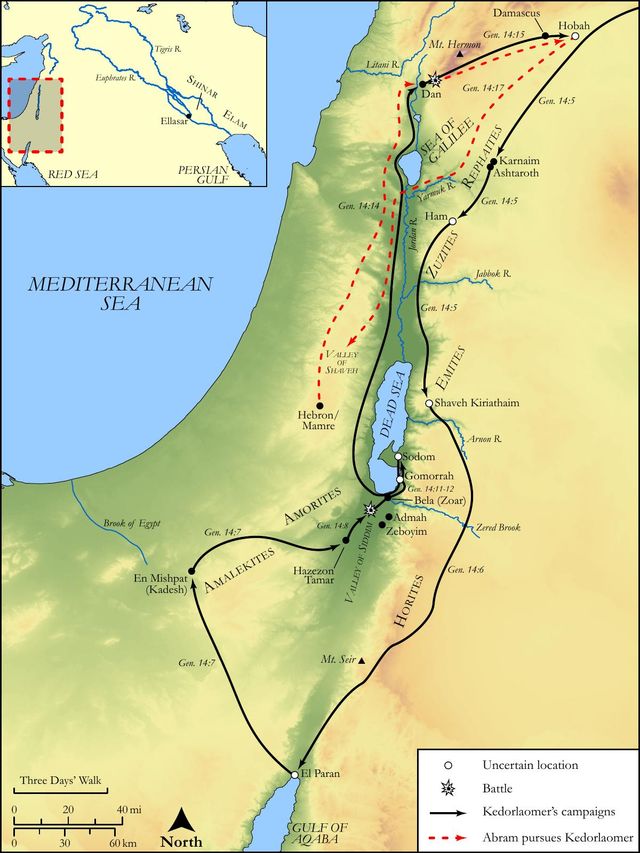
Genesis 14:7 meticulously traces the southward progression of the four eastern kings' military campaign, led by Chedorlaomer, as they "returned" to Enmishpat, which is identified as Kadesh. At this strategic location, they comprehensively subjugated the territory of the Amalekites and the Amorites residing in Hazezontamar (modern En-gedi). This verse offers vital geographical and demographic insights into ancient Canaan, underscoring the extensive reach of the invading forces and introducing peoples who would later play pivotal roles in Israel's history, all within the unfolding divine narrative that culminates in Abram's decisive intervention.
Context
ShowHideLiterary Context
Genesis 14 presents a unique historical account within the patriarchal narratives, detailing a significant military conflict involving powerful eastern kings and Canaanite city-states. Verses Genesis 14:1-4 set the stage with the rebellion of five city-states against Chedorlaomer. The preceding verses, Genesis 14:5-6, meticulously chronicle the invaders' initial conquests to the north and east, systematically subduing various peoples. Verse 7 continues this itinerary, shifting the focus to their southwestward movement, demonstrating the thoroughness of their campaign to secure regional dominance and punish disloyal subjects. This strategic sweep ultimately positions them for the climactic confrontation in the Valley of Siddim, which directly leads to Lot's capture and sets the stage for Abram's divinely empowered rescue.
Historical & Cultural Context
The events of Genesis 14 reflect the geopolitical realities of the early second millennium BCE, a period characterized by shifting alliances, regional conflicts, and the rise of powerful city-states and empires. The presence of kings from Mesopotamia (Elam, Shinar, Ellasar, Goiim) indicates a significant projection of power into Canaan, a region often serving as a land bridge and buffer zone between major powers. The mention of specific peoples like the Amalekites and Amorites, and locations such as Kadesh and Hazezontamar, provides a snapshot of the diverse tribal and ethnic landscape of Canaan prior to the Israelite conquest. Military campaigns of this scale were common, often driven by tribute collection, territorial expansion, or punitive expeditions against rebellious tributaries, underscoring the volatile nature of the region and the constant threat of external powers.
Key Themes
ShowHideThis verse, embedded within the broader narrative of Genesis 14, contributes to several key themes. It highlights God's Sovereignty over human affairs, even in seemingly secular military conflicts, as the kings' actions inadvertently prepare the way for Abram's righteous intervention and the unfolding of God's covenant purposes. The meticulous geographical and demographic details reinforce the theme of The Land and Its Inhabitants, emphasizing the diverse peoples inhabiting Canaan, which God had promised to Abram and his descendants (Genesis 12:7). Furthermore, the early introduction of peoples like the Amalekites and Amorites serves as Foreshadowing for future interactions and conflicts with Israel, illustrating the long-term narrative design of Scripture and God's foreknowledge of the challenges His people would face in the promised land (Genesis 15:16).
Exposition and Analysis
ShowHideKey Word Analysis
ShowHideMeaning "to strike (lightly or severely, literally or figuratively)." In this context, it signifies a decisive and forceful military action, indicating that the invading kings inflicted a severe defeat upon the Amalekites and Amorites, likely involving slaughter, plunder, and subjugation. This verb emphasizes the comprehensive nature of their conquest.
A primitive root meaning "to sit down; by implication, to dwell, to remain." This word describes the established presence of the Amorites in Hazezontamar, indicating that this was their settled habitation. It highlights their rootedness in the land, making their defeat by the invading kings a significant disruption to their established way of life.
Meaning "fountain of judgment." This proper noun refers to a specific geographical location, identified as Kadesh. The name itself suggests a place of legal or tribal arbitration, or perhaps a site where a significant judgment (military or judicial) occurred. Its identification with Kadesh underscores its strategic importance as a vital oasis and a point of decision or reckoning in the desert.
Verse Breakdown
ShowHide"And they returned, and came to Enmishpat, which [is] Kadesh"
This clause marks a crucial directional shift in the campaign of the four kings. Having swept through regions to the east and north, their "return" indicates a pivot, likely westward or southwestward, bringing them into the arid wilderness regions. Enmishpat, meaning "Fountain of Judgment," is explicitly identified with Kadesh, a significant oasis and strategic location in the wilderness of Zin. This identification is vital for understanding the ancient geography and foreshadows Kadesh's immense importance in Israel's later history, notably as a primary encampment during the Exodus and the site from which the spies were sent into Canaan (Numbers 13:26). The kings' arrival here demonstrates their deep penetration into the southern reaches of Canaan.
"and smote all the country of the Amalekites"
This phrase details the invading forces' military action against the Amalekites, one of the earliest biblical mentions of this people group. The Amalekites are depicted as inhabiting the southern regions of Canaan, specifically the Negeb. The verb "smote" indicates a comprehensive and decisive defeat, suggesting a thorough subjugation of their territory. This early encounter foreshadows the long and bitter animosity that would characterize the relationship between the Amalekites and the nation of Israel for centuries, beginning with their unprovoked attack on the Israelites during the Exodus (Exodus 17:8-16).
"and also the Amorites, that dwelt in Hazezontamar."
This final clause identifies another significant people group, the Amorites, and their specific dwelling place. The Amorites were a widespread Semitic people, prominent throughout Canaan both before and during the Israelite conquest. Hazezontamar is widely identified with modern En-gedi, a fertile oasis on the western shore of the Dead Sea, renowned for its abundant springs and lush vegetation. The kings' campaign extending to this location on the Dead Sea coast highlights the vast geographical scope and methodical thoroughness of their military operations, designed to eliminate all potential resistance and secure the loyalty of the region's diverse inhabitants.
Literary Devices
ShowHideGenesis 14:7 employs several significant literary devices. The most prominent is Geographical Specificity, where precise place names like Enmishpat (Kadesh) and Hazezontamar are used. This detailed naming anchors the narrative in a verifiable historical and geographical reality, lending credibility to the account and allowing readers to trace the invaders' movements. Coupled with this is Ethno-geographical Survey, as the verse explicitly names the "Amalekites" and "Amorites" in conjunction with their dwelling places. This serves to introduce key peoples of the land, providing a demographic snapshot of Canaan during the patriarchal era. Furthermore, the early mention of the Amalekites functions as Foreshadowing or a Proleptic Mention. While seemingly a simple historical detail, their inclusion sets the stage for their significant and often hostile role in Israel's later history, subtly hinting at future conflicts and God's long-term plan for His people and the land.
Theological and Thematic Connections
ShowHideGenesis 14:7, while detailing a historical military campaign, subtly reveals God's overarching sovereignty even amidst human conflict and ambition. The movements of these powerful kings, seemingly driven by their own geopolitical interests, are implicitly part of a larger divine plan, preparing the stage for Abram's righteous act and the unfolding of God's covenant purposes. The early introduction of the Amalekites and Amorites, peoples who would become significant adversaries to Israel, highlights God's foreknowledge and the Bible's long-term narrative design, demonstrating that God's plan often involves navigating through hostile environments.
Reflection and Application
ShowHideGenesis 14:7, though a verse rich in historical and geographical detail, offers a profound spiritual reflection on the nature of divine providence. It reminds us that even in the seemingly chaotic ebb and flow of human history—the rise and fall of empires, the clash of armies, and the pursuit of earthly power—God remains supremely sovereign. The meticulous account of the kings' campaign, leading them precisely to the strategic points where key peoples resided and where Lot would eventually be captured, illustrates that God's unseen hand guides and orchestrates events, ensuring that all things ultimately serve His perfect, redemptive purposes. For believers today, this truth provides immense comfort and encouragement: just as God was actively at work in the geopolitical complexities of ancient Canaan, He is intimately involved in the intricate circumstances of our modern world, ensuring that His will is accomplished. We are called to cultivate a deep trust in His sovereignty, even when the path ahead seems unclear or when powerful earthly forces appear to dominate the landscape. This trust enables us to live with confident hope, knowing that our lives and the grand narrative of history are securely held in the hands of an all-wise and all-powerful God.
Questions for Reflection
ShowHideFAQ
ShowHideWhat is the significance of Enmishpat being identified as Kadesh?
ShowHideThe identification of Enmishpat with Kadesh (later Kadesh-barnea) is profoundly significant because it establishes a vital geographical and historical link between the patriarchal narrative and the foundational events of the nation of Israel. Kadesh was not merely an oasis; it was a strategically crucial point in the wilderness of Zin, serving as a major encampment for the Israelites during their Exodus journey. It was from Kadesh that Moses sent the twelve spies into Canaan (Numbers 13:26), and it was a site of both rebellion against God's command and divine judgment for the generation that wandered in the wilderness (Numbers 20:1-13). Its mention here in Genesis 14:7 underscores its ancient importance and provides a geographical anchor that connects the earliest history of God's chosen family to the pivotal events of their national formation.
Christ-Centered Fulfillment
ShowHideWhile Genesis 14:7 describes a specific historical military campaign, its Christ-centered fulfillment is woven into the broader tapestry of God's redemptive plan, which finds its ultimate culmination in Jesus Christ. The meticulous detailing of the land and its inhabitants, including the early mention of future adversaries like the Amalekites and Amorites, underscores God's sovereign preparation of the stage for the lineage through whom the Messiah would come. This very campaign, by leading directly to the capture of Lot, prompts Abram's righteous and victorious intervention, an act that powerfully foreshadows Christ's ultimate and perfect act of rescue for humanity from the dominion of sin and death (Colossians 1:13-14). The establishment of God's covenant with Abram, which is further solidified by these events and Abram's subsequent encounter with Melchizedek, is the foundational promise through which all nations would ultimately be blessed in Christ (Galatians 3:16). Thus, even the seemingly secular movements of ancient history, as recorded in this verse, are intricately woven into the fabric of God's eternal purpose to bring forth His Son as the world's Redeemer and King, demonstrating that He "works all things according to the counsel of His will" (Ephesians 1:11).