


Genesis 19:36
Bible text: King James Version (1769 Blayney text) · Public domain
Bible text: Berean Standard Bible · Public domain
Bible text: American Standard Version (1901) · Public domain
Bible text: World English Bible, Messianic edition · Public domain
Bible text: Geneva Bible (1599) · Public domain
Bible text: Young's Literal Translation · Public domain
- וַתַּהֲרֶיןָva·ta·ha·Rei·naand they conceivedH2029Conj-w ¦ V-Qal-ConsecImperf-3fpVerb Qal Consecutive Imperfect 3rd Plural Feminineוַandתַּהֲרֶיןָthey conceived
- שְׁתֵּיshe·Tei[the] twoH8147Adj-fdcAdjective Numerical Dual Feminine Construct
- בְנוֹתve·not[the] daughters ofH1323N-fpcNoun Plural Feminine Construct
- לוֹטLotLotH3876N-proper-mNoun Proper Masculine
- מֵאֲבִיהֶןme·'a·vi·Henfrom their fatherH1Prep-m ¦ N-msc ¦ 3fpNoun Singular Masculine Constructמֵfromאֲבִיfatherהֶןtheir
English is a literal word-by-word gloss of the Hebrew, not the KJV's wording. Why?
This is the original text the KJV's translators worked from — each Hebrew word with its own literal English meaning in this verse, prepared by scholars at Tyndale House, Cambridge. The KJV translates whole sentences, not word by word, so its wording differs: one Hebrew word can become several English words, and the KJV may choose “the LORD” where the gloss reads “Yahweh”. Both are faithful — they answer different questions. For the KJV's own rendering, switch to the KJV text.
Details
See on the biblical-era maps


Study this verse
Public-domain commentary
Matthew Henry
From his Commentary on the Whole Bible. Henry comments on passages, not single verses — this entry covers Genesis 19:30–38. His four-level outline is real structure in the source text, so it is rendered as structure.
Here is, I. The great trouble and distress that Lot was brought into after his deliverance, Gen 19:30. 1. He was frightened out of Zoar, durst not dwell there; probably because he was conscious to himself that it was a refuge of his own choosing and that herein he had foolishly prescribed to God, and therefore he could not but distrust his safety in it; or because he found it as wicked as Sodom, and therefore concluded it could not long survive it; or perhaps he observed the rise and increase of those waters which after the conflagration, perhaps from Jordan, began to overflow the plain, and which, mixing with the ruins, by degrees made the Dead Sea; in those waters he concluded Zoar must needs perish (though it had escaped the fire) because it stood upon the same flat. Note, Settlements and shelters of our own choosing, and in which we do not follow God, commonly prove uneasy to us. 2. He was forced to betake himself to the mountain, and to take up with a cave for his habitation there. Methinks it was strange that he did not return to Abraham, and put himself under his protection, to whom he had once and again owed his safety: but the truth is there are some good men that are not wise enough to know what is best for themselves. Observe, (1.) He was now glad to go to the mountain, the place which God had appointed for his shelter. Note, It is well if disappointment in our way drive us at last to God's way. (2.) He that, awhile ago, could not find room enough for himself and his stock in the whole land, but must jostle with Abraham, and get as far from him as he could, is now confined to a hole in a hill, where he has scarcely room to turn himself, and there he is solitary and trembling. Note, It is just with God to reduce those to poverty and restraint who have abused their liberty and plenty. See also in Lot what those bring themselves to, at last, that forsake the communion of saints for secular advantages; they will be beaten with their own rod.
II.The great sin that Lot and his daughters were guilty of, when they were in this desolate place. It is a sad story.
1.His daughters laid a very wicked plot to bring him to sin; and theirs was, doubtless, the greater guilt. They contrived, under pretence of cheering up the spirits of their father in his present condition, to make him drunk, and then to lie with him, Gen 19:31, Gen 19:32.
(1.)Some think that their pretence was plausible. Their father had no sons, they had no husbands, nor knew they were to have any of the holy seed, or, if they had children by others, their father's name would not be preserved in them. Some think that they had the Messiah in their eye, who, they hoped, might descend form their father; for he came from Terah's elder son, who separated from the rest of Shem's posterity as well as Abraham, and was now signally delivered out of Sodom. Their mother, and the rest of the family, were gone; they might not marry with the cursed Canaanites; and therefore they supposed that the end they aimed at and the extremity they were brought to, would excuse the irregularity. Thus the learned Monsieur Allix. Note, Good intentions are often abused to patronize bad actions. But,
(2.)Whatever their pretence was, it is certain that their project was very wicked and vile, and an impudent affront to the very light and law of nature. Note,
[1.]The sight of God's most tremendous judgments upon sinners will not of itself, without the grace of God, restrain evil hearts from evil practices: one would wonder how the fire of lust could possibly kindle upon those, who had so lately been the eye-witnesses of Sodom's flames.
[2.]Solitude has its temptations as well as company, and particularly to uncleanness. When Joseph was alone with his mistress he was in danger, Gen 39:11. Relations that dwell together, especially if solitary, have need carefully to watch even against the least evil thought of this kind, lest Satan get an advantage.
2.Lot himself, by his own folly and unwariness, was wretchedly overcome, and suffered himself so far to be imposed upon by his own children as, two nights together, to be drunk, and to commit incest, Gen 19:33, etc. Lord, what is man! What are the best of men, when God leaves them to themselves! See here,
(1.)The peril of security. Lot, who not only kept himself sober and chaste in Sodom, but was a constant mourner for the wickedness of the place and a witness against it, was yet, in the mountain, where he was alone, and as he thought quite out of the way of temptation, shamefully overtaken. Let him therefore that thinks he stands, stands high and stands firm, take heed lest he fall. No mountain, on this side the holy hill above, can set us out of the reach of Satan's fiery darts.
(2.)The peril of drunkenness. It is not only a great sin itself, but it is the inlet of many sins; it may prove the inlet of the worst and mast unnatural sins, which may b a perpetual wound and dishonour. Excellently does Mr. Herbert describe it,
He that is drunken may his mother kill
Big with his sister -
A man may do that without reluctance, when he is drunk, which, when he is sober, he could not think of without horror. (3.) The peril of temptation from our dearest relations and friends, whom we love, and esteem, and expect kindness from. Lot, whose temperance and chastity were impregnable against the batteries of foreign force, was surprised into sin and shame by the base treachery of his own daughters: we must dread a snare wherever we are, and be always upon our guard.
3.In the close we have an account of the birth of the two sons, or grandsons (call them which you will), of Lot, Moab and Ammon, the fathers of two nations, neighbours to Israel, and which we often read of in the Old Testament; both together are called the children of Lot, Psa 83:8. Note, Though prosperous births may attend incestuous conceptions, yet they are so far from justifying them that they rather perpetuate the reproach of them and entail infamy upon posterity; yet the tribe of Judah, of which our Lord sprang, descended from such a birth, and Ruth, a Moabitess, has a name in his genealogy, Mat 1:3, Mat 1:5.
Lastly, Observe that, after this, we never read any more of Lot, nor what became of him: no doubt he repented of his sin, and was pardoned; but from the silence of the scripture concerning him henceforward we may learn that drunkenness, as it makes men forgetful, so it makes them forgotten; and many a name, which otherwise might have been remembered with respect, is buried by it in contempt and oblivion.
Historical interpretation
Two Centuries of Reception
4 surviving comments on this verse. Each one is dated, so this reads as a timeline rather than a list.
Select a marker to jump to its quote. Markers stagger vertically where authors wrote within a few decades of each other.
This had happened without Lot’s knowledge and without his having been a slave to pleasure; it was accomplished wholly by divine arrangement, through which the two synagogues born from one and the same father, without carnal pleasure, were evoked. For there was no one else who could give them vital seed and the fruit of children, as it was written.
As we have been able, we have carved out these explanations according to the spiritual understanding of Lot and his wife and daughters. We pass no judgment on those who have been able to perceive something more sacred from this text.But above, in the moral sense, we referred Lot indeed to the rational understanding and the courageous soul; but his wife, who looked back, we said to be the flesh given to concupiscence and pleasures. Do not, O hearer, receive these things carelessly. For you ought to watch lest perhaps even when you have fled the flames of the world and have escaped the fires of the flesh, even when you have risen above “Zoar, the city” that is “small and not small,” which is somewhere in the middle … you seem to have ascended to the height of knowledge, as to some mountain peak. Beware lest those two daughters lie in wait for you, who do not depart from you but follow you even when you ascend the mountain. They are vainglory and her older sister, pride. Beware lest with their embraces those daughters constrict you, deprived of sense and sleeping, while you seem neither to perceive nor know. They are called daughters because they do not come upon us from outside but proceed from us and from a kind of innocence, as it were, of our acts. Be vigilant, therefore, as much as you can, and watch lest you beget sons from these daughters, because those who have been born from them “shall not enter the assembly of the Lord.” But if you wish to beget, beget in the spirit, since “he who sows in the spirit, of the spirit shall reap life everlasting.” If you wish to embrace, embrace wisdom and “say wisdom is your sister,” that Wisdom also may say of you: He “who shall do the will of my Father who is in heaven, he is my brother and sister and mother.” Jesus Christ our Lord is this wisdom, “to whom be glory and sovereignty forever and ever. Amen.”
After these things, therefore, Lot ascends into the mountains, and there “he dwells in a cave,” as the Scripture says, “he and his two daughters.” The law also should be thought to have ascended, because an embellishment was added to it by the temple built by Solomon, when it became indeed “the house of God, a house of prayer.” Evil inhabitants, however, made it “a den of thieves.” Therefore “Lot and his two daughters dwelt in a cave.” The prophet evidently describes these two daughters saying that Oholah and Oholibah are two sisters, and Oholah indeed is “Judah” and Oholibah is “Samaria.” The people therefore divided into two parts made the two daughters of the law. Those daughters, desiring carnal offspring to be preserved and the forces of earthly dominion to be fortified by an abundant posterity, depriving their father of sense and making him sleep, that is, covering and obscuring his spiritual understanding, draw only carnal understanding from him. Then they conceive. Then they give birth to such sons as their father neither perceives nor recognizes. For it was neither the understanding nor the will of the law to beget carnally. But the law is deprived of its sense that such posterity might be begotten that “shall not enter the assembly of the Lord.” “For the Ammonites,” Scripture says, “and Moabites shall not enter the assembly of the Lord unto the third and fourth generation and forever.”
(Versed. 36 seqq.) And the two daughters of Lot conceived by their father, and the firstborn son was born and she called his name Moab. He is the father of the Moabites to this day. And the younger, she also gave birth to a son, and she called his name Ammon, that is, son of my people. He is the father of the Ammonites. The name Moab means 'from the father' and has its etymology in it. But Ammon, whose name is given as if a cause, is derived as son of my race, or as it is better in Hebrew (), son of my people, so it is derived partly from the meaning of the name, partly from the language itself: Ammi, from whom the Ammonites are called, means my people.
Continue studying Genesis 19:36 across the web’s major study libraries — every link below opens this exact verse, chapter, or book on the destination site.
Read & Compare
 BibleGatewayThis verse in more than 200 translations and 70 languages.
 Bible.comThe YouVersion reader — hundreds of translations, reading plans, and highlights.
 ESV.orgCrossway's official English Standard Version reader.
 NET BibleThe NET translation with 60,000+ translators' notes on every rendering decision.
 STEP BibleTyndale House's free study tool — original text, vocabulary, and scholarly resources.
 BibliaLogos Bible Software's free web reader.
 USCCBThe New American Bible (Revised Edition) with the U.S. bishops' study notes.
Commentaries
 BibleHub CommentariesDozens of classic commentaries on this verse, gathered on one page.
 StudyLightMore than 100 commentary sets — the largest collection on the web.
 BibleRefPlain-English commentary on what this verse means, verse by verse.
 Enduring WordDavid Guzik's free commentary on this chapter, widely used by Bible teachers.
 Bible Study ToolsVerse commentary alongside Greek and Hebrew study aids.
Original Language & Research
- BibleHub InterlinearThe verse word by word — original language, transliteration, and English.
- BibleHub LexiconEvery word's original-language definition and Strong's entry.
 Blue Letter BibleDeep-study tools — Strong's numbers, concordance, and word studies.
 SefariaThe Hebrew text with Rashi and centuries of Jewish commentary.
Sermons, Hymns & Audio


TrulyRandomVerse is not affiliated with these sites and doesn’t control their content. They’re linked because they’re genuinely useful.
Summary
Genesis 19:36 delivers a stark and unambiguous declaration, confirming the tragic and morally reprehensible outcome of the daughters of Lot's desperate plan: both became pregnant by their own father. This verse serves as a sober, unvarnished confirmation of the incestuous acts detailed in the preceding narrative, highlighting the profound moral degradation that can occur in extreme circumstances and underscoring the Bible's unflinching portrayal of human sin and its far-reaching consequences.
Context
ShowHideLiterary Context
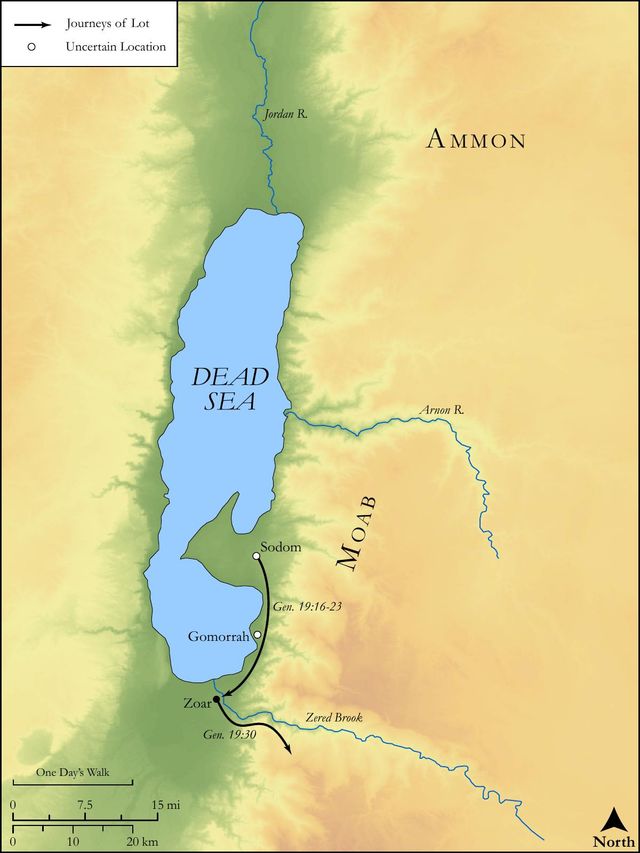
This verse stands near the close of the deeply disturbing account of Lot and his daughters following the catastrophic destruction of Sodom and Gomorrah. Having narrowly escaped the divine judgment, Lot, along with his two daughters, sought refuge in a cave after his wife perished by looking back and becoming a pillar of salt. Isolated and fearing the extinction of their family line, the daughters, without consulting Lot, conceived and executed a plan to ensure progeny by intoxicating their father and engaging in incestuous relations with him over two successive nights, as meticulously described in Genesis 19:30-35. Genesis 19:36, therefore, acts as the grim culmination and factual confirmation of these acts, setting the stage for the subsequent birth of Moab and Ben-Ammi.
Historical & Cultural Context
In the households of the patriarchs, the preservation of family lineage and the continuation of a patriarchal household were paramount. The fear expressed by Lot's daughters—that "there is not a man on earth to come in unto us after the manner of all the earth" (Genesis 19:31)—reflects the cultural imperative for procreation and the perceived necessity of male heirs. While the method they chose was a severe violation of universal moral norms and later explicitly forbidden by Mosaic Law as an abomination (Leviticus 18:6-7), their desperation arose from a context where a woman's identity and security were often tied to her marital status and ability to bear children. The geographical isolation in the cave further exacerbated their sense of urgency and limited their perceived options, leading to a profound moral lapse.
Key Themes
ShowHideGenesis 19:36 contributes significantly to several major themes woven throughout the book of Genesis and the broader biblical narrative. It powerfully illustrates the pervasiveness of human sin and moral corruption, even among those spared from divine judgment, underscoring humanity's fallen nature (Genesis 6:5). The verse also highlights the consequences of moral compromise and desperation, showing how extreme circumstances can lead to actions that violate fundamental divine and natural laws. Furthermore, it serves as an etiological narrative, providing the origin story for the Moabite and Ammonite nations, peoples who would later become significant, often adversarial, figures in Israel's history, demonstrating how even through deeply flawed and sinful acts, God's sovereign plan continues to unfold, shaping the destinies of nations (Deuteronomy 23:3-6).
Exposition and Analysis
ShowHideKey Word Analysis
ShowHideThis term, derived from the root meaning "to build" (בָּנָה, banah), emphasizes the role of daughters in building a family line. Here, it tragically highlights the very individuals who, in their desperation to "build" a family, engaged in an act that simultaneously undermined the foundational structure of the family unit. The use of "both" (H8147, shᵉnayim) further stresses the joint nature of their transgression.
This primitive root signifies the state of being pregnant or conceiving, whether literally or figuratively. In this context, it is a stark, unadorned declaration of a physical reality. The Hebrew text offers no euphemism or softening of the truth, directly stating the biological outcome of the incestuous union. This directness underscores the Bible's commitment to portraying human events, even the most disturbing, with unvarnished accuracy.
This fundamental word denotes the male parent, a figure typically associated with protection, provision, and moral guidance. The use of "father" in this context is profoundly shocking, as it identifies the direct violation of one of the most sacred and foundational relationships, highlighting the complete breakdown of natural and divine order within this family unit.
Verse Breakdown
ShowHide"Thus were both the daughters of Lot"
This opening clause serves as a direct and immediate consequence of the preceding narrative. The word "Thus" (וַתַּהֲרֶ֣יןָ, wataharenah, implied in the verb form) links the outcome directly to the daughters' actions described in Genesis 19:30-35. The explicit mention of "both" emphasizes the shared culpability and the complete success of their desperate, albeit morally reprehensible, plan.
"with child"
This phrase unequivocally states the physical reality of pregnancy. The Hebrew verb (הָרוֹת, harot, from H2029) is a simple, factual declaration, leaving no room for ambiguity. It is a stark confirmation of the biological result of the incestuous acts, underscoring the undeniable consequences of their choices.
"by their father"
This final, shocking phrase identifies the source of the conception, leaving no doubt about the incestuous nature of the event. It highlights the profound moral transgression and the complete collapse of familial boundaries and natural law. This detail is crucial for understanding the ethical gravity of the passage and its implications for the lineage that follows.
Literary Devices
ShowHideThe primary literary device at play in Genesis 19:36 is Unvarnished Realism or Direct Statement. The text presents the grim outcome with stark simplicity and no attempt at euphemism or moral commentary within the verse itself. This directness reflects the biblical narrative's commitment to portraying human history, including its darkest chapters, without embellishment. The verse also employs Foreshadowing, as this factual statement about conception sets the stage for the birth of the Moabite and Ammonite nations, whose future interactions with Israel will be a recurring theme throughout the Old Testament. The brevity and bluntness of the statement amplify its shocking impact, leaving the reader to grapple with the profound moral implications of the act.
Theological and Thematic Connections
ShowHideThis somber verse, while disturbing, offers profound theological insights into the depths of human depravity and the pervasive nature of sin, even in the lives of those who have experienced divine deliverance. It underscores that human desperation, when untethered from divine principles, can lead to severe moral compromise and the violation of fundamental natural and familial laws. The narrative unflinchingly records this act, not to condone it, but to illustrate the severe consequences of isolation, a distorted sense of necessity, and a departure from God's established order. Ultimately, it serves as a stark reminder of humanity's fallen nature and the enduring ripple effects of sinful choices across generations.
Reflection and Application
ShowHideThis somber passage offers critical insights for believers today, underscoring the dangers of succumbing to extreme circumstances without steadfast reliance on God's guidance and moral law. It serves as a powerful reminder that isolation and desperation can profoundly distort judgment, leading to grave moral compromise. The narrative emphasizes the importance of maintaining a strong connection to community and unwavering adherence to divine principles, even when faced with overwhelming pressure or perceived lack of options. Furthermore, the long-term, intergenerational consequences of the daughters' actions, as seen in the subsequent history of the Moabites and Ammonites, powerfully illustrate that sinful choices carry far-reaching ripple effects. This urges believers to live righteously, considering the broader impact of their decisions on future generations and the testimony of God's people.
Questions for Reflection
ShowHideFAQ
ShowHideWhy is this disturbing event included in the biblical narrative?
ShowHideThe Bible, as a divinely inspired text, presents a realistic and unvarnished account of human history, including its darkest moments. This event is recorded not to condone incest but to demonstrate the pervasive nature of sin, the consequences of moral compromise, and the origins of nations that would later interact with Israel. It provides crucial historical and theological context for future biblical narratives, showing how even deeply flawed human actions fit into God's larger, often mysterious, providential plan, as seen in the later interactions between Israel and the Moabites and Ammonites.
What was the fate of the descendants of Lot's daughters?
ShowHideThe children born from this union became the ancestors of two distinct nations: the Moabites (from the elder daughter's son, Moab) and the Ammonites (from the younger daughter's son, Ben-Ammi). These nations later became significant, often adversarial, figures in Israel's history, engaging in conflict and idolatry. For example, the Moabites famously hired Balaam to curse Israel in Numbers 22, and both nations were excluded from the assembly of the Lord for ten generations due to their hostility towards Israel during the Exodus (Deuteronomy 23:3-6).
Christ-Centered Fulfillment
ShowHideEven within this dark and disturbing narrative, the overarching theme of God's sovereign plan working through flawed humanity can be observed, ultimately pointing to Christ. While the origins of the Moabites and Ammonites are rooted in profound sin and moral transgression, God's redemptive plan is so vast and encompassing that it can incorporate and even redeem elements from such brokenness. Notably, Ruth, a Moabitess, is later found in the lineage of King David (Ruth 4:18-22) and, by extension, in the very genealogy of Jesus Christ (Matthew 1:1-17). This inclusion powerfully demonstrates God's boundless grace, His ability to bring good from tragic and sinful circumstances, and His willingness to include those from unexpected and even morally compromised origins into His covenant purposes. It underscores that God's redemptive work transcends human failure, ultimately fulfilling His promise of a Messiah who would come not just for Israel, but for all humanity, drawing people from every nation into His glorious kingdom (Revelation 7:9-10).