


1 Samuel 15:33
Bible text: King James Version (1769 Blayney text) · Public domain
Bible text: King James Version with Strong's numbers · Public domain
Bible text: Berean Standard Bible · Public domain
Bible text: American Standard Version (1901) · Public domain
Bible text: World English Bible, Messianic edition · Public domain
Bible text: Geneva Bible (1599) · Public domain
Bible text: Young's Literal Translation · Public domain
- וַיֹּאמֶרvai·Yo·merand he saidH559Conj-w ¦ V-Qal-ConsecImperf-3msVerb Qal Consecutive Imperfect 3rd Singular Masculineוַandיֹּאמֶרhe said
- שְׁמוּאֵלshe·mu·'ElSamuelH8050N-proper-mNoun Proper Masculine
- כַּאֲשֶׁרka·'a·Sherjust asH834Prep-k ¦ RelParticle Relativeכַּjustאֲשֶׁרas
- שִׁכְּלָהshi·ke·Lahit has made childlessH7921V-Piel-Perf-3fsVerb Piel Perfect 3rd Singular Feminine
- נָשִׁיםna·ShimwomenH802N-mpNoun Plural Masculine Absolute
- חַרְבֶּךָchar·Be·khayour swordH2719N-fsc ¦ 2msNoun Singular Feminine Constructחַרְבֶּswordךָyour
- כֵּןkensoH3651AdvAdverb
- תִּשְׁכַּלtish·Kalshe will become childlessH7921V-Qal-Imperf-3fsVerb Qal Imperfect 3rd Singular Feminine
- מִנָּשִׁיםmi·na·Shimfrom womenH802Prep-m ¦ N-mpNoun Plural Masculine Absoluteמִfromנָּשִׁיםwomen
- אִמֶּךָ'i·Me·khayour motherH517N-fsc ¦ 2msNoun Singular Feminine Constructאִמֶּmotherךָyour
- וַיְשַׁסֵּףvay·sha·Sefand he cut to piecesH8158Conj-w ¦ V-Piel-ConsecImperf-3msVerb Piel Consecutive Imperfect 3rd Singular Masculineוַandיְשַׁסֵּףhe cut to pieces
- שְׁמוּאֵלshe·mu·'ElSamuelH8050N-proper-mNoun Proper Masculine
- אֶת'et<obj.>H853DirObjMParticle Object Indicator
- אֲגָג'a·GagAgagH90N-proper-mNoun Proper Masculine
- לִפְנֵיlif·Nei<to> beforeH6440Prep-l ¦ N-mpcNoun Plural Masculine Constructלִ<to>פְנֵיbefore
- יְהוָהYah·wehYahwehH3068N-properNoun Proper Title
- בַּגִּלְגָּלba·gil·Galin <the> GilgalH1537Prep-b ¦ N-properNoun Proper Locationבַּin <the>גִּלְגָּלGilgal
English is a literal word-by-word gloss of the Hebrew, not the KJV's wording. Why?
This is the original text the KJV's translators worked from — each Hebrew word with its own literal English meaning in this verse, prepared by scholars at Tyndale House, Cambridge. The KJV translates whole sentences, not word by word, so its wording differs: one Hebrew word can become several English words, and the KJV may choose “the LORD” where the gloss reads “Yahweh”. Both are faithful — they answer different questions. For the KJV's own rendering, switch to the KJV text.
Details
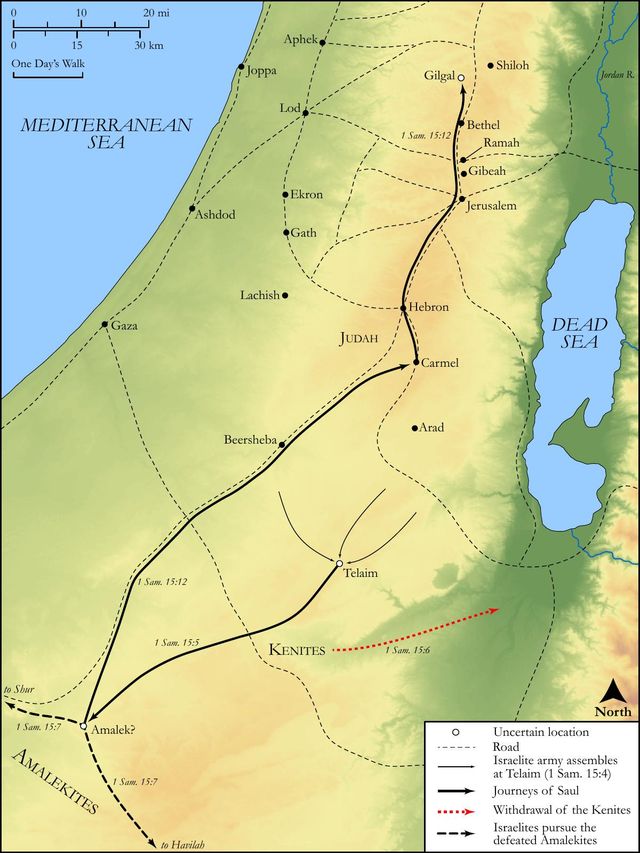
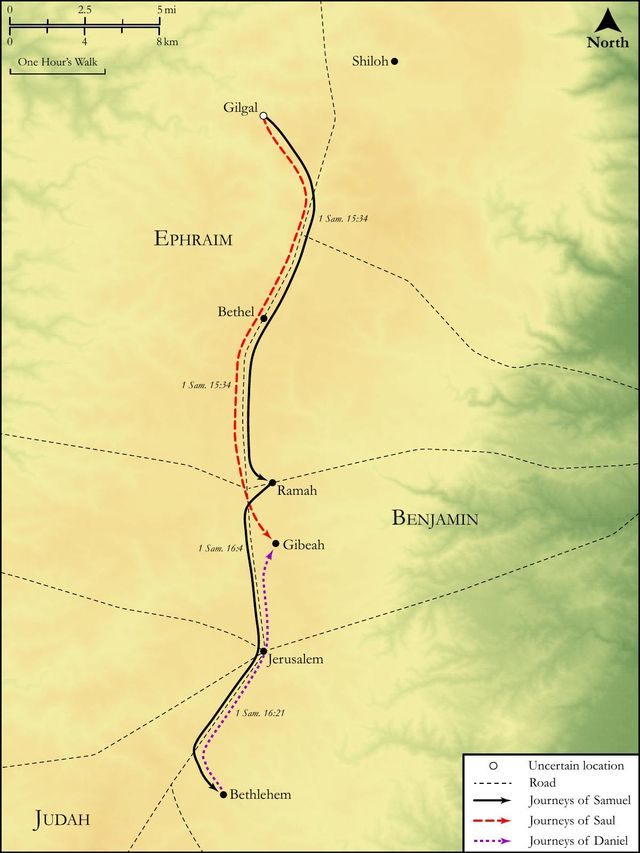
See on the biblical-era maps
Study this verse
Public-domain commentary
Matthew Henry
From his Commentary on the Whole Bible. Henry comments on passages, not single verses — this entry covers 1 Samuel 15:32–35. His three-level outline is real structure in the source text, so it is rendered as structure.
Samuel, as a prophet, is here set over kings, Jer 1:10.
I.He destroys king Agag, doubtless by such special direction from heaven as none now can pretend to.
He hewed Agag in pieces. Some think he only ordered it to be done; or perhaps he did it with his own hands, as a sacrifice to God's injured justice (Sa1 15:33), and sacrifices used to be cut in pieces. Now observe in this,
1.How Agag's present vain hopes were frustrated: He came delicately, in a stately manner, to show that he was a king, and therefore to be treated with respect, or in a soft effeminate manner, as one never used to hardship, that could not set the sole of his foot to the ground for tenderness and delicacy (Deu 28:56), to move compassion: and he said, "Surely, now that the heat of the battle is over, the bitterness of death is past, Sa1 15:32. Having escaped the sword of Saul," that man of war, he thought he was in no danger from Samuel, and old prophet, a man of peace. Note,
(1.)There is bitterness in death, it is terrible to nature. Surely death is bitter, so divers versions read those words of Agag; as the Septuagint read the former clause, He came trembling. Death will dismay the stoutest heart.
(2.)Many think the bitterness of death is past when it is not so; they put that evil day far from them which is very near. True believers may, through grace, say this, upon good grounds, though death be not past, the bitterness of it is. O death! where is thy sting?
2.How his former wicked practices were now punished. Samuel calls him to account, not only for the sins of his ancestors, but his own sins: Thy sword has made women childless, Sa1 15:33. He trod in the steps of his ancestors' cruelty, and those under him, it is likely, did the same; justly therefore is all the righteous blood shed by Amalek required of this generation, Mat 23:36. Agag, that was delicate and luxurious himself, was cruel and barbarous to others. It is commonly so: those who are indulgent in their appetites are not less indulgent of their passions. But blood will be reckoned for; even kings must account to the King of kings for the guiltless blood they shed or cause to be shed. It was that crime of king Manasseh which the Lord would not pardon, Kg2 24:4. See Rev 13:10.
II.He deserts king Saul, takes leave of him (Sa1 15:34), and never came any more to see him (Sa1 15:35), to advise or assist him in any of his affairs, because Saul did not desire his company nor would he be advised by him. He looked upon him as rejected of God, and therefore he forsook him. Though he might sometimes see him accidentally (as Sa1 19:24), yet he never came to see him out of kindness or respect. Yet he mourned for Saul, thinking it a very lamentable thing that a man who stood so fair for great things should ruin himself so foolishly. He mourned for the bad state of the country, to which Saul was likely to have been so great a blessing, but now would prove a curse and a plague. He mourned for his everlasting state, having no hopes of bringing him to repentance. When he wept for him, it is likely, he made supplication, but the Lord had repented that he had made Saul king, and resolved to undo that work of his, so that Samuel's prayers prevailed not for him. Observe, We must mourn for the rejection of sinners,
1.Though we withdraw from them, and dare not converse familiarly with them. Thus the prophet determines to leave his people and go from them, and yet to weep day and night for them, Jer 9:1, Jer 9:2.
2.Though they do not mourn for themselves. Saul seems unconcerned at the tokens of God's displeasure which he lay under, and yet Samuel mourns day and night for him. Jerusalem was secure when Christ wept over it.
Historical interpretation
Historical reception
2 surviving comments on this verse. Each one is dated, so this reads as a timeline rather than a list.
And Samuel said, "As your sword has made women childless, etc." Understand the sword of Agag as the most effective fury of pride; the Hebrew women bereft of children by him, as faithful souls deprived of the fruit of good works by victorious pride. But as you, he said, have turned countless from the path of truth, O proud presumption, so when the appointed time arrives, when He who will justly judge and destroy the entire kingdom of iniquity comes, your mother impiety, captured by innumerable crimes, will be deprived of that most wicked progeny of vices, having no more whom to seduce.
And Samuel hewed Agag in pieces, etc. And every spiritual and prophetic teacher hews the king of the licking people in pieces; when, diligently exposing the manifold deceptions of pride, carefully disemboweling the vice, he considers and explains what must be done against each of its wiles for himself and his followers. He clarifies and reveals that within the very fat Agag, that is, the covering of malice, are hidden the blind recesses of decay and corruption; and this, in Gilgal, that is, the revelation of manifest truth and faith, the teacher accomplishes. And in another sense: When, in the revelation of the final judgment, the whole body of sin is to be utterly destroyed, which the reprobate foolishly spare now, he foresees and proclaims it must be broken.
Continue studying 1 Samuel 15:33 across the web’s major study libraries — every link below opens this exact verse, chapter, or book on the destination site.
Read & Compare
 BibleGatewayThis verse in more than 200 translations and 70 languages.
 Bible.comThe YouVersion reader — hundreds of translations, reading plans, and highlights.
 ESV.orgCrossway's official English Standard Version reader.
 NET BibleThe NET translation with 60,000+ translators' notes on every rendering decision.
 STEP BibleTyndale House's free study tool — original text, vocabulary, and scholarly resources.
 BibliaLogos Bible Software's free web reader.
 USCCBThe New American Bible (Revised Edition) with the U.S. bishops' study notes.
Commentaries
 BibleHub CommentariesDozens of classic commentaries on this verse, gathered on one page.
 StudyLightMore than 100 commentary sets — the largest collection on the web.
 BibleRefPlain-English commentary on what this verse means, verse by verse.
 Enduring WordDavid Guzik's free commentary on this chapter, widely used by Bible teachers.
 Bible Study ToolsVerse commentary alongside Greek and Hebrew study aids.
Original Language & Research
- BibleHub InterlinearThe verse word by word — original language, transliteration, and English.
- BibleHub LexiconEvery word's original-language definition and Strong's entry.
 Blue Letter BibleDeep-study tools — Strong's numbers, concordance, and word studies.
 SefariaThe Hebrew text with Rashi and centuries of Jewish commentary.
Sermons, Hymns & Audio


TrulyRandomVerse is not affiliated with these sites and doesn’t control their content. They’re linked because they’re genuinely useful.
Summary
1 Samuel 15:33 vividly recounts the prophet Samuel's decisive and brutal execution of Agag, the king of the Amalekites, in Gilgal. This climactic act of divine judgment serves as the stark culmination of King Saul's narrative of partial obedience and subsequent rejection by God. Samuel's pronouncement to Agag, directly linking Agag's past violence to his own impending demise, powerfully underscores the principle of divine retribution, while the public dismemberment functions as a chillingly effective, ritualistic affirmation of God's unwavering commitment to His commands and justice, especially when human agents falter.
Context
ShowHideLiterary Context
This verse provides the grim and definitive resolution to the pivotal narrative of King Saul's disobedience in 1 Samuel 15. The chapter begins with a clear, unequivocal command from God, delivered through Samuel, for Saul to utterly destroy the Amalekites as an act of herem (devotion to destruction), a judgment stemming from their ancient hostility towards Israel (1 Samuel 15:2-3). However, Saul disobeys this divine mandate by sparing Agag, the Amalekite king, and preserving the best of the livestock, ostensibly for sacrifice (1 Samuel 15:9). This act of partial obedience is unequivocally deemed outright rebellion by God, leading to His solemn decision to reject Saul as king (1 Samuel 15:10-23). Deeply grieved by Saul's profound failure, Samuel confronts the king, pronounces God's unalterable judgment, and then, with unwavering resolve, personally carries out the divine command that Saul had failed to fulfill. The execution of Agag thus marks the definitive end of Saul's reign in God's eyes and powerfully highlights the uncompromising nature of divine justice and the absolute necessity of complete obedience.
Historical & Cultural Context
The Amalekites were a nomadic, predatory people with a long-standing and deeply rooted history of animosity towards Israel. Their most notable offense was an unprovoked and cowardly attack on the Israelites from the rear during their Exodus journey from Egypt, specifically targeting the weak and vulnerable (Deuteronomy 25:17-19). This egregious act led to a divine decree that Amalek's memory should be blotted out. The concept of herem was a specific command for holy war, where everything captured was to be dedicated to God, typically through destruction, to prevent defilement or the appropriation of forbidden spoils. Gilgal, the precise location of Agag's execution, held immense historical and covenantal significance for Israel. It was their first encampment after crossing the Jordan into the Promised Land (Joshua 4:19), a place of covenant renewal, mass circumcision, and the symbolic "rolling away" of the reproach of Egypt (Joshua 5:9). It was also where Saul was publicly confirmed as king (1 Samuel 11:15) and, ironically, where he had previously offered an unauthorized sacrifice, demonstrating his early spiritual failures (1 Samuel 13:8-14). Thus, Gilgal serves as a poignant and powerful backdrop for both Saul's initial anointing and his ultimate rejection, culminating in this profound act of divine judgment.
Key Themes
ShowHideThe events of 1 Samuel 15, culminating in Agag's execution, powerfully illustrate several foundational biblical themes. First is Divine Justice and Retribution, where God's righteous judgment is meted out precisely and fittingly. Samuel's declaration to Agag, that his own violence would be repaid in kind, echoes the biblical principle of lex talionis and underscores God's sovereign oversight of human actions, ensuring that wickedness does not go unpunished. Second, the passage emphasizes the Severity of Disobedience and the Imperative of Complete Obedience. Saul's partial obedience was deemed complete rebellion, demonstrating that God demands wholehearted adherence to His commands, not humanly reasoned compromises or self-serving justifications. Samuel's famous declaration, "to obey is better than sacrifice," finds its starkest illustration here, as Saul's failure to obey fully costs him the kingdom. Third, the narrative highlights God's Uncompromising Holiness and Sovereignty. God's character is revealed as one who is not swayed by human expediency or sentimentality when His holy purposes and declared judgments are at stake. His commands are not suggestions but require absolute fidelity. Finally, Samuel's role as God's Faithful Agent is paramount. As prophet and judge, Samuel acts as God's unwavering instrument to ensure divine justice is carried out when human leadership (Saul) fails, embodying unwavering devotion to God's will above all else.
Exposition and Analysis
ShowHideKey Word Analysis
ShowHideThe Hebrew noun חֶרֶב (chereb) refers to a cutting instrument, specifically a sword, dagger, or knife, emphasizing its destructive effect. In this context, "thy sword" directly implicates Agag's personal agency and the instrument of his violence, linking his past actions of causing death and bereavement to the retribution he now faces. It highlights the direct correlation between his means of inflicting suffering and the suffering now visited upon him.
The Hebrew verb שָׁכֹל (shakol) means "to be bereaved," "to suffer abortion," or "to be childless." It conveys a profound sense of loss, specifically the loss of children, which in Israel was a devastating personal and familial tragedy, threatening the continuation of one's lineage and legacy. Samuel's repeated use of this term directly links Agag's violent acts—which caused other women to become shakol—to his own mother experiencing the same, emphasizing a direct, retributive justice. The repetition underscores the poetic and judicial nature of Samuel's pronouncement.
The Hebrew verb שָׁסַף (shatsaph) is a graphic and forceful term meaning "to cut in pieces" or "to slaughter." While the Strong's data provided for H8158 is shâçaph, the KJV text uses "hewed in pieces" which aligns with the meaning of shatsaph. This verb emphasizes the brutality, completeness, and public nature of Agag's execution. The choice of this verb highlights that Agag was not merely killed but ritually dismembered, underscoring the severity of the divine judgment and the complete annihilation of his power and person.
The Hebrew phrase לִפְנֵי יְהוָה (lifnei YHWH) literally translates to "in the face of Yahweh" or "in the presence of Yahweh." This signifies that Agag's execution was not a private act of vengeance or a mere political assassination, but a solemn, public, and ritualistic act carried out under God's direct authority and in His sight. It elevates the event from a human act to a divine judgment, a sacred execution performed by God's appointed representative, Samuel, in a manner that affirmed God's absolute sovereignty and justice.
Verse Breakdown
ShowHide"And Samuel said, As thy sword hath made women childless, so shall thy mother be childless among women."
Samuel's declaration is a powerful and precise statement of lex talionis, the law of retribution, where the punishment directly mirrors the crime. Agag, as a king and likely a warrior, was responsible for the deaths of many, leaving their mothers and wives bereaved of their sons and husbands. Samuel pronounces that the same sorrow and loss that Agag inflicted upon others will now be visited upon his own mother. This is not merely a curse but a judicial sentence, emphasizing God's perfect and equitable justice, demonstrating that the oppressor will experience the very pain he inflicted.
"And Samuel hewed Agag in pieces before the LORD in Gilgal."
This clause describes the immediate and brutal execution of the sentence. Samuel, acting as God's unwavering agent, personally carries out the divine command that King Saul had failed to fulfill. The graphic nature of "hewed in pieces" (as discussed in Key Word Analysis) signifies a complete and utter destruction, leaving no doubt about the finality of the judgment. The location "in Gilgal" reinforces the historical and covenantal significance of the place, transforming the act into a public demonstration of God's unwavering justice and sovereignty. The phrase "before the LORD" elevates the execution to a sacred, divinely sanctioned act, underscoring that it was done in God's immediate presence and according to His explicit will, not out of personal malice or human passion.
Literary Devices
ShowHideThe passage employs several potent literary devices to convey its profound and challenging message. Retribution Theology is central, explicitly stated in Samuel's pronouncement: Agag's fate directly mirrors his past actions, illustrating the principle that divine justice ensures that the perpetrator experiences the consequences of their own violence. This is not merely human vengeance but a theological statement about God's righteous governance of the world. Irony is powerfully present; Saul, the anointed king, failed to execute God's command, but the prophet Samuel, a man of God, steps in to fulfill the king's duty, highlighting Saul's spiritual inadequacy and the transfer of divine favor away from him. The act of "hewing in pieces" carries potent Symbolism, evoking the imagery of a sacrificial offering, which is deeply ironic given Saul's false pretense of sparing Agag for sacrifice. Agag becomes a sacrificial offering, but one of divine judgment and complete destruction, not human piety or atonement. Furthermore, the scene serves as a dramatic Foreshadowing of Saul's own ultimate rejection and violent end, as his failure to obey God's command fully leads to his downfall, much as Agag's violence leads to his own dismemberment. The stark contrast between Saul's hesitation and Samuel's resolute action also highlights the enduring theme of Prophetic Authority versus failed kingship.
Theological and Thematic Connections
ShowHideThe execution of Agag in 1 Samuel 15:33 is a stark reminder of God's unwavering justice and the absolute necessity of complete obedience to His commands. It reveals a God who is holy and righteous, who sees and judges evil, and who will not tolerate partial obedience or human rationalizations in place of His explicit will. This event underscores the seriousness of sin and rebellion against God's revealed word, demonstrating that divine judgment, though often delayed, is certain and comprehensive. It also highlights the principle that God will ensure His purposes are fulfilled, even if it requires His faithful servants to step into difficult and uncompromising roles when human leadership falters. While the severity of the act may challenge modern sensibilities, it serves as a powerful testament to God's commitment to justice and the eradication of evil that persistently opposes His people and His kingdom.
Reflection and Application
ShowHideThe narrative of Agag's execution, though set in a distant and challenging historical context, offers profound spiritual lessons for believers today. It compels us to confront the nature of our own obedience to God. Are we prone to "partial obedience," holding back areas of our lives from God's full authority, perhaps rationalizing our compromises as Saul did? This passage challenges us to recognize that true obedience is holistic and unwavering, not selective or convenient. Furthermore, it calls us to trust in God's perfect justice, even when His ways seem harsh or incomprehensible from a human perspective. We are reminded that God is sovereign over all things, and His judgments, though sometimes severe, are always righteous. Spiritually, this passage can be applied to the need for decisive action against sin in our lives. Just as Agag represented a persistent enemy of God's people, so too can certain sins or patterns of rebellion become entrenched within us. We are called to "hew them in pieces," to utterly destroy them by God's grace and power, rather than sparing them or making excuses for their presence. This requires a radical commitment to holiness and a willingness to confront and eliminate anything that stands in opposition to God's will in our lives.
Questions for Reflection
ShowHideFAQ
ShowHideWas Samuel's act of "hewing Agag in pieces" an act of personal vengeance or divine justice?
ShowHideSamuel's act was unequivocally an execution of divine justice, not personal vengeance. The text explicitly states it was done "before the LORD," signifying that it was a solemn, ritualistic act carried out under God's direct command and authority. Samuel, as God's prophet and judge, was fulfilling a divine decree that King Saul had failed to execute. The command to utterly destroy the Amalekites was a long-standing divine judgment against a people who had persistently opposed God's chosen nation, dating back to their unprovoked attack on the Israelites during the Exodus (Deuteronomy 25:17-19). Samuel's action underscores God's uncompromising holiness and His commitment to His declared judgments, even when they are severe from a human perspective.
How can a God of love command such a violent act?
ShowHideThis is a challenging question that requires understanding God's character in its fullness. While God is indeed love (1 John 4:8), He is also perfectly holy, righteous, and just. The command to destroy the Amalekites was not arbitrary but a judgment against a people whose wickedness and persistent hostility towards God's people had reached a point of no return. This act of herem (devotion to destruction) was a unique command for specific historical circumstances, often aimed at preventing the corruption of Israel by pagan practices and ensuring the purity of God's covenant people. From a biblical perspective, God's justice is a necessary aspect of His love, as it ensures that evil does not ultimately triumph and that righteousness prevails. While difficult to reconcile with modern sensibilities, this passage reminds us that God is sovereign, and His judgments are always righteous, even when they are beyond our full comprehension.
What is the significance of the execution taking place "in Gilgal"?
ShowHideGilgal holds deep historical and theological significance for Israel. It was the first encampment after crossing the Jordan into the Promised Land (Joshua 4:19), a place where the reproach of Egypt was "rolled away" through circumcision, signifying a new covenant beginning (Joshua 5:9). It was also where Saul was confirmed as king (1 Samuel 11:15) and, ironically, where he later offered an unauthorized sacrifice, demonstrating his early disobedience (1 Samuel 13:8-14). Thus, Gilgal represents both covenant faithfulness and the consequences of disobedience. Agag's execution there, "before the LORD," at the very place of Israel's renewed covenant with God and Saul's initial anointing, underscores the profound nature of Saul's failure and the solemnity of God's judgment, serving as a public declaration of the end of Saul's reign in God's eyes.
Christ-Centered Fulfillment
ShowHideThe grim scene of Agag's execution, while confronting in its severity, ultimately points us to the perfect justice and redemptive work of Jesus Christ. Samuel's act of executing divine judgment foreshadows the ultimate judgment against sin and evil that is fully realized in Christ. While Samuel dismembers Agag, the persistent enemy of Israel, Christ, the true Lamb of God, is himself "cut off" for the sins of His people, bearing the full weight of God's righteous wrath against sin (Isaiah 53:8). The principle of retribution, "as thy sword hath made women childless, so shall thy mother be childless," finds its ultimate resolution not in humanity's self-inflicted judgment, but in Christ taking the judgment due to us. He became sin for us, so that in Him we might become the righteousness of God (2 Corinthians 5:21). Furthermore, Saul's partial obedience, which led to his rejection and the loss of his kingdom, highlights the profound need for a perfect King who would offer complete and unwavering obedience. Jesus Christ is that King, who perfectly fulfilled all righteousness (Matthew 3:15) and was "obedient to the point of death, even death on a cross" (Philippians 2:8). His perfect obedience stands in stark contrast to Saul's failure, securing salvation for all who believe. Ultimately, the decisive judgment against evil, symbolized by Agag's demise, is fully accomplished in Christ's victory over sin, death, and the devil on the cross and through His resurrection, ushering in a new covenant where God's justice and mercy perfectly meet (Romans 3:25-26).