


1 Samuel 15:34
Bible text: King James Version (1769 Blayney text) · Public domain
Bible text: Berean Standard Bible · Public domain
Bible text: American Standard Version (1901) · Public domain
Bible text: World English Bible, Messianic edition · Public domain
Bible text: Geneva Bible (1599) · Public domain
Bible text: Young's Literal Translation · Public domain
- וַיֵּלֶךְvai·Ye·lekhand he wentH1980Conj-w ¦ V-Qal-ConsecImperf-3msVerb Qal Consecutive Imperfect 3rd Singular Masculineוַandיֵּלֶךְhe went
- שְׁמוּאֵלshe·mu·'ElSamuelH8050N-proper-mNoun Proper Masculine
- הָרָמָתָהha·ra·Ma·tah<the> Ramah towardsH7414Art ¦ N-proper ¦ SfxNoun Proper Locationהָ<the>רָמָתָRamahהtowards
- וְשָׁאוּלve·sha·'Uland SaulH7586Conj-w ¦ N-proper-mNoun Proper MasculineוְandשָׁאוּלSaul
- עָלָה'a·Lahhe went upH5927V-Qal-Perf-3msVerb Qal Perfect 3rd Singular Masculine
- אֶל'eltoH413PrepPreposition
- בֵּיתוֹbei·Tohis houseH1004N-msc ¦ 3msNoun Singular Masculine Constructבֵּיתhouseוֹhis
- גִּבְעַתgiv·'AtGibeah ofH1390N-fscNoun Singular Feminine Construct
- שָׁאוּלsha·'UlSaulH7586N-proper-mNoun Proper Masculine
English is a literal word-by-word gloss of the Hebrew, not the KJV's wording. Why?
This is the original text the KJV's translators worked from — each Hebrew word with its own literal English meaning in this verse, prepared by scholars at Tyndale House, Cambridge. The KJV translates whole sentences, not word by word, so its wording differs: one Hebrew word can become several English words, and the KJV may choose “the LORD” where the gloss reads “Yahweh”. Both are faithful — they answer different questions. For the KJV's own rendering, switch to the KJV text.
Details
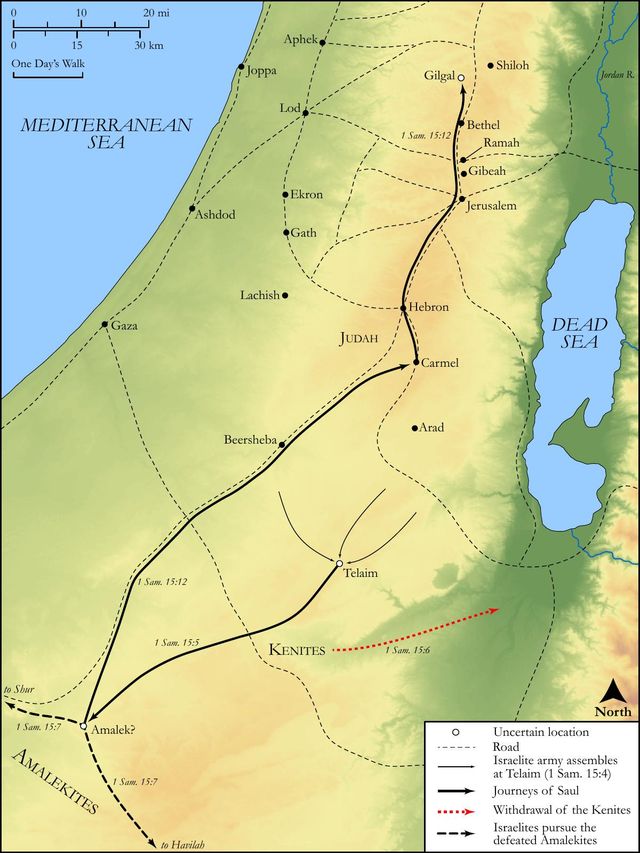
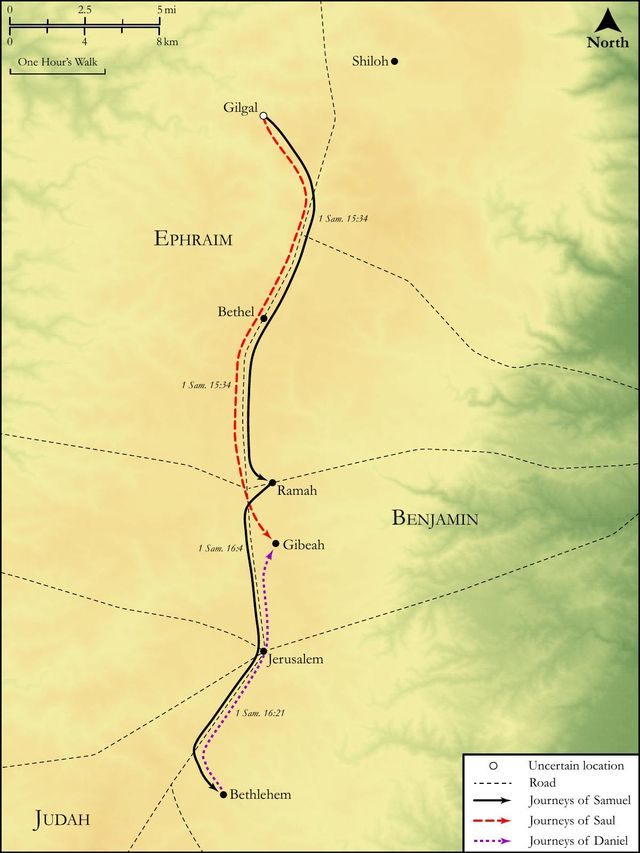
See on the biblical-era maps
Study this verse
Public-domain commentary
Matthew Henry
From his Commentary on the Whole Bible. Henry comments on passages, not single verses — this entry covers 1 Samuel 15:32–35. His three-level outline is real structure in the source text, so it is rendered as structure.
Samuel, as a prophet, is here set over kings, Jer 1:10.
I.He destroys king Agag, doubtless by such special direction from heaven as none now can pretend to.
He hewed Agag in pieces. Some think he only ordered it to be done; or perhaps he did it with his own hands, as a sacrifice to God's injured justice (Sa1 15:33), and sacrifices used to be cut in pieces. Now observe in this,
1.How Agag's present vain hopes were frustrated: He came delicately, in a stately manner, to show that he was a king, and therefore to be treated with respect, or in a soft effeminate manner, as one never used to hardship, that could not set the sole of his foot to the ground for tenderness and delicacy (Deu 28:56), to move compassion: and he said, "Surely, now that the heat of the battle is over, the bitterness of death is past, Sa1 15:32. Having escaped the sword of Saul," that man of war, he thought he was in no danger from Samuel, and old prophet, a man of peace. Note,
(1.)There is bitterness in death, it is terrible to nature. Surely death is bitter, so divers versions read those words of Agag; as the Septuagint read the former clause, He came trembling. Death will dismay the stoutest heart.
(2.)Many think the bitterness of death is past when it is not so; they put that evil day far from them which is very near. True believers may, through grace, say this, upon good grounds, though death be not past, the bitterness of it is. O death! where is thy sting?
2.How his former wicked practices were now punished. Samuel calls him to account, not only for the sins of his ancestors, but his own sins: Thy sword has made women childless, Sa1 15:33. He trod in the steps of his ancestors' cruelty, and those under him, it is likely, did the same; justly therefore is all the righteous blood shed by Amalek required of this generation, Mat 23:36. Agag, that was delicate and luxurious himself, was cruel and barbarous to others. It is commonly so: those who are indulgent in their appetites are not less indulgent of their passions. But blood will be reckoned for; even kings must account to the King of kings for the guiltless blood they shed or cause to be shed. It was that crime of king Manasseh which the Lord would not pardon, Kg2 24:4. See Rev 13:10.
II.He deserts king Saul, takes leave of him (Sa1 15:34), and never came any more to see him (Sa1 15:35), to advise or assist him in any of his affairs, because Saul did not desire his company nor would he be advised by him. He looked upon him as rejected of God, and therefore he forsook him. Though he might sometimes see him accidentally (as Sa1 19:24), yet he never came to see him out of kindness or respect. Yet he mourned for Saul, thinking it a very lamentable thing that a man who stood so fair for great things should ruin himself so foolishly. He mourned for the bad state of the country, to which Saul was likely to have been so great a blessing, but now would prove a curse and a plague. He mourned for his everlasting state, having no hopes of bringing him to repentance. When he wept for him, it is likely, he made supplication, but the Lord had repented that he had made Saul king, and resolved to undo that work of his, so that Samuel's prayers prevailed not for him. Observe, We must mourn for the rejection of sinners,
1.Though we withdraw from them, and dare not converse familiarly with them. Thus the prophet determines to leave his people and go from them, and yet to weep day and night for them, Jer 9:1, Jer 9:2.
2.Though they do not mourn for themselves. Saul seems unconcerned at the tokens of God's displeasure which he lay under, and yet Samuel mourns day and night for him. Jerusalem was secure when Christ wept over it.
Continue studying 1 Samuel 15:34 across the web’s major study libraries — every link below opens this exact verse, chapter, or book on the destination site.
Read & Compare
 BibleGatewayThis verse in more than 200 translations and 70 languages.
 Bible.comThe YouVersion reader — hundreds of translations, reading plans, and highlights.
 ESV.orgCrossway's official English Standard Version reader.
 NET BibleThe NET translation with 60,000+ translators' notes on every rendering decision.
 STEP BibleTyndale House's free study tool — original text, vocabulary, and scholarly resources.
 BibliaLogos Bible Software's free web reader.
 USCCBThe New American Bible (Revised Edition) with the U.S. bishops' study notes.
Commentaries
 BibleHub CommentariesDozens of classic commentaries on this verse, gathered on one page.
 StudyLightMore than 100 commentary sets — the largest collection on the web.
 BibleRefPlain-English commentary on what this verse means, verse by verse.
 Enduring WordDavid Guzik's free commentary on this chapter, widely used by Bible teachers.
 Bible Study ToolsVerse commentary alongside Greek and Hebrew study aids.
Original Language & Research
- BibleHub InterlinearThe verse word by word — original language, transliteration, and English.
- BibleHub LexiconEvery word's original-language definition and Strong's entry.
 Blue Letter BibleDeep-study tools — Strong's numbers, concordance, and word studies.
 SefariaThe Hebrew text with Rashi and centuries of Jewish commentary.
Sermons, Hymns & Audio


TrulyRandomVerse is not affiliated with these sites and doesn’t control their content. They’re linked because they’re genuinely useful.
Summary
1 Samuel 15:34 marks a pivotal and somber moment in the narrative of King Saul, illustrating the definitive physical and symbolic separation between the Prophet Samuel and the disobedient monarch. Following Saul's egregious unfaithfulness in the campaign against the Amalekites and Samuel's pronouncement of divine rejection, this verse concisely records Samuel's return to his prophetic home in Ramah and Saul's retreat to his royal residence in Gibeah. This geographical parting underscores the irreparable breach in their relationship, signaling the cessation of Samuel's direct prophetic guidance for Saul and the commencement of Saul's increasingly isolated, troubled, and ultimately tragic reign.
Context
ShowHideLiterary Context
This verse immediately follows the climactic and devastating confrontation between Samuel and Saul in 1 Samuel 15. God had explicitly commanded Saul to utterly destroy the Amalekites, including all their livestock, as a divine judgment against a long-standing enemy of Israel (1 Samuel 15:3). However, Saul partially obeyed, sparing King Agag and the choicest of the sheep and oxen, rationalizing his actions as a desire to offer sacrifices to the Lord. Samuel, acting as God's mouthpiece, delivered a severe rebuke, famously declaring that "to obey is better than sacrifice, and to listen is better than the fat of rams" (1 Samuel 15:22). He then pronounced God's definitive rejection of Saul as king due to his disobedience and rebellion (1 Samuel 15:23). The execution of Agag by Samuel himself, a stark demonstration of divine justice and the seriousness of Saul's failure, immediately precedes this verse, making the separation in 1 Samuel 15:34 a powerful visual culmination of the spiritual and relational breach.
Historical & Cultural Context
The early monarchy in Israel was a period of profound transition from a tribal confederacy led by judges to a centralized kingdom. The prophet Samuel played a crucial, divinely appointed role as God's intermediary, anointing both Saul and later David as kings. Kingship in Israel was distinct from surrounding nations; it was not absolute but was meant to be subservient to God's law and prophetic instruction. Saul's failure to fully execute the herem (a command of complete devotion to destruction) against the Amalekites was not merely a military misstep but a direct act of rebellion against God's sovereign command and a violation of covenantal obligations. The Amalekites were a perennial enemy of Israel, first attacking them after the Exodus (Exodus 17:8-16), and God had sworn to blot out their memory. Saul's sparing of Agag and the livestock was a significant breach of this divine mandate. Geographically, Ramah was Samuel's hometown and a recognized center for prophetic activity, while Gibeah was Saul's capital and stronghold, making their respective destinations symbolic of their differing spiritual states and roles.
Key Themes
ShowHideThis verse powerfully encapsulates several key themes prevalent in 1 Samuel: the absolute necessity of obedience to God's word over human reasoning or ritualistic performance. Saul's partial obedience is revealed as outright disobedience, leading directly to divine rejection and the loss of God's favor. The physical separation between Samuel and Saul profoundly symbolizes the severed relationship between God and His chosen king, highlighting the conditional nature of the monarchy in Israel. It also foreshadows Saul's increasing isolation and spiritual decline, as he is left without the direct prophetic guidance that was vital for a king ruling under God's authority. The narrative emphasizes that God's choices and judgments are final, as seen in Samuel's sorrow but ultimate adherence to God's decree (1 Samuel 15:35). This pivotal event sets the stage for the search for a new king, one who would be "a man after his own heart" (1 Samuel 13:14).
Exposition and Analysis
ShowHideKey Word Analysis
ShowHideThe Hebrew verb עָלָה (‘âlâh, H5927) literally means "to go up," "ascend," or "climb." While Gibeah was indeed situated on a hill, the use of ‘âlâh here for Saul's return to his house carries a subtle but significant nuance. It suggests a movement not just geographically upward, but also a retreat to his own domain, his stronghold, his place of perceived authority and security. In contrast to Samuel's departure to his home in Ramah, a place of spiritual leadership and prophetic dwelling, Saul ascends to "his house to Gibeah of Saul," emphasizing his self-reliance and isolation, now stripped of divine favor and prophetic counsel.
The Hebrew term גִּבְעָה (Gibʻâh, H1390) means "hill" and refers to a specific place, Gibeah, which was Saul's hometown and capital (1 Samuel 10:26). The addition of "of Saul" (שָׁאוּל, Shâʼûwl, H7586) to "Gibeah" in the verse is highly significant. This specific designation, "Gibeah of Saul," underscores his personal claim and connection to the place. However, in the context of his rejection, his return to "his" Gibeah highlights a retreat into his own sphere, a place where he would increasingly rely on his own strength and counsel rather than God's. It becomes a powerful symbol of his isolated kingship, now severed from the divine anointing and prophetic guidance that had initially legitimized his rule.
Verse Breakdown
ShowHide"Then Samuel went to Ramah;"
This clause describes Samuel's immediate departure from Gilgal, the site of the intense confrontation and pronouncement of judgment. Ramah was Samuel's hometown and a significant center for prophetic ministry, possibly where schools of prophets were located. His return there signifies a definitive withdrawal from direct engagement with Saul and the affairs of the kingdom under Saul's compromised rule. It marks the end of his active role as Saul's spiritual mentor and guide, symbolizing the finality of God's rejection of Saul. Samuel's deep sorrow over Saul's fate is explicitly noted in the very next verse (1 Samuel 15:35).
"and Saul went up to his house to Gibeah of Saul."
In stark contrast to Samuel's destination, Saul retreats to his own capital, Gibeah. The phrase "his house" (בֵּיתוֹ, bayith, H1004) emphasizes his personal domain, suggesting a retreat into self-imposed isolation or a desperate attempt to reassert his authority within his own sphere. The specification "Gibeah of Saul" further highlights his personal claim to power and territory, even as that power has been divinely compromised and stripped of its spiritual foundation. This movement signifies Saul's withdrawal from the spiritual confrontation and his return to a kingship that would now be characterized by increasing internal turmoil, paranoia, and a profound lack of divine blessing.
Literary Devices
ShowHideThe verse employs several powerful Literary Devices. Juxtaposition is central, sharply contrasting the distinct paths taken by Samuel and Saul. Samuel, the faithful prophet, returns to Ramah, a place of spiritual authority and prophetic dwelling, while Saul, the disobedient king, retreats to "his house to Gibeah of Saul," a place of earthly power now divested of divine favor. This physical separation serves as potent Symbolism, representing the irreparable spiritual breach between God and Saul. The geographical destinations themselves carry profound Geographical Significance: Ramah as a center of divine communication and prophetic presence, and Gibeah as Saul's personal stronghold, now a symbol of his increasing isolation and the tragic consequences of his rebellion. The succinctness of the verse, following the dramatic preceding events, lends it a sense of finality and tragic inevitability, underscoring the irreversible nature of God's judgment and the profound consequences of disobedience.
Theological and Thematic Connections
ShowHideThis seemingly simple verse carries profound theological weight, serving as a stark reminder of the gravity of disobedience and the unyielding nature of God's holiness and justice. It underscores the principle that God values complete obedience more than outward religious performance or human rationalization. Saul's failure demonstrates that even those chosen for high office are accountable to God's commands, and rebellion against His word is tantamount to idolatry. The separation signifies the withdrawal of divine favor and guidance, a spiritual consequence far more severe than any earthly loss. It highlights the often-painful reality that unrepentant sin creates a chasm between humanity and God, even for those once intimately connected to Him. This narrative prepares the reader for the subsequent anointing of David, a king who, despite his flaws, would be characterized by a heart of repentance and a desire to obey God, setting a new standard for leadership in Israel.
Reflection and Application
ShowHideThe parting of Samuel and Saul in 1 Samuel 15:34 serves as a timeless and sobering lesson for all who seek to walk with God. It challenges us to examine the sincerity and completeness of our own obedience. Are we prone to partial obedience, rationalizing our compromises, or prioritizing our own desires and perceived benefits over God's clear commands? Saul's tragedy reminds us that God desires a yielded heart, not just outward religious acts or sacrifices. True spiritual authority and blessing flow from humble submission to divine will. When we persist in disobedience, we risk not only losing God's favor but also experiencing increasing isolation, inner turmoil, and a spiritual separation that can be deeply painful. This verse calls us to a posture of radical obedience, recognizing that God's ways are always best, and His commands are for our ultimate good, even when they seem difficult or counter-intuitive. It encourages us to seek and cherish prophetic and pastoral guidance, understanding that such counsel is a gift from God to keep us aligned with His purposes and prevent us from drifting into self-reliance and spiritual decline.
Questions for Reflection
ShowHideFAQ
ShowHideWhy was Saul's disobedience regarding the Amalekites considered so severe by God?
ShowHideSaul's disobedience was considered so severe because it was a direct act of rebellion against God's explicit command, not merely a tactical error. God had commanded the complete destruction (herem) of the Amalekites as an act of divine judgment for their persistent wickedness and their historical enmity against Israel, dating back to their attack on the Israelites after the Exodus (Exodus 17:8-16; Deuteronomy 25:17-19). By sparing King Agag and the best of the livestock, Saul not only defied God's authority but also usurped God's prerogative in determining what was holy and what was to be utterly destroyed. His attempt to justify his actions by claiming the spared animals were for sacrifice further demonstrated a profound misunderstanding of true worship, prioritizing ritual over obedience. Samuel famously declared, "To obey is better than sacrifice, and to listen is better than the fat of rams" (1 Samuel 15:22). This act revealed a heart of rebellion and self-will, which God deemed unfit for kingship over His people.
What is the symbolic significance of Samuel and Saul separating and going to their respective homes?
ShowHideThe physical separation of Samuel and Saul, with each returning to their own geographical domain, is deeply symbolic of the spiritual and relational breach that had occurred. Samuel's return to Ramah, his prophetic home, signifies the withdrawal of God's direct prophetic guidance and favor from Saul. It marks the end of Samuel's role as Saul's spiritual mentor and intermediary with God. Saul's retreat to "his house to Gibeah of Saul" symbolizes his increasing isolation and reliance on his own strength and counsel, now that God's Spirit had departed from him (1 Samuel 16:14). This parting marks a definitive turning point, signaling the finality of God's rejection of Saul as king and the beginning of his tragic descent into paranoia and spiritual darkness. It visually represents the chasm that unrepentant disobedience creates between humanity and God, a chasm that would plague Saul's remaining reign.
Christ-Centered Fulfillment
ShowHideThe tragic narrative of Saul's rejection and the subsequent separation from Samuel, as depicted in 1 Samuel 15:34, profoundly highlights the need for a perfect King and points forward to the ultimate fulfillment found in Jesus Christ. Saul's kingship, flawed by disobedience and self-will, underscores humanity's inherent inability to perfectly obey God's commands and maintain righteousness. He failed to be the faithful shepherd God's people needed, ultimately leading to his rejection and isolation from divine favor. In stark contrast, Jesus Christ is the King who perfectly embodies obedience. He did not come to do His own will but the will of the Father who sent Him (John 6:38). His entire life was an act of perfect submission, culminating in His obedience "even to the point of death on a cross" (Philippians 2:8). Unlike Saul, who was rejected for his rebellion, Christ's perfect obedience qualified Him to be the eternal King, the Lamb of God who takes away the sin of the world (John 1:29). Where Saul's disobedience led to separation from God, Christ's obedience bridges the chasm of sin, reconciling humanity to God and offering eternal fellowship to all who believe in Him (2 Corinthians 5:18-19). He is the true and faithful King, Prophet, and Priest, whose reign is marked by perfect righteousness, unending grace, and an unbreakable covenant with His people (Hebrews 7:22-28).