


1 Samuel 15:35
Bible text: King James Version (1769 Blayney text) · Public domain
Bible text: King James Version with Strong's numbers · Public domain
Bible text: Berean Standard Bible · Public domain
Bible text: American Standard Version (1901) · Public domain
Bible text: World English Bible, Messianic edition · Public domain
Bible text: Geneva Bible (1599) · Public domain
Bible text: Young's Literal Translation · Public domain
- וְלֹאve·lo'and notH3808Conj-w ¦ NegParticle Negativeוְandלֹאnot
- יָסַףya·Safhe repeatedH3254V-Qal-Perf-3msVerb Qal Perfect 3rd Singular Masculine
- שְׁמוּאֵלshe·mu·'ElSamuelH8050N-proper-mNoun Proper Masculine
- לִרְאוֹתlir·'otto seeH7200Prep-l ¦ V-Qal-InfVerb Qal Infinitive Constructלִtoרְאוֹתsee
- אֶת'et<obj.>H853DirObjMParticle Object Indicator
- שָׁאוּלsha·'UlSaulH7586N-proper-mNoun Proper Masculine
- עַד'aduntilH5704PrepPreposition
- יוֹםYom[the] day ofH3117N-mscNoun Singular Masculine Construct
- מוֹתוֹmo·Tohis deathH4194N-msc ¦ 3msNoun Singular Masculine Constructמוֹתdeathוֹhis
- כִּיkiforH3588PrtParticle Conditional
- הִתְאַבֵּלhit·'a·Belhe mournedH56V-Hithpael-Perf-3msVerb Hithpael Perfect 3rd Singular Masculine
- שְׁמוּאֵלshe·mu·'ElSamuelH8050N-proper-mNoun Proper Masculine
- אֶל'elconcerningH413PrepPreposition
- שָׁאוּלsha·'UlSaulH7586N-proper-mNoun Proper Masculine
- וַיהוָהva·Yah·wehand YahwehH3068Conj-w ¦ N-properNoun Proper TitleוַandיהוָהYahweh
- נִחָםni·Chamhe regrettedH5162V-Niphal-Prtcpl-msVerb Niphal Participle Singular Masculine Absolute
- כִּיkithatH3588PrtParticle Conditional
- הִמְלִיךְhim·Likhhe had made kingH4427V-Hiphil-Perf-3msVerb Hiphil Perfect 3rd Singular Masculine
- אֶת'et<obj.>H853DirObjMParticle Object Indicator
- שָׁאוּלsha·'UlSaulH7586N-proper-mNoun Proper Masculine
- עַל'aloverH5921PrepPreposition
- יִשְׂרָאֵלYis·ra·'ElIsraelH3478N-properNoun Proper Location
English is a literal word-by-word gloss of the Hebrew, not the KJV's wording. Why?
This is the original text the KJV's translators worked from — each Hebrew word with its own literal English meaning in this verse, prepared by scholars at Tyndale House, Cambridge. The KJV translates whole sentences, not word by word, so its wording differs: one Hebrew word can become several English words, and the KJV may choose “the LORD” where the gloss reads “Yahweh”. Both are faithful — they answer different questions. For the KJV's own rendering, switch to the KJV text.
Details
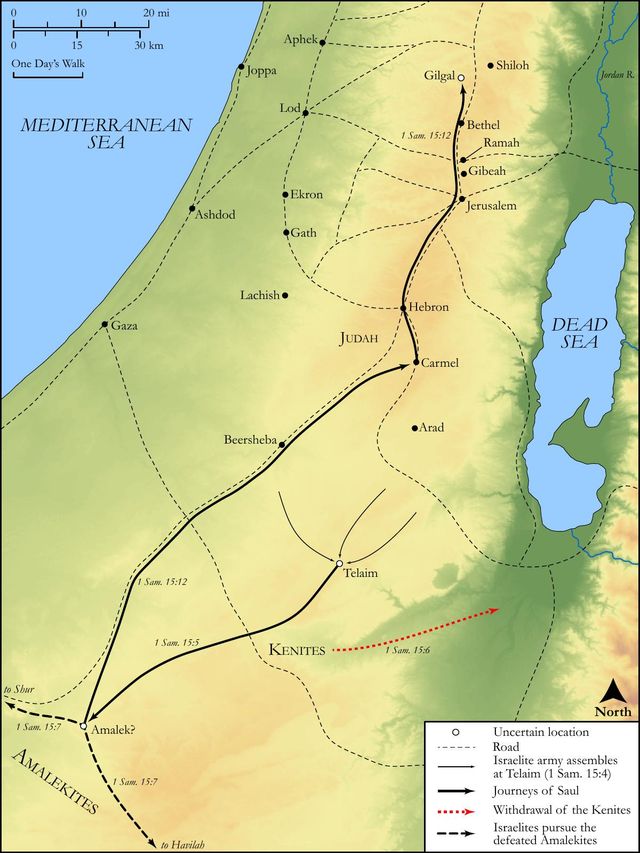
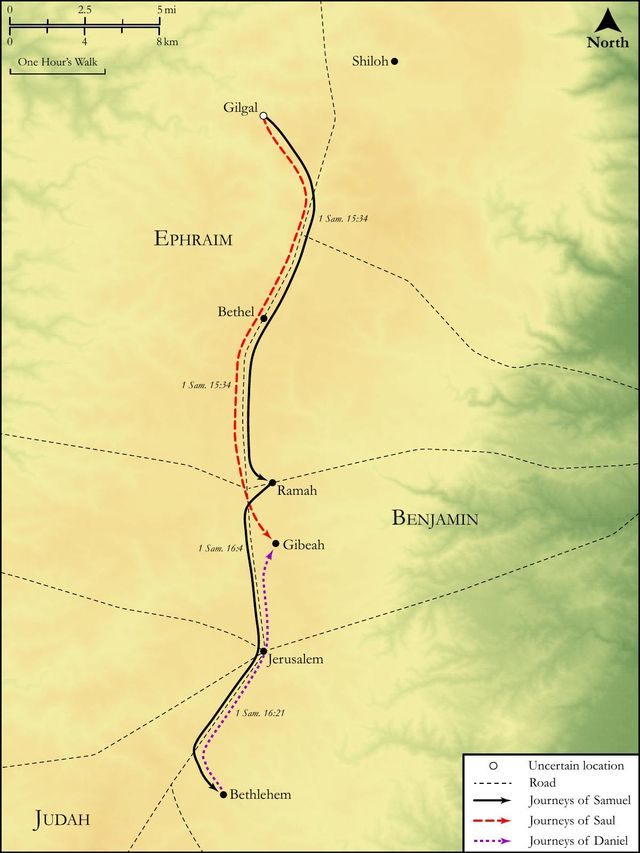
See on the biblical-era maps
Study this verse
Public-domain commentary
Matthew Henry
From his Commentary on the Whole Bible. Henry comments on passages, not single verses — this entry covers 1 Samuel 15:32–35. His three-level outline is real structure in the source text, so it is rendered as structure.
Samuel, as a prophet, is here set over kings, Jer 1:10.
I.He destroys king Agag, doubtless by such special direction from heaven as none now can pretend to.
He hewed Agag in pieces. Some think he only ordered it to be done; or perhaps he did it with his own hands, as a sacrifice to God's injured justice (Sa1 15:33), and sacrifices used to be cut in pieces. Now observe in this,
1.How Agag's present vain hopes were frustrated: He came delicately, in a stately manner, to show that he was a king, and therefore to be treated with respect, or in a soft effeminate manner, as one never used to hardship, that could not set the sole of his foot to the ground for tenderness and delicacy (Deu 28:56), to move compassion: and he said, "Surely, now that the heat of the battle is over, the bitterness of death is past, Sa1 15:32. Having escaped the sword of Saul," that man of war, he thought he was in no danger from Samuel, and old prophet, a man of peace. Note,
(1.)There is bitterness in death, it is terrible to nature. Surely death is bitter, so divers versions read those words of Agag; as the Septuagint read the former clause, He came trembling. Death will dismay the stoutest heart.
(2.)Many think the bitterness of death is past when it is not so; they put that evil day far from them which is very near. True believers may, through grace, say this, upon good grounds, though death be not past, the bitterness of it is. O death! where is thy sting?
2.How his former wicked practices were now punished. Samuel calls him to account, not only for the sins of his ancestors, but his own sins: Thy sword has made women childless, Sa1 15:33. He trod in the steps of his ancestors' cruelty, and those under him, it is likely, did the same; justly therefore is all the righteous blood shed by Amalek required of this generation, Mat 23:36. Agag, that was delicate and luxurious himself, was cruel and barbarous to others. It is commonly so: those who are indulgent in their appetites are not less indulgent of their passions. But blood will be reckoned for; even kings must account to the King of kings for the guiltless blood they shed or cause to be shed. It was that crime of king Manasseh which the Lord would not pardon, Kg2 24:4. See Rev 13:10.
II.He deserts king Saul, takes leave of him (Sa1 15:34), and never came any more to see him (Sa1 15:35), to advise or assist him in any of his affairs, because Saul did not desire his company nor would he be advised by him. He looked upon him as rejected of God, and therefore he forsook him. Though he might sometimes see him accidentally (as Sa1 19:24), yet he never came to see him out of kindness or respect. Yet he mourned for Saul, thinking it a very lamentable thing that a man who stood so fair for great things should ruin himself so foolishly. He mourned for the bad state of the country, to which Saul was likely to have been so great a blessing, but now would prove a curse and a plague. He mourned for his everlasting state, having no hopes of bringing him to repentance. When he wept for him, it is likely, he made supplication, but the Lord had repented that he had made Saul king, and resolved to undo that work of his, so that Samuel's prayers prevailed not for him. Observe, We must mourn for the rejection of sinners,
1.Though we withdraw from them, and dare not converse familiarly with them. Thus the prophet determines to leave his people and go from them, and yet to weep day and night for them, Jer 9:1, Jer 9:2.
2.Though they do not mourn for themselves. Saul seems unconcerned at the tokens of God's displeasure which he lay under, and yet Samuel mourns day and night for him. Jerusalem was secure when Christ wept over it.
Historical interpretation
Fourteen Centuries of Reception
4 surviving comments on this verse. Each one is dated, so this reads as a timeline rather than a list.
Select a marker to jump to its quote. Markers stagger vertically where authors wrote within a few decades of each other.
Holy Scripture is often accustomed to attributing expressions to God such that seem quite like our own, for example, “The Lord was angry, and he was grieved because of their sins”; and again, “He repented that he had anointed Saul king” … and besides this, it makes mention of his sitting, and standing, and moving, and the like, which are not as a fact connected with God but are not without their use as an accommodation to those who are under teaching. For in the case of the too unbridled, a show of anger restrains them by fear. And to those who need the medicine of repentance, it says that the Lord repents along with them of the evil, and those who grow insolent through prosperity it warns, by God’s repentance in respect to Saul, that their good fortune is no certain possession, though it seems to come from God.
I am induced to write to you, a stranger to a stranger, by the entreaties of that holy servant of Christ, Hedibia, and of my daughter in the faith Artemia, once your wife but now no longer your wife but your sister and fellow servant. Not content with assuring her own salvation, she has sought yours also, in former days at home and now in the holy places. She is anxious to emulate the thoughtfulness of the apostles Andrew and Philip, who, after Christ had found them, desired in their turn to find, the one his brother Simon and the other his friend Nathanael. … So of old Lot desired to rescue his wife as well as his two daughters, and refusing to leave blazing Sodom and Gomorrah until he was himself half on fire, tried to lead forth one who was tied and bound by her past sins. But in her despair she lost her composure, and looking back became a monument of an unbelieving soul. Yet, as if to make up for the loss of a single woman, Lot’s glowing faith set free the whole city of Zoar. In fact, when he left the dark valleys in which Sodom lay and came to the mountains the sun rose upon him as he entered Zoar or the little city; so-called because the little faith that Lot possessed, though unable to save greater places, was at least able to preserve smaller ones.… Good people have always sorrowed for the sins of others. Samuel of old lamented for Saul because he neglected to treat the ulcers of pride with the balm of penitence. And Paul wept for the Corinthians who refused to wash out with their tears the stains of fornication.
And Samuel did not see Saul anymore, etc. It is better to imitate than to allegorize, that one whom he so detests due to the merit of sin, that he does not deign to see him even once, yet with the same consideration of brotherhood, he expends so much piety that he even testifies to this with mourning and tears. From whence it is not unfitting for such men of spirit, and that of the Psalmist, which he says: "Do I not hate those who hate you, O God? And do I not loathe those who rise up against you?" (Psalm 139), and likewise the evangelical blessing which says: "Blessed are those who mourn now, for they shall be comforted" (Matthew 5). For if without any doubt he is blessed, who with eyes troubled by the fear of impending wrath, laboring in his groaning, washes his own bed, that is, the works of virtues, with tears each night in which he ought to rest; how much more blessed is he who, already made more secure by God's favor concerning his own salvation, prays and laments to the Lord for the transgressions of his brothers?
Saw Saul no more till the day of his death: That is, he went no more to see him: he visited him no more.
Continue studying 1 Samuel 15:35 across the web’s major study libraries — every link below opens this exact verse, chapter, or book on the destination site.
Read & Compare
 BibleGatewayThis verse in more than 200 translations and 70 languages.
 Bible.comThe YouVersion reader — hundreds of translations, reading plans, and highlights.
 ESV.orgCrossway's official English Standard Version reader.
 NET BibleThe NET translation with 60,000+ translators' notes on every rendering decision.
 STEP BibleTyndale House's free study tool — original text, vocabulary, and scholarly resources.
 BibliaLogos Bible Software's free web reader.
 USCCBThe New American Bible (Revised Edition) with the U.S. bishops' study notes.
Commentaries
 BibleHub CommentariesDozens of classic commentaries on this verse, gathered on one page.
 StudyLightMore than 100 commentary sets — the largest collection on the web.
 BibleRefPlain-English commentary on what this verse means, verse by verse.
 Enduring WordDavid Guzik's free commentary on this chapter, widely used by Bible teachers.
 Bible Study ToolsVerse commentary alongside Greek and Hebrew study aids.
Original Language & Research
- BibleHub InterlinearThe verse word by word — original language, transliteration, and English.
- BibleHub LexiconEvery word's original-language definition and Strong's entry.
 Blue Letter BibleDeep-study tools — Strong's numbers, concordance, and word studies.
 SefariaThe Hebrew text with Rashi and centuries of Jewish commentary.
Sermons, Hymns & Audio


TrulyRandomVerse is not affiliated with these sites and doesn’t control their content. They’re linked because they’re genuinely useful.
Summary
1 Samuel 15:35 serves as a profound and somber marker, signaling the definitive end of God's favor upon Saul's reign and the irreversible consequences of his persistent disobedience. This pivotal verse not only records Samuel's permanent separation from King Saul, symbolizing the severing of the divine-human covenantal relationship, but also poignantly reveals the prophet's deep personal anguish over Saul's tragic spiritual and political decline. Most significantly, it articulates the LORD's own profound sorrow and regret over having established Saul as king, a complex theological statement that underscores divine pathos and disappointment in response to human rebellion, rather than implying any change in God's immutable character or eternal purposes.
Context
ShowHideLiterary Context
This verse acts as a solemn and conclusive epilogue to the dramatic narrative of Saul's definitive rejection as king, a process meticulously detailed throughout 1 Samuel 15. Immediately preceding this, Samuel has confronted Saul for his egregious failure to fully execute the herem (utter destruction) command against the Amalekites. Despite God's explicit instruction to utterly destroy everything (1 Samuel 15:3), Saul spared King Agag and the choicest livestock, offering a self-serving justification that it was for sacrifice (1 Samuel 15:9). Samuel's damning pronouncement in 1 Samuel 15:23 declares that "rebellion is as the sin of divination, and stubbornness is as iniquity and idolatry," directly leading to God's rejection of Saul's kingship. Verse 35 solidifies this irreversible break, setting the narrative stage for God's subsequent search for "a man after his own heart" and Samuel's anointing of David in 1 Samuel 16:1.
Historical & Cultural Context
The establishment of kingship in ancient Israel represented a significant shift from the direct theocracy under judges, a development both divinely ordained and prompted by the people's desire to "be like all the nations" (1 Samuel 8:5). Saul, as Israel's inaugural king, was chosen by God through Samuel, yet his reign was fraught with tension between divine expectation and human leadership. The Amalekites were a long-standing, bitter enemy of Israel, having attacked them during the Exodus (Exodus 17:8-16). The herem command, or ban, was a specific, divinely ordained act of judgment against notoriously wicked peoples, not a general policy of warfare. Saul's failure to execute this command fully was not merely a tactical misstep but a direct act of insubordination against God's explicit word, fundamentally undermining the very foundation of his divinely appointed authority and demonstrating a lack of trust and obedience.
Key Themes
ShowHideThis verse powerfully encapsulates several critical themes that resonate throughout the book of Samuel and beyond. It underscores the gravity of obedience to God's explicit commands, demonstrating unequivocally that partial obedience, or obedience mixed with self-will, is considered full disobedience in God's eyes. The finality of divine judgment is starkly evident in Samuel's permanent withdrawal from Saul, signifying an irreversible breach in their relationship and, more critically, in God's favor toward Saul's kingship. The theme of prophetic grief is deeply moving, as Samuel, despite being the bearer of God's severe verdict, personally mourns the tragic trajectory of Saul's life. Most profoundly, the statement that "the LORD repented" introduces the complex and crucial theme of divine pathos, revealing God's emotional engagement with humanity and His profound sorrow over the destructive consequences of human sin and rebellion, even as His ultimate purposes and immutable character remain steadfast (Numbers 23:19).
Exposition and Analysis
ShowHideKey Word Analysis
ShowHideThis verb (H5162), often translated as "repent," carries a range of meanings including "to sigh," "to be sorry," "to grieve," "to console oneself," or "to rue." When applied to God, as in this context, it does not imply a change in His immutable character, perfect knowledge, or eternal purpose, nor does it suggest He made a mistake. Rather, it signifies a profound sorrow, regret, or grief over the outcome of a situation brought about by human choices. It reflects God's emotional response to human sin and the necessity of altering His dealings or relationship with humanity, consistent with His justice and holiness. This nuanced understanding prevents contradiction with passages affirming God's unchangeableness (e.g., Numbers 23:19).
This word (H56) denotes deep sorrow, lamentation, or grief, frequently associated with death or significant loss. Samuel's mourning for Saul is not a mere formality or a perfunctory act but a genuine expression of his profound personal anguish over Saul's spiritual and political demise. It highlights the prophet's compassionate heart, even towards one who has fallen from grace, and the heavy burden of delivering divine judgment while simultaneously feeling the weight of its human cost.
The verb (H3254) meaning "to add or augment" is used here with a negative, literally "did not add to see." This phrase emphasizes the absolute and permanent cessation of Samuel's prophetic visits, counsel, and direct interaction with Saul. It signifies the finality of the break in their relationship and, by extension, the definitive end of God's anointing and favor upon Saul as His chosen king. This was not a temporary estrangement but a definitive severing of the crucial prophetic-royal connection.
Verse Breakdown
ShowHide"And Samuel came no more to see Saul until the day of his death:"
This clause emphatically establishes the irreversible nature of the break between the revered prophet and the rejected king. Samuel, who had initially anointed Saul and served as his spiritual mentor and conduit of divine instruction, now permanently withdraws his presence and counsel. This physical separation profoundly symbolizes the spiritual and relational chasm that Saul's persistent disobedience created between himself and God, a chasm mediated through Samuel. It signifies the end of God's direct prophetic communication and guidance for Saul, leaving him isolated and ultimately abandoned in his kingship.
"nevertheless Samuel mourned for Saul:"
Despite the finality of the divine judgment and the painful necessity of Samuel's withdrawal, the prophet's heart was filled with profound grief. This demonstrates Samuel's deep compassion and personal sorrow over the tragic fate of Saul, whom he had anointed, counseled, and for whom he had interceded. It highlights the personal cost of prophetic ministry, where the messenger of divine judgment also bears the emotional weight of human failure and the prophet's empathy for the individual caught in the devastating consequences of their sin, even when God's judgment is undeniably just.
"and the LORD repented that he had made Saul king over Israel."
This is a profound and complex theological statement. As explored in the key word analysis, God's "repentance" here conveys His deep sorrow, grief, and disappointment over the outcome of Saul's reign, which was marred by his persistent and willful disobedience. It expresses God's emotional response to human sin, not a change in His eternal plan, perfect knowledge, or immutable character. It signifies that the relationship and covenantal interaction with Saul, as king, had failed from God's perspective due to Saul's choices, leading to a necessary change in divine dealings with the monarchy and the eventual anointing of a new king.
Literary Devices
ShowHideThe verse employs several powerful literary devices to convey its weighty message. Foreshadowing is strikingly evident as Samuel's permanent withdrawal and God's "repentance" clearly signal the impending doom for Saul's dynasty and his eventual tragic death. The phrase "until the day of his death" grimly points to the ultimate end of Saul's life and reign, a direct consequence of his spiritual demise. There is a strong element of Irony: Saul, chosen by God to lead Israel and deliver them, ultimately leads himself to rejection through his own self-willed choices and disobedience. The poignant contrast between Samuel's deep personal Pathos (his profound mourning for Saul) and the stern finality of God's judgment creates a rich and emotionally resonant landscape. Finally, the use of Anthropomorphism in "the LORD repented" attributes human-like emotion (grief, regret, sorrow) to God, making His disappointment relatable and emphasizing His active, emotional engagement with His creation and the consequences of human actions, all without compromising His divine transcendence and immutability.
Theological and Thematic Connections
ShowHide1 Samuel 15:35 stands as a stark and enduring reminder of the absolute necessity of wholehearted obedience to God's revealed will, particularly for those in positions of leadership and influence. It powerfully underscores that God values genuine, humble submission over outward religious performance or human rationale. The profound concept of God "repenting" is a crucial theological truth, demonstrating that while God's character and ultimate purposes are unchanging and steadfast (Malachi 3:6 and Romans 11:29), He is not a stoic, detached deity. Rather, He deeply grieves over human sin and rebellion, and His "repentance" signifies His sorrowful response to the thwarting of His immediate will by human disobedience, leading to a necessary change in His relationship or dealings with individuals or nations (Jeremiah 18:7-10). This verse highlights divine justice, the severe consequences of persistent rebellion against divine authority, and the profound emotional reality of God's active and relational interaction with His creation.
Reflection and Application
ShowHideThe tragic account of Saul's downfall, culminating in this poignant verse, offers profound and timeless lessons for contemporary believers and leaders alike. It serves as a potent warning against the insidious dangers of partial obedience, self-justification, and the subtle pride that elevates one's own reasoning above God's clear commands. Saul's claim that he spared the best of the livestock for sacrifice, though seemingly pious and well-intentioned, was a direct contradiction of God's command for utter destruction. This starkly reveals that God desires genuine, humble, and complete obedience more than outward religious acts or humanly devised compromises. We are powerfully reminded that persistent disobedience, even in areas we might deem minor, can lead to severe and irreversible consequences in our relationship with God and can profoundly hinder our effectiveness in His service. Furthermore, Samuel's deep mourning and God's "repentance" invite us to consider the profound grief that our sin causes in the very heart of God. He is not indifferent to our choices; He is deeply invested in our faithfulness and grieves when we choose paths that lead away from His perfect will and design. This profound truth should motivate us to cultivate a heart of sincere repentance, unwavering obedience, and a deep reverence for God's Word, recognizing that our choices impact not only ourselves but also the heart of our loving and holy God.
Questions for Reflection
ShowHideFAQ
ShowHideDoes God truly "repent" or change His mind, given that He is immutable?
ShowHideThe Hebrew word for "repented" (נָחַם, nacham, H5162) when applied to God, as in 1 Samuel 15:35, does not imply that God made a mistake, changed His essential character, or altered His eternal, sovereign plan. Rather, it signifies His profound grief, sorrow, or regret over the outcome of a situation brought about by human sin and rebellion. God's immutability (His unchanging nature in character, faithfulness, and ultimate purpose) is affirmed in passages like Numbers 23:19 and Malachi 3:6. Therefore, God's "repentance" in this context reflects His emotional response to human choices that deviate from His immediate, revealed will, leading to a necessary change in His dealings or relationship with humanity, not a change in His own perfect nature or ultimate decrees. It highlights His active, relational, and deeply invested involvement with His creation.
Why did Samuel mourn for Saul if God had already rejected him?
ShowHideSamuel's profound mourning for Saul, even after delivering God's severe judgment and pronouncement of rejection, reveals the prophet's deep compassion and personal sorrow. Samuel had been instrumental in anointing Saul as Israel's first king, had invested significantly in his leadership, and likely felt a profound sense of responsibility and attachment to him. His grief was not a questioning of God's righteous judgment but an expression of genuine human empathy for a man who had fallen so tragically from grace and divine favor. It underscores the personal cost of prophetic ministry and the prophet's heart for the people, even those who, through their own choices, bring about their own downfall. This reflects a godly sorrow, akin to Jesus weeping over Jerusalem's unbelief and impending destruction in Luke 19:41-44 or the Apostle Paul's anguish for Israel's rejection of Christ in Romans 9:1-5.
Christ-Centered Fulfillment
ShowHideThe tragic narrative of Saul's rejection in 1 Samuel 15:35 finds its profound Christ-centered fulfillment in the person and redemptive work of Jesus. Saul's failure as Israel's first king, marked by his persistent disobedience, self-will, and the ultimate severing of his relationship with God, necessitated God's "repentance" – His profound grief over human sin and the subsequent divine search for a new, faithful king. This divine quest ultimately culminates in Jesus, the perfect King, who embodies the wholehearted obedience that Saul so tragically lacked. Unlike Saul, who prioritized his own agenda and perceived piety over God's explicit command, Jesus perfectly fulfilled the Father's will in every respect, even to the point of obedient death on a cross (Philippians 2:8). God's "repentance" over Saul's reign, a divine sorrow over human failure and the destructive consequences of sin, is ultimately met and overcome by God's perfect plan of redemption through Christ. Jesus, the true Lamb of God who takes away the sin of the world, perfectly atoned for the very rebellion that caused God's grief. He is the faithful Shepherd-King (John 10:11) who never fails, never disobeys, and whose righteous kingdom will have no end (Revelation 19:16). Thus, Saul's story, while a cautionary tale of human failure, ultimately serves to highlight the necessity and glory of Christ's perfect reign and His complete fulfillment of God's redemptive purposes.