


Deuteronomy 2:24
Bible text: King James Version (1769 Blayney text) · Public domain
Bible text: King James Version with Strong's numbers · Public domain
Bible text: Berean Standard Bible · Public domain
Bible text: American Standard Version (1901) · Public domain
Bible text: World English Bible, Messianic edition · Public domain
Bible text: Geneva Bible (1599) · Public domain
Bible text: Young's Literal Translation · Public domain
- קוּמוּKu·muariseH6965V-Qal-Imp-2mpVerb Qal Imperative 2nd Plural Masculine
- סְּעוּse·'Uset outH5265V-Qal-Imp-2mpVerb Qal Imperative 2nd Plural Masculine
- וְעִבְרוּve·'iv·Ruand pass overH5674Conj-w ¦ V-Qal-Imp-2mpVerb Qal Imperative 2nd Plural Masculineוְandעִבְרוּpass over
- אֶת'et<obj.>H853DirObjMParticle Object Indicator
- נַחַלNa·chal[the] wadi ofH5158N-mscNoun Singular Masculine Construct
- אַרְנֹן'ar·NonArnonH769N-properNoun Proper Location
- רְאֵהre·'EhseeH7200V-Qal-Imp-2msVerb Qal Imperative 2nd Singular Masculine
- נָתַתִּיna·Ta·tiI giveH5414V-Qal-Perf-1csVerb Qal Perfect 1st Singular common gender
- בְיָדְךָVe·ya·de·khain your handH3027Prep-b ¦ N-csc ¦ 2msNoun Singular common gender Constructבְinיָדְhandךָyour
- אֶת'et<obj.>H853DirObjMParticle Object Indicator
- סִיחֹןsi·ChonSihonH5511N-proper-mNoun Proper Masculine
- מֶלֶךְMe·lekh[the] king ofH4428N-mscNoun Singular Masculine Construct
- חֶשְׁבּוֹןchesh·BonHeshbonH2809N-properNoun Proper Location
- הָאֱמֹרִיha·'e·mo·Rithe AmoriteH567Art ¦ N-msNoun Gentilic Singular Masculine AbsoluteהָtheאֱמֹרִיAmorite
- וְאֶתve·'Etand <obj.>H853Conj-w ¦ DirObjMParticle Object Indicatorוְandאֶת<obj.>
- אַרְצוֹ'ar·Tzohis landH776N-fsc ¦ 3msNoun Singular Feminine Constructאַרְצlandוֹhis
- הָחֵלha·ChelbeginH2490V-Hiphil-Imp-2msVerb Hiphil Imperative 2nd Singular Masculine
- רָשׁRashtake possession of [it]H3423V-Qal-Imp-2msVerb Qal Imperative 2nd Singular Masculine
- וְהִתְגָּרve·hit·Garand engage in strifeH1624Conj-w ¦ V-Hithpael-Imp-2msVerb Hithpael Imperative 2nd Singular Masculineוְandהִתְגָּרengage in strife
- בּוֹbowith himPrep-b ¦ 3msSuffix Personal 3rd Singular Masculineבּwithוֹhim
- מִלְחָמָהmil·cha·MahbattleH4421N-fsNoun Singular Feminine Absolute
English is a literal word-by-word gloss of the Hebrew, not the KJV's wording. Why?
This is the original text the KJV's translators worked from — each Hebrew word with its own literal English meaning in this verse, prepared by scholars at Tyndale House, Cambridge. The KJV translates whole sentences, not word by word, so its wording differs: one Hebrew word can become several English words, and the KJV may choose “the LORD” where the gloss reads “Yahweh”. Both are faithful — they answer different questions. For the KJV's own rendering, switch to the KJV text.
Details
See on the biblical-era maps
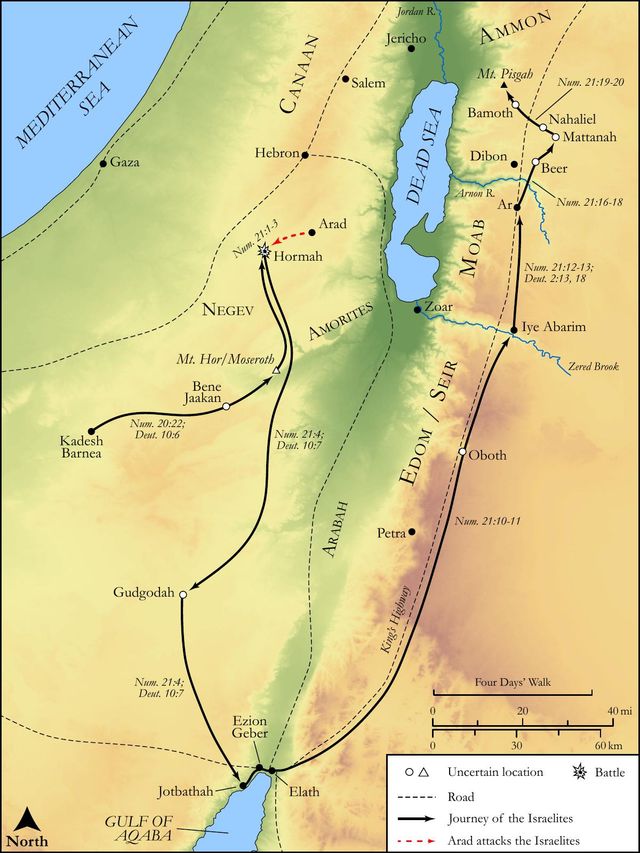
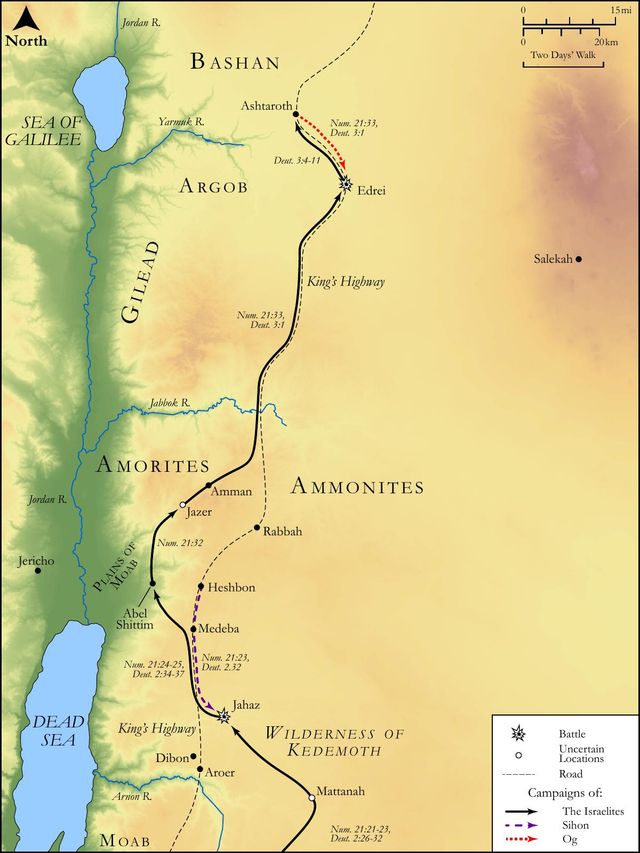
Study this verse
Public-domain commentary
Matthew Henry
From his Commentary on the Whole Bible. Henry comments on passages, not single verses — this entry covers Deuteronomy 2:24–37. His two-level outline is real structure in the source text, so it is rendered as structure.
God having tried the self-denial of his people in forbidding them to meddle with the Moabites and Ammonites, and they having quietly passed by those rich countries, and, though superior in number, not made any attack upon them, here he recompenses them for their obedience by giving them possession of the country of Sihon king of the Amorites. If we forbear what God forbids, we shall receive what he promises, and shall be no losers at last by our obedience, though it may seem for the present to be to our loss. Wrong not others, and God shall right thee.
I.God gives them commission to seize upon the country of Sihon king of Heshbon, Deu 2:24, Deu 2:25.
This was then God's way of disposing of kingdoms, but such particular grants are not now either to be expected or pretended. In this commission observe,
1.Though God assured them that the land should be their own, yet they must bestir themselves, and contend in battle with the enemy. What God gives we must endeavour to get.
2.God promises that when they fight he will fight for them. Do you begin to possess it, and I will begin to put the dread of you upon them. God would dispirit the enemy and so destroy them, would magnify Israel and so terrify all those against whom they were commissioned. See Exo 15:14.
II.Moses sends to Sihon a message of peace, and only begs a passage through his land, with a promise to give his country no disturbance, but the advantage of trading for ready money with so great a body, Deu 2:26-29. Moses herein did neither disobey God, who bade him contend with Sihon, nor dissemble with Sihon; but doubtless it was by divine direction that he did it, that Sihon might be left inexcusable, though God hardened his heart. This may illustrate the method of God's dealing with those to whom he gives his gospel, but does not give grace to believe it.
III.Sihon began the war (Deu 2:32), God having made his heart obstinate, and hidden from his eyes the thing that belonged to his peace (Deu 2:30), that he might deliver him into the hand of Israel. Those that meddle with the people of God meddle to their own hurt; and God sometimes ruins his enemies by their own resolves. See Mic 4:11-13; Rev 16:14.
IV.Israel was victorious.
1.They put all the Amorites to the sword, men, women, and children (Deu 2:33, Deu 2:34); this they did as the executioners of God's wrath; now the measure of the Amorites' iniquity was full (Gen 15:16), and the longer it was in the filling the sorer was the reckoning at last. This was one of the devoted nations. They died, not as Israel's enemies, but as sacrifices to divine justice, in the offering of which sacrifices Israel was employed, as a kingdom of priests. The case being therefore extraordinary, it ought not to be drawn into a precedent for military executions, which make no distinction and give no quarter: those will have judgment without mercy that show no mercy.
2.They took possession of all they had; their cities (Deu 2:34), their goods (Deu 2:35), and their land, Deu 2:36. The wealth of the sinner is laid up for the just. What a new world did Israel now come into! Most of them were born, and had lived all their days, in a vast howling wilderness, where they knew not what either fields or cities were, had no houses to dwell in, and neither sowed nor reaped; and now of a sudden to become masters of a country so well built, so well husbanded, this made them amends for their long waiting, and yet it was but the earnest of a great deal more. Much more joyful will the change be which holy souls will experience when they remove out of the wilderness of this world to the better country, that is, the heavenly, to the city that has foundations.
Continue studying Deuteronomy 2:24 across the web’s major study libraries — every link below opens this exact verse, chapter, or book on the destination site.
Read & Compare
 BibleGatewayThis verse in more than 200 translations and 70 languages.
 Bible.comThe YouVersion reader — hundreds of translations, reading plans, and highlights.
 ESV.orgCrossway's official English Standard Version reader.
 NET BibleThe NET translation with 60,000+ translators' notes on every rendering decision.
 STEP BibleTyndale House's free study tool — original text, vocabulary, and scholarly resources.
 BibliaLogos Bible Software's free web reader.
 USCCBThe New American Bible (Revised Edition) with the U.S. bishops' study notes.
Commentaries
 BibleHub CommentariesDozens of classic commentaries on this verse, gathered on one page.
 StudyLightMore than 100 commentary sets — the largest collection on the web.
 BibleRefPlain-English commentary on what this verse means, verse by verse.
 Enduring WordDavid Guzik's free commentary on this chapter, widely used by Bible teachers.
 Bible Study ToolsVerse commentary alongside Greek and Hebrew study aids.
Original Language & Research
- BibleHub InterlinearThe verse word by word — original language, transliteration, and English.
- BibleHub LexiconEvery word's original-language definition and Strong's entry.
 Blue Letter BibleDeep-study tools — Strong's numbers, concordance, and word studies.
 SefariaThe Hebrew text with Rashi and centuries of Jewish commentary.
Sermons, Hymns & Audio


TrulyRandomVerse is not affiliated with these sites and doesn’t control their content. They’re linked because they’re genuinely useful.
Summary
Deuteronomy 2:24 marks a pivotal turning point in Israel's wilderness journey, as Moses recounts God's direct command for the Israelites to transition from peaceful passage to active conquest. After decades of wandering and being instructed to bypass the territories of their kinsmen, God now explicitly directs them to cross the Arnon River and confront Sihon, the formidable Amorite king of Heshbon. This verse powerfully declares God's pre-ordained victory, assuring Israel that Sihon and his land have already been "given into thine hand," while simultaneously calling them to obedient action by beginning to possess the land and engage in battle.
Context
ShowHideLiterary Context
Deuteronomy 2:24 is situated within Moses's historical review of Israel's journey from Mount Horeb (Sinai) to the plains of Moab, just before they enter the Promised Land. Chapters 1 and 2 recount the forty years of wilderness wandering, emphasizing God's faithfulness and Israel's past disobedience. Specifically, verses 1-23 detail God's instructions to Israel to bypass the territories of Edom, Moab, and Ammon, nations with whom Israel shared kinship. This directive highlighted God's sovereignty over all lands and His specific plans for each nation, demonstrating His justice even towards pagan peoples. Verse 24 marks a dramatic shift: the period of peaceful passage is over, and the era of conquest is about to begin. It serves as the divine "green light" for Israel to engage in their first major military conflict on the eastern side of the Jordan, setting the stage for the subsequent victories against Sihon and Og Deuteronomy 2:26-37 and Deuteronomy 3:1-11 and the broader conquest narrative that follows in the book of Joshua.
Historical & Cultural Context
The Amorites were a prominent people who had established significant kingdoms, particularly in Transjordan, where Sihon reigned in Heshbon. Sihon, king of Heshbon, had conquered territory from Moab and established a formidable kingdom, controlling a crucial trade route that Israel needed to traverse. Heshbon was a strategically important city, and the Arnon River served as a natural boundary and a significant geographical marker in Transjordan, often delineating Moabite territory from Amorite or other regions. For Israel, confronting Sihon meant engaging a powerful, established kingdom, representing a significant military challenge. In Israel's wars, divine pronouncements of victory were given before battle, as to Gideon before the host of Midian, serving to bolster morale and declare the war to be the LORD's. God's declaration that He had "given into thine hand" the land of Sihon would have been understood as a divine transfer of ownership and a guarantee of success, a concept deeply rooted in the covenantal promises made to Abraham regarding the land Genesis 12:7.
Key Themes
ShowHideThis verse powerfully encapsulates several overarching themes central to Deuteronomy and the Pentateuch. First, Divine Initiative and Promise is paramount; God explicitly commands the action and declares the outcome before Israel lifts a sword. The conquest is not merely a human endeavor but a divinely orchestrated fulfillment of God's covenant promises to Abraham, Isaac, and Jacob Deuteronomy 1:8. Second, Faithful Obedience and Action is crucial; despite the divine assurance of victory, Israel is commanded to "begin to possess [it], and contend with him in battle." God's promise does not negate the need for human effort and obedience, but rather empowers it. This highlights the synergistic relationship between divine sovereignty and human responsibility. Third, the Possession of the Land is a foundational theme. The conquest of Sihon's territory represents the critical first step in Israel's long-awaited inheritance, serving as a tangible demonstration of God's faithfulness to bring them into the land He had sworn to give them, a promise reiterated throughout the entire book.
Exposition and Analysis
ShowHideKey Word Analysis
ShowHideThe Hebrew verb "nâthan" (H5414) here is in the perfect tense ("I have given"), which is highly significant. While the battle is yet to occur, the perfect tense indicates a completed action from God's perspective. This is not a future promise but a declared reality; the victory is already assured, the transfer of ownership already effected in the divine counsel. This emphasizes God's absolute sovereignty and the certainty of His word.
The Hebrew noun "yâd" (H3027), translated as "hand" in the phrase "into thine hand," is a common biblical idiom signifying divine delivery, control, or transfer of power, particularly in a military context. When something is "given into one's hand," it means it is delivered into their power, control, or possession. It underscores that the victory over Sihon is not a result of Israel's might but a gift from God, empowering them for the task.
The Hebrew verb "gârâh" (H1624) means "to stir up strife, provoke, contend, wage war." It implies an active, aggressive engagement. While God has already "given" the land, Israel must still actively "contend" for it. This highlights the principle that divine promise often requires human participation and effort; God's sovereignty does not negate human responsibility but calls for it.
Verse Breakdown
ShowHide"Rise ye up, take your journey, and pass over the river Arnon:"
This opening clause is a direct, imperative command from God, signaling an end to the period of wandering and a decisive move towards the Promised Land. The Arnon River, a significant geographical boundary, marks the threshold into the territory God intends for Israel to conquer. The triple command emphasizes urgency, movement, and crossing a critical barrier, indicating a divinely ordained shift in their journey.
"behold, I have given into thine hand Sihon the Amorite, king of Heshbon, and his land:"
This is the divine declaration of victory and transfer of ownership. The interjection "behold" (Hebrew, hinnēh) draws immediate attention to the profound truth being revealed. God, the sovereign Lord, has already decided and enacted the transfer of Sihon, his royal authority, and his entire kingdom into Israel's possession, even before the battle has begun. This is a powerful statement of divine predetermination and assurance, removing any doubt about the outcome.
"begin to possess [it], and contend with him in battle."
This final clause outlines Israel's immediate responsibility. The command to "begin to possess" implies taking the initial steps of occupation and claiming what God has already granted. The instruction to "contend with him in battle" clarifies that this possession will not be passive but will require active military engagement. It perfectly balances divine sovereignty with human responsibility: God has given, but Israel must act in faith to receive and secure the promised inheritance.
Literary Devices
ShowHideDeuteronomy 2:24 employs several potent literary devices that amplify its message. The most prominent is Divine Command, expressed through a series of direct imperatives ("Rise ye up, take your journey, pass over, begin to possess, contend"). This direct address underscores God's active involvement and absolute authority over Israel's destiny. Coupled with this is Divine Assurance, powerfully conveyed by the perfect tense of "I have given," which functions as a Prophetic Perfect. This grammatical construction declares a future event as already accomplished, emphasizing its certainty and God's unwavering purpose. The phrase "given into thine hand" is a powerful Idiom, common in biblical warfare narratives, symbolizing the transfer of power and guaranteed victory. Finally, the verse serves as a Foreshadowing of the broader conquest narrative, signaling the transition from peaceful passage to active warfare and setting the precedent for the numerous battles that will follow in the book of Joshua.
Theological and Thematic Connections
ShowHideDeuteronomy 2:24 is a profound theological statement on God's sovereignty, faithfulness, and the nature of His covenant with Israel. It reveals that God's promises are not contingent on human strength or strategy but are rooted in His divine decree and accomplished through His power. The command to "rise up" and "contend" despite the prior declaration of victory highlights the essential biblical tension between divine sovereignty and human responsibility. God's assurance of victory empowers Israel to act in faith, knowing that their efforts are not in vain but are part of a larger divine plan. This passage serves as a foundational example of God leading His people into their inheritance, providing the means and the victory for what He commands. It teaches that true possession comes through obedient action, empowered by divine promise, demonstrating that God's people are called to participate actively in the fulfillment of His purposes.
Reflection and Application
ShowHideDeuteronomy 2:24 offers timeless principles for believers navigating the challenges of life today. Just as Israel stood at the precipice of a daunting military campaign, we often find ourselves facing "Arnon Rivers" – formidable obstacles, new ventures, or spiritual battles that seem overwhelming. This verse reminds us that God often declares His victory and provision before we fully engage in the struggle. Our call is to "rise up," to take the journey, and to "contend" in faith, trusting in His declared promises. God's assurance that He has already "given into thine hand" the victory does not negate our need for active obedience and strategic engagement. Instead, it empowers us to move forward boldly, confident that where God leads, He also provides the strength, wisdom, and means for what He commands. This passage encourages us to step out in faith, knowing that our efforts are not isolated but are part of God's greater plan to bring us into the inheritance He has prepared for us, whether that be spiritual growth, overcoming temptation, or fulfilling our unique calling.
Questions for Reflection
ShowHideFAQ
ShowHideWhy did God command Israel to fight after bypassing other nations?
ShowHideGod's command to fight Sihon after bypassing Edom, Moab, and Ammon demonstrates His sovereign control over nations and His specific purposes for Israel. The nations Israel bypassed were considered "kinsmen" (descendants of Lot or Esau), and God had already allotted their territories to them, instructing Israel not to harass them Deuteronomy 2:4-19. Sihon, however, was an Amorite king who had conquered territory from Moab and was not part of this protected group. His kingdom lay directly in Israel's path to the Promised Land. God's command to engage Sihon was a strategic and theological necessity: it was the first step in Israel's active possession of the land promised to Abraham, demonstrating God's faithfulness to His covenant and preparing Israel for the larger conquest of Canaan. It also served as a test of Israel's obedience and faith in God's power to grant victory.
What is the significance of Heshbon and the Arnon River in this context?
ShowHideThe Arnon River served as a significant natural boundary, often marking the border between Moab and the Amorite kingdom of Sihon. Crossing it symbolized entering contested territory and the beginning of military engagement, marking a decisive shift from peaceful passage to active conquest. Heshbon was the capital city of Sihon's Amorite kingdom, strategically located on a major trade route. Its conquest was crucial for Israel's control of Transjordan and for opening a path to the Jordan River and the land of Canaan. The capture of Heshbon and the surrounding territory of Sihon and Og Deuteronomy 3:1-11 provided Israel with their first major land holdings east of the Jordan, setting a precedent for God's power to deliver the land into their hands.
Christ-Centered Fulfillment
ShowHideDeuteronomy 2:24, with its declaration of divine victory preceding human engagement, finds its ultimate and most profound fulfillment in Jesus Christ. Just as God "gave into thine hand" Sihon and his land to Israel, so too has God the Father "given" all authority and victory into the hand of His Son, Jesus Christ. The New Testament reveals that Christ's triumph over sin, death, and the powers of darkness was a divine certainty, accomplished on the cross and sealed in the resurrection. Colossians 2:15 declares that Christ "disarmed the powers and authorities, he made a public spectacle of them, triumphing over them by the cross." This is the ultimate "I have given into thine hand" moment, where the spiritual enemies that held humanity captive were decisively defeated. For believers, this means we are called to "rise up" and "contend" in spiritual warfare, not for a victory yet to be won, but from a victory already secured by Christ. We are commanded to "take your journey" into the spiritual inheritance of redemption, righteousness, and eternal life that is already ours in Christ Ephesians 1:3. Our "possession" of this spiritual land involves living out the implications of Christ's finished work, engaging in the good fight of faith 2 Corinthians 10:3-5, and entering into the rest that remains for the people of God Hebrews 4:9-10. The earthly conquest of Sihon foreshadows the spiritual conquest accomplished by Christ, enabling His followers to live in the reality of His triumph and to walk in the freedom of His finished work.