


Numbers 31:11
- וַיִּקְחוּvai·yik·Chuand they tookH3947Conj-w ¦ V-Qal-ConsecImperf-3mpVerb Qal Consecutive Imperfect 3rd Plural Masculineוַandיִּקְחוּthey took
- אֶת'et<obj.>H853DirObjMParticle Object Indicator
- כָּלkolallH3605N-mscNoun Singular Masculine Construct
- הַשָּׁלָלha·sha·Lalthe plunderH7998Art ¦ N-msNoun Singular Masculine Absoluteהַtheשָּׁלָלplunder
- וְאֵתve·'Etand <obj.>H853Conj-w ¦ DirObjMParticle Object Indicatorוְandאֵת<obj.>
- כָּלkolallH3605N-mscNoun Singular Masculine Construct
- הַמַּלְקוֹחַha·mal·Ko·achthe bootyH4455Art ¦ N-msNoun Singular Masculine Absoluteהַtheמַּלְקוֹחַbooty
- בָּאָדָםba·'a·Damamong <the> humankindH120Prep-b ¦ N-msNoun Singular Masculine Absoluteבָּamong <the>אָדָםhumankind
- וּבַבְּהֵמָהu·va·be·he·Mahand among the livestockH929Conj-w ¦ Prep-b ¦ N-fsNoun Singular Feminine Absoluteוּandבַamong theבְּהֵמָהlivestock
English is a literal word-by-word gloss of the Hebrew, not the KJV's wording. Why?
This is the original text the KJV's translators worked from — each Hebrew word with its own literal English meaning in this verse, prepared by scholars at Tyndale House, Cambridge. The KJV translates whole sentences, not word by word, so its wording differs: one Hebrew word can become several English words, and the KJV may choose “the LORD” where the gloss reads “Yahweh”. Both are faithful — they answer different questions. For the KJV's own rendering, switch to the KJV text.
Details
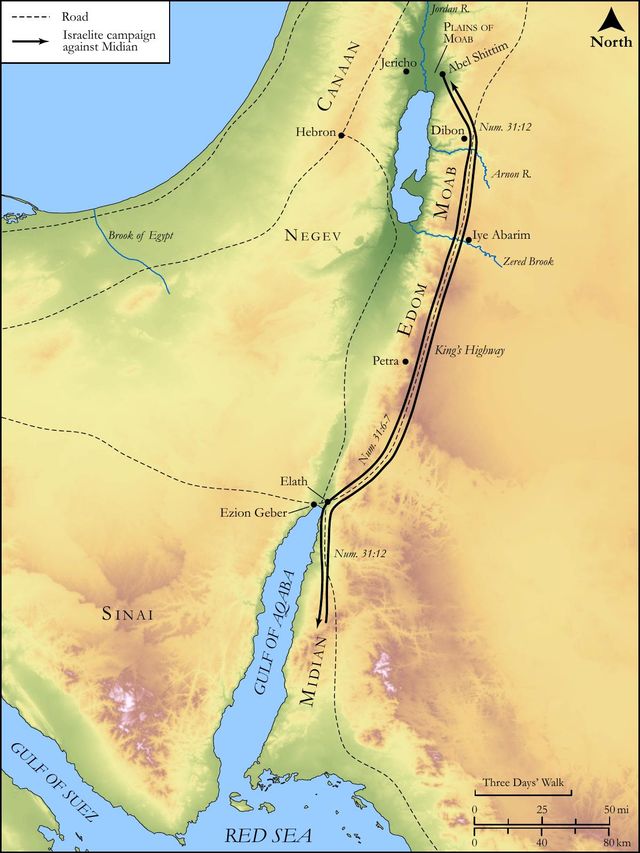
See on the biblical-era map
Study this verse
Continue studying Numbers 31:11 across the web’s major study libraries — every link below opens this exact verse, chapter, or book on the destination site.
Read & Compare
 BibleGatewayThis verse in more than 200 translations and 70 languages.
 Bible.comThe YouVersion reader — hundreds of translations, reading plans, and highlights.
 ESV.orgCrossway's official English Standard Version reader.
 NET BibleThe NET translation with 60,000+ translators' notes on every rendering decision.
 STEP BibleTyndale House's free study tool — original text, vocabulary, and scholarly resources.
 BibliaLogos Bible Software's free web reader.
 USCCBThe New American Bible (Revised Edition) with the U.S. bishops' study notes.
Commentaries
 BibleHub CommentariesDozens of classic commentaries on this verse, gathered on one page.
 StudyLightMore than 100 commentary sets — the largest collection on the web.
 BibleRefPlain-English commentary on what this verse means, verse by verse.
 Enduring WordDavid Guzik's free commentary on this chapter, widely used by Bible teachers.
 Bible Study ToolsVerse commentary alongside Greek and Hebrew study aids.
Original Language & Research
- BibleHub InterlinearThe verse word by word — original language, transliteration, and English.
- BibleHub LexiconEvery word's original-language definition and Strong's entry.
 Blue Letter BibleDeep-study tools — Strong's numbers, concordance, and word studies.
 SefariaThe Hebrew text with Rashi and centuries of Jewish commentary.
Sermons, Hymns & Audio


TrulyRandomVerse is not affiliated with these sites and doesn’t control their content. They’re linked because they’re genuinely useful.
Summary
Numbers 31:11 meticulously records the comprehensive outcome of Israel's divinely commanded punitive expedition against the Midianites, detailing the capture of all their material possessions and living beings. This verse underscores the totality of the Israelite victory, reflecting the thoroughness of God's righteous judgment against Midian for their egregious role in corrupting Israel at Baal-peor, and highlighting Israel's unwavering obedience to the divine mandate.
Context
ShowHideLiterary Context
Numbers 31:11 is strategically placed within the narrative of the war against Midian, which serves as a direct and severe response to the devastating incident at Baal-peor described in Numbers 25. The preceding verses establish the divine imperative for this conflict: God explicitly commands Moses to "avenge the children of Israel of the Midianites" (Numbers 31:1-2). Moses, in turn, commissions a formidable force of a thousand men from each tribe, led by the zealous priest Phinehas, to execute this divine judgment (Numbers 31:3-6). The immediate context, Numbers 31:7-8, recounts the successful military operation, including the slaying of all Midianite males, their five kings, and the prophet Balaam. Verse 11, therefore, functions as a summary statement of the immediate material gains and the capture of human and animal "prey" following the initial slaughter, setting the stage for the subsequent purification rituals and the intricate division of the spoils described in the remainder of Numbers 31.
Historical & Cultural Context
The war against Midian was not a typical territorial conquest driven by expansionist motives but a unique act of divine retribution, deeply rooted in the historical and cultural landscape of the ancient Near East. Midian, a semi-nomadic people, had actively lured Israel into idolatry and sexual immorality through the cult of Baal-peor, resulting in a devastating plague that claimed 24,000 Israelite lives (Numbers 25:1-9). This punitive expedition reflects ancient Near Eastern warfare practices where the vanquished's possessions (spoil) and even their people (prey, initially women and children, though the command was later refined in Numbers 31:17-18) became the spoils of the victors. The concept of herem (devotion to destruction), often applied to enemies of God, signified their complete annihilation or dedication to God. While not a full herem in the sense of total destruction, a significant portion of the spoil was dedicated to God, emphasizing the war's sacred nature. The scale of the "spoil" and "prey" in verse 11 highlights both the immense wealth and resources of Midian and the thoroughness of the Israelite victory, which was a direct and comprehensive fulfillment of God's command for vengeance.
Key Themes
ShowHideThis verse powerfully contributes to several overarching themes within the Book of Numbers and the broader Pentateuch. Firstly, it underscores Divine Judgment and Retribution, demonstrating God's unwavering holiness and His severe, uncompromising response to sin, especially apostasy that leads His covenant people astray. The comprehensive nature of the spoils taken emphasizes the totality of this judgment against a nation that sought to corrupt Israel's spiritual purity. Secondly, the verse highlights the critical theme of Obedience to God's Command. The Israelites' actions, including the meticulous taking of "all the spoil" and "all the prey," were in direct and precise obedience to God's explicit instructions given to Moses in Numbers 31:1-2. This obedience was paramount for maintaining their covenant relationship with Yahweh and ensuring His continued blessing and presence among them. Thirdly, the verse exemplifies Victory and the Spoils of War, signifying not merely material gain but the decisive and overwhelming success of the Israelite mission. This victory, leaving nothing behind, serves as a powerful testament to God fighting for His people when they remain faithful to His commands, securing their triumph over formidable adversaries.
Exposition and Analysis
ShowHideKey Word Analysis
ShowHideThis primitive root signifies "to take" in its widest variety of applications, encompassing actions such as accepting, bringing, seizing, or receiving. In the context of warfare, it denotes the act of capturing or acquiring. The use of this verb here emphasizes the active and deliberate nature of the Israelites' acquisition of the Midianite possessions and captives, directly fulfilling the divine mandate to take vengeance.
Derived from a root meaning "to plunder," this term specifically refers to the non-living material possessions, valuables, or general plunder acquired during warfare. It includes items like gold, silver, garments, and other goods. The comprehensive modifier "all" (כָּל־, kol') preceding "spoil" highlights the exhaustive nature of what was seized, indicating that no material wealth of the Midianites was left untouched.
Distinct from "spoil," this word specifically denotes living captives, whether human or animal, taken alive during military conflict. Its root, also lâqach ("to take"), reinforces the idea of seizure. The immediate clarification "both of men and of beasts" directly following "prey" confirms that this category encompassed both human captives (women and children, as the males were killed) and all forms of livestock. This distinction is crucial for understanding the full scope of the capture and the subsequent divine directives regarding their handling.
Verse Breakdown
ShowHide"And they took all the spoil"
This initial clause declares the complete acquisition of all inanimate possessions and material wealth from the Midianites. The Israelites, acting as agents of divine judgment, systematically gathered every piece of valuable property. This act was not merely for personal enrichment but was an integral part of the divinely ordained consequence for Midian's wickedness and their attempt to corrupt Israel. The emphasis on "all" underscores the thoroughness of the operation, leaving nothing behind.
"and all the prey"
This phrase expands on the previous declaration, indicating that beyond material goods, the Israelites also captured all living beings that were not slain in battle. This included both human captives (specifically women and children, as all Midianite males had been put to the sword) and all forms of livestock. The repetition of "all" further emphasizes the comprehensive and exhaustive nature of the capture, highlighting the complete subjugation of the Midianite nation.
"[both] of men and of beasts"
This explanatory phrase serves to clarify the precise nature of the "prey" mentioned in the preceding clause. It explicitly specifies that the living captives comprised both human beings and animals. This vital detail provides a complete picture of the spoils of war, differentiating between the human and animal components of the captured living beings. This distinction is crucial for understanding the subsequent instructions regarding the purification and division of these specific categories of captives, particularly concerning the women and children who were initially spared but later subject to further divine directives in Numbers 31:17-18.
Literary Devices
ShowHideNumbers 31:11 employs several powerful literary devices to underscore the totality and significance of the Israelite victory. Repetition is prominently featured in the dual use of the quantifier "all" ("all the spoil," "all the prey"). This repetition functions as a form of hyperbole or intense emphasis, impressing upon the reader the comprehensive and exhaustive nature of what was taken. It is not mere redundancy but a rhetorical strategy to highlight the absolute fulfillment of the divine command. The deliberate distinction between "spoil" (inanimate objects) and "prey" (living beings), followed by the explicit clarification "of men and of beasts," demonstrates a precise and meticulous accounting of the captured assets, reflecting the ordered and deliberate nature of God's judgment and the Israelites' obedient execution. Furthermore, the entire verse, in its stark declaration of capture, functions as a powerful synecdoche, where the taking of "all the spoil" and "all the prey" represents the complete subjugation, despoliation, and judgment of the entire Midianite nation.
Theological and Thematic Connections
ShowHideNumbers 31:11, though describing a violent act of ancient warfare, carries profound theological implications that resonate far beyond its immediate historical context. It powerfully illustrates God's absolute holiness and His unwavering justice against sin, particularly when it threatens the spiritual purity and covenant fidelity of His people. The thoroughness of the judgment against Midian, reflected in the comprehensive taking of spoils, underscores that God takes sin, especially apostasy and spiritual corruption, with utmost seriousness and will not tolerate that which leads His chosen people astray. This passage serves as a stark reminder of the severe consequences of rebellion against God and the paramount importance of maintaining spiritual distinctiveness and purity. It also highlights the theme of divine enablement: Israel's decisive victory was not merely a military triumph born of their own strength but a divinely orchestrated execution of judgment, demonstrating God's sovereign power to deliver His people and execute His righteous decrees against those who oppose His will and seek to corrupt His covenant community.
Reflection and Application
ShowHideWhile the immediate context of Numbers 31:11 is ancient warfare and divine retribution, its underlying spiritual principles offer timeless and vital lessons for believers today. The passage profoundly reminds us of the seriousness with which God views sin, especially that which seeks to corrupt or lead His people away from Him. Just as Midian's insidious influence brought spiritual devastation and physical plague to ancient Israel, so too can worldly temptations, ungodly ideologies, and corrupting influences today lead believers astray, capturing hearts and minds. This calls us to a vigilant spiritual discernment, recognizing the "spoil" and "prey" of sin—the destructive consequences it leaves in its wake and the spiritual captives it takes in our lives and communities. We are called to engage in spiritual warfare, not with physical weapons, but by putting on the full armor of God (Ephesians 6:11-17), to reclaim ground lost to sin and to live in the glorious freedom Christ has won for us. The comprehensive victory of Israel serves as a powerful encouragement that through Christ, we can experience complete and decisive victory over the spiritual enemies that seek to enslave us, leading to profound liberation, restoration, and a life of purity and devotion to God.
Questions for Reflection
ShowHideFAQ
ShowHideWhy was the war against Midian so severe, and what does "spoil" and "prey" specifically refer to in this context?
ShowHideThe war against Midian was exceptionally severe because it was a direct act of divine retribution for their egregious role in the Baal-peor incident, where Midianite women lured Israelite men into idolatry and sexual immorality (Numbers 25:1-9). This profound sin brought a devastating plague upon Israel, killing 24,000 people. God commanded this war as a specific act of vengeance, emphasizing the seriousness with which He views apostasy and the defilement of His covenant people (Numbers 31:1-2). The terms "spoil" and "prey" distinguish between different categories of captured items. "Spoil" (Hebrew: shalal) refers to inanimate material possessions and valuables taken in war, such as gold, silver, clothing, and other goods. "Prey" (Hebrew: malqoach), as clarified by the phrase "of men and of beasts," specifically refers to living captives—both human beings (women and children, as all Midianite males were killed) and livestock (cattle, sheep, donkeys). The comprehensive nature of "all the spoil" and "all the prey" underscores the totality of the Israelite victory and the thoroughness of God's righteous judgment.
Christ-Centered Fulfillment
ShowHideNumbers 31:11, though depicting a scene of ancient warfare and the taking of physical spoils, finds its profound Christ-centered fulfillment in the spiritual victory achieved by Jesus Christ. Just as Israel meticulously took "all the spoil" and "all the prey" from their defeated Midianite enemy, so Christ, through His sacrificial death and glorious resurrection, has decisively triumphed over the spiritual enemies that held humanity captive. The "spoil" of His victory includes the complete liberation from sin's dominion, the breaking of the curse of the law (Galatians 3:13), and the nullification of death's sting and victory (1 Corinthians 15:55-57). The "prey" He has taken are those who were once enslaved by sin, darkness, and the power of Satan, now set gloriously free and brought into His marvelous kingdom of light (Colossians 1:13-14). Christ's decisive victory on the cross disarmed the spiritual powers and authorities, making a public spectacle of them and triumphing over them in it (Colossians 2:15). He is the ultimate Avenger, not against a physical nation, but against the spiritual forces of evil that sought to corrupt humanity and lead it eternally astray from God. Through His perfect sacrifice, He has secured a comprehensive, eternal, and redemptive victory, allowing all who believe to share in His triumph and inherit the true spiritual "spoils" of redemption, eternal life, and abundant blessings in Christ (Ephesians 1:3-14).