


Joshua 7:3
Bible text: King James Version (1769 Blayney text) · Public domain
Bible text: King James Version with Strong's numbers · Public domain
Bible text: Berean Standard Bible · Public domain
Bible text: American Standard Version (1901) · Public domain
Bible text: World English Bible, Messianic edition · Public domain
Bible text: Geneva Bible (1599) · Public domain
Bible text: Young's Literal Translation · Public domain
- וַיָּשֻׁבוּvai·ya·Shu·vuand they returnedH7725Conj-w ¦ V-Qal-ConsecImperf-3mpVerb Qal Consecutive Imperfect 3rd Plural Masculineוַandיָּשֻׁבוּthey returned
- אֶל'eltoH413PrepPreposition
- יְהוֹשֻׁעַye·ho·Shu·a'JoshuaH3091N-proper-mNoun Proper Masculine
- וַיֹּאמְרוּvai·yo·me·Ruand they saidH559Conj-w ¦ V-Qal-ConsecImperf-3mpVerb Qal Consecutive Imperfect 3rd Plural Masculineוַandיֹּאמְרוּthey said
- אֵלָיו'e·Lavto himH413Prep ¦ 3msPreposition Definiteאֵלָיtoוhim
- אַל'almay notH408NegParticle Negative
- יַעַלYa·'alit go upH5927V-Qal-Imperf-3msVerb Qal Imperfect 3rd Singular Masculine
- כָּלkolallH3605N-mscNoun Singular Masculine Construct
- הָעָםha·'Amthe peopleH5971Art ¦ N-msNoun Singular Masculine Absoluteהָtheעָםpeople
- כְּאַלְפַּיִםke·'al·Pa·yimabout two thousandH505Prep-k ¦ Adj-cdAdjective Numerical Dual common gender Absoluteכְּaboutאַלְפַּיִםtwo thousand
- אִישׁ'IshmanH376N-msNoun Singular Masculine Absolute
- אוֹ'oorH176ConjConjunction
- כִּשְׁלֹשֶׁתkish·Lo·shetabout threeH7969Prep-k ¦ Adj-cscAdjective Numerical Singular common gender Constructכִּaboutשְׁלֹשֶׁתthree
- אֲלָפִים'a·la·Fimthousand<s>H505Adj-cpAdjective Numerical Plural common gender Absolute
- אִישׁ'IshmanH376N-msNoun Singular Masculine Absolute
- יַעֲלוּya·'a·Lulet them go upH5927V-Qal-Imperf-3mpVerb Qal Imperfect 3rd Plural Masculine
- וְיַכּוּve·ya·Kuand they may attackH5221Conj-w ¦ V-Hiphil-ConjImperf-3mpVerb Hiphil Conjunction+Imperfect 3rd Plural Masculineוְandיַכּוּthey may attack
- אֶת'et<obj.>H853DirObjMParticle Object Indicator
- הָעָיha·'Ai<the> AiH5857Art ¦ N-properNoun Proper Locationהָ<the>עָיAi
- אַל'almay notH408NegParticle Negative
- תְּיַגַּעte·ya·ga'you make go wearilyH3021V-Piel-Imperf-2msVerb Piel Imperfect 2nd Singular Masculine
- שָׁמָּהSha·mahthere towardsH8033Adv ¦ SfxAdverbשָׁמָּthereהtowards
- אֶת'et<obj.>H853DirObjMParticle Object Indicator
- כָּלkolallH3605N-mscNoun Singular Masculine Construct
- הָעָםha·'Amthe peopleH5971Art ¦ N-msNoun Singular Masculine Absoluteהָtheעָםpeople
- כִּיkiforH3588PrtParticle Conditional
- מְעַטme·'At[are] fewH4592N-msNoun Singular Masculine Absolute
- הֵמָּהHe·mahtheyH1992Pro-3mpPronoun Personal 3rd Plural Masculine
English is a literal word-by-word gloss of the Hebrew, not the KJV's wording. Why?
This is the original text the KJV's translators worked from — each Hebrew word with its own literal English meaning in this verse, prepared by scholars at Tyndale House, Cambridge. The KJV translates whole sentences, not word by word, so its wording differs: one Hebrew word can become several English words, and the KJV may choose “the LORD” where the gloss reads “Yahweh”. Both are faithful — they answer different questions. For the KJV's own rendering, switch to the KJV text.
Details
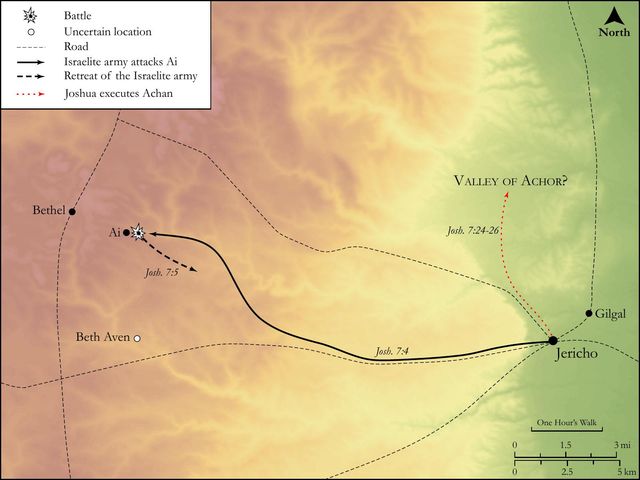
See on the biblical-era map
Study this verse
Public-domain commentary
Matthew Henry
From his Commentary on the Whole Bible. Henry comments on passages, not single verses — this entry covers Joshua 7:1–5. His three-level outline is real structure in the source text, so it is rendered as structure.
The story of this chapter begins with a but. The Lord was with Joshua, and his fame was noised through all that country, so the foregoing chapter ends, and it left no room to doubt but that he would go on as he had begun conquering and to conquer. He did right, and observed his orders in every thing. But the children of Israel committed a trespass, and so set God against them; and then even Joshua's name and fame, his wisdom and courage, could do them no service. If we lose our God, we lose our friends, who cannot help us unless God be for us. Now here is,
I.Achan sinning, Jos 7:1.
Here is only a general mention made of the sin; we shall afterwards have a more particular account of it from his own mouth. The sin is here said to be taking of the accursed thing, in disobedience to the command and in defiance of the threatening, Jos 6:18. In the sacking of Jericho orders were given that they should neither spare any lives nor take any treasure to themselves; we read not of the breach of the former prohibition (there were none to whom they showed any mercy), but of the latter: compassion was put off and yielded to the law, but covetousness was indulged. The love of the world is that root of bitterness which of all others is most hardly rooted up. Yet the history of Achan is a plain intimation that he of all the thousands of Israel was the only delinquent in this matter. Had there been more in like manner guilty, no doubt we should have heard of it: and it is strange there were no more. The temptation was strong. It was easy to suggest what a pity it was that so many things of value should be burnt; to what purpose is this waste? In plundering cities, every man reckons himself entitled to what he can lay his hands on. It was easy to promise themselves secrecy and impunity. Yet by the grace of God such impressions were made upon the minds of the Israelites by the ordinances of God, circumcision and the passover, which they had lately been partakers of, and by the providences of God which had been concerning them, that they stood in awe of the divine precept and judgment, and generously denied themselves in obedience to their God. And yet, though it was a single person that sinned, the children of Israel are said to commit the trespass, because one of their body did it, and he was not as yet separated from them, nor disowned by them. They did it, that is, by what Achan did guilt was brought upon the whole society of which he was a member. This should be a warning to us to take heed of sin ourselves, lest by it many be defiled or disquieted (Heb 12:15), and to take heed of having fellowship with sinners, and of being in league with them, lest we share in their guilt. Many a careful tradesman has been broken by a careless partner. And it concerns us to watch over one another for the preventing of sin, because others' sins may redound to our damage.
II.The camp of Israel suffering for the same:
The anger of the Lord was kindled against Israel; he saw the offence, though they did not, and takes a course to make them see it; for one way or other, sooner or later, secret sins will be brought to light; and, if men enquire not after them, God will, and with his enquiries will awaken theirs. man a community is under guilt and wrath and is not aware of it till the fire breaks out: here it broke out quickly.
1.Joshua sends a detachment to seize upon the next city that was in their way, and that was Ai. Only 3000 men were sent, advice being brought him by his spies that the place was inconsiderable, and needed no greater force for the reduction of it, Jos 7:2, Jos 7:3. Now perhaps it was a culpable assurance, or security rather that led them to send so small a party on this expedition; it might also be an indulgence of the people in the love of ease, for they will not have all the people to labour thither. Perhaps the people were the less forward to go upon this expedition because they were denied the plunder of Jericho; and these spies were willing they should be gratified. Whereas when the town was to be taken, though God by his own power would throw down the walls, yet they must all labour thither and labour there too, in walking round it. It did not bode well at all that God's Israel began to think much of their labour, and contrived how to spare their pains. It is required that we work out our salvation, though it is God that works in us. It has likewise often proved of bad consequence to make too light of an enemy. They are but few (say the spies), but, as few as they were, they were too many for them. It will awaken our care and diligence in our Christian warfare to consider that we wrestle with principalities and powers.
2.The party he sent, in their first attack upon the town, were repulsed with some loss (Jos 7:4, Jos 7:5): They fled before the men of Ai, finding themselves unaccountably dispirited, and their enemies to sally out upon them with more vigour and resolution than they expected. In their retreat they had about thirty-six men cut off: no great loss indeed out of such a number, but a dreadful surprise to those who had no reason to expect any other in any attack than clear, cheap, and certain victory. And now, as it proves, it is well there were but 3000 that fell under this disgrace. Had the body of the army been there, they would have been no more able to keep their ground, now they were under guilt and wrath, than this small party, and to them the defeat would have been much more grievous and dishonourable. However, it was bad enough as it was, and served,
(1.)To humble God's Israel, and to teach them always to rejoice with trembling. Let not him that girdeth on the harness boast as he that putteth if off.
(2.)To harden the Canaanites, and to make them the more secure notwithstanding the terrors they had been struck with, that their ruin, when it came, might be the more dreadful.
(3.)To be an evidence of God's displeasure against Israel, and a call to them to purge out the old leaven. And this was principally intended in their defeat.
3.The retreat of this party in disorder put the whole camp of Israel into a fright: The hearts of the people melted, not so much for the loss as for the disappointment. Joshua had assured them that the living God would without fail drive out the Canaanites from before them, Jos 3:10. How can this event be reconciled to that promise? To every thinking man among them it appeared an indication of God's displeasure, and an omen of something worse, and therefore no marvel it put them into such a consternation; if God turn to be their enemy and fight against them, what will become of them? True Israelites tremble when God is angry.
Continue studying Joshua 7:3 across the web’s major study libraries — every link below opens this exact verse, chapter, or book on the destination site.
Read & Compare
 BibleGatewayThis verse in more than 200 translations and 70 languages.
 Bible.comThe YouVersion reader — hundreds of translations, reading plans, and highlights.
 ESV.orgCrossway's official English Standard Version reader.
 NET BibleThe NET translation with 60,000+ translators' notes on every rendering decision.
 STEP BibleTyndale House's free study tool — original text, vocabulary, and scholarly resources.
 BibliaLogos Bible Software's free web reader.
 USCCBThe New American Bible (Revised Edition) with the U.S. bishops' study notes.
Commentaries
 BibleHub CommentariesDozens of classic commentaries on this verse, gathered on one page.
 StudyLightMore than 100 commentary sets — the largest collection on the web.
 BibleRefPlain-English commentary on what this verse means, verse by verse.
 Enduring WordDavid Guzik's free commentary on this chapter, widely used by Bible teachers.
 Bible Study ToolsVerse commentary alongside Greek and Hebrew study aids.
Original Language & Research
- BibleHub InterlinearThe verse word by word — original language, transliteration, and English.
- BibleHub LexiconEvery word's original-language definition and Strong's entry.
 Blue Letter BibleDeep-study tools — Strong's numbers, concordance, and word studies.
 SefariaThe Hebrew text with Rashi and centuries of Jewish commentary.
Sermons, Hymns & Audio


TrulyRandomVerse is not affiliated with these sites and doesn’t control their content. They’re linked because they’re genuinely useful.
Summary
Joshua 7:3 records the confident but ultimately flawed recommendation from the Israelite spies sent to scout the city of Ai. Following their assessment of Ai's size and defenses, they advise Joshua that only a small contingent of men—specifically two or three thousand—would be sufficient to conquer it, thereby sparing the entire army the unnecessary effort of a full deployment. This counsel, based purely on human observation and military logic, stands in stark contrast to the divine instructions and absolute dependence on God that characterized the preceding miraculous victory at Jericho, setting the stage for a significant and humbling defeat for Israel.
Context
ShowHideLiterary Context
This verse immediately follows the monumental and divinely orchestrated victory at Jericho, where Israel's success was achieved not through military might but through obedient faith in God's unconventional commands, as seen in Joshua 6:20. Flush with this recent, miraculous triumph, Joshua dispatches spies to Ai, a smaller city strategically located to the west in the central highlands. The report in Joshua 7:3 marks a pivotal shift from divine instruction to human initiative and assessment. Unbeknownst to the spies or Joshua, a grave sin had already been committed by Achan, detailed in Joshua 7:1, which had broken the covenant relationship and God's favor, rendering Israel vulnerable despite their recent success. This human-centric counsel, devoid of divine consultation, directly precedes the disastrous defeat at Ai, narrated in Joshua 7:5, highlighting the immediate consequences of presumption and a departure from divine leading.
Historical & Cultural Context
Ai (meaning "ruin" or "heap of ruins") was a Canaanite city, likely smaller than Jericho, situated near Bethel in the central Benjaminite territory. Its strategic location on a major east-west route through the central highlands made its capture crucial for controlling the land and dividing Canaan. Ancient warfare often involved reconnaissance, and sending spies was a standard military practice. However, Israel's unique covenant relationship with Yahweh meant that military strategy was often superseded by divine command and dependence. The cultural context of the time also involved a strong emphasis on the spoils of war, which, in Israel's case, were subject to specific divine regulations, particularly concerning "devoted things" (herem), as seen at Jericho. The spies' confidence reflects a common human tendency to underestimate perceived weaker opponents and to rely on conventional military wisdom, a wisdom that proved insufficient for a people whose victories were meant to be demonstrations of God's power and sovereignty, not human ingenuity.
Key Themes
ShowHideThe spies' recommendation in Joshua 7:3 is a critical turning point that introduces several profound themes. Firstly, it underscores the stark contrast between human confidence and divine dependence. After the supernatural victory at Jericho, where God alone secured the triumph, the spies' reliance on human observation and logic demonstrates a dangerous shift away from seeking God's counsel. Secondly, it highlights the peril of underestimating challenges and fostering complacency. By deeming Ai's inhabitants "but few," they cultivated an overconfident mindset that neglected the spiritual realities at play. Thirdly, though not explicitly stated in this verse, it subtly foreshadows the consequences of unaddressed sin. The flawed counsel and subsequent defeat are direct repercussions of Achan's hidden transgression, as God reveals in Joshua 7:11-12, illustrating how individual disobedience can undermine the entire community's spiritual standing and military success. Finally, the entire narrative arc of Ai, beginning with this verse, powerfully emphasizes the absolute necessity of seeking God's counsel in all endeavors, especially after spiritual victories, rather than presuming continued success based on past achievements or human calculations, a lesson echoed throughout the book of Joshua.
Exposition and Analysis
ShowHideKey Word Analysis
ShowHideA primitive root meaning "to turn back (hence, away) transitively or intransitively, literally or figuratively (not necessarily with the idea of return to the starting point); generally to retreat; often adverbial, again." Here, it signifies the completion of the spies' reconnaissance mission and their presentation of findings to Joshua. While the word itself is neutral, the content of their report reveals a turning away from the posture of absolute dependence on God that characterized the Jericho campaign, subtly indicating a shift in Israel's spiritual orientation.
A primitive root meaning "to strike (lightly or severely, literally or figuratively); beat, cast forth, clap, give (wounds), [idiom] go forward, [idiom] indeed, kill, make (slaughter), murderer, punish, slaughter, slay(-er, -ing), smite(-r, -ing), strike, be stricken, (give) stripes, [idiom] surely, wound." This strong verb conveys the intention of a decisive and destructive military action. The spies' use of this term reflects their confidence in achieving a complete victory, implying an easy conquest that would eliminate the enemy. The profound irony lies in the fact that Israel would soon be "smitten" by Ai, rather than smiting it.
From a root meaning "to be little or few." This word means "a little or few (often adverbial or compar.); almost (some, very) few(-er, -est), lightly, little (while), (very) small (matter, thing), some, soon, [idiom] very." Its use here is central to the spies' flawed assessment. By describing Ai's inhabitants as "but few," they dismiss the enemy as insignificant, leading to a dangerous underestimation of the task at hand and a presumption of effortless victory. This word encapsulates their human-centric, superficial evaluation, which tragically contrasts with the true spiritual state of affairs.
Verse Breakdown
ShowHide"And they returned to Joshua, and said unto him"
This opening clause establishes the setting: the spies have completed their mission and are now delivering their report to the leader, Joshua. It sets the stage for the critical advice that follows, indicating that this is official counsel from trusted scouts, yet it lacks the divine mandate that characterized previous instructions for conquest.
"Let not all the people go up; but let about two or three thousand men go up and smite Ai"
This is the core of the spies' recommendation. They advise against deploying the entire army, suggesting that a small contingent of 2,000-3,000 men would be sufficient to conquer Ai. This counsel is based purely on their human observation of Ai's size and defenses, reflecting a military calculation rather than a spiritual inquiry. It directly contrasts with the full mobilization and divine strategy employed at Jericho, where God's power, not human numbers, was paramount.
"[and] make not all the people to labour thither"
This phrase provides the rationale for their recommendation. The spies advocate for efficiency and conservation of resources, arguing that a full deployment would be an unnecessary burden or "labour" for the entire army. This practical, human-centered reasoning further underscores their oversight of the spiritual dimension of the conflict, prioritizing human comfort and logistical ease over divine command and spiritual readiness.
"for they [are but] few"
This final clause is the spies' justification for their confident, albeit flawed, assessment. Their perception of Ai's population as small and insignificant leads them to conclude that the city poses minimal threat, thus requiring only a small force. This statement encapsulates their overconfidence and the dangerous underestimation of the enemy, which ultimately proves disastrous for Israel, revealing a profound lack of spiritual discernment.
Literary Devices
ShowHideJoshua 7:3 is rich with Irony. The spies' confident assertion that Ai's inhabitants "are but few" and that a small force will "smite Ai" stands in stark contrast to the impending reality of Israel's humiliating defeat at the hands of this very "few" enemy. This dramatic irony highlights the chasm between human perception and divine reality. The verse also employs Foreshadowing, subtly hinting at the disaster to come. The overconfidence and lack of divine consultation, especially after the supernatural victory at Jericho, create a sense of unease, signaling that something is amiss and that the human-devised plan will not succeed. Furthermore, there is a strong Contrast established between the methodology of the Jericho campaign (total dependence on God, unconventional warfare) and the proposed strategy for Ai (human assessment, conventional military logic), which serves to emphasize the spiritual decline and its dire consequences.
Theological and Thematic Connections
ShowHideJoshua 7:3 serves as a powerful theological pivot, shifting the narrative from God's miraculous intervention at Jericho to a profound lesson in human presumption and the consequences of spiritual negligence. The spies' confident, human-centric assessment of Ai's weakness, devoid of any recorded consultation with God, highlights the critical theme of dependence on divine counsel versus reliance on human wisdom. After experiencing God's overwhelming power, Israel quickly reverts to a worldly mindset, demonstrating the human tendency to forget past deliverances and trust in visible strength rather than invisible grace. This verse underscores that true victory for God's people is never a matter of superior numbers or strategic brilliance alone, but always a result of His presence and leading. It also subtly introduces the theme of corporate responsibility for individual sin, as the spies' flawed advice, born of a general spiritual complacency, occurs against the backdrop of Achan's hidden transgression, which had already severed God's favor from the community.
Reflection and Application
ShowHideJoshua 7:3 offers a timeless cautionary tale for believers. It reminds us that past spiritual victories, no matter how grand, do not guarantee future success if we abandon our dependence on God. The spies' overconfidence, rooted in a superficial assessment and a lack of divine consultation, led to a disastrous outcome. In our own lives, whether in personal decisions, ministry endeavors, or corporate church life, there is a pervasive temptation to rely on our own wisdom, experience, or resources, especially after a season of success. This verse challenges us to consistently seek God's guidance through prayer, His Word, and the counsel of the Holy Spirit, rather than presuming that our logic or past achievements are sufficient. It calls us to cultivate a posture of humility and constant reliance on God, recognizing that true success is defined by His will and His power, not by our human calculations. The story of Ai teaches us that even seemingly small challenges can become insurmountable obstacles when God's presence and favor are absent due to unaddressed sin or a lack of spiritual discernment.
Questions for Reflection
ShowHideFAQ
ShowHideWhy did Joshua send spies to Ai after the miraculous victory at Jericho, and why was their advice flawed?
ShowHideJoshua sent spies to Ai as a standard military practice, a common reconnaissance strategy in ancient warfare. This was not inherently wrong, as he had also sent spies to Jericho in Joshua 2:1. However, the flaw in their advice stemmed from two critical issues. First, their assessment was purely human and logical: Ai appeared small ("but few"), suggesting an easy victory, leading them to recommend a minimal force. This overlooked the spiritual dimension of Israel's warfare, which required divine leading, not just human strategy. Second, and more critically, neither the spies nor Joshua consulted God before making this decision. After the supernatural triumph at Jericho, there was a dangerous presumption of continued success based on human observation rather than divine command. Unbeknownst to them, Achan's sin had already broken fellowship with God, as revealed in Joshua 7:1, rendering Israel vulnerable. Their advice, though seemingly logical, was spiritually blind and ultimately led to defeat.
Christ-Centered Fulfillment
ShowHideThe narrative of Joshua 7:3, with its emphasis on human overconfidence leading to failure, finds profound Christ-centered fulfillment in the person and work of Jesus. The spies' flawed assessment of Ai, based on visible strength and human logic, stands in stark contrast to the spiritual discernment required for true victory. In Christ, we see the ultimate embodiment of divine dependence and perfect obedience. Unlike the Israelites who presumed success, Jesus consistently relied on the Father, declaring, "I can do nothing on my own" in John 5:30. His victory over sin and death was not achieved through human might or strategic brilliance, but through humble self-sacrifice on the cross, an act that seemed like weakness to the world but was God's ultimate power, as detailed in 1 Corinthians 1:25. The "few" inhabitants of Ai proved insurmountable to an overconfident Israel, but Christ, by Himself, decisively defeated the "strong man" and plundered his house, as seen in Mark 3:27, triumphing over spiritual principalities and powers, as affirmed in Colossians 2:15. For believers, the lesson of Ai is not merely about seeking God's counsel, but about recognizing that our true strength and victory come solely through our union with Christ, who is our wisdom, righteousness, sanctification, and redemption, according to 1 Corinthians 1:30. We are called to fight our battles not with human confidence, but with the spiritual weapons provided by Him, acknowledging that "the battle is the Lord's" (1 Samuel 17:47) and that in Christ, we are "more than conquerors" (Romans 8:37).