


Joshua 7:4
Bible text: King James Version (1769 Blayney text) · Public domain
Bible text: Berean Standard Bible · Public domain
Bible text: American Standard Version (1901) · Public domain
Bible text: World English Bible, Messianic edition · Public domain
Bible text: Geneva Bible (1599) · Public domain
Bible text: Young's Literal Translation · Public domain
- וַיַּעֲלוּvai·ya·'a·Luand they went upH5927Conj-w ¦ V-Qal-ConsecImperf-3mpVerb Qal Consecutive Imperfect 3rd Plural Masculineוַandיַּעֲלוּthey went up
- מִןminsome ofH4480PrepPreposition
- הָעָםha·'Amthe peopleH5971Art ¦ N-msNoun Singular Masculine Absoluteהָtheעָםpeople
- שָׁמָּהSha·mahthere <towards>H8033Adv ¦ SfxAdverbשָׁמָּthereה<towards>
- כִּשְׁלֹשֶׁתkish·Lo·shetabout threeH7969Prep-k ¦ Adj-cscAdjective Numerical Singular common gender Constructכִּaboutשְׁלֹשֶׁתthree
- אֲלָפִים'a·la·Fimthousand<s>H505Adj-cpAdjective Numerical Plural common gender Absolute
- אִישׁ'IshmanH376N-msNoun Singular Masculine Absolute
- וַיָּנֻסוּvai·ya·Nu·suand they fledH5127Conj-w ¦ V-Qal-ConsecImperf-3mpVerb Qal Consecutive Imperfect 3rd Plural Masculineוַandיָּנֻסוּthey fled
- לִפְנֵיlif·Nei<to> beforeH6440Prep-l ¦ N-mpcNoun Plural Masculine Constructלִ<to>פְנֵיbefore
- אַנְשֵׁי'an·Shei[the] men ofH582N-mpcNoun Plural Masculine Construct
- הָעָיha·'Ai<the> AiH5857Art ¦ N-properNoun Proper Locationהָ<the>עָיAi
English is a literal word-by-word gloss of the Hebrew, not the KJV's wording. Why?
This is the original text the KJV's translators worked from — each Hebrew word with its own literal English meaning in this verse, prepared by scholars at Tyndale House, Cambridge. The KJV translates whole sentences, not word by word, so its wording differs: one Hebrew word can become several English words, and the KJV may choose “the LORD” where the gloss reads “Yahweh”. Both are faithful — they answer different questions. For the KJV's own rendering, switch to the KJV text.
Details
See on the biblical-era map
Study this verse
Public-domain commentary
Matthew Henry
From his Commentary on the Whole Bible. Henry comments on passages, not single verses — this entry covers Joshua 7:1–5. His three-level outline is real structure in the source text, so it is rendered as structure.
The story of this chapter begins with a but. The Lord was with Joshua, and his fame was noised through all that country, so the foregoing chapter ends, and it left no room to doubt but that he would go on as he had begun conquering and to conquer. He did right, and observed his orders in every thing. But the children of Israel committed a trespass, and so set God against them; and then even Joshua's name and fame, his wisdom and courage, could do them no service. If we lose our God, we lose our friends, who cannot help us unless God be for us. Now here is,
I.Achan sinning, Jos 7:1.
Here is only a general mention made of the sin; we shall afterwards have a more particular account of it from his own mouth. The sin is here said to be taking of the accursed thing, in disobedience to the command and in defiance of the threatening, Jos 6:18. In the sacking of Jericho orders were given that they should neither spare any lives nor take any treasure to themselves; we read not of the breach of the former prohibition (there were none to whom they showed any mercy), but of the latter: compassion was put off and yielded to the law, but covetousness was indulged. The love of the world is that root of bitterness which of all others is most hardly rooted up. Yet the history of Achan is a plain intimation that he of all the thousands of Israel was the only delinquent in this matter. Had there been more in like manner guilty, no doubt we should have heard of it: and it is strange there were no more. The temptation was strong. It was easy to suggest what a pity it was that so many things of value should be burnt; to what purpose is this waste? In plundering cities, every man reckons himself entitled to what he can lay his hands on. It was easy to promise themselves secrecy and impunity. Yet by the grace of God such impressions were made upon the minds of the Israelites by the ordinances of God, circumcision and the passover, which they had lately been partakers of, and by the providences of God which had been concerning them, that they stood in awe of the divine precept and judgment, and generously denied themselves in obedience to their God. And yet, though it was a single person that sinned, the children of Israel are said to commit the trespass, because one of their body did it, and he was not as yet separated from them, nor disowned by them. They did it, that is, by what Achan did guilt was brought upon the whole society of which he was a member. This should be a warning to us to take heed of sin ourselves, lest by it many be defiled or disquieted (Heb 12:15), and to take heed of having fellowship with sinners, and of being in league with them, lest we share in their guilt. Many a careful tradesman has been broken by a careless partner. And it concerns us to watch over one another for the preventing of sin, because others' sins may redound to our damage.
II.The camp of Israel suffering for the same:
The anger of the Lord was kindled against Israel; he saw the offence, though they did not, and takes a course to make them see it; for one way or other, sooner or later, secret sins will be brought to light; and, if men enquire not after them, God will, and with his enquiries will awaken theirs. man a community is under guilt and wrath and is not aware of it till the fire breaks out: here it broke out quickly.
1.Joshua sends a detachment to seize upon the next city that was in their way, and that was Ai. Only 3000 men were sent, advice being brought him by his spies that the place was inconsiderable, and needed no greater force for the reduction of it, Jos 7:2, Jos 7:3. Now perhaps it was a culpable assurance, or security rather that led them to send so small a party on this expedition; it might also be an indulgence of the people in the love of ease, for they will not have all the people to labour thither. Perhaps the people were the less forward to go upon this expedition because they were denied the plunder of Jericho; and these spies were willing they should be gratified. Whereas when the town was to be taken, though God by his own power would throw down the walls, yet they must all labour thither and labour there too, in walking round it. It did not bode well at all that God's Israel began to think much of their labour, and contrived how to spare their pains. It is required that we work out our salvation, though it is God that works in us. It has likewise often proved of bad consequence to make too light of an enemy. They are but few (say the spies), but, as few as they were, they were too many for them. It will awaken our care and diligence in our Christian warfare to consider that we wrestle with principalities and powers.
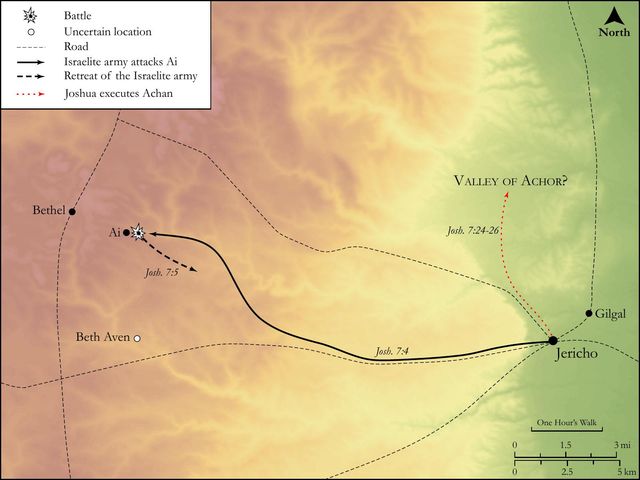
2.The party he sent, in their first attack upon the town, were repulsed with some loss (Jos 7:4, Jos 7:5): They fled before the men of Ai, finding themselves unaccountably dispirited, and their enemies to sally out upon them with more vigour and resolution than they expected. In their retreat they had about thirty-six men cut off: no great loss indeed out of such a number, but a dreadful surprise to those who had no reason to expect any other in any attack than clear, cheap, and certain victory. And now, as it proves, it is well there were but 3000 that fell under this disgrace. Had the body of the army been there, they would have been no more able to keep their ground, now they were under guilt and wrath, than this small party, and to them the defeat would have been much more grievous and dishonourable. However, it was bad enough as it was, and served,
(1.)To humble God's Israel, and to teach them always to rejoice with trembling. Let not him that girdeth on the harness boast as he that putteth if off.
(2.)To harden the Canaanites, and to make them the more secure notwithstanding the terrors they had been struck with, that their ruin, when it came, might be the more dreadful.
(3.)To be an evidence of God's displeasure against Israel, and a call to them to purge out the old leaven. And this was principally intended in their defeat.
3.The retreat of this party in disorder put the whole camp of Israel into a fright: The hearts of the people melted, not so much for the loss as for the disappointment. Joshua had assured them that the living God would without fail drive out the Canaanites from before them, Jos 3:10. How can this event be reconciled to that promise? To every thinking man among them it appeared an indication of God's displeasure, and an omen of something worse, and therefore no marvel it put them into such a consternation; if God turn to be their enemy and fight against them, what will become of them? True Israelites tremble when God is angry.
Continue studying Joshua 7:4 across the web’s major study libraries — every link below opens this exact verse, chapter, or book on the destination site.
Read & Compare
 BibleGatewayThis verse in more than 200 translations and 70 languages.
 Bible.comThe YouVersion reader — hundreds of translations, reading plans, and highlights.
 ESV.orgCrossway's official English Standard Version reader.
 NET BibleThe NET translation with 60,000+ translators' notes on every rendering decision.
 STEP BibleTyndale House's free study tool — original text, vocabulary, and scholarly resources.
 BibliaLogos Bible Software's free web reader.
 USCCBThe New American Bible (Revised Edition) with the U.S. bishops' study notes.
Commentaries
 BibleHub CommentariesDozens of classic commentaries on this verse, gathered on one page.
 StudyLightMore than 100 commentary sets — the largest collection on the web.
 BibleRefPlain-English commentary on what this verse means, verse by verse.
 Enduring WordDavid Guzik's free commentary on this chapter, widely used by Bible teachers.
 Bible Study ToolsVerse commentary alongside Greek and Hebrew study aids.
Original Language & Research
- BibleHub InterlinearThe verse word by word — original language, transliteration, and English.
- BibleHub LexiconEvery word's original-language definition and Strong's entry.
 Blue Letter BibleDeep-study tools — Strong's numbers, concordance, and word studies.
 SefariaThe Hebrew text with Rashi and centuries of Jewish commentary.
Sermons, Hymns & Audio


TrulyRandomVerse is not affiliated with these sites and doesn’t control their content. They’re linked because they’re genuinely useful.
Summary
Joshua 7:4 starkly recounts the unexpected and humiliating defeat of approximately three thousand Israelite soldiers at the hands of the much smaller city of Ai. This verse serves as a crucial turning point in the book of Joshua, immediately following the miraculous victory at Jericho, and dramatically reveals that Israel's success in the conquest was not based on their military might or strategic planning, but solely on the active presence and blessing of God, which had been withdrawn due to unconfessed sin within the camp.
Context
ShowHideLiterary Context
Joshua 7:4 is situated within a pivotal narrative shift following the triumphant and divinely orchestrated fall of Jericho in Joshua 6. The preceding chapter meticulously details God's specific instructions regarding the ḥerem (devoted things) of Jericho, explicitly prohibiting Israel from taking any plunder for themselves, save for precious metals consecrated to the Lord's treasury (Joshua 6:18-19). The immediate verses leading up to this defeat describe the overconfident assessment of Israelite scouts, who, relying on human wisdom rather than divine counsel, advised sending only a small contingent to conquer Ai (Joshua 7:2-3). Crucially, the entire chapter is framed by the revelation of Achan's trespass against God's command in Joshua 7:1. The defeat at Ai, therefore, serves as a dramatic and necessary narrative device to expose this hidden sin, re-establish God's absolute holiness, and underscore the indispensable requirement of Israel's corporate obedience for their success in possessing the Promised Land.
Historical & Cultural Context
The conquest of Canaan was understood by ancient Israel as a divinely mandated "holy war," a unique enterprise where victory was not attributed to human military prowess but to Yahweh's direct intervention and presence. Central to this concept was the ḥerem principle, where certain spoils were entirely consecrated to God, often for destruction, to prevent Israel from being corrupted by pagan practices and to affirm God's absolute sovereignty. The defeat at Ai was thus far more than a military setback; it was a profound theological crisis. In Israel, a decisive rout, especially by a numerically inferior force, was a deep humiliation and a clear indicator of divine displeasure, as Moses had warned, "The LORD shall cause thee to be smitten before thine enemies," significantly impacting national morale and the perception of the LORD's name among the nations. This defeat signaled that God's covenant presence, which guaranteed victory, had been withdrawn due to a serious breach of covenant by His people.
Key Themes
ShowHideThis verse powerfully contributes to several overarching theological and narrative themes within the book of Joshua and the broader Old Testament. Firstly, it vividly illustrates the Consequences of Disobedience, demonstrating that God's covenant faithfulness to Israel is inextricably linked to their obedience. A single act of sin can have devastating corporate repercussions, leading to divine judgment and defeat, as clearly stated by God in Joshua 7:11-12. Secondly, the episode highlights the perils of Overconfidence and Presumption. Following the supernatural triumph at Jericho, the Israelite leaders and scouts became complacent, relying on their own strategic assessments rather than humbly seeking divine counsel, which directly led to the disastrous outcome at Ai (Joshua 7:3). Finally, the narrative powerfully underscores the principle of Corporate Responsibility or solidarity. Achan's individual sin brought defilement and judgment upon the entire community of Israel, emphasizing the profound interconnectedness of the covenant people and the truth that the sin of one could jeopardize the well-being and divine favor upon all (Joshua 7:1).
Exposition and Analysis
ShowHideKey Word Analysis
ShowHideThis verb, often translated as "went up," signifies an ascent or a confident advance. In this context, it describes the initial movement of the Israelite force towards Ai, implying a purposeful and perhaps even presumptuous forward march. The stark contrast between this confident "going up" and the subsequent panicked "fleeing" underscores the dramatic reversal of fortune and the misplaced confidence that characterized this initial engagement, setting the stage for the devastating reality of their defeat.
This term refers to a man as an individual or a male person, often used to denote a soldier or a specific group of people. Here, it is used twice: "three thousand men" and "the men of Ai." Its usage emphasizes the human element of the conflict, highlighting the individual soldiers involved in both the Israelite contingent and the defending force. The defeat of "three thousand men" by "the men of Ai" underscores the unexpected nature of the rout, as Israelite "men" (soldiers) who had just witnessed God's power were now utterly defeated by seemingly ordinary "men" from a smaller city.
This primitive root signifies a hasty, panicked, and disorderly retreat, to vanish away, or to be put to flight. It is not a strategic withdrawal but a desperate, unorganized flight from a superior or overwhelming force. In this context, it powerfully emphasizes the utter rout and humiliation of the Israelite soldiers who, despite their numerical advantage over the men of Ai, were completely broken and scattered. The use of this word highlights the severity of their defeat and the unexpected nature of their collapse, contrasting sharply with their disciplined advance and overwhelming victory at Jericho.
Verse Breakdown
ShowHide"So there went up thither of the people about three thousand men:"
This clause describes the initial, confident deployment of the Israelite forces. The number "about three thousand men" reflects the overconfident assessment of the scouts in Joshua 7:3, who believed this small force would be more than sufficient to conquer Ai. This decision, notably made without seeking divine counsel, indicates a dangerous reliance on human wisdom and a degree of spiritual complacency following the miraculous victory at Jericho. The phrase "of the people" emphasizes that these were ordinary Israelite soldiers, part of the covenant community, whose actions and fate were intertwined with the spiritual state of the entire nation.
"and they fled before the men of Ai."
This second clause delivers the shocking and humiliating outcome. The verb "fled" conveys a complete and disorderly rout, a panicked retreat. The Israelites, who had just witnessed God's supernatural power dismantle the formidable walls of Jericho, were now thoroughly defeated by a seemingly insignificant city. This unexpected and devastating defeat was a direct consequence of God's withdrawal of favor due to Achan's unconfessed sin, demonstrating unequivocally that military success for Israel was not a given, nor was it dependent on their numbers or strategy, but entirely on their faithful obedience to the covenant and God's active, holy presence among them. The phrase "before the men of Ai" highlights the unexpected weakness of the Israelites against an enemy they had profoundly underestimated.
Literary Devices
ShowHideThe narrative in Joshua 7:4 masterfully employs several powerful literary devices to convey its profound theological message. The most prominent is Irony, as the small, seemingly insignificant city of Ai, which the scouts confidently asserted could be taken by a minimal force, utterly defeats the Israelite army that had just witnessed the miraculous fall of Jericho. This unexpected reversal creates a profound sense of dramatic irony, highlighting the folly of human presumption when divine favor is absent. There is also a strong element of Contrast between the overwhelming, divinely-empowered victory at Jericho and the humiliating, human-led defeat at Ai, serving to underscore the absolute necessity of God's presence and obedience for Israel's success. Furthermore, the verse functions as a Foreshadowing device, signaling that something is deeply wrong within the Israelite camp, leading to the subsequent revelation of Achan's sin and the necessary purification of the community. The swift and decisive defeat also serves as a Symbol of God's displeasure and the broken covenant relationship, vividly illustrating the spiritual consequences of disobedience.
Theological and Thematic Connections
ShowHideJoshua 7:4 powerfully illustrates the critical theological principle that God's blessing and success for His people are fundamentally contingent upon their obedience and faithfulness to His covenant. The devastating defeat at Ai was not a random misfortune or a strategic miscalculation, but a direct divine judgment, a consequence of Achan's sin, which had brought a "devoted thing" (a curse) upon the entire Israelite camp. This event underscores God's absolute holiness and His intolerance for unaddressed sin within His covenant community, demonstrating that His empowering presence, which guarantees victory, is withdrawn when sin is unconfessed and unpurged. It highlights the corporate nature of sin and its far-reaching consequences in ancient Israel, where the actions of one individual could profoundly affect the well-being and divine favor upon the entire nation, necessitating communal accountability and purification. This episode serves as a stark reminder that spiritual victories are never guaranteed by past successes or human strategy, but by humble dependence on God and unwavering adherence to His commands.
Reflection and Application
ShowHideThe humiliating defeat at Ai, as recorded in Joshua 7:4, serves as a timeless and sobering lesson for believers today. It reminds us that past spiritual victories, no matter how grand or miraculous, do not exempt us from the ongoing necessity of humility, obedience, and total reliance on God. When we become complacent, overconfident in our own abilities or strategies, or allow unconfessed sin to fester in our lives or communities, we risk withdrawing from God's active blessing and inviting spiritual defeat. This passage calls us to a rigorous self-examination, both individually and corporately, to ensure that our walk aligns with God's commands and that there is no "accursed thing" hindering His presence and power among us. It teaches us that true success in God's work is not measured by human metrics or military might, but by the manifest presence of His Spirit, which is contingent upon our purity, faithfulness, and humble dependence.
Questions for Reflection
ShowHideFAQ
ShowHideWhy was Achan's sin so severe that it led to the defeat of the entire Israelite army at Ai?
ShowHideAchan's sin was profoundly severe for several critical reasons, leading to corporate consequences for all Israel. Firstly, it was an act of direct and deliberate disobedience to a clear, specific divine command regarding the "devoted things" (ḥerem) from Jericho (Joshua 6:18-19). This command was not arbitrary but foundational to the nature of the holy war, designed to prevent Israel from adopting the corrupt practices of the Canaanites and to affirm God's absolute sovereignty over the conquest. Secondly, it constituted an act of covenant infidelity, a breach of the sacred agreement between God and Israel, which had profound implications for their relationship and God's promised presence. Thirdly, Achan's secret sin had devastating corporate consequences; it brought defilement and God's displeasure upon the entire community, making them vulnerable to defeat and demonstrating that the holiness of the camp was paramount for God's presence and blessing (Joshua 7:11-12). God's judgment was not merely punitive but corrective, designed to purify the community, restore His favor, and re-establish the sanctity of the covenant.
Christ-Centered Fulfillment
ShowHideThe humiliating defeat at Ai, stemming from the corporate impact of Achan's sin, powerfully foreshadows the ultimate solution to humanity's pervasive sin problem found exclusively in Jesus Christ. Achan's transgression brought a curse and death upon the community, starkly demonstrating the biblical truth that "the wages of sin is death" (Romans 6:23). Just as Israel needed a radical purification from the "accursed thing" to regain God's favor and proceed with the conquest of the land, humanity, universally tainted by sin, needed a perfect, once-for-all sacrifice to atone for sin and reconcile with a holy God. Jesus, the true Lamb of God who takes away the sin of the world, willingly became the "accursed thing" for us, taking upon Himself the full weight of divine wrath and the curse that our sins justly deserved (Galatians 3:13). His perfect obedience, in profound contrast to Achan's disobedience, secured not defeat but ultimate spiritual victory for all who believe. Through Christ, the corporate solidarity of sin (rooted in Adam's fall, as described in Romans 5:12) is overcome by a new, redemptive corporate solidarity in Him, where His perfect righteousness is imputed to us, enabling us to walk in newness of life and experience God's unfailing presence and blessing (2 Corinthians 5:21). The Ai narrative, therefore, points beyond Israel's temporary setback to the profound truth that our ultimate victory over sin, death, and the curse comes not through human strength, strategy, or purification rituals, but through the perfect, substitutionary work of Christ, who bore our curse and secured our eternal triumph.