


2 Kings 5:12
Bible text: King James Version (1769 Blayney text) · Public domain
Bible text: King James Version with Strong's numbers · Public domain
Bible text: Berean Standard Bible · Public domain
Bible text: American Standard Version (1901) · Public domain
Bible text: World English Bible, Messianic edition · Public domain
Bible text: Geneva Bible (1599) · Public domain
Bible text: Young's Literal Translation · Public domain
- הֲלֹאha·Lo'¿ notH3808Interrog ¦ NegParticle Negativeהֲ¿לֹאnot
- טוֹבtOvgoodH2896Adj-msAdjective Singular Masculine Absolute
- אֲמָנָה'a·va·nah[are] AmanaH549N-properNoun Proper Location
- וּפַרְפַּרu·far·Parand PharparH6554Conj-w ¦ N-properNoun Proper LocationוּandפַרְפַּרPharpar
- נַהֲרוֹתna·ha·Rot[the] rivers ofH5104N-fpcNoun Plural Feminine Construct
- דַּמֶּשֶׂקda·Me·sekDamascusH1834N-properNoun Proper Location
- מִכֹּלmi·Kolmore than allH3605Prep-m ¦ N-mscNoun Singular Masculine Constructמִmore thanכֹּלall
- מֵימֵיmei·Mei[the] waters ofH4325N-mpcNoun Plural Masculine Construct
- יִשְׂרָאֵלYis·ra·'ElIsraelH3478N-properNoun Proper Location
- הֲלֹאha·lo'¿ notH3808Interrog ¦ NegParticle Negativeהֲ¿לֹאnot
- אֶרְחַץ'er·Chatzwill I washH7364V-Qal-Imperf-1csVerb Qal Imperfect 1st Singular common gender
- בָּהֶםba·Hemin themPrep-b ¦ 3mpSuffix Personal 3rd Plural Masculineבָּinהֶםthem
- וְטָהָרְתִּיve·ta·Ha·re·tiand I will be cleanH2891Conj-w ¦ V-Qal-ConsecPerf-1csVerb Qal Consecutive Perfect 1st Singular common genderוְandטָהָרְתִּיI will be clean
- וַיִּפֶןvai·Yi·fenand he turnedH6437Conj-w ¦ V-Qal-ConsecImperf-3msVerb Qal Consecutive Imperfect 3rd Singular Masculineוַandיִּפֶןhe turned
- וַיֵּלֶךְvai·Ye·lekhand he wentH1980Conj-w ¦ V-Qal-ConsecImperf-3msVerb Qal Consecutive Imperfect 3rd Singular Masculineוַandיֵּלֶךְhe went
- בְּחֵמָהbe·che·Mahin a rageH2534Prep-b ¦ N-fsNoun Singular Feminine Absoluteבְּinחֵמָהa rage
English is a literal word-by-word gloss of the Hebrew, not the KJV's wording. Why?
This is the original text the KJV's translators worked from — each Hebrew word with its own literal English meaning in this verse, prepared by scholars at Tyndale House, Cambridge. The KJV translates whole sentences, not word by word, so its wording differs: one Hebrew word can become several English words, and the KJV may choose “the LORD” where the gloss reads “Yahweh”. Both are faithful — they answer different questions. For the KJV's own rendering, switch to the KJV text.
Details
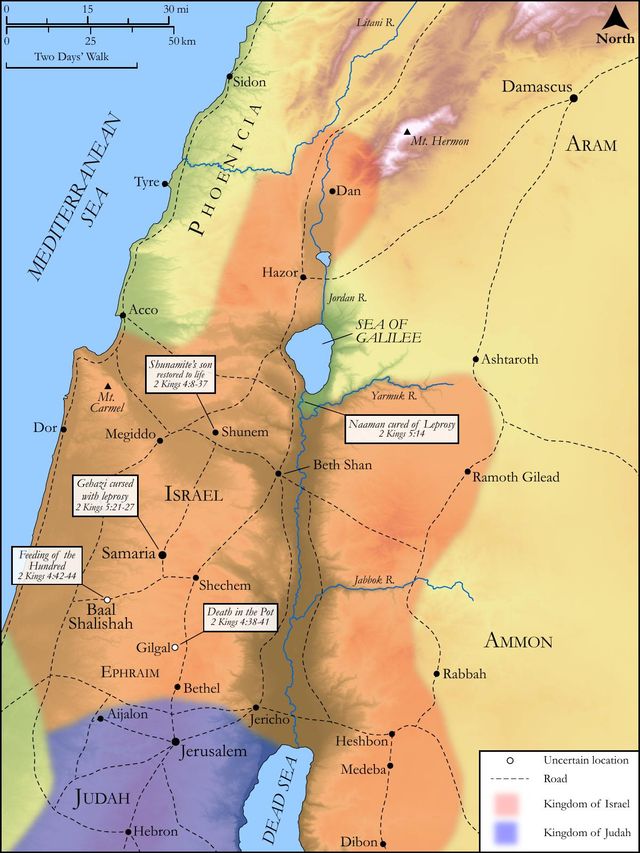
See on the biblical-era map
Study this verse
Public-domain commentary
Matthew Henry
From his Commentary on the Whole Bible. Henry comments on passages, not single verses — this entry covers 2 Kings 5:9–14. His three-level outline is real structure in the source text, so it is rendered as structure.
We have here the cure of Naaman's leprosy.
I.The short and plain direction which the prophet gave him, with assurance of success.
Naaman designed to do honour to Elisha when he came in his chariot, and with all his retinue, to Elisha's door, Kg2 5:9. Those that showed little respect to prophets at other times were very complaisant to them when they needed them. He attended at Elisha's door as a beggar for an alms. Those that would be cleansed from the spiritual leprosy must wait at Wisdom's gate, and watch at the posts of her doors. Naaman expected to have his compliment returned, but Elisha gave him his answer without any formality, would not go to the door to him, lest he should seem too much pleased with the honour done him, but sent a messenger to him, saying, Go wash in Jordan seven times, and promising him that if he did so his disease should be cured. The promise was express: Thou shalt be clean. The method prescribed was plain: Go wash in Jordan. This was not intended as any means of the cure; for, though cold bathing is recommended by many as a very wholesome thing, yet some think that in the case of a leprosy it was rather hurtful. But it was intended as a sign of the cure, and a trial of his obedience. Those that will be helped of God must do as they are bidden. But why did Elisha send a messenger to him with these directions?
1.Because he had retired, at this time, for devotion, was intent upon his prayers for the cure, and would not be diverted; or,
2.Because he knew Naaman to be a proud man, and he would let him know that before the great God all men stand upon the same level.
II.Naaman's disgust at the method prescribed, because it was not what he expected. Two things disgusted him: -
1.That Elisha, as he thought, put a slight upon his person, in sending him orders by a servant, and not coming to him himself, Kg2 5:11. Being big with the expectation of a cure, he had been fancying how this cure would be wrought, and the scheme he had laid was this: "He will surely come out to me, that is the least he can do to me, a peer of Syria, to me that have come to him in all this state, to me that have so often been victorious over Israel. He will stand, and call on the name of his God, and name me in his prayer, and then he will wave his hand over the place, and so effect the cure." And, because the thing was not done just thus, he fell into a passion, forgetting,
(1.)That he was a leper, and the law of Moses, which Elisha would religiously observe, shut lepers out from society - a leper, and therefore he ought not to insist upon the punctilios of honor. Note, Many have hearts unhumbled under humbling providences; see Num 12:14.
(2.)That he was a petitioner, suing for a favour which he could not demand; and beggars must not be choosers, patients must not prescribe to their physicians. See in Naaman the folly of pride. A cure will not content him unless he be cured with ceremony, with a great deal of pomp and parade; he scorns to be healed, unless he be humoured.
2.That Elisha, as he thought, put a slight upon his country. He took it hard that he must be sent to wash in Jordan, a river of Israel, when he thought Abana and Pharpar, rivers of Damascus, better than all the waters of Israel. How magnificently does he speak of these two rivers that watered Damascus, which soon after fell into one, called by geographers Chrysoroas - the golden stream! How scornfully does he speak of all the waters of Israel, though God had called the land of Israel the glory of all lands, and particularly for its brooks of water! Deu 8:7. So common it is for God and man to differ in their judgments. How slightly does he speak of the prophet's directions! May I not wash in them and be clean? He might wash in them and be clean from dirt, but not wash in them and be clean from leprosy. He was angry that the prophet bade him wash and be clean; he thought that the prophet must do all and was not pleased that he was bidden to do any thing, - or he thought this too cheap, too plain, too common a thing for so great a man to be cured by, - or he did not believe it would at all effect the cure, or, if it would, what medicinal virtue was there in Jordan more than in the rivers of Damascus? But he did not consider,
(1.)That Jordan belonged to Israel's God, from whom he was to expect the cure, and not from the gods of Damascus; it watered the Lord's land, the holy land, and, in a miraculous cure, relation to God was much more considerable than the depth of the channel or the beauty of the stream.
(2.)That Jordan had more than once before this obeyed the commands of omnipotence. It had of old yielded a passage to Israel, and of late to Elijah and Elisha, and therefore was fitter for such a purpose than those rivers which had only observed the common law of their creation, and had never been thus distinguished; but, above all,
(3.)Jordan was the river appointed, and, if he expected a cure from the divine power, he ought to acquiesce in the divine will, without asking why or wherefore. Note, It is common for those that are wise in their own conceit to look with contempt on the dictates and prescriptions of divine wisdom and to prefer their own fancies before them; those that are for establishing their own righteousness will not submit to the righteousness of God, Rom 10:3. Naaman talked himself into such a heat (as passionate men usually do) that he turned away from the prophet's door in a rage, ready to swear he would never have any thing more to say to Elisha; and who then would be the loser? Note, Those that observe lying vanities forsake their own mercies. Jon 2:8. Proud men are the worst enemies to themselves and forego their own redemption.
III.The modest advice which his servants gave him, to observe the prophet's prescriptions, with a tacit reproof of his resentments, Kg2 5:13.
Though at other times they kept their distance, and now saw him in a passion, yet, knowing him to be a man that would hear reason at any time, and from any body (a good character of great men, and a very rare one), they drew near, and made bold to argue the matter a little with him. They had conceived a great opinion of the prophet (having, perhaps, heard more of him from the common people, whom they had conversed with, than Naaman had heard from the king and courtiers, whom he had conversed with), and therefore begged of him to consider: "If the prophet had bidden thee to do some great thing, had ordered thee into a tedious course of physic, or to submit to some painful operation, blistering, or cupping, or salivating, Wouldst thou not have done it? No doubt thou wouldst. And wilt thou not submit to so easy a method as this, Wash and be clean?" Observe,
1.His own servants gave him this reproof and counsel, which was no more disparagement to him than that he had intelligence of one that could cure him from his wife's maid, Kg2 5:3. Note, It is a great mercy to have those about us that will be free with us, and faithfully tell us of our faults and follies, though they be our inferiors. Masters must be willing to hear reason from their servants, Job 31:13, Job 31:14. As we should be deaf to the counsel of the ungodly, though given by the greatest and most venerable names, so we should have our ear open to good advice, though brought us by those who are much below us: no matter who speaks, if the thing be well said.
2.The reproof was very modest and respectful. They call him Father; for servants must honour and obey their masters with a kind of filial affection. In giving reproof or counsel we must make it appear that it comes from love and true honour, and that we intend, not reproach, but reformation.
3.It was very rational and considerate. If the rude and unthinking servants had stirred up their master's angry resentment, and offered to avenge his quarrel upon the prophet, who (he thought) affronted him, how mischievous would the consequences have been! Fire from heaven, probably, upon them all! But they, to our great surprise, took the prophet's part. Elisha, though it is likely he perceived that what he had said had put Naaman out of humour, did not care to pacify him: it was at his peril if he persisted in his wrath. But his servants were made use of by Providence to reduce him to temper. They reasoned with him,
(1.)From his earnest desire of a cure: Wouldst thou not do any thing? Note, When diseased sinners come to this, that they are content to do any thing, to submit to any thing, to part with any thing, for a cure, then, and not till then, there begin to be some hopes of them. Then they will take Christ on his own terms when they are made willing to have Christ upon any terms.
(2.)From the easiness of the method prescribed: "It is but, Wash and be clean. It is but trying; the experiment is cheap and easy, it can do no hurt, but may do good." Note, the methods prescribed for the healing of the leprosy of sin are so plain that we are utterly inexcusable if we do not observe them. It is but, "Believe, and be saved" - "Repent, and be pardoned" - "Wash, and be clean."
IV.The cure effected, in the use of the means prescribed, Kg2 5:14.
Naaman, upon second thoughts, yielded to make the experiment, yet, it should seem, with no great faith and resolution; for, whereas the prophet bade him wash in Jordan seven times, he did but dip himself so many times, as lightly as he could. However God was pleased so far to honour himself and his word as to make that effectual. His flesh came again, like the flesh of a child. to his great surprise and joy. This men get by yielding to the will of God, by attending to his institutions. His being cleansed by washing put an honour on the law for cleansing lepers. God will magnify his word above all his name.
Historical interpretation
Historical reception
2 surviving comments on this verse. Each one is dated, so this reads as a timeline rather than a list.
Select a marker to jump to its quote. Markers stagger vertically where authors wrote within a few decades of each other.
But in addition, that we may accept the interpretation of the Jordan, that river that is so fresh and grants so much grace, it is useful to present both Naaman the Syrian, who was cleansed from leprosy, and the comments made about the rivers by the enemies of religion. It is written of Naaman, therefore: "He came with his horse and chariot and stood at the doors of the house of Elisha. And Elisha sent a messenger to him, saying, 'Go and wash seven times in the Jordan, and your flesh will return to you, and you will be cleansed.' " Then Naaman becomes angry because he does not perceive that it is our Jordan, and not the prophet, that removes the uncleanness of those who are unclean because of leprosy and heals them. For the work of a prophet is to send one to that which heals.Since, therefore, Naaman does not understand the great mystery of the Jordan, he says, "Behold, I said that he will assuredly come out to me and will stand and call on the name of the Lord his God and will place his hand on the place and the leprosy will recover," for placing the hand on leprosy and cleansing it was the work of my Lord Jesus alone. To the man who asked with faith, "If you will, you can make me clean, he not only said "I will, be made clean," but in addition to the word that he spoke, he also touched him, and he was cleansed from leprosy.
Naaman, who is still in error and does not see how inferior the other rivers are to the Jordan for healing the suffering, praises the rivers of Damascus, Abana and Pharphar, saying, "Are not the Abana and the Pharphar, rivers of Damascus, better than all the waters of Israel? Shall I not go and wash in them and be cleansed?"
Naaman was suffering from leprosy, and when he heard that a prophet who lived under the command of Jehoram, king of Israel, could cure him, he left and proceeded to the country of the healer and went to the house of Elisha, because he had learned that he was the prophet who could aid him in his distress and that he had to ask him to be healed. But Elisha did not go out to meet him or speak to him. He informed him through a messenger: If he wanted to be healed, he had to wash his body in the Jordan seven times. Now a question rises: Why did Elisha prevent Naaman from seeing him and did not allow him to come into his house? In the first place, because he had served Ben-hadad in his wars. In fact, the prophet knew that the king of Aram had killed many children of Israel, and how Naaman had destroyed their lands and how his hands were stained with innocent blood, for he was the commander of the army and had received full authority over the Arameans. In the second place, because he was stopped by the corruption of leprosy. Elisha knew that the Law prescribed that no leper could be approached or touched.Naaman, as a consequence, was enraged. Blaming and accusing Elisha, he left [saying] that he would have never thought to come to a prophet just in order to see him act mysteriously and that he certainly did not expect such words. He believed that his healing would be accomplished through a simple imposition of the hands. So he blamed Elisha and said, “Why did he not come out to meet a man of power who had come to his house? And why did he prevent me from seeing him, and why did he not judge me worthy of speaking to him? And why did he not heal me with the remedy he uses and which is easy and effortless for me? On the contrary, he sends me to the Jordan, as though that river may really purify me; but are not the rivers of my land, the Amana and the Pharpar, sufficient for such purification?”
It is not surprising that he had such thoughts and rebelled, the man who had heard with his own ears and compared the words of the prophet. A man who had made his career in the army could not have access to the mystery hidden in that unusual healing.
Therefore Naaman was sent to the Jordan as to the remedy capable to heal a human being. Indeed, sin is the leprosy of the soul, which is not perceived by the senses, but intelligence has the proof of it, and human nature must be delivered from this disease by Christ’s power which is hidden in baptism. It was necessary that Naaman, in order to be purified from two diseases, that of the soul and that of the body, might represent in his own person the purification of all the nations through the bath of regeneration, whose beginning was in the river Jordan, the mother and originator of baptism.
Continue studying 2 Kings 5:12 across the web’s major study libraries — every link below opens this exact verse, chapter, or book on the destination site.
Read & Compare
 BibleGatewayThis verse in more than 200 translations and 70 languages.
 Bible.comThe YouVersion reader — hundreds of translations, reading plans, and highlights.
 ESV.orgCrossway's official English Standard Version reader.
 NET BibleThe NET translation with 60,000+ translators' notes on every rendering decision.
 STEP BibleTyndale House's free study tool — original text, vocabulary, and scholarly resources.
 BibliaLogos Bible Software's free web reader.
 USCCBThe New American Bible (Revised Edition) with the U.S. bishops' study notes.
Commentaries
 BibleHub CommentariesDozens of classic commentaries on this verse, gathered on one page.
 StudyLightMore than 100 commentary sets — the largest collection on the web.
 BibleRefPlain-English commentary on what this verse means, verse by verse.
 Enduring WordDavid Guzik's free commentary on this chapter, widely used by Bible teachers.
 Bible Study ToolsVerse commentary alongside Greek and Hebrew study aids.
Original Language & Research
- BibleHub InterlinearThe verse word by word — original language, transliteration, and English.
- BibleHub LexiconEvery word's original-language definition and Strong's entry.
 Blue Letter BibleDeep-study tools — Strong's numbers, concordance, and word studies.
 SefariaThe Hebrew text with Rashi and centuries of Jewish commentary.
Sermons, Hymns & Audio


TrulyRandomVerse is not affiliated with these sites and doesn’t control their content. They’re linked because they’re genuinely useful.
Summary
Second Kings 5:12 vividly captures the indignant outburst of Naaman, the esteemed Syrian commander, upon receiving Elisha's seemingly simplistic and undignified instruction to wash in the Jordan River for his leprosy. Having journeyed to Israel with grand expectations of a miraculous display, Naaman's profound pride and preconceived notions clashed violently with God's unconventional method of healing. His rhetorical question, contrasting the esteemed, pure rivers of Damascus with the humble Jordan, reveals his deep disdain and self-righteousness, culminating in a furious departure that momentarily threatened his miraculous cure and underscored the spiritual barrier of his own hubris.
Context
ShowHideLiterary Context
This verse marks a pivotal moment in the unfolding narrative of Naaman's miraculous healing, immediately following Elisha's indirect but clear instruction delivered via a messenger to "Go and wash in Jordan seven times" (2 Kings 5:10). Naaman's explosive rage in verse 12 directly sets the stage for the crucial intervention of his wise servants in 2 Kings 5:13, who skillfully counsel him to reconsider and obey. The preceding verses meticulously establish Naaman's elevated status and the desperate, incurable nature of his leprosy, as well as the initial, somewhat chaotic, approach to the king of Israel, who felt utterly powerless to provide assistance (2 Kings 5:6). This entire episode powerfully highlights Elisha's prophetic authority as God's representative and God's sovereign power, which is often manifested through humble, unexpected means, contrasting sharply with human expectations of grandeur and display.
Historical & Cultural Context
Naaman was a high-ranking military official in Aram (Syria), a powerful kingdom that frequently engaged in conflict with Israel. Leprosy in Israel was a devastating, progressive, and incurable disease, leading to social isolation and often viewed as a direct divine curse. Healing from leprosy was considered an extraordinary miracle, typically reserved for direct divine intervention, as powerfully evidenced by the king of Israel's despairing reaction upon receiving Naaman's request in 2 Kings 5:7. Damascus, Naaman's capital city, was renowned throughout the region for its abundant and pure water sources, particularly the Abana (modern Barada) and Pharpar (modern Awaj) rivers, which irrigated its fertile plains and sustained its thriving populace. The Jordan River, by stark contrast, was often muddy, especially during certain seasons, and held no particular prestigious reputation for its waters; it was not revered like the grand rivers of Naaman's homeland. Naaman's cultural pride, coupled with the common understanding of ritual purity (which often involved clean, flowing water), profoundly informed his disdain for the Jordan's humble appearance.
Key Themes
ShowHideThe narrative of Naaman's healing, with his initial rage serving as a dramatic turning point, powerfully illustrates several profound theological themes. Firstly, it underscores the theme of God's sovereignty and unconventional methods, demonstrating unequivocally that divine power operates independently of human expectations or impressive displays, often choosing humble means to achieve mighty ends, as seen in Elisha's simple, almost dismissive command versus Naaman's desire for a grand, theatrical ritual (2 Kings 5:11). Secondly, it highlights the pervasive theme of pride versus humility. Naaman's high status and profound pride initially blind him to God's grace, rendering him unwilling to submit to a seemingly undignified instruction. His eventual, miraculous healing comes only after he humbles himself and obeys, reflecting the timeless biblical principle that "God opposes the proud but gives grace to the humble" (James 4:6). Finally, the story powerfully speaks to the theme of universal salvation and God's grace extending beyond the boundaries of Israel. Naaman, a Gentile, receives healing from the God of Israel, prophetically foreshadowing God's expansive redemptive plan for all nations, a truth later emphasized by Jesus Himself when He referenced Naaman in Luke 4:27).
Exposition and Analysis
ShowHideKey Word Analysis
ShowHideThis river, often identified with the modern Barada, was the principal river of Damascus, renowned for its clear, abundant waters that brought life and fertility to the city. Naaman's rhetorical reference to Abana (and Pharpar) emphasizes his perception of their superior quality and purity compared to the Jordan, reflecting a cultural and aesthetic preference that he believed should dictate the efficacy of a cleansing ritual. His question implies that if cleansing is the goal, surely the "better" rivers of his homeland would be more effective, revealing his fundamental misunderstanding of the true source of power behind Elisha's command, which was God's sovereign will, not the physical properties of the water.
This primitive root signifies "to be bright" and, by implication, "to be pure." It encompasses physical soundness, clarity, and unadulterated quality, but also Levitical uncontamination and moral innocence or holiness. Naaman's desire to "be clean" was primarily physical, seeking a cure for his leprosy. However, the narrative subtly introduces a deeper, spiritual dimension of cleansing that requires humility and obedience. His expectation of achieving physical cleanliness through his preferred, "better" rivers highlights his focus on external, ritualistic purity rather than the internal transformation and submission required by God.
This word denotes intense heat, figuratively representing anger, fury, or hot displeasure, and can even imply poison from its feverish nature. Naaman's "rage" is a visceral and profound reaction, indicating not merely annoyance but a deep-seated offense and indignation. It stems directly from his wounded pride, the perceived insult of Elisha's indirectness, and the indignity of the Jordan's humble waters. This "rage" serves as a critical turning point, demonstrating the significant spiritual barrier of pride that Naaman had to overcome before he could receive God's blessing. It powerfully underscores the destructive power of unchecked anger and hubris when confronted with divine instruction.
Verse Breakdown
ShowHide"[Are] not Abana and Pharpar, rivers of Damascus, better than all the waters of Israel?"
This rhetorical question powerfully reveals Naaman's profound disdain and wounded pride. He explicitly contrasts the renowned, pure, and abundant rivers of his homeland, Damascus, with the comparatively muddy and unimpressive Jordan. His question implies a logical fallacy: if the goal is cleansing, surely superior water sources would be more effective. This highlights his focus on the means (the perceived quality of the water) rather than the source (God's command through Elisha). His pride prevents him from discerning the spiritual significance that transcends the physical act.
"may I not wash in them, and be clean?"
This continues Naaman's rhetorical challenge, asserting his own preferred method of healing and expressing his belief in his own capacity to achieve the desired outcome. He believes that if mere washing is required, he could achieve the same or even superior results in his own country's rivers. This statement underscores his self-sufficiency and his desire to control the terms of his healing. It reflects a works-based mentality, where the efficacy of the act is tied to human effort or the perceived quality of the ritual elements, rather than to the sovereign power of God operating through a specific, divinely appointed command.
"So he turned and went away in a rage."
This describes Naaman's immediate, emotional, and defiant response to Elisha's instruction. His "rage" signifies a complete and vehement rejection of the divine command, fueled by his injured pride and profound sense of humiliation. This turning away is a physical manifestation of his spiritual resistance, a dramatic moment where his human will directly clashes with God's simple, yet profound, requirement for humble obedience. It sets up the critical decision point where he must either maintain his pride and forfeit healing or submit to God's unconventional path to restoration.
Literary Devices
ShowHideThe verse masterfully employs Rhetorical Question to convey Naaman's intense indignation and to implicitly challenge Elisha's authority. His questions are not genuine inquiries seeking information but rather expressions of incredulity, scorn, and self-righteousness, highlighting his perceived superiority of the Damascene rivers over the Jordan. This is powerfully coupled with Contrast, as the purity, abundance, and prestige of Abana and Pharpar are explicitly set against the humble, perhaps muddy, waters of Israel's Jordan, underscoring Naaman's deep-seated cultural bias and pride. The abrupt and decisive statement, "So he turned and went away in a rage," utilizes Direct Characterization and Action to vividly portray Naaman's volatile temperament and immediate, emotional rejection of the divine command. This sudden outburst serves as a dramatic turning point in the narrative, emphasizing the powerful barrier of human pride that must be overcome for God's grace to be received.
Theological and Thematic Connections
ShowHideNaaman's initial rage and defiant refusal to obey Elisha's simple instruction underscore a profound and timeless theological truth: God's ways are often counter-intuitive to human wisdom, pride, and expectations. His healing was not contingent on the quality of the water, the grandeur of the ritual, or the status of the recipient, but solely on humble obedience to God's specific, divinely appointed command. This narrative powerfully illustrates that genuine divine blessings and spiritual transformation are received through faith and submission, not through human merit, social status, or preferred methods. Naaman's journey from indignant pride to humble obedience serves as a timeless paradigm for how God often works through seemingly foolish or undignified means to expose human pride and powerfully magnify His own sovereign power and boundless grace.
Reflection and Application
ShowHideNaaman's furious reaction in 2 Kings 5:12 serves as a timeless mirror for our own hearts and a potent reminder of the human tendency towards pride. How often do we, like Naaman, allow our pride, deeply ingrained expectations, or preconceived notions to hinder us from receiving God's profound blessings or from obeying His seemingly simple, yet divinely profound, commands? We may earnestly seek God's intervention in our lives, yet subtly attempt to dictate the terms, expecting grand displays or methods that perfectly align with our human logic, our sense of dignity, or our personal preferences. This verse challenges us to profoundly examine our willingness to submit to God's often unconventional ways, even when they appear illogical, undignified, or beneath our perceived status. True spiritual cleansing, genuine healing, and lasting transformation often require a humble surrender of our own agenda and a childlike trust in God's prescribed path, regardless of how foolish or unimpressive it may appear to the world. It powerfully reminds us that God is glorified not by our impressive works, our sophisticated rituals, or our elevated status, but by our simple, obedient faith.
Questions for Reflection
ShowHideFAQ
ShowHideWhy was Naaman so angry about washing in the Jordan River?
ShowHideNaaman's intense anger stemmed primarily from a combination of wounded pride and unmet expectations. As a powerful and highly respected Syrian general, he arrived in Israel expecting Elisha, the prophet of God, to personally come out, perform a grand and dramatic ritual, perhaps wave his hand over the afflicted area, and invoke the name of the Lord (as described in 2 Kings 5:11). Instead, Elisha sent a mere messenger with a simple, seemingly undignified instruction to wash seven times in the Jordan River. This river was often muddy and held no special prestige compared to the clear, abundant, and renowned rivers of his homeland, Abana and Pharpar. Naaman felt deeply insulted by Elisha's indirectness and the mundane, unimpressive nature of the command, believing that if mere washing was required, his own rivers were far superior and more fitting for a man of his stature. His rage was a powerful manifestation of his refusal to humble himself and submit to God's unconventional, yet divinely appointed, method of healing.
Christ-Centered Fulfillment
ShowHideThe narrative of Naaman's healing, particularly his initial resistance and rage in 2 Kings 5:12, profoundly foreshadows the very nature of salvation found in Christ. Naaman, afflicted with incurable leprosy (a potent biblical type for the pervasive and destructive nature of sin), sought healing on his own terms, expecting a grand, impressive display commensurate with his status and human understanding. Yet, God's prescribed path to his cleansing was one of humble submission to a seemingly foolish and undignified act—washing in the humble Jordan. This powerfully parallels the core gospel message: humanity, afflicted with the incurable "leprosy" of sin, cannot be saved by impressive works, elaborate religious rituals, or any form of human merit. Instead, salvation comes only through humble faith in God's simple, yet profoundly powerful, provision. Just as Naaman had to abandon his pride and accept the "foolishness" of the Jordan's waters, so too must we humble ourselves and accept the "foolishness" of the cross, where God's ultimate power and cleansing grace are revealed not through human grandeur but through the seemingly humble and scandalous sacrifice of Christ. The waters of the Jordan, though ordinary, became the conduit for Naaman's physical healing through obedience, much like the water of baptism and the simple act of faith in Jesus become the conduits for spiritual cleansing and new life. This is not because of their inherent power, but because of God's divine command and promise attached to them. Naaman's eventual cleansing prefigures the ultimate spiritual cleansing offered by the Lamb of God, who takes away the sin of the world, whose sacrifice, though seemingly scandalous to the proud, is the only path to true and lasting purity. This story beautifully illustrates that God's grace is freely given to the humble, regardless of their background or previous understanding, echoing the New Testament truth that "by grace you have been saved through faith" (Ephesians 2:8).