


Mark 1:9
- ΚαὶKaiAndG2532CONJConjunction
- ἐγένετοegenetoit came to passG1096V-2ADI-3SVerb 2nd Aorist Middle Deponent Indicative 3rd Singular
- ἐνeninG1722PREPPreposition
- ἐκείναιςekeinaisthoseG1565D-DPFDemonstrative pronoun Dative Plural Feminine
- ταῖςtais<the>G3588T-DPFDefinite article Dative Plural Feminine
- ἡμέραιςhēmeraisdaysG2250N-DPFNoun Dative Plural Feminine
- ἦλθενēlthen[that] cameG2064V-2AAI-3SVerb 2nd Aorist Active Indicative 3rd Singular
- ἸησοῦςIēsousJesusG2424N-NSM-PNoun Nominative Singular Masculine Individual
- ἀπὸapofromG575PREPPreposition
- ΝαζαρὲτNazaretNazarethG3478N-GSF-LNoun Genitive Singular Feminine Location
- τῆςtēs<the>G3588T-GSFDefinite article Genitive Singular Feminine
- ΓαλιλαίαςGalilaiasof GalileeG1056N-GSF-LNoun Genitive Singular Feminine Location
- καὶkaiandG2532CONJConjunction
- ἐβαπτίσθηebaptisthēwas baptizedG907V-API-3SVerb Aorist Passive Indicative 3rd Singular
- εἰςeisinG1519PREPPreposition
- τὸνtontheG3588T-ASMDefinite article Accusative Singular Masculine
- ἸορδάνηνIordanēnJordanG2446N-ASM-LNoun Accusative Singular Masculine Location
- ὑπὸhupobyG5259PREPPreposition
- ἸωάννουIōannouJohnG2491N-GSM-PNoun Genitive Singular Masculine Individual
English is a literal word-by-word gloss of the Greek, not the KJV's wording. Why?
This is the original text the KJV's translators worked from — each Greek word with its own literal English meaning in this verse, prepared by scholars at Tyndale House, Cambridge. The KJV translates whole sentences, not word by word, so its wording differs: one Greek word can become several English words, and the KJV may choose “charity” where the gloss reads “love”. Both are faithful — they answer different questions. For the KJV's own rendering, switch to the KJV text.
Details
See on the biblical-era map
Study this verse
Public-domain commentary
Matthew Henry
From his Commentary on the Whole Bible. Henry comments on passages, not single verses — this entry covers Mark 1:9–13. His three-level outline is real structure in the source text, so it is rendered as structure.
We have here a brief account of Christ's baptism and temptation, which were largely related Mt. 3 and 4.
I.His baptism, which was his first public appearance, after he had long lived obscurely in Nazareth.
O how much hidden worth is there, which in this world is either lost in the dust of contempt and cannot be known, or wrapped up in the veil of humility and will not be known! But sooner or later it shall be known, as Christ's was.
1.See how humbly he owned God, by coming to be baptized of John; and thus it became him to fulfil all righteousness. Thus he took upon him the likeness of sinful flesh, that, though he was perfectly pure and unspotted, yet he was washed as if he had been polluted; and thus for our sakes he sanctified himself, that we also might be sanctified, and be baptized with him, Joh 17:19.
2.See how honourably God owned him, when he submitted to John's baptism. Those who justify God, and they are said to do, who were baptized with the baptism of John, he will glorify, Luk 7:29, Luk 7:30.
(1.)He saw the heavens opened; thus he was owned to be the Lord from heaven, and had a glimpse of the glory and joy that were set before him, and secured to him, as the recompence of his undertaking. Matthew saith, The heavens were opened to him. Mark saith, He saw them opened. Many have the heavens opened to receive them, but they do not see it; Christ had not only a clear foresight of his sufferings, but of his glory too.
(2.)He saw the Spirit like a dove descending upon him. Note, Then we may see heaven opened to us, when we perceive the Spirit descending and working upon us. God's good work in us is the surest evidence of his good will towards us, and his preparations for us. Justin Martyr says, that when Christ was baptized, a fire was kindled in Jordan: and it is an ancient tradition, that a great light shone round the place; for the Spirit brings both light and heat.
(3.)He heard a voice which was intended for his encouragement to proceed in his undertaking, and therefore it is here expressed as directed to him, Thou art my beloved Son. God lets him know, [1.] That he loved him never the less for that low and mean estate to which he had now humbled himself; "Though thus emptied and made of no reputation, yet he is my beloved Son still." [2.] That he loved him much the more for that glorious and kind undertaking in which he had now engaged himself. God is well pleased in him, as referee of all matters in controversy between him and man; and so well pleased in him, as to be well pleased with us in him.
II.His temptation.
The good Spirit that descended upon him, led him into the wilderness, Mar 1:12. Paul mentions it as a proof that he had his doctrine from God, and not from man - that, as soon as he was called, he went not to Jerusalem, but went into Arabia, Gal 1:17. Retirement from the world is an opportunity of more free converse with God, and therefore must sometimes be chosen, for a while, even by those that are called to the greatest business. Mark observes this circumstance of his being in the wilderness - that he was with the wild beasts. It was an instance of his Father's care of him, that he was preserved from being torn in pieces by the wild beasts, which encouraged him the more that his Father would provide for him when he was hungry. Special protections are earnests of seasonable supplies. It was likewise an intimation to him of the inhumanity of the men of that generation, whom he was to live among - no better than wild beasts in the wilderness, nay abundantly worse. In that wilderness,
1.The evil spirits were busy with him; he was tempted of Satan; not by any inward injections (the prince of this world had nothing in him to fasten upon), but by outward solicitations. Solicitude often gives advantages to the tempter, therefore two are better than one. Christ himself was tempted, not only to teach us, that it is no sin to be tempted, but to direct us whither to go for succour when we are tempted, even to him that suffered, being tempted; that he might experimentally sympathize with us when we are tempted.
2.The good spirits were busy about him; the angels ministered to him, supplied him with what he needed, and dutifully attended him. Note, The ministration of the good angels about us, is matter of great comfort in reference to the malicious designs of the evil angels against us; but much more doth it befriend us, to have the indwelling of the spirit in our hearts, which they that have, are so born of God, that, as far as they are so, the evil one toucheth them not, much less shall be triumph over them.
Historical interpretation
Five Centuries of Reception
6 surviving comments on this verse. Each one is dated, so this reads as a timeline rather than a list.
Select a marker to jump to its quote. Markers stagger vertically where authors wrote within a few decades of each other.
Mark the Evangelist, like a hart, longing after the fountains of water, leaps forward over places, smooth and steep; and, as a bee laden with honey, he sips the tops of the flowers. Wherefore he hath shown us in his narrative Jesus coming from Nazareth, saying, And it came to pass in those days, &c.
But this is the anointing of Christ according to the flesh, namely, the Holy Ghost, of which anointing it is said, God, even thy God, hath anointed thee with the oil of gladness above thy fellows. (Ps. 45:8)
Again, the Holy Ghost came down in the shape of a dove, because in the Canticles it is sung of the Church: (Cant. passim.) My bride, my love, my beloved, my dove. Bride in the Patriarchs, love in the Prophets, near of kin in Joseph and Mary, beloved in John the Baptist, dove in Christ and His Apostles: to whom it is said, Be ye wise as serpents, and harmless as doves. (Mat. 10:16)
Morally also it may be interpreted; we also, drawn aside from the fleeting world by the smell and purity of flowers, run with the young maidens after the bridegroom, (v. Cant. 1:2. 3.) and are washed in the sacrament of baptism, from the two fountains of the love of God, and of our neighbour, by the grace of remission, and mounting up by hope gaze upon heavenly mysteries with the eyes of a clean heart. Then we receive in a contrite and lowly spirit, with simplicity of heart, the Holy Spirit, who comes down to the meek, and abides in us, by a never-failing charity. And the voice of the Lord from heaven is directed to us the beloved of God; Blessed are the peacemakers, for they shall be called the sons of God; (Matt. 5:9) and then the Father, with the Son and the Holy Spirit, is well-pleased with us, when we are made one spirit with God.
In fact, they say that Jesus Christ descended, that is, that the dove came down on Jesus; and, since the dove is styled by the Greek name peristera/-(peristera), it has in itself this number DCCCI.
As man he was baptized, but he absolved sins as God. He needed no purifying rites himself—his purpose was to hallow water.
(Vict. Ant. e Cat. in Marc.) Forasmuch as He was ordaining a new baptism, He came to the baptism of John, which, in respect of His own baptism, was incomplete, but different from the Jewish baptism, as being between both. He did this that He might show, by the nature of His baptism, that He was not baptized for the remission of sins, nor as wanting the reception of the Holy Ghost: for the baptism of John was destitute of both these. But He was baptized that He might be made known to all, that they might believe on Him and fulfil all righteousness, which is keeping of the commandments: for it had been commanded to men that they should submit to the Prophet's baptism.
(Vict. Ant. e Cat. in Marc.) Or else, that from heaven sanctification might be given to men, and earthly things be joined to heavenly. But the Holy Spirit is said to have descended upon Him, not as if He then first came to Him, for He never had left Him; but that He might show forth the Christ, Who was preached by John, and point Him out to all, as it were by the finger of faith.
(in Marc. i. 4) He was baptized, that by being baptized Himself He might show His approval of John's baptisme, and that, by sanctifying the waters of Jordan through the descent of the dove, He might show the coming of the Holy Ghost in the laver of believers; whence there follows, And straightway coming up out of the water, he saw the heavens opened, and the Holy Spirit like a dove descending, and resting upon him. But the heavens are opened, not by the unclosing of the elements, but to the eyes of the spirit, to which Ezekiel in the beginning of his book relates that they were opened; (Ezek. 1.) or this His seeing the heavens opened after baptism was done for our sakes, to whom the door of the kingdom of heaven is opened by the laver of regeneration.
(ubi sup.) This event also, in which the Holy Ghost was seen to come down upon baptism, was a sign of spiritual grace to be given to us in baptism.
(ubi sup.) Well indeed in the shape of a dove did the Holy Ghost come down, for it is an animal of great simplicity, and far removed from the malice of gall, that in a figure He might show us that He looks out for simple hearts, and deigns not to dwell in the minds of the wicked.
(ubi sup.) Now the Dove sat on the head of Jesus, lest any one should think that the voice of the Father was addressed to John and not to Christ. And well did he add, abiding on Him; for this is peculiar to Christ, that the Holy Ghost once filling Him should never leave Him. For sometimes to His faithful disciples the grace of the Spirit is conferred for signs of virtue, and for the working of miracles, sometimes it is taken away; though for the working of piety and righteousness, for the preservation of love to God and to one's neighbour, the grace of the Spirit is never absent. But the voice of the Father showed, that He Himself, who came to John to be baptized with the others, was the very Son of God, willing to baptize with the Holy Spirit, whence there follows, And there came a voice from heaven, Thou art my beloved Son, in thee I am well pleased. Not that this informed the Son Himself of a thing of which He was ignorant, but it shows to us what we ought to believe.
(ubi sup.) The same voice has taught us, that we also, by the water of cleansing, and by the Spirit of sanctification, may be made the sons of God. The mystery of the Trinity also is shown forth in the baptism; the Son is baptized, the Spirit comes down in the shape of a dove, the voice of the Father bearing witness to the Son is heard.
And it came to pass in those days, etc. The Savior received baptism from John for three reasons. First, because He was born a man, He might fulfill all righteousness and humility of the law. Second, that by His baptism He might approve the baptism of John. Third, that sanctifying the water of Jordan, through the descent of the dove, He might show the coming of the Holy Spirit in the washing of believers.
Continue studying Mark 1:9 across the web’s major study libraries — every link below opens this exact verse, chapter, or book on the destination site.
Read & Compare
 BibleGatewayThis verse in more than 200 translations and 70 languages.
 Bible.comThe YouVersion reader — hundreds of translations, reading plans, and highlights.
 ESV.orgCrossway's official English Standard Version reader.
 NET BibleThe NET translation with 60,000+ translators' notes on every rendering decision.
 STEP BibleTyndale House's free study tool — original text, vocabulary, and scholarly resources.
 BibliaLogos Bible Software's free web reader.
 USCCBThe New American Bible (Revised Edition) with the U.S. bishops' study notes.
Commentaries
 BibleHub CommentariesDozens of classic commentaries on this verse, gathered on one page.
 StudyLightMore than 100 commentary sets — the largest collection on the web.
 BibleRefPlain-English commentary on what this verse means, verse by verse.
 Enduring WordDavid Guzik's free commentary on this chapter, widely used by Bible teachers.
 Bible Study ToolsVerse commentary alongside Greek and Hebrew study aids.
Original Language & Research
- BibleHub InterlinearThe verse word by word — original language, transliteration, and English.
- BibleHub LexiconEvery word's original-language definition and Strong's entry.
 Blue Letter BibleDeep-study tools — Strong's numbers, concordance, and word studies.
 CNTR CollationThe earliest Greek manuscripts of this verse, collated letter by letter.
Sermons, Hymns & Audio


TrulyRandomVerse is not affiliated with these sites and doesn’t control their content. They’re linked because they’re genuinely useful.
Summary
Mark 1:9 records the pivotal moment of Jesus' baptism by John the Baptist in the Jordan River, signaling the formal inauguration of His public ministry. This event, where Jesus travels from His humble hometown of Nazareth in Galilee to submit to John's baptism, underscores His profound identification with humanity and His intentional step into His redemptive mission, setting the stage for the unfolding of the Gospel narrative.
Context
ShowHideLiterary Context
Mark 1:9 immediately follows John the Baptist's powerful ministry of preparing the way for the Messiah, preaching a baptism of repentance for the forgiveness of sins, as foretold by the prophets (Mark 1:2-4). John had explicitly stated that one greater than he was coming, who would baptize with the Holy Spirit (Mark 1:7-8). Thus, when Jesus arrives, it is the direct fulfillment of John's proclamation and the anticipated arrival of the promised Messiah. Mark, known for his concise and action-oriented narrative, moves swiftly from John's preparatory work to Jesus' public appearance, emphasizing the direct and immediate commencement of the Kingdom of God. The brevity of Mark's account of the baptism itself (contrasted with Matthew's or Luke's) highlights the event's significance as a launching point rather than an extended theological discourse within this particular Gospel.
Historical & Cultural Context
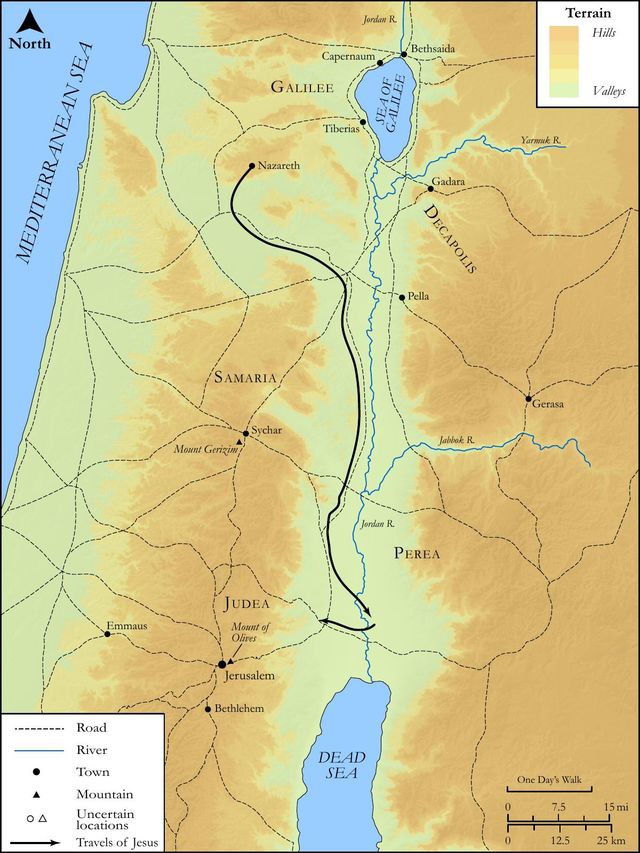
Nazareth was a small, obscure village in the region of Galilee, a northern district of Israel often looked down upon by those in Judea, particularly Jerusalem, as being less religiously pure or sophisticated. The dismissive question, "Can anything good come out of Nazareth?" (John 1:46), reflects this sentiment. Jesus' journey from Nazareth to the Jordan River was a significant undertaking, involving travel from the hills of Galilee down to the Jordan Valley. The Jordan River itself held deep historical and symbolic meaning for the Jewish people, being the boundary crossed by Joshua into the Promised Land (Joshua 3). It was also a place of ritual cleansing and prophetic activity, making it a fitting location for John's ministry of repentance and for the symbolic inauguration of Jesus' new covenant work. John's baptism was a unique movement, drawing large crowds and signifying a spiritual cleansing and readiness for God's impending intervention.
Key Themes
ShowHideMark 1:9 contributes significantly to several key themes in the Gospel of Mark and broader biblical theology. Firstly, it underscores the theme of Divine Initiative and Timing, as Jesus appears precisely when John's preparatory work has reached its zenith, demonstrating God's sovereign plan unfolding in history. Secondly, it highlights Jesus' Humility and Identification with humanity. Despite being sinless, Jesus submits to a baptism of repentance, aligning Himself with sinners to fulfill all righteousness (Matthew 3:15). This act foreshadows His ultimate identification with humanity in bearing their sins. Thirdly, the baptism marks the Inauguration of Jesus' Public Ministry, serving as the definitive starting point for His teaching, healing, and redemptive work. It is immediately followed by the descent of the Holy Spirit and the Father's affirmation (Mark 1:10-11), confirming His divine Sonship and messianic role.
Exposition and Analysis
ShowHideKey Word Analysis
ShowHideThis verb signifies motion, "to come or go," and is used broadly in the New Testament. In Mark 1:9, it emphasizes Jesus' deliberate and purposeful journey from Nazareth. It is not a casual arrival but a significant movement towards a specific destiny, highlighting His active participation in God's plan.
This term means "to immerse, submerge; to make whelmed (i.e. fully wet)." It describes the act performed by John, indicating a full immersion in water. This literal meaning is crucial for understanding the symbolism of baptism, representing a complete spiritual washing, burial of the old self, and rising to new life.
Refers to "the Jordanes," the primary river of Palestine. Its mention specifically locates the event and evokes its rich historical and symbolic significance as a boundary, a place of crossing, and a site associated with divine intervention and cleansing in Israel's history.
Verse Breakdown
ShowHide"And it came to pass in those days"
This introductory phrase sets the scene, indicating a continuation of the narrative flow from the preceding verses that describe John the Baptist's ministry. It implies a specific, divinely appointed moment within the broader historical context of John's work, emphasizing that Jesus' appearance was not random but part of a pre-ordained timeline.
"that Jesus came from Nazareth of Galilee"
This clause identifies Jesus' origin, highlighting His humble beginnings in a culturally overlooked region. His deliberate journey "from Nazareth" signifies His purposeful movement towards the place of His public inauguration, underscoring His intentionality in fulfilling His messianic calling.
"and was baptized of John in Jordan"
This is the central action of the verse, describing Jesus' submission to John's baptism. The phrase "of John" (meaning "by John") emphasizes John's role as the divinely appointed forerunner. The location "in Jordan" specifies the setting, imbuing the event with historical and symbolic weight as a place of cleansing and new beginnings. This act marks the definitive commencement of Jesus' public ministry.
Literary Devices
ShowHideMark's Gospel is characterized by its directness and action-oriented narrative, and Mark 1:9 exemplifies this with its concise yet impactful declaration. The verse employs Inauguration as a key literary device, serving as the explicit starting point for Jesus' public work. It acts as a narrative pivot, transitioning from John's preparatory ministry to Jesus' active presence. The mention of "Nazareth of Galilee" and "Jordan" utilizes Geographical Specificity, grounding the divine event in concrete, recognizable locations, making the narrative feel immediate and historically verifiable. Furthermore, the act of baptism itself is rich in Symbolism, representing purification, identification, and a new beginning, which, though not fully unpacked in this single verse, is powerfully evoked for the reader familiar with biblical themes. The brevity of the account, typical of Mark, also serves as a form of Narrative Economy, quickly moving to the core event and its immediate aftermath, maintaining a sense of urgency and forward momentum.
Theological and Thematic Connections
ShowHideJesus' baptism is a foundational event that deeply connects to core Christian doctrines. It is not merely a historical record but a profound theological statement about Jesus' identity, mission, and the nature of salvation. His willingness to be baptized, despite being sinless, demonstrates His perfect obedience to the Father's will and His profound solidarity with humanity. This act foreshadows His ultimate identification with sinners on the cross, where He would bear the full weight of humanity's sin. It also reveals the Trinitarian nature of God, as the Father's voice and the Spirit's descent immediately follow in the narrative, confirming Jesus' divine Sonship and empowering Him for His ministry. This event sets the stage for the new covenant, where cleansing and empowerment come not through ritual alone, but through the person and work of Christ.
Reflection and Application
ShowHideJesus' baptism in Mark 1:9 offers profound lessons for believers today, serving as a powerful model for our own walk of faith. His journey from Nazareth to the Jordan, and His willing submission to John's baptism, underscores the importance of obedience to God's call, even when it involves humility or seemingly unnecessary acts. For us, this translates into a commitment to follow Christ's example in all areas of life, embracing the path of righteousness that He laid out. His identification with humanity in baptism invites us to identify with Him—in His death, burial, and resurrection—through our own baptism, which serves as an outward declaration of an inward spiritual transformation. This event marks the beginning of Jesus' public ministry, reminding us that our own spiritual commitments often lead to a renewed sense of purpose and a call to service within God's Kingdom. Just as the Spirit descended upon Jesus, we too are empowered by the Holy Spirit for the work God has called us to do, enabling us to live lives that reflect His character and advance His purposes in the world.
Questions for Reflection
ShowHideFAQ
ShowHideWhy was Jesus, who was sinless, baptized for the remission of sins?
ShowHideJesus' baptism was not for the remission of His own sins, as He was entirely without sin (Hebrews 4:15). Instead, His baptism served several crucial purposes. Firstly, it was an act of profound humility and identification with humanity. By submitting to a baptism intended for sinners, Jesus demonstrated His solidarity with the very people He came to save, embracing their condition to redeem them. Secondly, as Matthew's Gospel records, Jesus stated it was "to fulfill all righteousness" (Matthew 3:15). This meant fulfilling prophetic expectations, endorsing John's legitimate ministry, and inaugurating His own messianic work in perfect obedience to the Father's will. It was a public declaration of His mission and an anointing for His ministry, marked by the descent of the Holy Spirit and the Father's affirmation (Mark 1:10-11).
What is the significance of the Jordan River as the location for Jesus' baptism?
ShowHideThe Jordan River holds deep historical and symbolic significance in Jewish tradition, making it a fitting location for Jesus' baptism. It was the geographical boundary that the Israelites crossed to enter the Promised Land under Joshua's leadership (Joshua 3), symbolizing a new beginning and entrance into God's covenant promises. In the time of John the Baptist, it was also a place associated with prophetic activity and ritual cleansing. By being baptized in the Jordan, Jesus implicitly connected His ministry to the historical narrative of Israel, signaling a new exodus and a new covenant. It underscored the continuity of God's redemptive plan while simultaneously inaugurating a new phase of that plan through His own person and work.
Christ-Centered Fulfillment
ShowHideJesus' baptism in Mark 1:9 is a foundational Christ-centered event, not merely a historical detail, but a profound foreshadowing and inauguration of His redemptive work. His journey from Nazareth and submission to John's baptism powerfully illustrates His voluntary identification with humanity and sinful flesh, even though He Himself was sinless (2 Corinthians 5:21). This act of humility and solidarity prefigures His ultimate identification with humanity on the cross, where He would bear the full weight of the world's sin, becoming the Lamb of God who takes away sin (John 1:29). The descent of the Holy Spirit and the Father's affirmation immediately following the baptism (Mark 1:10-11) confirm His divine Sonship and messianic anointing, empowering Him for the ministry that would culminate in His death and resurrection. Thus, Jesus' baptism is the public inauguration of the One who would provide the true and ultimate cleansing, not merely through water, but through His sacrificial blood, offering new life and the indwelling Spirit to all who believe (Romans 6:3-4).