


Mark 1:10
- καὶkaiAndG2532CONJConjunction
- εὐθὺςeuthusimmediatelyG2112ADVAdverb
- ἀναβαίνωνanabainōngoing upG305V-PAP-NSMVerb Present Active Participle Nominative Singular Masculine
- ἐκekfromG1537PREPPreposition
- τοῦtoutheG3588T-GSNDefinite article Genitive Singular Neuter
- ὕδατοςhudatoswaterG5204N-GSNNoun Genitive Singular Neuter
- εἶδενeidenhe sawG1492V-2AAI-3SVerb 2nd Aorist Active Indicative 3rd Singular
- σχιζομένουςschizomenoustearing openG4977V-PPP-APMVerb Present Passive Participle Accusative Plural Masculine
- τοὺςtoustheG3588T-APMDefinite article Accusative Plural Masculine
- οὐρανοὺςouranousheavensG3772N-APMNoun Accusative Plural Masculine
- καὶkaiandG2532CONJConjunction
- τὸtotheG3588T-ASNDefinite article Accusative Singular Neuter
- πνεῦμαpneumaSpiritG4151N-ASNNoun Accusative Singular Neuter
- ὡςhōsasG5613PRTParticle or Disjunctive
- περιστερὰνperisterana doveG4058N-ASFNoun Accusative Singular Feminine
- καταβαῖνονkatabainondescendingG2597V-PAP-ASNVerb Present Active Participle Accusative Singular Neuter
- εἰςeisuponG1519PREPPreposition
- αὐτόν·autonHimG846P-ASMPersonal pronoun Accusative Singular Masculine
English is a literal word-by-word gloss of the Greek, not the KJV's wording. Why?
This is the original text the KJV's translators worked from — each Greek word with its own literal English meaning in this verse, prepared by scholars at Tyndale House, Cambridge. The KJV translates whole sentences, not word by word, so its wording differs: one Greek word can become several English words, and the KJV may choose “charity” where the gloss reads “love”. Both are faithful — they answer different questions. For the KJV's own rendering, switch to the KJV text.
Details
See on the biblical-era map
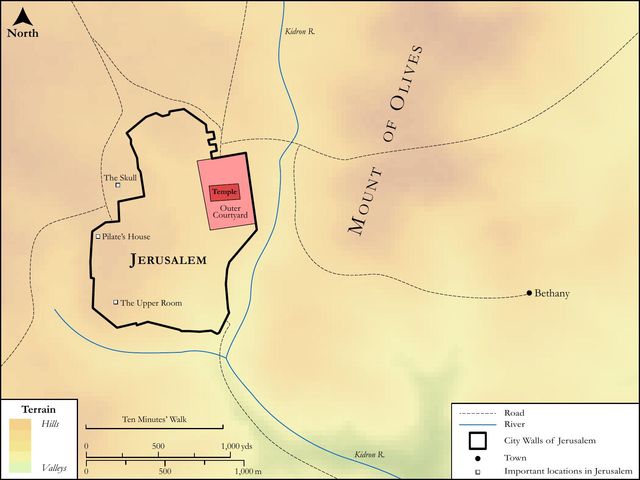
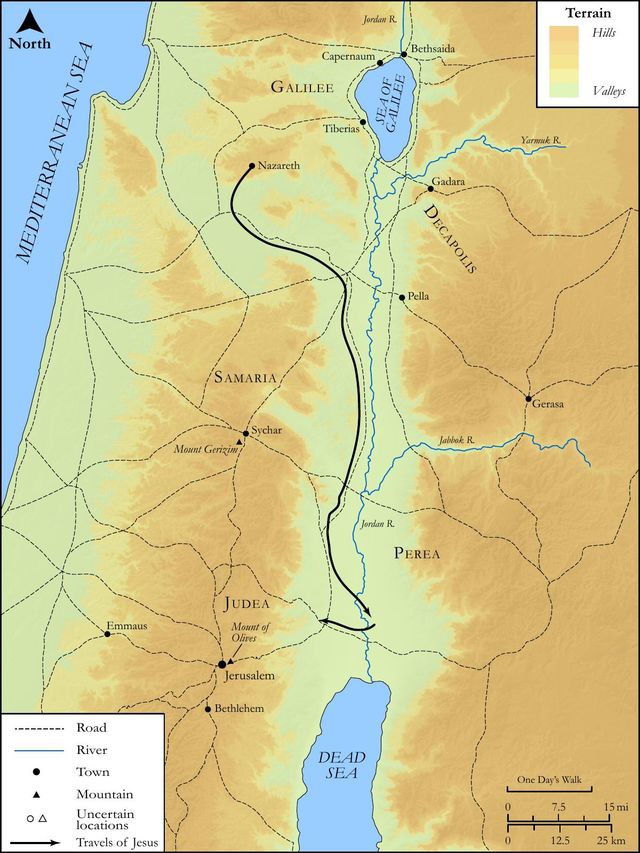
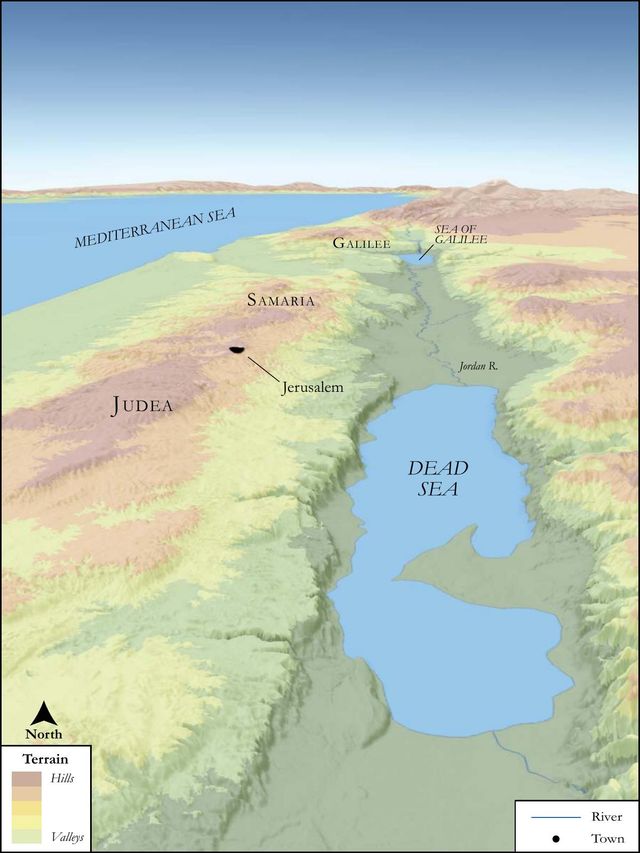
Study this verse
Public-domain commentary
Matthew Henry
From his Commentary on the Whole Bible. Henry comments on passages, not single verses — this entry covers Mark 1:9–13. His three-level outline is real structure in the source text, so it is rendered as structure.
We have here a brief account of Christ's baptism and temptation, which were largely related Mt. 3 and 4.
I.His baptism, which was his first public appearance, after he had long lived obscurely in Nazareth.
O how much hidden worth is there, which in this world is either lost in the dust of contempt and cannot be known, or wrapped up in the veil of humility and will not be known! But sooner or later it shall be known, as Christ's was.
1.See how humbly he owned God, by coming to be baptized of John; and thus it became him to fulfil all righteousness. Thus he took upon him the likeness of sinful flesh, that, though he was perfectly pure and unspotted, yet he was washed as if he had been polluted; and thus for our sakes he sanctified himself, that we also might be sanctified, and be baptized with him, Joh 17:19.
2.See how honourably God owned him, when he submitted to John's baptism. Those who justify God, and they are said to do, who were baptized with the baptism of John, he will glorify, Luk 7:29, Luk 7:30.
(1.)He saw the heavens opened; thus he was owned to be the Lord from heaven, and had a glimpse of the glory and joy that were set before him, and secured to him, as the recompence of his undertaking. Matthew saith, The heavens were opened to him. Mark saith, He saw them opened. Many have the heavens opened to receive them, but they do not see it; Christ had not only a clear foresight of his sufferings, but of his glory too.
(2.)He saw the Spirit like a dove descending upon him. Note, Then we may see heaven opened to us, when we perceive the Spirit descending and working upon us. God's good work in us is the surest evidence of his good will towards us, and his preparations for us. Justin Martyr says, that when Christ was baptized, a fire was kindled in Jordan: and it is an ancient tradition, that a great light shone round the place; for the Spirit brings both light and heat.
(3.)He heard a voice which was intended for his encouragement to proceed in his undertaking, and therefore it is here expressed as directed to him, Thou art my beloved Son. God lets him know, [1.] That he loved him never the less for that low and mean estate to which he had now humbled himself; "Though thus emptied and made of no reputation, yet he is my beloved Son still." [2.] That he loved him much the more for that glorious and kind undertaking in which he had now engaged himself. God is well pleased in him, as referee of all matters in controversy between him and man; and so well pleased in him, as to be well pleased with us in him.
II.His temptation.
The good Spirit that descended upon him, led him into the wilderness, Mar 1:12. Paul mentions it as a proof that he had his doctrine from God, and not from man - that, as soon as he was called, he went not to Jerusalem, but went into Arabia, Gal 1:17. Retirement from the world is an opportunity of more free converse with God, and therefore must sometimes be chosen, for a while, even by those that are called to the greatest business. Mark observes this circumstance of his being in the wilderness - that he was with the wild beasts. It was an instance of his Father's care of him, that he was preserved from being torn in pieces by the wild beasts, which encouraged him the more that his Father would provide for him when he was hungry. Special protections are earnests of seasonable supplies. It was likewise an intimation to him of the inhumanity of the men of that generation, whom he was to live among - no better than wild beasts in the wilderness, nay abundantly worse. In that wilderness,
1.The evil spirits were busy with him; he was tempted of Satan; not by any inward injections (the prince of this world had nothing in him to fasten upon), but by outward solicitations. Solicitude often gives advantages to the tempter, therefore two are better than one. Christ himself was tempted, not only to teach us, that it is no sin to be tempted, but to direct us whither to go for succour when we are tempted, even to him that suffered, being tempted; that he might experimentally sympathize with us when we are tempted.
2.The good spirits were busy about him; the angels ministered to him, supplied him with what he needed, and dutifully attended him. Note, The ministration of the good angels about us, is matter of great comfort in reference to the malicious designs of the evil angels against us; but much more doth it befriend us, to have the indwelling of the spirit in our hearts, which they that have, are so born of God, that, as far as they are so, the evil one toucheth them not, much less shall be triumph over them.
Historical interpretation
Five Centuries of Reception
14 surviving comments on this verse. Each one is dated, so this reads as a timeline rather than a list.
Select a marker to jump to its quote. Markers stagger vertically where authors wrote within a few decades of each other.
Mark the Evangelist, like a hart, longing after the fountains of water, leaps forward over places, smooth and steep; and, as a bee laden with honey, he sips the tops of the flowers. Wherefore he hath shown us in his narrative Jesus coming from Nazareth, saying, And it came to pass in those days, &c.
But this is the anointing of Christ according to the flesh, namely, the Holy Ghost, of which anointing it is said, God, even thy God, hath anointed thee with the oil of gladness above thy fellows. (Ps. 45:8)
Again, the Holy Ghost came down in the shape of a dove, because in the Canticles it is sung of the Church: (Cant. passim.) My bride, my love, my beloved, my dove. Bride in the Patriarchs, love in the Prophets, near of kin in Joseph and Mary, beloved in John the Baptist, dove in Christ and His Apostles: to whom it is said, Be ye wise as serpents, and harmless as doves. (Mat. 10:16)
Morally also it may be interpreted; we also, drawn aside from the fleeting world by the smell and purity of flowers, run with the young maidens after the bridegroom, (v. Cant. 1:2. 3.) and are washed in the sacrament of baptism, from the two fountains of the love of God, and of our neighbour, by the grace of remission, and mounting up by hope gaze upon heavenly mysteries with the eyes of a clean heart. Then we receive in a contrite and lowly spirit, with simplicity of heart, the Holy Spirit, who comes down to the meek, and abides in us, by a never-failing charity. And the voice of the Lord from heaven is directed to us the beloved of God; Blessed are the peacemakers, for they shall be called the sons of God; (Matt. 5:9) and then the Father, with the Son and the Holy Spirit, is well-pleased with us, when we are made one spirit with God.
The Holy Spirit came in the form of a dove in order that the nature of the Holy Spirit might be made plain by means of a creature of utter simplicity and innocence. For the dove’s body has no gall in it. So after the deluge, by which the iniquity of the old world was purged away, after, so to speak, the baptism of the world, the dove as herald proclaimed to the earth the tempering of the wrath of heaven—sent forth from the ark and returning with an olive branch, which is a sign of peace among the nations.
Do you see, beloved, how many and how great blessings we would have lost if the Lord had yielded to the exhortation of John and declined baptism? For the heavens had been shut before this. The region above was inaccessible. We might descend to the lower parts, but not ascend to the upper. So it happened not only that the Lord was being baptized—he also was making new the old creation. He was bringing the alienated under the scepter of adoption. For straightway “the heavens were opened to him.” A reconciliation took place between the visible and the invisible. The celestial orders were filled with joy, the diseases of earth were healed, secret things made known, those at enmity restored to amity. For you have heard the word of the Evangelist, saying, “The heavens were opened to him,” on account of three wonders. At the baptism of Christ the Bridegroom, it was fitting that the heavenly chamber should open its glorious gates. So when the Holy Spirit descended in the form of a dove, and the Father’s voice spread everywhere, it was fitting that “the gates of heaven should be lifted up.”
A dove—a tame, innocent and simple bird. Hence we are taught to copy the innocence of doves.
And stretching forth slowly his right hand, which seemed both to tremble and to rejoice, John baptized the Lord. Then his detractors who were present, with those in the vicinity and those from a distance, connived together, and spoke among themselves asking: “Was John then superior to Jesus? Was it without cause that we thought John greater, and does not his very baptism attest this? Is not he who baptizes presented as the greater, and he who is baptized as the less important?” But just as they, in their ignorance of the mystery of the divine economy, babbled about with each other, the holy One who alone is Lord spoke. He who by nature is the Father of the only begotten (who alone was begotten in unblemished fashion) instantly rectified their blunted imaginations. He opened the gates of the heavens and sent down the Holy Spirit in the form of a dove, lighting upon the head of Jesus, pointing him out right there as the new Noah, even the maker of Noah, and the good pilot of the nature which is in shipwreck. And he himself calls with clear voice out of heaven, and says: “This is my beloved Son,”—Jesus, not John: the One baptized, and not the one baptizing; the One who was begotten of me before all time, and not the one who was begotten of Zechariah; the One who was born of Mary after the flesh, and not the one who was brought forth by Elizabeth beyond all expectation; the One who was the fruit of the virginity which he yet preserved intact, not the one who was the shoot from a sterility removed; the One who had his encounter with you, and not the one brought up in the wilderness. This is my beloved Son, in whom I am well pleased: my Son, of the same substance with myself, and not of a different; of the same essence with me according to what is unseen, and of the same essence with you according to what is seen, yet without sin.
Christ descended, and John stood who was baptizing, and behold, as if a dove the Holy Spirit descended. It was not a dove that descended, but as if a dove. Remember what I said: Christ took on flesh, not like flesh; but he took on the truth of that flesh, true flesh Christ took on: But the Holy Spirit did not descend in the truth of a dove, but in the likeness of a dove from heaven. Therefore, John saw and believed.
Christ descended, the Holy Spirit descended as well. Why did Christ descend first, and then the Holy Spirit, when the form and use of baptism require that the font be consecrated before and then the one to be baptized descends? For when the priest first enters, he performs the exorcism according to the nature of water, then he offers the invocation and prayer, so that the font may be sanctified and the presence of the eternal Trinity may be present: but Christ descended before, and then the Spirit followed. By what reasoning? So that the Lord Jesus Himself would not appear to need the mystery of sanctification, but rather that He Himself would sanctify, and that the Spirit would sanctify as well.
But why in the form of a dove? The dove is a gentle and pure creature. Since then the Spirit, too, is “a Spirit of gentleness,” he appears in the form of a dove, reminding us of Noah, to whom, when once a common disaster had overtaken the whole world and humanity was in danger of perishing, the dove appeared as a sign of deliverance from the tempest, and bearing an olive branch, published the good tidings of a serene presence over the whole world. All these things were given as a type of things to come.… In this case the dove also appeared, not bearing an olive branch, but pointing to our Deliverer from all evils, bringing hope filled with grace. For this dove does not simply lead one family out of an ark, but the whole world toward heaven at her appearing. And instead of a branch of peace from an olive tree, she conveys the possibility of adoption for all the world’s offspring in common. THE GOSPEL OF ST.
Those who receive the baptism of Christ need not seek the baptism of John. Those who received the baptism of John did indeed seek the baptism of Christ.… No baptism was necessary for Christ, but he freely received the baptism of a servant (John) to draw us toward his baptism.
Why did the Son of God appear as a man and the Holy Spirit as a dove? Because the Son of God came to show humanity a pattern for living, whereas the Holy Spirit made his appearance to bestow the gift which enables excellent living. Moreover, both appearances surely came in a visible manner for the sake of carnal eyes. For we must pass by degrees through the visible sacraments from those things which are seen with the physical eyes to those things which are understood spiritually by the mind. For human words make a sound and then pass away. But when the divine Word is expressed, that which is signified by the words does not pass away.
The dove is not for sale; it is given gratis. Hence it is called grace.
(Vict. Ant. e Cat. in Marc.) Forasmuch as He was ordaining a new baptism, He came to the baptism of John, which, in respect of His own baptism, was incomplete, but different from the Jewish baptism, as being between both. He did this that He might show, by the nature of His baptism, that He was not baptized for the remission of sins, nor as wanting the reception of the Holy Ghost: for the baptism of John was destitute of both these. But He was baptized that He might be made known to all, that they might believe on Him and fulfil all righteousness, which is keeping of the commandments: for it had been commanded to men that they should submit to the Prophet's baptism.
(Vict. Ant. e Cat. in Marc.) Or else, that from heaven sanctification might be given to men, and earthly things be joined to heavenly. But the Holy Spirit is said to have descended upon Him, not as if He then first came to Him, for He never had left Him; but that He might show forth the Christ, Who was preached by John, and point Him out to all, as it were by the finger of faith.
And immediately ascending out of the water He saw the heavens opened, etc. The mystery of the Trinity is demonstrated in the baptism of the Lord. The Lord is baptized, the Spirit descends in the form of a dove, and the voice of the Father bearing witness to the Son is heard. The heavens are opened, not by the unbinding of elements, but by spiritual eyes, with which Ezekiel too at the beginning of his book recalls them as opened. Also, a dove sat upon Jesus' head, lest anyone should think that the voice of the Father was made to John, and not to the Lord. Rightly did it say: And the Spirit like a dove descending, and added, and remaining on Him. For this indeed is the special gift conferred upon the Mediator of God and men, that the Holy Spirit, once filling Him, should never depart but remain perpetual in Him. For to His faithful, for the performance of notable virtues and miracles, the grace of the Spirit is sometimes given, sometimes withdrawn. Yet it is never absent to them for the work of piety and justice, for maintaining the love of God and neighbor. Hence of that Spirit it is promised, the Lord saying to them: You know Him because He will remain with you and be in you (John 14). But in the Lord particularly, the Spirit remains always, not as in His elect according to the measure of faith, but as John says: We have seen His glory, the glory as of the Only Begotten of the Father, full of grace and truth (John 1). But the Spirit remains in Him, not from the time only when He was baptized in the Jordan, but rather from the time when He was conceived in the virginal womb. For that the Spirit appeared to descend upon Him at His baptism was a sign of the spiritual grace to be conferred upon us in baptism, to those regenerated from water and the Spirit for the remission of sins, the fuller grace of the same Spirit is customarily given by the heavenly imposition of the bishop's hand. Also, the fact that He saw the heavens opened after baptism, was done for our benefit, by which the gate of the heavenly kingdom is opened through the washing of the regenerating water, which was closed to the whole human race, with cherubim and a flaming sword interposed, when the first parents sinned and were driven from paradise. For this flame is quenched for each faithful person, when he is dipped into the vital waters. He is reconciled to the angelic spirits, when he returns to the peace of his Creator, so that if he keeps the sacraments of faith with a pure heart and body, he may soon, loosed from the flesh, enter the heavenly kingdom. Otherwise, how then were the heavens opened to the Lord, who, when He became man and dwelt with us on earth, equally contained heaven and earth by divine power? But also, the paternal voice was revealed from heaven: You are My beloved Son, in You I am well pleased, not teaching the Son what He did not know, but showing to us what we should believe: that He who came to be baptized with others by John was indeed the true Son of God; not only the Lord of John but of the whole world, and therefore truly able to baptize in the Holy Spirit. The same voice also taught us that by the water of purification and the Spirit of sanctification we could be made sons of God. For as many as received Him, He gave them power to become sons of God (John 1). Also, the Holy Spirit descended in the form of a dove, because it is a very simple animal, and alien to the malice of gall, to figuratively suggest to us that He seeks simple hearts, and does not deign to dwell in impure minds, as was Simon to whom Peter said: You have neither part nor lot in this matter; for I see that you are in the gall of bitterness and in the bond of iniquity (Acts 8).
(in Marc. i. 4) He was baptized, that by being baptized Himself He might show His approval of John's baptisme, and that, by sanctifying the waters of Jordan through the descent of the dove, He might show the coming of the Holy Ghost in the laver of believers; whence there follows, And straightway coming up out of the water, he saw the heavens opened, and the Holy Spirit like a dove descending, and resting upon him. But the heavens are opened, not by the unclosing of the elements, but to the eyes of the spirit, to which Ezekiel in the beginning of his book relates that they were opened; (Ezek. 1.) or this His seeing the heavens opened after baptism was done for our sakes, to whom the door of the kingdom of heaven is opened by the laver of regeneration.
(ubi sup.) This event also, in which the Holy Ghost was seen to come down upon baptism, was a sign of spiritual grace to be given to us in baptism.
(ubi sup.) Well indeed in the shape of a dove did the Holy Ghost come down, for it is an animal of great simplicity, and far removed from the malice of gall, that in a figure He might show us that He looks out for simple hearts, and deigns not to dwell in the minds of the wicked.
(ubi sup.) Now the Dove sat on the head of Jesus, lest any one should think that the voice of the Father was addressed to John and not to Christ. And well did he add, abiding on Him; for this is peculiar to Christ, that the Holy Ghost once filling Him should never leave Him. For sometimes to His faithful disciples the grace of the Spirit is conferred for signs of virtue, and for the working of miracles, sometimes it is taken away; though for the working of piety and righteousness, for the preservation of love to God and to one's neighbour, the grace of the Spirit is never absent. But the voice of the Father showed, that He Himself, who came to John to be baptized with the others, was the very Son of God, willing to baptize with the Holy Spirit, whence there follows, And there came a voice from heaven, Thou art my beloved Son, in thee I am well pleased. Not that this informed the Son Himself of a thing of which He was ignorant, but it shows to us what we ought to believe.
(ubi sup.) The same voice has taught us, that we also, by the water of cleansing, and by the Spirit of sanctification, may be made the sons of God. The mystery of the Trinity also is shown forth in the baptism; the Son is baptized, the Spirit comes down in the shape of a dove, the voice of the Father bearing witness to the Son is heard.
The image of a dove is placed before us by God so that we may learn the simplicity favored by him. So let us meditate on the nature of the dove, that from each one of its features of innocence we may learn the principles of a more becoming life. The dove is a stranger to malice. So may all bitterness, anger and indignation be taken away from us, together with all malice. The dove injures nothing with its mouth or talons, nor does it nourish itself or its young on tiny mice or grubs, as do almost all smaller birds. Let us see that our teeth are not weapons and arrows.
Continue studying Mark 1:10 across the web’s major study libraries — every link below opens this exact verse, chapter, or book on the destination site.
Read & Compare
 BibleGatewayThis verse in more than 200 translations and 70 languages.
 Bible.comThe YouVersion reader — hundreds of translations, reading plans, and highlights.
 ESV.orgCrossway's official English Standard Version reader.
 NET BibleThe NET translation with 60,000+ translators' notes on every rendering decision.
 STEP BibleTyndale House's free study tool — original text, vocabulary, and scholarly resources.
 BibliaLogos Bible Software's free web reader.
 USCCBThe New American Bible (Revised Edition) with the U.S. bishops' study notes.
Commentaries
 BibleHub CommentariesDozens of classic commentaries on this verse, gathered on one page.
 StudyLightMore than 100 commentary sets — the largest collection on the web.
 BibleRefPlain-English commentary on what this verse means, verse by verse.
 Enduring WordDavid Guzik's free commentary on this chapter, widely used by Bible teachers.
 Bible Study ToolsVerse commentary alongside Greek and Hebrew study aids.
Original Language & Research
- BibleHub InterlinearThe verse word by word — original language, transliteration, and English.
- BibleHub LexiconEvery word's original-language definition and Strong's entry.
 Blue Letter BibleDeep-study tools — Strong's numbers, concordance, and word studies.
 CNTR CollationThe earliest Greek manuscripts of this verse, collated letter by letter.
Sermons, Hymns & Audio


TrulyRandomVerse is not affiliated with these sites and doesn’t control their content. They’re linked because they’re genuinely useful.
Summary
Mark 1:10 captures a pivotal moment immediately following Jesus' baptism in the Jordan River: a profound divine affirmation of His identity and mission. As Jesus emerged from the water, He experienced a dramatic opening of the heavens and witnessed the Holy Spirit descending upon Him in a visible, tangible form, appearing "like a dove." This event serves as a powerful inauguration of Jesus' public ministry, signaling His divine anointing and the Father's approval.
Context
ShowHideLiterary Context
This verse is the immediate successor to Jesus' baptism by John the Baptist. In Mark's Gospel, which is characterized by its swift narrative pace, this event quickly follows John's preparatory ministry of preaching repentance and baptism for the forgiveness of sins (Mark 1:4). The sequence of John's ministry, Jesus' baptism, and the divine affirmation in Mark 1:10-11 serves as the foundational prologue to Jesus' public ministry, setting the stage for His subsequent call of disciples, teaching, and miracles. It is the divine stamp of approval before Jesus embarks on His mission.
Historical & Cultural Context
Baptism, while practiced by John in a unique way, had roots in Jewish ritual washings (mikvah) for purification and conversion, signifying a new start or dedication. John's baptism, however, was distinct as a "baptism of repentance for the forgiveness of sins," preparing the way for the Messiah. The expectation of a Messiah was high in first-century Judaism, and many believed God would intervene dramatically in history. The imagery of "heavens opened" and the Spirit's descent would have resonated with Old Testament prophetic expectations of divine intervention and anointing, such as in Isaiah 64:1 where the prophet cries out for God to "rend the heavens." The dove, while not a common messianic symbol, evokes purity, peace, and the Spirit's presence in creation (Genesis 1:2) and the new beginning after the flood (Genesis 8:8-12).
Key Themes
ShowHideMark 1:10 powerfully contributes to several key themes in Mark's Gospel and broader biblical theology. Firstly, it highlights Divine Affirmation and Sonship, as the Father's voice in the subsequent verse (Mark 1:11) explicitly declares Jesus as His beloved Son, a theme central to Mark's portrayal of Jesus' identity. Secondly, it underscores the Holy Spirit's Anointing and Empowerment for ministry, signifying that Jesus' subsequent works were not merely human but divinely enabled. This anointing is crucial for understanding Jesus' authority and power throughout His ministry. Thirdly, the scene offers a foundational Trinitarian Revelation, presenting Jesus the Son, the Holy Spirit, and God the Father (implied by the voice) in distinct yet unified action, setting the stage for a deeper understanding of God's nature. Finally, it serves as the Inauguration of Jesus' Public Ministry, marking the transition from His private life to His active role as the Messiah, fulfilling the prophetic expectations.
Exposition and Analysis
ShowHideKey Word Analysis
ShowHideThis adverb, frequently used by Mark (over 40 times), emphasizes immediacy, urgency, and rapid progression. In Mark 1:10, it highlights the instantaneous nature of the divine manifestation following Jesus' emergence from the water, underscoring the direct and swift action of God in initiating Jesus' ministry. It sets a brisk pace for the entire Gospel narrative.
While often translated as "opened," the Greek verb schízō carries a stronger connotation of "torn asunder," "split," or "ripped open." This is not a gentle opening but a forceful, dramatic rending of the heavens, indicating a powerful, even violent, divine intervention that breaks through the natural order. It signifies God's direct and undeniable intrusion into human history, revealing His presence and purpose.
This term refers to "a current of air," "breath," or "breeze," but in a theological context, it denotes the Holy Spirit, the third person of the Godhead. Here, it signifies the divine power and presence that descends upon Jesus, anointing Him for His messianic task. The Spirit's descent is a visible manifestation of divine empowerment, essential for Jesus' ministry of teaching, healing, and ultimately, salvation.
Verse Breakdown
ShowHide"And straightway coming up out of the water,"
This phrase immediately connects the divine manifestation to Jesus' baptism. The "straightway" (Greek euthéōs) emphasizes the immediacy of the event, indicating that the heavenly revelation was directly consequent to His emergence from the waters of baptism. It suggests a divine response to His act of identification with humanity and His commitment to fulfill all righteousness, even though He was sinless.
"he saw the heavens opened,"
This clause describes Jesus' personal experience of a dramatic celestial event. The "heavens opened" (Greek schizomenous) conveys a powerful, forceful tearing apart of the sky, not merely a gentle parting. This is a visual sign of God breaking through the barrier between the divine and human realms, signaling a direct communication and intervention from God to Jesus. It is a moment of profound revelation, where the spiritual reality becomes visibly manifest.
"and the Spirit like a dove descending upon him:"
This final clause identifies the content of the heavenly vision: the Holy Spirit. The Spirit's descent is described as being "like a dove," a simile that evokes images of purity, peace, gentleness, and perhaps new creation, reminiscent of the dove in Noah's ark story. The Spirit "descending upon him" signifies a divine anointing and empowerment for Jesus' messianic ministry, marking Him as the one uniquely chosen and equipped by God for His redemptive mission.
Literary Devices
ShowHideMark 1:10 is rich in Symbolism and Theophany. The "heavens opened" is a powerful symbol of divine revelation and intervention, signifying God's direct communication and breaking into the earthly realm. The Symbolism of the "Spirit like a dove" is multi-layered, evoking purity, peace, and the gentle yet powerful presence of God, contrasting with more fiery Old Testament manifestations of God's Spirit. It also subtly hints at new creation and a new covenant, much like the dove bringing an olive branch after the flood. This entire scene is a Theophany, a visible manifestation of God, specifically a Trinitarian Theophany as it involves Jesus (the Son), the Holy Spirit (as a dove), and the voice of God (the Father) in the subsequent verse. Mark's characteristic use of Immediacy through the adverb "straightway" (Greek euthéōs) also functions as a literary device, propelling the narrative forward and emphasizing the swift, decisive action of God in inaugurating Jesus' ministry.
Theological and Thematic Connections
ShowHideMark 1:10 is a foundational text for understanding the identity of Jesus and the nature of God. It presents a profound Trinitarian moment, where the Son is baptized, the Spirit descends, and the Father speaks (in the following verse), revealing the distinct persons within the unified Godhead. This event marks Jesus' anointing as the Messiah, empowered by the Holy Spirit for His public ministry. It signifies that Jesus' authority and power derive directly from God, affirming His divine sonship and setting the stage for His redemptive work. The "opened heavens" symbolize the breaking down of the barrier between God and humanity, a theme that will culminate in Jesus' death and resurrection, opening the way for all to approach God.
Reflection and Application
ShowHideMark 1:10 offers profound insights for the believer's journey. Just as Jesus received divine affirmation and empowerment at the outset of His ministry, so too are believers called to live in the knowledge of God's love and empowering presence. Through faith in Christ, we are adopted as children of God, receiving a spiritual affirmation that mirrors the Father's declaration over Jesus. The descent of the Holy Spirit on Jesus foreshadows the indwelling of the Spirit in every believer after Pentecost, equipping us for service, witness, and a life that honors God. This passage encourages us to be attentive to the ways God reveals Himself and empowers us for His purposes in our daily lives, reminding us that our spiritual journey is not one of self-reliance but of divine partnership. It calls us to recognize the active presence of the Triune God in our world and to respond to His call with faith and obedience, just as Jesus did.
Questions for Reflection
ShowHideFAQ
ShowHideWhy did the Spirit descend "like a dove" and not in another form?
ShowHideThe imagery of the dove is highly symbolic and carries multiple layers of meaning. Unlike more dramatic manifestations of God's presence (e.g., fire, wind), the dove suggests gentleness, purity, and peace. It may harken back to the dove in the Noahic flood narrative (Genesis 8:8-12), symbolizing a new creation and a new beginning after judgment. The dove also represents innocence and sacrifice in Jewish tradition. Its gentle descent emphasizes the peaceful, pure, and life-giving nature of the Holy Spirit's anointing upon Jesus, signifying a new era of God's redemptive work.
What is the significance of "the heavens opened" at Jesus' baptism?
ShowHideThe phrase "the heavens opened" (Greek schízō, meaning "torn asunder" or "ripped open") signifies a dramatic and forceful divine intervention. It is not merely a poetic image but a literal rending of the sky, indicating that God Himself is breaking through the barrier between the divine and human realms. This powerful act reveals God's direct presence and communication, marking a moment of profound revelation. It suggests that the long silence since the Old Testament prophets has ended, and God is now actively initiating His redemptive plan through His Son, Jesus. It also fulfills prophetic longings for God to "rend the heavens and come down" (Isaiah 64:1).
Christ-Centered Fulfillment
ShowHideMark 1:10, though brief, is a foundational Christ-centered moment. Jesus' baptism and the subsequent divine affirmation establish His identity as the unique Son of God, empowered by the Holy Spirit for His messianic mission. This event is not merely a personal experience for Jesus but a public inauguration of His redemptive work. The descent of the Spirit "like a dove" signifies His anointing as the Christ (the Anointed One), fulfilling Old Testament prophecies of a Spirit-anointed Messiah who would bring justice and salvation (Isaiah 42:1). This anointing empowers Jesus for every aspect of His ministry—His teaching with authority, His miraculous healings, His confrontation with demonic forces, and ultimately, His sacrificial death and resurrection. The "heavens opened" foreshadows the tearing of the temple veil at Jesus' crucifixion (Mark 15:38), signifying that through Christ, the way to God is now fully opened for all humanity. This moment at the Jordan prefigures the ultimate outpouring of the Holy Spirit at Pentecost (Acts 2:1-4), where the same Spirit that empowered Christ now indwells believers, uniting them to Him and empowering them to continue His mission in the world, embodying the very life and power of the resurrected Lord.