


2 Kings 5:10
Bible text: King James Version (1769 Blayney text) · Public domain
Bible text: King James Version with Strong's numbers · Public domain
Bible text: Berean Standard Bible · Public domain
Bible text: American Standard Version (1901) · Public domain
Bible text: World English Bible, Messianic edition · Public domain
Bible text: Geneva Bible (1599) · Public domain
Bible text: Young's Literal Translation · Public domain
- וַיִּשְׁלַחvai·yish·Lachand he sentH7971Conj-w ¦ V-Qal-ConsecImperf-3msVerb Qal Consecutive Imperfect 3rd Singular Masculineוַandיִּשְׁלַחhe sent
- אֵלָיו'e·Lavto himH413Prep ¦ 3msPrepositionאֵלָיtoוhim
- אֱלִישָׁע'e·li·Sha'ElishaH477N-proper-mNoun Proper Masculine
- מַלְאָךְmal·'Akha messengerH4397N-msNoun Singular Masculine Absolute
- לֵאמֹרle·Mor<to> sayingH559Prep-l ¦ V-Qal-InfVerb Qal Infinitive Constructלֵ<to>אמֹרsaying
- הָלוֹךְha·LokhgoH1980V-Qal-InfAbsVerb Qal Infinitive Absolute
- וְרָחַצְתָּve·ra·chatz·Taand you will washH7364Conj-w ¦ V-Qal-ConsecPerf-2msVerb Qal Consecutive Perfect 2nd Singular Masculineוְandרָחַצְתָּyou will wash
- שֶׁבַעshe·va'sevenH7651N-csNoun Singular common gender Absolute
- פְּעָמִיםpe·'a·MimtimesH6471N-mpNoun Plural Masculine Absolute
- בַּיַּרְדֵּןbai·yar·Denin the JordanH3383Prep-b ¦ N-properNoun Proper Locationבַּin theיַּרְדֵּןJordan
- וְיָשֹׁבve·ya·Shoand it may returnH7725Conj-w ¦ V-Qal-Imperf-3msVerb Qal Imperfect 3rd Singular Masculineוְandיָשֹׁבit may return
- בְּשָׂרְךָbe·sa·re·Khayour fleshH1320N-msc ¦ 2msNoun Singular Masculine Constructבְּשָׂרְfleshךָyour
- לְךָle·Khato youPrep-l ¦ 2msSuffix Personal 2nd Singular Masculineלְtoךָyou
- וּטְהָרu·te·Harand be cleanH2891Conj-w ¦ V-Qal-Imp-2msVerb Qal Imperative 2nd Singular Masculineוּandטְהָרbe clean
English is a literal word-by-word gloss of the Hebrew, not the KJV's wording. Why?
This is the original text the KJV's translators worked from — each Hebrew word with its own literal English meaning in this verse, prepared by scholars at Tyndale House, Cambridge. The KJV translates whole sentences, not word by word, so its wording differs: one Hebrew word can become several English words, and the KJV may choose “the LORD” where the gloss reads “Yahweh”. Both are faithful — they answer different questions. For the KJV's own rendering, switch to the KJV text.
Details
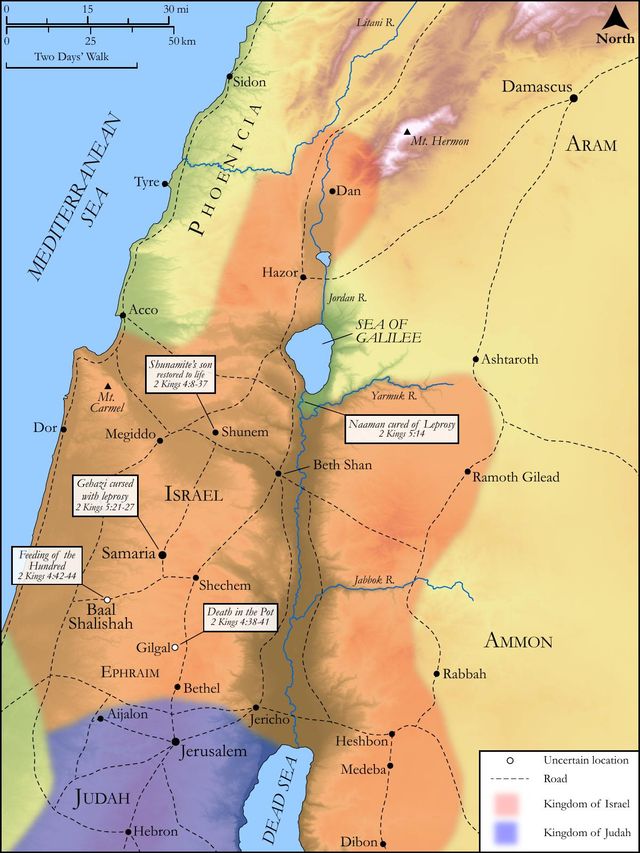
See on the biblical-era map
Study this verse
Public-domain commentary
Matthew Henry
From his Commentary on the Whole Bible. Henry comments on passages, not single verses — this entry covers 2 Kings 5:9–14. His three-level outline is real structure in the source text, so it is rendered as structure.
We have here the cure of Naaman's leprosy.
I.The short and plain direction which the prophet gave him, with assurance of success.
Naaman designed to do honour to Elisha when he came in his chariot, and with all his retinue, to Elisha's door, Kg2 5:9. Those that showed little respect to prophets at other times were very complaisant to them when they needed them. He attended at Elisha's door as a beggar for an alms. Those that would be cleansed from the spiritual leprosy must wait at Wisdom's gate, and watch at the posts of her doors. Naaman expected to have his compliment returned, but Elisha gave him his answer without any formality, would not go to the door to him, lest he should seem too much pleased with the honour done him, but sent a messenger to him, saying, Go wash in Jordan seven times, and promising him that if he did so his disease should be cured. The promise was express: Thou shalt be clean. The method prescribed was plain: Go wash in Jordan. This was not intended as any means of the cure; for, though cold bathing is recommended by many as a very wholesome thing, yet some think that in the case of a leprosy it was rather hurtful. But it was intended as a sign of the cure, and a trial of his obedience. Those that will be helped of God must do as they are bidden. But why did Elisha send a messenger to him with these directions?
1.Because he had retired, at this time, for devotion, was intent upon his prayers for the cure, and would not be diverted; or,
2.Because he knew Naaman to be a proud man, and he would let him know that before the great God all men stand upon the same level.
II.Naaman's disgust at the method prescribed, because it was not what he expected. Two things disgusted him: -
1.That Elisha, as he thought, put a slight upon his person, in sending him orders by a servant, and not coming to him himself, Kg2 5:11. Being big with the expectation of a cure, he had been fancying how this cure would be wrought, and the scheme he had laid was this: "He will surely come out to me, that is the least he can do to me, a peer of Syria, to me that have come to him in all this state, to me that have so often been victorious over Israel. He will stand, and call on the name of his God, and name me in his prayer, and then he will wave his hand over the place, and so effect the cure." And, because the thing was not done just thus, he fell into a passion, forgetting,
(1.)That he was a leper, and the law of Moses, which Elisha would religiously observe, shut lepers out from society - a leper, and therefore he ought not to insist upon the punctilios of honor. Note, Many have hearts unhumbled under humbling providences; see Num 12:14.
(2.)That he was a petitioner, suing for a favour which he could not demand; and beggars must not be choosers, patients must not prescribe to their physicians. See in Naaman the folly of pride. A cure will not content him unless he be cured with ceremony, with a great deal of pomp and parade; he scorns to be healed, unless he be humoured.
2.That Elisha, as he thought, put a slight upon his country. He took it hard that he must be sent to wash in Jordan, a river of Israel, when he thought Abana and Pharpar, rivers of Damascus, better than all the waters of Israel. How magnificently does he speak of these two rivers that watered Damascus, which soon after fell into one, called by geographers Chrysoroas - the golden stream! How scornfully does he speak of all the waters of Israel, though God had called the land of Israel the glory of all lands, and particularly for its brooks of water! Deu 8:7. So common it is for God and man to differ in their judgments. How slightly does he speak of the prophet's directions! May I not wash in them and be clean? He might wash in them and be clean from dirt, but not wash in them and be clean from leprosy. He was angry that the prophet bade him wash and be clean; he thought that the prophet must do all and was not pleased that he was bidden to do any thing, - or he thought this too cheap, too plain, too common a thing for so great a man to be cured by, - or he did not believe it would at all effect the cure, or, if it would, what medicinal virtue was there in Jordan more than in the rivers of Damascus? But he did not consider,
(1.)That Jordan belonged to Israel's God, from whom he was to expect the cure, and not from the gods of Damascus; it watered the Lord's land, the holy land, and, in a miraculous cure, relation to God was much more considerable than the depth of the channel or the beauty of the stream.
(2.)That Jordan had more than once before this obeyed the commands of omnipotence. It had of old yielded a passage to Israel, and of late to Elijah and Elisha, and therefore was fitter for such a purpose than those rivers which had only observed the common law of their creation, and had never been thus distinguished; but, above all,
(3.)Jordan was the river appointed, and, if he expected a cure from the divine power, he ought to acquiesce in the divine will, without asking why or wherefore. Note, It is common for those that are wise in their own conceit to look with contempt on the dictates and prescriptions of divine wisdom and to prefer their own fancies before them; those that are for establishing their own righteousness will not submit to the righteousness of God, Rom 10:3. Naaman talked himself into such a heat (as passionate men usually do) that he turned away from the prophet's door in a rage, ready to swear he would never have any thing more to say to Elisha; and who then would be the loser? Note, Those that observe lying vanities forsake their own mercies. Jon 2:8. Proud men are the worst enemies to themselves and forego their own redemption.
III.The modest advice which his servants gave him, to observe the prophet's prescriptions, with a tacit reproof of his resentments, Kg2 5:13.
Though at other times they kept their distance, and now saw him in a passion, yet, knowing him to be a man that would hear reason at any time, and from any body (a good character of great men, and a very rare one), they drew near, and made bold to argue the matter a little with him. They had conceived a great opinion of the prophet (having, perhaps, heard more of him from the common people, whom they had conversed with, than Naaman had heard from the king and courtiers, whom he had conversed with), and therefore begged of him to consider: "If the prophet had bidden thee to do some great thing, had ordered thee into a tedious course of physic, or to submit to some painful operation, blistering, or cupping, or salivating, Wouldst thou not have done it? No doubt thou wouldst. And wilt thou not submit to so easy a method as this, Wash and be clean?" Observe,
1.His own servants gave him this reproof and counsel, which was no more disparagement to him than that he had intelligence of one that could cure him from his wife's maid, Kg2 5:3. Note, It is a great mercy to have those about us that will be free with us, and faithfully tell us of our faults and follies, though they be our inferiors. Masters must be willing to hear reason from their servants, Job 31:13, Job 31:14. As we should be deaf to the counsel of the ungodly, though given by the greatest and most venerable names, so we should have our ear open to good advice, though brought us by those who are much below us: no matter who speaks, if the thing be well said.
2.The reproof was very modest and respectful. They call him Father; for servants must honour and obey their masters with a kind of filial affection. In giving reproof or counsel we must make it appear that it comes from love and true honour, and that we intend, not reproach, but reformation.
3.It was very rational and considerate. If the rude and unthinking servants had stirred up their master's angry resentment, and offered to avenge his quarrel upon the prophet, who (he thought) affronted him, how mischievous would the consequences have been! Fire from heaven, probably, upon them all! But they, to our great surprise, took the prophet's part. Elisha, though it is likely he perceived that what he had said had put Naaman out of humour, did not care to pacify him: it was at his peril if he persisted in his wrath. But his servants were made use of by Providence to reduce him to temper. They reasoned with him,
(1.)From his earnest desire of a cure: Wouldst thou not do any thing? Note, When diseased sinners come to this, that they are content to do any thing, to submit to any thing, to part with any thing, for a cure, then, and not till then, there begin to be some hopes of them. Then they will take Christ on his own terms when they are made willing to have Christ upon any terms.
(2.)From the easiness of the method prescribed: "It is but, Wash and be clean. It is but trying; the experiment is cheap and easy, it can do no hurt, but may do good." Note, the methods prescribed for the healing of the leprosy of sin are so plain that we are utterly inexcusable if we do not observe them. It is but, "Believe, and be saved" - "Repent, and be pardoned" - "Wash, and be clean."
IV.The cure effected, in the use of the means prescribed, Kg2 5:14.
Naaman, upon second thoughts, yielded to make the experiment, yet, it should seem, with no great faith and resolution; for, whereas the prophet bade him wash in Jordan seven times, he did but dip himself so many times, as lightly as he could. However God was pleased so far to honour himself and his word as to make that effectual. His flesh came again, like the flesh of a child. to his great surprise and joy. This men get by yielding to the will of God, by attending to his institutions. His being cleansed by washing put an honour on the law for cleansing lepers. God will magnify his word above all his name.
Historical interpretation
Historical reception
2 surviving comments on this verse. Each one is dated, so this reads as a timeline rather than a list.
Select a marker to jump to its quote. Markers stagger vertically where authors wrote within a few decades of each other.
But in addition, that we may accept the interpretation of the Jordan, that river that is so fresh and grants so much grace, it is useful to present both Naaman the Syrian, who was cleansed from leprosy, and the comments made about the rivers by the enemies of religion. It is written of Naaman, therefore: "He came with his horse and chariot and stood at the doors of the house of Elisha. And Elisha sent a messenger to him, saying, 'Go and wash seven times in the Jordan, and your flesh will return to you, and you will be cleansed.' " Then Naaman becomes angry because he does not perceive that it is our Jordan, and not the prophet, that removes the uncleanness of those who are unclean because of leprosy and heals them. For the work of a prophet is to send one to that which heals.Since, therefore, Naaman does not understand the great mystery of the Jordan, he says, "Behold, I said that he will assuredly come out to me and will stand and call on the name of the Lord his God and will place his hand on the place and the leprosy will recover," for placing the hand on leprosy and cleansing it was the work of my Lord Jesus alone. To the man who asked with faith, "If you will, you can make me clean, he not only said "I will, be made clean," but in addition to the word that he spoke, he also touched him, and he was cleansed from leprosy.
Naaman, who is still in error and does not see how inferior the other rivers are to the Jordan for healing the suffering, praises the rivers of Damascus, Abana and Pharphar, saying, "Are not the Abana and the Pharphar, rivers of Damascus, better than all the waters of Israel? Shall I not go and wash in them and be cleansed?"
Naaman was suffering from leprosy, and when he heard that a prophet who lived under the command of Jehoram, king of Israel, could cure him, he left and proceeded to the country of the healer and went to the house of Elisha, because he had learned that he was the prophet who could aid him in his distress and that he had to ask him to be healed. But Elisha did not go out to meet him or speak to him. He informed him through a messenger: If he wanted to be healed, he had to wash his body in the Jordan seven times. Now a question rises: Why did Elisha prevent Naaman from seeing him and did not allow him to come into his house? In the first place, because he had served Ben-hadad in his wars. In fact, the prophet knew that the king of Aram had killed many children of Israel, and how Naaman had destroyed their lands and how his hands were stained with innocent blood, for he was the commander of the army and had received full authority over the Arameans. In the second place, because he was stopped by the corruption of leprosy. Elisha knew that the Law prescribed that no leper could be approached or touched.Naaman, as a consequence, was enraged. Blaming and accusing Elisha, he left [saying] that he would have never thought to come to a prophet just in order to see him act mysteriously and that he certainly did not expect such words. He believed that his healing would be accomplished through a simple imposition of the hands. So he blamed Elisha and said, “Why did he not come out to meet a man of power who had come to his house? And why did he prevent me from seeing him, and why did he not judge me worthy of speaking to him? And why did he not heal me with the remedy he uses and which is easy and effortless for me? On the contrary, he sends me to the Jordan, as though that river may really purify me; but are not the rivers of my land, the Amana and the Pharpar, sufficient for such purification?”
It is not surprising that he had such thoughts and rebelled, the man who had heard with his own ears and compared the words of the prophet. A man who had made his career in the army could not have access to the mystery hidden in that unusual healing.
Therefore Naaman was sent to the Jordan as to the remedy capable to heal a human being. Indeed, sin is the leprosy of the soul, which is not perceived by the senses, but intelligence has the proof of it, and human nature must be delivered from this disease by Christ’s power which is hidden in baptism. It was necessary that Naaman, in order to be purified from two diseases, that of the soul and that of the body, might represent in his own person the purification of all the nations through the bath of regeneration, whose beginning was in the river Jordan, the mother and originator of baptism.
Continue studying 2 Kings 5:10 across the web’s major study libraries — every link below opens this exact verse, chapter, or book on the destination site.
Read & Compare
 BibleGatewayThis verse in more than 200 translations and 70 languages.
 Bible.comThe YouVersion reader — hundreds of translations, reading plans, and highlights.
 ESV.orgCrossway's official English Standard Version reader.
 NET BibleThe NET translation with 60,000+ translators' notes on every rendering decision.
 STEP BibleTyndale House's free study tool — original text, vocabulary, and scholarly resources.
 BibliaLogos Bible Software's free web reader.
 USCCBThe New American Bible (Revised Edition) with the U.S. bishops' study notes.
Commentaries
 BibleHub CommentariesDozens of classic commentaries on this verse, gathered on one page.
 StudyLightMore than 100 commentary sets — the largest collection on the web.
 BibleRefPlain-English commentary on what this verse means, verse by verse.
 Enduring WordDavid Guzik's free commentary on this chapter, widely used by Bible teachers.
 Bible Study ToolsVerse commentary alongside Greek and Hebrew study aids.
Original Language & Research
- BibleHub InterlinearThe verse word by word — original language, transliteration, and English.
- BibleHub LexiconEvery word's original-language definition and Strong's entry.
 Blue Letter BibleDeep-study tools — Strong's numbers, concordance, and word studies.
 SefariaThe Hebrew text with Rashi and centuries of Jewish commentary.
Sermons, Hymns & Audio


TrulyRandomVerse is not affiliated with these sites and doesn’t control their content. They’re linked because they’re genuinely useful.
Summary
This pivotal verse from 2 Kings 5 outlines Elisha's surprising and seemingly simplistic instruction to Naaman, the esteemed Syrian general, for his miraculous healing from leprosy. It serves as the critical turning point in a narrative that profoundly illustrates God's unconventional methods, the necessity of humble obedience, and the universal reach of divine grace, setting the stage for Naaman's ultimate physical and spiritual transformation.
Context
ShowHideLiterary Context
2 Kings 5:10 stands at the narrative's climax, following Naaman's grand arrival at Elisha's house with a royal retinue and gifts, expecting an impressive, personal healing ceremony. The preceding verses detail Naaman's high status, his debilitating leprosy, and the pivotal role of a young Israelite servant girl who directs him to the prophet in Samaria. Elisha's refusal to meet Naaman directly, instead sending a messenger with this terse command, deliberately subverts Naaman's expectations of a dramatic display of power. This unexpected and seemingly demeaning instruction immediately provokes Naaman's indignant rage, as recorded in 2 Kings 5:11-12, who felt insulted that he was not given a more honorable or impressive healing ritual, preferring the grander rivers of Damascus over the humble Jordan. The subsequent verses (2 Kings 5:13-14) then describe his servants' wise counsel, his eventual reluctant obedience, and the miraculous outcome.
Historical & Cultural Context
Naaman was a powerful and esteemed military commander for Aram (Syria), a nation often at odds with Israel, making his healing by an Israelite prophet particularly significant. Leprosy (Hebrew: tzara'at) in ancient Israel was not merely a physical ailment but carried profound social and religious implications. Individuals afflicted were considered ceremonially unclean, isolated from the community, and unable to participate in worship. Healing from leprosy was considered akin to resurrection and required a priestly declaration of cleanness, as detailed in Leviticus 13-14. Naaman's expectation of an elaborate, public ritual was consistent with the cultural norms of displaying power and honor among high-ranking officials. The Jordan River, while central to Israel's history (e.g., the crossing into the Promised Land in Joshua 3), was not a grand or majestic river compared to the Abana and Pharpar of Damascus, further contributing to Naaman's initial disdain.
Key Themes
ShowHideThis verse powerfully encapsulates several major theological and narrative themes within 2 Kings and the broader biblical narrative. Firstly, it highlights the Divine Simplicity vs. Human Expectation, demonstrating that God's ways are often contrary to human wisdom and pride, choosing to work through humble and unconventional means rather than grand displays. Secondly, it underscores the critical theme of Obedience and Humility. Naaman's healing was contingent not on the inherent power of the Jordan's water, but on his willingness to humble himself and obey a command that seemed beneath his dignity and counter-intuitive. This tests the very nature of his faith. Thirdly, the narrative showcases God's Sovereignty and Grace, as He chooses to heal a Syrian gentile, an "enemy" of Israel, demonstrating His universal concern and ability to extend His grace beyond national or ethnic boundaries, foreshadowing the inclusion of Gentiles in God's redemptive plan. Finally, the instruction to wash "seven times" carries significant biblical weight, often signifying completeness, perfection, or divine fulfillment, emphasizing the totality of Naaman's required obedience and the divine timing for his miraculous restoration.
Exposition and Analysis
ShowHideKey Word Analysis
ShowHideFrom רָחַץ; a primitive root; to lave (the whole or a part of a thing); bathe (self), wash (self). In this context, it signifies not merely physical hygiene but a ritual act of purification, essential for ceremonial cleansing from tzara'at (leprosy). Elisha's command to "wash" implies a submission to a divinely prescribed ritual through which God would effect healing.
The number seven (שֶׁבַע) is from שָׁבַע, a primitive cardinal number signifying completeness, perfection, or divine fullness. The word for "times" (פַּעַם) is from פָּעַם, meaning a stroke or a repetition. Together, "seven times" emphasizes that the healing was not instantaneous but required a full, complete, and persistent act of obedience, testing Naaman's resolve and demonstrating God's sovereign timing and method.
From טָהֵר; a primitive root; properly, to be bright; i.e. (by implication); to be pure (physical sound, clear, unadulterated; Levitically, uncontaminated; morally, innocent or holy); be (make, make self, pronounce) clean, cleanse (self), purge, purify(-ier, self). For a leper, being declared ṭâhêr meant a comprehensive restoration: physical health, social reintegration into family and community, and spiritual re-admittance to worship. This word underscores that Naaman's healing was holistic, addressing his physical affliction, his social ostracization, and his ceremonial impurity.
Verse Breakdown
ShowHide"And Elisha sent a messenger unto him, saying"
This opening phrase immediately establishes Elisha's deliberate distance and unconventional approach. Rather than performing a dramatic, personal healing ritual that Naaman might have expected from a great prophet, Elisha chooses to communicate through an intermediary. This act, seemingly dismissive to Naaman, serves to challenge the general's pride and expectations, forcing him to confront his own assumptions about how God works and how a man of his stature should be treated.
"Go and wash in Jordan seven times"
This is the core of Elisha's command—simple, specific, and seemingly illogical to Naaman. The instruction to "go" implies an active step of faith. The "Jordan" is a humble river, contrasting sharply with the "better" rivers of Damascus Naaman preferred, emphasizing the humility required. The "seven times" specifies the completeness of the required obedience, indicating that the miracle would manifest only after the full, prescribed action was completed, testing Naaman's persistence and faith.
"and thy flesh shall come again to thee"
This clause promises the physical restoration of Naaman's body. Leprosy caused deterioration of the flesh, so this promise speaks to a complete reversal of the disease's effects, restoring his skin to its original, healthy state. It is a direct, tangible promise of physical healing, indicating a return to healthy, unblemished skin.
"and thou shalt be clean"
This final clause extends the promise beyond mere physical healing to encompass ritual and social purity. As discussed, "clean" (ṭâhêr) implies Naaman's re-admittance to society, his family, and, if he chose, to a relationship with the God of Israel, from whom his disease had separated him. It signifies a holistic restoration, addressing both the physical manifestation and the profound social and spiritual implications of his condition.
Literary Devices
ShowHideThe narrative of 2 Kings 5:10 is rich with irony and symbolism. The primary irony lies in the stark contrast between Naaman's high status as a powerful general and his expectation of a grand healing ceremony versus Elisha's simple, almost dismissive, command delivered by a messenger. Naaman, expecting a dramatic display, is instead told to perform a mundane, humbling act. This serves to highlight God's preference for humble means over human showmanship. The symbolism of the Jordan River is also significant; it is not a majestic river but a humble, muddy one, representing the unglamorous path to divine healing and the necessity of setting aside pride. The number "seven" functions as a symbol of divine completeness and perfection, emphasizing that the healing was not arbitrary but occurred at God's appointed time and through Naaman's full, complete obedience. Furthermore, the entire episode functions as a type or foreshadowing of God's grace extended to Gentiles and the simple, faith-filled acts required for spiritual cleansing.
Theological and Thematic Connections
ShowHideThe command in 2 Kings 5:10 powerfully illustrates that God's methods often defy human logic and expectation, prioritizing humble obedience over impressive displays of power. This narrative challenges our preconceived notions of how God should act, emphasizing that true faith is demonstrated by submission to His specific, sometimes counter-intuitive, instructions. Naaman's initial resistance and eventual compliance underscore the spiritual truth that pride is a significant barrier to receiving divine grace, while humility and simple, faith-filled obedience unlock God's blessings. The healing of a powerful Syrian general also highlights God's universal sovereignty, demonstrating His concern for all humanity, not just Israel, and His ability to work through unexpected channels.
Reflection and Application
ShowHideThe story of Naaman and Elisha's command in 2 Kings 5:10 offers profound lessons for believers today. We often approach God with our own expectations of how He should intervene in our lives, preferring grand, dramatic solutions to our problems. However, this passage calls us to trust God's wisdom, even when His instructions seem simple, inconvenient, or illogical from our human perspective. It challenges us to confront our pride, which can often hinder us from receiving God's blessings. Like Naaman, we may need to set aside our status, our perceived wisdom, or our desire for recognition, and simply submit to God's seemingly humble commands. True spiritual healing, growth, and breakthrough often come not through elaborate rituals or impressive displays, but through consistent, simple acts of faith and obedience to God's Word, demonstrating that the power lies not in the method itself, but in the God who commands it.
Questions for Reflection
ShowHideFAQ
ShowHideWhy did Elisha send a messenger instead of meeting Naaman directly?
ShowHideElisha's decision to send a messenger rather than meet Naaman directly was a deliberate act designed to humble the proud Syrian general. Naaman, accustomed to deference and grand displays due to his high military rank, expected a personal, dramatic encounter where the prophet would wave his hand over the afflicted area, as detailed in 2 Kings 5:11. By sending a servant, Elisha communicated that God's power was not dependent on human showmanship or the status of the recipient. It forced Naaman to confront his own pride and to understand that healing came through humble obedience to God's specific command, not through a performance tailored to his expectations. This act emphasized God's sovereignty and the simplicity of His ways.
What is the significance of the Jordan River in this healing?
ShowHideThe Jordan River's significance lies precisely in its lack of grandeur, especially when compared to the "better" rivers of Damascus, the Abana and Pharpar, which Naaman initially preferred (2 Kings 5:12). The Jordan was a relatively humble, often muddy river. God's choice of the Jordan emphasized that the healing power was not inherent in the water itself, but in the act of obedience to God's command. It served as a further test of Naaman's humility, requiring him to set aside his pride and immerse himself in a river he deemed inferior. Historically, the Jordan was also significant in Israel's narrative (e.g., the crossing into the Promised Land in Joshua 3), subtly linking Naaman's cleansing to the land and God of Israel.
Why did Naaman have to wash "seven times"?
ShowHideThe instruction to wash "seven times" is deeply significant in biblical numerology, where the number seven often symbolizes completeness, perfection, or divine fullness. It was not merely an arbitrary number or a magical incantation. Instead, it underscored that the healing was not instantaneous upon the first dip, but required a full, complete, and persistent act of obedience on Naaman's part. It tested his patience, his resolve, and his willingness to fully submit to God's unconventional method. Naaman's healing only occurred after the seventh immersion (2 Kings 5:14), demonstrating that God's timing and method, though seemingly simple, are precise and require complete compliance.
Christ-Centered Fulfillment
ShowHideThe miraculous cleansing of Naaman from leprosy, a disease that rendered one ceremonially unclean and socially ostracized, serves as a powerful Old Testament foreshadowing of the comprehensive spiritual cleansing available through Jesus Christ. Naaman's healing was not achieved through his own merit, status, or elaborate rituals, but through a simple, humble act of obedience to a seemingly illogical command from God's prophet. This mirrors the New Covenant truth that salvation and spiritual cleansing are not earned by works or human effort, but are freely given by God's grace through faith in Christ, as articulated in Ephesians 2:8-9. Just as Naaman's flesh was restored, so too does Christ offer a complete regeneration, a washing away of sin that makes us truly "clean" in God's sight, as described in Titus 3:5 and the cleansing power of His blood in 1 John 1:7. Furthermore, God's willingness to heal a Syrian gentile, an outsider, powerfully prefigures the inclusion of all nations—Jew and Gentile—into the family of God through Christ, breaking down all barriers of ethnicity and status, a theme powerfully proclaimed in Galatians 3:28. Naaman's journey from prideful expectation to humble obedience and miraculous cleansing beautifully illustrates the path to redemption found ultimately and perfectly in the person and work of Jesus Christ.