


2 Kings 4:41
- וַיֹּאמֶרvai·Yo·merand he saidH559Conj-w ¦ V-Qal-ConsecImperf-3msVerb Qal Consecutive Imperfect 3rd Singular Masculineוַandיֹּאמֶרhe said
- וּקְחוּu·ke·chuand fetchH3947Conj-w ¦ V-Qal-Imp-2mpVerb Qal Imperative 2nd Plural Masculineוּandקְחוּfetch
- קֶמַחKe·machflourH7058N-msNoun Singular Masculine Absolute
- וַיַּשְׁלֵךְvai·yash·Lekhand he threw [it]H7993Conj-w ¦ V-Hiphil-ConsecImperf-3msVerb Hiphil Consecutive Imperfect 3rd Singular Masculineוַandיַּשְׁלֵךְhe threw [it]
- אֶל'elintoH413PrepPreposition
- הַסִּירha·Sirthe potH5518Art ¦ N-fsNoun Singular Feminine Absoluteהַtheסִּירpot
- וַיֹּאמֶרvai·Yo·merand he saidH559Conj-w ¦ V-Qal-ConsecImperf-3msVerb Qal Consecutive Imperfect 3rd Singular Masculineוַandיֹּאמֶרhe said
- צַקtzakpour [it] outH3332V-Qal-Imp-2msVerb Qal Imperative 2nd Singular Masculine
- לָעָםla·'Amfor the peopleH5971Prep-l ¦ N-msNoun Singular Masculine Absoluteלָfor theעָםpeople
- וְיֹאכֵלוּve·yo·Khe·luso they may eatH398Conj-w ¦ V-Qal-ConjImperf-3mpVerb Qal Conjunction+Imperfect 3rd Plural Masculineוְsoיֹאכֵלוּthey may eat
- וְלֹאve·Lo'and notH3808Conj-w ¦ NegParticle Negativeוְandלֹאnot
- הָיָהha·Yahit wasH1961V-Qal-Perf-3msVerb Qal Perfect 3rd Singular Masculine
- דָּבָרda·Vara thingH1697N-msNoun Singular Masculine Absolute
- רָעra'badH7451Adj-msAdjective Singular Masculine Absolute
- בַּסִּירba·Sirin the potH5518Prep-b ¦ N-fsNoun Singular Feminine Absoluteבַּin theסִּירpot
English is a literal word-by-word gloss of the Hebrew, not the KJV's wording. Why?
This is the original text the KJV's translators worked from — each Hebrew word with its own literal English meaning in this verse, prepared by scholars at Tyndale House, Cambridge. The KJV translates whole sentences, not word by word, so its wording differs: one Hebrew word can become several English words, and the KJV may choose “the LORD” where the gloss reads “Yahweh”. Both are faithful — they answer different questions. For the KJV's own rendering, switch to the KJV text.
Details
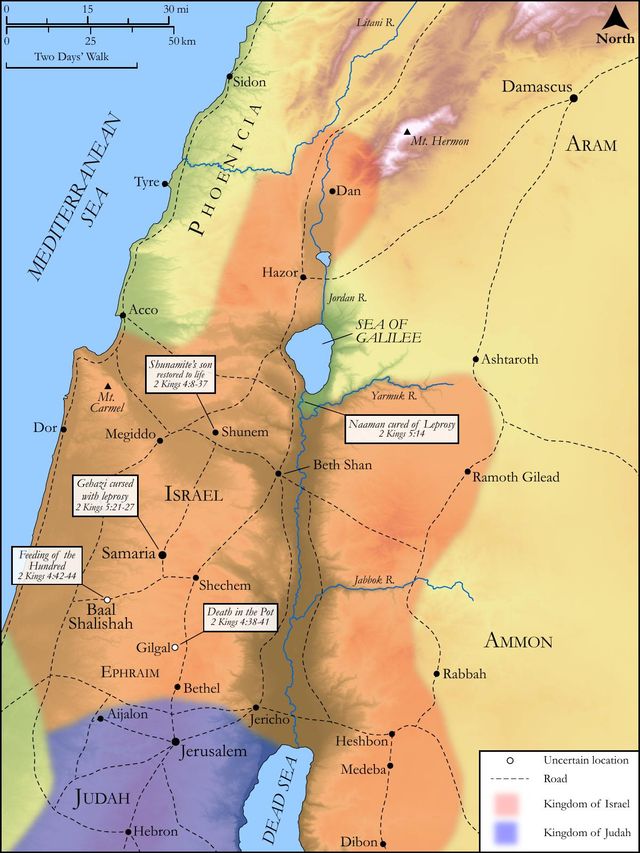
See on the biblical-era map
Study this verse
Public-domain commentary
Matthew Henry
From his Commentary on the Whole Bible. Henry comments on passages, not single verses — this entry covers 2 Kings 4:38–44. His two-level outline is real structure in the source text, so it is rendered as structure.
We have here Elisha in his place, in his element, among the sons of the prophets, teaching them, and, as a father, providing for them; and happy it was for them that they had one over them who naturally cared for their state, under whom they were well fed and well taught. There was a dearth in the land, for the wickedness of those that dwelt therein, the same that we read of, Kg2 8:1. It continued seven years, just as long again as that in Elijah's time. A famine of bread there was, but not of hearing the word of God, for Elisha had the sons of the prophets sitting before him, to hear his wisdom, who were taught, that they might teach others. Two instances we have here of the care he took about their meat. Christ twice fed those to whom he preached. Elisha was in the more care about it now because of the dearth, that the sons of the prophets might not be ashamed in this evil time, but, even in the days of famine, might be satisfied, Psa 37:19.
I.He made hurtful food to become safe and wholesome.
1.On the lecture-day, the sons of the prophets being all to attend, he ordered his servant to provide food for their bodies, while he was breaking to them the bread of life for their souls. Whether there was any flesh-meat for them does not appear; he orders only that pottage should be seethed for them of herbs, Kg2 4:38. The sons of the prophets should be examples of temperance and mortification, not desirous of dainties, but content with plain food. If they have neither savoury meats nor sweet meats, nay, if a mess of pottage be all the dinner, let them remember that this great prophet entertained himself and his guests no better.
2.One of the servitors, who was sent to gather herbs (which, it should seem, must serve instead of flesh for the pottage), by mistake brought in that which was noxious, or at least very nauseous, and shred it into the pottage: wild gourds they are called, Kg2 4:39. Some think it was coloquintida, a herb strongly cathartic, and, if not qualified, dangerous. The sons of the prophets, it seems, were better skilled in divinity than in natural philosophy, and read their Bibles more than their herbals. If any of the fruits of the earth be hurtful, we must look upon it as an effect of the curse (thorns and thistles shall it bring forth unto thee), for the original blessing made all good.
3.The guests complained to Elisha of the unwholesomeness of their food. Nature has given man the sense of tasting, not only that wholesome food may be pleasant, but that that which is unwholesome may be discovered before it comes to the stomach; the mouth tries meat by tasting it, Job 12:11. This pottage was soon found by the taste of it to be dangerous, so that they cried out, There is death in the pot, Kg2 4:40. The table often becomes a snare, and that which should be for our welfare proves a trap, which is a good reason why we should not feed ourselves without fear; when we are receiving the supports and comforts of life we must keep up an expectation of death and a fear of sin.
4.Elisha immediately cured the bad taste and prevented the bad consequences of this unwholesome pottage; as before he had healed the bitter waters with salt, so now the bitter broth with meal, Kg2 4:41. It is probable that there was meal in it before, but that was put in by a common hand, only to thicken the pottage; this was the same thing, but cast in by Elisha's hand, and with intent to heal the pottage, by which it appears that the change was not owing to the meal (that was the sign only, not the means), but to the divine power. Now all was well, not only no death, but no harm in the pot. We must acknowledge God's goodness in making our food wholesome and nourishing. I am the Lord that healeth thee.
II.He made a little food to go a great way.
1.Elisha had a present brought him of twenty barley-loaves and some ears of corn (Kg2 4:42), a present which, in those ages, would not be despicable at any time, but now in a special manner valuable, when there was a dearth in the land. It is said to be of the first-fruits, which was God's due out of their increase; and when the priests and Levites were all at Jerusalem, out of their reach, the religious people among them, with good reason, looked upon the prophets as God's receivers, and brought their first-fruits to them, which helped to maintain their schools.
2.Having freely received, he freely gave, ordering it all to be set before the sons of the prophets, reserving none for himself, none for the hereafter. "Let the morrow take thought for the things of itself, give it all to the people that they may eat." It well becomes the men of God to be generous and open-handed, and the fathers of the prophets to be liberal to the sons of the prophets.
3.Though the loaves were little, it is likely no more than what one man would ordinarily eat at a meal, yet with twenty of them he satisfied 100 men, Kg2 4:43, Kg2 4:44. his servant thought that to set so little meat before so many men was but to tantalize them, and shame his master for making so great an invitation to such short commons; but he in God's name, pronounced it a full meal for them, and so it proved; they did eat, and left thereof, not because their stomachs failed them, but because the bread increased in the eating. God has promised his church (Psa 132:15) that he will abundantly bless her provision, and satisfy her poor with bread; for whom he feeds he fills, and what he blesses comes to much, as what he blows upon comes to little, Hag 1:9. Christ's feeding his hearers was a miracle far beyond this; but both teach us that those who wait upon God in the way of duty may hope to be both protected and supplied by a particular care of divine Providence.
Historical interpretation
Historical reception
1 surviving comment on this verse from the historical church.
Elisha corrects the nature of the cooked foods with some flour and gives them a new taste. Our Lord did the same according to the [divine] economy, so that he might be imitated, as he said for our exhortation, with the result that we might walk the path of the righteous and the pious, and might rejoice because of the great reward he promised us and might heal the diseases and the anguish and the tribulations that constantly surround us from the beginning of our life. The father of our race, Adam, gathered those [bitter] fruits as a consequence of his sin and proposed and offered them to us in the hour in which he heard [these words] from his Creator: “The ground is cursed because of you; it will bring forth thorns and thistles for you. You are dust, and to dust you shall return.”
Continue studying 2 Kings 4:41 across the web’s major study libraries — every link below opens this exact verse, chapter, or book on the destination site.
Read & Compare
 BibleGatewayThis verse in more than 200 translations and 70 languages.
 Bible.comThe YouVersion reader — hundreds of translations, reading plans, and highlights.
 ESV.orgCrossway's official English Standard Version reader.
 NET BibleThe NET translation with 60,000+ translators' notes on every rendering decision.
 STEP BibleTyndale House's free study tool — original text, vocabulary, and scholarly resources.
 BibliaLogos Bible Software's free web reader.
 USCCBThe New American Bible (Revised Edition) with the U.S. bishops' study notes.
Commentaries
 BibleHub CommentariesDozens of classic commentaries on this verse, gathered on one page.
 StudyLightMore than 100 commentary sets — the largest collection on the web.
 BibleRefPlain-English commentary on what this verse means, verse by verse.
 Enduring WordDavid Guzik's free commentary on this chapter, widely used by Bible teachers.
 Bible Study ToolsVerse commentary alongside Greek and Hebrew study aids.
Original Language & Research
- BibleHub InterlinearThe verse word by word — original language, transliteration, and English.
- BibleHub LexiconEvery word's original-language definition and Strong's entry.
 Blue Letter BibleDeep-study tools — Strong's numbers, concordance, and word studies.
 SefariaThe Hebrew text with Rashi and centuries of Jewish commentary.
Sermons, Hymns & Audio


TrulyRandomVerse is not affiliated with these sites and doesn’t control their content. They’re linked because they’re genuinely useful.
Summary
Second Kings 4:41 narrates the miraculous intervention of the prophet Elisha, who, during a severe famine, purifies a large pot of stew that had been inadvertently poisoned by wild gourds gathered by the "sons of the prophets." Through a simple command to bring meal and casting it into the pot, Elisha, acting as God's instrument, completely neutralizes the deadly substance, rendering the food safe and edible. This divine act prevents a tragic loss of life, powerfully demonstrating God's sovereign power to provide and protect His people even in the most dire and unexpected circumstances.
Context
ShowHideLiterary Context
This verse is intricately woven into a series of Elisha's miracles recorded in 2 Kings 4, all of which collectively underscore God's unwavering power and faithful provision through His chosen prophet. The immediate preceding narrative establishes the setting: the "sons of the prophets," a community of prophetic disciples, are gathered in Gilgal during a period of severe famine (2 Kings 4:38). In their desperate search for sustenance, one of the students mistakenly gathers poisonous wild gourds, leading to the urgent and desperate cry, "O thou man of God, there is death in the pot!" (2 Kings 4:40). Elisha's action in 2 Kings 4:41 is the direct, divinely empowered response to this life-threatening culinary error. This miracle then seamlessly transitions into another demonstration of divine provision: Elisha feeding one hundred men with twenty loaves of barley (2 Kings 4:42-44), further emphasizing God's abundant care for His people.
Historical & Cultural Context
The "sons of the prophets" were not biological offspring but rather groups of disciples or students who gathered to learn from and serve prominent prophets like Elijah and Elisha, often living in communal settings. Their presence in Gilgal is noteworthy, as this location held significant historical and spiritual importance for Israel, serving as an early encampment after crossing the Jordan (Joshua 4:19-20). The "famine" mentioned in 2 Kings 4:38 highlights a widespread and severe scarcity of food, a recurring challenge in ancient Israel due to reliance on rain-fed agriculture. In such times, any source of food, no matter how unusual, would be sought after. The "wild gourds" (likely colocynths or similar bitter, poisonous plants) were easily mistaken for edible vegetables by those unfamiliar with them or desperate for food. This incident vividly portrays the precariousness of life in ancient Israel and the profound reliance on divine intervention for survival when natural resources or human knowledge failed.
Key Themes
ShowHide2 Kings 4:41 powerfully illuminates several core themes prevalent throughout the book of 2 Kings. Firstly, it underscores Divine Intervention, showcasing God's active and immediate involvement in both the mundane and life-threatening aspects of human existence, transforming a deadly situation into one of safety and sustenance. Secondly, it reinforces Prophetic Authority, as Elisha acts as God's chosen and empowered instrument, demonstrating the Lord's omnipotence through simple, yet divinely directed, actions. This echoes earlier biblical precedents, such as Moses making the bitter waters of Marah sweet (Exodus 15:25). Thirdly, the event profoundly illustrates God's Provision, demonstrating His unwavering faithfulness to care for His covenant people even amidst severe famine and human error. Finally, the miracle embodies Transformation, where something inherently harmful and deadly is completely changed into something beneficial and life-sustaining, a powerful motif in biblical narratives where God brings life out of death or order out of chaos, reminiscent of the creation account itself.
Exposition and Analysis
ShowHideKey Word Analysis
ShowHideThis Hebrew term refers to flour, typically ground from grain. In this context, it represents a common, everyday substance. Its profound significance here lies not in any inherent magical or purifying property, but rather as the simple, ordinary medium through which God chooses to perform an extraordinary miracle. It powerfully underscores the principle that God can utilize the most humble and readily available means to accomplish His mighty purposes, thereby demonstrating His power and sovereignty rather than attributing efficacy to the substance itself.
This primitive root means "to throw out, down or away." Elisha's action of "casting" the meal into the pot is a deliberate and decisive physical act. It is the outward, visible manifestation of the divine intervention. The word implies a definitive, unhesitating action, signaling the immediate and complete nature of the miracle that is about to unfold. It is not a gradual process but a singular, impactful event initiated by the prophet's obedient action.
While the KJV translates this as "harm," the Hebrew word ra' carries a broader and more potent meaning, encompassing "evil," "bad," "calamity," or "hurt." In the preceding verse (2 Kings 4:40), the "sons of the prophets" explicitly declare "death" (מָוֶת, maweth) in the pot. The use of ra' in 2 Kings 4:41 confirms that the "harm" was indeed lethal, emphasizing the complete and radical reversal of the stew's nature from deadly poison to safe, edible food. The absence of ra' signifies not merely a lack of unpleasantness, but a total nullification of the life-threatening, evil quality that permeated the food.
Verse Breakdown
ShowHide"But he said, Then bring meal."
Elisha's response to the desperate cry is immediate, calm, and authoritative. He does not panic or seek a complex, human solution. His command for "meal" (flour) is strikingly simple, yet it initiates the divine intervention. This highlights Elisha's role as a faithful conduit for God's power, acting on divine instruction rather than relying on human wisdom or scientific understanding.
"And he cast [it] into the pot;"
This is the pivotal action where the miracle takes place. Elisha's physical act of casting the meal into the pot is the outward, tangible manifestation of the miraculous work. It is a symbolic gesture, indicating that the power to purify resides not in the meal itself, but in God's command and Elisha's obedient faith. The divine transformation of the stew's essence occurs at this precise moment.
"and he said, Pour out for the people, that they may eat."
Elisha's subsequent command confidently confirms the completion and efficacy of the miracle. He instructs them to eat without hesitation, signifying that the danger has been completely and irrevocably removed. This demonstrates the prophet's absolute assurance in God's power and the immediate, thorough effectiveness of the divine intervention.
"And there was no harm in the pot."
This concluding statement provides the definitive, unequivocal outcome of the miracle. The declaration "no harm" (literally "no evil" or "no badness") stands in direct, powerful contrast to the "death in the pot" cried out in 2 Kings 4:40. It emphasizes the completeness of the transformation; the stew was not merely diluted or made less harmful, but entirely purified, rendered safe, and fit for consumption.
Literary Devices
ShowHideThe narrative in 2 Kings 4:41 masterfully employs several effective literary devices to amplify its message. There is a profound contrast established between the initial state of "death in the pot" (2 Kings 4:40) and the final declaration that "there was no harm in the pot." This stark opposition dramatically highlights the complete and supernatural nature of the miracle. The use of divine fiat is evident in Elisha's simple, authoritative commands ("bring meal," "pour out"), which, though outwardly mundane, function as performative utterances that bring about the supernatural change. The "meal" itself functions as a potent symbol, not of its own inherent power, but as a tangible, ordinary medium through which an extraordinary divine act is channeled, emphasizing God's ability to utilize the humble and common to accomplish the mighty. Furthermore, there is a subtle element of irony in that the very substance intended to provide sustenance (the stew) becomes a source of death, only to be miraculously transformed back into life-giving food by divine power, showcasing God's ultimate reversal of human misfortune.
Theological and Thematic Connections
ShowHideThe purification of the poisoned stew in 2 Kings 4:41 serves as a powerful testament to God's sovereign control over creation and His intimate, compassionate care for His people. It underscores the profound theological truth that no situation, no matter how dire, dangerous, or seemingly mundane, is beyond His redemptive and transformative power. This miracle is not merely about physical sustenance; it is a profound demonstration of divine protection and the active, living presence of God among His covenant people, mediated through His chosen prophet. It foreshadows a greater spiritual truth: God's ultimate ability to transform what is deadly and corrupt into something life-giving and pure, offering enduring hope and assurance that His provision extends to every facet of human need, encompassing both physical sustenance and spiritual well-being.
Reflection and Application
ShowHideThe profound narrative of the purified pot in 2 Kings 4:41 offers timeless and deeply relevant lessons for contemporary believers. It serves as a powerful reminder that God's meticulous care extends to the most practical, seemingly insignificant, and even perilous details of our daily lives. Just as He intervened decisively to save the "sons of the prophets" from a poisoned meal, He remains intimately attentive to our daily struggles, our nagging anxieties, our hidden dangers, and our deepest needs. This miracle profoundly encourages us to bring our own "deadly pots"—our seemingly insurmountable problems, our toxic relationships, our periods of spiritual dryness, our overwhelming fears, or our deeply rooted sins—before the Lord. It teaches us that through simple faith and obedient action, God can take what is inherently harmful, transform it completely, and make it a source of nourishment, blessing, and even life. It is a compelling call to radical trust in God's transformative power, believing that He can bring life out of death, hope out of despair, and purity out of corruption, often choosing to use the most ordinary and humble means to accomplish His extraordinary, supernatural purposes.
Questions for Reflection
ShowHideFAQ
ShowHideWhat was the "meal" that Elisha cast into the pot, and did it have any special properties that neutralized the poison?
ShowHideThe "meal" (Hebrew: qemach) was simply flour, most likely ground from grain, a common staple food in ancient Israel. It possessed no inherent magical, medicinal, or chemical properties that could neutralize a potent poison. Its significance lies precisely in its ordinariness. Elisha's act of casting it into the pot was a symbolic gesture, an act of obedience and faith, through which God Himself performed the miracle. The power to transform the deadly stew into safe food resided not in the flour itself, but solely in the divine intervention that occurred through Elisha's action. This powerfully demonstrates that God can use the most common and unassuming elements to accomplish extraordinary feats, highlighting His omnipotence rather than the efficacy of the material. This principle is mirrored elsewhere in scripture, such as when Jesus used mud to heal a blind man (John 9:6-7) or when a piece of wood made bitter waters sweet (Exodus 15:25).
Christ-Centered Fulfillment
ShowHideThe miracle of the purified pot in 2 Kings 4:41 finds its ultimate, most profound, and eternally significant fulfillment in the person and work of Jesus Christ. Just as Elisha transformed a source of physical death into life-giving sustenance, Jesus, the very Bread of Life, transforms the spiritual death of humanity into eternal life. The poisoned stew powerfully represents the fallen, corrupted state of humanity, inherently leading to spiritual death and separation from God (Romans 6:23). Christ, through His perfect life, sacrificial death on the cross, and glorious resurrection, took upon Himself the "poison" of sin and death, rendering it utterly powerless and offering true, life-giving nourishment to all who believe. His body, broken for us, and His blood, shed for the forgiveness of sins, are the ultimate "meal" that purifies and sustains, miraculously turning what was deadly (our sin and condemnation) into salvation, redemption, and eternal communion with God (John 6:53-58). Furthermore, Christ's absolute power over all harm, evil, and spiritual toxicity, as supremely demonstrated in His triumph over sickness, demons, and death itself (Colossians 2:15), far surpasses Elisha's miracle. He offers a complete, lasting, and spiritual purification, making us fit to partake in the eternal banquet of God's kingdom (Revelation 19:9), where there will be no more "harm" or "death" forevermore.