


2 Kings 4:43
Bible text: King James Version (1769 Blayney text) · Public domain
Bible text: King James Version with Strong's numbers · Public domain
Bible text: Berean Standard Bible · Public domain
Bible text: American Standard Version (1901) · Public domain
Bible text: World English Bible, Messianic edition · Public domain
Bible text: Geneva Bible (1599) · Public domain
Bible text: Young's Literal Translation · Public domain
- וַיֹּאמֶרvai·Yo·merand he saidH559Conj-w ¦ V-Qal-ConsecImperf-3msVerb Qal Consecutive Imperfect 3rd Singular Masculineוַandיֹּאמֶרhe said
- מְשָׁרְתוֹme·Sha·re·Tohis servantH8334V-Piel-Prtcpl-ms ¦ 3msVerb Piel Participle Singular Masculine Constructמְשָׁרְתservantוֹhis
- מָהmahwhat?H4100InterrogPronoun Interrogative
- אֶתֵּן'e·Tenwill I putH5414V-Qal-Imperf-1csVerb Qal Imperfect 1st Singular common gender
- זֶהZehthisH2088PrtParticle Demonstrative
- לִפְנֵיlif·Nei<to> beforeH6440Prep-l ¦ N-mpcNoun Plural Masculine Constructלִ<to>פְנֵיbefore
- מֵאָהMe·'aha hundredH3967N-fsNoun Singular Feminine Absolute
- אִישׁ'IshmanH376N-msNoun Singular Masculine Absolute
- וַיֹּאמֶרvai·Yo·merand he saidH559Conj-w ¦ V-Qal-ConsecImperf-3msVerb Qal Consecutive Imperfect 3rd Singular Masculineוַandיֹּאמֶרhe said
- תֵּןtengive [it]H5414V-Qal-Imp-2msVerb Qal Imperative 2nd Singular Masculine
- לָעָםla·'Amto the peopleH5971Prep-l ¦ N-msNoun Singular Masculine Absoluteלָto theעָםpeople
- וְיֹאכֵלוּve·yo·Khe·luso they may eatH398Conj-w ¦ V-Qal-ConjImperf-3mpVerb Qal Conjunction+Imperfect 3rd Plural Masculineוְsoיֹאכֵלוּthey may eat
- כִּיkiforH3588PrtParticle Conditional
- כֹהkhohthusH3541AdvAdverb
- אָמַר'a·Marhe saysH559V-Qal-Perf-3msVerb Qal Perfect 3rd Singular Masculine
- יְהוָהYah·wehYahwehH3068N-properNoun Proper Title
- אָכֹל'a·Kholthey will eatH398V-Qal-InfAbsVerb Qal Infinitive Absolute
- וְהוֹתֵרve·ho·Terand they will have more than enoughH3498Conj-w ¦ V-Hiphil-InfAbsVerb Hiphil Infinitive Absoluteוְandהוֹתֵרthey will have more than enough
English is a literal word-by-word gloss of the Hebrew, not the KJV's wording. Why?
This is the original text the KJV's translators worked from — each Hebrew word with its own literal English meaning in this verse, prepared by scholars at Tyndale House, Cambridge. The KJV translates whole sentences, not word by word, so its wording differs: one Hebrew word can become several English words, and the KJV may choose “the LORD” where the gloss reads “Yahweh”. Both are faithful — they answer different questions. For the KJV's own rendering, switch to the KJV text.
Details
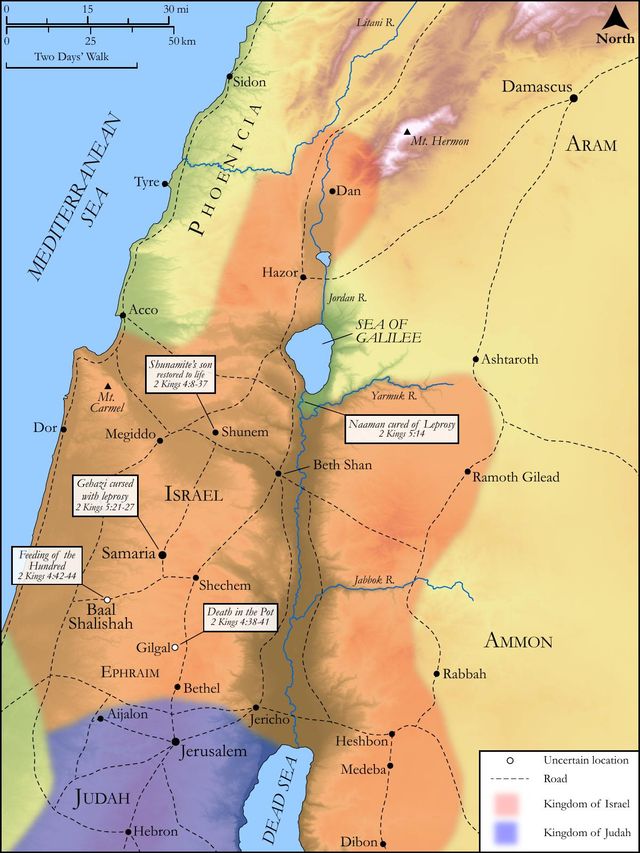
See on the biblical-era map
Study this verse
Public-domain commentary
Matthew Henry
From his Commentary on the Whole Bible. Henry comments on passages, not single verses — this entry covers 2 Kings 4:38–44. His two-level outline is real structure in the source text, so it is rendered as structure.
We have here Elisha in his place, in his element, among the sons of the prophets, teaching them, and, as a father, providing for them; and happy it was for them that they had one over them who naturally cared for their state, under whom they were well fed and well taught. There was a dearth in the land, for the wickedness of those that dwelt therein, the same that we read of, Kg2 8:1. It continued seven years, just as long again as that in Elijah's time. A famine of bread there was, but not of hearing the word of God, for Elisha had the sons of the prophets sitting before him, to hear his wisdom, who were taught, that they might teach others. Two instances we have here of the care he took about their meat. Christ twice fed those to whom he preached. Elisha was in the more care about it now because of the dearth, that the sons of the prophets might not be ashamed in this evil time, but, even in the days of famine, might be satisfied, Psa 37:19.
I.He made hurtful food to become safe and wholesome.
1.On the lecture-day, the sons of the prophets being all to attend, he ordered his servant to provide food for their bodies, while he was breaking to them the bread of life for their souls. Whether there was any flesh-meat for them does not appear; he orders only that pottage should be seethed for them of herbs, Kg2 4:38. The sons of the prophets should be examples of temperance and mortification, not desirous of dainties, but content with plain food. If they have neither savoury meats nor sweet meats, nay, if a mess of pottage be all the dinner, let them remember that this great prophet entertained himself and his guests no better.
2.One of the servitors, who was sent to gather herbs (which, it should seem, must serve instead of flesh for the pottage), by mistake brought in that which was noxious, or at least very nauseous, and shred it into the pottage: wild gourds they are called, Kg2 4:39. Some think it was coloquintida, a herb strongly cathartic, and, if not qualified, dangerous. The sons of the prophets, it seems, were better skilled in divinity than in natural philosophy, and read their Bibles more than their herbals. If any of the fruits of the earth be hurtful, we must look upon it as an effect of the curse (thorns and thistles shall it bring forth unto thee), for the original blessing made all good.
3.The guests complained to Elisha of the unwholesomeness of their food. Nature has given man the sense of tasting, not only that wholesome food may be pleasant, but that that which is unwholesome may be discovered before it comes to the stomach; the mouth tries meat by tasting it, Job 12:11. This pottage was soon found by the taste of it to be dangerous, so that they cried out, There is death in the pot, Kg2 4:40. The table often becomes a snare, and that which should be for our welfare proves a trap, which is a good reason why we should not feed ourselves without fear; when we are receiving the supports and comforts of life we must keep up an expectation of death and a fear of sin.
4.Elisha immediately cured the bad taste and prevented the bad consequences of this unwholesome pottage; as before he had healed the bitter waters with salt, so now the bitter broth with meal, Kg2 4:41. It is probable that there was meal in it before, but that was put in by a common hand, only to thicken the pottage; this was the same thing, but cast in by Elisha's hand, and with intent to heal the pottage, by which it appears that the change was not owing to the meal (that was the sign only, not the means), but to the divine power. Now all was well, not only no death, but no harm in the pot. We must acknowledge God's goodness in making our food wholesome and nourishing. I am the Lord that healeth thee.
II.He made a little food to go a great way.
1.Elisha had a present brought him of twenty barley-loaves and some ears of corn (Kg2 4:42), a present which, in those ages, would not be despicable at any time, but now in a special manner valuable, when there was a dearth in the land. It is said to be of the first-fruits, which was God's due out of their increase; and when the priests and Levites were all at Jerusalem, out of their reach, the religious people among them, with good reason, looked upon the prophets as God's receivers, and brought their first-fruits to them, which helped to maintain their schools.
2.Having freely received, he freely gave, ordering it all to be set before the sons of the prophets, reserving none for himself, none for the hereafter. "Let the morrow take thought for the things of itself, give it all to the people that they may eat." It well becomes the men of God to be generous and open-handed, and the fathers of the prophets to be liberal to the sons of the prophets.
3.Though the loaves were little, it is likely no more than what one man would ordinarily eat at a meal, yet with twenty of them he satisfied 100 men, Kg2 4:43, Kg2 4:44. his servant thought that to set so little meat before so many men was but to tantalize them, and shame his master for making so great an invitation to such short commons; but he in God's name, pronounced it a full meal for them, and so it proved; they did eat, and left thereof, not because their stomachs failed them, but because the bread increased in the eating. God has promised his church (Psa 132:15) that he will abundantly bless her provision, and satisfy her poor with bread; for whom he feeds he fills, and what he blesses comes to much, as what he blows upon comes to little, Hag 1:9. Christ's feeding his hearers was a miracle far beyond this; but both teach us that those who wait upon God in the way of duty may hope to be both protected and supplied by a particular care of divine Providence.
Historical interpretation
Historical reception
1 surviving comment on this verse from the historical church.
Here two miracles are proposed, which Elisha performed while he was among his disciples. He accomplished the first when he caused death to leave the pot, where, as they said, it had hidden. He performed the second when he nourished one hundred prophets with a little bit of bread. In both miracles he prefigures him who multiplies twice some barley loaves and nourishes with them “about five thousand men, besides women and children.”
Continue studying 2 Kings 4:43 across the web’s major study libraries — every link below opens this exact verse, chapter, or book on the destination site.
Read & Compare
 BibleGatewayThis verse in more than 200 translations and 70 languages.
 Bible.comThe YouVersion reader — hundreds of translations, reading plans, and highlights.
 ESV.orgCrossway's official English Standard Version reader.
 NET BibleThe NET translation with 60,000+ translators' notes on every rendering decision.
 STEP BibleTyndale House's free study tool — original text, vocabulary, and scholarly resources.
 BibliaLogos Bible Software's free web reader.
 USCCBThe New American Bible (Revised Edition) with the U.S. bishops' study notes.
Commentaries
 BibleHub CommentariesDozens of classic commentaries on this verse, gathered on one page.
 StudyLightMore than 100 commentary sets — the largest collection on the web.
 BibleRefPlain-English commentary on what this verse means, verse by verse.
 Enduring WordDavid Guzik's free commentary on this chapter, widely used by Bible teachers.
 Bible Study ToolsVerse commentary alongside Greek and Hebrew study aids.
Original Language & Research
- BibleHub InterlinearThe verse word by word — original language, transliteration, and English.
- BibleHub LexiconEvery word's original-language definition and Strong's entry.
 Blue Letter BibleDeep-study tools — Strong's numbers, concordance, and word studies.
 SefariaThe Hebrew text with Rashi and centuries of Jewish commentary.
Sermons, Hymns & Audio


TrulyRandomVerse is not affiliated with these sites and doesn’t control their content. They’re linked because they’re genuinely useful.
Summary
Second Kings 4:43 vividly portrays a moment of miraculous divine provision through the prophet Elisha, demonstrating God's boundless capacity to supply abundantly from seemingly insufficient resources. This verse is central to the narrative where Elisha feeds one hundred men with only twenty loaves of barley and some fresh ears of grain, serving as a powerful testament to God's supernatural power, unwavering faithfulness, and generous nature in meeting the needs of His people, even in challenging circumstances.
Context
ShowHideLiterary Context
This verse is embedded within a series of miracles performed by Elisha, showcasing his prophetic authority and God's active presence in the Northern Kingdom of Israel. The immediate preceding verses 2 Kings 4:38-42 describe Elisha's return to Gilgal, where he purifies a poisoned stew for the "sons of the prophets." This miracle of feeding the hundred men follows directly, emphasizing a consistent theme of Elisha's ministry: divine intervention in practical, life-sustaining ways. The narrative flow highlights the transition from a potentially fatal situation (the poisoned stew) to one of abundant life (the miraculous feeding), underscoring God's comprehensive care for His servants.
Historical & Cultural Context
The event takes place in Gilgal, a historically significant site, often associated with Israel's entry into the Promised Land and early covenant renewals (e.g., Joshua 5:9-10). Elisha's ministry occurred in the Northern Kingdom of Israel during a period marked by spiritual decline and idolatry, yet God continued to work through His prophets. The "hundred men" were likely members of the "sons of the prophets," a community of prophetic disciples or students who lived together, often in poverty, and were under the tutelage of a senior prophet like Elisha. Their sustenance would have been a significant concern. The servitor's question reflects a common human reaction to scarcity and a rational assessment of resources, contrasting sharply with the divine economy.
Key Themes
ShowHideThe central theme is Divine Provision, illustrating God's limitless ability to supply for His people, transforming scarcity into superabundance. This miracle underscores that God's resources are not bound by human limitations or mathematical calculations, echoing the truth that God will supply all needs according to His riches in glory. Another crucial theme is Faith and Obedience. Elisha's command, "Give the people, that they may eat," is an act of unwavering faith in God's promise. The servitor's obedience, despite his initial skepticism, is also crucial for the miracle to unfold, demonstrating that without faith it is impossible to please God. Finally, the phrase "They shall eat, and shall leave [thereof]" highlights Supernatural Abundance, emphasizing that God's provision is not merely sufficient but generous, resulting in a surplus. This motif of overflowing provision is a recurring pattern in God's dealings, often providing more than what is strictly necessary, as seen in the manna in the wilderness.
Exposition and Analysis
ShowHideKey Word Analysis
ShowHideDerived from the root H8334, meaning "to attend as a menial or worshipper" or "to serve." In this context, it refers to Elisha's attendant, who serves as a practical foil to Elisha's faith. His question, born of human logic, highlights the stark contrast between limited human resources and God's boundless capacity for provision.
This is H3068, the divine name "Jehovah" or "the Lord," signifying the "self-Existent or Eternal" God. The phrase "thus saith the LORD" (which includes the verb saith H559, ʼâmar) unequivocally attributes the miraculous provision to God's sovereign will and power, establishing the divine origin and certainty of the promise.
This verb (H3498) means "to remain or be left," or causatively, "to leave, cause to abound, preserve." Its inclusion in the divine promise "They shall eat, and shall leave [thereof]" is crucial, indicating that God's provision would not merely be sufficient but would result in a surplus, demonstrating His generous and super-abundant nature.
Verse Breakdown
ShowHide"And his servitor said, What, should I set this before an hundred men?"
This clause immediately introduces the human perspective of doubt and disbelief. The servitor, faced with a meager supply of twenty barley loaves and fresh ears of grain, logically questions how such a small quantity could possibly feed a hundred hungry men. This highlights the stark contrast between human limitation and divine power, setting the stage for the miracle.
"He said again, Give the people, that they may eat:"
Elisha's response is a reiteration of his command, emphasizing the imperative of obedience despite the apparent impossibility. His words are not a suggestion but a firm directive, rooted in his prophetic authority and confidence in God's word. This command requires an act of faith from the servitor, to proceed with the distribution even when the outcome seems absurd from a human vantage point.
"for thus saith the LORD, They shall eat, and shall leave [thereof]."
This is the divine guarantee that underpins Elisha's command. The prophetic formula "thus saith the LORD" authenticates the promise, indicating that the outcome is not dependent on the quantity of food but on the power and will of God. The promise includes not only that they "shall eat" (sufficiency) but also that they "shall leave [thereof]" (abundance), foretelling a miraculous surplus that defies natural laws and confirms God's overflowing generosity.
Literary Devices
ShowHideThe passage employs several potent literary devices to underscore its message. Contrast is central, pitting the servitor's human logic and skepticism against Elisha's divine faith and the miraculous outcome. This creates a dramatic tension that is resolved by God's power. There is also an element of Irony in the servitor's question, as his doubt inadvertently highlights the extraordinary nature of the miracle that is about to unfold, making God's power even more evident. Finally, the use of Divine Declaration ("thus saith the LORD") functions as a powerful rhetorical device, transforming Elisha's words from a mere instruction into an infallible prophecy, securing the certainty of the miracle and emphasizing the direct involvement of God's will.
Theological and Thematic Connections
ShowHideThis miracle in 2 Kings 4:43 is a profound theological statement about God's character as a provider, echoing earlier instances of divine sustenance and foreshadowing greater acts to come. It demonstrates that God's power is not constrained by human scarcity or logical limitations; rather, He delights in manifesting His abundance through seemingly impossible circumstances. The miracle reinforces the covenant faithfulness of Yahweh, who cares for His people's most basic needs, even when they are in a state of spiritual decline. It serves as a powerful reminder that true security and provision come from trusting in God's word, not in the visible resources at hand.
Reflection and Application
ShowHideThe narrative of 2 Kings 4:43 challenges believers to cultivate a radical trust in God's provision, even when our circumstances seem to defy logical solutions. It invites us to move beyond human calculations and embrace the divine economy, where scarcity can be transformed into abundance through faith and obedience. Just as the servitor was called to act despite his doubt, we are called to step out in faith, knowing that God's promises are sure and His resources are limitless. This passage encourages us to present our meager offerings to God, whether they be our time, talents, or material possessions, confident that He can multiply them for His purposes, often exceeding our wildest expectations and leaving a surplus. It reminds us that God's generosity is not merely about meeting needs but about demonstrating His overflowing goodness and power in our daily lives.
Questions for Reflection
ShowHideFAQ
ShowHideWho were the "sons of the prophets" mentioned in this context?
ShowHideThe "sons of the prophets" were groups or communities of prophetic disciples or students who lived and studied together under the guidance of a senior prophet, such as Elisha. They were not necessarily the biological children of prophets but rather individuals dedicated to prophetic training and ministry. They often lived in simple, communal settings and were dependent on divine provision and the support of the wider community. This particular group was likely gathered at Gilgal, a significant spiritual center. Elisha's care for them, including providing food and purifying their stew (2 Kings 4:38-41), highlights his pastoral role and God's direct concern for those dedicated to His service.
What is the significance of the phrase "They shall eat, and shall leave [thereof]"?
ShowHideThis phrase is highly significant because it emphasizes God's generosity and the supernatural nature of His provision. It means that not only would the one hundred men be fully satisfied, but there would also be a surplus of food remaining. This goes beyond mere sufficiency to demonstrate God's abundant power and grace. It's a recurring motif in biblical miracles of provision, showing that God's blessings often exceed what is strictly necessary, providing "more than enough." This surplus serves as tangible proof of the miracle and a testament to God's overflowing goodness, reinforcing the promise given by Elisha, "for thus saith the LORD."
Christ-Centered Fulfillment
ShowHideThe miracle of Elisha feeding the one hundred men with twenty loaves in 2 Kings 4:43 serves as a powerful Old Testament type, prophetically pointing to the ultimate divine provider, Jesus Christ. Just as Elisha, by God's power, transformed scarcity into abundance, Jesus, the greater Prophet, repeatedly demonstrated His divine authority and boundless compassion by feeding thousands with a few loaves and fish (e.g., Matthew 14:13-21 and Matthew 15:32-39). In both instances, there was not only enough to satisfy but also a significant surplus, underscoring God's overflowing generosity. Elisha's miracle foreshadows Jesus as the true Bread of Life, who provides not merely physical sustenance but eternal spiritual nourishment. The "leaving thereof" points to the inexhaustible nature of Christ's provision, culminating in His sacrifice on the cross, which provides an abundant and everlasting supply of grace and salvation for all who believe, ensuring that no one who comes to Him will ever hunger or thirst spiritually.