


Luke 9:13
Bible text: King James Version (1769 Blayney text) · Public domain
Bible text: King James Version with Strong's numbers · Public domain
Bible text: Berean Standard Bible · Public domain
Bible text: American Standard Version (1901) · Public domain
Bible text: World English Bible, Messianic edition · Public domain
Bible text: Geneva Bible (1599) · Public domain
Bible text: Young's Literal Translation · Public domain
- ΕἶπενEipenHe saidG2036V-2AAI-3SVerb 2nd Aorist Active Indicative 3rd Singular
- δὲdenowG1161CONJConjunction
- πρὸςprostoG4314PREPPreposition
- αὐτούς·autousthemG846P-APMPersonal pronoun Accusative Plural Masculine
- δότεdotedo giveG1325V-2AAM-2PVerb 2nd Aorist Active Imperative 2nd Plural
- αὐτοῖςautoisto themG846P-DPMPersonal pronoun Dative Plural Masculine
- ὑμεῖςhumeisyou yourselvesG4771P-2NPPersonal pronoun Nominative 2nd Plural
- φαγεῖνphageinto eatG5315V-AANVerb Aorist Active Infinitive
- οἱhoi<the>G3588T-NPMDefinite article Nominative Plural Masculine
- δὲdeButG1161CONJConjunction
- εἶπαν·eipanthey saidG2036V-2AAI-3PVerb 2nd Aorist Active Indicative 3rd Plural
- οὐκoukNotG3756PRT-NNegative Particle Negative
- εἰσὶνeisinthere areG1510V-PAI-3PVerb Present Active Indicative 3rd Plural
- ἡμῖνhēminto usG3165P-1DPPersonal pronoun Dative 1st Plural
- πλεῖονpleionmoreG4119A-NSN-CAdjective Nominative Singular Neuter Comparative
- ἢēthanG2228CONJConjunction
- ἄρτοιartoiloavesG740N-NPMNoun Nominative Plural Masculine
- πέντεpentefiveG4002A-NUIAdjective
- καὶkaiandG2532CONJConjunction
- ἰχθύεςichthuesfishG2486N-NPMNoun Nominative Plural Masculine
- δύοduotwoG1417A-NUIAdjective
- εἰeiexceptG1487CONDConjunction
- μήτιmētisurely evenG3385PRT-NNegative Particle Negative
- πορευθέντεςporeuthenteshaving goneG4198V-AOP-NPMVerb Aorist Passive Deponent Participle Nominative Plural Masculine
- ἡμεῖςhēmeiswe ourselvesG3165P-1NPPersonal pronoun Nominative 1st Plural
- ἀγοράσωμενagorasōmenshall buyG59V-AAS-1PVerb Aorist Active Subjunctive 1st Plural
- εἰςeisforG1519PREPPreposition
- πάνταpantaallG3956A-ASMAdjective Accusative Singular Masculine
- τὸνton<the>G3588T-ASMDefinite article Accusative Singular Masculine
- λαὸνlaonpeopleG2992N-ASMNoun Accusative Singular Masculine
- τοῦτονtoutonthisG3778D-ASMDemonstrative pronoun Accusative Singular Masculine
- βρώματαbrōmatafoodG1033N-APNNoun Accusative Plural Neuter
English is a literal word-by-word gloss of the Greek, not the KJV's wording. Why?
This is the original text the KJV's translators worked from — each Greek word with its own literal English meaning in this verse, prepared by scholars at Tyndale House, Cambridge. The KJV translates whole sentences, not word by word, so its wording differs: one Greek word can become several English words, and the KJV may choose “charity” where the gloss reads “love”. Both are faithful — they answer different questions. For the KJV's own rendering, switch to the KJV text.
Details
See on the biblical-era maps
Study this verse
Public-domain commentary
Matthew Henry
From his Commentary on the Whole Bible. Henry comments on passages, not single verses — this entry covers Luke 9:10–17. His two-level outline is real structure in the source text, so it is rendered as structure.
We have here, I. The account which the twelve gave their Master of the success of their ministry. They were not long out; but, when they returned, they told him all that they had done, as became servants who were sent on an errand. They told him what they had done, that, if they had done any thing amiss, they might mend it next time.
II.Their retirement, for a little breathing:
He took them, and went aside privately into a desert place, that they might have some relaxation from business and not be always upon the stretch. Note, He that hath appointed our man-servant and maid-servant to rest would have his servants to rest too. Those in the most public stations, and that are most publicly useful, must sometimes go aside privately, both for the repose of their bodies, to recruit them, and for the furnishing of their minds by meditation for further public work.
III.The resort of the people to him, and the kind reception he gave them.
They followed him, though it was into a desert place; for that is no desert where Christ is. And, though they hereby disturbed the repose he designed here for himself and his disciples, yet he welcomed them, Luk 9:11. Note, Pious zeal may excuse a little rudeness; it did with Christ, and should with us. Though they came unseasonably, yet Christ gave them what they came for.
1.He spoke unto them of the kingdom of God, the laws of that kingdom with which they must be bound, and the privileges of that kingdom with which they might be blessed.
2.He healed them that had need of healing, and, in a sense of their need, made their application to him. Though the disease was ever so inveterate, and incurable by the physicians, though the patients were ever so poor and mean, yet Christ healed them. There is healing in Christ for all that need it, whether for soul or body. Christ hath still a power over bodily diseases, and heals his people that need healing. Sometimes he sees that we need the sickness for the good of our souls, more than the healing for the ease of our bodies, and then we must be willing for a season, because there is need, to be in heaviness; but, when he sees that we need healing, we shall have it. Death is his servant, to heal the saints of all diseases. He heals spiritual maladies by his graces, by his comforts, and has for each what the case calls for; relief for every exigence.
IV.The plentiful provision Christ made for the multitude that attended him.
With five loaves of bread, and two fishes, he fed five thousand men. This narrative we had twice before, and shall meet with it again; it is the only miracle of our Saviour's that is recorded by all the four evangelists. Let us only observe out of it,
1.Those who diligently attend upon Christ in the way of duty, and therein deny or expose themselves, or are made to forget themselves and their outward conveniences by their zeal for God's house, are taken under his particular care, and may depend upon Jehovah-jireh - The Lord will provide. He will not see those that fear him, and serve him faithfully, want any good thing.
2.Our Lord Jesus was of a free and generous spirit. His disciples said, Send them away, that they may get victuals; but Christ said, "No, give ye them to eat; let what we have go as far as it will reach, and they are welcome to it." Thus he has taught both ministers and Christians to use hospitality without grudging, Pe1 4:9. Those that have but a little, let them do what they can with that little, and that is the way to make it more. There is that scatters, and yet increases.
3.Jesus Christ has not only physic, but food, for all those that by faith apply themselves to him; he not only heals them that need healing, cures the diseases of the soul, but feeds them too that need feeding, supports the spiritual life, relieves the necessities of it, and satisfies the desires of it. Christ has provided not only to save the soul from perishing by its diseases, but to nourish the soul unto life eternal, and strengthen it for all spiritual exercises.
4.All the gifts of Christ are to be received by the church in a regular orderly manner; Make them sit down by fifties in a company, Luk 9:14. Notice is here taken of the number of each company which Christ appointed for the better distribution of the meat and the easier computation of the number of the guests.
5.When we are receiving our creature-comforts, we must look up to heaven. Christ did so, to teach us to do so. We must acknowledge that we receive them from God, and that we are unworthy to receive them, - that we owe them all, and all the comfort we have in them, to the mediation of Christ, by whom the curse is removed, and the covenant of peace settled, - that we depend upon God's blessing upon them to make them serviceable to us, and desire that blessing.
6.The blessing of Christ will make a little go a great way. The little that the righteous man has is better than the riches of many wicked, a dinner of herbs better than a stalled ox.
7.Those whom Christ feeds he fills; to whom he gives, he gives enough; as there is in him enough for all, so there is enough for each. He replenishes every hungry soul, abundantly satisfies it with the goodness of his house. Here were fragments taken up, to assure us that in our Father's house there is bread enough, and to spare. We are not straitened, or stinted, in him.
Historical interpretation
Sixteen Centuries of Reception
12 surviving comments on this verse. Each one is dated, so this reads as a timeline rather than a list.
Select a marker to jump to its quote. Markers stagger vertically where authors wrote within a few decades of each other.
(Orat. Catech. Mag. c. 23.) For whom neither the heaven rained manna, nor the earth brought forth corn according to its nature, but from the unspeakable garner of divine power the blessing was poured forth. The bread is supplied in the hands of those who serve, it is even increased through the fulness of those who eat. The sea supplied not their wants with the food of fishes, but He who placed in the sea the race of fishes.
It is clear that the multitude were filled not by a scanty meal, but by a constant and increasing supply of food. You might see in an incomprehensible manner amid the hands of those who distributed, the particles multiplying which they broke not; the fragments too, untouched by the fingers of the breakers, spontaneously mounting up.
After that she who received the type of the Church was cured of the issue of blood, and that the Apostles were appointed to preach the Gospel of the kingdom of God, the nourishment of heavenly grace is imparted. But mark to whom it is imparted. Not to the indolent, not to those in a city, of rank in the synagogue, or in high secular office, but to those who seek Christ in the desert.
But they who are not proud are themselves received by Christ, and the Word of God speaks with them, not about worldly things, but of the kingdom of God. And if any have ulcers of bodily passions, to these He willingly affords His cure. But every where the order of the mystery is preserved, that first through the remission of sins the wounds should be healed, but afterwards the nourishment of the heavenly table should plentifully abound.
Although the multitude is not as yet fed with stronger food. For first, as milk, there are five loaves; secondly, seven; thirdly, the Body of Christ is the stronger food. But if any one fears to seek food, let him leave every thing that belongs to him, and listen to the word of God. But whoever begins to hear the word of God begins to hunger, the Apostles begin to see him hungering. And if they who eat, as yet know not what they eat, Christ knows; He knows that they cat not this world's food, but the food of Christ. For they did not as yet know that the food of a believing people was not to be bought and sold. Christ knew that we are rather to be bought with a ransom, but His banquet to be without price.
But here the bread which Jesus brake is mystically indeed the word of God, and discourse concorning Christ, which when it is divided is increased. For from these few words, He ministered abundant nourishment to the people. He gave us words like loaves, which while they are tasted by our mouth are doubled.
AMBROSE.; Not without meaning are the fragments which remained over and above what the multitudes had eaten, collected by the disciples, since those things which are divine you may more easily find among the elect than among the people. Blessed is he who can collect those which remain over and above even to the learned. But for what reason did Christ fill twelve baskets, except that He might solve that word concerning the Jewish people, His hands served in the basket? (Ps. 81:6.) that is, the people who before collected mud for the pots, now through the cross of Christ gather up the nourishment of the heavenly life. Nor is this the office of few, but all. For by the twelve baskets, as if of each of the tribes, the foundation of the faith is spread abroad.
For we read that first five thousand are fed with five loaves, then four thousand with seven loaves. So let us seek the mystery which the miracle represents. Those five thousand, like the body’s five senses, seem to have received from Christ food similar to physical food. But the four thousand are still in the body and in the world that is known to be of four elements.… Seven baskets of fragments remained from the four thousand. This bread of sabbaths is no ordinary bread. It is sanctified bread. It is a bread of rest. Perhaps, if you will first eat the five loaves with the senses, I shall dare also to say you will not eat bread on earth on the third day, after eating the five loaves and the seven. You will eat eight loaves above the earth, like those who are in the heavens. As the seven loaves are loaves of rest, so the eight loaves are the loaves of the resurrection. Therefore those who are fed on the seven loaves will persevere to the third day and, perhaps, attain the whole faith and steadfastness of the future resurrection. Then there is the voice of the saints: “We will go a three days’ journey, that we may feast with the Lord our God.”
(Hom. 49. in Matt.) Now He did not depart before, but after it was told Him what had happened, manifesting in each particular the reality of His incarnation.
(ubi sup.) Or He went into a desert place that no one might follow Him. But the people did not retire, but accompanied Him, as it follows, And the people when they knew it, followed him.
(Hom. 49. in Matt.) And to make men believe that He came from the Father, Christ when He was about to work the miracle looked up to heaven. As it follows, Then he took the five loaves, &c.
(ubi sup.) He distributes to them by the hands of His disciples, so honouring them that they might not forget it when the miracle was past. Now He did not create food for the multitude out of what did not exist, that He might stop the mouth of the Manichæans, who say that the creatures are independent (ἀλλοτριούντων. κτίσιν.) of Him; showing that He Himself is both the Giver of food, and the same who said, Let the earth bring forth, &c.He makes also the fishes to increase, to signify that He has dominion over the seas, as well as the dry land. But well did He perform a special miracle for the weak, at the same time that He gives also a general blessing in feeding all the strong as well as the weak. And they did all eat, and were filled.
(ubi sup.) But He caused not loaves to remain over, but fragments, that He might show them to be the remnants of the loaves, and these were made to be of that number, that there might be as many baskets as disciples.
The five loaves are understood as the five books of Moses. Rightly, they are not wheat but barley loaves because they belong to the Old Testament. You know that barley was created in such a way that one can scarcely get to its kernel. This kernel is clothed with a covering of husk, and this husk is tenacious and adhering, so that it is stripped off with effort. Such is the letter of the Old Testament, clothed with the coverings of carnal mysteries. If one gets to its kernel, it feeds and satisfies.
For, as has been said, they sought to be healed of different diseases, and because the disciples saw that what they sought might be accomplished by His simple assent, they say, Send them away, that they be no more distressed. But mark the overflowing kindness of Him who is asked. He not only grants those things which the disciples seek, but to those who follow Him, He supplies the bounty of a munificent hand, commanding food to be set before them; as it follows, But he said unto them, Give ye them to eat.
But this was a command which the disciples were unable to comply with, since they had with them but five loaves and two fishes. As it follows, And they said, We have no more but five loaves and two fishes; except we go and buy meat for all this people.
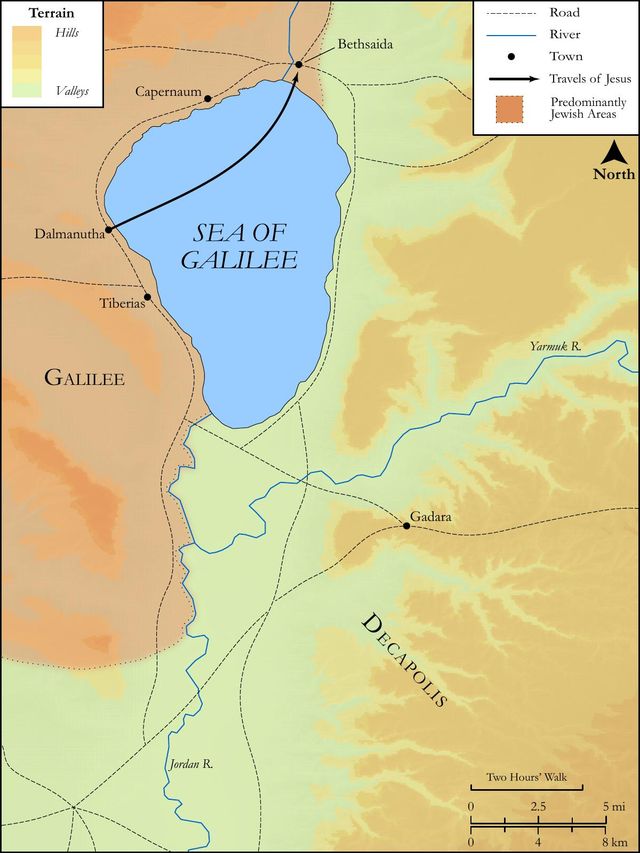
(l. I. ep. 233.) Our Lord because He hates the men of blood, and those that dwell with them, as long as they depart not from their crimes, after the murder of the Baptist left the murderers and departed; as it follows, And he took them, and went aside privately into a desert place belonging to the city called Bethsaida.
But he said to them, "You give them something to eat." He challenges the apostles to the breaking of bread, so that, as they declare themselves not to have anything, the greatness of the miracle might become more known, at the same time suggesting that through them our hungry hearts are to be fed daily. For what does Peter do when he speaks through the Epistles, if not to fill our poorly hungry hearts with the nourishment of the word? What do Paul and John achieve by speaking through the Epistles, if not that our minds may perceive heavenly nourishment and overcome the revulsion of famine by which they were dying?
But they not only tell Him what they had done and taught, but also, as Matthew implies, the things which John suffered while they were occupied in teaching, are now repeated to Him either by His own, or, according to Matthew, by John's disciples. (Matt. 14:12.)
Now Bethsaida is in Galilee, the city of the Apostles Andrew, Peter, and Philip, near the lake of Gennesaret. Our Lord did not this from fear of death, (as some think,) but to spare His enemies, lest they should commit two murders, waiting also for the proper time for His own sufferings.
But He as the powerful and merciful Saviour by receiving the weary, by teaching the ignorant, curing the sick, filling the hungry, implies how He was pleased with their devotion; as it follows, And he received them, and spake unto them of the kingdom of God, &c.
Who Himself having left Judæa, which by unbelief had bereft herself of the source of prophecy, in the desert of the Church which had no husband, dispenses the food of the word. But many companies of the faithful leaving the city of their former manner of life, and their various opinions, follow Christ into the deserts of the Gentiles.
Now when the day was going down, he refreshes the multitudes, that is, as the end of the world approaches, or when the Sun of righteousness sets for us.
The Apostles had only got but the five loaves of the Mosaic law, and the two fishes of each covenant, which were covered in the secret place of obscure mysteries, as in the waters of the deep. But because men have five external senses, the five thousand men who followed the Lord signify those who still live in worldly ways, knowing well how to use the external things they possess. For they who entirely renounce the world are raised aloft in the enjoyment of His Gospel feast. But the different divisions of the guests, indicate the different congregations of Churches throughout the world, which together compose the one Catholic.
Now our Saviour does not create new food for the hungry multitudes, but He took those things which the disciples had and blessed them, since coming in the flesh He preaches nothing else than what had been foretold, but demonstrates the words of prophecy to be pregnant with the mysteries of grace; He looks towards heaven, that thither He may teach us to direct the eye of the mind, there to seek the light of knowledge; He breaks and distributes to the disciples to be placed before the multitude, because He revealed to them the Sacraments of the Law and the Prophets that they might preach them to the world.
Or by the twelve baskets the twelve Apostles are figured, and all succeeding teachers, despised indeed by men without, but within loaded with the fragments of saving food.
But they said: We have no more than five loaves and two fish. The apostles did not yet have more than five loaves of the Mosaic law and two fish of both Testaments, which, for a longer time, were hidden in the mystery of things latent, as if covered and nourished by the waves of the abyss. However, it is well said in the Gospel of John that the loaves, which designate the law, were barley loaves, which is the food of draught animals and most rustic slaves: because to beginners and those not yet perfected, harsher and coarser precepts are to be entrusted. For the animal man does not receive the things of the spirit of God (1 Cor. II). And so the Lord, giving gifts to each according to their strength, and always provoking to greater perfection, first feeds five thousand with five loaves, then four thousand with seven loaves. Thirdly, he entrusts the mystery of his flesh and blood to his disciples. Finally, he grants the great gift to the elect, that they may eat and drink at his table in the kingdom.
But our Lord went into a desert place because He was about to perform the miracle of the loaves of bread, that no one should say that the bread was brought from the neighbouring cities.
That you may learn that the wisdom which is in us is distributed into word and work, and that it becomes us to speak of what has been done, and to do what we speak of. But when the day was wearing away, the disciples now beginning to have a care of others take compassion on the multitude.
Now He said not this as ignorant of their answer, but wishing to induce them to tell Him how much bread they had, that so a great miracle might be manifested through their confession, when the quantity of bread was made known.
Our Lord teaches us, that when we entertain any one, we ought to make him sit down at meat, and partake of every comfort. Hence it follows, And he said to his disciples, &c.
And that we might learn the value of hospitality, and how much our own store is increased when we help those that need.
There is an activity of God displayed throughout creation, a wholesale activity let us say which men refuse to recognize. The miracles done by God incarnate, living as a man in Palestine, perform the very same things as this wholesale activity, but at a different speed and on a smaller scale. One of their chief purposes is that men, having seen a thing done by personal power on the small scale, may recognize, when they see the same thing done on the large scale, that the power behind it is also personal – is indeed the very same person who lived among us two thousand years ago. The miracles in fact are a retelling in small letters of the very same story which is written across the whole world in letters too large for some of us to see...
Every year God makes a little corn into much corn: the seed is sown and there is an increase, and men, according to the fashion of their age, say “It is Ceres, it is Adonis, it is the Corn-King,” or else “It is the laws of Nature.” The close-up, the translation, of this annual wonder is the feeding of the five thousand. Bread is not made there of nothing. Bread is not made of stones, as the Devil once suggested to Our Lord in vain. A little bread is made into much bread. The Son will do nothing but what He sees the Father do. There is, so to speak, a family style...
When He fed the thousands He multiplied fish as well as bread. Look in every bay and almost every river. This swarming, pulsating fecundity shows He is still at work. The ancients had a god called Genius – the god of animal and human fertility, the presiding spirit of gynecology, embryology, or the marriage bed – the “genial bed” as they called it after its god Genius. As the miracles of wine and bread and healing showed who Bacchus really was, who Ceres, who Apollo, and that all were one, so this miraculous multiplication of fish reveals the real Genius.
Continue studying Luke 9:13 across the web’s major study libraries — every link below opens this exact verse, chapter, or book on the destination site.
Read & Compare
 BibleGatewayThis verse in more than 200 translations and 70 languages.
 Bible.comThe YouVersion reader — hundreds of translations, reading plans, and highlights.
 ESV.orgCrossway's official English Standard Version reader.
 NET BibleThe NET translation with 60,000+ translators' notes on every rendering decision.
 STEP BibleTyndale House's free study tool — original text, vocabulary, and scholarly resources.
 BibliaLogos Bible Software's free web reader.
 USCCBThe New American Bible (Revised Edition) with the U.S. bishops' study notes.
Commentaries
 BibleHub CommentariesDozens of classic commentaries on this verse, gathered on one page.
 StudyLightMore than 100 commentary sets — the largest collection on the web.
 BibleRefPlain-English commentary on what this verse means, verse by verse.
 Enduring WordDavid Guzik's free commentary on this chapter, widely used by Bible teachers.
 Bible Study ToolsVerse commentary alongside Greek and Hebrew study aids.
Original Language & Research
- BibleHub InterlinearThe verse word by word — original language, transliteration, and English.
- BibleHub LexiconEvery word's original-language definition and Strong's entry.
 Blue Letter BibleDeep-study tools — Strong's numbers, concordance, and word studies.
 CNTR CollationThe earliest Greek manuscripts of this verse, collated letter by letter.
Sermons, Hymns & Audio


TrulyRandomVerse is not affiliated with these sites and doesn’t control their content. They’re linked because they’re genuinely useful.
Summary
Luke 9:13 captures a pivotal moment preceding the miraculous feeding of the five thousand, where Jesus issues a profound command to His disciples: "Give ye them to eat." This directive immediately exposes the vast chasm between the disciples' limited human resources—a mere five loaves and two fishes—and the immense need of the multitude, prompting their pragmatic suggestion to purchase food for the vast crowd. The verse thus sets the stage for a powerful demonstration of divine provision, highlighting both the disciples' initial bewilderment and the boundless capacity of Christ to meet overwhelming needs.
Context
ShowHideLiterary Context
Luke 9:13 is situated within a significant narrative block (Luke 9:10-17) detailing the feeding of the five thousand. Immediately prior, Jesus has returned from sending out the twelve disciples on a mission (Luke 9:1-6), and upon their return, He withdraws with them to a secluded place near Bethsaida (Luke 9:10). However, the crowds follow Him, and Jesus, moved by compassion, receives them, teaching about the kingdom of God and healing the sick (Luke 9:11). As evening approaches, the disciples, recognizing the logistical challenge of feeding such a large multitude in a desolate place, suggest sending the people away to find food in the surrounding villages and countryside (Luke 9:12). Jesus's command in verse 13 is a direct, unexpected counter-proposal to their practical, yet faithless, solution, initiating the miraculous event that follows.
Historical & Cultural Context
The setting is likely a remote, unpopulated area near Bethsaida, a city on the northeastern shore of the Sea of Galilee. Large crowds following a popular teacher like Jesus were common, often traveling significant distances and thus requiring sustenance. In ancient Galilee, food was typically simple and self-provided, or purchased in villages. The disciples' suggestion to send the crowd away reflects the practical realities of the time: there were no large-scale catering services, and feeding thousands in a wilderness setting was an impossible task by human means. Their mention of "five loaves and two fishes" points to the common staple diet of the poor in that region—barley loaves and small, dried fish. The sheer number of people, estimated at five thousand men, not counting women and children (Luke 9:14), underscores the immense scale of the problem from a human perspective, making the disciples' proposed solution of buying "meat" (food) for everyone seem the only logical, albeit financially impossible, option.
Key Themes
ShowHideThis verse contributes significantly to several key themes prevalent in Luke's Gospel and the broader biblical narrative. Firstly, it highlights the theme of divine provision and human inadequacy. The disciples' meager resources stand in stark contrast to the overwhelming need, setting the stage for Jesus to demonstrate His supernatural power to provide (compare with the manna in Exodus 16 or Elisha feeding one hundred men with twenty loaves in 2 Kings 4:42-44). Secondly, it underscores Jesus's compassion for the physical needs of humanity, as He does not dismiss the hunger of the crowd but actively seeks to meet it. This compassion is a hallmark of Luke's portrayal of Jesus, often showing Him ministering to the lowly and needy. Finally, the interaction foreshadows the theme of faith and obedience, as the disciples are called to act on Jesus's seemingly impossible command, even with their limited resources, demonstrating that God often works through human insufficiency when it is offered in faith (as seen in the broader miracle account in Luke 9:14-17).
Exposition and Analysis
ShowHideKey Word Analysis
ShowHideThis verb means "to give" in a very wide application, encompassing bestowing, committing, delivering, granting, and offering. In this context, it is an imperative command, placing a direct responsibility upon the disciples. It is not merely a suggestion but a divine directive, challenging their perception of their capabilities and resources. Jesus is not asking if they can give, but commanding them to give, implying His power will enable their obedience.
This term refers to "food" in general, literally or figuratively. While the KJV translates it as "meat," it more broadly means "victuals" or "provisions." The disciples' suggestion to "buy meat for all this people" reveals their conventional, human-centric solution to the problem—to acquire food through normal commercial means, a task far beyond their financial capacity for such a crowd.
This word specifically means "bread" or "a loaf." In the context of the disciples' meager supply of "five loaves," it highlights the stark reality of their limited provisions. These were likely small, flat barley loaves, common among the poor, emphasizing the extreme inadequacy of their resources in comparison to the thousands present.
Verse Breakdown
ShowHide"But he said unto them, Give ye them to eat."
This is Jesus's direct, authoritative command. The "but" (G1161, dé) indicates a contrast to the disciples' previous suggestion to send the crowds away. Jesus shifts the responsibility from Himself to the disciples, challenging their perception of what is possible and calling them to participate in His divine provision. It is an imperative that demands action despite apparent impossibility.
"And they said, We have no more but five loaves and two fishes;"
The disciples' response is one of pragmatic realism, bordering on exasperation. They state their total inventory, emphasizing its extreme scarcity with the phrase "no more but" (G3756 ou G1526 eisí G4119 pleíōn G2228 ḗ). This highlights their human limitation and the perceived futility of the command given their meager resources. Their focus is on what they lack rather than what Jesus can do.
"except we should go and buy meat for all this people."
This clause presents the disciples' logical, yet impossible, alternative. They understand the need for food ("meat" / brōma) for "all this people" (G3956 pâs G5126 toûton G2992 laós) and propose the only human solution: to purchase it. The phrase "except we should go and buy" (G1509 ei mḗ ti G4198 poreúomai G59 agorázō) underscores their recognition that their current resources are utterly insufficient, and any solution would require a vast expenditure, which they clearly do not possess.
Literary Devices
ShowHideThe verse employs several significant literary devices. Contrast is prominent, juxtaposing Jesus's seemingly impossible command with the disciples' stark reality of scarcity. This sets up the dramatic tension that will be resolved by the miracle. Irony is also present: Jesus tells those with virtually nothing to feed thousands, highlighting the divine reversal of human logic. The Dialogue format effectively reveals the differing perspectives: Jesus's divine authority and compassion versus the disciples' human practicality and limited vision. The disciples' response also uses Understatement (or perhaps Litotes), as "no more but five loaves and two fishes" is an extreme understatement of the resources needed for 5,000+ people, emphasizing their utter inadequacy. This dramatic setup serves to magnify the power of the subsequent miracle.
Theological and Thematic Connections
ShowHideLuke 9:13 is a profound theological statement on God's nature as provider and humanity's call to participate in His work, even from a place of perceived insufficiency. It challenges the common human tendency to rely solely on visible resources and highlights the divine economy, where God often uses the "little" that is surrendered in faith to accomplish "much." The disciples' initial focus on scarcity ("no more but five loaves and two fishes") mirrors humanity's frequent inability to grasp God's boundless capacity. Jesus's command, "Give ye them to eat," is an invitation to trust in His power to multiply, not just to manage existing resources. This event prefigures the spiritual sustenance Jesus offers, demonstrating that He is the ultimate source of life and provision, capable of satisfying the deepest hunger of humanity.
Reflection and Application
ShowHideLuke 9:13 serves as a timeless challenge to our faith and a powerful reminder of God's boundless capacity to work through our perceived limitations. In our own lives, we often face "multitudes" of needs—whether in our communities, families, or personal struggles—that seem overwhelming, and our "five loaves and two fishes" (our limited time, talent, finances, or energy) feel utterly inadequate. Like the disciples, our first instinct might be to retreat, to send the problem away, or to seek conventional, human-centric solutions that are beyond our means. However, Jesus's command to "Give ye them to eat" calls us to a different response. It invites us to bring our insufficiency, our meager offerings, and our perceived lack to Him. It teaches us that true provision comes not from the abundance of our own resources, but from the power of Christ multiplying what we faithfully surrender. This verse encourages us to step out in obedience, trusting that when we offer what little we have to God, He can transform it into something miraculous, far exceeding our expectations and demonstrating His glory. It is a call to move from a mindset of scarcity to one of divine abundance, recognizing that with Christ, all things are possible.
Questions for Reflection
ShowHideFAQ
ShowHideWhy did Jesus tell the disciples to feed the crowd when He knew they had so little?
ShowHideJesus's command to "Give ye them to eat" (G1325 dídōmi G5315 phágō) served several crucial purposes. Firstly, it was a test of the disciples' faith and understanding. They had just returned from a mission where they had witnessed Jesus's power (Luke 9:1-6), and this situation presented an immediate opportunity for them to apply their lessons and trust in His supernatural ability. Secondly, it revealed their human limitations and pragmatic, yet ultimately insufficient, solutions. Their response, highlighting their meager resources and the impossibility of buying enough food, underscored the vast chasm between human capacity and divine power. By placing the responsibility on them, Jesus prepared them to witness and participate in a profound miracle, teaching them that His power could work through their insufficiency. It was a pedagogical moment, designed to deepen their reliance on Him and to demonstrate that true provision comes from God, not from human ingenuity or resources. This event was a foundational lesson in divine economics and the nature of faith.
Christ-Centered Fulfillment
ShowHideLuke 9:13, though seemingly a simple command and a statement of human limitation, profoundly points to Christ as the ultimate Provider and the "Bread of Life." Jesus's directive, "Give ye them to eat," is not merely a logistical instruction but a foreshadowing of His own self-giving. He is not just commanding His disciples to feed the hungry; He is demonstrating His divine nature as the one who can satisfy the deepest human needs, both physical and spiritual. This miracle, where a meager offering is multiplied to feed thousands, prefigures the greater spiritual sustenance Jesus offers through His body and blood, given for the life of the world (as articulated in John 6:51). Just as the physical loaves were broken and distributed, Jesus's own body would be broken on the cross, providing spiritual nourishment for all who believe (see 1 Corinthians 11:23-26). The disciples' inability to provide highlights humanity's spiritual bankruptcy, while Jesus's miraculous provision points to His all-sufficiency. He is the one who truly takes away the hunger of the soul, inviting all to come and eat of Him, the true bread from heaven (compare John 6:35). Thus, this passage is a powerful testament to Jesus's compassion, His divine power, and His ultimate fulfillment as the one who provides eternal life.