


Mark 6:37
Bible text: King James Version (1769 Blayney text) · Public domain
Bible text: King James Version with Strong's numbers · Public domain
Bible text: Berean Standard Bible · Public domain
Bible text: American Standard Version (1901) · Public domain
Bible text: World English Bible, Messianic edition · Public domain
Bible text: Geneva Bible (1599) · Public domain
Bible text: Young's Literal Translation · Public domain
- ὁho<the>G3588T-NSMDefinite article Nominative Singular Masculine
- δὲdeButG1161CONJConjunction
- ἀποκριθεὶςapokritheisansweringG611V-AOP-NSMVerb Aorist Passive Deponent Participle Nominative Singular Masculine
- εἶπενeipenHe saidG2036V-2AAI-3SVerb 2nd Aorist Active Indicative 3rd Singular
- αὐτοῖς·autoisto themG846P-DPMPersonal pronoun Dative Plural Masculine
- δότεdotedo giveG1325V-2AAM-2PVerb 2nd Aorist Active Imperative 2nd Plural
- αὐτοῖςautoisto themG846P-DPMPersonal pronoun Dative Plural Masculine
- ὑμεῖςhumeisyou yourselvesG4771P-2NPPersonal pronoun Nominative 2nd Plural
- φαγεῖνphagein[something] to eatG5315V-AANVerb Aorist Active Infinitive
- καὶkaiAndG2532CONJConjunction
- λέγουσινlegousinthey sayG3004V-PAI-3PVerb Present Active Indicative 3rd Plural
- αὐτῷ·autōto HimG846P-DSMPersonal pronoun Dative Singular Masculine
- ἀπελθόντεςapelthontesHaving goneG565V-2AAP-NPMVerb 2nd Aorist Active Participle Nominative Plural Masculine
- ἀγοράσωμενagorasōmenshall we buyG59V-AAS-1PVerb Aorist Active Subjunctive 1st Plural
- δηναρίωνdēnariōndenariiG1220N-GPNNoun Genitive Plural Neuter
- διακοσίωνdiakosiōntwo hundredG1250A-GPNAdjective Genitive Plural Neuter
- ἄρτουςartousof breadG740N-APMNoun Accusative Plural Masculine
- καὶkaiand [then]G2532CONJConjunction
- δώσομενdōsomenwe will giveG1325V-FAI-1PVerb Future Active Indicative 1st Plural
- αὐτοῖςautoisthem [it]G846P-DPMPersonal pronoun Dative Plural Masculine
- φαγεῖν;phageinto eat?G5315V-AANVerb Aorist Active Infinitive
English is a literal word-by-word gloss of the Greek, not the KJV's wording. Why?
This is the original text the KJV's translators worked from — each Greek word with its own literal English meaning in this verse, prepared by scholars at Tyndale House, Cambridge. The KJV translates whole sentences, not word by word, so its wording differs: one Greek word can become several English words, and the KJV may choose “charity” where the gloss reads “love”. Both are faithful — they answer different questions. For the KJV's own rendering, switch to the KJV text.
Details
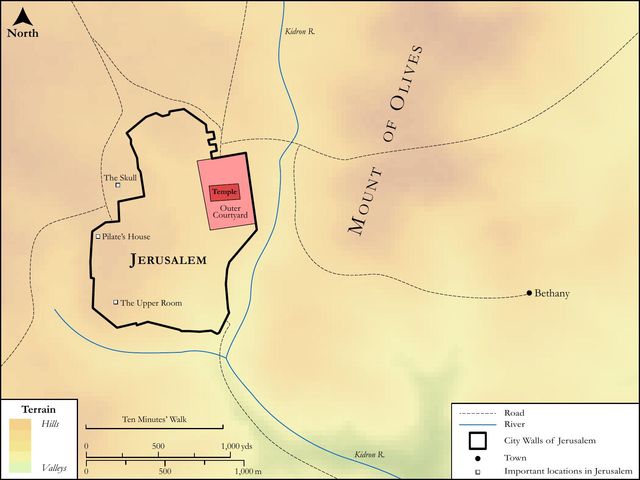
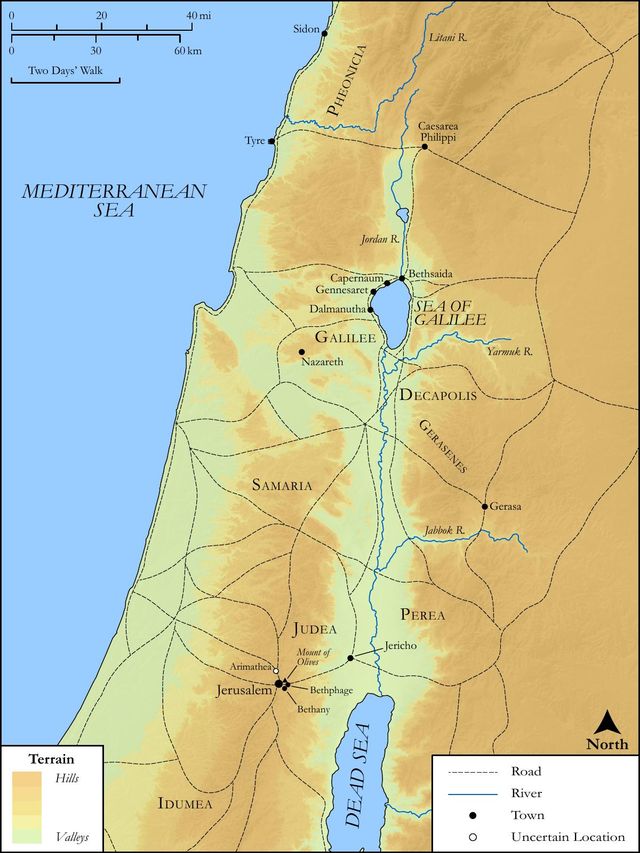
See on the biblical-era maps

Study this verse
Public-domain commentary
Matthew Henry
From his Commentary on the Whole Bible. Henry comments on passages, not single verses — this entry covers Mark 6:30–44. His three-level outline is real structure in the source text, so it is rendered as structure.
In there verses, we have,
I.The return to Christ of the apostles whom he had sent forth (Mar 6:7), to preach, and work miracles.
They had dispersed themselves into several quarters of the country for some time, but when they had made good their several appointments, by consent they gathered themselves together, to compare notes, and came to Jesus, the centre of their unity, to give him an account of what they had done pursuant to their commission: as the servant that was sent to invite to the feast, and had received answers from the guests, came, and showed his Lord all those things, so did the apostles here; they told him all things, both what they had done, and what they had taught. Ministers are accountable both for what they do, and for what they teach; and must both watch over their own souls, and watch for the souls of others, as those that must give account, Heb 13:17. Let them not either do any thing, or teach any thing, but what they are willing should be related and repeated to the Lord Jesus. It is a comfort to faithful ministers, when they can appeal to Christ concerning their doctrine and manner of life, both which perhaps have been misrepresented by men; and he gives them leave to be free with him, and to lay open their case before him, to tell him all things, what treatment they have met with, what success, and what disappointment.
II.The tender care Christ took for their repose, after the fatigue they had (Mar 6:31); He said unto them, perceiving them to be almost spent, and out of breath, Come ye yourselves apart into a desert place, and rest awhile. It should seem that John's disciples came to Christ with the mournful tidings of their master's death, much about the same time that his own disciples came to him with the report of their negotiation. Note, Christ takes cognizance of the frights of some, and the toils of others, of his disciples, and provides suitable relief for both, rest for those that are tired, and refuge for those that are terrified. With what kindness and compassion doth Christ say to them, Come, and rest! Note, The most active servants of Christ cannot be always upon the stretch of business, but have bodies that require some relaxation, some breathing-time; we shall not be able to serve God without ceasing, day and night, till we come to heaven, where they never rest from praising him, Rev 4:8. And the Lord is for the body, considers its frame, and not only allows it time for rest, but puts it in mind of resting. Come, my people, enter thou into thy chambers. Return to thy rest. And those that work diligently and faithfully, may cheerfully retire to rest. The sleep of the labouring man is sweet. But observe,
1.Christ calls them to come themselves apart; for, if they had any body with them, they would have something to say, or something to do, for their good; if they must rest, they must be alone.
2.He invites them not to some pleasant country-seat, where there were fine buildings and fine gardens, but into a desert place, where the accommodations were very poor, and which was fitted by nature only, and not by art, for quietness and rest. But it was of a piece with all the other circumstances he was in; no wonder that he who had but a ship for his preaching place, had but a desert for his resting place.
3.He calls them only to rest awhile; they must not expect to rest long, only to get breath, and then to go to work again. There is no remaining rest for the people of God till they come to heaven.
4.The reason given for this, is, not so much because they had been in constant work, but because they now were in a constant hurry; so that they had not their work in any order; for there were many coming and going, and they had no leisure so much as to eat. Let but proper time be set, and kept for every thing, and a great deal of work may be done with a great deal of ease; but if people be continually coming and going, and no rule or method be observed, a little work will not be done without a deal of trouble.
5.They withdrew, accordingly, by ship; not crossing the water, but making a coasting voyage to the desert of Bethsaida, Mar 6:32. Going by water was much less toilsome than going by land would have been. They went away privately, that they might be by themselves. The most public persons cannot but wish to be private sometimes.
III.The diligence of the people to follow him.
It was rude to do so, when he and his disciples were desirous, for such good reason, to retire; and yet they are not blamed for it, nor bid to go back, but bid welcome. Note, A failure in good manners will easily be excused in those who follow Christ, if it be but made up in a fulness of good affections. They followed him of their own accord, without being called upon. Here is no time set, no meeting appointed, no bell tolled; yet they thus fly like a cloud, and as the doves to their windows. They followed him out of the cities, quitted their houses and shops, their callings and affairs, to hear him preach. They followed him afoot, though he was gone by sea, and so, to try them, seemed to put a slight upon them, and to endeavour to shake them off; yet they stuck to him. They ran afoot, and made such haste, that they out-went the disciples, and came together to him with an appetite to the word of God. Nay they followed him, though it was into a desert place, despicable and inconvenient. The presence of Christ will turn a wilderness into a paradise.
IV.The entertainment Christ gave them (Mar 6:34); When he saw much people, instead of being moved with displeasure, because they disturbed him when he desired to be private, as many a man, many a good man, would have been, he was moved with compassion toward them, and looked upon them with concern, because they were as sheep having no shepherd, they seemed to be well-inclined, and manageable as sheep, and willing to be taught, but they had no shepherd, none to lead and guide them in the right way, none to feed them with good doctrine: and therefore, in compassion to them, he not only healed their sick, as it is in Matthew, but he taught them many things, and we may be sure that they were all true and good, and fit for them to learn.
V.The provision he made for them all; all his hearers he generously made his guests, and treated them at a splendid entertainment: so it might truly be called, because a miraculous one.
1.The disciples moved that they should be sent home. When the day was not far spent, and night drew on, they said, This is a desert place, and much time is now past; send them away to buy bread, Mar 6:35, Mar 6:36. This the disciples suggested to Christ; but we do not find that the multitude themselves did. They did not say, Send us away (though they could not but be hungry), for they esteemed the words of Christ's mouth more than their necessary food, and forgot themselves when they were hearing him; but the disciples thought it would be a kindness to them to dismiss them. Note, Willing minds will do more, and hold out longer, in that which is good, than one would expect from them.
2.Christ ordered that they should all be fed (Mar 6:37); Give ye them to eat. Though their crowding after him and his disciples hindered them from eating (Mar 6:31), yet he would not therefore, to be even with them, send them away fasting, but, to teach us to be kind to those who are rude to us, he ordered provision to be made for them; that bread which Christ and his disciples took with them into the desert, that they might make a quiet meal of it for themselves, he will have them to partake of. Thus was he given to hospitality. They attended on the spiritual food of his word, and then he took care that they should not want corporal food. The way of duty, as it is the way of safety, so it is the way to supply. Let God alone to fill the pools with rain from heaven, and so to make a well even in the valley of Baca, for those that are going Zion-ward, from strength to strength, Psa 84:6, Psa 84:7. Providence, not tempted, but duly trusted, never yet failed any of God's faithful servants, but has refreshed many with seasonable and surprising relief. It has often been seen in the mount of the Lord, Jehovah-jireh, that the Lord will provide for those that wait on him.
3.The disciples objected against it as impracticable; Shall we go, and buy two hundred penny-worth of bread, and give them to eat? Thus, through the weakness of their faith, instead of waiting for directions from Christ, they perplex the cause with projects of their own. It was a question, whether they had two hundred pence with them, whether the country would of a sudden afford so much bread if they had, and whether that would suffice so great a company; but thus Moses objected (Num 11:22), Shall the flocks and the herds be slain for them? Christ would let them see their folly in forecasting for themselves, that they might put the greater value upon his provision for them.
4.Christ effected it, to universal satisfaction. They had brought with them five loaves, for the victualling of their ship, and two fishes perhaps they caught as they came along; and that is the bill of fare. This was but a little for Christ and his disciples, and yet this they must give away, as the widow her two mites, and as the church of Macedonia's deep poverty abounded to the riches of their liberality. We often find Christ entertained at other people's tables, dining with one friend, and supping with another: but here we have him supping a great many at his own charge, which shows that, when others ministered to him of their substance, it was not because he could not supply himself otherwise (if he was hungry, he needed not tell them); but it was a piece of humiliation, that he was pleased to submit to, nor was it agreeable to the intention of miracles, that he should work them for himself. Observe,
(1.)The provision was ordinary. Here were no rarities, no varieties, though Christ, if he had pleased, could have furnished his table with them; but thus he would teach us to be content with food convenient for us, and not to be desirous of dainties. If we have for necessity, it is no matter though we have not for delicacy and curiosity. God, in love, gives meat for our hunger; but, in wrath, gives meat for our lusts, Psa 78:18. The promise to them that fear the Lord, is, that verily they shall be fed; he doth not say, They shall be feasted. If Christ and his disciples took up with mean things, surely we may.
(2.)The guests were orderly; for they sat down by companies on the green grass (Mar 6:39), they sat down in ranks by hundreds and by fifties (Mar 6:40), that the provision might the more easily and regularly be distributed among them; for God is the God of order, and not of confusion. Thus care was taken that every one should have enough, and none be over-looked, nor any have more than was fitting.
(3.)A blessing was craved upon the meat; He looked up to heaven, and blessed. Christ did not call one of his disciples to crave a blessing, but did it himself (Mar 6:41); and by virtue of this blessing the bread strangely multiplied, and so did the fishes, for they did all eat, and were filled, though they were to the number of five thousand, Mar 6:42, Mar 6:44. This miracle was significant, and shows that Christ came into the world, to be the great feeder as well as the great healer; not only to restore, but to preserve and nourish, spiritual life; and in him there is enough for all that come to him, enough to fill the soul, to fill the treasures; none are sent empty away from Christ, but those that come to him full of themselves.
(4.)Care was taken of the fragments that remained, with which they filled twelve baskets. Though Christ had bread enough at command, he would hereby teach us, not to make waste of any of God's good creatures; remembering how many there are that do want, and that we know not but we may some time or other want such fragments as we throw away.
Historical interpretation
Sixteen Centuries of Reception
9 surviving comments on this verse. Each one is dated, so this reads as a timeline rather than a list.
Select a marker to jump to its quote. Markers stagger vertically where authors wrote within a few decades of each other.
Or, in the gathering of the twelve baskets full of fragments, is signified the time, when they shall sit on thrones, judging all who are left of Abraham, Isaac, and Jacob, the twelve tribes of Israel, when the remnant of Israel shall be saved.
As man he was put to the test, but as God he came through victorious—yes, he bids us be of good cheer, because he has conquered the world. He hungered—yet he fed thousands. He is indeed “living, heavenly bread.” He thirsted—yet he exclaimed: “Whoever thirsts, let him come to me and drink.” Indeed he promised that believers would become fountains.
(Con. Evan. 2. 46) This in the Gospel of John is the answer of Philip, but Mark gives it as the answer of the disciples, wishing it to be understood that Philip made this answer as a mouthpiece of the others; although he might put the plural number for the singular, as is usual. It goes on, And he saith unto them, How many loaves hare ye? go and see. The other Evangelists pass over this being done by the Lord. It goes on, And when they knew, they say, Five, and two fishes. This, which was suggested by Andrew, as we learn from John, the other Evangelists, using the plural for the singular, have put into the mouth of the disciples. It goes on, And he commanded them to wake all sit down by companies upon the green grass, and they sat down in ranks by hundreds and by fifties. But we need not be perplexed, though Luke says that they were ordered to sit down by fifties, and Mark by hundreds and fifties, for one has mentioned a part, the other the whole. Mark, who mentions the hundreds, fills up what the other has left out.
For if the incarnation was a fantasy, then our salvation is a delusion. The Christ was at the same time visible man and invisible God. He ate as man, quite like ourselves. He possessed from his humanness the same passions we have. He fed the five thousand with five loaves as God. As man he really died. As God he raised the dead on the fourth day. As human he slept in the boat. As God he walked upon the waters.
(Mor. 16, 55) The different ranks in which those who ate lie down, mark out the divers churches which make up the one Catholicx. But the Jubilee rest is contained in the mystery of the number fifty, and fifty must be doubled before it reaches up to a hundred. As then the first step is to rest from doing evil, that afterwards the soul may rest more fully from evil thoughts, some lie down in parties of fifty, others of a hundred.
(in Marc. 2, 26) But when Christ goes to the deserts of the Gentiles, many bauds of the faithful leaving the walls of their cities, that is their old manner of living, follow Him.
(ubi sup.) The time being far spent, points out that it was evening. Wherefore Luke says, But the day had begun to decline.
(ubi sup.) By these words He calls on His Apostles, to break bread for the people, that they might be able to testify that they had no bread, and thus the greatness of the miracle might become more known.
(ubi sup.) Again, in a mystical sense, the Saviour refreshes the hungry crowds at the day's decline, because, either now that the end of the world approaches, or now that the Sun of justice has set in death for us, we are saved from wasting away in spiritual hunger. He calls the Apostles to Him at the breaking of bread, intimating that daily by them our hungry souls are fed, that is, by their letters and examples. By the five loaves are figured the Five Books of Moses, by the two fishes the Psalms and Prophets.
(ubi sup.) wThere are five senses in the outward man, which shows that by the five thousand men are meant those who, living in the world, know how to make a good use of external things.
(ubi sup.) Again, those men lie down on grass and are fed by the food of the Lord, who have trodden under foot their concupiscences by continence, and apply themselves diligently to hear and fulfil the words of God. The Saviour, however, does not create a new sort of food; for when He came in the flesh He preached no other things than were predicted, but showed how pregnant with mysteries of grace were the writings of the Law and the Prophets. He looks up to heaven, that He may teach us that there we must look for grace. He breaks and distributes to the disciples that they may place the bread before the multitudes, because He has opened the mysteries of prophecy to holy doctors, who are to preach them to the whole world. What is left by the crowd is taken up by the disciples, because the more sacred mysteries, which cannot be received by the foolish, are not to be passed by with negligence, but to be inquired into by the perfect. For by the twelve baskets, the Apostles and the following Doctors are typified, externally indeed despised by men, but inwardly full of healthful food. For all know that carrying baskets is a part of the work of slaves.
And he answering said to them: Give them something to eat. He provokes the apostles to the breaking of the bread, so that by their testifying they have nothing, the greatness of the sign might be better known: at the same time insinuating that daily through them our fasting hearts must be fed, clearly when we are roused to love heavenly things either by their examples or their writings. Note, however, that the evangelist John, writing about this miracle of the loaves, prefaced it with the announcement that the Passover, the feast day of the Jews, was near. However, Matthew and Mark recall that this happened immediately after John was killed. From this, it is inferred that John was beheaded at the approach of this same Paschal festival, and the mystery of the Lord's Passion was completed in the following year, when the Paschal time returned again. And therefore, signified in the book of the Sacraments is his nativity on the fourth Kalends of September, and in the Martyrology, which is adorned with the names of Eusebius and Jerome, it is read: on the fourth Kalends of September, in the city of Edessa in the province of Phoenicia, the nativity of John the Baptist, the day on which he was beheaded: this does not specifically denote the day of his beheading, but rather the day on which his head was found in the same city of Edessa and placed in a church. Indeed, as the Chronicles of Marcellinus testify, in the time of Emperor Marcian, two eastern monks came to Jerusalem to worship and see the holy places; to whom the same precursor of the Lord, standing by revelation, commanded to go to the dwelling of Herod the king and seek his head there, and upon finding it, to place it in honor. Found by them and taken, but soon lost through negligence, it was brought to Edessa by others and placed in a certain cave in an urn underground, ignobly for a considerable time, until John again showed himself and his head to a certain pious abbot and priest named Marcellus, when he lived in the same cave. Clearly, it was found by the bishop of that city, named Julioramus, through the aforementioned priest. From that time, the beheading of the blessed precursor began to be celebrated in that city on the day when his head was found or lifted. You will find this written more extensively in the aforementioned book of Chronicles.
The Lord, placing before them, first, what is most profitable, that is, the food of the word of God, afterwards also gave the multitude food for their bodies; in beginning to relate which, the Evangelist says, And when the day was now far spent, his disciples came unto him, and said, This is a desert place.
See now, how those who are disciples of Christ grow in love to man, for they pity the multitudes, and come to Christ to intercede for them. But the Lord tried them, to see whether they would know that His power was great enough to feed them. Wherefore it goes on, He answered, and said unto them, Give ye them to eat.
But the disciples thought that He did not know what was necessary for the feeding of so large a multitude, for their answer shows that they were troubled. For it goes on, And they said unto him, Let us go and buy two hundred pennyworth, of bread, and give them to eat.
We are given to understand that they lay down in parties, separate from one another, for what is translated by companies, is repeated twice over in the Greek, as though it were by companies and companies. It goes on, And when he had taken the five loaves and the two fishes, he looked up to heaven, and blessed, and brake the loaves, and gave them to his disciples to set before them: and the two fishes divided he among them all.
He also looks up to heaven, that He may teach us to seek our food from God, and not from the devil, as they do who unjustly feed on other men's labours. By this also He intimated to the crowd, that He could not be opposed to God, since He called upon God. And He gives the bread to His disciples to set before the multitude, that by handling the bread, they might see that it was an undoubted miracle. It goes on: And they did all eat, and were filled: and they took up twelve baskets full of the fragments. Twelve baskets of fragments remained over and above, that each of the Apostles, carrying a basket on his shoulder, might recognise the unspeakable wonder of the miracle. For it was a proof of overflowing power not only to feed so many men, but also to leave such a superabundance of fragments. Even though Moses gave manna, yet what was given to each was measured by his necessity, and what was over and above was overrun with worms. Elias also fed the woman, but gave her just what was enough for her; but Jesus, being the Lord, makes his gifts with superabundant profusion.
Or the two fishes are the discourses of fishermen, that is, their Epistles and Gospel.
There is an activity of God displayed throughout creation, a wholesale activity let us say which men refuse to recognize. The miracles done by God incarnate, living as a man in Palestine, perform the very same things as this wholesale activity, but at a different speed and on a smaller scale. One of their chief purposes is that men, having seen a thing done by personal power on the small scale, may recognize, when they see the same thing done on the large scale, that the power behind it is also personal – is indeed the very same person who lived among us two thousand years ago. The miracles in fact are a retelling in small letters of the very same story which is written across the whole world in letters too large for some of us to see...
Every year God makes a little corn into much corn: the seed is sown and there is an increase, and men, according to the fashion of their age, say “It is Ceres, it is Adonis, it is the Corn-King,” or else “It is the laws of Nature.” The close-up, the translation, of this annual wonder is the feeding of the five thousand. Bread is not made there of nothing. Bread is not made of stones, as the Devil once suggested to Our Lord in vain. A little bread is made into much bread. The Son will do nothing but what He sees the Father do. There is, so to speak, a family style...
When He fed the thousands He multiplied fish as well as bread. Look in every bay and almost every river. This swarming, pulsating fecundity shows He is still at work. The ancients had a god called Genius – the god of animal and human fertility, the presiding spirit of gynecology, embryology, or the marriage bed – the “genial bed” as they called it after its god Genius. As the miracles of wine and bread and healing showed who Bacchus really was, who Ceres, who Apollo, and that all were one, so this miraculous multiplication of fish reveals the real Genius.
Continue studying Mark 6:37 across the web’s major study libraries — every link below opens this exact verse, chapter, or book on the destination site.
Read & Compare
 BibleGatewayThis verse in more than 200 translations and 70 languages.
 Bible.comThe YouVersion reader — hundreds of translations, reading plans, and highlights.
 ESV.orgCrossway's official English Standard Version reader.
 NET BibleThe NET translation with 60,000+ translators' notes on every rendering decision.
 STEP BibleTyndale House's free study tool — original text, vocabulary, and scholarly resources.
 BibliaLogos Bible Software's free web reader.
 USCCBThe New American Bible (Revised Edition) with the U.S. bishops' study notes.
Commentaries
 BibleHub CommentariesDozens of classic commentaries on this verse, gathered on one page.
 StudyLightMore than 100 commentary sets — the largest collection on the web.
 BibleRefPlain-English commentary on what this verse means, verse by verse.
 Enduring WordDavid Guzik's free commentary on this chapter, widely used by Bible teachers.
 Bible Study ToolsVerse commentary alongside Greek and Hebrew study aids.
Original Language & Research
- BibleHub InterlinearThe verse word by word — original language, transliteration, and English.
- BibleHub LexiconEvery word's original-language definition and Strong's entry.
 Blue Letter BibleDeep-study tools — Strong's numbers, concordance, and word studies.
 CNTR CollationThe earliest Greek manuscripts of this verse, collated letter by letter.
Sermons, Hymns & Audio


TrulyRandomVerse is not affiliated with these sites and doesn’t control their content. They’re linked because they’re genuinely useful.
Summary
Mark 6:37 captures a pivotal exchange between Jesus and His disciples just before the miraculous feeding of the five thousand, starkly illustrating the chasm between human limitations and divine power. Following Jesus' compassionate observation of the vast, hungry crowd, He issues a direct command to His disciples to feed them. Their immediate response, rooted in human logic and financial constraints, reveals their incredulity, calculating the immense cost required—a sum equivalent to eight months' wages—thereby setting the stage for Jesus to demonstrate His supernatural provision.
Context
ShowHideLiterary Context
This verse is embedded within the broader narrative of Jesus' ministry in Galilee, specifically following the disciples' return from their first missionary journey and the tragic news of John the Baptist's death. Jesus, seeking a quiet place for rest and teaching, finds Himself confronted by an immense crowd. The immediate verses, Mark 6:34-36, describe Jesus' deep compassion for the people, whom He saw as "sheep without a shepherd," and the disciples' practical, but limited, suggestion to send the crowds away to buy food. Jesus' command in Mark 6:37 directly challenges their human-centric solution, initiating the miraculous feeding of the five thousand, a narrative also found in the other Gospels (Matthew 14:13-21, Luke 9:10-17, John 6:1-14).
Historical & Cultural Context
The setting is a desolate place, likely on the eastern side of the Sea of Galilee, far from towns or markets where such a large multitude could easily purchase food. The Jewish cultural expectation was that hospitality included providing food for guests, especially in such a remote area. The "two hundred pennyworth" (200 denarii) mentioned by the disciples was a significant sum. A denarius was a common day's wage for a laborer, meaning 200 denarii represented approximately eight months' wages. This figure underscores the sheer impossibility of the disciples meeting the need from their own resources or even from readily available communal funds, highlighting the economic reality of their situation and the vast scale of the crowd, estimated later to be five thousand men, besides women and children.
Key Themes
ShowHideMark 6:37 powerfully contributes to several overarching themes in Mark's Gospel. It highlights the theme of Divine Authority and Provision, contrasting Jesus' omnipotence with human inadequacy. Jesus' command, "Give ye them to eat," asserts His authority and intent to provide, challenging the disciples' reliance on their limited resources. This exchange also develops the theme of Discipleship and Faith, as the disciples are confronted with a task seemingly beyond their capabilities, forcing them to look beyond their own means. Their question reveals their Limited Understanding of Jesus' power, a recurring motif in Mark, where the disciples often struggle to grasp the full implications of Jesus' identity and mission, despite witnessing His miracles (e.g., Mark 4:41). Ultimately, this event serves as a foundational example of Jesus' compassion and His ability to meet both physical and spiritual needs, foreshadowing His identity as the true "Bread of Life" as later expounded in John 6.
Exposition and Analysis
ShowHideKey Word Analysis
ShowHideThis verb (G611) means "to conclude for oneself, i.e., to respond." In a Hebraic sense, it can also mean "to begin to speak where an address is expected." Here, it signifies Jesus' direct and decisive response to the disciples' suggestion to send the crowds away. It's not merely a casual reply but a deliberate counter-command, setting a new course of action.
This verb (G1325) is a primary verb meaning "to give," used in a very wide application, literally or figuratively. In this context, it is a direct imperative from Jesus: "You give them to eat." This command is a test, pushing the disciples beyond their natural capacities and forcing them to confront their limitations and Jesus' extraordinary expectations. It implies a transfer of responsibility and an invitation to participate in divine provision.
Derived from Latin, this noun (G1220) refers to a denarius, a Roman silver coin that was the typical daily wage for a common laborer. The mention of "two hundred pennyworth" (200 denarii) immediately conveys a substantial financial sum, equivalent to approximately eight months' wages. This detail highlights the disciples' practical, economic assessment of the situation, underscoring the human impossibility of the task from their perspective.
Verse Breakdown
ShowHide"He answered and said unto them, 'Give ye them to eat.'"
Jesus, responding to the disciples' suggestion to dismiss the crowds, issues a direct and challenging command. His words are not a question but an imperative, shifting the responsibility from the crowds to the disciples. This command forces them to consider how they, with their limited resources, could possibly feed such a vast multitude, setting up the dramatic demonstration of divine provision that follows.
"And they say unto him, Shall we go and buy two hundred pennyworth of bread, and give them to eat?"
The disciples' immediate reaction is one of incredulity and practical calculation. Their question is rhetorical, expressing the perceived impossibility of the task. They instantly calculate the immense financial outlay required ("two hundred pennyworth," or 200 denarii), highlighting the overwhelming scale of the need and their own utter inadequacy to meet it through conventional means. Their response reveals their human perspective, focused on visible resources and logistical constraints, rather than on Jesus' divine power.
Literary Devices
ShowHideThe passage employs several significant literary devices. Irony is prominent, as Jesus, the Son of God with infinite resources, commands His financially limited disciples to perform an impossible task. This creates a tension that is resolved by the subsequent miracle, highlighting the stark contrast between human limitation and divine capability. Contrast is also a key element, seen in the juxtaposition of Jesus' divine command ("Give ye them to eat") and the disciples' human, pragmatic response ("Shall we go and buy two hundred pennyworth of bread?"). This contrast emphasizes the disciples' lack of understanding and faith at this moment. Finally, the disciples' question itself functions as a Rhetorical Question, not seeking an actual answer from Jesus about buying bread, but rather expressing their astonishment, disbelief, and the perceived absurdity of the command from a purely human standpoint.
Theological and Thematic Connections
ShowHideMark 6:37 serves as a profound theological statement on God's nature as provider and humanity's call to faith despite perceived impossibilities. Jesus' command to "Give ye them to eat" is not merely a logistical instruction but a test of the disciples' faith, pushing them beyond their reliance on human resources and toward dependence on divine power. It underscores the principle that God often calls His people to tasks that exceed their natural abilities, precisely so that His power, not theirs, may be glorified. The disciples' focus on the "two hundred pennyworth" reveals a common human tendency to measure divine challenges by earthly metrics, limiting God's capacity to our own understanding. This episode teaches that true provision comes not from our abundance, but from God's limitless supply, often channeled through our meager offerings when surrendered to Him.
Reflection and Application
ShowHideMark 6:37 offers a timeless lesson for believers navigating the challenges of life and ministry. We, much like the disciples, often face situations that seem overwhelming, whether it's a daunting personal calling, a pressing community need, or an impossible financial burden. Our natural inclination is to calculate, to assess our own resources, and to conclude that the task is simply too big, too expensive, or too complex. Jesus' command to "Give ye them to eat" challenges us to move beyond this human-centric perspective. It calls us to recognize that our limitations are merely opportunities for God's limitless power to be displayed. The application for us today is to surrender our meager resources, our limited understanding, and our initial sense of impossibility to Christ. When God calls us to a task, He also provides the means, often in ways we cannot foresee or imagine. Our obedience, even when it seems illogical, opens the door for His miraculous provision and transforms our faith.
Questions for Reflection
ShowHideFAQ
ShowHideWhy did Jesus ask the disciples to feed the crowd when He knew He would perform a miracle?
ShowHideJesus' command was a pedagogical tool, designed to reveal the disciples' limitations and to deepen their faith. He knew He would feed the multitude, but He wanted the disciples to confront the overwhelming need and their own inadequacy first. This experience was crucial for their spiritual development, teaching them to depend on His divine power rather than their human resources. It was a test, as John 6:6 explicitly states in the parallel account, to show them that true provision comes from Him alone.
Christ-Centered Fulfillment
ShowHideMark 6:37, while seemingly a simple logistical exchange, powerfully foreshadows the ultimate Christ-centered fulfillment of God's provision. Jesus' command to "Give ye them to eat" and the disciples' incredulous response highlight the fundamental human inability to meet the world's deepest hunger. This physical feeding miracle points to Jesus' identity as the true Bread of Life, who alone can satisfy the spiritual hunger of humanity. Just as He miraculously multiplied a few loaves and fish to feed thousands, so too did He offer His own body and blood as the ultimate sustenance for eternal life (John 6:48-51). The disciples' calculation of "two hundred pennyworth" underscores the infinite cost of sin, a debt that no human resource could ever pay. Christ, however, paid that immeasurable cost with His own life, offering Himself as the perfect sacrifice. This episode also serves as a model for the Church's mission: to participate in Christ's ongoing work of compassion and provision, not by our own strength or wealth, but by faithfully offering what little we have to Him, trusting that He will multiply it to meet the vast needs of a lost and hungry world (Matthew 25:35). Jesus' sympathetic understanding of human weakness (Hebrews 4:15-16) is evident in His patient teaching of the disciples, preparing them to be instruments of His abundant grace.