


Matthew 14:21
- οἱhoiThoseG3588T-NPMDefinite article Nominative Plural Masculine
- δὲdethenG1161CONJConjunction
- ἐσθίοντεςesthionteseatingG2068V-PAP-NPMVerb Present Active Participle Nominative Plural Masculine
- ἦσανēsanwereG1510V-IAI-3PVerb Imperfect Active Indicative 3rd Plural
- ἄνδρεςandresmenG435N-NPMNoun Nominative Plural Masculine
- ὡσεὶhōseiaboutG5616PREPPreposition
- πεντακισχίλιοιpentakischilioifive thousandG4000A-NPMAdjective Nominative Plural Masculine
- χωρὶςchōrisbesidesG5565PREPPreposition
- γυναικῶνgunaikōnwomenG1135N-GPFNoun Genitive Plural Feminine
- καὶkaiandG2532CONJConjunction
- παιδίωνpaidiōnchildrenG3813N-GPNNoun Genitive Plural Neuter
English is a literal word-by-word gloss of the Greek, not the KJV's wording. Why?
This is the original text the KJV's translators worked from — each Greek word with its own literal English meaning in this verse, prepared by scholars at Tyndale House, Cambridge. The KJV translates whole sentences, not word by word, so its wording differs: one Greek word can become several English words, and the KJV may choose “charity” where the gloss reads “love”. Both are faithful — they answer different questions. For the KJV's own rendering, switch to the KJV text.
Details
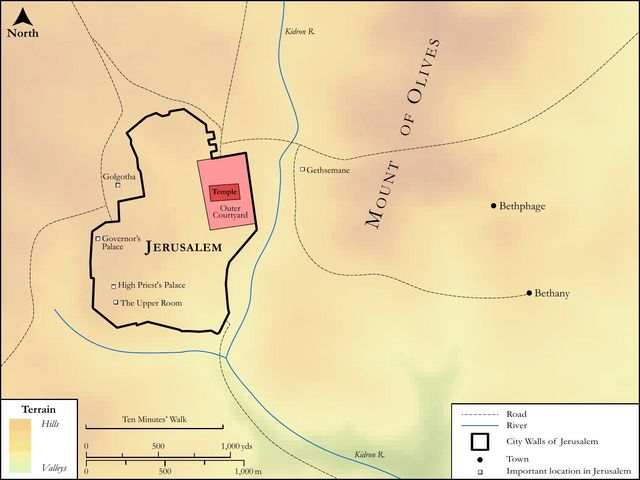
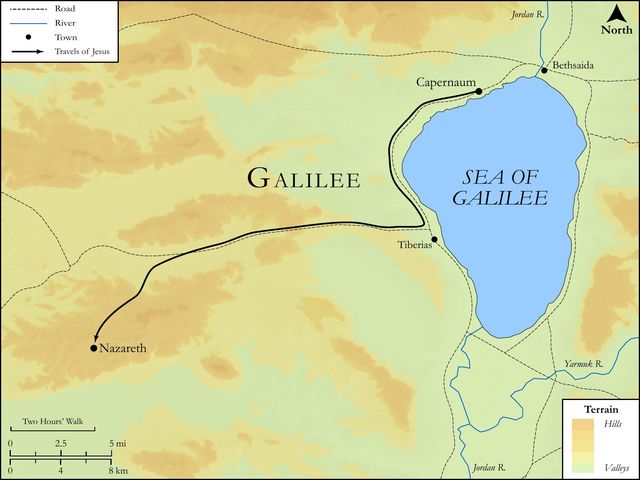
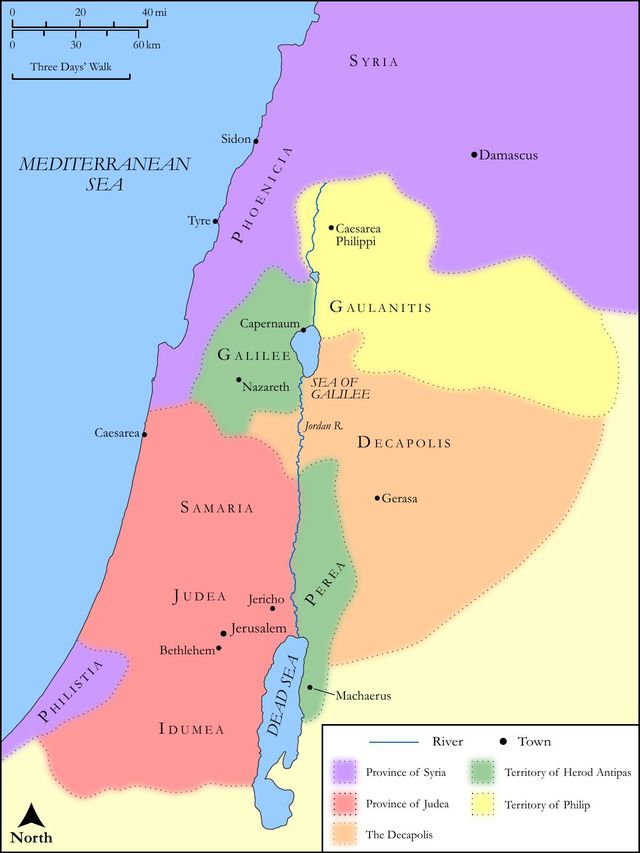
See on the biblical-era map
Study this verse
Public-domain commentary
Matthew Henry
From his Commentary on the Whole Bible. Henry comments on passages, not single verses — this entry covers Matthew 14:13–21. His two-level outline is real structure in the source text, so it is rendered as structure.
This passage of story, concerning Christ's feeding five thousand men with five loaves and two fishes, is recorded by all the four Evangelists, which very few, if any, of Christ's miracles are: this intimates that there is something in it worthy of special remark. Observe,
I.The great resort of people to Christ, when he was retired into a desert place, Mat 14:13.
He withdrew into privacy when he heard, not of John's death, but of the thoughts Herod had concerning him, that he was John the Baptist risen from the dead, and therefore so feared by Herod as to be hated; he departed further off, to get out of Herod's jurisdiction. Note, In times of peril, when God opens a door of escape, it is lawful to flee for our own preservation, unless we have some special call to expose ourselves. Christ's hour was not yet come, and therefore he would not thrust himself upon suffering. He could have secured himself by divine power, but because his life was intended for an example, he did it by human prudence; he departed by ship. But a city on a hill cannot be hid; when the people heard it, they followed him on foot from all parts. Such an interest Christ had in the affections of the multitude, that his withdrawing from them did but draw them after him with so much the more eagerness. Here, as often, the scripture was fulfilled, that unto him shall the gathering of the people be. It should seem, there was more crowding to Christ after John's martyrdom than before. Sometimes the suffering of the saints are made to further the gospel (Phi 1:12), and "the blood of the martyrs is the seed of the church." Now John's testimony was finished, it was recollected, and more improved than ever. Note,
1.When Christ and his word withdraw from us, it is best for us (whatever flesh and blood may object to the contrary) to follow it, preferring opportunities for our souls before any secular advantages whatsoever. When the ark removes, ye shall remove, and go after it, Jos 3:3.
2.Those that truly desire the sincere milk of the word, will not stick at the difficulties they may meet with in their attendance on it. The presence of Christ and his gospel makes a desert place not only tolerable, but desirable; it makes the wilderness an Eden, Isa 51:3; Isa 41:19, Isa 41:20.
II.The tender compassion of our Lord Jesus towards those who thus followed him, Mat 14:14.
1.He went forth, and appeared publicly among them. Though he retired for his own security, and his own repose, yet he went forth from his retirement, when he saw people desirous to hear him, as one willing both to toil himself, and to expose himself, for the good of souls; for even Christ pleased not himself.
2.When he saw the multitude, he had compassion on them. Note, The sight of a great multitude may justly move compassion. To see a great multitude, and to think how many precious, immortal souls here are, the greatest part of which, we have reason to fear, are neglected and ready to perish, would grieve one to the heart. None like Christ for pity to souls; his compassions fails not.
3.He did not only pity them, but he helped them; many of them were sick, and he, in compassion to them, healed them; for he came into the world to be the great Healer. After awhile, they were all hungry, and he, in compassion to them, fed them. Note, In all the favours Christ shows to us, he is moved with compassion, Isa 63:9.
III.The motion which the disciples made for the dismissing of the congregation, and Christ's setting aside the motion.
1.The evening drawing on, the disciples moved it to Christ to send the multitude away; they thought there was a good day's work done, and it was time to disperse. Note, Christ's disciples are often more careful to show their discretion, than to show their zeal; and their abundant affection in the things of God.
2.Christ would not dismiss them hungry as they were, nor detain them longer without meat, nor put them upon the trouble and charge of buying meat for themselves, but orders his disciples to provide for them. Christ all along expressed more tenderness toward the people than his disciples did; for what are the compassions of the most merciful men, compared with the tender mercies of God in Christ? See how loth Christ is to part with those who are resolved to cleave to him! They need not depart. Note, Those who have Christ have enough, and need not depart to seek a happiness and livelihood in the creature; they that have made sure of the one thing needful, need not be cumbered about much serving: nor will Christ put his willing followers upon a needless expense, but will make their attendance cheap to them.
But if they be hungry, they have need to depart, for that is a necessity which has no law, therefore, give you them to eat. Note, The Lord is for the body; it is the work of his hands, it is part of his purchase; he was himself clothed with a body, that he might encourage us to depend upon him for the supply of our bodily wants. But he takes a particular care of the body, when it is employed to serve the soul in his more immediate service. If we seek first the kingdom of God, and make that our chief care, we may depend upon God to add other things to us, as far as he sees fit, and may cast all care of them upon him. These followed Christ but for a trial, in a present fit of zeal, and yet Christ took this care of them; much more will he provide for those who follow him fully.
IV.The slender provision that was made for this great multitude; and here we must compare the number of invited guests with the bill of fare.
1.The number of the guests was five thousand of men, besides women and children; and it is probable the women and children might be as many as the men, if not more. This was a vast auditory that Christ preached to, and we have reason to think an attentive auditory; and, yet it should seem, far the greater part, notwithstanding all this seeming zeal and forwardness, came to nothing; they went off and followed him no more; for many are called, but few are chosen. We would rather perceive the acceptableness of the word by the conversion, than by the crowds, of its hearers; though that also is a good sight and a good sign.
2.The bill of fare was very disproportionable to the number of the guests, but five loaves and two fishes. This provision the disciples carried about with them for the use of the family, now they were retired into the desert. Christ could have fed them by miracle, but to set us an example of providing for those of our own households, he will have their own camp victualled in an ordinary way. Here is neither plenty, nor variety, nor dainty; a dish of fish was no rarity to them that were fishermen, but it was food convenient for the twelve; two fishes for their supper, and bread to serve them perhaps for a day or two: here was no wine or strong drink; fair water from the rivers in the desert was the best they had to drink with their meat; and yet out of this Christ will have the multitude fed. Note, Those who have but a little, yet when the necessity is urgent, must relieve others out of that little, and that is the way to make it more. Can God furnish a table in the wilderness? Yes, he can, when he pleases, a plentiful table.
V.The liberal distribution of this provision among the multitude (Mat 14:18, Mat 14:19); Bring them hither to me.
Note, The way to have our creature-like comforts, comforts indeed to us, is to bring them to Christ; for every thing is sanctified by his word, and by prayer to him: that is likely to prosper and do well with us, which we put into the hands of our Lord Jesus, that he may dispose of it as he pleases, and that we may take it back from his hand, and then it will be doubly sweet to us. What we give in charity, we should bring to Christ first, that he may graciously accept it from us, and graciously bless it to those to whom it is given; this is doing it as unto the Lord.
Now at this miraculous meal we may observe,
1.The seating of the guests (Mat 14:19); He commanded them to sit down; which intimates, that while he was preaching to them, they were standing, which is a posture of reverence, and readiness for motion. But what shall we do for chairs for them all? Let them sit down on the grass. When Ahasuerus would show the riches of his glorious kingdom, and the honour of his excellent majesty, in a royal feast for the great men of all his provinces, the beds or couches they sat on were of gold and silver, upon a pavement of red, and blue, and white, and black marble, Est 1:6. Our Lord Jesus did now show, in a divine feast, the riches of a more glorious kingdom than that, and the honour of a more excellent majesty, even a dominion over nature itself; but here is not so much as a cloth spread, no plates or napkins laid, no knives or forks, nor so much as a bench to sit down on; but, as if Christ intended indeed to reduce the world to the plainness and simplicity, and so to the innocency and happiness, of Adam in paradise, he commanded them to sit down on the grass. By doing every thing thus, without any pomp or splendour, he plainly showed that his kingdom was not of this world, nor cometh with observation.
2.The craving of a blessing. He did not appoint one of his disciples to be his chaplain, but he himself looked up to heaven, and blessed, and gave thanks; he praised God for the provision they had, and prayed to God to bless it to them. His craving a blessing, was commanding a blessing; for as he preached, so he prayed, like one having authority; and in this prayer and thanksgiving, we may suppose, he had special reference to the multiplying of this food; but herein he has taught us that good duty of craving a blessing and giving thanks at our meals: God's good creatures must be received with thanksgiving, Ti1 4:4. Samuel blessed the feast, Sa1 9:13; Act 2:46, Act 2:47; Act 27:34, Act 27:35. This is eating and drinking to the glory of God (Co1 10:31); giving God thanks (Rom 14:6); eating before God, as Moses, and his father-in-law, Exo 18:12, Exo 18:15. When Christ blessed, he looked up to heaven, to teach us, in prayer, to eye God as a Father in heaven; and when we receive our creature-comforts to look thitherward, as taking them from God's hand, and depending on him for a blessing.
3.The carving of the meat. The Master of the feast was himself head-carver, for he brake, and gave the loaves to the disciples, and the disciples to the multitude. Christ intended hereby to put honour upon his disciples, that they might be respected as workers together with him; as also to signify in what way the spiritual food of the word should be dispensed to the world; from Christ, as the original Author, by his ministers. What Christ designed for the churches he signified to his servant John (Rev 1:1, Rev 1:4); they delivered all that, and that only, which they received from the Lord, Co1 11:23. Ministers can never fill the people's hearts, unless Christ first fill their hands: and what he has given to the disciples, they must give to the multitude; for they are stewards, to give to every one his portion of meat, Mat 24:45. And, blessed be God, be the multitude ever so great, there is enough for all, enough for each.
4.The increase of the meat. This is taken notice of only in the effect, not in the cause or manner of it; here is no mention of any word that Christ spoke, by which the food was multiplied; the purposes and intentions of his mind and will shall take effect, though they be not spoken out: but this is observable, that the meat was multiplied, not in the heap at first, but in the distribution of it. As the widow's oil increased in the pouring out, so here the bread in the breaking. Thus grace grows by being acted, and, while other things perish in the using, spiritual gifts increase in the using. God ministers seed to the sower, and multiplies not the seed hoarded up, but the seed sown, Co2 9:10. Thus there is that scattereth and yet increaseth; that scattereth, and so increaseth.
VI.The plentiful satisfaction of all the guests with this provision. Though the disproportion was so great, yet there was enough and to spare.
1.There was enough: They did all eat, and were filled. Note, Those whom Christ feeds, he fills; so runs the promise (Psa 37:19), They shall be satisfied. As there was enough for all, they did all eat, so there was enough for each, they were filled; though there was but little, there was enough, and that is as good as a feast. Note, The blessing of God can make a little go a great way; as, if God blasts what we have, we eat, and have not enough, Hag 1:6.
2.There was to spare; They took up of the fragments that remained, twelve baskets full, one basket for each apostle: thus what they gave they had again, and a great deal more with it; and they were so far from being nice, that they could make this broken meat serve another time, and be thankful. This was to manifest and magnify the miracle, and to show that the provision Christ makes for those who are his is not bare and scanty, but rich and plenteous; bread enough, and to spare (Luk 15:17), an overflowing fulness. Elisha's multiplying the loaves was somewhat like this, but far short of it; and then it was said, They shall eat and leave, Kg2 4:43.
It is the same divine power, though exerted in an ordinary way, which multiplies the seed sown in the ground every year, and makes the earth yield her increase; so that what was brought out by handfuls, is brought home in sheaves. This is the Lord's doing; it is by Christ that all natural things consist, and by the word of his power that they are upheld.
Historical interpretation
Sixteen Centuries of Reception
10 surviving comments on this verse. Each one is dated, so this reads as a timeline rather than a list.
Select a marker to jump to its quote. Markers stagger vertically where authors wrote within a few decades of each other.
The five loaves are not multiplied into more, but fragments succeed to fragments; the substance growing whether upon the tables, or in the hands that took them up, I know not.
But the Lord answered, They have no need to go, showing that those whom He heals have no need of the food of mercenary doctrine, and have no necessity to return to Judæa to buy food; and He commands the Apostles that they give them food. Did He not know then that there was nothing to give them? But there was a complete series of types to be set forth; for as yet it was not given the Apostles to make and minister the heavenly bread, the food of eternal life; and their answer thus belongs to the chain of spiritual interpretation; they were as yet confined to the five loaves, that is, the five books of the Law, and the two fishes, that is, the preaching of the Prophets and of John.
These therefore the Apostles first set forth, because they were yet in these things; and from these things the preaching of the Gospel grows to its more abundant strength and virtue. Then the people is commanded to sit down upon the grass, as no longer lying upon the ground, but resting upon the Law, each one reposing upon the fruit of his own works as upon the grass of the earth.
Then the loaves are given to the Apostles, because through them the gifts of divine grace were to be rendered. And the number of them that did eat is found to be the same as that of those who should believe; for we find in the book of Acts that out of the vast number of the people of Israel, five thousand men believed.
The same number of those eating proved to be the number of those who believed. As noted in the book of Acts, out of the countless people of Israel five thousand men believed. Once the people had been satisfied, when they took up the loaves that had been broken into pieces with the fish, there was enough left over to match the number of believers and apostles to be filled with heavenly grace. Thus both the measure suited the number and the number the measure. Within its bounds the calculation was keyed to the proper effect and depended on the guidance of divine power.
It is a proof of the faith of these multitudes that they endured hunger in waiting for the Lord even till evening; to which purpose it follows, And when it was evening, his disciples came unto him, saying, This is a desert place, and the time is now past. The Lord purposing to feed them waits to be asked, as always not stepping forward first to do miracles, but when called upon. None out of the crowd approached Him, both because they stood in great awe of Him, and because in their zeal of love they did not feel their hunger. But even the disciples do not come and say, Give them to eat; for the disciples were as yet in an imperfect condition; but they say, This is a desert place. So that what was proverbial among the Jews to express a miracle, as it is said, Can he spread a table in the wilderness? (Ps. 78:19.) this also He shows among his other works. For this cause also He leads them out into the desert, that the miracle might be clear of all suspicion, and that none might suppose that any thing was supplied towards the feast from any neighbouring town. But though the place be desert, yet is He there who feeds the world; and though the hour is, as they say, past, yet He who now commanded was not subjected to hours. And though the Lord had gone before His disciples in healing many sick, yet they were so imperfect that they could not judge what He would do concerning food for them, wherefore they add, Send the multitude away, that they may go into the towns, and buy themselves food. Observe the wisdom of the Master; He says not straightway to them, 'I will give them to eat;' for they would not easily have received this, but, Jesus said unto them, They need not depart, Give ye them to eat.
Yet not even by these words were the disciples set right, but speak yet to Him as to man; They answered unto Him, We have here but five loaves and two fishes. From this we learn the philosophy of the disciples, how far they despised food; they were twelve in number, yet they had but five loaves and two fishes; for things of the body were contemned by them, they were altogether possessed by spiritual things. But because the disciples were yet attracted to earth, the Lord begins to introduce the things that were of Himself; He saith unto them, Bring them hither to me. Wherefore does He not create out of nothing the bread to feed the multitude with? That He might put to silence the mouth of Marcion and Manichæus, who take away from God His creatures, (i. e. deny that God created the visible world.) and by His deeds might teach that all things that are seen are His works and creation, and that it is He that has given us the fruits of the earth, who said in the beginning, Let the earth bring forth the green herb; (Gen. 1:11.) for this is no less a deed than that. For of five loaves to make so many loaves, and fishes in like manner, is no less a thing than to bring fruits from the earth, reptiles and other living things from the waters; which showed Him to be Lord both of land and sea. By the example of the disciples also we ought to be taught, that though we should have but little, we ought to give that to such as have need. For they when bid to bring their five loaves say not, Whence shall we satisfy our own hunger? but immediately obey; And He commanded the multitude to sit down on the grass, and took the five loaves and the two fishes, and looking up to heaven blessed them, and brake. Why did He look to heaven and bless? For it should be believed concerning Him that He is from the Father, and that He is equal with the Father. His equality He shows when He does all things with power. That He is from the Father He shows by referring to Him whatsoever He does, and calling upon Him on all occasions. To prove these two things therefore, He works His miracles at times with power, at other times with prayer. It should be considered also that in lesser things He looks to heaven, but in greater He does all with power. When He forgave sins, raised the dead, stilled the sea, opened the secrets of the heart, opened the eyes of him that was born blind, which were works only of God, He is not seen to pray; but when He multiplies the loaves, a work less than any of these, He looks up to heaven, that you may learn that even in little things He has no power but from His Father. And at the same time He teaches us not to touch our food, until we have returned thanks to Him who gives it us. For this reason also He looks up to heaven, because His disciples had examples of many other miracles, but none of this.
In doing which He not only honoured them, but would that upon this miracle they should not be unbelieving, nor forget it when it was past, seeing their own hands had borne witness to it. Therefore also He suffers the multitudes first to feel the sense of hunger, and His disciples to come to Him, and to ask Him, and He took the loaves at their hands, that they might have many testimonies of that that was done, and many things to remind them of the miracle. From this that He gave them, nothing more than bread and fish, and that He set this equally before all, He taught them moderation, frugality, and that charity by which they should have all things in common. This He also taught them in the place, in making them sit down upon the grass; for He sought not to feed the body only, but to instruct the mind. But the bread and fish multiplied in the disciples' hands; whence it follows, And they did all eat, and were filled. But the miracle ended not here; for He caused to abound not only whole loaves, but fragments also; to show that the first loaves were not so much as what was left, and that they who were not present might learn what had been done, and that none might think that what had been done was a phantasy; And they took up fragments that were left, twelve baskets full.
For this reason also He caused twelve baskets to remain over and above, that Judas might bear his basket. He took up the fragments, and gave them to the disciples and not to the multitudes, who were yet more imperfectly trained than the disciples.
This was to the very great credit of the people, that the women and the men stood up when these remnants still remained.
But He is about to feed them also. And He doth not this of Himself, but waits to be entreated; on every occasion, as I have said, maintaining this rule, not to spring onward to His miracles, preventing them, but upon some call.
And why did none of the multitude come near and speak for them? They reverenced Him exceedingly, and felt not even their hunger, through their longing to stay with Him. Neither indeed do His disciples, when they were come to Him, say, "Feed them;" for as yet they were rather in an imperfect state; but what?
"And when it was evening," it is said, "His disciples came to Him, saying, This is a desert place, and the time is now passed; send the multitude away, that they may go and buy themselves victuals."
For if even after the miracle they forgot what had been done, and after the baskets, supposed Him to be speaking of loaves, when He gave the name of "leaven" to the doctrine of the Pharisees; much less, when they had never yet had experience of such a miracle, would they have expected any such thing. And yet He had made a beginning by actually healing many sick; but nevertheless, not even from this did they expect the miracle of the loaves; so imperfect were they as yet.
But mark thou, I pray, the Teacher's skill, how distinctly He summons them on towards believing. For He said not at once, "I feed them;" which indeed would not have been easily received; but what?
"But Jesus," so it is written, "said unto them, They need not depart; give ye them to eat."
He said not, "I give them," but, "Give ye them;" for as yet their regard to Him was as to a man. But they not even so are awakened, but still reason as with a man, saying,
"We have but five loaves, and two fishes."
Wherefore Mark also saith, "They understood not the saying, for their heart was hardened."
They continuing therefore to crawl on the ground, then at length He brings in His own part, and saith, "Bring them hither to me." For although the place be desert, yet He that feeds the world is here; and although the time be now past, yet He that is not subject to time is discoursing with you.
But John saith also, that they were "barley loaves," not mentioning it without object, but teaching us to trample under foot the pride of costly living. Such was the diet of the prophets also.
"He took therefore the five loaves, and the two fishes, and commanded the multitude," it is said, "to sit down upon the grass, and looking up to Heaven, He blessed, and brake, and gave to His disciples, and the disciples to the multitude. And they did all eat and were filled, and they took up of the fragments that remained twelve baskets full. And they that had eaten were about five thousand men, beside women and children."
Wherefore did He look up to Heaven, and bless? It was to be believed of Him, both that He is of the Father, and that He is equal to Him. But the proofs of these things seemed to oppose one another. For while His equality was indicated by His doing all with authority, of His origin from the Father they could no otherwise be persuaded, than with His doing all with great lowliness, and with reference to Him, and invoking Him on His works. Wherefore we see that He neither did these actions only, nor those, that both might be confirmed; and now He works miracles with authority, now with prayer.
Then again, that what He did might not seem an inconsistency, in the lesser things He looks up to Heaven, but in the greater doth all with authority; to teach thee in the lesser also, that not as receiving power from elsewhere, but as honoring Him that begat Him, so He acts. For example: when He forgave sins, and opened paradise, and brought in the thief, and most utterly set aside the old law, and raised innumerable dead, and bridled the sea, and reproved the unuttered thoughts of men, and created an eye;-which are achievements of God only and of none else;-we see Him in no instance praying: but when He provided for the loaves to multiply themselves, a far less thing than all these, then He looks up to Heaven; at once establishing these truths which I have spoken of, and instructing us not to touch a meal, until we have given thanks to Him who giveth us this food.
And why doth He not make it of things that are not? Stopping the mouth of Marcion, and of Manichaeans, who alienate His creation from Him, and teaching by His very works, that even all the things that are seen are His works and creatures, and signifying that it is Himself who gives the fruits, who said at the beginning, "Let the earth put forth the herb of grass," and "Let the waters bring forth things moving with living souls."
For this is not at all a less work than the other. For though those were made of things that are not, yet nevertheless were they of water; and it was no greater thing to produce fruits out of the earth, and moving things with life out of the water, than out of five loaves to make so many; and of fishes again, which was a sign that He was ruler both of the earth and of the sea.
Thus, since the sick were constantly the subject of His miracles, He works also a general benefit, that the many might not be spectators only of what befell others, but themselves also partakers of the gift.
And that which in the wilderness seemed to the Jews marvellous, (they said at least, "Can He give bread also? or prepare a table in the wilderness?") this He shows forth in His works. With this view also He leads them into the wilderness, that the miracle might be very far beyond suspicion, and that no one might think that any village lying near contributed ought to the meal. For this reason He mentions the hour also, not the place only.
And another thing too we learn, the self-restraint of the disciples which they practised in necessary things, and how little they accounted of food. For being twelve, they had five loaves only and two fishes; so secondary to them were the things of the body: so did they cling to the things spiritual only.
And not even that little did they hold fast, but gave up even it when asked. Whereby we should be taught, that though we have but little, this too we ought to give up to them that are in need. Thus, when commanded to bring the five loaves, they say not, "and whence are we to have food? whence to appease our own hunger?" but they obey at once.
And besides what I have mentioned, to this end, as I at least think, He makes it out of the materials which they had, namely, that He might lead them to faith; for as yet they were rather in a weak state.
Wherefore also "He looks up to Heaven." For of the other miracles they had many examples, but of this none.
"He took the loaves," therefore, "and brake them, and gave them by His disciples," hereby to honor them; and not in honor to them only, but also that, when the miracle had been done they might not disbelieve it, nor forget it when it had past, their own hands bearing them witness.
Wherefore also He suffers the multitudes first to have a sense of hunger, and waits for these to come to Him first and ask Him, and by them makes the people sit down, and by them distributes; being minded by their own confessions and actions to prepossess them every one.
Therefore also, from them He receives the loaves, that the testimonies of what was doing might be many, and that they might have memorials of the miracle. For if even after these occurrences they forgot, what would not have been their case, had He omitted those provisions?
And He commands them to sit down on the trampled grass, instructing the multitudes in self-denial. For His will was not to feed their bodies only, but also to instruct their souls. As well by the place therefore, as by His giving them nothing more than loaves and fishes, and by setting the same before all, and making it common, and by affording no one more than another, He was teaching them humility, and temperance, and charity, and to be of like mind one towards another, and to account all things common.
"And He brake and gave to the disciples, and the disciples to the multitude." The five loaves He brake and gave, and the five multiplied themselves in the hands of the disciples. And not even here doth He stay the miracle, but He made them even to exceed; to exceed, not as whole loaves, but as fragments; to signify that of those loaves these were remains, and in order that the absent might learn what had been done.
For this purpose indeed He suffered the multitudes to hunger, that no one might suppose what took place to be illusion.
For this also He caused just twelve baskets to remain over, that Judas also might bear one. For He was able indeed to have appeased their hunger, but the disciples would not have known His power, since in Elijah's case also this took place.
At all events, so greatly were the Jews amazed at Him for this, that they wished even to make Him a king, although with regard to the other miracles they did not so in any instance.
What reasoning now may set forth, how the loaves multiplied themselves; how they flowed together in the wilderness; how they were enough for so many (for there were "five thousand men beside women and children;" which was a very great commendation of the people, that both women and men attended Him); how the remnants had their being (for this again is no less than the former), and became so abundant, that the baskets were equal in number to the disciples, and neither more nor less?
Having then taken the fragments, He gave them not to the multitudes, but to the disciples, and that, because the multitudes were in a more imperfect state than the disciples.
(Verse 21) Now the number of those who ate was five thousand men, besides women and children. According to the number of five loaves and the multitude of five thousand men who ate, it had not yet reached the seven-fold number according to another account, of whom there are four thousand who eat, close to the number of the Gospels. But those who ate were five thousand men who had grown into full maturity, and they followed him of whom Zacharias says: Behold the man, his name is the Rising Sun. But women and children, being of the weaker sex and younger age, are considered unworthy of being counted. Therefore, in the Book of Numbers, whenever priests, Levites, armies, or fighting crowds are described, slaves, women, children, and the common people are omitted from the count.
It is to be observed moreover, that when the Lord came into the desert, great crowds followed Him; for before He went into the wilderness of the Gentiles, He was worshipped by only one people. They leave their cities, that is, their former conversation, and various dogmas. That Jesus went out, shows that the multitudes had the will to go, but not the strength to attain, therefore the Saviour departs out of His place and goes to meet them.
Wherein He calls the Apostles to breaking of bread, that the greatness of the miracle might be more evident by their testimony that they had none.
While the Lord breaks there is a sowing of food; for had the loaves been whole and not broken into fragments, and thus divided into a manifold harvest, they could not have fed so great a multitude. The multitude receives the food from the Lord through the Apostles; as it follows, And he gave the loaves to his disciples, and the disciples to the multitude.
Each of the Apostles fills his basket of the fragments left by his Saviour, that these fragments might witness that they were true loaves that were multiplied.
To the number of loaves, five, the number of the men that ate is apportioned, five thousand; And the number of them that had eaten was about five thousand men, besides women and children.
But all these things are full of mysteries; the Lord does these things not in the morning, nor at noon, but in the evening, when the Sun of righteousness was set.
Or, they are bid to lie down on the grass, and that, according to another Evangelist, by fifties and by hundreds, that after they have trampled upon their flesh, and have subjugated the pleasures of the world as dried grass under them, then by the presencea of the number fifty, they ascend to the eminent perfection of a hundred. He looks up to heaven to teach us that our eyes are to be directed thither. The Law with the Prophets is broken, and in the midst of them are brought forward mysteries., that whereas they partook not of it whole, when broken into pieces it may be food for the multitude of the Gentiles.
There partook five thousand who had reached maturity; for women and children, the weaker sex, and the tender age, were unworthy of number; thus in the book of Numbers, slaves, women, children, and an undistinguished crowd, are passed over unnumbered.
By the evening the Lord's death is denoted; and after He, the true Sun, was set on the altar of the cross, He filled the hungry. Or by evening is denoted the last age of this world, in which the Son of God came and refreshed the multitudes of those that believed on Him.
When John is to describe this miracle, he first tells us that the passover is at hand; Matthew and Mark place it immediately after the execution of John. Hence we may gather, that he was beheaded when the paschal festival was near at hand, and that at the passover of the following year, the mystery of the Lord's passion was accomplished.
When the disciples ask the Lord to send away the multitudes that they might buy food in the towns, it signifies the pride of the Jews towards the multitudes of the Gentiles, whom they judged rather fit to seek for themselves food in the assemblies of the Pharisees than to use the pasture of the Divine books.
Or, by the two fishes we may understand the Prophets, and the Psalms, for the whole of the Old Testament was comprehended in these three, the Law, the Prophets, and the Psalms.
The multitude being hungry, He creates no new viands, but having taken what the disciples had, He gave thanks. In like manner when He came in the flesh, He preached no other things than what had been foretold, but showed that the writings of the Law and the Prophets were big with mysteries. That which, the multitude leave is taken up by the disciples, because the more secret mysteries which cannot be comprehended by the uninstructed, are not to be treated with neglect, but are to be diligently sought out by the twelve Apostles (who are represented by the twelve baskets) and their successors. For by baskets servile offices are performed, and God has chosen the weak things of the world to confound the strong. The five thousand for the five senses of the body are they who in a secular condition know how to use rightly things without.
. He gives the loaves to the disciples so that they might always retain the miracle in their memory and not have it fade from their minds, although they did in fact immediately forget. There was food left over lest you think that He performed the miracle only in appearance. There were twelve baskets so that Judas too might carry one and thus remembering the miracle not rush headlong into betrayal. And He multiplies both the loaves and the fish to show that He is the Creator of earth and sea, and the Giver of what we eat everyday, and it is multiplied by Him. He performed the miracle in a deserted place lest anyone think that He bought the loaves from a neighboring town and distributed them to the multitude, for it was deserted. This is the explanation of the literal account. But in its spiritual sense, learn that when Herod, who represents the fleshly and superficial mind of the Jews (for "Herod" means "fleshly" and "skinlike"), cut off the head of John who was the head and chief of the prophets, it showed that Herod rejected those who prophesied of Christ. Whereupon Jesus withdrew to a desert place, to the nations who were desolate without God, and He healed the sick in soul and then He fed them. For if He had not forgiven our sins and healed our sicknesses by baptism He could not have nourished us by giving us the immaculate Mysteries, for no one partakes of Holy Communion who has not first been baptized. The five thousand are those who are sick in their five senses and who are healed by the five loaves. Since the five senses were diseased, there are as many poultices as there are wounds. The two fish are the words of the fishermen. The one fish is the Gospel and the other the Epistles. Some have understood the five loaves to signify the Pentateuch of Moses: Genesis, Exodus, Leviticus, Numbers, and Deuteronomy. Twelve baskets were lifted up and carried by the apostles; for whatever we, the multitude, are unable to eat, that is, to understand, the apostles carried and held, that is, they accepted and understood. "Besides women and children." This means, allegori-cally, that a Christian man, woman, or child, must not in any way be childish, womanly, or unmanly.
There is an activity of God displayed throughout creation, a wholesale activity let us say which men refuse to recognize. The miracles done by God incarnate, living as a man in Palestine, perform the very same things as this wholesale activity, but at a different speed and on a smaller scale. One of their chief purposes is that men, having seen a thing done by personal power on the small scale, may recognize, when they see the same thing done on the large scale, that the power behind it is also personal – is indeed the very same person who lived among us two thousand years ago. The miracles in fact are a retelling in small letters of the very same story which is written across the whole world in letters too large for some of us to see...
Every year God makes a little corn into much corn: the seed is sown and there is an increase, and men, according to the fashion of their age, say “It is Ceres, it is Adonis, it is the Corn-King,” or else “It is the laws of Nature.” The close-up, the translation, of this annual wonder is the feeding of the five thousand. Bread is not made there of nothing. Bread is not made of stones, as the Devil once suggested to Our Lord in vain. A little bread is made into much bread. The Son will do nothing but what He sees the Father do. There is, so to speak, a family style...
When He fed the thousands He multiplied fish as well as bread. Look in every bay and almost every river. This swarming, pulsating fecundity shows He is still at work. The ancients had a god called Genius – the god of animal and human fertility, the presiding spirit of gynecology, embryology, or the marriage bed – the “genial bed” as they called it after its god Genius. As the miracles of wine and bread and healing showed who Bacchus really was, who Ceres, who Apollo, and that all were one, so this miraculous multiplication of fish reveals the real Genius.
Continue studying Matthew 14:21 across the web’s major study libraries — every link below opens this exact verse, chapter, or book on the destination site.
Read & Compare
 BibleGatewayThis verse in more than 200 translations and 70 languages.
 Bible.comThe YouVersion reader — hundreds of translations, reading plans, and highlights.
 ESV.orgCrossway's official English Standard Version reader.
 NET BibleThe NET translation with 60,000+ translators' notes on every rendering decision.
 STEP BibleTyndale House's free study tool — original text, vocabulary, and scholarly resources.
 BibliaLogos Bible Software's free web reader.
 USCCBThe New American Bible (Revised Edition) with the U.S. bishops' study notes.
Commentaries
 BibleHub CommentariesDozens of classic commentaries on this verse, gathered on one page.
 StudyLightMore than 100 commentary sets — the largest collection on the web.
 BibleRefPlain-English commentary on what this verse means, verse by verse.
 Enduring WordDavid Guzik's free commentary on this chapter, widely used by Bible teachers.
 Bible Study ToolsVerse commentary alongside Greek and Hebrew study aids.
Original Language & Research
- BibleHub InterlinearThe verse word by word — original language, transliteration, and English.
- BibleHub LexiconEvery word's original-language definition and Strong's entry.
 Blue Letter BibleDeep-study tools — Strong's numbers, concordance, and word studies.
 CNTR CollationThe earliest Greek manuscripts of this verse, collated letter by letter.
Sermons, Hymns & Audio


TrulyRandomVerse is not affiliated with these sites and doesn’t control their content. They’re linked because they’re genuinely useful.
Summary
Matthew 14:21 concludes the biblical account of Jesus' miraculous feeding of the five thousand, providing a crucial numerical detail that underscores the immense scale and divine nature of the miracle. By explicitly stating that "about five thousand men" were fed, "beside women and children," the verse highlights that the actual number of beneficiaries was significantly larger, emphasizing the overwhelming abundance of Christ's provision and His boundless compassion for the multitude.
Context
ShowHideLiterary Context
This verse serves as the culminating statement of the first miraculous feeding narrative in Matthew's Gospel, immediately following the detailed description of Jesus' actions. The preceding verses (Matthew 14:15-20) recount how Jesus, moved with compassion for the vast crowd, took five loaves and two fish, blessed them, broke them, and distributed them through His disciples. The disciples had initially expressed concern about the logistical impossibility of feeding such a multitude in a desolate place, highlighting their human limitations in contrast to Jesus' divine power. Verse 21 provides the final, astonishing tally, confirming the superabundance of the miracle and setting the stage for Jesus' subsequent walking on water (Matthew 14:22-33).
Historical & Cultural Context
In the ancient Near East, and particularly within Jewish society, large gatherings were often enumerated by counting adult males, especially for purposes of census, military conscription, or logistical planning. The explicit mention of "beside women and children" in Matthew 14:21 is therefore significant, as it clarifies that the "five thousand" figure was not a total headcount of all individuals present. This practice of counting men separately means the actual crowd size was likely much larger, potentially well over 15,000 people, including entire families. The setting was a "desolate place" (Matthew 14:15), likely an uninhabited area near the Sea of Galilee, emphasizing the complete lack of natural resources and the absolute necessity of divine intervention for sustenance.
Key Themes
ShowHideMatthew 14:21 contributes powerfully to several overarching themes in Matthew's Gospel. Foremost is the theme of Divine Abundance and Provision, demonstrating God's limitless capacity to meet human needs, far exceeding any human expectation or resource. This miracle foreshadows the spiritual sustenance Jesus offers as the "bread of life" (John 6:35). It also highlights Jesus' Compassion and Authority, showcasing His deep empathy for the physical hunger of the crowds, coupled with His sovereign power over creation. Furthermore, the sheer scale of the miracle underscores the Messianic Identity of Jesus, as such a miraculous feeding event would evoke comparisons to God's provision of manna in the wilderness during the Exodus (Exodus 16), positioning Jesus as the greater Moses and the true provider for His people.
Exposition and Analysis
ShowHideKey Word Analysis
ShowHideThis verb (G2068) literally means "to eat" or "to devour." In this context, it emphasizes the physical act of consumption, confirming that the multitude partook of the miraculously provided food. The implication is not merely that food was present, but that it was consumed by a vast number of people, satisfying their hunger.
G435 specifically refers to an "individual male" or "man" (as opposed to a general term for people, like anthrōpos). This precise terminology is crucial for understanding the numerical count. It indicates that the "five thousand" explicitly refers to adult males, making the subsequent mention of "women and children" a vital detail for the true scope of the miracle.
An adverb meaning "at a space, i.e., separately or apart from." This word clarifies that the women and children were in addition to the five thousand men, not included within that count. It serves to amplify the total number of people fed, emphasizing the extraordinary magnitude of Jesus' provision beyond the stated male headcount.
Verse Breakdown
ShowHide"And they that had eaten"
This phrase refers to the vast multitude who had just partaken of the miraculously multiplied bread and fish. It establishes the subject of the numerical count that follows, focusing on those who directly benefited from Jesus' provision.
"were about five thousand men"
This is the primary numerical detail provided. The use of "about" (Greek, hōseí) suggests an approximate but substantial figure. Crucially, the term "men" (Greek, anḗr) specifies that this count refers exclusively to adult males, a common practice in ancient censuses or crowd estimations.
"beside women and children"
This critical addendum clarifies the true scope of the miracle. The Greek word chōrís ("beside" or "apart from") explicitly states that women and children were present in addition to the 5,000 men. This implies that the total number of individuals fed was significantly higher, likely numbering in the tens of thousands, amplifying the miraculous nature of Jesus' ability to provide for such a vast crowd.
Literary Devices
ShowHideMatthew 14:21 employs several effective literary devices to convey the impact of the miracle. The most prominent is Numerical Specificity, which provides a concrete figure ("five thousand men") while simultaneously using Understatement or Synecdoche by adding "beside women and children." While "five thousand" is a large number, the inclusion of "women and children" indicates that this is a partial count, implying a much larger, unquantified total. This technique amplifies the perceived scale of the miracle, suggesting that the actual number fed was far greater than what is explicitly stated, thereby enhancing the sense of divine abundance. The use of Climax is also evident, as this verse serves as the final, impactful statement following the narrative of the feeding, delivering the astonishing outcome and leaving the reader in awe of Jesus' power.
Theological and Thematic Connections
ShowHideMatthew 14:21 profoundly illustrates God's boundless capacity for provision, moving beyond mere sufficiency to overwhelming abundance. This miracle is not simply about feeding a hungry crowd; it is a profound theological statement about the character of God, who delights in providing for His people in ways that exceed human imagination and limitation. It foreshadows the spiritual sustenance found only in Christ, who offers Himself as the true bread of life, satisfying the deepest hunger of the human soul. The inclusion of women and children highlights God's comprehensive care for all, regardless of status or age, underscoring His universal compassion. This event serves as a powerful reminder that in Christ, there is always more than enough, both for physical needs and for eternal spiritual nourishment.
Reflection and Application
ShowHideMatthew 14:21 stands as a powerful testament to the limitless generosity and compassion of Jesus. In a world often marked by scarcity and anxiety over resources, this verse calls us to shift our perspective from human limitation to divine abundance. Just as Jesus took meager provisions and multiplied them to feed thousands, He can take our seemingly insignificant offerings—our limited time, talents, or resources—and use them to accomplish extraordinary things for His kingdom. This passage encourages us to bring our needs, both physical and spiritual, to Him with complete trust, knowing that He is more than able to provide. It also challenges us to participate in His compassionate work, sharing what we have, however little, so that others might experience His provision and grace. Ultimately, this miracle reminds us that our deepest hunger is for Christ Himself, and He alone can satisfy us completely.
Questions for Reflection
ShowHideFAQ
ShowHideWhy is it important that the verse specifies "men" and then "women and children" separately?
ShowHideThe distinction is crucial for understanding the true scale of the miracle. In ancient Jewish culture, particularly for census or crowd estimations, it was common practice to count only adult males. By stating "about five thousand men" and then explicitly adding "beside women and children," the text indicates that the total number of people fed was significantly larger than 5,000. This implies that the actual crowd could have numbered 15,000, 20,000, or even more, as families typically accompanied men to such events. This detail amplifies the astonishing nature of Jesus' miraculous provision, demonstrating His power to supernaturally feed a truly massive multitude in a desolate place, leaving no doubt about the overwhelming abundance of the food and the satisfaction of all present, as confirmed in Mark 6:42.
Christ-Centered Fulfillment
ShowHideMatthew 14:21, while a historical account of a physical miracle, powerfully points to the person and work of Jesus Christ as the ultimate provider and sustainer. This miraculous feeding foreshadows the spiritual sustenance that Jesus offers to a spiritually hungry world. Just as He provided bread for the physical hunger of the multitude, He declares Himself to be the "bread of life" in John 6:35, promising that those who come to Him will never hunger. The abundance seen in the twelve baskets of leftovers (Matthew 14:20) symbolizes the overflowing grace and eternal life found in Christ, far exceeding human need or expectation. This event also prefigures the ultimate feast of salvation, the Lord's Supper, where believers partake of symbols representing Christ's body and blood, remembering His sacrificial provision for our sin and spiritual nourishment unto eternal life (1 Corinthians 11:23-26). Thus, Matthew 14:21 is not merely a record of a past miracle but a vibrant testament to Christ's ongoing capacity to satisfy every human longing, both physical and spiritual, through His inexhaustible love and power, culminating in His redemptive work on the cross and His resurrection, which provides true and lasting life for all who believe (John 6:51).