


John 6:5
Bible text: King James Version (1769 Blayney text) · Public domain
Bible text: King James Version with Strong's numbers · Public domain
Bible text: Berean Standard Bible · Public domain
Bible text: American Standard Version (1901) · Public domain
Bible text: World English Bible, Messianic edition · Public domain
Bible text: Geneva Bible (1599) · Public domain
Bible text: Young's Literal Translation · Public domain
- ἘπάραςEparasHaving lifted upG1869V-AAP-NSMVerb Aorist Active Participle Nominative Singular Masculine
- οὖνounthenG3767CONJConjunction
- τοὺςtoustheG3588T-APMDefinite article Accusative Plural Masculine
- ὀφθαλμοὺςophthalmouseyesG3788N-APMNoun Accusative Plural Masculine
- ὁho<the>G3588T-NSMDefinite article Nominative Singular Masculine
- ἸησοῦςIēsousJesusG2424N-NSM-PNoun Nominative Singular Masculine Individual
- καὶkaiandG2532CONJConjunction
- θεασάμενοςtheasamenoshaving seenG2300V-ADP-NSMVerb Aorist Middle Deponent Participle Nominative Singular Masculine
- ὅτιhotithatG3754CONJConjunction
- πολὺςpolusa greatG4183A-NSMAdjective Nominative Singular Masculine
- ὄχλοςochloscrowdG3793N-NSMNoun Nominative Singular Masculine
- ἔρχεταιerchetaiis comingG2064V-PNI-3SVerb Present Middle Or Passive Deponent Indicative 3rd Singular
- πρὸςprostoG4314PREPPreposition
- αὐτὸνautonHimG846P-ASMPersonal pronoun Accusative Singular Masculine
- λέγειlegeiHe saysG3004V-PAI-3SVerb Present Active Indicative 3rd Singular
- πρὸςprostoG4314PREPPreposition
- τὸνton<the>G3588T-ASMDefinite article Accusative Singular Masculine
- Φίλιππον·PhilipponPhilipG5376N-ASM-PNoun Accusative Singular Masculine Individual
- πόθενpothenFrom whereG4159ADV-IAdverb Interrogative
- ἀγοράσωμενagorasōmenwe may buyG59V-AAS-1PVerb Aorist Active Subjunctive 1st Plural
- ἄρτουςartousbreadG740N-APMNoun Accusative Plural Masculine
- ἵναinathatG2443CONJConjunction
- φάγωσινphagōsinmay eatG5315V-AAS-3PVerb Aorist Active Subjunctive 3rd Plural
- οὗτοι;houtoithese?G3778D-NPMDemonstrative pronoun Nominative Plural Masculine
English is a literal word-by-word gloss of the Greek, not the KJV's wording. Why?
This is the original text the KJV's translators worked from — each Greek word with its own literal English meaning in this verse, prepared by scholars at Tyndale House, Cambridge. The KJV translates whole sentences, not word by word, so its wording differs: one Greek word can become several English words, and the KJV may choose “charity” where the gloss reads “love”. Both are faithful — they answer different questions. For the KJV's own rendering, switch to the KJV text.
Details
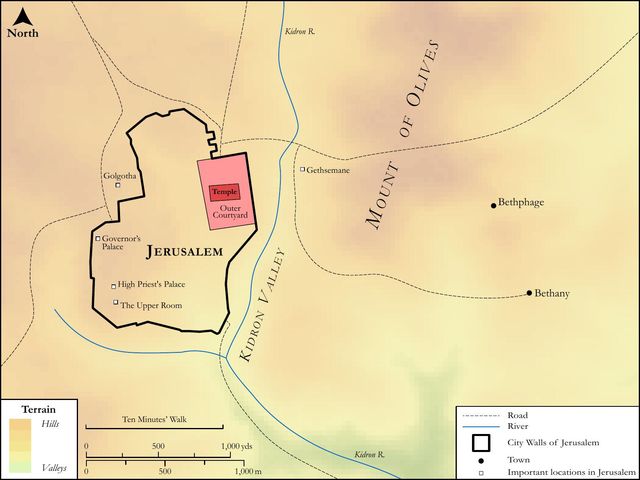
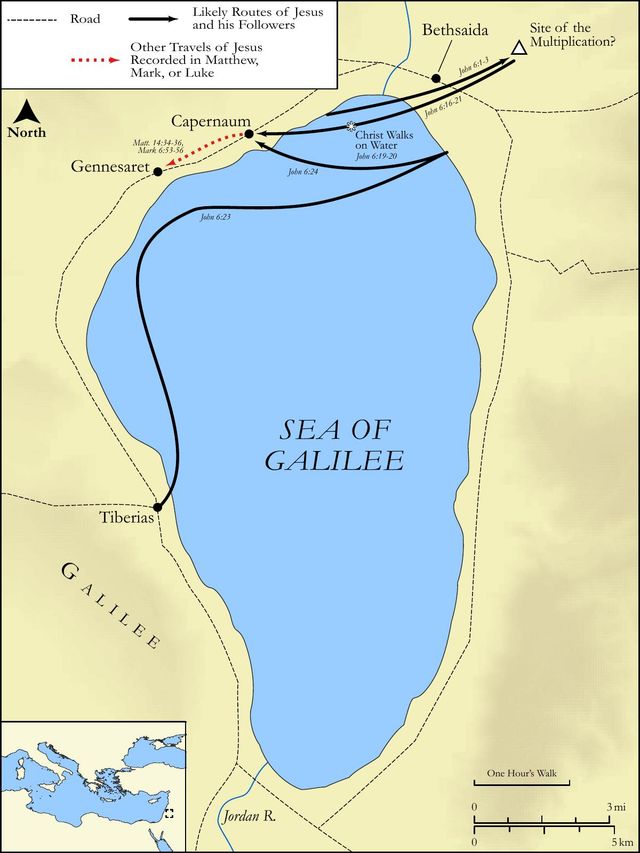
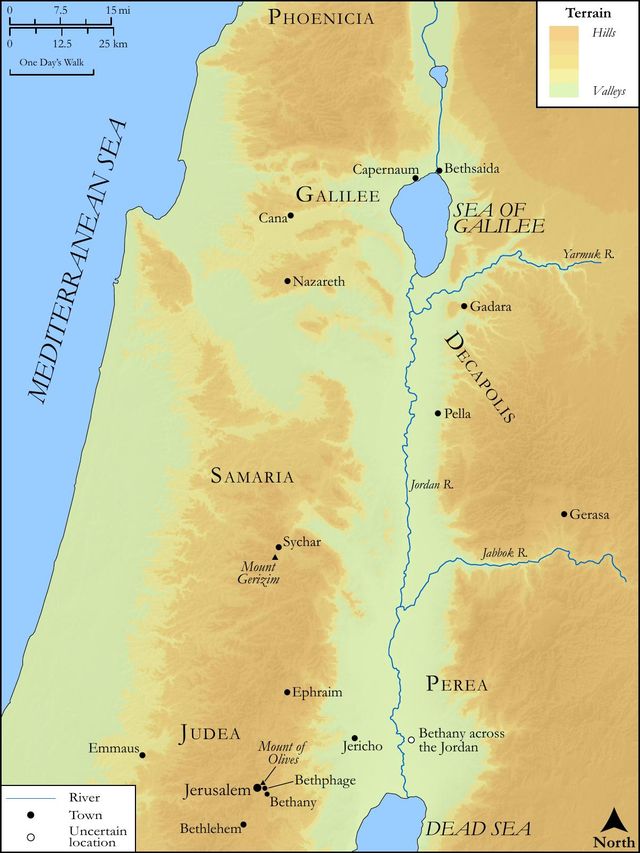
See on the biblical-era maps
Study this verse
Public-domain commentary
Matthew Henry
From his Commentary on the Whole Bible. Henry comments on passages, not single verses — this entry covers John 6:1–14. His four-level outline is real structure in the source text, so it is rendered as structure.
We have here an account of Christ's feeding five thousand men with five loaves and two fishes, which miracle is in this respect remarkable, that it is the only passage of the actions of Christ's life that is recorded by all the four evangelists. John, who does not usually relate what had been recorded by those who wrote before him, yet relates this, because of the reference the following discourse has to it. Observe,
I.The place and time where and when this miracle was wrought, which are noted for the greater evidence of the truth of the story; it is not said that it was done once upon a time, nobody knows where, but the circumstances are specified, that the fact might be enquired into.
1.The country that Christ was in (Joh 6:1): He went over the sea of Galilee, called elsewhere the lake of Gennesareth, here the sea of Tiberias, from a city adjoining, which Herod had lately enlarged and beautified, and called so in honour of Tiberius the emperor, and probably had made his metropolis. Christ did not go directly over cross this inland sea, but made a coasting voyage to another place on the same side. It is not tempting God to choose to go by water, when there is convenience for it, even to those places whither we might go by land; for Christ never tempted the Lord his God, Mat 4:7.
2.The company that he was attended with: A great multitude followed him, because they saw his miracles, Joh 6:2. Note,
(1.)Our Lord Jesus, while he went about doing good, lived continually in a crowd, which gave him more trouble than honour. Good and useful men must not complain of a hurry of business, when they are serving God and their generation; it will be time enough to enjoy ourselves when we come to that world where we shall enjoy God.
(2.)Christ's miracles drew many after him that were not effectually drawn to him. They had their curiosity gratified by the strangeness of them, who had not their consciences convinced by the power of them.
3.Christ's posting himself advantageously to entertain them (Joh 6:3): He went up into a mountain, and there he sat with his disciples, that he might the more conveniently be seen and heard by the multitude that crowded after him; this was a natural pulpit, and not, like Ezra's, made for the purpose. Christ was now driven to be a field preacher; but his word was never the worse, nor the less acceptable, for that, to those who knew how to value it, who followed him still, not only when he went out to a desert place, but when he went up to a mountain, though up-hill be against heart. He sat there, as teachers do in cathedra - in the chair of instruction. He did not sit at ease, not sit in state, yet he sat as one having authority, sat ready to receive addresses that were made to him; whoever would might come, and find him there. He sat with his disciples; he condescended to take them to sit with him, to put a reputation upon them before the people, and give them an earnest of the glory in which they should shortly sit with him. We are said to sit with him, Eph 2:6.
4.The time when it was. The first words, After those things, do not signify that this immediately followed what was related in the foregoing chapter, for it was a considerable time after, and they signify no more than in process of time; but we are told (Joh 6:4) that it was when the passover was nigh, which is here noted,
(1.)Because, perhaps, that had brought in all the apostles from their respective expeditions, whither they were sent as itinerant preachers, that they might attend their Master to Jerusalem, to keep the feast.
(2.)Because it was a custom with the Jews religiously to observe the approach of the passover thirty days before, with some sort of solemnity; so long before they had it in their eye, repaired the roads, mended bridges, if there was occasion, and discoursed of the passover and the institution of it.
(3.)Because, perhaps, the approach of the passover, when every one knew Christ would go up to Jerusalem, and be absent for some time, made the multitude flock the more after him and attend the more diligently on him. Note, The prospect of losing our opportunities should quicken us to improve them with double diligence; and, when solemn ordinances are approaching, it is good to prepare for them by conversing with the word of Christ.
II.The miracle itself. And here observe,
1.The notice Christ took of the crowd that attended him (Joh 6:5): He lifted up his eyes, and saw a great company come to him, poor, mean, ordinary people, no doubt, for such make up the multitudes, especially in such remote corners of the country; yet Christ showed himself pleased with their attendance, and concerned for their welfare, to teach us to condescend to those of low estate, and not to set those with the dogs of our flock whom Christ hath set with the lambs of his. The souls of the poor are as precious to Christ, and should be so to us, as those of the rich.
2.The enquiry he made concerning the way of providing for them. He directed himself to Philip, who had been his disciple from the first, and had seen all his miracles, and particularly that of his turning water into wine, and therefore it might be expected that he should have said, "Lord, if thou wilt, it is easy to thee to feed them all." Those that, like Israel, have been witnesses of Christ's works, and have shared in the benefit of them, are inexcusable if they say, Can he furnish a table in the wilderness? Philip was of Bethsaida, in the neighbourhood of which town Christ now was, and therefore he was most likely to help them to provision at the best hand; and probably much of the company was known to him, and he was concerned for them. Now Christ asked, Whence shall we buy bread, that these may eat?
(1.)He takes it for granted that they must all eat with him. One would think that when he had taught and healed them he had done his part; and that now they should rather have been contriving how to treat him and his disciples, for some of the people were probably rich, and we are sure that Christ and his disciples were poor; yet he is solicitous to entertain them. Those that will accept Christ's spiritual gifts, instead of paying for them, shall be paid for their acceptance of them. Christ, having fed their souls with the bread of life, feeds their bodies also with food convenient, to show that the Lord is for the body, and to encourage us to pray for our daily bread, and to set us an example of compassion to the poor, Jam 2:15, Jam 2:16.
(2.)His enquiry is, Whence shall we buy bread? One would think, considering his poverty, that he should rather have asked, Where shall we have money to buy for them? But he will rather lay out all he has than they shall want. He will buy to give, and we must labour, that we may give, Eph 4:28.
3.The design of this enquiry; it was only to try the faith of Philip, for he himself knew what he would do, Joh 6:6. Note,
(1.)Our Lord Jesus is never at a loss in his counsels; but, how difficult soever the case is, he knows what he has to do and what course he will take, Act 15:18. He knows the thoughts he has towards his people (Jer 29:11) and is never at uncertainty; when we know not, he himself knows what he will do.
(2.)When Christ is pleased to puzzle his people, it is only with a design to prove them. The question put Philip to a nonplus, yet Christ proposed it, to try whether he would say, "Lord, if thou wilt exert thy power for them, we need not buy bread."
4.Philip's answer to this question: "Two hundred pennyworth of bread is not sufficient, Joh 6:7. Master, it is to no purpose to talk of buying bread for them, for neither will the country afford so much bread, nor can we afford to lay out so much money; ask Judas, who carries the bag." Two hundred pence of their money amount to about six pounds of ours, and, if they lay out all that at once, it will exhaust their fund, and break them, and they must starve themselves. Grotius computes that two hundred pennyworth of bread would scarcely reach to two thousand, but Philip would go as near hand as he could, would have every one to take a little; and nature, we say, is content with a little. See the weakness of Philip's faith, that in this strait, as if the Master of the family had been an ordinary person, he looked for supply only in an ordinary way. Christ might now have said to him, as he did afterwards, Have I been so long time with you, and yet hast thou not known me, Philip? Or, as God to Moses in a like case, Is the Lord's hand waxen short? We are apt thus to distrust God's power when visible and ordinary means fail, that is, to trust him no further than we can see him.
5.The information which Christ received from another of his disciples concerning the provision they had. It was Andrew, here said to be Simon Peter's brother; though he was senior to Peter in discipleship, and instrumental to bring Peter to Christ, yet Peter afterwards so far outshone him that he is described by his relation to Peter: he acquainted Christ with what they had at hand; and in this we may see,
(1.)The strength of his love to those for whom he saw his Master concerned, in that he was willing to bring out all they had, though he knew not but they might want themselves, and any one would have said, Charity begins at home. He did not go about to conceal it, under pretence of being a better husband of their provision than the master was, but honestly gives in an account of all they had. There is a lad here, paidarion - a little lad, probably one that used to follow this company, as settlers do the camp, with provisions to sell, and the disciples had bespoken what he had for themselves; and it was five barley-loaves, and two small fishes. Here,
[1.]The provision was coarse and ordinary; they were barley loaves. Canaan was a land of wheat (Deu 8:8); its inhabitants were commonly fed with the finest wheat (Psa 81:16), the kidneys of wheat (Deu 32:14); yet Christ and his disciples were glad of barley-bread. It does not follow hence that we should tie ourselves to such coarse fare, and place religion in it (when God brings that which is finer to our hands, let us receive it, and be thankful); but it does follow that therefore we must not be desirous of dainties (Psa 23:3); nor murmur if we be reduced to coarse fare, but be content and thankful, and well reconciled to it; barley-bread is what Christ had, and better than we deserve. Nor let us despise the mean provision of the poor, nor look upon it with contempt, remembering how Christ was provided for.
[2.]It was but short and scanty; there were but five loaves, and those so small that one little lad carried them all; and we find (Kg2 4:42, Kg2 4:43) that twenty barley-loaves, with some other provision to help out, would not dine a hundred men without a miracle. There were but two fishes, and those small ones (duo opsaria), so small that one of them was but a morsel, pisciculi assati. I take the fish to have been pickled, or soused, for they had not fire to dress them with. The provision of bread was little, but that of fish was less in proportion to it, so that many a bit of dry bread they must eat before they could make a meal of this provision; but they were content with it. Bread is meat for our hunger; but of those that murmured for flesh it is said, They asked meat for their lust, Psa 78:18. Well, Andrew was willing that the people should have this, as far as it would go. Note, A distrustful fear of wanting ourselves should not hinder us from needful charity to others.
(2.)See here the weakness of his faith in that word, "But what are they among so many? To offer this to such a multitude is but to mock them." Philip and he had not that actual consideration of the power of Christ (of which they had had such large experience) which they should have had. Who fed the camp of Israel in the wilderness? He that could make one man chase a thousand could make one loaf feed a thousand.
6.The directions Christ gave the disciples to seat the guests (Joh 6:10): "Make the men sit down, though you have nothing to set before them, and trust me for that." This was like sending providence to market, and going to buy without money: Christ would thus try their obedience. Observe,
(1.)The furniture of the dining-room: there was much grass in that place, though a desert place; see how bountiful nature is, it makes grass to grow upon the mountains, Psa 147:8. This grass was uneaten; God gives not only enough, but more then enough. Here was this plenty of grass where Christ was preaching; the gospel brings other blessings along with it: Then shall the earth yield her increase, Psa 67:6. This plenty of grass made the place the more commodious for those that must sit on the ground, and served them for cushions, or beds (as they called what they sat on at meat, Est 1:6), and, considering what Christ says of the grass of the field (Mat 6:29, Mat 6:30), these beds excelled those of Ahasuerus: nature's pomp is the most glorious.
(2.)The number of the guests: About five thousand: a great entertainment, representing that of the gospel, which is a feast for all nations (Isa 25:6), a feast for all comers.
7.The distribution of the provision, Joh 6:11. Observe,
(1.)It was done with thanksgiving: He gave thanks. Note,
[1.]We ought to give thanks to God for our food, for it is a mercy to have it, and we have it from the hand of God, and must receive it with thanksgiving, Ti1 4:4, Ti1 4:5. And this is the sweetness of our creature-comforts, that they will furnish us with matter, and give us occasion, for that excellent duty of thanksgiving.
[2.]Though our provision be coarse and scanty, though we have neither plenty nor dainty, yet we must give thanks to God for what we have.
(2.)It was distributed from the hand of Christ by the hands of his disciples, Joh 6:11. Note,
[1.]All our comforts come to us originally from the hand of Christ; whoever brings them, it is he that sends them, he distributes to those who distribute to us.
[2.]In distributing the bread of life to those that follow him, he is pleased to make use of the ministration of his disciples; they are the servitors at Christ's table, or rather rulers in his household, to give to every one his portion of meat in due season.
(3.)It was done to universal satisfaction. They did not every one take a little, but all had as much as they would; not a short allowance, but a full meal; and considering how long they had fasted, with what an appetite they sat down, how agreeable this miraculous food may be supposed to have been, above common food, it was not a little that served them when they ate as much as they would and on free cost. Those whom Christ feeds with the bread of life he does not stint, Psa 81:10. There were but two small fishes, and yet they had of them too as much as they would. He did not reserve them for the better sort of the guests, and put off the poor with dry bread, but treated them all alike, for they were all alike welcome. Those who call feeding upon fish fasting reproach the entertainment Christ here made, which was a full feast.
8.The care that was taken of the broken meat. (1.) The orders Christ gave concerning it (Joh 6:12): When they were filled, and every man had within him a sensible witness to the truth of the miracle, Christ said to the disciples, the servants he employed, Gather up the fragments. Note, We must always take care that we make no waste of any of God's good creatures; for the grant we have of them, though large and full, is with this proviso, wilful waste only excepted. It is just with God to bring us to the want of that which we make waste of. The Jews were very careful not to lose any bread, nor let it fall to the ground, to be trodden upon. Qui panem contemnit in gravem incidit paupertatem - He who despises bread falls into the depths of poverty, was a saying among them. Though Christ could command supplies whenever he pleased, yet he would have the fragments gathered up. When we are filled we must remember that others want, and we may want. Those that would have wherewith to be charitable must be provident. Had this broken meat been left upon the grass, the beasts and fowls would have gathered it up; but that which is fit to be meat for men is wasted and lost if it be thrown to the brute-creatures. Christ did not order the broken meat to be gathered up till all were filled; we must not begin to hoard and lay up till all is laid out that ought to be, for that is withholding more than is meet. Mr. Baxter notes here, "How much less should we lose God's word, or helps, or our time, or such greater mercies!" (2.) The observance of these orders (Joh 6:13): They filled twelve baskets with the fragments, which was an evidence not only of the truth of the miracle, that they were fed, not with fancy, but with real food (witness those remains), but of the greatness of it; they were not only filled, but there was all this over and above. See how large the divine bounty is; it not only fills the cup, but makes it run over; bread enough, and to spare, in our Father's house. The fragments filled twelve baskets, one for each disciple; they were thus repaid with interest for their willingness to part with what they had for public service; see Ch2 31:10. The Jews lay it as a law upon themselves, when they have eaten a meal, to be sure to leave a piece of bread upon the table, upon which the blessing after meat may rest; for it is a curse upon the wicked man (Job 20:21) that there shall none of his meat be left.
III.Here is the influence which this miracle had upon the people who tasted of the benefit of it (Joh 6:14): They said, This is of a truth that prophet. Note,
1.Even the vulgar Jews with great assurance expected the Messiah to come into the world, and to be a great prophet, They speak here with assurance of his coming. The Pharisees despised them as not knowing the law; but, it should seem, they knew more of him that is the end of the law than the Pharisees did.
2.The miracles which Christ wrought did clearly demonstrate that he was the Messiah promised, a teacher come from God, the great prophet, and could not but convince the amazed spectators that this was he that should come. There were many who were convinced he was that prophet that should come into the world who yet did not cordially receive his doctrine, for they did not continue in it. Such a wretched incoherence and inconsistency there is between the faculties of the corrupt unsanctified soul, that it is possible for men to acknowledge that Christ is that prophet, and yet to turn a deaf ear to him.
Historical interpretation
Sixteen Centuries of Reception
10 surviving comments on this verse. Each one is dated, so this reads as a timeline rather than a list.
Select a marker to jump to its quote. Markers stagger vertically where authors wrote within a few decades of each other.
(iii. de Trin. c. 18) Five loaves are then set before the multitude, and broken. The broken portions pass through into the hands of those who break, that from which they are broken all the time not at all diminishing. And yet there they are, the bits taken from it, in the hands of the persons breakingd. There is no catching by eye or touch the miraculous operation: that is, which was not, that is seen, which is not understood. It only remains for us to believe that God can do all things.
(Hom. xlii. 1) As missiles rebound with great force from a hard body, and fly off in all directions, whereas a softer material retains and stops them; so violent men are only excited to greater rage by violence on the side of their opponents, whereas gentleness softens them. Christ quieted the irritation of the Jews by retiring from Jerusalem. He went into Galilee, but not to Cana again, but beyond the sea: After these things Jesus went over the sea of Galilee, which is the sea of Tiberias.
(Hom. xlii. 1) Though favoured with such teaching, they were influenced less by it, than by the miracles; a sign of their low state of belief: for Paul says of tongues, that they are for a sign, not to them that believe, but to them that believe not. (1 Cor. 14:22) They were wiser of whom it is said, that they were astonished at His doctrine. (Matt. 7:28) The Evangelist does not say what miracles He wrought, the great object of his book being to give our Lord's discourses. It follows: And Jesus went up into a mountain, and there sat with His disciples. He went up into the mountain, on account of the miracle which was going to be done. That the disciples alone ascended with Him, implies that the people who stayed behind were in fault for not following. He went up to the mountain too, as a lesson to us to retire from the tumult and confusion of the world, and leave wisdom in solitude. And the passover, a feast of the Jews, was nigh. Observe, in a whole year, the Evangelist has told us of no miracles of Christ, except His healing the impotent man, and the nobleman's son. His object was to give not a regular history, but only a few of the principal acts of our Lord. But why did not our Lord go up to the feast? He was taking occasion, from the wickedness of the Jews, gradually to abolish the Law.
(Hom. xlii. 1) Nor did He only sit with His disciples, but conversed with them familiarly, and gained possession of their minds. Then He looked, and saw a crowd advancing. But why did He ask Philip that question? Because He knew that His disciples, and he especially, needed further teaching. For this Philip it was who said afterwards, show us the Father, and it sufficeth us. (c. 14:8) And if the miracle had been performed at once, without any introduction, the greatness of it would not have been seen. The disciples were made to confess their own inability, that they might see the miracle more clearly; And this He said to prove him.
(Hom. xlii. s. 1) Or they are two different occasions altogether.
(Hom. xlii. 2.) Probably He had some reason in his mind for this speech. He would know of Elijah's miracle, by which a hundred men were fed with twenty loaves. This was a great step; but here he stopped. He did not rise any higher. For his next words are, But what are these among so many? He thought that less could produce less in a miracle, and more more; a great mistake; inasmuch as it was as easy for Christ to feed the multitude from a few fishes as from many. He did not really want any material to work from, but only made use of created things for this purpose in order to show that no part of the creation was severed from His wisdom.
(Hom. xlii. 2.) And let those of us, who are given to pleasure, observe the plain and abstemious eating of those great and wonderful menb. He made the men sit down before the loaves appeared, to teach us that with Him, things that are not are as things that are; as Paul says, Who calleth those things that be not, as though they were. (Rom. 4:17.) The passage proceeds then: And Jesus said, Make the men sit down.
(Hom. xlii. 2.) But why when He is going to heal the impotent, to raise the dead, to calm the sea, does He not pray, but here does give thanks? To teach us to give thanks to God, whenever we sit down to eat. And He prays more in lesser matters, in order to show that He does not pray from any motive of need. For had prayer been really necessary to supply His wants, His praying would have been in proportion to the importance of each particular work. But acting, as He does, on His own authority, it is evident, He only prays out of condescension to us. And, as a great multitude was collected, it was an opportunity of impressing on them, that His coming was in accordance with God's will. Accordingly, when a miracle was private, He did not pray; when numbers were present, He did.
(Hom. xlii. 3) Observe the difference between the servant and the lord. The Prophets received grace, as it were, by measure, and according to that measure performed their miracles: whereas Christ, working this by His own absolute power, produces a kind of superabundant result. When they were filled, He said unto His disciples, Gather up the fragments that remain, that nothing be lost. Therefore they gathered them together, and filled twelve baskets with the fragments. This was not done for needless ostentation, but to prevent men from thinking the whole a delusion; which was the reason why He made use of an existing material to work from. But why did He give the fragments to His disciples to carry away, and not to the multitude? Because the disciples were to be the teachers of the world, and therefore it was most important that the truth should be impressed upon them. Wherefore I admire not only the multitude of the loaves which were made, but the definite quantity of the fragments; neither more nor less than twelve baskets full, and corresponding to the number of the twelve Apostles.
Their expression, that should come into the world, shows that they expected the arrival of some great Prophet. And this is why they say, This is of a truth that Prophet: the article being put in the Greek, to show that He was distinct from other Prophets.
"And as He lifted up His eyes, He beheld a great company." This showeth that He sat not at any time idly with the disciples, but perhaps carefully conversing with them, and making them attend and turn towards Him, a thing which peculiarly marks His tender care, and the humility and condescension of His demeanor towards them. For they sat with Him, perhaps looking at one another; then having lifted up His eyes, He beheld the multitudes coming unto Him.
Wherefore then doth He ask "Philip"? He knew which of His disciples needed most instruction; for this is he who afterwards said, "Show us the Father, and it sufficeth us", and on this account Jesus was beforehand bringing him into a proper state. For had the miracle simply been done, without any introduction, the marvel would not have seemed so great, but now He beforehand constraineth him to confess the existing want, that knowing the state of matters he might be the more exactly acquainted with the magnitude of the miracle about to take place.
(de Con. Evang. l. ii. c. xlvi) But if our Lord, according to John's account, on seeing the multitude, asked Philip, tempting him, whence they could buy food for them, it is difficult at first to see how it can be true, according to the other account, that the disciples first told our Lord, to send away the multitude; and that our Lord replied, They need not depart; give ye them to eat. (Matt. 25:16) We must understand then it was after saying this, that our Lord saw the multitude, and said to Philip what John had related, which has been omitted by the rest.
A lesson most excellent did Christ again devise for His disciples, and fittest for the most holy men, both persuading them in utter straits to overcome cowardice in respect of hospitality, and to cast far away hesitation hereto, rather with more zealous motions to attain unto the virtue thereof. For what is there greater than this among those who know and will the things whereby it befitteth to purchase unto themselves the friendship from above? For when no small crowd cometh to Him, and an innumerable multitude is pouring forth like waters upon the parts, wherein He was stopping, He immediately ordered them to make preparations for feeding them. And in truth it was not unlikely that the zeal even of a very rich man would numb, by the multitude of those he saw startled into fear of not being able to be hospitable. But Christ shows that it is nothing at all great, when our brotherly love comes to a few, but wills that we should overcome with manful courage also things that surpass our expectation, firmly grounded by confidence in Him to boldness unto all good things.
In regard then of the narrative, the force of what is said, aims not away from the mark; but changing again these things unto their spiritual significance, and cutting away the gross typical dress, we say more openly, that those who by good zeal and faith seek Him, God fore-beholdeth, as from a mountain, that is from His high and God-befitting foreknowledge, according to that which is said by Paul, For whom He did foreknow and predestinate to be conformed to the Image of His Son, these He also called. Christ then lifts up His Eyes as showing that they who love Him are worthy of the Divine Gaze, even as in blessing it was said to Israel, The Lord lift up His Countenance upon thee and give thee peace. But not by the mere looking on them is His grace toward them that honour Him bounded, but the blessed Evangelist adding something more, shows that the Lord was not unmindful of the multitudes, but well prepared for their food and entertainment: that hereby again thou mayest understand that which is delivered us in Proverbs, The Lord will not suffer the righteous soul to famish. For He sets before them Himself, as Bread from Heaven, and will nourish the souls of them that fear Him: and prepareth all things sufficient to them for sustenance; as he saith in the Psalms, Thou preparest their food, for thus is Thy provision. And Christ Himself somewhere saith, Verily, verily I say unto you, he that cometh to Me shall never hunger. For He will give, as we said before, food from heaven, and will richly bestow the manifold grace of the Spirit. He prepareth moreover to give food to them that come to Him, not even awaiting their asking. For we know not what we should pray for as we ought, but He forecometh us in reaching forth those things which preserve us unto eternal life.
He saith then unto Philip, Whence shall we buy bread? We must needs see, why to Philip, although the rest of the disciples were standing by and cleaving to Him: Philip then was a questioner and apt to learn, but not over quick in ready power of understanding the more Divine. This you will learn, if you consider with yourself that he, after having followed the Saviour for a long time and gathered manifold lessons concerning His Godhead and gotten to himself apprehension through both deeds and words, as though he had learnt nothing yet, in the last times of the economy says to Jesus, Lord, show us the Father, and it sufficeth us; but as saying it in his simplicity he was fitly re-instructed, So long time am I with you, and hast thou not known Me, Philip? saith Christ. Therefore as to one duller of understanding, and advancing more slowly than he ought to the apprehension of things more Divine, He puts forth the question, exercising the disciple in faith. For this is one meaning of, To prove him, in this passage, although as the blessed Evangelist affirmed, He Himself knew what He would do.
But His saying Whence shall we buy proves the uncare for money of them that were with Him, and their voluntary poverty for God's sake, in that they had not even wherewithal to buy necessary food. Together with this He works something, and orders it skillfully. For He says Whence, not emptily, as to those who had taken no trouble to provide anything at all, but as to those who were accustomed to entire uncare for money. Excluding then, and cutting short most skilfully expectation arising from money, He well nigh persuades them to go on to entreat the Lord, that He would, if He willeth them when they have nothing to feed those that come to Him, by His unspeakable Power and God-befitting Might create food. For this was what yet remained, and He was calling them at length to see that their only remaining hopes were thence, according to the Greek poets,
---------- the iron wound of necessity.
If we compare the accounts of the different Evangelists, we shall find very clearly, that there was an interval of a year between the beheading of John, and our Lord's Passion. For, since Matthew says that our Lord, on hearing of the death of John, withdrew into a desert place, where He fed the multitude; and John says that the Passover was nigh, when He fed the multitude; it is evident that John was beheaded shortly before the Passover. And at the same feast, the next year Christ suffered. It follows, When Jesus then lifted up His eyes, and saw a great company come unto Him, He saith unto Philip, Whence shall we buy bread, that these may eat? When Jesus lifted up His eyes, this is to show us, that Jesus was not generally with His eyes lifted up, looking about Him, but sitting calm and attentive, surrounded by His disciples.
He asks him this question, not for His own information, but in order to show His yet unformed disciple his dulness of mind, which he could not perceive of himself.
Mystically, the sea signifies this tumultuous world. In the fulness of time, when Christ had entered the sea of our mortality by His birth, trodden it by His death, passed over it by His resurrectionf, then followed Him crowds of believers, both from the Jews and Gentiles.
His leaving the multitude below, and ascending the heights with His disciples, signifies, that lesser precepts are to be given to beginners, higher to the more matured. His refreshing the people shortly before the Passover signifies our refreshment by the bread of the divine word; and the body and blood, i. e. our spiritual passover, by which we pass over from vice to virtue. And the Lord's eyes are spiritual gifts, which he mercifully bestows on His Elect. He turns His eyes upon them, i. e. has compassionate respect unto them.
Baskets are used for servile work. The baskets here are the Apostles and their followers, who, though despised in this present life, are within filled with the riches of spiritual sacraments. The Apostles too are represented as baskets, because, that through them, the doctrine of the Trinity was to be preached in the four parts of the world. His not making new loaves, but multiplying what there were, means that He did not reject the Old Testament, but only developed and explained it.
There is an activity of God displayed throughout creation, a wholesale activity let us say which men refuse to recognize. The miracles done by God incarnate, living as a man in Palestine, perform the very same things as this wholesale activity, but at a different speed and on a smaller scale. One of their chief purposes is that men, having seen a thing done by personal power on the small scale, may recognize, when they see the same thing done on the large scale, that the power behind it is also personal – is indeed the very same person who lived among us two thousand years ago. The miracles in fact are a retelling in small letters of the very same story which is written across the whole world in letters too large for some of us to see...
Every year God makes a little corn into much corn: the seed is sown and there is an increase, and men, according to the fashion of their age, say “It is Ceres, it is Adonis, it is the Corn-King,” or else “It is the laws of Nature.” The close-up, the translation, of this annual wonder is the feeding of the five thousand. Bread is not made there of nothing. Bread is not made of stones, as the Devil once suggested to Our Lord in vain. A little bread is made into much bread. The Son will do nothing but what He sees the Father do. There is, so to speak, a family style...
When He fed the thousands He multiplied fish as well as bread. Look in every bay and almost every river. This swarming, pulsating fecundity shows He is still at work. The ancients had a god called Genius – the god of animal and human fertility, the presiding spirit of gynecology, embryology, or the marriage bed – the “genial bed” as they called it after its god Genius. As the miracles of wine and bread and healing showed who Bacchus really was, who Ceres, who Apollo, and that all were one, so this miraculous multiplication of fish reveals the real Genius.
Continue studying John 6:5 across the web’s major study libraries — every link below opens this exact verse, chapter, or book on the destination site.
Read & Compare
 BibleGatewayThis verse in more than 200 translations and 70 languages.
 Bible.comThe YouVersion reader — hundreds of translations, reading plans, and highlights.
 ESV.orgCrossway's official English Standard Version reader.
 NET BibleThe NET translation with 60,000+ translators' notes on every rendering decision.
 STEP BibleTyndale House's free study tool — original text, vocabulary, and scholarly resources.
 BibliaLogos Bible Software's free web reader.
 USCCBThe New American Bible (Revised Edition) with the U.S. bishops' study notes.
Commentaries
 BibleHub CommentariesDozens of classic commentaries on this verse, gathered on one page.
 StudyLightMore than 100 commentary sets — the largest collection on the web.
 BibleRefPlain-English commentary on what this verse means, verse by verse.
 Enduring WordDavid Guzik's free commentary on this chapter, widely used by Bible teachers.
 Bible Study ToolsVerse commentary alongside Greek and Hebrew study aids.
Original Language & Research
- BibleHub InterlinearThe verse word by word — original language, transliteration, and English.
- BibleHub LexiconEvery word's original-language definition and Strong's entry.
 Blue Letter BibleDeep-study tools — Strong's numbers, concordance, and word studies.
 CNTR CollationThe earliest Greek manuscripts of this verse, collated letter by letter.
Sermons, Hymns & Audio


TrulyRandomVerse is not affiliated with these sites and doesn’t control their content. They’re linked because they’re genuinely useful.
Summary
John 6:5 captures a pivotal moment preceding one of Jesus' most renowned miracles, the feeding of the five thousand. In this verse, Jesus, observing the vast multitude approaching Him, proactively addresses the pressing practical need for food by posing a strategic question to His disciple Philip. This exchange not only highlights Jesus' divine awareness of human hunger and His profound compassion but also sets the stage for a dramatic demonstration of His power to provide supernaturally, challenging His disciples' understanding of His capabilities and preparing them for a revelation of His glory.
Context
ShowHideLiterary Context
John 6:5 is situated within the broader narrative of Jesus' Galilean ministry, specifically following His withdrawal across the Sea of Tiberias (also known as the Sea of Galilee) after hearing of John the Baptist's death (implied by the Synoptics, though not explicitly stated as the reason for withdrawal in John). The preceding verses (John 6:1-4) establish that a "great multitude" was already following Jesus because they had seen His miraculous signs. Jesus' ascent to a mountain with His disciples (John 6:3) provides the setting for this encounter. Crucially, John 6:4 notes that the Passover, a feast deeply associated with divine provision and liberation, was near, adding a layer of theological significance to the impending miracle. Immediately following John 6:5, John 6:6 explicitly states Jesus' intention in asking the question: "this he said to prove him: for he himself knew what he would do," revealing His foreknowledge and deliberate testing of Philip. The miracle of feeding the multitude then unfolds in the subsequent verses (John 6:7-13).
Historical & Cultural Context
The event takes place in a "desert place" or "mountain" region on the eastern side of the Sea of Galilee, a relatively remote area not conducive to easily purchasing food for thousands. The mention of the Passover being "nigh" (John 6:4) is significant. Passover was one of the three major pilgrimage festivals, attracting large numbers of people to Jerusalem, but also stirring messianic expectations throughout Israel. The crowds following Jesus were likely a mix of pilgrims, the curious, and those genuinely seeking healing or spiritual truth. In ancient Israel, hospitality was a deeply ingrained cultural value, and hosts were expected to provide for their guests. Jesus, in this context, takes on the role of the ultimate host, demonstrating divine hospitality. The sheer number of people—"five thousand men, besides women and children" (Matthew 14:21, Mark 6:44)—would have presented an insurmountable logistical and financial challenge for any human group, underscoring the necessity of divine intervention.
Key Themes
ShowHideThis verse contributes to several key themes within the Gospel of John and the broader biblical narrative. Firstly, it powerfully illustrates Divine Awareness and Compassion, as Jesus, unprompted, perceives the physical need of the vast crowd, demonstrating His proactive concern for their well-being, a theme echoed in other Gospels where Jesus has compassion on the crowds "because they were like sheep without a shepherd" (Mark 6:34). Secondly, it introduces the theme of Testing of Faith. Jesus' question to Philip is not born of ignorance but is a deliberate challenge designed to reveal Philip's limitations and prepare him for a greater understanding of Jesus' power, as explicitly stated in John 6:6. This testing serves to highlight the contrast between human inadequacy and divine omnipotence. Finally, the verse initiates the theme of Divine Provision and Abundance, setting the stage for a miraculous demonstration of God's ability to provide for His people in overwhelming ways, often from seemingly insignificant resources, foreshadowing the greater spiritual provision Jesus would offer as the "Bread of Life" later in John 6.
Exposition and Analysis
ShowHideKey Word Analysis
ShowHideFrom the Greek verb G1869, meaning "to raise up" (literally or figuratively). In this context, it describes Jesus physically raising His eyes to survey the scene. This seemingly simple action carries theological weight, indicating Jesus' deliberate observation and awareness of the approaching multitude and their impending need. It is not a casual glance but a purposeful act of perception.
From the Greek verb G2300, a prolonged form of a primary verb, meaning "to look closely at, i.e. (by implication) perceive (literally or figuratively); by extension to visit." Unlike a fleeting glimpse, theáomai implies a sustained, intentional gaze, suggesting a deep and comprehensive understanding of what is being observed. Jesus "saw" not just a crowd, but a "great company" with an implicit need, indicating His profound insight and empathetic observation.
From the Greek noun G3793, meaning "a throng (as borne along); by implication, the rabble; by extension, a class of people; figuratively, a riot." This term emphasizes the sheer size and perhaps the somewhat disorganized nature of the crowd. It denotes a large, undifferentiated mass of people, highlighting the immense scale of the logistical problem Jesus was about to address, making the subsequent miracle all the more astounding.
Verse Breakdown
ShowHide"When Jesus then lifted up [his] eyes"
This opening clause immediately centers the action on Jesus. The phrase "lifted up his eyes" signifies a deliberate act of observation, indicating that Jesus was not merely reacting to circumstances but was proactively assessing the situation. It suggests a moment of divine foresight and intentionality, setting the stage for His subsequent action.
"and saw a great company come unto him"
This part describes the object of Jesus' gaze: a vast multitude ("great company") approaching Him. The verb "saw" (theáomai) implies a comprehensive and discerning observation, not just a casual glance. Jesus perceives not merely the physical presence of the crowd but their underlying condition and need, which He is about to address. The "great company" underscores the overwhelming scale of the challenge from a human perspective.
"he saith unto Philip"
Jesus' direct address to Philip is significant. Philip was from Bethsaida (John 1:44), a town near the area where this miracle occurred, and might have been expected to have some local knowledge. This personal interaction highlights Jesus' method of engaging with His disciples, often through direct questions that probe their understanding and faith.
"‹Whence shall we buy bread, that these may eat?›"
This is Jesus' critical question, posed as a seemingly practical inquiry. "Whence" (from where) emphasizes the logistical impossibility of the task. The question is designed to elicit a human assessment of the problem, revealing the disciples' limitations and setting up the contrast with Jesus' divine capacity. It focuses on the immediate physical need ("bread") and the ultimate purpose ("that these may eat"), laying bare the immense challenge that only divine power could overcome.
Literary Devices
ShowHideJohn 6:5 employs several literary devices to enhance its impact and convey deeper meaning. The most prominent is the Rhetorical Question posed by Jesus to Philip. This question, "Whence shall we buy bread, that these may eat?", is not asked for information, as John 6:6 immediately clarifies that Jesus "himself knew what he would do." Instead, it serves to highlight the human impossibility of the situation, drawing the disciples' attention to the overwhelming need and their own inadequacy, thereby magnifying the subsequent miracle. There is also an element of Foreshadowing, as this question sets the stage for Jesus' miraculous provision, which will later be expounded upon in the "Bread of Life" discourse, where the physical bread points to a spiritual reality. The description of the approaching crowd as a "great company" uses Hyperbole to emphasize the immense scale of the multitude, making the logistical challenge seem even more insurmountable and thus elevating the divine power required to meet it. Finally, the entire scene functions as a Paradigm for faith, illustrating how Jesus tests His followers' trust in His power when faced with overwhelming circumstances.
Theological and Thematic Connections
ShowHideJohn 6:5 serves as a powerful theological statement about the nature of Christ, His relationship with humanity, and the dynamics of faith. Jesus' proactive observation and question demonstrate His divine omniscience and sovereign control, as He already knew the solution before posing the problem. This act of "seeing" and "asking" is rooted in His profound compassion for the physical and spiritual needs of humanity, mirroring God's consistent care for His people throughout salvation history, providing manna in the wilderness or water from a rock. The verse also introduces the critical theme of testing, a recurring motif in scripture where God allows challenges to reveal the limits of human ability and the boundless nature of His own power, ultimately strengthening faith. This moment is a microcosm of the larger biblical narrative where human inadequacy meets divine sufficiency.
Reflection and Application
ShowHideJohn 6:5 offers profound insights for contemporary believers. Just as Jesus "lifted up his eyes" and saw the need of the multitude, He remains keenly aware of our needs, both physical and spiritual, even before we articulate them. We, like Philip, often face situations that appear humanly impossible—financial shortfalls, health crises, relational brokenness, or overwhelming responsibilities. Jesus' question, "Whence shall we buy bread, that these may eat?", invites us to confront the seeming impossibility of our circumstances and to acknowledge our own limitations. However, the true lesson is not to dwell on our inadequacy but to recognize that our limitations are precisely where God's infinite capacity to provide can be most powerfully demonstrated. This verse challenges us to move beyond human reasoning and to trust in God's supernatural provision, even when the solution is beyond our comprehension. It calls us to faith that believes God can do "exceedingly abundantly above all that we ask or think" (Ephesians 3:20). Our role is to present the need and our meager resources (like the boy's loaves and fish), then step back and witness God's miraculous work, allowing Him to use us as instruments in His grand plan, no matter how small our contribution may seem.
Questions for Reflection
ShowHideFAQ
ShowHideWhy did Jesus specifically ask Philip this question, and not another disciple?
ShowHideWhile the text does not explicitly state Jesus' exact reason for choosing Philip, John 6:6 clarifies that "this he said to prove him: for he himself knew what he would do." Philip was from Bethsaida (John 1:44), a town in the region where this miracle occurred. It's possible Jesus chose Philip because of his local knowledge, perhaps expecting him to quickly calculate the immense logistical and financial challenge. Philip's immediate, pragmatic response in John 6:7 ("Two hundred pennyworth of bread is not sufficient for them, that every one of them may take a little") confirms his practical, human-centered assessment, which Jesus intended to highlight as insufficient in the face of divine power. This interaction served as a personal lesson for Philip, and by extension, for all the disciples, about the vast difference between human limitation and divine omnipotence.
What is the significance of the "great company" coming to Jesus?
ShowHideThe "great company" (Greek: óchlos) signifies the immense scale of the multitude, estimated at "about five thousand men, besides women and children" (Matthew 14:21). This large number underscores the human impossibility of feeding them through conventional means, thereby magnifying the miraculous nature of Jesus' subsequent provision. It also highlights the widespread appeal of Jesus' ministry at that time, as people were drawn to Him by His signs and teachings (John 6:2). The sheer size of the crowd creates a dramatic tension, setting the stage for Jesus to reveal His divine power and compassion in a way that would leave no doubt about His identity and authority.
Christ-Centered Fulfillment
ShowHideJohn 6:5, while seemingly a simple logistical question, profoundly foreshadows Jesus' ultimate role as the divine provider and the "Bread of Life." The physical hunger of the multitude in this scene becomes a powerful metaphor for humanity's deeper spiritual hunger, which only Christ can truly satisfy. Just as Jesus miraculously multiplied a few loaves and fish to feed thousands, He offers Himself as the ultimate sustenance for eternal life. This physical miracle points directly to the spiritual reality articulated later in John 6, where Jesus declares, "I am the bread of life: he that cometh to me shall never hunger; and he that believeth on me shall never thirst" (John 6:35). The provision of physical bread for a temporary need anticipates the eternal provision of spiritual life through His body and blood, offered as the true manna from heaven. The question of "Whence shall we buy bread?" is answered not by human commerce, but by the divine self-giving of the Son of God, who came "to give his life a ransom for many" (Mark 10:45). Thus, this verse advances a narrative that culminates in the revelation of Jesus as the one who fully satisfies humanity's deepest cravings for meaning, purpose, and eternal life, fulfilling the Old Testament types of divine provision and pointing towards the ultimate feast of salvation.