


John 1:43
Bible text: King James Version (1769 Blayney text) · Public domain
Bible text: Berean Standard Bible · Public domain
Bible text: American Standard Version (1901) · Public domain
Bible text: World English Bible, Messianic edition · Public domain
Bible text: Geneva Bible (1599) · Public domain
Bible text: Young's Literal Translation · Public domain
- ΤῇTēaOn theG3588T-DSFDefinite article Dative Singular Feminine
- ἐπαύριονepaurionnext dayG1887ADVAdverb
- ἠθέλησενēthelēsenHe desiredG2309V-AAI-3SVerb Aorist Active Indicative 3rd Singular
- ἐξελθεῖνexeltheinto go forthG1831V-2AANVerb 2nd Aorist Active Infinitive
- εἰςeisintoG1519PREPPreposition
- τὴνtēn<the>G3588T-ASFDefinite article Accusative Singular Feminine
- ΓαλιλαίανGalilaianGalileeG1056N-ASF-LNoun Accusative Singular Feminine Location
- καὶkaiAndG2532CONJConjunction
- εὑρίσκειheuriskeiHe findsG2147V-PAI-3SVerb Present Active Indicative 3rd Singular
- ΦίλιππονPhilipponPhilipG5376N-ASM-PNoun Accusative Singular Masculine Individual
- καὶkaiAndG2532CONJConjunction
- λέγειlegeisaysG3004V-PAI-3SVerb Present Active Indicative 3rd Singular
- αὐτῷautōto himG846P-DSMPersonal pronoun Dative Singular Masculine
- ὁho<the>G3588T-NSMDefinite article Nominative Singular Masculine
- Ἰησοῦς·IēsousJesusG2424N-NSM-PNoun Nominative Singular Masculine Individual
- ἀκολούθειakoloutheido followG190V-PAM-2SVerb Present Active Imperative 2nd Singular
- μοιmoiMeG3165P-1DSPersonal pronoun Dative 1st Singular
English is a literal word-by-word gloss of the Greek, not the KJV's wording. Why?
This is the original text the KJV's translators worked from — each Greek word with its own literal English meaning in this verse, prepared by scholars at Tyndale House, Cambridge. The KJV translates whole sentences, not word by word, so its wording differs: one Greek word can become several English words, and the KJV may choose “charity” where the gloss reads “love”. Both are faithful — they answer different questions. For the KJV's own rendering, switch to the KJV text.
Details
See on the biblical-era maps
Study this verse
Public-domain commentary
Matthew Henry
From his Commentary on the Whole Bible. Henry comments on passages, not single verses — this entry covers John 1:43–51. His four-level outline is real structure in the source text, so it is rendered as structure.
We have here the call of Philip and Nathanael.
I.Philip was called immediately by Christ himself, not as Andrew, who was directed to Christ by John, or Peter, who was invited by his brother. God has various methods of bringing his chosen ones home to himself. But, whatever means he uses, he is not tied to any.
1.Philip was called in a preventing was: Jesus findeth Philip. Christ sought us, and found us, before we made any enquiries after him. The name Philip is of Greek origin, and much used among the Gentiles, which some make an instance of the degeneracy of the Jewish church at this time, and their conformity to the nations; yet Christ changed not his name.
2.He was called the day following. See how closely Christ applied himself to his business. When work is to be done for God, we must not lose a day. Yet observe, Christ now called one or two a day; but, after the Spirit was poured out, there were thousands a day effectually called, in which was fulfilled Joh 14:12.
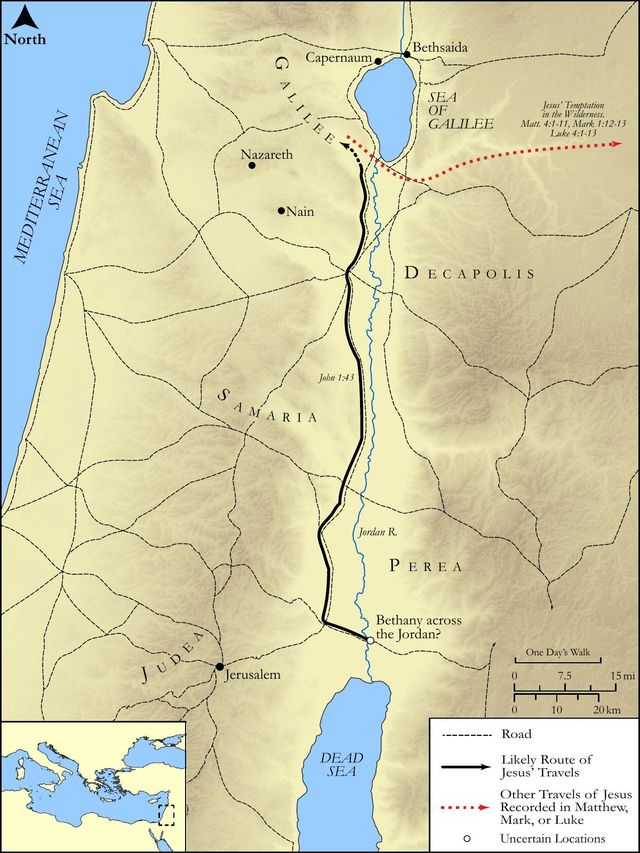
3.Jesus would go forth into Galilee to call him. Christ will find out all those that are given to him, wherever they are, and none of them shall be lost.
4.Philip was brought to be a disciple by the power of Christ going along with that word, Follow me. See the nature of true Christianity; it is following Christ, devoting ourselves to his converse and conduct, attending his movements, and treading in his steps. See the efficacy of the grace of it is the rod of his strength.
5.We are told that Philip was of Bethsaida, and Andrew and Peter were so too, Joh 1:44. These eminent disciples received not honour from the place of their nativity, but reflected honour upon it. Bethsaida signifies the house of nets, because inhabited mostly by fishermen; thence Christ chose disciples, who were to be furnished with extraordinary gifts, and therefore needed not the ordinary advantages of learning. Bethsaida was a wicked place (Mat 11:21), yet even there was a remnant, according to the election of grace.
II.Nathanael was invited to Christ by Philip, and much is said concerning him. In which we may observe,
1.What passed between Philip and Nathanael, in which appears an observable mixture of pious zeal with weakness, such as is usually found in beginners, that are yet but asking the way to Zion. Here is,
(1.)The joyful news that Philip brought to Nathanael, Joh 1:45. As Andrew before, so Philip here, having got some knowledge of Christ himself, rests not till he has made manifest the savour of that knowledge. Philip, though newly come to an acquaintance with Christ himself, yet steps aside to seek Nathanael. Note, When we have the fairest opportunities of getting good to our own souls, yet ever then we must seek opportunities of doing good to the souls of others, remembering the words of Christ, It is more blessed to give than to receive, Act 20:35. O, saith Philip, we have found him of whom Moses and the prophets did write, Observe here, [1.] What a transport of joy Philip was in, upon this new acquaintance with Christ: "We have found him whom we have so often talked of, so long wished and waited for; at last, he is come he is come, and we have found him!" [2.] What an advantage it was to him that he was so well acquainted with the scriptures of the Old Testament, which prepared his mind for the reception of evangelical light, and made the entrance of it much the more easy: Him of whom Moses and the prophets did write. What was written entirely and from eternity in the book of the divine counsels was in part, at sundry times and in divers manners, copied out into the book of the divine revelations. Glorious things were written there concerning the Seed of the woman, the Seed of Abraham, Shiloh, the prophet like Moses, the Son of David, Emmanuel, the Man, the Branch, Messiah the Prince. Philip had studied these things, and was full of them, which made him readily welcome Christ. [3.] What mistakes and weaknesses he laboured under: he called Christ Jesus of Nazareth, whereas he was of Bethlehem; and the Son of Joseph, whereas he as but his supposed Son. Young beginners in religion are subject to mistakes, which time and the grace of God will rectify. It was his weakness to say, We have found him, for Christ found them before they found Christ. He did not yet apprehend, as Paul did, how he was apprehended of Christ Jesus, Phi 3:12.
(2.)The objection which Nathanael made against this, Can any good thing come out of Nazareth? Joh 1:46. Here,
[1.]His caution was commendable, that he did not lightly assent to every thing that was said, but took it into examination; our rule is, Prove all things. But,
[2.]His objection arose from Ignorance. If he meant that no good thing could come out of Nazareth it was owing to his ignorance of the divine grace, as if that were less affected to one place than another, or tied itself to men's foolish and ill-natured observations. If he meant that the Messiah, that great good thing, could not come out of Nazareth, so far he was right (Moses, in the law, said that he should come out of Judah, and the prophets had assigned Bethlehem for the place of his nativity); but then he was ignorant of the matter of fact, that this Jesus was born at Bethlehem; so that the blunder Philip made, in calling him Jesus of Nazareth, occasioned this objection. Note, The mistakes of preachers often give rise to the prejudices of hearers.
(3.)The short reply which Philip gave to this objection: Come and see.
[1.]It was his weakness that he could not give a satisfactory answer to it; yet it is the common case of young beginners in religion. We may know enough to satisfy ourselves, and yet not be able to say enough to silence the cavils of a subtle adversary.
[2.]It was his wisdom and zeal that, when he could not answer the objection himself, he would have him go to one that could: Come and see. Let us not stand arguing here, and raising difficulties to ourselves which we cannot get over; let us go and converse with Christ himself, and these difficulties will all vanish presently. Note, It is folly to spend that time in doubtful disputation which might be better spent, and to much better purpose, in the exercises of piety and devotion. Come and see; not, Go and see, but, "Come, and I will go along with thee;" as Isa 2:3; Jer 1:5. From this parley between Philip and Nathanael, we may observe, First, That many people are kept from the ways of religion by the unreasonable prejudices they have conceived against religion, upon the account of some foreign circumstances which do not at all touch the merits of the case. Secondly, The best way to remove the prejudices they have entertained against religion is to prove themselves, and make trial of it. Let us not answer this matter before we hear it.
2.What passed between Nathanael and our Lord Jesus. He came and saw, not in vain.
(1.)Our Lord Jesus bore a very honourable testimony to Nathanael's integrity: Jesus saw him coming, and met him with favourable encouragement; he said of him to those about him, Nathanael himself being within hearing, Behold an Israelite indeed. Observe,
[1.]That he commended him; not to flatter him, or puff him up with a good conceit of himself, but perhaps because he knew him to be a modest man, if not a melancholy man, one that had hard and mean thoughts of himself, was ready to doubt his own sincerity; and Christ by this testimony put the matter out of doubt. Nathanael had, more than any of the candidates, objected against Christ; but Christ hereby showed that he excused it, and was not extreme to mark what he had said amiss, because he knew his heart was upright. He did not retort upon him, Can any good thing come out of Cana (Joh 21:2), an obscure town in Galilee? But kindly gives him this character, to encourage us to hope for acceptance with Christ, notwithstanding our weakness, and to teach us to speak honourably of those who without cause have spoken slightly of us, and to give them their due praise.
[2.]That he commended him for his integrity. First, Behold an Israelite indeed. It is Christ's prerogative to know what men are indeed; we can but hope the best. The whole nation were Israelites in name, but all are not Israel that are of Israel (Rom 9:6); here, however, was an Israelite indeed. 1. A sincere follower of the good example of Israel, whose character it was that he was a plain man, in opposition to Esau's character of a cunning man. He was a genuine son of honest Jacob, not only of his seed, but of his spirit. 2. A sincere professor of the faith of Israel; he was true to the religion he professed, and lived up to it: he was really as good as he seemed, and his practice was of a piece with his profession. He is the Jew that is one inwardly (Rom 2:29), so is he the Christian. Secondly, He is one in whom is no guile - that is the character of an Israelite indeed, a Christian indeed: no guile towards men; a man without trick or design; a man that one may trust; no guile towards God, that is, sincere in his repentance for sin; sincere in his covenanting with God; in whose spirit is no guile, Psa 32:2. He does not say without guilt, but without guile. Though in many things he is foolish and forgetful, yet in nothing false, nor wickedly departing from God: there is no allowed approved guilt in him; not painted, though he have his spots: "Behold this Israelite indeed." 1. "Take notice of him, that you may learn his way, and do like him." 2. "Admire him; behold, and wonder." The hypocrisy of the scribes and Pharisees had so leavened the Jewish church and nation, and their religion was so degenerated into formality or state-policy, that an Israelite indeed was a man wondered at, a miracle of divine grace, like Job, Job 1:8.
(2.)Nathanael is much surprised at this, upon which Christ gives him a further proof of his omnisciency, and a kind memorial of his former devotion.
[1.]Here is Nathanael's modesty, in that he was soon put out of countenance at the kind notice Christ was pleased to take of him: "Whence knowest thou me, me that am unworthy of thy cognizance? who am I, O Lord God?" Sa2 7:18. This was an evidence of his sincerity, that he did not catch at the praise he met with, but declined it. Christ knows us better than we know ourselves; we know not what is in a man's heart by looking in his face, but all things are naked and open before Christ, Heb 4:12, Heb 4:13. Doth Christ know us? Let us covet to know him.
[2.]Here is Christ's further manifestation of himself to him: Before Philip called thee, I saw thee. First, He gives him to understand that he knew him, and so manifests his divinity. It is God's prerogative infallibly to know all persons and all things; by this Christ proved himself to be God upon many occasions. It was prophesied concerning the Messiah that he should be of quick understanding in the fear of the Lord, that is, in judging the sincerity and degree of the fear of God in others, and that he should not judge after the sight of his eyes, Isa 11:2, Isa 11:3. Here he answers that prediction. See Ti2 2:19. Secondly, That before Philip called him he saw him under the fig-tree; this manifests a particular kindness for him. 1. His eye was towards him before Philip called him, which was the first time that ever Nathanael was acquainted with Christ. Christ has knowledge of us before we have any knowledge of him; see Isa 45:4; Gal 4:9. 2. His eye was upon him when he as under the fig-tree; this was a private token which nobody understood but Nathanael: "When thou wast retired under the fig-tree in thy garden, and thoughtest that no eye saw thee, I have then my eye upon thee, and saw that which was very acceptable." It is most probable that Nathanael under the fig-tree was employed, as Isaac in the field, in meditation, and prayer, and communion with God. Perhaps then and there it was that he solemnly joined himself to the Lord in an inviolable covenant. Christ saw in secret, and by this public notice of it did in part reward him openly. Sitting under the fig-tree denotes quietness and composedness of spirit, which much befriend communion with God. See Mic 4:4; Zac 3:10. Nathanael herein was an Israelite indeed, that, like Israel, he wrestled with God alone (Gen 32:24), prayed not like the hypocrites, in the corners of the streets, but under the fig-tree.
(3.)Nathanael hereby obtained a full assurance of faith in Jesus Christ, expressed in that noble acknowledgment (Joh 1:49): Rabbi, thou art the Son of God, thou art the king of Israel; that is, in short, thou art the true Messiah. Observe here,
[1.]How firmly he believed with the heart. Though he had lately laboured under some prejudices concerning Christ, they had now all vanished. Note, The grace of God, in working faith, casts down imaginations. Now he asks no more, Can any good thing come out of Nazareth? For he believes Jesus of Nazareth to be the chief good, and embraces him accordingly.
[2.]How freely he confessed with the mouth. His confession is made in form of an adoration, directed to our Lord Jesus himself, which is a proper way of confessing our faith. First, He confesses Christ's prophetical office, in calling him Rabbi, a title which the Jews commonly gave to their teachers. Christ is the great rabbi, at whose feet we must all be brought up. Secondly, He confesses his divine nature and mission, in calling him the Son of God (that Son of God spoken of Psa 2:7); though he had but a human form and aspect, yet having a divine knowledge, the knowledge of the heart, and of things distant and secret, Nathanael thence concludes him to be the Son of God. Thirdly, He confesses, "Thou art the king of Israel; that king of Israel whom we have been long waiting for." If he be the Son of God, he is king of the Israel of God. Nathanael hereby proves himself an Israelite indeed that he so readily owns and submits to the king of Israel.
(4.)Christ hereupon raises the hopes and expectations of Nathanael to something further and greater than all this, Joh 1:50, Joh 1:51. Christ is very tender of young converts, and will encourage good beginnings, though weak, Mat 12:20.
[1.]He here signifies his acceptance, and (it should seem) his admiration, of the ready faith of Nathanael: Because I said, I saw thee under the fig-tree, believest thou? He wonders that such a small indication of Christ's divine knowledge should have such an effect; it was a sign that Nathanael's heart was prepared beforehand, else the work had not been done so suddenly. Note, It is much for the honour of Christ and his grace, when the heart is surrendered to him at the first summons.
[2.]He promises him much greater helps for the confirmation and increase of his faith than he had had for the first production of it.
First, In general: "Thou shalt see greater things than these, stronger proofs of my being the Messiah;" the miracles of Christ, and his resurrection. Note, 1. To him that hath, and maketh good use of what he hath, more shall be given. 2. Those who truly believe the gospel will find its evidences grow upon them, and will see more and more cause to believe it. 3. Whatever discoveries Christ is pleased to make of himself to his people while they are here in this world, he hath still greater things than these to make known to them; a glory yet further to be revealed.
Secondly, In particular: "Not thou only, but you, all you my disciples, whose faith this is intended for the confirmation of, you shall see heaven opened;" this is more than telling Nathanael of his being under the fig-tree. This is introduced with a solemn preface, Verily, verily I say unto you, which commands both a fixed attention to what is said as very weighty, and a full assent to it as undoubtedly true: "I say it, whose word you may rely upon, amen, amen." None used this word at the beginning of a sentence but Christ, though the Jews often used it at the close of a prayer, and sometimes doubled it. It is a solemn asseveration. Christ is called the Amen (Rev 3:14), and so some take it here, I the Amen, the Amen, say unto you. I the faithful witness. Note, The assurances we have of the glory to be revealed are built upon the word of Christ. Now see what it is that Christ assures them of: Hereafter, or within awhile, or ere long, or henceforth, ye shall see heaven opened.
a.It is a mean title that Christ here takes to himself: The Son of man; a title frequently applied to him in the gospel, but always by himself. Nathanael had called him the Son of God and king of Israel: he calls himself Son of man, (1.) To express his humility in the midst of the honours done him. (b.) To teach his humanity, which is to be believed as well as his divinity. (c.) To intimate his present state of humiliation, that Nathanael might not expect this king of Israel to appear in external pomp.
b.Yet they are great things which he here foretels: You shall see heaven opened, and the angels of God ascending and descending upon the Son of man. (a.) Some understand it literally, as pointing at some particular event. Either, [a.] There was some vision of Christ's glory, in which this was exactly fulfilled, which Nathanael was an eye-witness of, as Peter, and James, and John were of his transfiguration. There were many things which Christ did, and those in the presence of his disciples, which were not written (Joh 20:30), and why not this? Or, [b.] It was fulfilled in the many ministrations of the angels to our Lord Jesus, especially that at his ascension, when heaven was opened to receive him, and the angels ascended and descended, to attend him and to do him honour, and this in the sight of the disciples. Christ's ascension was the great proof of his mission, and much confirmed the faith of his disciples, Joh 6:62. Or, [c.] It may refer to Christ's second coming, to judge the world, when the heavens shall be open, and every eye shall see him, and the angels of God shall ascend and descend about him, as attendants on him, every one employed; and a busy day it will be. See Th2 1:10. (b.) Others take it figuratively, as speaking of a state or series of things to commence from henceforth; and so we may understand it, [a.] Of Christ's miracles. Nathanael believed, because Christ, as the prophets of old, could tell him things secret; but what is this? Christ is now beginning a dispensation of miracles, much more great and strange than this, as if heaven were opened; and such a power shall be exerted by the Son of man as if the angels, which excel in strength, were continually attending his orders. Immediately after this, Christ began to work miracles, Joh 2:11. Or, [b.] Of his mediation, and that blessed intercourse which he hath settled between heaven and earth, which his disciples should be degrees be let into the mystery of. First, By Christ, as Mediator, they shall see heaven opened, that we may enter into the holiest by his blood (Heb 10:19, Heb 10:20); heaven opened, that by faith we may look in, and at length may go in; may now behold the glory of the Lord, and hereafter enter into the joy of our Lord. And, Secondly, They shall see angels ascending and descending upon the Son of man. Through Christ we have communion with and benefit by the holy angels, and things in heaven and things on earth are reconciled and gathered together. Christ is to us as Jacob's ladder (Gen 28:12), by whom angels continually ascend and descend for the good of the saints.
Historical interpretation
Seven Centuries of Reception
7 surviving comments on this verse. Each one is dated, so this reads as a timeline rather than a list.
Select a marker to jump to its quote. Markers stagger vertically where authors wrote within a few decades of each other.
Now in the case of Nathanael this was not so wonderful, because the fame of Jesus had gone forth into all Syria. (Matt. iv. 24.) But the wonderful thing was respecting Peter and James and Philip, that they believed, not only before the miracles, but that they did so being of Galilee, out of which "ariseth no prophet," nor "can any good thing come"; for the Galilaeans were somehow of a more boorish and dull disposition than others; but even in this Christ displayed forth His power, by selecting from a land which bore no fruit His choicest disciples. It is then probable that Philip having seen Peter and Andrew, and having heard what John had said, followed; and it is probable also that the voice of Christ wrought in him somewhat; for He knew those who would be serviceable. But all these points the Evangelist cuts short. That Christ should come, he knew; that this was Christ, he knew not, and this I say that he heard either from Peter or John. But John mentions his village also, that you may learn that "God hath chosen the weak things of the world." (1 Cor. i. 27.)
"To every careful thinker there is a gain" (Prov. xiv. 23, LXX.), saith the proverb; and Christ implied more than this, when He said, "He that seeketh findeth." (Matt. vii. 8.) Wherefore it does not occur to me any more to wonder how Philip followed Christ. Andrew was persuaded when he had heard from John, and Peter the same from Andrew, but Philip not having learned anything from any but Christ who said to him only this, "Follow Me," straightway obeyed, and went not back, but even became a preacher to others. For he ran to Nathanael and said to him, "We have found Him of whom Moses in the Law and the Prophets did write." Seest thou what a thoughtful mind he had, how assiduously he meditated on the writings of Moses, and expected the Advent? for the expression, "we have found," belongs always to those who are in some way seeking. "The day following Jesus went forth into Galilee." Before any had joined Him, He called no one; and He acted thus not without cause, but according to his own wisdom and intelligence. For if, when no one came to Him spontaneously, He had Himself drawn them, they might perhaps have started away; but now, having chosen this of themselves, they afterwards remained firm. He calls Philip, one who was better acquainted with Him; for he, as having been born and bred in Galilee, knew Him more than others. Having then taken the disciples, He next goes to the capture of the others, and draws to Him Philip and Nathanael.
(Hom. xix) After gaining these disciples, Christ proceeded to convert others, viz. Philip and Nathanael: The day following, Jesus would go forth into Galilee.
(Hom. xx. 1) Observe, He did not call them, before some had of their own accord joined Him: for had He invited them, before any had joined Him, perhaps they would have started back: but now having determined to follow of their own free choice, they remain firm ever after. He calls Philip, however, because he would be known to him, from living in Galilee. But what made Philip follow Christ? Andrew heard from John the Baptist, and Peter from Andrew; he had heard from no one; and yet on Christ saying, Follow Me, was persuaded instantly. It is not improbable that Philip may have heard John: and yet it may have been the mere voice of Christ which produced this effect.
(Hom. xx. 1) The power of Christ appears by His gathering fruit out of a barren country. For from that Galilee, out of which there ariseth no prophet, He takes His most distinguished disciples.
Likeminded with those preceding was Philip, and very ready to follow Christ. For Christ knew that he would be good. Therefore also He says Follow Me, making the word a token of the grace that was upon him, and wherein he bid him follow, testifying to him that most excellent was his conversation. For He would not have chosen him, if he had not been altogether good.
Leaving, that is, Judaea, where John was baptizing, out of respect to the Baptist, and not to appear to lower his office, so long as it continued. He was going too to call a disciple, and wished to go forth into Galilee, i. e. to a place of "transition" or "revelation," that is to say, that as He Himself increased in wisdom or stature, and in favour with God and man, and as He suffered and rose again, and entered into His glory: so He would teach His followers to go forth, and increase in virtue, and pass through suffering to joy. He findeth Philip, and saith unto him, Follow Me. Every one follows Jesus who imitates His humility and suffering, in order to be partaker of His resurrection and ascension.
Andrew, by listening to the Forerunner, and Peter, by listening to Andrew, both followed Christ. But it appears that Philip, without the prompting of another, obeyed Jesus at once when He said to him, Follow me. How was he convinced so instantaneously? It appears, first of all, that the voice of the Lord stung his soul with love. The sound of the Lord's voice was not like that of any other; for those who were worthy, it immediately kindled within them a burning love for Him. As Cleopas and the other disciple on the road to Emmaus said, Did not our heart burn within us, while He talked with us by the way? (Lk. 24:32) Furthermore, Philip had pondered earnestly within his heart, and continuously studied the books of Moses, and was always waiting for the coming of the Christ; therefore, as soon as he saw Him, he was convinced. This is why he said, We have found Him! which shows that he had always been seeking Him. Perhaps he had learned something about Christ from Andrew and Peter. Because they were of the same city, it is likely that they had talked together and discussed the Lord. The Evangelist seems to imply this when He says, Now Philip was of the city of Andrew and John. This was a very small city, more like a village. Therefore, we should marvel at Christ's power, that from such insignificant places He chose His pre-eminent disciples. Philip does not keep this good thing to himself, but shares it with Nathanael. Because Nathanael was a diligent student of the law and knew it thoroughly, Philip refers him to the law and the prophets. Philip calls the Lord the son of Joseph, because they thought He was his child. And he names Him of Nazareth, although He was, properly speaking, of Bethlehem. He was born in Bethlehem and raised in Nazareth. Because the manner of His birth was hidden from most, while His upbringing was apparent, they called Him Jesus of Nazareth.
For the voice of Christ sounded not like a common voice to some, that is, the faithful, but kindled in their inmost soul the love of Him. Philip having been continually meditating on Christ, and reading the books of Moses, so confidently expected Him, that the instant he saw, he believed. Perhaps too he had heard of Him from Andrew and Peter, coming from the same district; an explanation which the Evangelist seems to hint at, when he adds, Now Philip was of Bethsaida, the city of Andrew and Peter.
Continue studying John 1:43 across the web’s major study libraries — every link below opens this exact verse, chapter, or book on the destination site.
Read & Compare
 BibleGatewayThis verse in more than 200 translations and 70 languages.
 Bible.comThe YouVersion reader — hundreds of translations, reading plans, and highlights.
 ESV.orgCrossway's official English Standard Version reader.
 NET BibleThe NET translation with 60,000+ translators' notes on every rendering decision.
 STEP BibleTyndale House's free study tool — original text, vocabulary, and scholarly resources.
 BibliaLogos Bible Software's free web reader.
 USCCBThe New American Bible (Revised Edition) with the U.S. bishops' study notes.
Commentaries
 BibleHub CommentariesDozens of classic commentaries on this verse, gathered on one page.
 StudyLightMore than 100 commentary sets — the largest collection on the web.
 BibleRefPlain-English commentary on what this verse means, verse by verse.
 Enduring WordDavid Guzik's free commentary on this chapter, widely used by Bible teachers.
 Bible Study ToolsVerse commentary alongside Greek and Hebrew study aids.
Original Language & Research
- BibleHub InterlinearThe verse word by word — original language, transliteration, and English.
- BibleHub LexiconEvery word's original-language definition and Strong's entry.
 Blue Letter BibleDeep-study tools — Strong's numbers, concordance, and word studies.
 CNTR CollationThe earliest Greek manuscripts of this verse, collated letter by letter.
Sermons, Hymns & Audio


TrulyRandomVerse is not affiliated with these sites and doesn’t control their content. They’re linked because they’re genuinely useful.
Summary
John 1:43 marks a pivotal moment in Jesus' nascent ministry as He transitions geographically from Judea to Galilee, where He intentionally seeks out and calls Philip to discipleship. This encounter underscores Jesus' divine initiative in gathering His first followers, setting the stage for the expansion of His kingdom work and illustrating the immediate, authoritative nature of His call to those He chooses to join Him on His mission.
Context
ShowHideLiterary Context
John 1:43 flows directly from the preceding narrative, which details John the Baptist's powerful testimonies about Jesus as the Lamb of God and the Son of God. Immediately prior, Jesus has already begun gathering His first disciples, including Andrew, Peter, and another unnamed individual (likely John himself), as recounted in John 1:35-42. The phrase "The day following" explicitly links this new encounter with Philip to the rapid succession of events in Judea, emphasizing the dynamic and purposeful commencement of Jesus' public ministry. This geographical shift to Galilee signals the beginning of Jesus' primary sphere of activity, moving from the more traditional religious center of Judea to a region often considered less orthodox, yet ripe for the harvest of His kingdom.
Historical & Cultural Context
Galilee, located in the northern part of ancient Israel, was a region characterized by its diverse population, including many Gentiles, earning it the moniker "Galilee of the Gentiles" (Isaiah 9:1). Unlike Judea, which was the heartland of Jewish religious and political life, Galilee was often viewed with some disdain by the religious elite in Jerusalem (John 7:52). Jesus' decision to begin His public ministry here, and specifically to call disciples from this region, highlights His inclusive approach and His mission to reach all people, not just the religious establishment. Culturally, while it was common for students to seek out a rabbi to follow, Jesus' method of actively "finding" and commanding "Follow me" to His disciples was distinctive, asserting His divine authority and initiative in the call to discipleship, rather than waiting to be chosen.
Key Themes
ShowHideThis verse powerfully contributes to several key themes within the Gospel of John and the broader New Testament. Firstly, it underscores the Divine Initiative of Jesus in calling His disciples; unlike traditional rabbinic practice where students sought out teachers, Jesus actively "findeth Philip," demonstrating His sovereign choice and intentionality in gathering those who would follow Him. Secondly, the simple yet profound command, "Follow me," highlights the Nature of Discipleship as a direct, authoritative, and life-altering summons, demanding complete allegiance and a reorientation of one's life around Christ. This call is not merely an invitation to learn but to participate in His mission, echoing similar calls made to other disciples like Peter and Andrew. Finally, the addition of Philip to the growing circle of followers signifies the Expansion of Jesus' Kingdom and the foundational work of building the community that would become His church, progressively laying the groundwork for the twelve apostles who would be formally chosen later (Mark 3:13-19).
Exposition and Analysis
ShowHideKey Word Analysis
ShowHideOf Hebrew origin (גָּלִיל), referring to a region of Palestine, specifically "the heathen circle." This geographical designation highlights the diverse, often non-Jewish, population of the area, making Jesus' ministry there significant for its outreach beyond traditional Jewish centers and challenging conventional religious boundaries.
A prolonged form of a primary verb meaning "to find (literally or figuratively)." In this context, it emphasizes Jesus' active, intentional pursuit and discovery of Philip, rather than a chance encounter or Philip seeking Jesus out. It conveys a sense of divine purpose and sovereign choice in the meeting.
From a particle of union and "a road," properly meaning "to be in the same way with, i.e., to accompany (specially, as a disciple)." This command is not merely an invitation to walk physically behind Jesus but a profound summons to committed discipleship, implying adherence to His teachings, way of life, and participation in His mission. It signifies a complete reorientation of one's life.
Verse Breakdown
ShowHide"The day following Jesus would go forth into Galilee"
This phrase establishes a direct chronological link to the preceding events, indicating Jesus' swift and purposeful progression in His early ministry. The verb "would go forth" (Greek, thelō exerchomai) suggests Jesus' deliberate intention and sovereign will to embark on this journey to Galilee, a region that would become the primary stage for much of His public ministry and the gathering of His core followers.
"and findeth Philip"
This clause powerfully highlights Jesus' divine initiative. The verb "findeth" (Greek, heuriskō) implies an active, purposeful search and discovery, rather than a coincidental meeting. Jesus is not passively waiting to be sought out; He is actively seeking those He intends to call, demonstrating His sovereign choice and intentionality in gathering His disciples.
"and saith unto him, 'Follow me.'"
This simple yet profound command encapsulates the essence of discipleship. It is a direct, authoritative summons from Jesus, demanding a complete reorientation of Philip's life. The imperative "Follow me" (Greek, akolouthei moi) signifies an invitation not merely to physical accompaniment but to a life of committed allegiance, learning, and participation in Jesus' mission, mirroring the call issued to other disciples throughout the Gospels.
Literary Devices
ShowHideJohn 1:43 employs several significant literary devices that enrich its meaning and underscore its theological implications. The most prominent is Divine Initiative, demonstrated through Jesus as the active subject of the verbs "would go forth" and "findeth." This narrative choice emphasizes Jesus' sovereign purpose and intentionality in selecting His followers, rather than portraying Him as a passive recipient of those who might seek Him out. The use of Direct Discourse in Jesus' command, "Follow me," provides immediate impact and underscores the authoritative nature of His call, making the invitation personal and undeniable. Furthermore, the verse serves as an instance of Foreshadowing, signaling the commencement of Jesus' extensive Galilean ministry, which would be the setting for many of His miracles and teachings, and the gradual Gathering of the Disciples who would form the core of His apostolic band, laying the groundwork for the future church.
Theological and Thematic Connections
ShowHideJohn 1:43 profoundly illustrates the theological truth of God's sovereign election and active calling in the lives of individuals. Discipleship, as presented here, is not primarily a human endeavor of seeking God, but rather a divine initiative where God, in Christ, actively seeks and calls individuals into relationship and service. This challenges the notion that salvation or spiritual growth is solely dependent on human effort, instead highlighting the prevenient grace of God that precedes and enables our response. The immediate and authoritative nature of Jesus' command to "Follow me" also underscores the radical demand of discipleship—it requires a reorientation of one's entire life, priorities, and allegiances to Christ. This call is a personal summons to participate in God's redemptive plan, a journey of transformation and mission that begins with His invitation.
Reflection and Application
ShowHideJohn 1:43 continues to resonate powerfully with believers today, serving as a profound reminder that Jesus' call to "Follow me" is not merely a historical event but an ongoing invitation to every generation. This verse challenges us to consider the active nature of our faith – are we merely admirers of Christ, or are we committed followers? Just as Jesus sought out Philip, He continues to seek out individuals, drawing them into a deeper relationship and purpose. True discipleship requires more than intellectual assent; it demands a radical reorientation of our lives, prioritizing Christ's will and mission above our own. It invites us to leave behind our former ways, our comfort zones, and our self-centered pursuits to walk in obedience and partnership with Him. This journey of following is dynamic, requiring continuous learning, submission, and active participation in the spread of His kingdom, transforming us from passive observers into active participants in God's redemptive work in the world.
Questions for Reflection
ShowHideFAQ
ShowHideWhy did Jesus specifically choose to go to Galilee at this point in His ministry?
ShowHideJesus' journey to Galilee was multifaceted, serving both prophetic and strategic purposes. Prophetically, it fulfilled Old Testament predictions that the Messiah's light would shine in "Galilee of the Gentiles" (Isaiah 9:1-2). Strategically, Galilee was a populous and diverse region, providing a fertile ground for His public ministry away from the immediate scrutiny of the Judean religious authorities who were already questioning Him (John 1:19-28). It also marked a shift in His base of operations, particularly as John the Baptist's ministry was nearing its end or had already been curtailed (Matthew 4:12). By establishing His ministry in Galilee, Jesus demonstrated His mission to reach all people, including those on the fringes of traditional Jewish society, and to build His kingdom from a new, less expected center.
Christ-Centered Fulfillment
ShowHideJohn 1:43, with Jesus' direct call to Philip, beautifully foreshadows the broader Christ-centered fulfillment of God's redemptive plan. Jesus, the Son of God, actively seeks out and gathers His people, embodying the very nature of the Good Shepherd who lays down His life for His sheep. This divine initiative in calling Philip is not merely about assembling a small group of disciples; it is the genesis of a movement that would culminate in the establishment of the Church, His body on earth. Jesus' command "Follow me" finds its ultimate fulfillment in His sacrificial death and resurrection, which opened the way for all humanity to truly follow Him into new life (Romans 6:4). Philip's immediate response prefigures the global mission of the Church, where disciples are called not only to follow but also to "go therefore and make disciples of all nations" (Matthew 28:19). Thus, this simple call in Galilee is a microcosm of Christ's overarching mission to draw all people to Himself, transforming them into followers who participate in His ongoing work of reconciliation and redemption in the world.