


John 1:42
Bible text: King James Version (1769 Blayney text) · Public domain
Bible text: King James Version with Strong's numbers · Public domain
Bible text: Berean Standard Bible · Public domain
Bible text: American Standard Version (1901) · Public domain
Bible text: World English Bible, Messianic edition · Public domain
Bible text: Geneva Bible (1599) · Public domain
Bible text: Young's Literal Translation · Public domain
- καὶkaiandG2532CONJConjunction
- ἤγαγενēgagenHe ledG71V-2AAI-3SVerb 2nd Aorist Active Indicative 3rd Singular
- αὐτὸνautonhimG846P-ASMPersonal pronoun Accusative Singular Masculine
- πρὸςprostoG4314PREPPreposition
- τὸνton<the>G3588T-ASMDefinite article Accusative Singular Masculine
- ἸησοῦνIēsounJesusG2424N-ASM-PNoun Accusative Singular Masculine Individual
- ἐμβλέψαςemblepsasHaving looked atG1689V-AAP-NSMVerb Aorist Active Participle Nominative Singular Masculine
- δὲdenowG1161CONJConjunction
- αὐτῷautōhimG846P-DSMPersonal pronoun Dative Singular Masculine
- ὁho<the>G3588T-NSMDefinite article Nominative Singular Masculine
- ἸησοῦςIēsousJesusG2424N-NSM-PNoun Nominative Singular Masculine Individual
- εἶπεν·eipensaidG2036V-2AAI-3SVerb 2nd Aorist Active Indicative 3rd Singular
- σὺsuYou yourselfG4771P-2NSPersonal pronoun Nominative 2nd Singular
- εἶeiareG1510V-PAI-2SVerb Present Active Indicative 2nd Singular
- ΣίμωνSimōnSimonG4613N-NSM-PNoun Nominative Singular Masculine Individual
- ὁhotheG3588T-NSMDefinite article Nominative Singular Masculine
- υἱὸςhuiossonG5207N-NSMNoun Nominative Singular Masculine
- Ἰωάννου·Iōannouof JohnG2491N-GSM-PNoun Genitive Singular Masculine Individual
- σὺsuYou yourselfG4771P-2NSPersonal pronoun Nominative 2nd Singular
- κληθήσῃklēthēsēwill be calledG2564V-FPI-2SVerb Future Passive Indicative 2nd Singular
- ΚηφᾶςKēphasCephasG2786N-NSM-PNoun Nominative Singular Masculine Individual
- ὃhowhichG3739R-NSNRelative pronoun Nominative Singular Neuter
- ἑρμηνεύεταιhermēneuetaimeansG2059V-PPI-3SVerb Present Passive Indicative 3rd Singular
- ΠέτροςPetrosPeterG4074N-NSM-PNoun Nominative Singular Masculine Individual
English is a literal word-by-word gloss of the Greek, not the KJV's wording. Why?
This is the original text the KJV's translators worked from — each Greek word with its own literal English meaning in this verse, prepared by scholars at Tyndale House, Cambridge. The KJV translates whole sentences, not word by word, so its wording differs: one Greek word can become several English words, and the KJV may choose “charity” where the gloss reads “love”. Both are faithful — they answer different questions. For the KJV's own rendering, switch to the KJV text.
Details
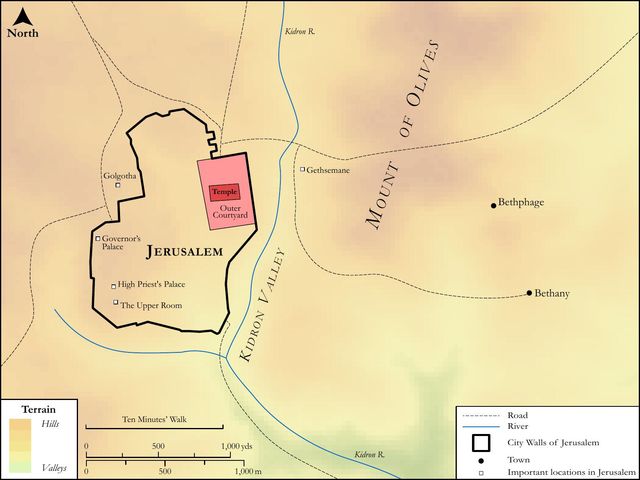
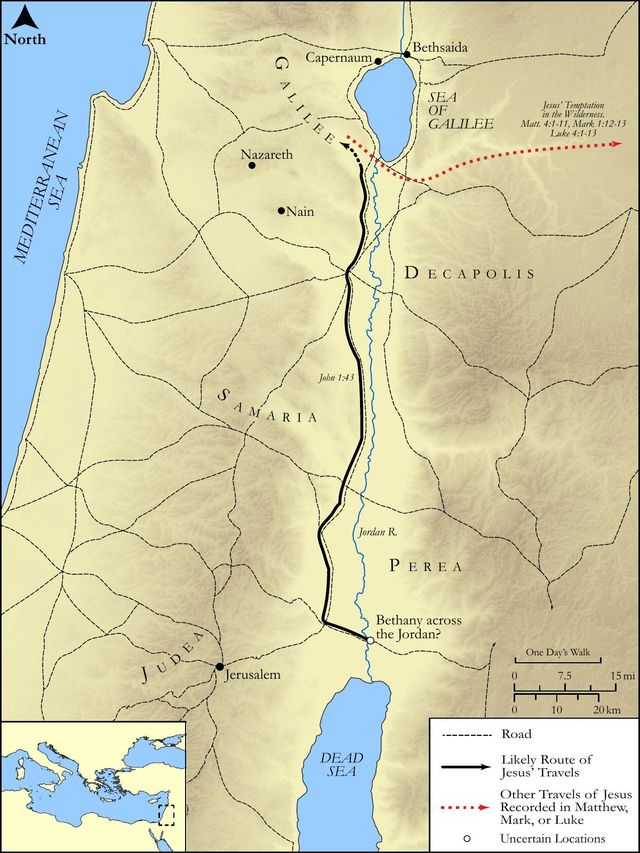
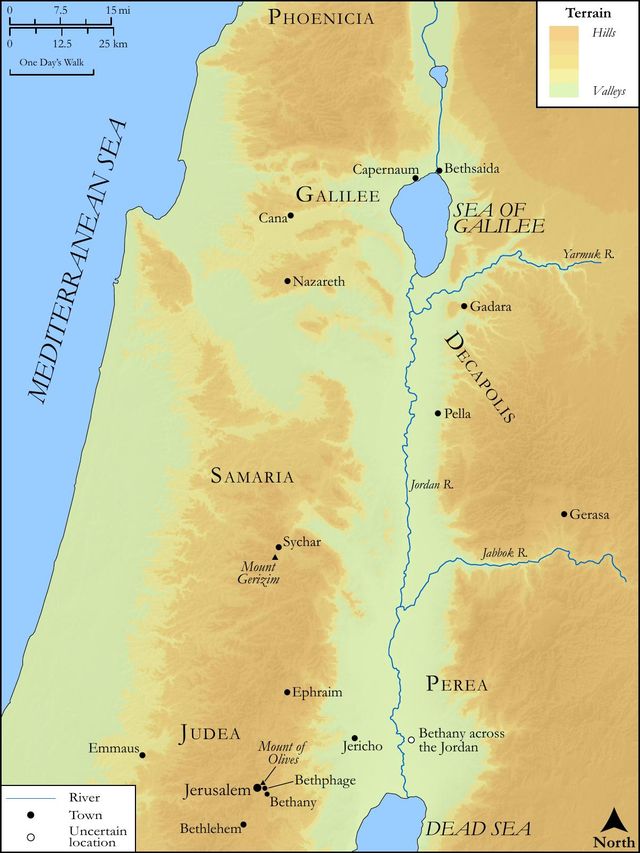
See on the biblical-era maps
Study this verse
Public-domain commentary
Matthew Henry
From his Commentary on the Whole Bible. Henry comments on passages, not single verses — this entry covers John 1:37–42. His four-level outline is real structure in the source text, so it is rendered as structure.
We have here the turning over of two disciples from John to Jesus, and one of them fetching in a third, and these are the first-fruits of Christ's disciples; see how small the church was in its beginnings, and what the dawning of the day of its great things was.
I.Andrew and another with him were the two that John Baptist had directed to Christ, Joh 1:37.
Who the other was we are not told; some think that it was Thomas, comparing Joh 21:2; others that it was John himself, the penman of this gospel, whose manner it is industriously to conceal his name, Joh 13:23, and Joh 20:3.
1.Here is their readiness to go over to Christ: They heard John speak of Christ as the Lamb of God, and they followed Jesus. Probably they had heard John say the same thing the day before, and then it had not the effect upon them which now it had; see the benefit of repetition, and of private personal converse. They heard him speak of Christ as the Lamb of God, that takes away the sin of the world, and this made them follow him. The strongest and most prevailing argument with a sensible awakened soul to follow Christ is that it is he, and he only, that takes away sin.
2.The kind notice Christ took of them, Joh 1:38. They came behind him; but, though he had his back towards them, he was soon aware of them, and turned, and saw them following. Note, Christ takes early cognizance of the first motions of a soul towards him, and the first step taken in the way to heaven; see Isa 64:5; Luk 15:20. He did not stay till they begged leave to speak with him, but spoke first. What communion there is between a soul and Christ, it is he that begins the discourse. He saith unto them, What seek ye? This was not a reprimand for their boldness in intruding into his company: he that came to seek us never checked any for seeking him; but, on the contrary, it is a kind invitation of them into his acquaintance whom he saw bashful and modest: "Come, what have you to say to me? What is your petition? What is your request." Note, Those whose business it is to instruct people in the affairs of their souls should be humble, and mild, and easy of access, and should encourage those that apply to them. The question Christ put to them is what we should all put to ourselves when we begin to follow Christ, and take upon us the profession of his holy religion: "What seek ye? What do we design and desire?" Those that follow Christ, and yet seek the world, or themselves, or the praise of men, deceive themselves. "What seek we in seeking Christ? Do we seek a teacher, ruler, and reconciler? In following Christ, do we seek the favour of God and eternal life?" If our eye be single in this, we are full of light.
3.Their modest enquiry concerning the place of his abode: Rabbi, where dwellest thou?
(1.)In calling him Rabbi, they intimated that their design in coming to him was to be taught by him; rabbi signifies a master, a teaching master; the Jews called their doctors, or learned men, rabbies. The word comes from rab, multus or magnus, a rabbi, a great man, and one that, as we say, has much in him. Never was there such a rabbi as our Lord Jesus, such a great one, in whom were hid all the treasures of wisdom and knowledge. These came to Christ to be his scholars, so must all those that apply themselves to him. John had told them that he was the Lamb of God; now this Lamb is worthy to take the book and open the seals as a rabbi, Rev 5:9. And, unless we give up ourselves to be ruled and taught by him, he will not take away our sins.
(2.)In asking where he dwelt, they intimate a desire to be better acquainted with him. Christ was a stranger in this country, so that they meant where was his inn where he lodged; for there they would attend him at some seasonable time, when he should appoint, to receive instruction from him; they would not press rudely upon him, when it was not proper. Civility and good manners well become those who follow Christ. And, besides, they hoped to have more from him than they could have in a short conference now by the way. They resolved to make a business, not a by-business of conversing with Christ. Those that have had some communion with Christ cannot but desire,
[1.]A further communion with him; they follow on to know more of him.
[2.]A fixed communion with him; where they may sit down at his feet, and abide by his instructions. It is not enough to take a turn with Christ now and then, but we must lodge with him.
4.The courteous invitation Christ gave them to his lodgings: He saith unto them, Come and see. Thus should good desires towards Christ and communion with him be countenanced.
(1.)He invites them to come to his lodgings: the nearer we approach to Christ, the more we see of his beauty and excellency. Deceivers maintain their interest in their followers by keeping them at a distance, but that which Christ desired to recommend him to the esteem and affections of his followers was that they would come and see: "Come and see what a mean lodging I have, what poor accommodations I take up with, that you may not expect any worldly advantage by following me, as they did who made their court to the scribes and Pharisees, and called them rabbin. Come and see what you must count upon if you follow me." See Mat 8:20.
(2.)He invites them to come immediately and without delay. They asked where he lodged, that they might wait upon him at a more convenient season; but Christ invites them immediately to come and see; never in better time than now. Hence learn,
[1.]As to others, that it is best taking people when they are in a good mind; strike while the iron is hot.
[2.]As to ourselves, that it is wisdom to embrace the present opportunities: Now is the accepted time, Co2 6:2.
5.Their cheerful and (no doubt) thankful acceptance of his invitation: They came and saw where he dwelt, and abode with him that day. It had been greater modesty and manners than had done them good if they had refused this offer. (2.) They readily went along with him: They came and saw where he dwelt. Gracious souls cheerfully accept Christ's gracious invitations; as David, Psa 27:8. They enquired not how they might be accommodated with him, but would put that to the venture, and make the best of what they found. It is good being where Christ is, wherever it be. (2.) They were so well pleased with what they found that they abode with him that day ("Master, it is good to be here"); and he bade them welcome. It was about the tenth hour. Some think that John reckons according to the Roman computation, and that it was about ten o'clock in the morning, and they staid with him till night; others think that John reckons as the other evangelists did, according to the Jewish computation, and that it was four o'clock in the afternoon, and they abode with him that night and the next day. Dr. Lightfoot conjectures that this next day that they spent with Christ was a sabbath-day, and, it being late, they could not get home before the sabbath. As it is our duty, wherever we are, to contrive to spend the sabbath as much as may be to our spiritual benefit and advantage, so they are blessed who, by the lively exercises of faith, love, and devotion, spend their sabbaths in communion with Christ. These are Lord's days indeed, days of the Son of man.
II.Andrew brought his brother Peter to Christ.
If Peter had been the first-born of Christ's disciples, the papists would have made a noise with it: he did indeed afterwards come to be more eminent in gifts, but Andrew had the honour first to be acquainted with Christ, and to be the instrument of bringing Peter to him. Observe,
1.The information which Andrew gave to Peter, with an intimation to come to Christ.
(1.)He found him: He first finds his own brother Simon; his finding implies his seeking him. Simon came along with Andrew to attend John's ministry and baptism, and Andrew knew where to look for him. Perhaps the other disciple that was with him went out to seek some friend of his at the same time, but Andrew sped first: He first findeth Simon, who came only to attend on John, but has his expectations out-done; he meets with Jesus.
(2.)He told him whom they had found: We have found the Messias. Observe, [1.] he speaks humbly; not, "I have found," assuming the honour of the discovery to himself, but "We have," rejoicing that he had shared with others in it. [2.] He speaks exultingly, and with triumph: We have found that pearl of great price, that true treasure; and, having found it, he proclaims it as those lepers, Kg2 7:9, for he knows that he shall have never the less in Christ for others sharing. [3.] He speaks intelligently: We have found the Messias, which was more than had yet been said. John had said, He is the Lamb of God, and the Son of God, which Andrew compares with the scriptures of the Old Testament, and, comparing them together, concludes that he is the Messiah promised to the fathers, for it is now that the fulness of time is come. Thus, by making God's testimonies his meditation, he speaks more clearly concerning Christ than ever his teacher had done, Psa 119:99.
(3.)He brought him to Jesus; would not undertake to instruct him himself, but brought him to the fountain-head, persuaded him to come to Christ and introduced him. Now this was,
[1.]An instance of true love to his brother, his own brother, so he is called here, because he was very dear to him. Note, We ought with a particular concern and application to seek the spiritual welfare of those that are related to us; for their relation to us adds both to the obligation and to the opportunity of doing good to their souls.
[2.]It was an effect of his day's conversation with Christ. Note, the best evidence of our profiting by the means of grace is the piety and usefulness of our conversation afterwards. Hereby it appeared that Andrew had been with Jesus that he was so full of him, that he had been in the mount, for his face shone. He knew there was enough in Christ for all; and, having tasted that he is gracious, he could not rest till those he loved had tasted it too. Note, True grace hates monopolies, and loves not to eat its morsels alone.
2.The entertainment which Jesus Christ gave to Peter, who was never the less welcome for his being influenced by his brother to come, Joh 1:42. Observe,
(1.)Christ called him by his name: When Jesus beheld him, he said, Thou art Simon, the son of Jona. It should seem that Peter was utterly a stranger to Christ, and if so,
[1.]It was a proof of Christ's omniscience that upon the first sight, without any enquiry, he could tell the name both of him and of his father. The Lord knows them that are his, and their whole case. However,
[2.]It was an instance of his condescending grace and favour, that he did thus freely and affably call him by his name, though he was of mean extraction, and vir mullius nominis - a man of no name. It was an instance of God's favour to Moses that he knew him by name, Exo 33:17. Some observe the signification of these names: Simon - obedient, Jona - a dove. An obedient dove-like spirit qualifies us to be the disciples of Christ.
(2.)He gave him a new name: Cephas.
[1.]His giving him a name intimates Christ's favour to him. A new name denotes some great dignity, Rev 2:17; Isa 62:2. By this Christ not only wiped off the reproach of his mean and obscure parentage, but adopted him into his family as one of his own.
[2.]The name which he gave him bespeaks his fidelity to Christ: Thou shalt be called Cephas (that is Hebrew for a stone), which is by interpretation Peter; so it should be rendered, as Act 9:36. Tabitha, which by interpretation is called Dorcas; the former Hebrew, the latter Greek, for a young roe. Peter's natural temper was stiff, and hardy, and resolute, which I take to be the principal reason why Christ called him Cephas - a stone. When Christ afterwards prayed for him, that his faith might not fail, that so he might be firm to Christ himself, and at the same time bade him strengthen his brethren, and lay out himself for the support of others, then he made him what he here called him, Cephas - a stone. Those that come to Christ must come with a fixed resolution to be firm and constant to him, like a stone, solid and stedfast; and it is by his grace that they are so. His saying, Be thou steady, makes them so. Now this does no more prove that Peter was the singular or only rock upon which the church is built than the calling of James and John Boanerges proves them the only sons of thunder, or the calling of Joses Barnabas proves him the only son of consolation.
Historical interpretation
Four Centuries of Reception
10 surviving comments on this verse. Each one is dated, so this reads as a timeline rather than a list.
Select a marker to jump to its quote. Markers stagger vertically where authors wrote within a few decades of each other.
(Hom. xix. 1, 2) And therefore he said not Messias, but the Messias. Mark the obedience of Peter from the very first; ho went immediately without delay, as appears from the next words: And he brought him to Jesus. Nor let us blame him as too yielding, because he did not ask many questions, before he received the word. It is reasonable to suppose that his brother had told him all, and sufficiently fully; but the Evangelists often make omissions for the sake of brevity. But, besides this, it is not absolutely said that he did believe, but only, He took him to Jesus; i. e. to learn from the mouth of Jesus Himself, what Andrew had reported. Our Lord begins now Himself to reveal the things of His Divinity, and to exhibit them gradually by prophecy. For prophecies are no less persuasive than miracles; inasmuch as they are preeminently God's work, and are beyond the power of devils to imitate, while miracles may be phantasy or appearance: the foretelling future events with certainty is an attribute of the incorruptible nature alone: And when Jesus beheld him, He said, Thou art Simon the son of Jonas; thou shall be called Cephas, which is by interpretation, A stone.
(Hom. xix. [al. xviii. 2]) He changed the name too to show that He was the same who done so before in the Old Testament; who had called Abram Abraham, Sarai Sarah, Jacob Israel. Many He had named from their birth, as Isaac and Samson; others again after being named by their parents, as were Peter, and the sons of Zebedee. Those whose virtue was to be eminent from their early youth, from that time received their names; while to those who were to become great at a later period, the title also was given later.
"And when Jesus beheld him," saith the Evangelist, "He said, Thou art Simon, the son of Jonas; thou shalt be called Cephas, which is, by interpretation, a stone."
He begins from this time forth to reveal the things belonging to His Divinity, and to open It out little by little by predictions. So He did in the case of Nathaniel and the Samaritan woman. For prophecies bring men over not less than miracles; and are free from the appearance of boasting. Miracles may possibly be slandered among foolish men, ("He casteth out devils," said they, "by Beelzebub"), but nothing of the kind has ever been said of prophecy. Now in the case of Nathaniel and Simon He used this method of teaching, but with Andrew and Philip He did not so. Why was this? Because those (two) had the testimony of John, no small preparation, and Philip received a credible evidence of faith, when he saw those who had been present.
"Thou art Simon, the son of Jonas." By the present, the future is guaranteed; for it is clear that He who named Peter's father foreknew the future also. And the prediction is attended with praise; but the object was not to flatter, but to foretell something future.
And behold, I beg of you, the mind of Peter obedient and tractable from the very beginning; he ran to Him without any delay; "He brought him," saith St. John, "to Jesus." Yet let no one blame his easy temper if he received the word without much questioning, because it is probable that his brother had told him these things more exactly and at length; but the Evangelists from their care for conciseness constantly cut many things short. Besides, it is not said absolutely that "he believed," but that "he brought him to Jesus," to give him up for the future to Him, so that from Him he might learn all; for the other disciple also was with him, and contributed to this. And if John the Baptist, when he had said that He was "the Lamb," and that He "baptized with the Spirit," gave them over to learn the clearer doctrine concerning this thing from Him, much more would Andrew have done this, not deeming himself sufficient to declare the whole, but drawing him to the very fount of light with so much zeal and joy, that the other neither deferred nor delayed at all.
But Peter makes no reply to these words; as yet he knew nothing clearly, but still was learning. And observe, that not even the prediction is fully set forth; for Jesus did not say, "I will change thy name to Peter, and upon this rock I will build My Church," but, "Thou shalt be called Cephas." The former speech would have expressed too great authority and power; for Christ does not immediately nor at first declare all His power, but speaks for a while in a humbler tone; and so, when He had given the proof of His Divinity, He puts it more authoritatively, saying, "Blessed art thou, Simon, because My Father hath revealed it to thee"; and again, "Thou art Peter, and upon this rock I will build My Church." Him therefore He so named, and James and his brother He called "sons of thunder." Why then doth He this? To show that it was He who gave the old covenant, that it was He who altered names, who called Abram "Abraham," and Sarai "Sarah," and Jacob "Israel." To many he assigned names even from their birth, as to Isaac, and Samson, and to those in Isaiah and Hosea; but to others He gave them after they had been named by their parents, as to those we have mentioned, and to Joshua the son of Nun. It was also a custom of the Ancients to give names from things, which in fact Leah also has done; and this takes place not without cause, but in order that men may have the appellation to remind them of the goodness of God, that a perpetual memory of the prophecy conveyed by the names may sound in the ears of those who receive it. Thus too He named John early, because they whose virtue was to shine forth from their early youth, from that time received their names; while to those who were to become great at a later period, the title also was given later.
The Evangelist John, again, tells us that before Jesus went into Galilee, Peter and Andrew were with him one day. He also tells us that on that occasion the former had this name, Peter, given to him, while before that he was called Simon. Likewise, John tells us that on the day following, when Jesus now wanted to go up to Galilee, he found Philip and told him to follow him. In this way, too, the Evangelist comes to give the narrative about Nathanael. Further, he informs us that on the third day, when he was yet in Galilee, Jesus brought about the miracle of the turning of the water into wine at Cana. All these incidents are left unrecorded by the other Evangelists, who continue their narratives at once with the statement of the return of Jesus into Galilee. From this, we are to understand that there was an interval here of several days during which those incidents took place in the history of the disciples that are inserted at this point by John. Neither is there anything contradictory here to that other passage where Matthew tells us how the Lord said to Peter, “You are Peter, and on this rock will I build my church.” But we are not to understand that that was the time when he first received this name. We are rather to suppose that this took place on the occasion when it was said to him, as John mentions, “You shall be called Cephas, which is, by interpretation, ‘a rock.’ ” Thus the Lord could address him at that later period by this very name when he said, “You are Peter.” For he does not say then, “You shall be called Peter” but “You are Peter,” because on a previous occasion it had already been said, “You shall be called.”
"And he brought him to Jesus; and when Jesus beheld him, He said, Thou art Simon the son of Joannes: thou shalt be called Cephas, which is, by interpretation, Peter." It is not a great thing that the Lord said whose son Peter was. What is great to the Lord? He knew all the names of His own saints, whom He predestinated before the foundation of the world; and dost thou wonder that He said to one man, Thou art the son of this man, and thou shalt be called this or that? Is it a great matter that He changed his name, and converted it from Simon to Peter? Peter is from petra, a rock, but the petra [rock] is the Church; in the name of Peter, then, was the Church figured. And who is safe, unless he who builds upon the rock? And what saith the Lord Himself? "He that heareth these my words, and doeth them, I will liken him unto a wise man building his house upon a rock" (he doth not yield to temptation). "The rain descended, the floods came, the winds blew, and beat upon that house; and it fell not: for it was founded upon a rock. But he that heareth my words, and doeth them not" (now let each one of us fear and beware), "I will liken him to a foolish man, who built his house upon the sand: the rain descended, the floods came, the winds blew, and beat upon that house; and it fell: and great was the fall of it." What profit is it to enter the Church for him who builds upon the sand? For, by hearing and not doing, he builds indeed, but on the sand. For if he hears nothing, he builds nothing; but if he hears, he builds. But we ask, Where? For if he hears and does, he builds upon the rock; if he hears and does not, he builds upon the sand. There are two kinds of builders, those building upon the rock, and those building upon the sand. What, then, are those who do not hear? Are they safe? Does He say that they are safe because they do not build? They are naked beneath the rains, before the winds, before the floods; when these come, they carry away: those persons before they overthrow the houses. It is then the only security, both to build, and to build upon the rock. If thou wilt hear and do not, thou buildest; but thou buildest a ruin: and when temptation comes it overthrows the house, and carries away thee with the ruin. But if thou dost not hear, thou art naked; thou thyself art dragged away by those temptations. Hear, then, and do; it is the only remedy. How many, perchance, on this day, by hearing and not doing, are hurried away on the stream of this festival! For, through hearing and not doing, the flood cometh, this annual festival; the torrent is filled, it will pass away and become dry, but woe to him whom it shall carry away! Know this, then, beloved, that unless a man hears and does, he builds not upon the rock, and he does not belong to that great name which the Lord so commended. For He has called thy attention. For if Simon had been called Peter before, thou wouldest not have so clearly seen the mystery of the rock, and thou wouldest have thought that he was called so by chance, not by the providence of God; therefore God willed that he should be called first something else, that by the very change of name the reality of the sacrament might be commended to our notice.
(Tr. vii. c. 14) There was nothing very great in our Lord saying whose son he was, for our Lord knew the names of all His saints, having predestinated them before the foundation of the world. But it was a great thing for our Lord to change his name from Simon to Peter. Peter is from petra, rock, which rock is the Church: so that the name of Peter represents the Church. And who is safe, unless he build upon a rock? Our Lord here rouses our attention: for had he been called Peter before, we should not have seen the mystery of the Rock, and should have thought that he was called so by chance, and not providentially. God therefore made him to be called by another name before, that the change of that name might give vividness to the mystery.
(de Con. Evang. l. ii. c. 17) The account here of the two disciples on the Jordan, who follow Christ (before he had gone into Galilee) in obedience to John's testimony; viz. of Andrew bringing his brother Simon to Jesus, who gave him, on this occasion, the name of Peter; disagrees considerably with the account of the other Evangelists, viz. that our Lord found these two, Simon and Andrew, fishing in Galilee, and then bid them follow Him: unless we understand that they did not regularly join our Lord when they saw Him on the Jordan; but only discovered who He was, and full of wonder, then returned to their occupations. Nor must we think that Peter first received his name on the occasion mentioned in Matthew, when our Lord says, Thou art Peter, and upon this rock will I build My Church; (Mat. 16:18) but rather when our Lord says, Thou shall be called Cephas, which is by interpretation, A stone.
He after a Divine sort looketh upon him, Who seeth the hearts and reins; and seeth to how great piety the disciple will attain, of how great virtue he will be possessed, and at what consummation he will leave off. For He Who knoweth all things before they be is not ignorant of ought. And herein does He specially instruct him that is called, that being Very God, He hath knowledge untaught. For not having needed a single word, nor even sought to learn who or whence the man came to Him; He says of what father he was born, and what was his own name, and permits him to be no more called Simon, already exercising lordship and power over him, as being His: but changes it to Peter from Petra: for upon him was He about to found His Church.
(Hom. i. Temp. Hier. in Vig. S. Andr.) He beheld him not with His natural eye only, but by the insight of His Godhead discerned from eternity the simplicity and greatness of his soul, for which he was to be elevated above the whole Church. In the word Peter, we must not look for any additional meaning, as though it were of Hebrew or Syriac derivation; for the Greek and Latin word Peter, has the same meaning as Cephas; being in both languages derived from petra. He is called Peter on account of the firmness of his faith, in cleaving to that Rock, of which the Apostle speaks, And that Rock was Christ; (1 Cor. 10:4) which secures those who trust in it from the snares of the enemy, and dispenses streams of spiritual gifts.
Or perhaps He does not actually give him the name now, but only fixes beforehand what He afterwards gave him when He said, Thou art Peter, and upon this rock will I build My Church. And while about to change his name, Christ wishes to show that even that which his parents had given him, was not without a meaning. For Simon signifies obedience, Joanna grace, Jona a dove: as if the meaning was; Thou art an obedient son of grace, or of the dove, i. e. the Holy Spirit; for thou hast received of the Holy Spirit the humility, to desire, at Andrew's call, to see Me. The elder disdained not to follow the younger; for where there is meritorious faith, there is no order of seniority.
Continue studying John 1:42 across the web’s major study libraries — every link below opens this exact verse, chapter, or book on the destination site.
Read & Compare
 BibleGatewayThis verse in more than 200 translations and 70 languages.
 Bible.comThe YouVersion reader — hundreds of translations, reading plans, and highlights.
 ESV.orgCrossway's official English Standard Version reader.
 NET BibleThe NET translation with 60,000+ translators' notes on every rendering decision.
 STEP BibleTyndale House's free study tool — original text, vocabulary, and scholarly resources.
 BibliaLogos Bible Software's free web reader.
 USCCBThe New American Bible (Revised Edition) with the U.S. bishops' study notes.
Commentaries
 BibleHub CommentariesDozens of classic commentaries on this verse, gathered on one page.
 StudyLightMore than 100 commentary sets — the largest collection on the web.
 BibleRefPlain-English commentary on what this verse means, verse by verse.
 Enduring WordDavid Guzik's free commentary on this chapter, widely used by Bible teachers.
 Bible Study ToolsVerse commentary alongside Greek and Hebrew study aids.
Original Language & Research
- BibleHub InterlinearThe verse word by word — original language, transliteration, and English.
- BibleHub LexiconEvery word's original-language definition and Strong's entry.
 Blue Letter BibleDeep-study tools — Strong's numbers, concordance, and word studies.
 CNTR CollationThe earliest Greek manuscripts of this verse, collated letter by letter.
Sermons, Hymns & Audio


TrulyRandomVerse is not affiliated with these sites and doesn’t control their content. They’re linked because they’re genuinely useful.
Summary
The profound initial encounter between Jesus and Simon, Andrew's brother, marking a pivotal moment in the formation of Jesus' disciples. In this encounter, Jesus demonstrates His divine foreknowledge by immediately identifying Simon and, more significantly, bestowing upon him a new name, "Cephas," which means "A stone." This renaming not only signifies a new identity and purpose for Simon but also foreshadows his future foundational role in the burgeoning Christian movement, highlighting Jesus' sovereign authority to call and transform individuals for His redemptive plan.
Context
ShowHideLiterary Context
This verse is situated early in John's Gospel, following John the Baptist's powerful testimony about Jesus as the "Lamb of God" and the subsequent calling of Jesus' first disciples. Andrew, having spent time with Jesus and recognized Him as the Messiah, immediately seeks out his brother, Simon, and brings him to Jesus. This act underscores the theme of personal evangelism and the ripple effect of genuine spiritual encounters. The narrative flow emphasizes the direct, personal nature of Jesus' calling, where individuals are invited to "come and see" John 1:39 for themselves, leading to a profound recognition of His identity and authority. The renaming of Simon occurs at this very first meeting, highlighting its significance as a divine declaration rather than a gradual development.
Historical & Cultural Context
In Israel, the act of renaming was a significant gesture, often signifying a change in status, a new covenant, or a divine appointment to a specific role or destiny. Examples include God renaming Abram to Abraham Genesis 17:5 and Jacob to Israel Genesis 32:28. This practice conveyed authority and a profound shift in identity and purpose. Furthermore, Jesus' use of "Cephas" (Aramaic for "rock") alongside its Greek interpretation "Peter" (Petros) reflects the bilingual environment of first-century Galilee, where Aramaic was the common spoken language, and Greek was widely understood. The immediate recognition and renaming by Jesus would have been understood by contemporary audiences as a powerful, authoritative act, signaling Simon's unique destiny.
Key Themes
ShowHideJohn 1:42 contributes significantly to several overarching themes in the Gospel of John and the broader biblical narrative. Firstly, it highlights Divine Foreknowledge and Sovereign Calling, as Jesus instantly perceives Simon's true identity and future potential, demonstrating His omniscience and intentional selection of His disciples. Secondly, the renaming to "Cephas" introduces the theme of Transformation and New Identity in Christ, where an individual's past is superseded by a divinely appointed future, reflecting God's ability to mold and repurpose lives. This new identity is not merely a label but a declaration of a new character and mission. Thirdly, the meaning of "rock" or "stone" foreshadows Simon's foundational role in the early church, not as the ultimate foundation (which is Christ Himself), but as a key leader and pillar, a concept further developed in passages like Matthew 16:18. Finally, Andrew's action of bringing Simon to Jesus powerfully illustrates the theme of Personal Witnessing and Evangelism, emphasizing the ripple effect of faith and the importance of introducing others to Christ.
Exposition and Analysis
ShowHideKey Word Analysis
ShowHideMeaning "to look on, i.e. (relatively) to observe fixedly, or (absolutely) to discern clearly." This word choice is significant because it implies more than a casual glance. Jesus "beheld" Simon, suggesting a penetrating gaze that saw beyond his outward appearance, into his character, potential, and future. It speaks to Jesus' divine insight and His ability to truly know individuals, even at their first meeting.
Meaning "to 'call' (properly, aloud, but used in a variety of applications, directly or otherwise)." Jesus' declaration, "thou shalt be called Cephas," is a direct and authoritative pronouncement. It is not merely a suggestion or a nickname but a divine act of naming, signifying a new identity and purpose. This "calling" is active and transformative, indicating God's initiation in bestowing a new status.
"the Rock; Cephas (i.e. Kepha), a surname of Peter." This is the Aramaic word for "rock" or "stone." Jesus, speaking in His native Aramaic, gives Simon this name, which is then immediately interpreted into Greek as "A stone" (G4074, Pétros). The name signifies stability, strength, and foundational quality, directly linking to Simon's future role as a pillar in the early Christian community.
Verse Breakdown
ShowHide"And he brought him to Jesus"
This clause highlights Andrew's immediate and effective act of personal evangelism. Having encountered Jesus himself, Andrew's first priority is to share this life-changing experience with his brother, Simon. It demonstrates the natural outflow of a genuine encounter with Christ—a desire to introduce others to Him.
"And when Jesus beheld him"
This phrase emphasizes Jesus' divine perception. The word "beheld" (emblépō) suggests a penetrating gaze, indicating that Jesus saw not just Simon's physical presence but also his inner character, his potential, and his divinely appointed destiny. This is a testament to Jesus' omniscience and His ability to know the hearts of men.
"he said, "Thou art Simon the son of Jona: thou shalt be called Cephas,""
Here, Jesus identifies Simon by his given name and lineage ("Simon the son of Jona") before immediately declaring his new name, "Cephas." This declaration is an authoritative act of renaming, signifying a profound shift in identity and purpose. It's a prophetic statement about who Simon will become, not just who he is.
"which is by interpretation, A stone"
This parenthetical explanation, provided by the Gospel writer, clarifies the meaning of "Cephas" for the Greek-speaking audience. "A stone" (Petros) is the Greek equivalent of the Aramaic "Cephas." This interpretation is crucial, as it immediately conveys the significance of Simon's new name, foreshadowing his future role as a steadfast and foundational figure in the early church.
Literary Devices
ShowHideJohn 1:42 masterfully employs several literary devices. Symbolism is central, with the renaming of Simon to "Cephas" (meaning "stone" or "rock") serving as a powerful symbol of stability, strength, and foundational importance. This new name is not merely a label but a prophetic declaration of Simon's future character and role, despite his initial human weaknesses. This symbolic renaming also functions as Foreshadowing, hinting at Simon Peter's significant leadership position within the apostolic band and his instrumental role in the early church's development, as further elaborated in Matthew 16:18. Furthermore, there is an element of Divine Irony in that Simon, known for his impulsiveness and occasional wavering, is named "the Rock" by Jesus, highlighting God's ability to use imperfect individuals and transform them into pillars of faith, demonstrating His grace and power to perfect His strength in weakness.
Theological and Thematic Connections
ShowHideJohn 1:42 profoundly illustrates God's sovereign initiative in calling individuals into His service, often seeing potential and purpose long before the individual themselves recognizes it. Jesus' immediate recognition and renaming of Simon underscore His divine authority and omniscience, demonstrating that His calling is based on His perfect knowledge and redemptive plan, not on human merit or pre-existing qualifications. This act of renaming signifies a new identity and a new destiny, a common theme throughout biblical history where God redefines individuals for His purposes, transforming their very being to align with His will. Simon's new name, "Cephas" or "Peter," meaning "rock," foreshadows his unique and foundational role in the nascent Christian community, serving as a key leader and a steadfast witness to Christ's resurrection, even though his own journey would involve moments of profound failure and restoration.
Reflection and Application
ShowHideJohn 1:42 offers profound insights into the nature of divine calling and personal transformation that resonate deeply with believers today. Just as Jesus "beheld" Simon and saw beyond his current state to his future potential, so too does God see us not merely for who we are, but for who He is calling us to be in Christ. This verse reminds us that our identity in Christ is not self-made but divinely bestowed, a new name and purpose given by the One who knows us intimately and loves us unconditionally. It encourages us to embrace the new identity we receive through faith, trusting that God will equip us for the unique role He has for us, even if we feel inadequate. Furthermore, Andrew's simple yet powerful act of bringing his brother to Jesus serves as a timeless model for personal evangelism, demonstrating that the most effective way to share our faith is often through genuine relationships and direct invitation, allowing others to encounter Christ for themselves.
Questions for Reflection
ShowHideFAQ
ShowHideWhy did Jesus rename Simon to Cephas/Peter?
ShowHideJesus renamed Simon to Cephas (Aramaic for "rock") and its Greek equivalent, Peter, as a prophetic declaration of his future character and role. Among the patriarchs and in Israel, renaming by a figure of authority often signified a change in status, a new covenant, or a divine appointment to a specific mission. By giving Simon this new name, Jesus was not just giving him a nickname but declaring that he would become a steadfast and foundational leader in the early Christian church, despite his human frailties. This act highlights Jesus' divine foreknowledge and His sovereign authority to call and transform individuals for His redemptive purposes, as further emphasized in Matthew 16:18.
What is the difference between "Cephas" and "Peter"?
ShowHideThere is no theological difference; they are simply two different language words for the same concept. "Cephas" (Kēphâs) is the Aramaic word for "rock" or "stone," which was the common language spoken by Jesus and His disciples in Galilee. "Peter" (Petros) is the Greek equivalent of "Cephas," also meaning "stone" or "rock." The Gospel of John, written in Greek, provides the interpretation "which is by interpretation, A stone" to clarify the meaning of "Cephas" for its Greek-speaking audience. Both names convey the idea of stability, solidity, and foundational strength.
Does this verse imply that Peter was the first Pope or the ultimate foundation of the church?
ShowHideWhile John 1:42 certainly highlights Peter's unique and foundational role among the apostles, particularly in the nascent stages of the church, it does not imply he was the ultimate foundation or the first Pope in the later hierarchical sense. The New Testament consistently presents Jesus Christ as the true and ultimate cornerstone and foundation of the church (e.g., 1 Corinthians 3:11; Ephesians 2:20). Peter's role as "the rock" is understood by many as foundational in the sense of being the first to confess Christ and a key leader in establishing the early church, but always in subordination to Christ Himself, who is the head of the church (Ephesians 1:22-23).
Christ-Centered Fulfillment
ShowHideJohn 1:42, with Jesus' renaming of Simon to "Cephas" (Aramaic for "rock"), finds its ultimate Christ-centered fulfillment not in Peter's inherent strength, but in the One who bestows the name: Jesus Christ Himself. While Peter would indeed become a foundational figure in the early church, his stability and leadership were always derived from and dependent upon Christ. Jesus is the true and ultimate "Rock," the "cornerstone" upon which God's spiritual house is built, as declared in 1 Corinthians 10:4 and 1 Peter 2:6-8. Peter's transformation from a fallible fisherman to "the Rock" is a microcosm of the greater redemptive work of Christ, who transforms all who come to Him into "living stones" built into a spiritual house (1 Peter 2:5). Thus, John 1:42 points beyond Peter to the sovereign power of Jesus, who not only knows the hearts of all but also possesses the authority to call, transform, and empower His followers, making them participants in His divine mission and building His church upon the unshakeable foundation of His own person and finished work (Matthew 16:18).