


Matthew 14:14
Bible text: King James Version (1769 Blayney text) · Public domain
Bible text: Berean Standard Bible · Public domain
Bible text: American Standard Version (1901) · Public domain
Bible text: World English Bible, Messianic edition · Public domain
Bible text: Geneva Bible (1599) · Public domain
Bible text: Young's Literal Translation · Public domain
- καὶkaiAndG2532CONJConjunction
- ἐξελθὼνexelthōnhaving gone outG1831V-2AAP-NSMVerb 2nd Aorist Active Participle Nominative Singular Masculine
- ὁho<the>G3588T-NSMDefinite article Nominative Singular Masculine
- ἸησοῦςIēsousJesusG2424N-NSM-PNoun Nominative Singular Masculine Individual
- εἶδενeidenHe sawG1492V-2AAI-3SVerb 2nd Aorist Active Indicative 3rd Singular
- πολὺνpolungreatG4183A-ASMAdjective Accusative Singular Masculine
- ὄχλονochlona crowdG3793N-ASMNoun Accusative Singular Masculine
- καὶkaiandG2532CONJConjunction
- ἐσπλαγχνίσθηesplagchnisthēwas moved with compassionG4697V-AOI-3SVerb Aorist Passive Deponent Indicative 3rd Singular
- ἐπ᾽ep᾽towardG1909PREPPreposition
- αὐτοῖςautoisthemG846P-DPMPersonal pronoun Dative Plural Masculine
- καὶkaiandG2532CONJConjunction
- ἐθεράπευσενetherapeusenhealedG2323V-AAI-3SVerb Aorist Active Indicative 3rd Singular
- τοὺςtoustheG3588T-APMDefinite article Accusative Plural Masculine
- ἀρρώστουςarrōstoussickG732A-APMAdjective Accusative Plural Masculine
- αὐτῶνautōnof themG846P-GPMPersonal pronoun Genitive Plural Masculine
English is a literal word-by-word gloss of the Greek, not the KJV's wording. Why?
This is the original text the KJV's translators worked from — each Greek word with its own literal English meaning in this verse, prepared by scholars at Tyndale House, Cambridge. The KJV translates whole sentences, not word by word, so its wording differs: one Greek word can become several English words, and the KJV may choose “charity” where the gloss reads “love”. Both are faithful — they answer different questions. For the KJV's own rendering, switch to the KJV text.
Details
See on the biblical-era maps
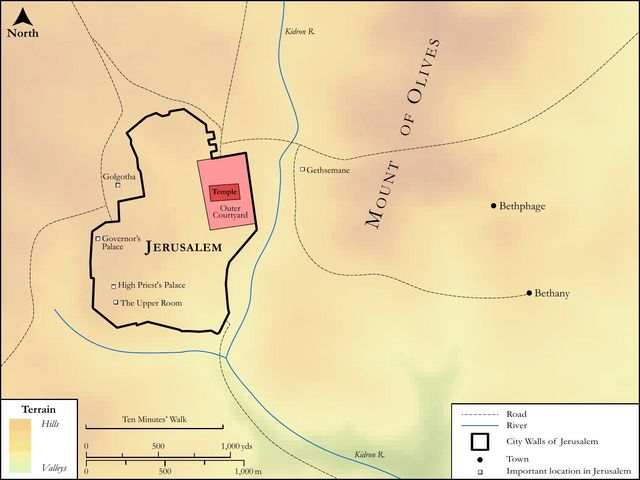

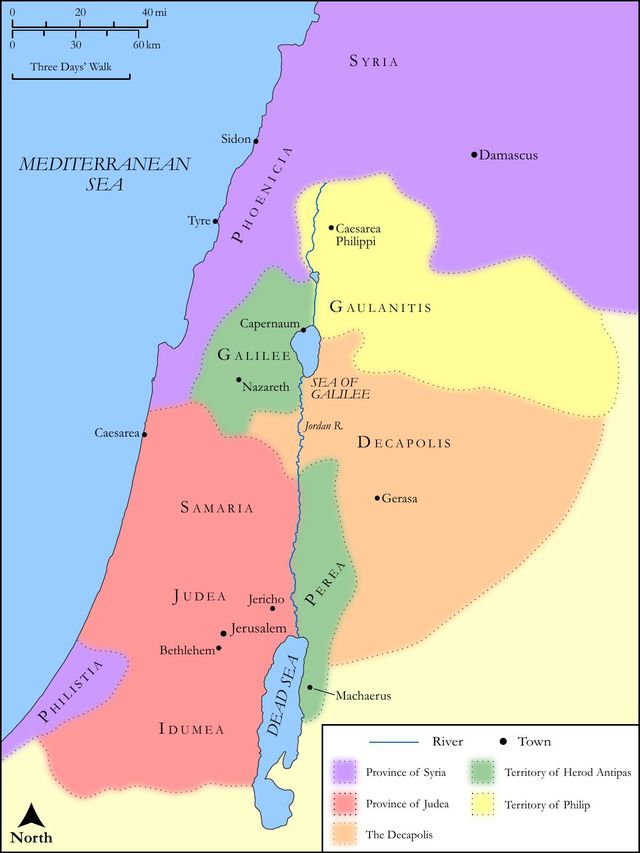
Study this verse
Public-domain commentary
Matthew Henry
From his Commentary on the Whole Bible. Henry comments on passages, not single verses — this entry covers Matthew 14:13–21. His two-level outline is real structure in the source text, so it is rendered as structure.
This passage of story, concerning Christ's feeding five thousand men with five loaves and two fishes, is recorded by all the four Evangelists, which very few, if any, of Christ's miracles are: this intimates that there is something in it worthy of special remark. Observe,
I.The great resort of people to Christ, when he was retired into a desert place, Mat 14:13.
He withdrew into privacy when he heard, not of John's death, but of the thoughts Herod had concerning him, that he was John the Baptist risen from the dead, and therefore so feared by Herod as to be hated; he departed further off, to get out of Herod's jurisdiction. Note, In times of peril, when God opens a door of escape, it is lawful to flee for our own preservation, unless we have some special call to expose ourselves. Christ's hour was not yet come, and therefore he would not thrust himself upon suffering. He could have secured himself by divine power, but because his life was intended for an example, he did it by human prudence; he departed by ship. But a city on a hill cannot be hid; when the people heard it, they followed him on foot from all parts. Such an interest Christ had in the affections of the multitude, that his withdrawing from them did but draw them after him with so much the more eagerness. Here, as often, the scripture was fulfilled, that unto him shall the gathering of the people be. It should seem, there was more crowding to Christ after John's martyrdom than before. Sometimes the suffering of the saints are made to further the gospel (Phi 1:12), and "the blood of the martyrs is the seed of the church." Now John's testimony was finished, it was recollected, and more improved than ever. Note,
1.When Christ and his word withdraw from us, it is best for us (whatever flesh and blood may object to the contrary) to follow it, preferring opportunities for our souls before any secular advantages whatsoever. When the ark removes, ye shall remove, and go after it, Jos 3:3.
2.Those that truly desire the sincere milk of the word, will not stick at the difficulties they may meet with in their attendance on it. The presence of Christ and his gospel makes a desert place not only tolerable, but desirable; it makes the wilderness an Eden, Isa 51:3; Isa 41:19, Isa 41:20.
II.The tender compassion of our Lord Jesus towards those who thus followed him, Mat 14:14.
1.He went forth, and appeared publicly among them. Though he retired for his own security, and his own repose, yet he went forth from his retirement, when he saw people desirous to hear him, as one willing both to toil himself, and to expose himself, for the good of souls; for even Christ pleased not himself.
2.When he saw the multitude, he had compassion on them. Note, The sight of a great multitude may justly move compassion. To see a great multitude, and to think how many precious, immortal souls here are, the greatest part of which, we have reason to fear, are neglected and ready to perish, would grieve one to the heart. None like Christ for pity to souls; his compassions fails not.
3.He did not only pity them, but he helped them; many of them were sick, and he, in compassion to them, healed them; for he came into the world to be the great Healer. After awhile, they were all hungry, and he, in compassion to them, fed them. Note, In all the favours Christ shows to us, he is moved with compassion, Isa 63:9.
III.The motion which the disciples made for the dismissing of the congregation, and Christ's setting aside the motion.
1.The evening drawing on, the disciples moved it to Christ to send the multitude away; they thought there was a good day's work done, and it was time to disperse. Note, Christ's disciples are often more careful to show their discretion, than to show their zeal; and their abundant affection in the things of God.
2.Christ would not dismiss them hungry as they were, nor detain them longer without meat, nor put them upon the trouble and charge of buying meat for themselves, but orders his disciples to provide for them. Christ all along expressed more tenderness toward the people than his disciples did; for what are the compassions of the most merciful men, compared with the tender mercies of God in Christ? See how loth Christ is to part with those who are resolved to cleave to him! They need not depart. Note, Those who have Christ have enough, and need not depart to seek a happiness and livelihood in the creature; they that have made sure of the one thing needful, need not be cumbered about much serving: nor will Christ put his willing followers upon a needless expense, but will make their attendance cheap to them.
But if they be hungry, they have need to depart, for that is a necessity which has no law, therefore, give you them to eat. Note, The Lord is for the body; it is the work of his hands, it is part of his purchase; he was himself clothed with a body, that he might encourage us to depend upon him for the supply of our bodily wants. But he takes a particular care of the body, when it is employed to serve the soul in his more immediate service. If we seek first the kingdom of God, and make that our chief care, we may depend upon God to add other things to us, as far as he sees fit, and may cast all care of them upon him. These followed Christ but for a trial, in a present fit of zeal, and yet Christ took this care of them; much more will he provide for those who follow him fully.
IV.The slender provision that was made for this great multitude; and here we must compare the number of invited guests with the bill of fare.
1.The number of the guests was five thousand of men, besides women and children; and it is probable the women and children might be as many as the men, if not more. This was a vast auditory that Christ preached to, and we have reason to think an attentive auditory; and, yet it should seem, far the greater part, notwithstanding all this seeming zeal and forwardness, came to nothing; they went off and followed him no more; for many are called, but few are chosen. We would rather perceive the acceptableness of the word by the conversion, than by the crowds, of its hearers; though that also is a good sight and a good sign.
2.The bill of fare was very disproportionable to the number of the guests, but five loaves and two fishes. This provision the disciples carried about with them for the use of the family, now they were retired into the desert. Christ could have fed them by miracle, but to set us an example of providing for those of our own households, he will have their own camp victualled in an ordinary way. Here is neither plenty, nor variety, nor dainty; a dish of fish was no rarity to them that were fishermen, but it was food convenient for the twelve; two fishes for their supper, and bread to serve them perhaps for a day or two: here was no wine or strong drink; fair water from the rivers in the desert was the best they had to drink with their meat; and yet out of this Christ will have the multitude fed. Note, Those who have but a little, yet when the necessity is urgent, must relieve others out of that little, and that is the way to make it more. Can God furnish a table in the wilderness? Yes, he can, when he pleases, a plentiful table.
V.The liberal distribution of this provision among the multitude (Mat 14:18, Mat 14:19); Bring them hither to me.
Note, The way to have our creature-like comforts, comforts indeed to us, is to bring them to Christ; for every thing is sanctified by his word, and by prayer to him: that is likely to prosper and do well with us, which we put into the hands of our Lord Jesus, that he may dispose of it as he pleases, and that we may take it back from his hand, and then it will be doubly sweet to us. What we give in charity, we should bring to Christ first, that he may graciously accept it from us, and graciously bless it to those to whom it is given; this is doing it as unto the Lord.
Now at this miraculous meal we may observe,
1.The seating of the guests (Mat 14:19); He commanded them to sit down; which intimates, that while he was preaching to them, they were standing, which is a posture of reverence, and readiness for motion. But what shall we do for chairs for them all? Let them sit down on the grass. When Ahasuerus would show the riches of his glorious kingdom, and the honour of his excellent majesty, in a royal feast for the great men of all his provinces, the beds or couches they sat on were of gold and silver, upon a pavement of red, and blue, and white, and black marble, Est 1:6. Our Lord Jesus did now show, in a divine feast, the riches of a more glorious kingdom than that, and the honour of a more excellent majesty, even a dominion over nature itself; but here is not so much as a cloth spread, no plates or napkins laid, no knives or forks, nor so much as a bench to sit down on; but, as if Christ intended indeed to reduce the world to the plainness and simplicity, and so to the innocency and happiness, of Adam in paradise, he commanded them to sit down on the grass. By doing every thing thus, without any pomp or splendour, he plainly showed that his kingdom was not of this world, nor cometh with observation.
2.The craving of a blessing. He did not appoint one of his disciples to be his chaplain, but he himself looked up to heaven, and blessed, and gave thanks; he praised God for the provision they had, and prayed to God to bless it to them. His craving a blessing, was commanding a blessing; for as he preached, so he prayed, like one having authority; and in this prayer and thanksgiving, we may suppose, he had special reference to the multiplying of this food; but herein he has taught us that good duty of craving a blessing and giving thanks at our meals: God's good creatures must be received with thanksgiving, Ti1 4:4. Samuel blessed the feast, Sa1 9:13; Act 2:46, Act 2:47; Act 27:34, Act 27:35. This is eating and drinking to the glory of God (Co1 10:31); giving God thanks (Rom 14:6); eating before God, as Moses, and his father-in-law, Exo 18:12, Exo 18:15. When Christ blessed, he looked up to heaven, to teach us, in prayer, to eye God as a Father in heaven; and when we receive our creature-comforts to look thitherward, as taking them from God's hand, and depending on him for a blessing.
3.The carving of the meat. The Master of the feast was himself head-carver, for he brake, and gave the loaves to the disciples, and the disciples to the multitude. Christ intended hereby to put honour upon his disciples, that they might be respected as workers together with him; as also to signify in what way the spiritual food of the word should be dispensed to the world; from Christ, as the original Author, by his ministers. What Christ designed for the churches he signified to his servant John (Rev 1:1, Rev 1:4); they delivered all that, and that only, which they received from the Lord, Co1 11:23. Ministers can never fill the people's hearts, unless Christ first fill their hands: and what he has given to the disciples, they must give to the multitude; for they are stewards, to give to every one his portion of meat, Mat 24:45. And, blessed be God, be the multitude ever so great, there is enough for all, enough for each.
4.The increase of the meat. This is taken notice of only in the effect, not in the cause or manner of it; here is no mention of any word that Christ spoke, by which the food was multiplied; the purposes and intentions of his mind and will shall take effect, though they be not spoken out: but this is observable, that the meat was multiplied, not in the heap at first, but in the distribution of it. As the widow's oil increased in the pouring out, so here the bread in the breaking. Thus grace grows by being acted, and, while other things perish in the using, spiritual gifts increase in the using. God ministers seed to the sower, and multiplies not the seed hoarded up, but the seed sown, Co2 9:10. Thus there is that scattereth and yet increaseth; that scattereth, and so increaseth.
VI.The plentiful satisfaction of all the guests with this provision. Though the disproportion was so great, yet there was enough and to spare.
1.There was enough: They did all eat, and were filled. Note, Those whom Christ feeds, he fills; so runs the promise (Psa 37:19), They shall be satisfied. As there was enough for all, they did all eat, so there was enough for each, they were filled; though there was but little, there was enough, and that is as good as a feast. Note, The blessing of God can make a little go a great way; as, if God blasts what we have, we eat, and have not enough, Hag 1:6.
2.There was to spare; They took up of the fragments that remained, twelve baskets full, one basket for each apostle: thus what they gave they had again, and a great deal more with it; and they were so far from being nice, that they could make this broken meat serve another time, and be thankful. This was to manifest and magnify the miracle, and to show that the provision Christ makes for those who are his is not bare and scanty, but rich and plenteous; bread enough, and to spare (Luk 15:17), an overflowing fulness. Elisha's multiplying the loaves was somewhat like this, but far short of it; and then it was said, They shall eat and leave, Kg2 4:43.
It is the same divine power, though exerted in an ordinary way, which multiplies the seed sown in the ground every year, and makes the earth yield her increase; so that what was brought out by handfuls, is brought home in sheaves. This is the Lord's doing; it is by Christ that all natural things consist, and by the word of his power that they are upheld.
Historical interpretation
Sixteen Centuries of Reception
10 surviving comments on this verse. Each one is dated, so this reads as a timeline rather than a list.
Select a marker to jump to its quote. Markers stagger vertically where authors wrote within a few decades of each other.
Mystically; The Word of God, on the close of the Law, entered the ship, that is, the Church; and departed into the desert, that is, leaving to walk with Israel, He passes into breasts void of Divine knowledge. The multitude learning this, follows the Lord out of the city into the desert, going, that is, from the Synagogue to the Church. The Lord sees them, and has compassion upon them, and heals all sickness and infirmity, that is, He cleanses their obstructed minds, and unbelieving hearts for the understanding of the new preaching.
Or; He did this because He desired to prolong the œconomy of His humanity, the time not being yet come for openly manifesting His deity; wherefore also He charged His disciples that they should tell no man that He was the Christ. But after His resurrection He would have this made manifest. Therefore although He knew of Himself what was done, yet before it was told Him He withdrew not, that He might show the verity of His incarnation in all things; for He would that this should be assured not by sight only, but by His actions. And when He withdrew, He did not go into the city, but into the desert by ship that none might follow Him. Yet do not the multitudes leave Him even for this, but still follow after Him, not deterred by what had been done concerning John; whence it follows, And when the multitudes had heard thereof, they followed him on foot out of the cities.
And they immediately reap the reward of this; for it follows, And he went out and saw a great multitude, and he had compassion upon them, and healed their sick. For though great was the affection of those who had left their cities, and sought Him carefully, yet the things that were done by Him surpassed the reward of any zeal. Therefore he assigns compassion as the cause of this healing. And it is great compassion to heal all, and not to require faith.
See Him on every occasion "departing," both when John was delivered up, and when he was slain, and when the Jews heard that He was making more disciples. For it is His will ordinarily to conduct things after the manner of a man, the time not yet calling Him to reveal His Godhead plainly. Wherefore also He bade His disciples "tell no man that He is the Christ;" for His will was that this should be better known after His resurrection. Wherefore upon those of the Jews that were for a time obstinate in their unbelief He was not very severe, but even disposed to be indulgent to them.
And on retiring, He departs not into a city, but into a wilderness, and in a vessel, so that no man should follow.
But do thou mark, I pray thee, how the disciples of John had now come to be more attached to Jesus. For it was they that told Him of the event; for indeed they have left all, and take refuge henceforth in Him. Thus, besides their calamity, His provision before made in that answer did no small good.
But wherefore did He not retire before they brought Him the tidings, when yet He knew the fact before they reported it? To signify all means the reality of His economy. For not by His appearance only, but by His actions He would have this confirmed, because He knew the devil's craft, and that he would leave nothing undone to destroy this doctrine.
He then for this end retires; but the multitudes not even so withdraw themselves from Him, but they follow, riveted to Him, and not even John's tragical end alarmed them. So great a thing is earnest desire, so great a thing is love; in such wise doth it overcome and dispel all dangers.
Therefore they straightway also received their reward. For "Jesus," it is said, "went forth, and saw a great multitude, and was moved with compassion toward them, and He healed their sick."
For great as their assiduity was, yet nevertheless His doings exceeded what any diligence could earn. Wherefore He sets forth also His motive for so healing them, His mercy, intense mercy: and He healeth all.
And He requires not faith here. For both by coming to Him, and by leaving their cities, and by diligently seeking Him, and by abiding with Him even when hunger was pressing, they display their own faith.
He did not retire into the desert through fear of death, as some suppose, but in mercy to His enemies, that they might not add murder to murder; putting off His death till the day of His passion; on which day the lamb is to be slain as the sacrament, and the posts of them that believe to be sprinkled with the blood. Or, He retired to leave us an example to shun that rashness which leads men to surrender themselves voluntarily, because not all persevere with like constancy under torture with the which they offered themselves to it. For this reason He says in another place, When they shall persecute you in one city, flee ye to another. Whence the Evangelist says not 'fled,' but elegantly, departed thence, (or, 'withdrew,') showing that He shunned rather than feared persecution. Or for another reason He might have withdrawn into a desert place on hearing of John's death, namely, to prove the faith of the believers.
They followed on foot, not riding, or in carriages, but with the toil of their own legs, to show the ardour of their mind.
It is to be observed moreover, that when the Lord came into the desert, great crowds followed Him; for before He went into the wilderness of the Gentiles, He was worshipped by only one people. They leave their cities, that is, their former conversation, and various dogmas. That Jesus went out, shows that the multitudes had the will to go, but not the strength to attain, therefore the Saviour departs out of His place and goes to meet them.
They announced the death of the Baptist to the Savior. When Jesus heard this, he withdrew to a lonely place apart, but not, as some people think, for fear of death. He withdrew to spare his enemies from compounding one murder with another or to defer his death to the day of Passover on which a lamb is ritually offered up and doorposts are sprinkled with the blood of the faithful. Or else he withdrew in order to give us an example of avoiding the foolhardiness of those who betrayed him, because not everyone perseveres amid torments with the same constancy they had when they offered themselves to be tortured. For this reason in another place he gave this admonition: “When they persecute you in this city, flee to another. It was also fitting that the Evangelist did not say “he fled to a lonely place” but “he withdrew,” so that he avoided his persecutors rather than feared them.
(Verse 14.) And going out, he saw a great crowd, and he had compassion on them, and he cured their sick. In the Gospel message, the spirit is always joined with the letters, and whatever seems cold at first glance, if you touch it, it becomes warm. The Lord was in a deserted place; the crowds followed him, leaving their cities, that is, their former ways of life and the varieties of teachings. But Jesus going out signifies that the crowds indeed had the will to go, but they did not have the strength to arrive: therefore, the Savior goes out from his place and goes to meet them, just as he had met the repentant son in another parable (Luke 15). And seeing the crowd, he has pity on them and cares for their illnesses, so that full faith immediately obtains the reward.
Otherwise; The beheading of John marks the increase of that fame which Christ has among the people, as the exaltation of the Lord upon the cross marks the progress of the faith; whence John had said, He must increase, but I must decrease. (John 3:30.)
The multitude show their faith by running to Jesus even as He is departing, for which they receive healing as the reward of faith. Their following on foot and without any provisions are also signs of faith.
(ap. Anselm.) The Saviour having heard the death of His Baptist, retired into the desert; as it follows, which when Jesus had heard, he departed thence by ship into a desert place.
There is an activity of God displayed throughout creation, a wholesale activity let us say which men refuse to recognize. The miracles done by God incarnate, living as a man in Palestine, perform the very same things as this wholesale activity, but at a different speed and on a smaller scale. One of their chief purposes is that men, having seen a thing done by personal power on the small scale, may recognize, when they see the same thing done on the large scale, that the power behind it is also personal – is indeed the very same person who lived among us two thousand years ago. The miracles in fact are a retelling in small letters of the very same story which is written across the whole world in letters too large for some of us to see...
Every year God makes a little corn into much corn: the seed is sown and there is an increase, and men, according to the fashion of their age, say “It is Ceres, it is Adonis, it is the Corn-King,” or else “It is the laws of Nature.” The close-up, the translation, of this annual wonder is the feeding of the five thousand. Bread is not made there of nothing. Bread is not made of stones, as the Devil once suggested to Our Lord in vain. A little bread is made into much bread. The Son will do nothing but what He sees the Father do. There is, so to speak, a family style...
When He fed the thousands He multiplied fish as well as bread. Look in every bay and almost every river. This swarming, pulsating fecundity shows He is still at work. The ancients had a god called Genius – the god of animal and human fertility, the presiding spirit of gynecology, embryology, or the marriage bed – the “genial bed” as they called it after its god Genius. As the miracles of wine and bread and healing showed who Bacchus really was, who Ceres, who Apollo, and that all were one, so this miraculous multiplication of fish reveals the real Genius.
Continue studying Matthew 14:14 across the web’s major study libraries — every link below opens this exact verse, chapter, or book on the destination site.
Read & Compare
 BibleGatewayThis verse in more than 200 translations and 70 languages.
 Bible.comThe YouVersion reader — hundreds of translations, reading plans, and highlights.
 ESV.orgCrossway's official English Standard Version reader.
 NET BibleThe NET translation with 60,000+ translators' notes on every rendering decision.
 STEP BibleTyndale House's free study tool — original text, vocabulary, and scholarly resources.
 BibliaLogos Bible Software's free web reader.
 USCCBThe New American Bible (Revised Edition) with the U.S. bishops' study notes.
Commentaries
 BibleHub CommentariesDozens of classic commentaries on this verse, gathered on one page.
 StudyLightMore than 100 commentary sets — the largest collection on the web.
 BibleRefPlain-English commentary on what this verse means, verse by verse.
 Enduring WordDavid Guzik's free commentary on this chapter, widely used by Bible teachers.
 Bible Study ToolsVerse commentary alongside Greek and Hebrew study aids.
Original Language & Research
- BibleHub InterlinearThe verse word by word — original language, transliteration, and English.
- BibleHub LexiconEvery word's original-language definition and Strong's entry.
 Blue Letter BibleDeep-study tools — Strong's numbers, concordance, and word studies.
 CNTR CollationThe earliest Greek manuscripts of this verse, collated letter by letter.
Sermons, Hymns & Audio


TrulyRandomVerse is not affiliated with these sites and doesn’t control their content. They’re linked because they’re genuinely useful.
Summary
Matthew 14:14 offers a profound glimpse into the character and ministry of Jesus Christ, immediately following the deeply personal and somber news of John the Baptist's execution. Despite His own profound grief and desire for solitude, Jesus' encounter with a vast, needy multitude elicits a visceral, divine compassion that compels Him to active, miraculous healing. This verse powerfully encapsulates Jesus' dual nature as both fully human, experiencing sorrow, and fully divine, manifesting God's boundless love and power to alleviate suffering.
Context
ShowHideLiterary Context
This verse is strategically placed within Matthew's narrative, directly following the account of John the Baptist's martyrdom in Matthew 14:1-12. Jesus, upon hearing the devastating news, seeks a quiet, solitary place to grieve and pray, withdrawing by boat to a deserted area (Matthew 14:13). However, His fame precedes Him, and the crowds, recognizing His departure, follow Him on foot from the surrounding towns. This sets up a poignant contrast: Jesus' personal need for withdrawal versus the overwhelming public need that He immediately addresses. The healing ministry described here also directly precedes and sets the stage for the miraculous feeding of the five thousand (Matthew 14:15-21), demonstrating Jesus' comprehensive care for both spiritual and physical needs.
Historical & Cultural Context
In first-century Galilee, large crowds often followed popular teachers and healers, driven by a combination of spiritual hunger, physical need, and curiosity. People with various ailments, often considered outcasts or suffering under divine judgment, would seek out those believed to possess healing power. The "deserted place" (ἔρημος τόπος, erēmos topos) would have been an uncultivated, uninhabited area, offering a measure of privacy, though not necessarily remote from human access. The act of healing the sick was a powerful demonstration of authority and divine favor, often associated with the coming of the Messiah. For Jesus to engage with such a "great multitude" (ὄχλος πολύς, ochlos polys) immediately after a personal tragedy underscores His unwavering commitment to His mission over personal comfort, a radical departure from typical human responses to grief.
Key Themes
ShowHideMatthew 14:14 contributes significantly to several overarching themes in the Gospel of Matthew. Firstly, it powerfully illustrates Jesus' Divine Compassion. His "being moved with compassion" is not mere sympathy but a profound, visceral empathy that consistently drives His actions, particularly towards the suffering and overlooked, echoing His earlier lament over the crowds as "sheep without a shepherd" in Matthew 9:36. Secondly, it highlights His Messianic Authority and Healing Ministry. The ability to heal all manner of sickness was a hallmark of Jesus' ministry, fulfilling Old Testament prophecies about the Messiah's restorative work (e.g., Isaiah 35:5-6). This act of healing demonstrates His power over the consequences of sin and the brokenness of the fallen world. Finally, the verse underscores Jesus' Selfless Service, prioritizing the urgent needs of the people over His own profound grief and desire for solitude, a consistent pattern throughout His earthly life that culminates in His ultimate sacrifice.
Exposition and Analysis
ShowHideKey Word Analysis
ShowHideThis primary verb, used here in the aorist tense, signifies a direct, immediate perception. It means "to see (literally or figuratively); by implication, (in the perfect tense only) to know." Jesus' seeing was not a casual glance but an attentive, discerning gaze that recognized the profound need and suffering of the "great multitude." This seeing is the catalyst for His subsequent compassion and action, implying an understanding of their plight beyond mere visual recognition.
This is a powerful, middle voice verb derived from splagchnon, meaning "bowels" or "inward parts." It literally means "to have the bowels yearn" or "to feel sympathy, to pity." It denotes a deep, visceral, gut-wrenching empathy, not just a fleeting emotion. This word is frequently used in the Gospels to describe Jesus' profound, active mercy towards those suffering, indicating a profound identification with human pain that compels Him to act.
Derived from therapōn (an attendant), this verb means "to wait upon menially, i.e. (figuratively) to adore (God), or (specially) to relieve (of disease)." In this context, it specifically refers to the act of curing or restoring health. It emphasizes Jesus' active, restorative power, directly linking His deep compassion to tangible, miraculous intervention that alleviates physical suffering and demonstrates His divine authority.
Verse Breakdown
ShowHide"And Jesus went forth,"
This phrase signifies Jesus' departure from the boat and His intended solitude. It marks His physical movement towards the waiting crowds, indicating a deliberate decision to engage with them despite His personal circumstances.
"and saw a great multitude,"
This highlights the immediate object of Jesus' attention. The term "great multitude" (Gk. ochlos polys) emphasizes the sheer number of people gathered, underscoring the widespread need and the overwhelming nature of the crowd that had interrupted His private time. His act of "seeing" is not passive but perceptive, leading to His emotional response.
"and was moved with compassion toward them,"
This is the emotional core of the verse. Jesus' "seeing" immediately triggers a deep, visceral empathy. The Greek word splanchnízomai indicates a profound, gut-level pity that goes beyond mere sympathy, compelling Him to respond to their suffering. This compassion is directed "toward them," emphasizing His active concern for the individuals within the crowd.
"and he healed their sick."
This clause describes the direct, tangible outcome of Jesus' compassion. His empathy is not abstract but leads to immediate, powerful action. The healing of "their sick" demonstrates His divine power and authority over disease, directly addressing the physical needs that were evident among the multitude. It serves as a practical manifestation of His profound love and mercy.
Literary Devices
ShowHideMatthew 14:14 employs several powerful literary devices. The most prominent is Pathos, as the narrative evokes deep sympathy for both Jesus (who is grieving) and the suffering multitude. This emotional appeal highlights Jesus' profound empathy, which transcends His personal sorrow. There is also a strong element of Contrast: Jesus' desire for solitude and His personal grief are sharply contrasted with the overwhelming public need and His immediate, selfless response. This contrast magnifies His divine character and unwavering commitment. Furthermore, the act of healing can be seen as Symbolism, representing not only physical restoration but also the spiritual healing and wholeness that Jesus offers to a broken world. The specific mention of "their sick" also serves as Synecdoche, where a part (the sick) represents the whole (the needy multitude), emphasizing the most pressing and visible need among them.
Theological and Thematic Connections
ShowHideMatthew 14:14 stands as a powerful testament to the incarnate Son of God, demonstrating that His divine power is always inextricably linked to His profound compassion for humanity. His willingness to set aside personal grief to minister to the suffering crowds reveals a fundamental aspect of God's character: active, empathetic love that responds to human need. This verse reinforces the truth that God is not distant or indifferent to our pain but is deeply moved by it, leading to tangible acts of grace and restoration. It foreshadows the ultimate act of compassion on the cross, where Jesus, out of love, took upon Himself the sickness and sin of the world.
Reflection and Application
ShowHideMatthew 14:14 offers a profound model for Christian living, challenging believers to cultivate a heart of active compassion that mirrors Christ's own. In a world often characterized by self-focus and indifference, this verse calls us to look beyond our personal circumstances, discomforts, or even our own grief, to truly "see" the needs of those around us. Just as Jesus' compassion led to tangible healing, our empathy should compel us to action—whether through acts of service, words of comfort, or practical assistance. It reminds us that authentic faith is not passive but is expressed through a deep, visceral concern for the suffering, leading us to participate in God's restorative work in the world. Furthermore, this passage reassures us of God's intimate knowledge of and responsiveness to our own weaknesses and pain, reminding us that we serve a Savior who is deeply moved by our condition and desires our wholeness.
Questions for Reflection
ShowHideFAQ
ShowHideWhy did Jesus heal the sick instead of seeking solitude for His grief?
ShowHideJesus' immediate response to the multitude, despite His profound personal grief over John the Baptist's death, highlights His divine nature and unwavering commitment to His mission. While He desired solitude (as seen in Matthew 14:13), His encounter with the "great multitude" triggered a deeper, divine compassion (Gk. splanchnízomai). This visceral empathy for human suffering superseded His personal need for withdrawal. It demonstrates that Jesus' identity as the Son of God included a perfect, active love for humanity, compelling Him to prioritize the needs of the suffering over His own comfort or sorrow. His healing ministry was a central part of His messianic work, demonstrating God's power and love.
What does "moved with compassion" truly mean in this context?
ShowHideThe phrase "moved with compassion" translates the Greek verb splanchnízomai (σπλαγχνίζομαι), which is a very strong and significant term in the Gospels. It literally means "to be moved in the bowels" or "in the gut," signifying a deep, visceral, heartfelt pity and mercy, not merely a fleeting or superficial emotion. It indicates a profound, almost physical, identification with the suffering of others. When used of Jesus, it consistently describes His profound empathy that leads to immediate, tangible action, such as healing the sick (Mark 1:41), feeding the hungry (Matthew 15:32), or teaching the lost (Matthew 9:36). It reveals the very heart of God's active love for humanity.
Christ-Centered Fulfillment
ShowHideMatthew 14:14 is a powerful microcosm of Christ's entire redemptive mission. Jesus' compassion for the sick and His subsequent healing of them are not merely isolated acts of benevolence but tangible demonstrations of His identity as the promised Messiah, the Great Physician who comes to restore a broken world. This scene, where Jesus' personal sorrow is eclipsed by His divine empathy for the suffering, foreshadows His ultimate act of compassion on the cross. There, He would not just heal individuals but would take upon Himself the sickness of sin for all humanity, offering spiritual and eternal healing. His willingness to sacrifice His own comfort and even His life (Philippians 2:5-8) for the sake of a "great multitude" who were "sick" with sin and alienation from God (Romans 5:8) reveals the depth of His love. Thus, Matthew 14:14 points us to the Lamb of God who, out of profound compassion, takes away the sin of the world (John 1:29), offering not just physical relief but eternal life and wholeness to all who believe.