


2 Corinthians 9:11
Bible text: King James Version (1769 Blayney text) · Public domain
Bible text: Berean Standard Bible · Public domain
Bible text: American Standard Version (1901) · Public domain
Bible text: World English Bible, Messianic edition · Public domain
Bible text: Geneva Bible (1599) · Public domain
Bible text: Young's Literal Translation · Public domain
- ἐνeninG1722PREPPreposition
- παντὶpantievery [way]G3956A-DSNAdjective Dative Singular Neuter
- πλουτιζόμενοιploutizomenoienriching youG4148V-PPP-NPMVerb Present Passive Participle Nominative Plural Masculine
- εἰςeistoG1519PREPPreposition
- πᾶσανpasanallG3956A-ASFAdjective Accusative Singular Feminine
- ἁπλότηταhaplotētagenerosityG572N-ASFNoun Accusative Singular Feminine
- ἥτιςhētiswhichG3748R-NSFRelative pronoun Nominative Singular Feminine
- κατεργάζεταιkatergazetaiproducesG2716V-PNI-3SVerb Present Middle Or Passive Deponent Indicative 3rd Singular
- δι᾽di᾽throughG1223PREPPreposition
- ἡμῶνhēmōnusG3165P-1GPPersonal pronoun Genitive 1st Plural
- εὐχαριστίανeucharistianthanksgivingG2169N-ASFNoun Accusative Singular Feminine
- τῷtō<the>G3588T-DSMDefinite article Dative Singular Masculine
- θεῷtheōto GodG2316N-DSM-TNoun Dative Singular Masculine Title
English is a literal word-by-word gloss of the Greek, not the KJV's wording. Why?
This is the original text the KJV's translators worked from — each Greek word with its own literal English meaning in this verse, prepared by scholars at Tyndale House, Cambridge. The KJV translates whole sentences, not word by word, so its wording differs: one Greek word can become several English words, and the KJV may choose “charity” where the gloss reads “love”. Both are faithful — they answer different questions. For the KJV's own rendering, switch to the KJV text.
Details
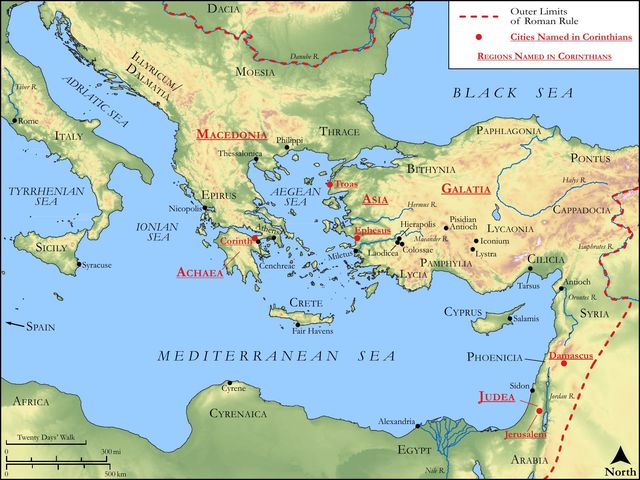
See on the biblical-era maps

Study this verse
Public-domain commentary
Matthew Henry
From his Commentary on the Whole Bible. Henry comments on passages, not single verses — this entry covers 2 Corinthians 9:6–15. His four-level outline is real structure in the source text, so it is rendered as structure.
Here we have,
I.Proper directions to be observed about the right and acceptable manner of bestowing charity; and it is of great concernment that we not only do what is required, but do it as is commanded. Now, as to the manner in which the apostle would have the Corinthians give, observe,
1.It should be bountifully; this was intimated, Co2 9:5, that a liberal contribution was expected, a matter of bounty, not what savoured of covetousness; and he offers to their consideration that men who expect a good return at harvest are not wont to pinch and spare in sowing their seed, for the return is usually proportionable to what they sow, Co2 9:6.
2.It should be deliberately Every man, according as he purposes in his heart, Co2 9:7. Works of charity, like other good works, should be done with thought and design; whereas some do good only by accident. They comply, it may be hastily, with the importunity of others, without any good design, and give more than they intended, and then repent of it afterwards. Or possibly, had they duly considered all things, they would have given more. Due deliberation, as to this matter of our own circumstances, and those of the persons we are about to relieve, will be very helpful to direct us how liberal we should be in our contributions for charitable uses.
3.It should be freely, whatever we give, be it more or less: Not grudgingly, nor of necessity, but cheerfully, Co2 9:7. Persons sometimes will give merely to satisfy the importunity of those who ask their charity, and what they give is in a manner squeezed or forced from them, and this unwillingness spoils all they do. We ought to give more freely than the modesty of some necessitous persons will allow them to ask: we should not only deal out bread, but draw out our souls to the hungry, Isa 58:10. We should give liberally, with an open hand, and cheerfully, with an open countenance, being glad we have ability and an opportunity to be charitable.
II.Good encouragement to perform this work of charity in the manner directed. Here the apostle tells the Corinthians,
1.They themselves would be no losers by what they gave in charity. This may serve to obviate a secret objection in the minds of many against this good work who are ready to think they may want what they give away; but such should consider that what is given to the poor in a right manner is far from being lost; as the precious seed which is cast into the ground is not lost, though it is buried there for a time, for it will spring up, and bear fruit; the sower shall receive it again with increase, Co2 9:6. Such good returns may those expect who give freely and liberally in charity. For,
(1.)God loveth a cheerful giver (Co2 9:7), and what may not those hope to receive who are the objects of the divine love? Can a man be a loser by doing that with which God is pleased? May not such a one be sure that he shall some way or other be a gainer? Nay, are not the love and favour of God better than all other things, better than life itself?
(2.)God is able to make our charity redound to our advantage, Co2 9:8. We have no reason to distrust the goodness of God, and surely we have no reason to question his power; he is able to make all grace abound towards us, and abound in us; to give a large increase of spiritual and temporal good things. He can cause us to have a sufficiency in all things, to be content with what we have, to make up what we give, to be able to give yet more: as it is written (Psa 112:9) concerning the charitable man, He hath dispersed abroad. He hath given to the poor. His righteousness, that is, his almsgiving, endureth for ever. The honour of it is lasting, the reward of it eternal, and he is still able to live comfortably himself and to give liberally to others.
(3.)The apostle puts up a prayer to God in their behalf that they might be gainers, and not losers, Co2 9:10, Co2 9:11. Here observe,
[1.]To whom the prayer is made - to God, who ministereth seed to the sower, who by his providence giveth such an increase of the fruits of the earth that we have not only bread sufficient to eat for one year, but enough to sow again for a future supply: or thus, It is God who giveth us not only a competency for ourselves, but that also wherewith we may supply the wants of others, and so should be as seed to be sown.
[2.]For what he prayeth. There are several things which he desires for them, namely, that they may have bread for their food, always a competency for themselves, food convenient, - that God will multiply their seed sown, that they may still be able to do more good, - and that there may be an increase of the fruits of righteousness, that they may reap plentifully, and have the best and most ample returns of their charity, so as to be enriched in every thing to all bountifulness (Co2 9:11), - that upon the whole they may find it true that they shall be no losers, but great gainers. Note, Works of charity are so far from impoverishing us that they are the proper means truly to enrich us, or make us truly rich.
2.While they would be no losers, the poor distressed saints would be gainers; for this service would supply their wants, Co2 9:12. If we have reason to think them to be saints, whom we believe to be of the household of faith, whose wants are great, how ready should we be to do them good! Our goodness can not extend unto God, but we should freely extend it to these excellent ones of the earth, and thus show that we delight in them.
3.This would redound to the praise and glory of God. Many thanksgivings would be given to God on this account, by the apostle, and by those who were employed in this ministration, Co2 9:11. These would bless God, who had made them happy instruments in so good a work, and rendered them successful in it. Besides these, others also would be thankful; the poor, who were supplied in their wants, would not fail to be very thankful to God, and bless God for them; and all who wished well to the gospel would glorify God for this experiment, or proof of subjection to the gospel of Christ, and true love to all men, Co2 9:13. Note,
(1.)True Christianity is a subjection to the gospel, a yielding of ourselves to the commanding influence of its truths and laws.
(2.)We must evince the sincerity of our subjection to the gospel by works of charity.
(3.)This will be for the credit of our profession, and to the praise and glory of God.
4.Those whose wants were supplied would make the best return they were able, by sending up many prayers to God for those who had relieved them, Co2 9:14. And thus should we recompense the kindnesses we receive when we are not in a capacity of recompensing them in any other way; and, as this is the only recompence the poor can make, so it is often greatly for the advantage of the rich.
Lastly, The apostle concludes this whole matter with this doxology, Thanks be to God for his unspeakable gift, Co2 9:15. Some think that by this unspeakable gift he means the gift of grace bestowed on the churches, in making them able and willing to supply the necessities of the saints, which would be attended with unspeakable benefit both to the givers and receivers. It should seem rather that he means Jesus Christ, who is indeed the unspeakable gift of God unto this world, a gift we have all reason to be very thankful for.
Historical interpretation
Historical reception
1 surviving comment on this verse from the historical church.
"That being enriched in every thing to all liberality, which worketh through us thanksgiving to God." Not that ye may consume it upon things not fitting, but upon such as bring much thanksgiving to God. For God made us to have the disposal of great things, and reserving to Himself that which is less yielded to us that which is greater. For corporeal nourishment is at His sole disposal, but mental He permitted to us; for we have it at our own disposal whether the crops we have to show be luxuriant. For no need is here of rains and of variety of seasons, but of the will only, and they run up to heaven itself. And largeness in giving is what he here calls liberality. "Which worketh through us thanksgiving to God." For neither is that which is done almsgiving merely, but also the ground of much thanksgiving: yea rather, not of thanksgiving only, but of many other things besides. And these as he goes on he mentions, that by showing it to be the cause of many good works, he may make them thereby the forwarder.
Continue studying 2 Corinthians 9:11 across the web’s major study libraries — every link below opens this exact verse, chapter, or book on the destination site.
Read & Compare
 BibleGatewayThis verse in more than 200 translations and 70 languages.
 Bible.comThe YouVersion reader — hundreds of translations, reading plans, and highlights.
 ESV.orgCrossway's official English Standard Version reader.
 NET BibleThe NET translation with 60,000+ translators' notes on every rendering decision.
 STEP BibleTyndale House's free study tool — original text, vocabulary, and scholarly resources.
 BibliaLogos Bible Software's free web reader.
 USCCBThe New American Bible (Revised Edition) with the U.S. bishops' study notes.
Commentaries
 BibleHub CommentariesDozens of classic commentaries on this verse, gathered on one page.
 StudyLightMore than 100 commentary sets — the largest collection on the web.
 BibleRefPlain-English commentary on what this verse means, verse by verse.
 Enduring WordDavid Guzik's free commentary on this chapter, widely used by Bible teachers.
 Bible Study ToolsVerse commentary alongside Greek and Hebrew study aids.
Original Language & Research
- BibleHub InterlinearThe verse word by word — original language, transliteration, and English.
- BibleHub LexiconEvery word's original-language definition and Strong's entry.
 Blue Letter BibleDeep-study tools — Strong's numbers, concordance, and word studies.
 CNTR CollationThe earliest Greek manuscripts of this verse, collated letter by letter.
Sermons, Hymns & Audio


TrulyRandomVerse is not affiliated with these sites and doesn’t control their content. They’re linked because they’re genuinely useful.
Summary
Second Corinthians 9:11 reveals God's divine purpose in enriching believers in every aspect of their lives: it is not for self-accumulation but to empower them for abundant generosity. This enablement to give with open-handed liberality, in turn, serves as a powerful catalyst, causing recipients and observers alike to offer heartfelt thanksgiving and praise to God, thereby completing a cycle of divine grace, human generosity, and ultimate glorification of the Giver of all good things.
Context
ShowHideLiterary Context
This verse is situated within Paul's extensive and passionate appeal to the Corinthian church concerning the collection for the impoverished saints in Jerusalem (2 Corinthians 8-9). Paul has already exhorted them to participate willingly, citing the example of the Macedonian churches' sacrificial giving (2 Corinthians 8:1-5). He emphasizes that God loves a cheerful giver (2 Corinthians 9:7) and assures them that God is able to make all grace abound toward them, enabling them to have sufficiency in everything and to abound in every good work (2 Corinthians 9:8). Verse 11 directly follows this assurance, articulating the purpose of such divine enrichment: it is so they can be a channel of blessing, leading to thanksgiving to God. The subsequent verses (2 Corinthians 9:12-15) further elaborate on the multi-faceted positive outcomes of their generosity, including the supply of needs, abounding thanksgiving, and the glorification of God.
Historical & Cultural Context
The collection for the Jerusalem saints was a significant undertaking for the early church, symbolizing unity between Gentile and Jewish believers and providing practical relief for those suffering from famine and poverty (likely exacerbated by Roman taxation and local conditions). Among the Greeks and Romans, patronage was common, where wealthy individuals provided for clients in exchange for honor and loyalty. However, Paul redefines generosity within a Christian framework, emphasizing a giving motivated by divine grace and love, not social obligation or a desire for personal acclaim. The Corinthians, a relatively prosperous church in a major trade city, were being called to an act of self-sacrificial giving that transcended typical cultural expectations, demonstrating the transformative power of the Gospel. This act of giving also served as a tangible expression of the unity of the body of Christ, bridging geographical and ethnic divides.
Key Themes
ShowHideThe overarching theme is Divine Provision and Human Generosity. God's abundant grace is not merely for personal comfort but is specifically purposed to enable believers to participate in His work of blessing others. This highlights the theme of Stewardship, where believers are entrusted with resources to manage them according to God's will. Another crucial theme is the Cycle of Grace and Thanksgiving: God gives, believers give, and the recipients (and the givers themselves) respond with thanksgiving to God, completing the circuit of divine glory. This generosity also fosters Unity in the Body of Christ, as the collection for Jerusalem demonstrated practical love across different communities. Finally, the passage underscores the Transformative Power of the Gospel, which moves individuals from self-centeredness to generous, joyful giving that ultimately glorifies God, as seen in the example of Christ's own self-giving (2 Corinthians 8:9).
Exposition and Analysis
ShowHideKey Word Analysis
ShowHideMeaning "to make wealthy (figuratively)." In this context, it signifies a divine act of empowering believers with abundant resources, not limited to financial wealth but encompassing all forms of blessing—spiritual, material, relational, and intellectual. It implies a generous overflow from God's inexhaustible supply, enabling the recipient to possess more than enough for their own needs.
Meaning "singleness, i.e. (subjectively) sincerity (without dissimulation or self-seeking), or (objectively) generosity (copious bestowal)." Here, it primarily conveys the objective sense of "generosity" or "liberality." It describes a giving that is open-handed, unreserved, and free from ulterior motives, reflecting a sincere heart. It stands in contrast to grudging or calculated giving.
Meaning "to work fully, i.e. accomplish; by implication, to finish, fashion." This verb indicates that the generosity facilitated by divine enrichment is not merely an incidental outcome but actively and effectively "produces" or "works out" a specific result. It highlights the direct causal link between the Corinthians' giving and the subsequent thanksgiving to God.
Meaning "gratitude; actively, grateful language (to God, as an act of worship)." This term denotes not just a feeling of gratitude but its active expression, particularly in the form of praise and worship directed towards God. It is the ultimate spiritual outcome of the entire process, where God receives glory for His provision and the generosity He inspires.
Verse Breakdown
ShowHide"Being enriched in every thing"
This clause establishes the source and scope of the believer's enablement. The passive voice ("Being enriched") indicates that God is the active agent of this enrichment. The phrase "in every thing" signifies a comprehensive and holistic abundance, not limited to material wealth but encompassing all areas of life where God's grace can be manifested—spiritual gifts, wisdom, opportunities, and material resources. This divine provision ensures that believers are fully equipped.
"to all bountifulness"
This phrase clarifies the purpose or goal of the divine enrichment. The preposition "to" (G1519, eis) denotes purpose or result. God enriches believers for the purpose of enabling them to exercise "all bountifulness"—that is, complete, open-handed, and sincere generosity. The "all" here emphasizes that this generosity should be pervasive and comprehensive, matching the "every thing" in which they are enriched.
"which causeth through us"
This clause highlights the mechanism and agency of the thanksgiving. The relative pronoun "which" (G3748, hóstis) refers back to the "bountifulness" (or the entire process of enrichment for bountifulness). This generosity "causeth" (G2716, katergázomai) or "produces" a specific outcome. The phrase "through us" (G1223, diá + G2257, hēmōn) indicates that believers are the channels or instruments through whom this effect is achieved. Their act of giving is the conduit for the subsequent thanksgiving.
"thanksgiving to God"
This is the ultimate spiritual outcome and the culmination of the entire process. The bountiful giving, facilitated by God's enrichment, results in "thanksgiving" (G2169, eucharistía) that is directed "to God" (G2316, theós). This signifies that the recipients of the generosity, and perhaps even the givers themselves, recognize God as the ultimate source of the blessing, leading them to praise and glorify Him. It completes the cycle, bringing glory back to the divine Giver.
Literary Devices
ShowHidePaul employs several literary devices in this concise verse to convey its profound theological truth. The primary device is Causality, expressed through the clear cause-and-effect relationship: divine enrichment leads to human generosity, which in turn causes thanksgiving to God. This creates a powerful chain of blessings. There is also a strong sense of Purpose Clause, as the enrichment is explicitly stated to be "to all bountifulness," indicating an intentional design behind God's provision. The phrase "in every thing" and "to all bountifulness" demonstrates Hyperbole or Emphasis, stressing the comprehensive nature of both God's provision and the expected generosity. Finally, the verse implicitly uses Metaphor by presenting God's enrichment as a divine investment, where the "return" on that investment is not personal gain for the believer, but the spiritual "profit" of thanksgiving and glory directed back to God.
Theological and Thematic Connections
ShowHide2 Corinthians 9:11 beautifully encapsulates a core theological principle: God's generosity is always purposeful, designed to enable His people to participate in His redemptive work and bring Him glory. It reveals God as the ultimate Giver, whose abundant provision empowers believers to reflect His character through their own liberality. This verse connects the act of giving not merely to material transactions but to a profound act of worship, where human generosity becomes the conduit for divine praise. It underscores the interconnectedness of the Christian community, where the needs of some are met through the abundance of others, fostering unity and mutual thanksgiving. This cycle of grace, generosity, and glorification of God is a fundamental aspect of the Kingdom of God, demonstrating that true spiritual wealth is found not in accumulation but in distribution.
Reflection and Application
ShowHideFor the contemporary believer, 2 Corinthians 9:11 serves as a profound call to re-evaluate the purpose of their blessings. It challenges the common misconception that divine enrichment is solely for personal comfort or security, redirecting our focus to God's greater Kingdom purposes. Every resource, talent, opportunity, and spiritual gift we possess is a trust from God, given with the explicit intention that we might be channels of His generosity to a needy world. This understanding transforms giving from a mere obligation into a joyful privilege and a powerful act of worship. When we embrace this truth, our lives become conduits through which God's provision flows, not only meeting physical needs but also stirring spiritual gratitude in the hearts of recipients, ultimately directing their praise and thanksgiving back to the ultimate Giver. This perspective fosters a deeper sense of stewardship and invites us into a partnership with God in His ongoing work of grace.
Questions for Reflection
ShowHideFAQ
ShowHideIs "enriched in every thing" only about money?
ShowHideNo, while financial resources are certainly included, "enriched in every thing" (Greek: en pan - G1722, G3956) signifies a comprehensive abundance. This includes spiritual gifts, talents, wisdom, opportunities, health, relationships, and material possessions. Paul's broader teaching on giving in 2 Corinthians 8-9 certainly addresses financial contributions for the saints in Jerusalem, but the principle of God's enrichment for generosity extends to every area of a believer's life. The purpose is always to enable us to be a blessing, reflecting God's own multifaceted generosity.
How does our giving "cause" thanksgiving to God?
ShowHideOur giving causes thanksgiving to God in several ways. Firstly, when believers generously meet the needs of others, the recipients are blessed and naturally express gratitude, not just to the giver but, more profoundly, to God who prompted and enabled the giving. Secondly, this act of generosity serves as a tangible demonstration of God's faithfulness and love to those who witness it, prompting them to glorify Him. Paul elaborates on this in 2 Corinthians 9:12-14, explaining that the "supply of the saints' needs" leads to "thanksgivings to God," and that "by the proof of this ministry, they glorify God for your obedience to the gospel of Christ." Thus, our generosity acts as a visible testimony to God's character and the transformative power of the Gospel.
Christ-Centered Fulfillment
ShowHide2 Corinthians 9:11 finds its ultimate fulfillment and deepest meaning in the person and work of Jesus Christ. He is the preeminent example of divine enrichment for bountifulness, and the ultimate cause of thanksgiving to God. Though He was rich, yet for our sakes He became poor, that we through His poverty might become rich (2 Corinthians 8:9). This profound act of self-emptying, the ultimate "bountifulness" from God, was not for His own gain but for the immeasurable spiritual enrichment of humanity. Through His sacrifice on the cross, Jesus fully accomplished (Greek: katergázomai) the work of redemption, which eternally "causeth through us thanksgiving to God." Every act of Christian generosity, empowered by the Spirit, is a reflection of Christ's own giving nature and an extension of His ongoing ministry in the world. As believers participate in this cycle of grace, they become living testimonies to the boundless love of God revealed in Christ, prompting a chorus of praise and gratitude that echoes the very heart of the Gospel, where God's greatest gift, His Son, elicits the greatest thanksgiving (John 3:16 and Ephesians 5:20).