


Mark 6:33
- καὶkaiAndG2532CONJConjunction
- εἶδονeidonthey sawG1492V-2AAI-3PVerb 2nd Aorist Active Indicative 3rd Plural
- αὐτοὺςautousthemG846P-APMPersonal pronoun Accusative Plural Masculine
- ὑπάγονταςhupagontasgoingG5217V-PAP-APMVerb Present Active Participle Accusative Plural Masculine
- οἱhoi<the>G3588T-NPMDefinite article Nominative Plural Masculine
- ὄχλοιochloicrowdsG3793N-NPMNoun Nominative Plural Masculine
- καὶkaiandG2532CONJConjunction
- ἐπέγνωσανepegnōsanrecognizedG1921V-2AAI-3PVerb 2nd Aorist Active Indicative 3rd Plural
- αὐτὸνautonhimG846P-ASMPersonal pronoun Accusative Singular Masculine
- πολλοὶpolloimanyG4183A-NPMAdjective Nominative Plural Masculine
- καὶkaiandG2532CONJConjunction
- πεζῇpezēaon footG3979ADVAdverb
- ἀπὸapofromG575PREPPreposition
- πασῶνpasōnallG3956A-GPFAdjective Genitive Plural Feminine
- τῶνtōntheG3588T-GPFDefinite article Genitive Plural Feminine
- πόλεωνpoleōncitiesG4172N-GPFNoun Genitive Plural Feminine
- συνέδραμονsunedramonran togetherG4936V-2AAI-3PVerb 2nd Aorist Active Indicative 3rd Plural
- ἐκεῖekeithereG1563ADVAdverb
- καὶkaiandG2532CONJConjunction
- προῆλθονproēlthonwent beforeG4281V-2AAI-3PVerb 2nd Aorist Active Indicative 3rd Plural
- αὐτούςautousthemG846P-APMPersonal pronoun Accusative Plural Masculine
- καὶkaiandG2532CONJConjunction
- συνῆλθονsunēlthontogether wentG4905V-2AAI-3PVerb 2nd Aorist Active Indicative 3rd Plural
- πρὸςprostoG4314PREPPreposition
- αὐτόνautonhimG846P-ASMPersonal pronoun Accusative Singular Masculine
English is a literal word-by-word gloss of the Greek, not the KJV's wording. Why?
This is the original text the KJV's translators worked from — each Greek word with its own literal English meaning in this verse, prepared by scholars at Tyndale House, Cambridge. The KJV translates whole sentences, not word by word, so its wording differs: one Greek word can become several English words, and the KJV may choose “charity” where the gloss reads “love”. Both are faithful — they answer different questions. For the KJV's own rendering, switch to the KJV text.
Details
See on the biblical-era map
Study this verse
Public-domain commentary
Matthew Henry
From his Commentary on the Whole Bible. Henry comments on passages, not single verses — this entry covers Mark 6:30–44. His three-level outline is real structure in the source text, so it is rendered as structure.
In there verses, we have,
I.The return to Christ of the apostles whom he had sent forth (Mar 6:7), to preach, and work miracles.
They had dispersed themselves into several quarters of the country for some time, but when they had made good their several appointments, by consent they gathered themselves together, to compare notes, and came to Jesus, the centre of their unity, to give him an account of what they had done pursuant to their commission: as the servant that was sent to invite to the feast, and had received answers from the guests, came, and showed his Lord all those things, so did the apostles here; they told him all things, both what they had done, and what they had taught. Ministers are accountable both for what they do, and for what they teach; and must both watch over their own souls, and watch for the souls of others, as those that must give account, Heb 13:17. Let them not either do any thing, or teach any thing, but what they are willing should be related and repeated to the Lord Jesus. It is a comfort to faithful ministers, when they can appeal to Christ concerning their doctrine and manner of life, both which perhaps have been misrepresented by men; and he gives them leave to be free with him, and to lay open their case before him, to tell him all things, what treatment they have met with, what success, and what disappointment.
II.The tender care Christ took for their repose, after the fatigue they had (Mar 6:31); He said unto them, perceiving them to be almost spent, and out of breath, Come ye yourselves apart into a desert place, and rest awhile. It should seem that John's disciples came to Christ with the mournful tidings of their master's death, much about the same time that his own disciples came to him with the report of their negotiation. Note, Christ takes cognizance of the frights of some, and the toils of others, of his disciples, and provides suitable relief for both, rest for those that are tired, and refuge for those that are terrified. With what kindness and compassion doth Christ say to them, Come, and rest! Note, The most active servants of Christ cannot be always upon the stretch of business, but have bodies that require some relaxation, some breathing-time; we shall not be able to serve God without ceasing, day and night, till we come to heaven, where they never rest from praising him, Rev 4:8. And the Lord is for the body, considers its frame, and not only allows it time for rest, but puts it in mind of resting. Come, my people, enter thou into thy chambers. Return to thy rest. And those that work diligently and faithfully, may cheerfully retire to rest. The sleep of the labouring man is sweet. But observe,
1.Christ calls them to come themselves apart; for, if they had any body with them, they would have something to say, or something to do, for their good; if they must rest, they must be alone.
2.He invites them not to some pleasant country-seat, where there were fine buildings and fine gardens, but into a desert place, where the accommodations were very poor, and which was fitted by nature only, and not by art, for quietness and rest. But it was of a piece with all the other circumstances he was in; no wonder that he who had but a ship for his preaching place, had but a desert for his resting place.
3.He calls them only to rest awhile; they must not expect to rest long, only to get breath, and then to go to work again. There is no remaining rest for the people of God till they come to heaven.
4.The reason given for this, is, not so much because they had been in constant work, but because they now were in a constant hurry; so that they had not their work in any order; for there were many coming and going, and they had no leisure so much as to eat. Let but proper time be set, and kept for every thing, and a great deal of work may be done with a great deal of ease; but if people be continually coming and going, and no rule or method be observed, a little work will not be done without a deal of trouble.
5.They withdrew, accordingly, by ship; not crossing the water, but making a coasting voyage to the desert of Bethsaida, Mar 6:32. Going by water was much less toilsome than going by land would have been. They went away privately, that they might be by themselves. The most public persons cannot but wish to be private sometimes.
III.The diligence of the people to follow him.
It was rude to do so, when he and his disciples were desirous, for such good reason, to retire; and yet they are not blamed for it, nor bid to go back, but bid welcome. Note, A failure in good manners will easily be excused in those who follow Christ, if it be but made up in a fulness of good affections. They followed him of their own accord, without being called upon. Here is no time set, no meeting appointed, no bell tolled; yet they thus fly like a cloud, and as the doves to their windows. They followed him out of the cities, quitted their houses and shops, their callings and affairs, to hear him preach. They followed him afoot, though he was gone by sea, and so, to try them, seemed to put a slight upon them, and to endeavour to shake them off; yet they stuck to him. They ran afoot, and made such haste, that they out-went the disciples, and came together to him with an appetite to the word of God. Nay they followed him, though it was into a desert place, despicable and inconvenient. The presence of Christ will turn a wilderness into a paradise.
IV.The entertainment Christ gave them (Mar 6:34); When he saw much people, instead of being moved with displeasure, because they disturbed him when he desired to be private, as many a man, many a good man, would have been, he was moved with compassion toward them, and looked upon them with concern, because they were as sheep having no shepherd, they seemed to be well-inclined, and manageable as sheep, and willing to be taught, but they had no shepherd, none to lead and guide them in the right way, none to feed them with good doctrine: and therefore, in compassion to them, he not only healed their sick, as it is in Matthew, but he taught them many things, and we may be sure that they were all true and good, and fit for them to learn.
V.The provision he made for them all; all his hearers he generously made his guests, and treated them at a splendid entertainment: so it might truly be called, because a miraculous one.
1.The disciples moved that they should be sent home. When the day was not far spent, and night drew on, they said, This is a desert place, and much time is now past; send them away to buy bread, Mar 6:35, Mar 6:36. This the disciples suggested to Christ; but we do not find that the multitude themselves did. They did not say, Send us away (though they could not but be hungry), for they esteemed the words of Christ's mouth more than their necessary food, and forgot themselves when they were hearing him; but the disciples thought it would be a kindness to them to dismiss them. Note, Willing minds will do more, and hold out longer, in that which is good, than one would expect from them.
2.Christ ordered that they should all be fed (Mar 6:37); Give ye them to eat. Though their crowding after him and his disciples hindered them from eating (Mar 6:31), yet he would not therefore, to be even with them, send them away fasting, but, to teach us to be kind to those who are rude to us, he ordered provision to be made for them; that bread which Christ and his disciples took with them into the desert, that they might make a quiet meal of it for themselves, he will have them to partake of. Thus was he given to hospitality. They attended on the spiritual food of his word, and then he took care that they should not want corporal food. The way of duty, as it is the way of safety, so it is the way to supply. Let God alone to fill the pools with rain from heaven, and so to make a well even in the valley of Baca, for those that are going Zion-ward, from strength to strength, Psa 84:6, Psa 84:7. Providence, not tempted, but duly trusted, never yet failed any of God's faithful servants, but has refreshed many with seasonable and surprising relief. It has often been seen in the mount of the Lord, Jehovah-jireh, that the Lord will provide for those that wait on him.
3.The disciples objected against it as impracticable; Shall we go, and buy two hundred penny-worth of bread, and give them to eat? Thus, through the weakness of their faith, instead of waiting for directions from Christ, they perplex the cause with projects of their own. It was a question, whether they had two hundred pence with them, whether the country would of a sudden afford so much bread if they had, and whether that would suffice so great a company; but thus Moses objected (Num 11:22), Shall the flocks and the herds be slain for them? Christ would let them see their folly in forecasting for themselves, that they might put the greater value upon his provision for them.
4.Christ effected it, to universal satisfaction. They had brought with them five loaves, for the victualling of their ship, and two fishes perhaps they caught as they came along; and that is the bill of fare. This was but a little for Christ and his disciples, and yet this they must give away, as the widow her two mites, and as the church of Macedonia's deep poverty abounded to the riches of their liberality. We often find Christ entertained at other people's tables, dining with one friend, and supping with another: but here we have him supping a great many at his own charge, which shows that, when others ministered to him of their substance, it was not because he could not supply himself otherwise (if he was hungry, he needed not tell them); but it was a piece of humiliation, that he was pleased to submit to, nor was it agreeable to the intention of miracles, that he should work them for himself. Observe,
(1.)The provision was ordinary. Here were no rarities, no varieties, though Christ, if he had pleased, could have furnished his table with them; but thus he would teach us to be content with food convenient for us, and not to be desirous of dainties. If we have for necessity, it is no matter though we have not for delicacy and curiosity. God, in love, gives meat for our hunger; but, in wrath, gives meat for our lusts, Psa 78:18. The promise to them that fear the Lord, is, that verily they shall be fed; he doth not say, They shall be feasted. If Christ and his disciples took up with mean things, surely we may.
(2.)The guests were orderly; for they sat down by companies on the green grass (Mar 6:39), they sat down in ranks by hundreds and by fifties (Mar 6:40), that the provision might the more easily and regularly be distributed among them; for God is the God of order, and not of confusion. Thus care was taken that every one should have enough, and none be over-looked, nor any have more than was fitting.
(3.)A blessing was craved upon the meat; He looked up to heaven, and blessed. Christ did not call one of his disciples to crave a blessing, but did it himself (Mar 6:41); and by virtue of this blessing the bread strangely multiplied, and so did the fishes, for they did all eat, and were filled, though they were to the number of five thousand, Mar 6:42, Mar 6:44. This miracle was significant, and shows that Christ came into the world, to be the great feeder as well as the great healer; not only to restore, but to preserve and nourish, spiritual life; and in him there is enough for all that come to him, enough to fill the soul, to fill the treasures; none are sent empty away from Christ, but those that come to him full of themselves.
(4.)Care was taken of the fragments that remained, with which they filled twelve baskets. Though Christ had bread enough at command, he would hereby teach us, not to make waste of any of God's good creatures; remembering how many there are that do want, and that we know not but we may some time or other want such fragments as we throw away.
Historical interpretation
Twelve Centuries of Reception
6 surviving comments on this verse. Each one is dated, so this reads as a timeline rather than a list.
Select a marker to jump to its quote. Markers stagger vertically where authors wrote within a few decades of each other.
For they return to the fountain-head whence the streams flow; those who are sent by God, always offer up thanks for those things which they have received.
Mystically, however, the Lord took apart those whom He chose, that though living amongst evil men, they might not apply their minds to evil things, as Lot in Sodom, Job in the land of Uz, and Obadiah in the house of Ahab.
Little indeed is the rest of the saints here on earth, long is their labour, but afterwards, they are bidden to rest from their labours. But as in the ark of Noah, the animals that were within were sent forth, and they that were without rushed in, so is it in the Church, Judas went, the thief came to Christ. But as long as men go back from the faith, the Church can have no refuge from grief; for Rachel weeping for her children would not be comforted. Moreover, this world is not the banquet, in which the new wine is drank, when the new song will be sung by men made anew, when this mortal shall have put on immortality.
(ubi sup.) Not only do the Apostles tell the Lord what they themselves had done and taught, but also his own and John's disciples together tell Him what John had suffered, during the time that they were occupied in teaching, as Matthew relates. It goes on: And he said to them, Come ye yourselves apart, &c.
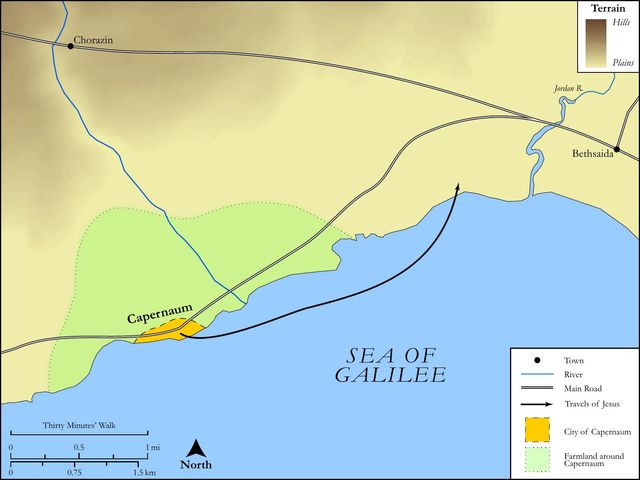
(ubi sup.) How arose the necessity for giving rest to His disciples, He shows, when He adds, For there were many coming and going, and they had no leisure so much as to eat; we may then see how great was the happiness of that time, both from the toil of the teachers, and from the diligence of the learners. It goes on, And embarking in a ship, they departed into a desert place privately. The disciples did not enter into the ship alone, but taking up the Lord with them, they went to a desert place, as Matthew shows. (Matt. 14) Here He tries the faith of the multitude, and by seeking a desert place He would see whether they care to follow Him. And they follow Him, and that not on horseback, nor in carriages, but laboriously coming on foot, they show how great is their anxiety for their salvation. There follows, And the people saw them departing, and many knew him, and ran afoot thither out of all cities, and outwent them. In saying that they outwent them on foot, it is proved that the disciples with the Lord did not reach the other bank of the sea, or of the Jordan, but they went to the nearest places of the same country, where the people of those parts could come to them on foot.
(in Marc. 2, 26) Matthew says that He healed their sick, for the real way of pitying the poor is to open to them the way of truth by teaching them, and to take away their bodily pains.
(in Marc. 2, 25) Leaving also Judæa, the holy preachers, in the desert of the Church, overwhelmed by the burden of their tribulations amongst the Jews, obtained rest by the imparting of the grace of faith to the Gentiles.
(in Marc. 2, 26) But when Christ goes to the deserts of the Gentiles, many bauds of the faithful leaving the walls of their cities, that is their old manner of living, follow Him.
And they saw them going away, and many recognized them, and they ran afoot from all the towns, etc. By saying that they outstripped them on foot, it is shown that the disciples with the Lord did not reach another shore of the sea or Jordan by ship, but having crossed a certain strait or lake, they went to the nearby places of the same region, which the natives could reach on foot.
Let us also learn, when we are sent on any mission, not to go far away, and not to overstep the bounds of the office committed, but to go often to him, who sends us, and report all that we have done and taught; for we must not only teach but act.
Again, He goes into a desert place from His humility. But Christ makes His disciples rest, that men who are set over others may learn, that they who labour in any work or in the word deserve rest, and ought not to labour continually.
So do thou not wait for Christ till He Himself call you, but outrun Him, and come before Him. There follows, And Jesus when he came out saw much people, and was moved with compassion towards them, because they were as sheep having no shepherd. The Pharisees being ravening wolves did not feed the sheep, but devoured them; for which reason they gather themselves to Christ, the true Shepherd, who gave them spiritual food, that is, the word of God. Wherefore it goes on, And he began to teach them many things. For seeing that those who followed Him on account of His miracles were tired from the length of the way, He pitied them, and wished to satisfy their wish by teaching them.
(non occ.) The Evangelist, after relating the death of John, gives an account of those things which Christ did with His disciples after the death of John, saying, And the Apostles gathered themselves together unto Jesus, and told him all things, both what they had done, and what they had taught.
There is an activity of God displayed throughout creation, a wholesale activity let us say which men refuse to recognize. The miracles done by God incarnate, living as a man in Palestine, perform the very same things as this wholesale activity, but at a different speed and on a smaller scale. One of their chief purposes is that men, having seen a thing done by personal power on the small scale, may recognize, when they see the same thing done on the large scale, that the power behind it is also personal – is indeed the very same person who lived among us two thousand years ago. The miracles in fact are a retelling in small letters of the very same story which is written across the whole world in letters too large for some of us to see...
Every year God makes a little corn into much corn: the seed is sown and there is an increase, and men, according to the fashion of their age, say “It is Ceres, it is Adonis, it is the Corn-King,” or else “It is the laws of Nature.” The close-up, the translation, of this annual wonder is the feeding of the five thousand. Bread is not made there of nothing. Bread is not made of stones, as the Devil once suggested to Our Lord in vain. A little bread is made into much bread. The Son will do nothing but what He sees the Father do. There is, so to speak, a family style...
When He fed the thousands He multiplied fish as well as bread. Look in every bay and almost every river. This swarming, pulsating fecundity shows He is still at work. The ancients had a god called Genius – the god of animal and human fertility, the presiding spirit of gynecology, embryology, or the marriage bed – the “genial bed” as they called it after its god Genius. As the miracles of wine and bread and healing showed who Bacchus really was, who Ceres, who Apollo, and that all were one, so this miraculous multiplication of fish reveals the real Genius.
Continue studying Mark 6:33 across the web’s major study libraries — every link below opens this exact verse, chapter, or book on the destination site.
Read & Compare
 BibleGatewayThis verse in more than 200 translations and 70 languages.
 Bible.comThe YouVersion reader — hundreds of translations, reading plans, and highlights.
 ESV.orgCrossway's official English Standard Version reader.
 NET BibleThe NET translation with 60,000+ translators' notes on every rendering decision.
 STEP BibleTyndale House's free study tool — original text, vocabulary, and scholarly resources.
 BibliaLogos Bible Software's free web reader.
 USCCBThe New American Bible (Revised Edition) with the U.S. bishops' study notes.
Commentaries
 BibleHub CommentariesDozens of classic commentaries on this verse, gathered on one page.
 StudyLightMore than 100 commentary sets — the largest collection on the web.
 BibleRefPlain-English commentary on what this verse means, verse by verse.
 Enduring WordDavid Guzik's free commentary on this chapter, widely used by Bible teachers.
 Bible Study ToolsVerse commentary alongside Greek and Hebrew study aids.
Original Language & Research
- BibleHub InterlinearThe verse word by word — original language, transliteration, and English.
- BibleHub LexiconEvery word's original-language definition and Strong's entry.
 Blue Letter BibleDeep-study tools — Strong's numbers, concordance, and word studies.
 CNTR CollationThe earliest Greek manuscripts of this verse, collated letter by letter.
Sermons, Hymns & Audio


TrulyRandomVerse is not affiliated with these sites and doesn’t control their content. They’re linked because they’re genuinely useful.
Summary
Mark 6:33 powerfully illustrates the overwhelming spiritual hunger and relentless pursuit of Jesus by the multitudes during His earthly ministry. Despite Jesus and His disciples seeking a secluded place for rest, the crowds, recognizing their departure and destination, exhibited extraordinary zeal, running along the shore from various cities to arrive at the intended location even before the boat, eager to be in His presence. This verse sets the immediate context for one of Jesus' most iconic miracles, the feeding of the five thousand, highlighting the profound impact of His ministry and the people's desperate need for Him.
Context
ShowHideLiterary Context
This verse immediately follows Jesus' attempt to withdraw with His disciples for rest after their first missionary journey, where they had been sent out with authority to preach and heal Mark 6:7-13. The disciples had just returned, reporting on their activities Mark 6:30. Jesus, observing their exhaustion and the ceaseless demands of the crowds, had compassionately suggested they go to a desolate place to rest Mark 6:31. Mark 6:33 describes the unexpected and overwhelming response of the people, who thwarted this attempt at solitude, setting the stage for Jesus' subsequent compassion and the miraculous feeding of the five thousand Mark 6:34-44.
Historical & Cultural Context
Galilee, during Jesus' ministry, was a densely populated region with numerous towns and villages. Travel by boat across the Sea of Galilee was common and often quicker than walking around its shores, especially for reaching less populated areas. The crowds following Jesus were not merely curious spectators; many were desperate for healing, deliverance, or spiritual teaching, having heard of His miracles and authoritative teaching. This era was marked by Roman occupation and a deep yearning among the Jewish people for a Messiah who would bring liberation and restoration. The widespread recognition of Jesus ("many knew him") indicates the extensive reach of His fame, which had spread rapidly through word of mouth across the region.
Key Themes
ShowHideThis verse contributes significantly to several overarching themes in Mark's Gospel. It underscores the intense spiritual hunger of the people, who prioritize access to Jesus over physical comfort, demonstrating their profound need for His presence and ministry. It highlights Jesus' immense popularity and the relentless demands of His ministry, showing that even His attempts at privacy were often overwhelmed by the crowds. Furthermore, it subtly introduces the theme of Jesus' compassion for the "sheep without a shepherd" Mark 6:34, which immediately follows this verse and motivates His teaching and miraculous provision. The crowds' extraordinary effort also serves as a powerful illustration of active pursuit of God, a theme echoed throughout the Scriptures, as seen in passages like Psalm 42:1-2.
Exposition and Analysis
ShowHideKey Word Analysis
ShowHideThis term refers to a "throng," "multitude," or "press." It emphasizes the sheer number of individuals gathered, often implying a less organized, perhaps even unruly, crowd. In this context, it highlights the vast scale of Jesus' following and the collective, almost spontaneous, movement of a large group.
More than just "saw" or "recognized superficially," this word implies becoming "fully acquainted with" or "acknowledging." It suggests that many in the crowd had a deeper understanding or personal experience of Jesus, perhaps having witnessed His miracles or heard His teaching previously, leading to a more profound recognition and conviction to follow Him.
This verb means "to go onward," "precede," or "arrive before." It underscores the remarkable speed and determination of the crowds. Despite Jesus and His disciples traveling by boat, the people, running "afoot" along the shore, managed to reach the destination ahead of them, demonstrating extraordinary zeal and eagerness to be in Jesus' presence.
Verse Breakdown
ShowHide"And the people saw them departing"
The large multitude observed Jesus and His disciples embarking on their boat, indicating that Jesus' movements were constantly monitored and His desire for solitude was difficult to achieve.
"and many knew him"
A significant portion of the crowd had personal knowledge or recognition of Jesus, likely from previous encounters with His ministry, confirming His widespread fame and the personal impact He had on individuals.
"and ran afoot thither out of all cities"
This clause vividly describes the immediate and intense response of the crowds. They did not merely walk but "ran" on foot, demonstrating an urgent and determined pursuit, gathering from numerous surrounding towns and villages to follow Him to His perceived destination.
"and outwent them"
This highlights the extraordinary effort and zeal of the people. Despite the disciples traveling by boat, the crowds, moving along the land, managed to arrive at the intended location before them, showcasing their relentless desire to be near Jesus.
"and came together unto him"
The ultimate outcome of their pursuit was to gather around Jesus, signifying their collective desire for His teaching, healing, or simply His presence, setting the stage for further interaction.
Literary Devices
ShowHideMark's narrative in this verse employs several effective literary devices. Vivid Imagery is prominent, painting a dynamic picture of the crowds "running afoot" and "outgoing" the boat, conveying their extraordinary zeal and the frenetic energy surrounding Jesus' ministry. The phrase "out of all cities" functions as a form of Hyperbole, emphasizing the vast geographical reach of Jesus' fame and the sheer multitude of people drawn to Him, rather than a literal count of every single city. This hyperbole underscores the overwhelming nature of the crowds. Furthermore, the verse creates a strong sense of Anticipation, building tension for the reader as Jesus' attempt at rest is thwarted, leading directly into the subsequent miraculous feeding, where Jesus' compassion will be fully displayed in response to this pressing need.
Theological and Thematic Connections
ShowHideMark 6:33 serves as a powerful testament to humanity's innate spiritual hunger and the magnetic draw of divine presence. The relentless pursuit of the crowds, despite physical exertion and inconvenience, underscores a profound need for truth, healing, and hope that only Jesus could offer. Theologically, it prefigures the universal appeal of the Gospel and the lengths to which people will go when genuinely seeking spiritual fulfillment. This scene also highlights the demanding nature of ministry for Jesus and His disciples, constantly pressed by the needs of the multitude, yet always met with Christ's boundless compassion.
Reflection and Application
ShowHideMark 6:33 presents a compelling challenge to our own spiritual priorities and the depth of our desire for Christ. The crowds' extraordinary effort—running on foot, out-pacing a boat, coming from "all cities"—reveals a profound spiritual hunger that transcended physical comfort or convenience. They sought Jesus with an urgency that should cause us to examine our own pursuit of Him. Do we approach our relationship with Christ with such intentionality and zeal, or do we allow distractions, busyness, or apathy to diminish our hunger for His presence and teaching? This verse encourages us to cultivate a similar fervent desire, to actively seek Him in His Word, in prayer, and in community, prioritizing our spiritual nourishment above all else. When we earnestly pursue Christ, we position ourselves to experience His transformative power and compassionate provision, just as the crowds did in the miracle that followed.
Questions for Reflection
ShowHideFAQ
ShowHideWhy were the crowds so determined to follow Jesus, even running on foot?
ShowHideThe crowds were driven by a profound spiritual and physical need. Jesus had become widely known for His authoritative teaching, miraculous healings, and compassionate ministry. Many were desperate for relief from sickness, demon possession, or simply sought hope and truth in a world under Roman occupation. Their determination to run "afoot" and "outwent" the boat demonstrates their extraordinary zeal and the deep conviction that only Jesus could meet their needs, as seen in the broader context of His ministry in Mark 6:53-56.
What does "outwent them" mean in this context?
ShowHideThe phrase "outwent them" means that the crowds, running along the shore, managed to arrive at the intended destination (likely a less populated area on the other side of the Sea of Galilee) before Jesus and His disciples, who were traveling by boat. This highlights the incredible speed, foresight, and determination of the people, who were so eager to be with Jesus that they physically exerted themselves to get there first. This detail emphasizes their intense spiritual hunger and commitment to following Him.
Christ-Centered Fulfillment
ShowHideMark 6:33, with its vivid portrayal of the crowds' relentless pursuit of Jesus, beautifully foreshadows Christ's ultimate role as the one who draws all people to Himself. The physical running of the multitudes toward Jesus on the shores of Galilee is a tangible illustration of the spiritual yearning for the Messiah that resides in the human heart, a yearning that only Christ can satisfy. Just as these crowds sought Him for physical sustenance and healing, Jesus would later declare Himself the "Bread of Life" John 6:35, the one who provides eternal spiritual nourishment. His compassion for these "sheep without a shepherd" Mark 6:34 prefigures His sacrificial love on the cross, where He became the Good Shepherd who lays down His life for His sheep John 10:11. The eagerness of the crowds to gather around Him anticipates the gathering of the Church, comprised of those from "every tribe and language and people and nation" Revelation 5:9, who are drawn to Him through the power of the Holy Spirit. Thus, this scene is not merely a historical account but a profound testament to Christ's magnetic grace, inviting all to run to Him for salvation and abundant life Matthew 11:28-30.