


2 Kings 5:14
Bible text: King James Version (1769 Blayney text) · Public domain
Bible text: King James Version with Strong's numbers · Public domain
Bible text: Berean Standard Bible · Public domain
Bible text: American Standard Version (1901) · Public domain
Bible text: World English Bible, Messianic edition · Public domain
Bible text: Geneva Bible (1599) · Public domain
Bible text: Young's Literal Translation · Public domain
- וַיֵּרֶדvai·Ye·redand he went downH3381Conj-w ¦ V-Qal-ConsecImperf-3msVerb Qal Consecutive Imperfect 3rd Singular Masculineוַandיֵּרֶדhe went down
- וַיִּטְבֹּלvai·yit·Boland he dippedH2881Conj-w ¦ V-Qal-ConsecImperf-3msVerb Qal Consecutive Imperfect 3rd Singular Masculineוַandיִּטְבֹּלhe dipped
- בַּיַּרְדֵּןbai·yar·Denin the JordanH3383Prep-b ¦ N-properNoun Proper Locationבַּin theיַּרְדֵּןJordan
- שֶׁבַעShe·va'sevenH7651N-csNoun Singular common gender Absolute
- פְּעָמִיםpe·'a·MimtimesH6471N-mpNoun Plural Masculine Absolute
- כִּדְבַרkid·Varaccording to [the] word ofH1697Prep-k ¦ N-mscNoun Singular Masculine Constructכִּaccording toדְבַר[the] word of
- אִישׁ'ish[the] man ofH376N-mscNoun Singular Masculine Construct
- הָאֱלֹהִיםha·'E·lo·Him<the> GodH430Art ¦ N-mpNoun Plural Masculine Absoluteהָ<the>אֱלֹהִיםGod
- וַיָּשָׁבvai·Ya·shovand it returnedH7725Conj-w ¦ V-Qal-ConsecImperf-3msVerb Qal Consecutive Imperfect 3rd Singular Masculineוַandיָּשָׁבit returned
- בְּשָׂרוֹbe·sa·Rohis fleshH1320N-msc ¦ 3msNoun Singular Masculine Constructבְּשָׂרfleshוֹhis
- כִּבְשַׂרkiv·Sarlike [the] flesh ofH1320Prep-k ¦ N-mscNoun Singular Masculine Constructכִּlikeבְשַׂר[the] flesh of
- נַעַרNa·'ara ladH5288N-msNoun Singular Masculine Absolute
- קָטֹןka·TonyoungH6996Adj-msAdjective Singular Masculine Absolute
- וַיִּטְהָרvai·yit·Harand he was cleanH2891Conj-w ¦ V-Qal-ConsecImperf-3msVerb Qal Consecutive Imperfect 3rd Singular Masculineוַandיִּטְהָרhe was clean
English is a literal word-by-word gloss of the Hebrew, not the KJV's wording. Why?
This is the original text the KJV's translators worked from — each Hebrew word with its own literal English meaning in this verse, prepared by scholars at Tyndale House, Cambridge. The KJV translates whole sentences, not word by word, so its wording differs: one Hebrew word can become several English words, and the KJV may choose “the LORD” where the gloss reads “Yahweh”. Both are faithful — they answer different questions. For the KJV's own rendering, switch to the KJV text.
Details
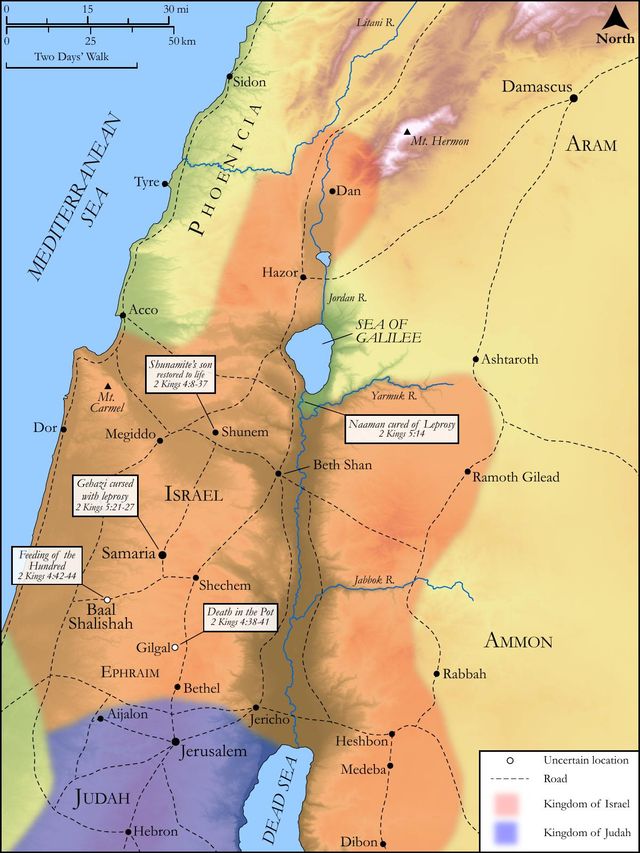
See on the biblical-era map
Study this verse
Public-domain commentary
Matthew Henry
From his Commentary on the Whole Bible. Henry comments on passages, not single verses — this entry covers 2 Kings 5:9–14. His three-level outline is real structure in the source text, so it is rendered as structure.
We have here the cure of Naaman's leprosy.
I.The short and plain direction which the prophet gave him, with assurance of success.
Naaman designed to do honour to Elisha when he came in his chariot, and with all his retinue, to Elisha's door, Kg2 5:9. Those that showed little respect to prophets at other times were very complaisant to them when they needed them. He attended at Elisha's door as a beggar for an alms. Those that would be cleansed from the spiritual leprosy must wait at Wisdom's gate, and watch at the posts of her doors. Naaman expected to have his compliment returned, but Elisha gave him his answer without any formality, would not go to the door to him, lest he should seem too much pleased with the honour done him, but sent a messenger to him, saying, Go wash in Jordan seven times, and promising him that if he did so his disease should be cured. The promise was express: Thou shalt be clean. The method prescribed was plain: Go wash in Jordan. This was not intended as any means of the cure; for, though cold bathing is recommended by many as a very wholesome thing, yet some think that in the case of a leprosy it was rather hurtful. But it was intended as a sign of the cure, and a trial of his obedience. Those that will be helped of God must do as they are bidden. But why did Elisha send a messenger to him with these directions?
1.Because he had retired, at this time, for devotion, was intent upon his prayers for the cure, and would not be diverted; or,
2.Because he knew Naaman to be a proud man, and he would let him know that before the great God all men stand upon the same level.
II.Naaman's disgust at the method prescribed, because it was not what he expected. Two things disgusted him: -
1.That Elisha, as he thought, put a slight upon his person, in sending him orders by a servant, and not coming to him himself, Kg2 5:11. Being big with the expectation of a cure, he had been fancying how this cure would be wrought, and the scheme he had laid was this: "He will surely come out to me, that is the least he can do to me, a peer of Syria, to me that have come to him in all this state, to me that have so often been victorious over Israel. He will stand, and call on the name of his God, and name me in his prayer, and then he will wave his hand over the place, and so effect the cure." And, because the thing was not done just thus, he fell into a passion, forgetting,
(1.)That he was a leper, and the law of Moses, which Elisha would religiously observe, shut lepers out from society - a leper, and therefore he ought not to insist upon the punctilios of honor. Note, Many have hearts unhumbled under humbling providences; see Num 12:14.
(2.)That he was a petitioner, suing for a favour which he could not demand; and beggars must not be choosers, patients must not prescribe to their physicians. See in Naaman the folly of pride. A cure will not content him unless he be cured with ceremony, with a great deal of pomp and parade; he scorns to be healed, unless he be humoured.
2.That Elisha, as he thought, put a slight upon his country. He took it hard that he must be sent to wash in Jordan, a river of Israel, when he thought Abana and Pharpar, rivers of Damascus, better than all the waters of Israel. How magnificently does he speak of these two rivers that watered Damascus, which soon after fell into one, called by geographers Chrysoroas - the golden stream! How scornfully does he speak of all the waters of Israel, though God had called the land of Israel the glory of all lands, and particularly for its brooks of water! Deu 8:7. So common it is for God and man to differ in their judgments. How slightly does he speak of the prophet's directions! May I not wash in them and be clean? He might wash in them and be clean from dirt, but not wash in them and be clean from leprosy. He was angry that the prophet bade him wash and be clean; he thought that the prophet must do all and was not pleased that he was bidden to do any thing, - or he thought this too cheap, too plain, too common a thing for so great a man to be cured by, - or he did not believe it would at all effect the cure, or, if it would, what medicinal virtue was there in Jordan more than in the rivers of Damascus? But he did not consider,
(1.)That Jordan belonged to Israel's God, from whom he was to expect the cure, and not from the gods of Damascus; it watered the Lord's land, the holy land, and, in a miraculous cure, relation to God was much more considerable than the depth of the channel or the beauty of the stream.
(2.)That Jordan had more than once before this obeyed the commands of omnipotence. It had of old yielded a passage to Israel, and of late to Elijah and Elisha, and therefore was fitter for such a purpose than those rivers which had only observed the common law of their creation, and had never been thus distinguished; but, above all,
(3.)Jordan was the river appointed, and, if he expected a cure from the divine power, he ought to acquiesce in the divine will, without asking why or wherefore. Note, It is common for those that are wise in their own conceit to look with contempt on the dictates and prescriptions of divine wisdom and to prefer their own fancies before them; those that are for establishing their own righteousness will not submit to the righteousness of God, Rom 10:3. Naaman talked himself into such a heat (as passionate men usually do) that he turned away from the prophet's door in a rage, ready to swear he would never have any thing more to say to Elisha; and who then would be the loser? Note, Those that observe lying vanities forsake their own mercies. Jon 2:8. Proud men are the worst enemies to themselves and forego their own redemption.
III.The modest advice which his servants gave him, to observe the prophet's prescriptions, with a tacit reproof of his resentments, Kg2 5:13.
Though at other times they kept their distance, and now saw him in a passion, yet, knowing him to be a man that would hear reason at any time, and from any body (a good character of great men, and a very rare one), they drew near, and made bold to argue the matter a little with him. They had conceived a great opinion of the prophet (having, perhaps, heard more of him from the common people, whom they had conversed with, than Naaman had heard from the king and courtiers, whom he had conversed with), and therefore begged of him to consider: "If the prophet had bidden thee to do some great thing, had ordered thee into a tedious course of physic, or to submit to some painful operation, blistering, or cupping, or salivating, Wouldst thou not have done it? No doubt thou wouldst. And wilt thou not submit to so easy a method as this, Wash and be clean?" Observe,
1.His own servants gave him this reproof and counsel, which was no more disparagement to him than that he had intelligence of one that could cure him from his wife's maid, Kg2 5:3. Note, It is a great mercy to have those about us that will be free with us, and faithfully tell us of our faults and follies, though they be our inferiors. Masters must be willing to hear reason from their servants, Job 31:13, Job 31:14. As we should be deaf to the counsel of the ungodly, though given by the greatest and most venerable names, so we should have our ear open to good advice, though brought us by those who are much below us: no matter who speaks, if the thing be well said.
2.The reproof was very modest and respectful. They call him Father; for servants must honour and obey their masters with a kind of filial affection. In giving reproof or counsel we must make it appear that it comes from love and true honour, and that we intend, not reproach, but reformation.
3.It was very rational and considerate. If the rude and unthinking servants had stirred up their master's angry resentment, and offered to avenge his quarrel upon the prophet, who (he thought) affronted him, how mischievous would the consequences have been! Fire from heaven, probably, upon them all! But they, to our great surprise, took the prophet's part. Elisha, though it is likely he perceived that what he had said had put Naaman out of humour, did not care to pacify him: it was at his peril if he persisted in his wrath. But his servants were made use of by Providence to reduce him to temper. They reasoned with him,
(1.)From his earnest desire of a cure: Wouldst thou not do any thing? Note, When diseased sinners come to this, that they are content to do any thing, to submit to any thing, to part with any thing, for a cure, then, and not till then, there begin to be some hopes of them. Then they will take Christ on his own terms when they are made willing to have Christ upon any terms.
(2.)From the easiness of the method prescribed: "It is but, Wash and be clean. It is but trying; the experiment is cheap and easy, it can do no hurt, but may do good." Note, the methods prescribed for the healing of the leprosy of sin are so plain that we are utterly inexcusable if we do not observe them. It is but, "Believe, and be saved" - "Repent, and be pardoned" - "Wash, and be clean."
IV.The cure effected, in the use of the means prescribed, Kg2 5:14.
Naaman, upon second thoughts, yielded to make the experiment, yet, it should seem, with no great faith and resolution; for, whereas the prophet bade him wash in Jordan seven times, he did but dip himself so many times, as lightly as he could. However God was pleased so far to honour himself and his word as to make that effectual. His flesh came again, like the flesh of a child. to his great surprise and joy. This men get by yielding to the will of God, by attending to his institutions. His being cleansed by washing put an honour on the law for cleansing lepers. God will magnify his word above all his name.
Historical interpretation
Two Centuries of Reception
2 surviving comments on this verse. Each one is dated, so this reads as a timeline rather than a list.
Select a marker to jump to its quote. Markers stagger vertically where authors wrote within a few decades of each other.
After Naaman had been persuaded by the prophet and had washed seven times in the Jordan, he eventually acknowledged his error. He was astonished, and a deep bewilderment took him when he realized that he had been delivered from his filthiness. And he thanked God for his healing and testified that the Lord of the universe, in his profound care for him, had conceded him that extraordinary power by simply using water. He also proclaimed that his healing could not have derived from the water of the river but had been caused by Elisha’s command. That is why he offered royal presents, but the prophet did not accept them and was not persuaded by the donor, even though he had pressed him many times. For that magnificently and very clearly prefigured the mystery of the healing, which is freely granted to all nations of the earth by our Lord through the intercession of the apostles. And this had been promised in advance to those masters by the prophet Isaiah, when he said, “You were sold for nothing, and you shall be redeemed without money.”Since all diseases are a sort of bondage, the prophet necessarily fixed the healing at the seventh bath, in parallel with the fact that the Law, too, orders and promises freedom for the slave at the seventh year.
Let us further see what blessed Elisha commanded Naaman the Syrian. “Go,” he says, “and wash seven times in the Jordan.” When Naaman heard that he was to wash seven times in the Jordan, he was indignant and did not want to comply, but accepting the advice of his friends, he consented to be washed and was cleansed. This signified that before Christ was crucified, the Gentiles did not believe in Christ when he spoke in his own person, but afterwards they devoutly came to the sacrament of baptism after the preaching of the apostles. For this reason Elisha told Naaman to wash seven times in the Jordan. See, brothers: Elisha sent Naaman to the river Jordan because Christ was to send the Gentiles to baptism. Moreover, the fact that Elisha did not touch Naaman himself or baptize him showed that Christ did not come to the Gentiles himself but through his apostles to whom he said, “Go, and baptize all nations in the name of the Father, and of the Son and of the Holy Spirit.” Notice further that Naaman, who prefigured the Gentiles, recovered his health in the same river that later Christ consecrated by his baptism. However, when Naaman heard that he was to wash seven times in the Jordan, he became angry and said, “Are not the waters of my region better, the rivers of Damascus, the Abana and the Pharphar, that I may wash in them and be made clean?” When he had said this, his servants advised him to agree to the counsel of the prophet. Carefully notice what this means, brothers.Holy Elisha, as we said, typified our Lord and Savior, while Naaman prefigured the Gentiles. The fact that Naaman believed he would recover his health as the result of his own rivers indicates that the human race presumed on its free will and its own merits; but without the grace of Christ their own merits cannot possess health, although they can have leprosy. For this reason if the human race had not followed the example of Naaman and listened to the advice of Elisha, with humility receiving the gift of baptism through the grace of Christ, they could not be freed from the leprosy of the original and actual sins. “Wash seven times,” he said, because of the sevenfold grace of the Holy Spirit, which reposed in Christ our Lord. Moreover, when our Lord was baptized in this river, the Holy Spirit came on him in the form of a dove. When Naaman descended into the river as a figure of baptism, “his flesh became like the flesh of a little child.” Notice, beloved brothers, that this likeness was perfected in the Christian people, for you know that all who are baptized are still called infants, whether they are old or young. Those who are born old through Adam and Eve are reborn as young people to death, the second one to life. The former produces children of wrath; the latter generates them again as vessels of mercy. The apostle says, “In Adam all die; in Christ all will be made to live.” Therefore, just as Naaman, although he was an old man, became like a boy by washing seven times, so the Gentiles, although old by reason of their former sins and covered with the many spots of iniquity as with leprosy, are renewed by the grace of baptism in such a way that no leprosy of either original or actual sin remains in them. Thus, following the example of Naaman, they are renewed like little children by salutary baptism, although they have always been bent down under the weight of sins.
Continue studying 2 Kings 5:14 across the web’s major study libraries — every link below opens this exact verse, chapter, or book on the destination site.
Read & Compare
 BibleGatewayThis verse in more than 200 translations and 70 languages.
 Bible.comThe YouVersion reader — hundreds of translations, reading plans, and highlights.
 ESV.orgCrossway's official English Standard Version reader.
 NET BibleThe NET translation with 60,000+ translators' notes on every rendering decision.
 STEP BibleTyndale House's free study tool — original text, vocabulary, and scholarly resources.
 BibliaLogos Bible Software's free web reader.
 USCCBThe New American Bible (Revised Edition) with the U.S. bishops' study notes.
Commentaries
 BibleHub CommentariesDozens of classic commentaries on this verse, gathered on one page.
 StudyLightMore than 100 commentary sets — the largest collection on the web.
 BibleRefPlain-English commentary on what this verse means, verse by verse.
 Enduring WordDavid Guzik's free commentary on this chapter, widely used by Bible teachers.
 Bible Study ToolsVerse commentary alongside Greek and Hebrew study aids.
Original Language & Research
- BibleHub InterlinearThe verse word by word — original language, transliteration, and English.
- BibleHub LexiconEvery word's original-language definition and Strong's entry.
 Blue Letter BibleDeep-study tools — Strong's numbers, concordance, and word studies.
 SefariaThe Hebrew text with Rashi and centuries of Jewish commentary.
Sermons, Hymns & Audio


TrulyRandomVerse is not affiliated with these sites and doesn’t control their content. They’re linked because they’re genuinely useful.
Summary
2 Kings 5:14 marks the miraculous climax of Naaman's healing, a powerful Syrian commander afflicted with leprosy. This verse encapsulates the moment of his complete restoration, not through grand ritual or human intervention, but through humble, obedient submission to God's simple, seemingly illogical command to dip seven times in the Jordan River. His flesh was supernaturally transformed to the pure, unblemished state of a young child, signifying a profound physical and ritual cleansing that underscores the divine power and faithfulness of the God of Israel.
Context
ShowHideLiterary Context
The narrative of Naaman's healing in 2 Kings 5 unfolds as a dramatic demonstration of God's sovereignty and the power of His prophet, Elisha. The story begins with Naaman, a revered but leprous commander, seeking healing in Israel. His initial expectation for a grand, personal intervention from Elisha is shattered when the prophet merely sends a messenger with the instruction to wash seven times in the Jordan River (2 Kings 5:10). This perceived slight, coupled with Naaman's pride and preference for the "better" rivers of Damascus (2 Kings 5:12), leads to a furious refusal. It is only through the wise counsel of his servants, who urge him to consider the simplicity and low cost of the command (2 Kings 5:13), that Naaman relents. Verse 14, therefore, is the pivotal moment of obedience that unlocks the promised miracle, serving as the narrative's resolution to Naaman's internal conflict and the external challenge of his disease, highlighting the divine power that operates through humble submission.
Historical & Cultural Context
Naaman was a high-ranking military commander of Aram (Syria), a powerful neighbor and often adversary of Israel. His leprosy, a highly stigmatized and debilitating disease under the law of Moses, rendered him ritually unclean and socially isolated in Israelite society, though perhaps less so in Aram. The Jordan River, while significant in Israelite history (e.g., Joshua 3), was not considered a pristine or majestic river compared to the Abana and Pharpar of Damascus, which Naaman initially preferred. Elisha's instruction to dip in the Jordan, a muddy and unremarkable river, would have been deeply offensive to a man of Naaman's stature and cultural background, highlighting the clash between human pride and divine simplicity. Furthermore, leprosy in the Old Testament was often viewed as a physical manifestation of sin or divine judgment, and its cleansing required a priestly declaration of purity according to Mosaic Law (Leviticus 14), making Naaman's restoration a profound theological statement of God's ability to purify beyond human means.
Key Themes
ShowHideThis verse powerfully encapsulates several overarching themes within 2 Kings and the broader biblical narrative. Firstly, Obedience and Humility are paramount; Naaman's healing was not a result of Elisha's physical touch or elaborate ritual, but solely his willingness to humble himself and obey God's simple, even demeaning, command. His initial pride nearly cost him the miracle, underscoring that God often works through unexpected and humble means, emphasizing that "to obey is better than sacrifice" (1 Samuel 15:22). Secondly, the theme of Divine Power and Complete Healing is evident in the instantaneous and total restoration of Naaman's flesh "like unto the flesh of a little child." This emphasizes that the healing was a supernatural act of God, not an inherent property of the Jordan's water, demonstrating God's absolute sovereignty over disease and His ability to restore fully, regardless of the severity of the condition. Finally, Symbolic Cleansing and Restoration is a significant theme. Leprosy rendered a person unclean, both physically and ritually. Naaman's restoration to being "clean" signifies a complete return to wholeness and acceptability, foreshadowing the broader biblical theme of God's desire to cleanse and restore humanity from the defilement of sin, as seen in passages like Isaiah 1:18.
Exposition and Analysis
ShowHideKey Word Analysis
ShowHideThis verb (H2881) signifies "to immerse," "to plunge," or "to dip." It is the same word used in the Old Testament for ritual cleansing, such as dipping a hyssop branch in blood for purification (Leviticus 14:6). Its use here emphasizes the ritualistic nature of the act, not as a magical incantation, but as an act of obedience within a prescribed divine framework, echoing the ceremonial washings required for purity in Israel. Naaman's physical immersion was a tangible demonstration of his submission.
This verb (H7725) means "to turn back," "to return," or "to restore." In this context, it highlights the miraculous reversal of Naaman's condition. His flesh did not merely improve; it was completely restored to its original, unblemished state, even to the tenderness and purity associated with a young child. This emphasizes the completeness and supernatural quality of the healing, indicating a full reversal of the degenerative effects of leprosy.
This adjective (H2891) denotes ritual purity, freedom from defilement, and a state of being morally or ceremonially unblemished. It is a crucial term in the Levitical laws concerning purity and impurity. For Naaman, being "clean" meant not just the absence of leprosy, but a comprehensive restoration to a state of wholeness, acceptability, and freedom from the social and religious stigma associated with his disease. It implies a return to full participation in society and, implicitly, a state of spiritual acceptance before God, signifying a complete transformation.
Verse Breakdown
ShowHide"Then went he down, and dipped himself seven times in Jordan, according to the saying of the man of God:"
This clause details Naaman's act of humble obedience. "Went he down" (H3381, yârad') implies a descent, both physically into the river and symbolically from his position of pride and initial resistance. The "seven times" (H7651, shebaʻ; H6471, paʻam') is a number of completeness and divine perfection in biblical numerology, signifying that the full measure of obedience was required and that the work was divinely ordained and completed. The phrase "according to the saying (H1697, dâbâr') of the man (H376, ʼîysh') of God (H430, ʼĕlôhîym')" is critical, explicitly linking the miraculous outcome to Naaman's adherence to Elisha's (and thus God's) precise instruction, rather than any inherent power of the water itself or Naaman's own merit.
"and his flesh came again like unto the flesh of a little child,"
This segment describes the immediate and profound result of Naaman's obedience. The transformation was not merely a healing of the leprosy, but a complete regeneration. His "flesh" (H1320, bâsâr') was renewed. "Like unto the flesh (H1320, bâsâr') of a little (H6996, qâṭân') child (H5288, naʻar')" vividly emphasizes the purity, softness, and unblemished perfection of the new skin, highlighting the miraculous and comprehensive nature of God's restorative power. It signifies a fresh start, a new beginning, and a complete reversal of his previous diseased state, indicating a level of restoration beyond what could be naturally achieved.
"and he was clean."
This final, concise statement declares the ultimate outcome. As discussed in the Key Word Analysis, "clean" (H2891, ṭāhôr') signifies not just physical health, but ritual purity and wholeness. This declaration confirms that Naaman was fully restored in every sense—physically, socially, and ritually—removing the stigma and isolation associated with leprosy. It is the divine pronouncement of his complete restoration, marking him as acceptable and whole in the sight of God and man.
Literary Devices
ShowHideThe verse employs several powerful literary devices. Symbolism is prominent, with the Jordan River representing not a source of inherent power, but a humble, divinely appointed medium through which God's power would flow. The act of dipping "seven times" is also highly symbolic, representing divine completeness and perfection, a recurring motif throughout Scripture that signifies a divinely ordained and finished work. The simile "like unto the flesh of a little child" vividly conveys the absolute and miraculous nature of Naaman's restoration, emphasizing purity, tenderness, and a complete renewal beyond mere healing, suggesting a state of pristine innocence. This transformation also functions as a form of hyperbole, exaggerating the extent of the healing to underscore its supernatural origin and God's boundless capacity for restoration. Furthermore, the entire narrative arc leading to this verse demonstrates irony, as Naaman, a powerful commander, must humble himself and perform a seemingly insignificant act in an "inferior" river to receive a miracle, contrasting sharply with his initial expectations of a grand, dramatic display.
Theological and Thematic Connections
ShowHideNaaman's healing in 2 Kings 5:14 serves as a profound theological statement about God's character and the nature of salvation. It underscores that God's power is not limited by human logic or expectation, often manifesting through humble means to confound the proud. The story highlights the critical importance of humble obedience as the conduit for divine blessing, demonstrating that true faith is active and submits to God's word, even when it seems foolish or beneath one's dignity. Naaman's complete restoration from a debilitating, unclean disease to the purity of a child's flesh powerfully foreshadows God's ultimate desire for humanity's spiritual cleansing and renewal. It reveals a God who is sovereign over all disease and defilement, capable of transforming the most desperate conditions into testimonies of His glorious power and grace, extending His mercy even to those outside the covenant community of Israel.
Reflection and Application
ShowHideThe story of Naaman's healing in 2 Kings 5:14 offers timeless lessons for believers today, challenging our preconceived notions of how God should work and how we should respond. It calls us to cultivate a spirit of radical humility, recognizing that God's wisdom often defies human logic and that His methods are frequently simple, even undignified, from a worldly perspective. Naaman's initial pride almost cost him his miracle; similarly, our own pride, self-sufficiency, or insistence on understanding every detail can hinder us from receiving God's blessings. This narrative urges us to embrace simple, consistent obedience to God's Word, trusting that His instructions, however mundane or challenging they may seem, are the pathway to His desired outcome and complete transformation. It reminds us that genuine faith is demonstrated through action and submission, leading to a profound experience of God's restorative power in every area of our lives, whether physical, emotional, or spiritual.
Questions for Reflection
ShowHideFAQ
ShowHideWhy did Naaman have to dip exactly seven times?
ShowHideThe number seven is highly symbolic in the Bible, frequently representing completeness, perfection, or divine fulfillment. It appears in creation (seven days of creation in Genesis 1), in the Levitical laws of purification (e.g., the seven-day isolation period or seven-fold sprinkling in Leviticus 14), and in prophetic visions (e.g., the seven spirits of God in Revelation 1:4). For Naaman, dipping seven times was not about the magical property of the number itself, but about a complete and obedient submission to God's specific, divinely ordained instruction. It demonstrated his full compliance and faith in the process prescribed by the "man of God," Elisha, signifying that the work was entirely God's and fully accomplished.
Why was the Jordan River chosen, especially since Naaman preferred other rivers?
ShowHideThe choice of the Jordan River was deliberately counter-intuitive for Naaman, highlighting God's power to work through humble and unexpected means. Naaman, a Syrian, initially disdained the Jordan, preferring the "better" and more majestic rivers of Damascus (2 Kings 5:12). The Jordan was not known for its purity or grandeur. This choice served to humble Naaman and to demonstrate that the healing came from God's power, not from the inherent quality of the water or the prestige of the location. It underscored that God's ways are higher than human ways (Isaiah 55:8-9) and that He often chooses the weak and despised things of the world to shame the strong (1 Corinthians 1:27). This act of humility in a seemingly insignificant river became the very conduit for a profound miracle.
Christ-Centered Fulfillment
ShowHideNaaman's miraculous cleansing in 2 Kings 5:14 serves as a profound Old Testament type pointing to the ultimate cleansing and new life found in Jesus Christ. Just as Naaman, a Gentile, was cleansed from a defiling disease by humble obedience to a simple command, so too are all humanity, both Jew and Gentile, cleansed from the defilement of sin through faith and obedience to Christ. Naaman's descent into the Jordan and emergence with "flesh like unto the flesh of a little child" powerfully prefigures Christian baptism, where believers symbolically die to their old, sinful selves and rise to new life in Christ (Romans 6:3-4). The complete restoration of Naaman's flesh foreshadows the spiritual regeneration and new creation experienced by those in Christ (2 Corinthians 5:17), where old things pass away and all things become new. Ultimately, Naaman's healing, an act of God's grace through a prophet, points to the perfect and final sacrifice of the Lamb of God, who takes away the sin of the world, providing a cleansing far greater than any physical restoration, leading to eternal life and spiritual purity that only Christ can offer. His healing demonstrates that God's grace extends beyond Israel, foreshadowing the universal scope of the Gospel found in Christ, who came "not to call the righteous, but sinners to repentance" (Luke 5:32).