


Zechariah 14:8
Bible text: King James Version (1769 Blayney text) · Public domain
Bible text: King James Version with Strong's numbers · Public domain
Bible text: Berean Standard Bible · Public domain
Bible text: American Standard Version (1901) · Public domain
Bible text: World English Bible, Messianic edition · Public domain
Bible text: Geneva Bible (1599) · Public domain
Bible text: Young's Literal Translation · Public domain
- וְהָיָהve·ha·Yahand it will beH1961Conj-w ¦ V-Qal-ConsecPerf-3msVerb Qal Consecutive Perfect 3rd Singular Masculineוְandהָיָהit will be
- בַּיּוֹםbai·Yomon the dayH3117Prep-b ¦ N-msNoun Singular Masculine Absoluteבַּon theיּוֹםday
- הַהוּאha·Hu'<the> thatH1931Art ¦ Pro-3msPronoun Personal 3rd Singular Masculineהַ<the>הוּאthat
- יֵצְאוּye·tze·'Uthey will go outH3318V-Qal-Imperf-3mpVerb Qal Imperfect 3rd Plural Masculine
- מַיִםma·yimwatersH4325N-mpNoun Plural Masculine Absolute
- חַיִּיםchai·YimlivingH2416Adj-mpAdjective Plural Masculine Absolute
- מִירוּשָׁלִַםmi·Ru·sha·Limfrom JerusalemH3389Prep-m ¦ N-properNoun Proper LocationמִfromירוּשָׁלִַםJerusalem
- חֶצְיָםchetz·Yamhalf of themH2677N-msc ¦ 3mpNoun Singular Masculine Constructחֶצְיָhalf ofםthem
- אֶל'eltoH413PrepPreposition
- הַיָּםhai·Yamthe seaH3220Art ¦ N-msNoun Singular Masculine Absoluteהַtheיָּםsea
- הַקַּדְמוֹנִיha·kad·mo·Ni<the> easternH6931Art ¦ Adj-msAdjective Singular Masculine Absoluteהַ<the>קַּדְמוֹנִיeastern
- וְחֶצְיָםve·chetz·Yamand half of themH2677Conj-w ¦ N-msc ¦ 3mpNoun Singular Masculine Constructוְandחֶצְיָhalf ofםthem
- אֶל'eltoH413PrepPreposition
- הַיָּםhai·Yamthe seaH3220Art ¦ N-msNoun Singular Masculine Absoluteהַtheיָּםsea
- הָאַחֲרוֹןha·'a·cha·Ron<the> westernH314Art ¦ Adj-msAdjective Singular Masculine Absoluteהָ<the>אַחֲרוֹןwestern
- בַּקַּיִץba·Ka·yitzin the summerH7019Prep-b ¦ N-msNoun Singular Masculine Absoluteבַּin theקַּיִץsummer
- וּבָחֹרֶףu·va·Cho·refand in the winterH2779Conj-w ¦ Prep-b ¦ N-msNoun Singular Masculine Absoluteוּandבָin theחֹרֶףwinter
- יִהְיֶהYih·Yehit will beH1961V-Qal-Imperf-3msVerb Qal Imperfect 3rd Singular Masculine
English is a literal word-by-word gloss of the Hebrew, not the KJV's wording. Why?
This is the original text the KJV's translators worked from — each Hebrew word with its own literal English meaning in this verse, prepared by scholars at Tyndale House, Cambridge. The KJV translates whole sentences, not word by word, so its wording differs: one Hebrew word can become several English words, and the KJV may choose “the LORD” where the gloss reads “Yahweh”. Both are faithful — they answer different questions. For the KJV's own rendering, switch to the KJV text.
Details
See on the biblical-era map
Study this verse
Public-domain commentary
Matthew Henry
From his Commentary on the Whole Bible. Henry comments on passages, not single verses — this entry covers Zechariah 14:8–15. His three-level outline is real structure in the source text, so it is rendered as structure.
Here are, I. Blessings promised to Jerusalem, the gospel-Jerusalem, in the day of the Messiah, and to all the earth, by virtue of the blessings poured out on Jerusalem, especially to the land of Israel.
1.Jerusalem shall be a spring of living waters to the world; it was made so when there the Spirit was poured out upon the apostles, and thence the word of the Lord diffused itself to the nations about (Zac 14:8): Living waters shall go out from Jerusalem; for there they began, and thence those set out who were to preach repentance and remission of sins unto all nations, Luk 24:47. Note, Where the gospel goes, and the graces of God's Spirit go along with it, there living waters go; those streams that make glad the city of our God make glad the country also, and make it like paradise, like the garden of the Lord, which was well watered. It was the honour of Jerusalem that thence the word of the Lord went forth (Isa 2:3); and thus far, even in its worst and most degenerate age, for old acquaintance-sake, it was made a blessing, and to be so is to be blessed. Half of these waters shall go towards the former sea and half towards the hinder sea, as all rivers bend their course towards some sea or other, some eastward, others westward. The gospel shall spread into all parts of the world, into some that lie remote from Jerusalem one way and others that lie as far off another way; for the dominion of the Redeemer, which was thereby to be set up, must be from sea to sea (Psa 72:8), and the earth must be full of the knowledge of the Lord, as the waters cover the sea, and as the waters that in various channels run to the sea. The knowledge of God shall diffuse itself,
(1.)Every way. These living waters shall produce both eastern churches and western churches, that shall each of them in its turn be illustrious.
(2.)Every day: In summer and in winter it shall be. Note, Those who are employed in spreading the gospel may find themselves work both winter and summer, and are to serve the Lord therein at all seasons, Act 20:18. And such a divine power goes along with these living waters that they shall not be dried up, nor the course of them be obstructed, either by the droughts in summer or by the frosts in winter.
2.The kingdom of God among men shall be a universal and united kingdom, Zac 14:9.
(1.)It shall be a universal kingdom: The Lord shall be King over all the earth. He is, and ever was, so of right, and in the sovereign disposals of his providence his kingdom does rule over all and none are exempt from his jurisdiction; but it is here promised that he shall be so by actual possession of the hearts of his subjects; he shall be acknowledged King by all in all places; his authority shall be owned and submitted to, and allegiance sworn to him. This will have its accomplishment with that word (Rev 11:15), The kingdoms of this world have become the kingdoms of our Lord and of his Christ.
(2.)It shall be a united kingdom: There shall be one Lord, and his name one. All shall worship one God only, and not idols, and shall be unanimous in the worship of him. All false gods shall be abandoned, and all false ways of worship abolished; and as God shall be the centre of their unity, in whom they shall all meet, so the scripture shall be the rule of their unity, by which they shall all walk.
3.The land of Judea, and Jerusalem, its mother-city, shall be repaired and replenished, and taken under the special protection of Heaven, Zac 14:10, Zac 14:11. Some think this denotes particular favour to the people of the Jews, and points at their conversion and restoration in the latter days; but it is rather to be understood figuratively of the gospel-church, typified by Judah and Jerusalem, and it signifies the abundant graces with which the church shall be crowned, and the fruitfulness of its members, and the vast numbers of them.
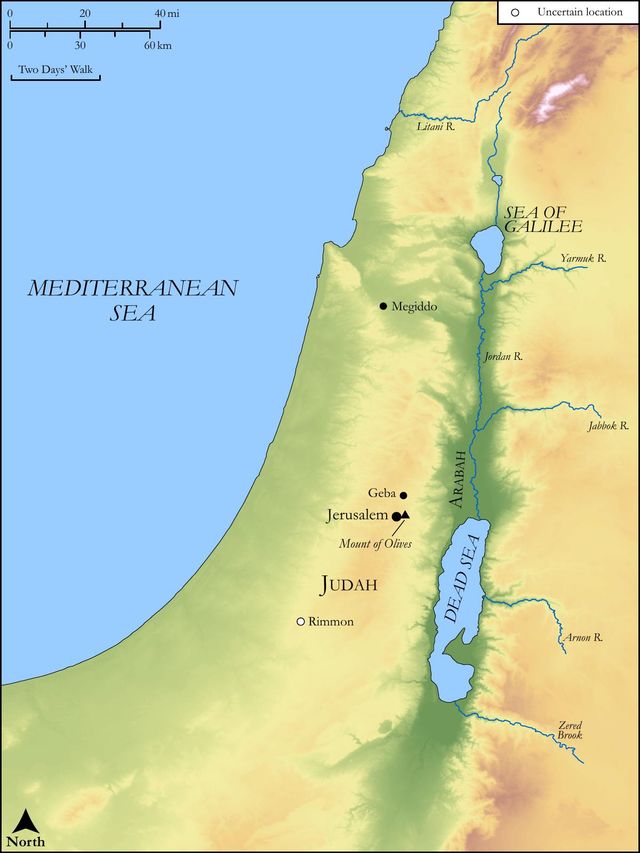
(1.)The church shall be like a fruitful country, abounding in all the rich products of the soil. The whole land of Judea, which is naturally uneven and hilly, shall be turned as a plain; it shall become a smooth level valley, from Geba, or Gibeah, its utmost border north, to Rimmon, which lay south of Jerusalem and was the utmost southern limit of Judea. The gospel of Christ, where it comes in its power, levels the ground; mountains and hills are brought low by it, that the Lord alone may be exalted.
(2.)It shall be like a populous city. As the holy land shall be levelled, so the holy city shall be peopled, shall be rebuilt and replenished. Jerusalem shall be lifted up out of its low estate, shall be raised out of its ruins; when the land is turned as a plain, and not only the mount of Olives removed (Zac 14:4), but other mountains too, then Jerusalem shall be lifted up, that is, shall appear the more conspicuous; she shall be inhabited in her place, even in Jerusalem, Zac 12:6. The whole city shall be inhabited in the utmost extent of it, and no part of it left to lie waste. The utmost limits of it are here mentioned, between which there shall be no ground lost, but all built upon, from Benjamin's-gate north-east to the corner-gate north-west, and from the tower of Hananeel in the south to the king's wine-presses in the north; when the churches of Christ in all places are replenished with great numbers of holy, humble, serious Christians, and many such are daily added to it, then this promise is fulfilled.
(3.)This country and this city shall both be safe, both the meat in the country and the mouths in the city: Those that dwell in it shall dwell securely, and there shall be none to make them afraid; there shall be no more of that utter destruction that has laid both town and country waste, no more anathema (as some read it), no more cutting off, no more curse, or separation from God to evil, no more such desolating judgments as you have been groaning under, but Jerusalem shall be safely inhabited; there shall be no danger, nor any apprehension of it; neither shall its friends be fearful to disquiet themselves nor its enemies formidable to disquiet them. That promise of Christ explains this - that the gates of hell shall not prevail against the church; and so do the holy security and serenity of mind which believers enjoy in relying on the divine protection.
II.Here are judgments threatened against the enemies of the church, that have fought, or do fight, against Jerusalem; and the threatening of these judgments is in order to the preservation of the church in safety. Men that read and hear of these plagues will be afraid of fighting against Jerusalem, much more when these threatenings are fulfilled in some will others hear and fear. Those that fight against the city of God, and his people, will be found fighting against God, against whom none ever hardened his heart and prospered (Zac 14:12): This shall be the plague wherewith the Lord will smite all the people that have fought against Jerusalem; whoever they are, God will punish them for the affront done to him, and avenge Jerusalem upon them.
1.They shall waste away under grievous and languishing diseases: Their flesh shall consume away, and they shall be miserably emaciated, even while they stand on their feet, so that they shall be walking skeletons; nothing shall remain but skin and bones. The flesh which they pampered and indulged, and made provision for, when they were fed to the full with the spoils of God's people, shall now consume away, that it cannot be seen, and the bones that were not seen shall stick out, Job 33:21. They keep their feet, and hope to keep their ground, crawling about as long as they can; but they must yield at last. The organs of sight, the outlets of sin, their eyes, shall consume away in their holes, shall sink into their heads or perhaps start out of them; their envious malicious, adulterous eyes, the eyes they had so often fed with spectacles of misery, these shall consume, which shall make not only their countenances ghastly, but their lives wretched. The organs of speech, the outlets of sin, their tongue, shall consume away in their mouth, whereby God will reckon with them for all their blasphemies against himself and invectives against his people. Thus their own tongues shall fall upon them, and their punishment shall be legible in their sin, as his was whose tongue was tormented in hell-flames. Thus Antiochus and Herod consumed away.
2.They shall be dashed in pieces one against another (Zac 14:13): A great tumult from the Lord shall be among them. But are tumults from the Lord, who is the God of order, and not of confusion? As they are the sin of those that raise them they are not from the Lord, but from the wicked one, and from men's own lusts; but, as they are the punishment of those that suffer by them, they are from the Lord, who serves his own purposes, and carries on his intentions, by the sins, and follies, and restless spirits, of men. It is of themselves that they bite and devour one another, but it is of the Lord, the righteous Judge, that thus they are consumed one of another (Gal 5:15); as Ahab was deceived by a lying spirit from the Lord, so Abimelech and the men of Shechem were divided, and so destroyed, by an evil spirit from the Lord, Jdg 9:23. Note, Those that are confederate and combined against the church will justly be separated, and set against one another; and their tumults raised against God will be avenged in tumults among themselves. And they shall lay hold every one on the hand of his neighbour, to hold him from striking, or to bind him as his prisoner; nay, his hand shall rise up against the hand of his neighbour, to strike and wound him. Note, Those that aim to destroy the church are often made to destroy one another; and every man's sword is sometimes set against his fellow, by him whose sword they all are. Some think this was fulfilled in the factions and dissensions that were among the Jews, when the Romans were destroying them all; for they had fought against the spiritual Jerusalem, the gospel-church; and to that well enough agrees Zac 14:14, Thou also, O Judah! shalt fight against Jerusalem; the Jewish nation shall be ruined by itself, shall die by its own hands; the city and country shall be at war with each other, and so both shall be destroyed. Suis et ipsa Roma viribus ruit - Rome was urged into ruin by its very strength.
3.The plunder of their camp shall greatly enrich the people of God, or the spoils of their country (Zac 14:14): Judah also shall eat at Jerusalem (so one learned interpreter reads it); people shall come from all parts to share in the prey; as when Sennacherib's army was routed before Jerusalem there was the prey of a great spoil divided (Isa 33:23), so it shall be now; the wealth of all the heathen round about, that had spoiled Jerusalem, shall be gathered together, gold, and silver, and apparel, in great abundance, that an equal dividend may be made among all the parties entitled to a share of the prize. Note, The wealth of the sinner is often laid up for the just, and the Israel of God enriched with the spoil of the Egyptians.
4.The very cattle shall share in the plague with which the enemies of God's church shall be cut off, as they did in divers of the plagues of Egypt (Zac 14:15): All the beasts that shall be in the tents of these wicked men, when God comes to contend with them, shall perish with them, not only beasts used in war, as the horse, but those used for travel, or in the plough, as the mule, the camel, and the ass. Note, The inferior creatures often suffer for the sin of man and in his plagues. Thus God will show his indignation against sin, and will make the creature that is thus subject to vanity groan to be delivered into the glorious liberty of the children of God, Rom 8:21, Rom 8:22.
Historical interpretation
Fourteen Centuries of Reception
3 surviving comments on this verse. Each one is dated, so this reads as a timeline rather than a list.
Select a marker to jump to its quote. Markers stagger vertically where authors wrote within a few decades of each other.
On that day living waters shall flow out from Jerusalem, half of them to the eastern sea and half of them to the western sea. After this, from Jerusalem the law of salvation will come. Indeed, as the Lord says, salvation is from the Jews, and it will spread among the neighbor nations. Two seas are proposed as a symbol of the nations: the eastern sea, which Scripture calls Sea of Salt, and the western sea, which is the Great Sea. Again, in a different manner, the prophet calls the eastern sea the people living in the region of light; while by the western sea he indicates the people of Judea, who would not be deprived of the light of the gospel, if they did not want to be. In fact, even though these people are signified through the image of the sunset and the night, nevertheless the living waters of the divine precepts of Christ would not be prevented from constantly flowing to irrigate their hearts, if only they wanted them to come back to their heart. And it shall continue in summer as in winter, as in the ancient times. That is, in the same order and with the same happiness they will flow to the nations who believe as they flowed to our ancestors.
(Verse 8.) And it shall be in that day, living waters shall come out from Jerusalem, half of them toward the eastern sea, and half of them toward the western sea; in summer and in winter it shall be. And the Lord shall be king over all the earth.
LXX: In that day living waters shall go out from Jerusalem, half of them toward the first sea and half of them toward the last sea; in summer and in spring it shall be so; and the Lord shall be king over all the earth.
At that time (for this refers to the day that is known to the Lord alone, in which there will be no succession of light and darkness; but there will be perpetual light, as it is written in the Apocalypse: And the city shall have no need of the sun, neither of the moon, to shine in it; for the Lord God giveth it light (Rev. 21:23))), living waters shall come forth from Jerusalem, of which we have discussed previously, presenting the testimony of Ezekiel, of which half shall go toward the eastern sea, which the Greek books call the Asphaltic Lake, commonly known as the Dead Sea, because nothing can live in its waters. And the middle part leads to the farthest sea, which leads to Egypt, and it makes the shores of Palestine. In summer, he says, and in winter it will be so, that these waters which flow out from Jerusalem will not be frozen by the winter's cold, nor will they be dried up by the excessive heat of summer: although they have changed the springtime of winter, which does not fit the distinction of summer. And when the life-giving waters have entered both seas, and have softened the bitter waters with a sweet river: then the Lord will be king over all the earth. The water that comes forth from Jerusalem, that is, from the Church, indicates the teaching of the Savior: For out of Zion shall go forth the law, and the word of the Lord from Jerusalem (Isaiah 2:3); according to what is written elsewhere: The earth shall be filled with the knowledge of the Lord, as the waters cover the sea (Ibid., 11:9). The middle part of these waters shall go to the Eastern Sea, to the people of the Circumcision, who were chosen in the apostles and through the apostles; and the middle part to the Western Sea, so that those who sit down with Abraham, Isaac, and Jacob may come from the East and the West. Certainly, let us understand the ancient Testament and the new Testament as the Eastern Sea and the Western Sea, which, unless it is sweetened by the river of the Savior and His spiritual understanding, is very bitter; with the letter dying, and the spirit giving life (Matthew 8). And what follows: In summer and in winter they shall be, is understood the living waters that come forth from Jerusalem, so that even in peace and in persecutions these living waters may not cease to flow. Whether because the Seventy translated it thus, or because in summer and in spring it will be as we say, during that time there will be no winter, but only spring and everlasting summer, when the voice of the turtledove will be heard in our land, and the fig tree will bring forth its ripening fruit, and the vineyards will flourish, and winter will pass away, and the rain will cease, and it will leave for itself (Song of Songs 2). During that time, spring will be necessary, because the flowers will appear in our land so that we may celebrate Easter and Pentecost, during which we pass from earthly things to heavenly things, and offer all our fruits to God. In the winter, the end of the season is the beginning of spring; in Pentecost, the beginning of summer, when we offer the labors of our hands and the fruits to God. Concerning this summer and everlasting spring, the righteous speaks to the Lord: 'You have created the dawn and the sun, you have shaped the summer and the spring' (Psalm 73:16, 17). Then the Lord will be king over all the earth, when we say: 'The Lord reigns, let the earth rejoice' (Psalm 97:1). And again: 'Tell it among the nations, the Lord reigns.' For indeed, He has established the course of the earth, which shall not be moved (Ps. XCV, 10). But the true understanding of the teaching of the Savior regarding the living water will be known by those who drink it and hear the Savior preaching: If anyone drinks of the water that I will give him, it shall become in him a fountain of living water, springing up unto eternal life (John IV, 14). And again: Whoever believes in Me (as the Scripture has said), out of his belly shall flow rivers of living water (John VII, 38). For just as one who drinks of his teaching will have within him a living fountain, so one who believes in him, according to what is contained in the words of Scripture, rivers of living water will flow out of his belly. Many refer the living waters to baptism, which are to be given to those thirsting in spring and summer, that is, in Easter and Pentecost, when what is written will be fulfilled: 'Be cleansed, become pure' (Isaiah 1:16).
Living waters: Viz., the gospel of Christ.
Continue studying Zechariah 14:8 across the web’s major study libraries — every link below opens this exact verse, chapter, or book on the destination site.
Read & Compare
 BibleGatewayThis verse in more than 200 translations and 70 languages.
 Bible.comThe YouVersion reader — hundreds of translations, reading plans, and highlights.
 ESV.orgCrossway's official English Standard Version reader.
 NET BibleThe NET translation with 60,000+ translators' notes on every rendering decision.
 STEP BibleTyndale House's free study tool — original text, vocabulary, and scholarly resources.
 BibliaLogos Bible Software's free web reader.
 USCCBThe New American Bible (Revised Edition) with the U.S. bishops' study notes.
Commentaries
 BibleHub CommentariesDozens of classic commentaries on this verse, gathered on one page.
 StudyLightMore than 100 commentary sets — the largest collection on the web.
 BibleRefPlain-English commentary on what this verse means, verse by verse.
 Enduring WordDavid Guzik's free commentary on this chapter, widely used by Bible teachers.
 Bible Study ToolsVerse commentary alongside Greek and Hebrew study aids.
Original Language & Research
- BibleHub InterlinearThe verse word by word — original language, transliteration, and English.
- BibleHub LexiconEvery word's original-language definition and Strong's entry.
 Blue Letter BibleDeep-study tools — Strong's numbers, concordance, and word studies.
 SefariaThe Hebrew text with Rashi and centuries of Jewish commentary.
Sermons, Hymns & Audio


TrulyRandomVerse is not affiliated with these sites and doesn’t control their content. They’re linked because they’re genuinely useful.
Summary
Zechariah 14:8 presents a profound eschatological vision of "living waters" flowing perpetually from Jerusalem in "that day," signifying the climactic establishment of God's kingdom. This miraculous outpouring will extend eastward to the Dead Sea and westward to the Mediterranean, symbolizing the universal and unending reach of divine blessing, spiritual vitality, and transformative power emanating from God's holy city, available in all seasons.
Context
ShowHideLiterary Context
Zechariah 14 is the culmination of Zechariah's prophetic book, often referred to as the "Little Apocalypse" due to its vivid depiction of end-time events. The chapter opens with the declaration of the "Day of the Lord" Zechariah 14:1, a period of intense divine judgment upon the nations that gather against Jerusalem, followed by the Lord's triumphal return to the Mount of Olives Zechariah 14:4. Verse 8, therefore, is situated within the post-judgment phase, describing the glorious conditions of the Messianic Kingdom. It immediately follows descriptions of alterations in the heavens and the earth, setting the stage for a divinely transformed world where Jerusalem becomes the undisputed center of God's reign and blessing.
Historical & Cultural Context
In the arid climate of ancient Israel, water was a precious commodity, and "living waters" (springs or flowing rivers) were highly valued over stagnant cisterns. Jerusalem itself, while strategically located, had limited natural water sources, primarily the Gihon Spring. The vision of a river flowing from Jerusalem is not unique to Zechariah; it echoes similar prophetic imagery in other Old Testament texts, such as Ezekiel 47:1-12 and Joel 3:18. The "former sea" refers to the Dead Sea (to the east), a barren, hypersaline body of water, while the "hinder sea" is the Mediterranean Sea (to the west). The flow of life-giving water to both signifies a complete transformation of the land, from east to west, and the overcoming of all desolation. The phrase "in summer and in winter" is significant, as natural rivers in the region often diminish or dry up during the hot summer months, emphasizing the supernatural and perpetual nature of this divine provision.
Key Themes
ShowHideZechariah 14:8 contributes significantly to several key themes within the book and broader biblical prophecy. Firstly, it highlights Divine Sovereignty and Kingdom Establishment, portraying God's direct intervention to establish His righteous rule on earth, with Jerusalem as its capital. Secondly, it powerfully conveys the theme of Transformation and Renewal, demonstrating God's ability to bring life and fruitfulness even to the most desolate places, symbolized by the Dead Sea. This echoes the broader biblical promise of a new creation and spiritual revitalization. Thirdly, the verse underscores Jerusalem's Eschatological Centrality, affirming its pivotal role as the source of divine blessing and the spiritual and governmental hub of God's future kingdom, a theme also found in passages like Isaiah 2:2-4 and Micah 4:1-3. Finally, the promise of water "in summer and in winter" emphasizes the Perpetual Nature of God's Blessing and Provision, signifying an unending source of life and refreshment that transcends natural limitations.
Exposition and Analysis
ShowHideKey Word Analysis
ShowHideThis term, derived from the root meaning "to live," denotes freshness, vitality, and active flow, contrasting with stagnant or "dead" water. In the context of "living waters," it signifies water from a spring or moving source, which was highly prized for its purity and life-sustaining properties. Metaphorically, it points to a source of spiritual life and vigor.
Meaning "the half or middle," this word indicates a division and distribution. The waters split into two distinct flows, signifying that the divine blessing is not confined to one direction but spreads comprehensively across the land, reaching both the eastern and western boundaries, ensuring widespread impact.
In the phrase "in that day," this refers to a specific, climactic period in God's redemptive plan, often synonymous with the "Day of the Lord" as described throughout Zechariah 14. It denotes a decisive time of divine intervention, judgment, and the glorious establishment of God's kingdom, marking a definitive turning point in history.
Verse Breakdown
ShowHide"And it shall be in that day,"
This phrase sets the eschatological stage, pointing to the climactic "Day of the Lord" detailed in Zechariah 14. It signifies a future, divinely appointed time of profound transformation and the ultimate establishment of God's reign on earth.
"[that] living waters shall go out from Jerusalem;"
This describes a miraculous and supernatural outpouring of fresh, flowing, life-giving water originating directly from Jerusalem. This imagery symbolizes not only physical sustenance but also divine blessing, purity, spiritual vitality, and the presence of God's Spirit, which will emanate from His holy city.
"half of them toward the former sea, and half of them toward the hinder sea:"
The waters are depicted as dividing into two streams. The "former sea" is the Dead Sea to the east, known for its desolation and inability to sustain life, while the "hinder sea" is the Mediterranean Sea to the west. This signifies the universal and comprehensive reach of God's blessing, extending across the entire land from east to west, transforming even the most barren and lifeless regions into vibrant ecosystems.
"in summer and in winter shall it be."
This emphasizes the perpetual and unceasing nature of this divine flow. Unlike natural rivers in the region that often diminish or dry up during the hot summer months, these waters will be constant and abundant throughout all seasons, signifying an everlasting source of life, refreshment, and renewal from God.
Literary Devices
ShowHideZechariah 14:8 is rich in literary devices that enhance its prophetic message. Symbolism is paramount, with "living waters" primarily symbolizing divine life, spiritual blessing, and the Holy Spirit, contrasting sharply with the barrenness of the Dead Sea. Jerusalem itself serves as a powerful symbol of God's presence and the spiritual center of His coming kingdom. The Imagery is vivid and concrete, painting a clear picture of abundant, flowing water, its geographical spread across the land, and its perpetual nature, creating a sense of overwhelming divine provision. The description of a river flowing continuously from Jerusalem to both the Dead Sea and the Mediterranean can be understood as Hyperbole or Idealization, depicting a reality that transcends natural limitations to emphasize the extraordinary and supernatural abundance of God's future blessings. This idealized depiction underscores the complete and radical transformation God will bring.
Theological and Thematic Connections
ShowHideZechariah 14:8 resonates deeply with the broader biblical narrative of God as the ultimate source of life and blessing. The "living waters" harken back to the rivers flowing from Eden, symbolizing paradise and divine sustenance, and look forward to the ultimate restoration. This vision connects to the prophetic tradition where water symbolizes spiritual cleansing, renewal, and the life-giving Spirit of God, transforming barrenness into fruitfulness. It underscores God's commitment to restoring creation and establishing a kingdom characterized by abundant life and universal peace, flowing from His very presence in Jerusalem.
Reflection and Application
ShowHideZechariah 14:8 offers profound hope and a powerful vision for believers today. It reminds us that God is the unending source of life, refreshment, and transformation, capable of bringing vitality even to the most desolate spiritual landscapes. Just as these waters flow perpetually, God's grace, mercy, and provision are constant and unfailing, available "in summer and in winter," through all seasons of our lives. This vision calls us to continually draw from this divine source, trusting in God's power to renew and sustain us. Furthermore, as recipients of these "living waters," we are called to be channels through whom God's life-giving truth and love can flow to others, bringing spiritual transformation and hope to a world often characterized by spiritual dryness and despair. It encourages us to anticipate God's future kingdom with eager expectation, while also living out its principles of life and abundance in the present.
Questions for Reflection
ShowHideFAQ
ShowHideWhat is the significance of "the former sea" and "the hinder sea" in this prophecy?
ShowHideThe "former sea" refers to the Dead Sea, located to the east of Jerusalem, infamous for its extreme salinity and inability to sustain life, symbolizing desolation and death. The "hinder sea" is the Mediterranean Sea, to the west of Jerusalem. Their inclusion in the prophecy signifies the universal and comprehensive reach of the life-giving waters. The flow from Jerusalem to both the east and west indicates that God's blessing and transformative power will extend across the entire land, bringing life even to the most barren regions. It underscores the complete and far-reaching nature of God's future renewal and the establishment of His kingdom.
Is this prophecy to be understood literally or symbolically?
ShowHideZechariah 14:8 is often interpreted with a combination of literal and symbolic understanding. The vivid imagery and geographical specifics suggest a literal fulfillment in the Messianic age, where the physical landscape around Jerusalem could indeed be miraculously transformed, including the revitalization of the Dead Sea. However, the "living waters" also carry profound symbolic meaning, representing the spiritual life, cleansing, and refreshment that flow from God's presence, often associated with the Holy Spirit and the gospel. This dual interpretation allows for both a future physical reality during the Lord's reign and a present spiritual truth about the life God offers. The ultimate fulfillment encompasses both the physical restoration of creation and the spiritual renewal of humanity.
Christ-Centered Fulfillment
ShowHideZechariah's vision of "living waters" flowing from Jerusalem finds its ultimate and most profound fulfillment in Jesus Christ. He is the true source of these life-giving waters, as He declared to the Samaritan woman at the well, "Everyone who drinks this water will be thirsty again, but whoever drinks the water I give them will never thirst. Indeed, the water I give them will become in them a spring of water welling up to eternal life" John 4:13-14. Later, at the Feast of Tabernacles, Jesus stood and cried out, "If anyone is thirsty, let him come to me and drink. Whoever believes in me, as the Scripture has said, 'Out of his heart will flow rivers of living water'" John 7:37-38. John clarifies that Jesus was speaking of the Holy Spirit, whom those who believed in Him were to receive John 7:39. The outpouring of the Holy Spirit at Pentecost, originating from Jerusalem Acts 2:1-4, marks a significant, initial fulfillment of this prophecy, as the gospel (the "living water") began to flow from Jerusalem to the ends of the earth. Ultimately, the vision culminates in the New Jerusalem of Revelation, where "the river of the water of life, bright as crystal, flowing from the throne of God and of the Lamb" Revelation 22:1-2 sustains the tree of life, symbolizing the eternal, unceasing life and blessing that flow from Christ's presence in the new creation. Thus, Zechariah's prophetic imagery points directly to Jesus as the embodiment and dispenser of all life, both spiritual and physical, in His present reign and future kingdom.