


Joel 3:18
Bible text: King James Version (1769 Blayney text) · Public domain
Bible text: King James Version with Strong's numbers · Public domain
Bible text: Berean Standard Bible · Public domain
Bible text: American Standard Version (1901) · Public domain
Bible text: World English Bible, Messianic edition · Public domain
Bible text: Geneva Bible (1599) · Public domain
Bible text: Young's Literal Translation · Public domain
- וְהָיָהve·ha·Yahand it will beH1961Conj-w ¦ V-Qal-ConsecPerf-3msVerb Qal Consecutive Perfect 3rd Singular Masculineוְandהָיָהit will be
- בַיּוֹםvai·Yomon the dayH3117Prep-b ¦ N-msNoun Singular Masculine Absoluteבַon theיּוֹםday
- הַהוּאha·Hu'<the> thatH1931Art ¦ Pro-3msPronoun Personal 3rd Singular Masculineהַ<the>הוּאthat
- יִטְּפוּyi·te·Futhey will dripH5197V-Qal-Imperf-3mpVerb Qal Imperfect 3rd Plural Masculine
- הֶהָרִיםhe·ha·Rimthe mountainsH2022Art ¦ N-mpNoun Plural Masculine Absoluteהֶtheהָרִיםmountains
- עָסִיס'a·Sissweet wineH6071N-msNoun Singular Masculine Absolute
- וְהַגְּבָעוֹתve·ha·ge·va·'Otand the hillsH1389Conj-w ¦ Art ¦ N-fpNoun Plural Feminine Absoluteוְandהַtheגְּבָעוֹתhills
- תֵּלַכְנָהte·Lakh·nahthey will goH1980V-Qal-Imperf-3fpVerb Qal Imperfect 3rd Plural Feminine
- חָלָבcha·LavmilkH2461N-msNoun Singular Masculine Absolute
- וְכָלve·kholand allH3605Conj-w ¦ N-mscNoun Singular Masculine Constructוְandכָלall
- אֲפִיקֵי'a·fi·Kei[the] ravines ofH650N-mpcNoun Plural Masculine Construct
- יְהוּדָהye·hu·DahJudahH3063N-properNoun Proper Location
- יֵלְכוּYe·le·khuthey will goH1980V-Qal-Imperf-3mpVerb Qal Imperfect 3rd Plural Masculine
- מָיִםMa·yimwaterH4325N-mpNoun Plural Masculine Absolute
- וּמַעְיָןu·ma'·Yanand a springH4599Conj-w ¦ N-msNoun Singular Masculine Absoluteוּandמַעְיָןa spring
- מִבֵּיתmi·Beitfrom [the] house ofH1004Prep-m ¦ N-mscNoun Singular Masculine Constructמִfromבֵּית[the] house of
- יְהוָהYah·wehYahwehH3068N-properNoun Proper Title
- יֵצֵאye·Tze'it will go forthH3318V-Qal-Imperf-3msVerb Qal Imperfect 3rd Singular Masculine
- וְהִשְׁקָהve·hish·Kahand it will waterH8248Conj-w ¦ V-Hiphil-ConsecPerf-3msVerb Hiphil Consecutive Perfect 3rd Singular Masculineוְandהִשְׁקָהit will water
- אֶת'et<obj.>H853DirObjMParticle Object Indicator
- נַחַלNa·chal[the] wadi ofH5158N-mscNoun Singular Masculine Construct
- הַשִּׁטִּיםha·shi·Tim<the> ShittimH7851Art ¦ N-properNoun Proper Locationהַ<the>שִּׁטִּיםShittim
English is a literal word-by-word gloss of the Hebrew, not the KJV's wording. Why?
This is the original text the KJV's translators worked from — each Hebrew word with its own literal English meaning in this verse, prepared by scholars at Tyndale House, Cambridge. The KJV translates whole sentences, not word by word, so its wording differs: one Hebrew word can become several English words, and the KJV may choose “the LORD” where the gloss reads “Yahweh”. Both are faithful — they answer different questions. For the KJV's own rendering, switch to the KJV text.
Details
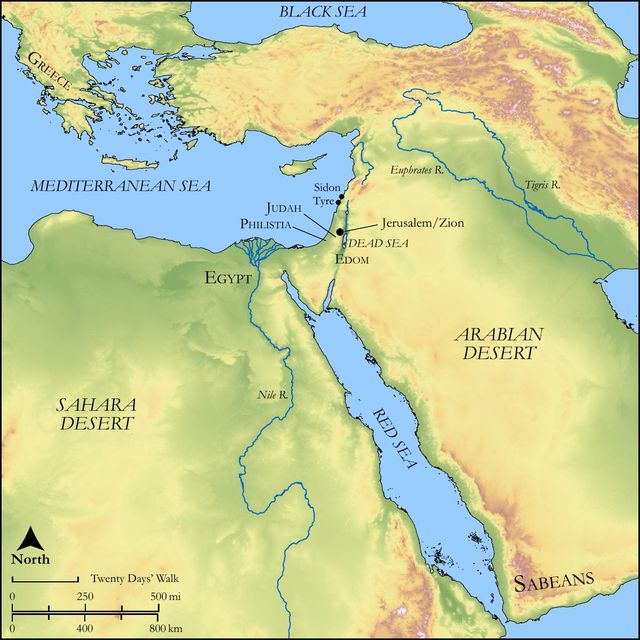
See on the biblical-era map
Study this verse
Public-domain commentary
Matthew Henry
From his Commentary on the Whole Bible. Henry comments on passages, not single verses — this entry covers Joel 3:18–21. His three-level outline is real structure in the source text, so it is rendered as structure.
These promises with which this prophecy concludes have their accomplishments in part in the kingdom of grace, and the comforts and graces of all the faithful subjects of that kingdom, but will have their full accomplishment in the kingdom of glory; for, as to the Jewish church, we know not of any event concerning that which answers to the extent of these promises, and what instances of peace and prosperity they were blessed with, which they may be supposed to be a hyperbolical description of, they were but figures of better things reserved for us, that they in their best estate without us might not be made perfect.
I.It is promised that the enemies of the church shall be vanquished and brought down, Joe 3:19.
Egypt, that old enemy of Israel, and Edom, which had an inveterate enmity to Israel, derived from Esau, these shall be a desolation, a desolate wilderness, no more to be inhabited; they have become the people of God's curse; so the Idumeans were, Isa 34:5. No strength nor wealth of a nation is a defence against the judgment of God. But what is the quarrel God has with these potent kingdoms? It is for their violence against the children of Judah, and the injuries they had done them; see Eze 25:3, Eze 25:8, Eze 25:12, Eze 25:15; Eze 26:2. They had shed the innocent blood of the Jews that fled to them for shelter or were making their escape through their country. Note, The innocent blood of God's people is very precious to him, and not a drop of it shall be shed but it shall be reckoned for. In the last day this earth, which has been filled with violence against the people of God, shall be made a desolation, when it and all the works that are therein shall be burnt up. And, sooner or later, the oppressors and persecutors of God's Israel shall be brought down and laid in the dust, nay, they will at length be brought down and laid in the flames.
II.It is promised that the church shall be very happy; and truly happy it is in spiritual privileges, even during its militant state, but much more when it comes to be triumphant. Three things are here promised it: -
1.Purity. This is put last here, as a reason for the rest (Joe 3:21); but we may consider it first, as the ground and foundation of the rest: I will cleanse their blood that I have not cleansed, that is, their bloody heinous sins, especially shedding innocent blood; that filth and guilt they had contracted by sin, which rendered them unfit for communion with God, and made them odious to his holiness and obnoxious to his justice; this they shall be washed from in the fountain opened, Zac 13:1. That shall be cleansed by the blood of Christ which could not be cleansed by the sacrifices and purifications of the ceremonial law. Or, if we apply it to the happiness of a future state, it intimates the cleansing of the saints from all these corruptions from which they were not cleansed either by ordinances or providences in the world; there shall not be the least remains of sin in them there. Here, though they are washing daily, there is still something that is not cleansed; but in heaven, even that also shall be done away. Ands the reason is because the Lord dwells in Zion, dwells with his church, and much more gloriously with that in heaven, and holiness becomes his house for ever, for which reason, where he dwells there must be, there shall be, a perfection of holiness. Note, Though the refining and reforming of the church is work that goes on slowly, and still there is something we complain of that is not cleansed, yet there is a day coming when every thing that is amiss shall be amended, and the church shall be all fair, and no spot, no stain in her; and we must wait for that day.
2.Plenty, Joe 3:18. This is put first, because it is the reverse of the judgment threatened in the foregoing chapters.
(1.)The streams of this plenty overflow the land and enrich it: The mountains shall drop new wine and the hills shall flow with milk, such great abundance shall they have of suitable provision, both for babes and for strong men. It intimates the abundance of vineyards, and all fruitful; and the abundance of cattle in the pastures that fill them with milk. And, to make the corn-land fruitful, the rivers of Judah shall flow with water, so that the country shall be like the garden of Eden, well-watered every where and greatly enriched, Psa 65:9. But this seems to be meant spiritually; the graces and comforts of the new covenant are compared to wine and milk (Isa 55:1), and the Spirit to rivers of living water, Joh 7:38. And these gifts abound much more under the New Testament than they did under the Old; when believers receive grace for grace from Christ's fulness, when they are enriched with everlasting consolations, and filled with joy and peace in believing, then the mountains drop new wine, and the hills flow with milk. Drink you, drink abundantly, O beloved! When there is plentiful effusion of the Spirit of grace, then the rivers of Judah flow with water, and make glad, not only the city of our God (Psa 46:4), but the whole land.
(2.)The fountain of this plenty is in the house of God, whence the streams take their rise, as those waters of the sanctuary (Eze 47:1) from under the threshold of the house, and the river of life out of the throne of God and the Lamb, Rev 22:1. The psalmist, speaking of Zion, says, All my springs are in thee, Psa 87:7. Those that take temporal blessings to be meant in the former part of the verse, yet by this fountain out of the house of the Lord understand the grace of God, which, if we abound in temporal blessings, we have so much more need of, that we may not abuse them. Christ himself is the fountain; his merit and grace cleanse us, refresh us, and make us fruitful. This is said to water the valley of Shittim, which lay a great way off from the temple at Jerusalem, on the other side of Jordan, and was a dry and barren valley, which intimates that gospel-grace, flowing from Christ, shall reach far, even to the Gentile world, to the most remote regions of it, and shall make those to abound in the fruits of righteousness who had long lain as the barren wilderness. This grace is a fountain overflowing, ever-flowing, from which we may be continually drawing, and yet need not fear its being drawn dry. This fountain comes out of the house of the Lord above, from his temple in heaven, flows all that good which here we are daily tasting the streams of, but hope to be shortly, hope to be eternally, drinking at the fountain-head of.
3.Perpetuity. This crowns all the rest (Joe 3:20): Judah shall dwell for ever (when Egypt and Edom are made a desolation), and Jerusalem shall continue from generation to generation. This is a promise, and a precious promise it is,
(1.)That the church of Christ shall continue in the world to the end of time. As one generation of professing Christians passes away, another shall come, in whom the throne of Christ shall endure for ever, and the gates of hell shall not prevail against it.
(2.)That all the living members of that church (Judah and Jerusalem are put for the inhabitants of that city and country, Mat 3:5) shall be established in their happiness to the utmost ages of eternity. This new Jerusalem shall be from generation to generation, for it is a city that has foundations, not made with hands, but eternal in the heavens.
Historical interpretation
Fourteen Centuries of Reception
3 surviving comments on this verse. Each one is dated, so this reads as a timeline rather than a list.
Select a marker to jump to its quote. Markers stagger vertically where authors wrote within a few decades of each other.
(Verse 18) And it shall come to pass in that day, the mountains shall drip sweetness, and the hills shall flow with milk, and all the streams of Judah shall flow with water. LXX: And it shall come to pass in that day, the mountains shall drip sweetness, and the hills shall flow with milk, and all the streams of Judah shall flow with water. The Lord will dwell in Zion and on His holy mountain, when no one attempts to pass through the holy Jerusalem, whoever is on the mountain and has reached the heights of virtue, shall sweat with sweetness and honey shall drip from him, and from him shall flow spiritual graces, of which the prophet speaks: How sweet are Your words to my taste, sweeter than honey to my mouth (Ps. CXVIII, 103)! But those who are lower in the mountains, and have not yet ascended to the summit of perfection, will be called hills, and from them will flow streams of milk, by which the roughness of infancy in Christ is nourished, and rivers of water, which the Lord has testified will flow from their womb (John 7). For all the streams, or outpourings, of Judah will be filled with water, and there will be nothing dry in them, with all spiritual grace overflowing.
And a spring will come forth from the house of the Lord and will water the torrent of thorns. The Septuagint translated 'torrent of thorns' as 'torrent of ropes,' that is, σχοίνων, which either means ropes or, according to the Egyptians, a certain measure of distance. The Psalmist says: 'You have searched out my path and my rope' (Psalm 138:2). For in the river Nile, or in its streams, ships are accustomed to be pulled by ropes, having certain spaces called ropes, so that fresh necks of those tired from labor may succeed to those pulling. It is not surprising that each nation designates specific distances with their own names, considering that the Latins call a thousand paces, the Gauls leucas, the Persians parasangas, and the Germans, the entire region, rastas, and each one has a different measurement. This is because the Hebrew word sattim () was translated as "funiculos" by the Seventy. However, there is no doubt that all the things we read in the tabernacle of God were made of acacia wood, which the Seventy interpreted as indestructible wood. But there is a species of tree in the desert, resembling white thorns in color and leaves, not in size. Otherwise, these trees are so large that the widest planks are cut from them, and the wood is very strong and incredibly light and beautiful, so much so that the wealthiest and most skilled craftsmen make presses, which they call 'ἂρσενας' and 'θηλύας', from these woods, which cannot be found in cultivated places or on Roman soil, but only in the wilderness of Arabia. For the stream of ropes or thorns, Symmachus translated it as the valley of thorns. This place is near Livias, across the Dead Sea, six miles away from it, where Israel once fornicated with the Midianites. The prophet Micah mentions this place on behalf of God, saying: My people, remember, I beg you, what Balak, the king of Moab, planned, and what Balaam, the son of Beor, answered him from Settim to Gilgal (Micah 6:5). For this reason, the Seventy translated it as 'from the ropes,' that is, from the ropes all the way to Galgal. Therefore, a spring will come out of the house of the Lord, which is interpreted as the Church. About this, both Ezekiel and Zechariah write at the end of their volumes (Ezek. 47, Zech. 13), that our thorns and vices and sins, which have produced no fruit of righteousness, will be transformed into the Lord's new vineyards, and our aridity will be moistened by abundant waters, and instead of thorns and thistles, we will bear multiple flowers of virtues. And in that place, where Israel once fornicated and Beelphegor was initiated, lilies of chastity and roses of modesty and virginity abound.
Christ himself is a virgin, and his mother is also a virgin; yes, though she is his mother, she is a virgin still. For Jesus has entered in through the closed doors, and in his sepulcher—a new one hewn out of the hardest rock—no man is laid either before him or after him. Mary is “a garden enclosed … a fountain sealed,” and from that fountain flows, according to Joel, the river that waters the torrent bed either of cords or of thorns. The cords [are] those of the sins by which we were beforetime bound, the thorns those which choked the seed the good man of the house had sown.
A fountain shall come forth of the house of the Lord: Viz., the fountain of grace in the church militant, and of glory in the church triumphant: which shall water the torrent or valley of thorns, that is, the souls that before, like barren ground brought forth nothing but thorns; or that were afflicted with the thorns of crosses and tribulations.
Continue studying Joel 3:18 across the web’s major study libraries — every link below opens this exact verse, chapter, or book on the destination site.
Read & Compare
 BibleGatewayThis verse in more than 200 translations and 70 languages.
 Bible.comThe YouVersion reader — hundreds of translations, reading plans, and highlights.
 ESV.orgCrossway's official English Standard Version reader.
 NET BibleThe NET translation with 60,000+ translators' notes on every rendering decision.
 STEP BibleTyndale House's free study tool — original text, vocabulary, and scholarly resources.
 BibliaLogos Bible Software's free web reader.
 USCCBThe New American Bible (Revised Edition) with the U.S. bishops' study notes.
Commentaries
 BibleHub CommentariesDozens of classic commentaries on this verse, gathered on one page.
 StudyLightMore than 100 commentary sets — the largest collection on the web.
 BibleRefPlain-English commentary on what this verse means, verse by verse.
 Enduring WordDavid Guzik's free commentary on this chapter, widely used by Bible teachers.
 Bible Study ToolsVerse commentary alongside Greek and Hebrew study aids.
Original Language & Research
- BibleHub InterlinearThe verse word by word — original language, transliteration, and English.
- BibleHub LexiconEvery word's original-language definition and Strong's entry.
 Blue Letter BibleDeep-study tools — Strong's numbers, concordance, and word studies.
 SefariaThe Hebrew text with Rashi and centuries of Jewish commentary.
Sermons, Hymns & Audio


TrulyRandomVerse is not affiliated with these sites and doesn’t control their content. They’re linked because they’re genuinely useful.
Summary
Joel 3:18 presents a vivid prophetic vision of unparalleled abundance and spiritual vitality that will characterize the "Day of the Lord," specifically after divine judgment on the nations and the restoration of God's people. This verse paints a picture of a transformed creation, where nature itself yields overflowing blessings of new wine, milk, and water, culminating in a life-giving fountain flowing from the very presence of God to bring fruitfulness even to historically desolate places. It is a powerful declaration of God's ultimate plan for restoration, provision, and intimate communion with His redeemed.
Context
ShowHideLiterary Context
Joel 3:18 stands as a climactic promise within the broader prophetic book of Joel. The preceding chapters meticulously detail a devastating locust plague and severe drought, interpreted as a foretaste of the "Day of the Lord" – a period of divine judgment and purification. This judgment is not only upon Judah, calling for repentance, but also extends to the nations who have oppressed God's people. Immediately prior to this verse, Joel describes God's judgment on the nations in the Valley of Jehoshaphat, followed by promises of God dwelling in Zion and Jerusalem becoming holy. Thus, Joel 3:18 serves as the glorious counterpoint to the earlier scenes of desolation and judgment, ushering in a vision of future, permanent blessing and restoration for God's faithful remnant, emphasizing the complete reversal of fortune.
Historical & Cultural Context
The imagery in Joel 3:18 is deeply rooted in the agricultural society of ancient Israel. "New wine" and "milk" were staple products and symbols of prosperity, representing a bountiful harvest and thriving livestock. A land flowing with milk and honey was the quintessential promise of the Promised Land, signifying divine blessing and provision. Conversely, drought and famine, as depicted earlier in Joel, were understood as signs of divine displeasure or judgment. The "valley of Shittim" (Hebrew: Shittim), located east of the Jordan River, was historically significant as the last encampment of Israel before crossing into Canaan (Numbers 25:1). It was also a place associated with Israel's moral failures, particularly their idolatry and sexual immorality with the Moabites and Midianites. The transformation of this specific, often dry and desolate, valley into a watered, fertile place by a divine fountain would have carried profound symbolic weight for Joel's audience, signifying God's power to redeem and transform even places of past sin and barrenness.
Key Themes
ShowHideJoel 3:18 contributes significantly to several major themes in the book of Joel and broader biblical theology. Firstly, it underscores the theme of Divine Abundance and Provision, contrasting sharply with the famine and desolation of earlier chapters. The imagery of mountains dripping with new wine and hills flowing with milk, along with rivers of Judah flowing with water, portrays an unprecedented agricultural and material prosperity, a hallmark of God's blessing on His restored people, echoing similar promises found in Amos 9:13. Secondly, the verse highlights Spiritual Renewal and Life, particularly through the image of "a fountain shall come forth of the house of the LORD." This represents the life-giving presence and power of God flowing out from His dwelling place, bringing spiritual vitality, cleansing, and healing to the land and its people. This theme resonates with the vision of the river flowing from the Temple in Ezekiel 47:1-12 and anticipates the ultimate river of the water of life in Revelation 22:1-2. Lastly, the transformation of the "valley of Shittim" speaks to the theme of Redemption and Transformation of Desolation, demonstrating God's sovereign power to bring life and fruitfulness to the most barren and historically tarnished places. This verse, therefore, offers a powerful vision of eschatological hope, pointing to a future era of complete restoration, peace, and intimate communion with God.
Exposition and Analysis
ShowHideKey Word Analysis
ShowHideRefers to H3117. While literally meaning a 24-hour period, in prophetic contexts like "in that day," it signifies a specific, decisive, and climactic period appointed by God. Here, it points to the eschatological era of divine intervention, judgment, and ultimate salvation, often associated with the Messianic age or the final establishment of God's kingdom. It emphasizes a unique and singular time in redemptive history.
Refers to H6071. This term specifically denotes fresh grape-juice or "must," indicating the first, most potent, and abundant yield of the harvest. Its presence signifies extreme agricultural fertility and overflowing prosperity, a stark contrast to the drought and scarcity depicted earlier in Joel. It is a symbol of God's lavish provision and the richness of His blessings.
Refers to H4599. This word describes a natural spring or well, a source of fresh, flowing water. In a land prone to drought, a fountain was a precious commodity, symbolizing life, refreshment, and sustenance. When it comes "forth of the house of the LORD" (H1004, H3068), it profoundly symbolizes the spiritual life, cleansing, and blessing that originates directly from God's presence and flows out to transform the world.
Verse Breakdown
ShowHide"And it shall come to pass in that day,"
This opening phrase serves as a crucial prophetic marker, signaling a future, divinely appointed time. It introduces the eschatological context of the prophecy, indicating a significant turning point in God's redemptive plan, a day of ultimate fulfillment and blessing.
"that the mountains shall drop down new wine, and the hills shall flow with milk,"
This clause employs hyperbole to depict an extraordinary, supernatural abundance. Mountains, typically rocky and less fertile, will spontaneously yield the richest grape juice, and hills will literally flow with milk. This imagery conveys a complete reversal of the previous desolation, promising an overflowing, effortless, and unprecedented material prosperity as a sign of God's favor.
"and all the rivers of Judah shall flow with waters,"
This reinforces the theme of abundant water, a vital necessity in the dry land of Judah. While Judah's rivers (or wadis) were often seasonal, this prophecy declares that they will perpetually flow with ample water, ensuring agricultural flourishing and sustaining life throughout the land, symbolizing a complete and enduring restoration.
"and a fountain shall come forth of the house of the LORD,"
This is the theological and spiritual heart of the verse. The "house of the LORD" (referring to the Temple or God's dwelling place in Jerusalem) is identified as the source of a life-giving fountain. This signifies that the ultimate source of all blessing—spiritual, physical, and ecological—is God Himself, whose presence brings forth an inexhaustible supply of life and vitality.
"and shall water the valley of Shittim."
This final clause highlights the transformative power of God's blessing. The valley of Shittim, historically associated with barrenness and Israel's past failures, will be irrigated and made fertile by the divine fountain. This symbolizes God's capacity to redeem and revitalize even the most desolate or tainted places, bringing life and fruitfulness where there was once only barrenness and remembrance of sin.
Literary Devices
ShowHideJoel 3:18 is rich with Imagery, painting a vivid picture of a transformed creation. The Hyperbole used in "mountains shall drop down new wine" and "hills shall flow with milk" emphasizes the extraordinary, supernatural nature of the promised abundance, far beyond natural fertility. The flowing "new wine," "milk," and "waters" are powerful Symbols of prosperity, life, and divine blessing. The "fountain from the house of the LORD" is a potent Metaphor for the spiritual life and cleansing that originates from God's presence, reminiscent of earlier prophetic visions. The Contrast between the earlier desolation in Joel and this vision of overflowing abundance, as well as the transformation of the barren "valley of Shittim," underscores God's redemptive power to reverse curses and bring forth new life. This verse also employs Eschatological Language with the phrase "in that day," pointing to a future, climactic fulfillment of God's promises.
Theological and Thematic Connections
ShowHideJoel 3:18 is a profound theological statement on God's ultimate intention for His creation and His people: one of lavish blessing, complete restoration, and intimate communion. It reveals that true and lasting abundance, both material and spiritual, flows directly from the presence and power of God. The imagery of a fountain originating from the "house of the LORD" underscores the truth that divine life, cleansing, and provision are centered in God Himself, emanating from His holy dwelling place to transform the world. This vision of a renewed earth, characterized by effortless fertility and divine sustenance, points to an eschatological reality where the effects of the Fall are reversed, and God's original design for creation is fully realized. It is a testament to God's faithfulness to His covenant promises, demonstrating His power not only to judge but also to redeem and restore beyond human imagination.
Reflection and Application
ShowHideJoel 3:18 offers a powerful message of hope and encouragement for believers navigating the challenges and barrenness of this present age. It reminds us that even in seasons of spiritual drought, personal struggle, or societal decay, God's ultimate plan is one of abundant life, restoration, and overflowing blessing. This prophecy calls us to anchor our hope not in fleeting worldly provisions or temporary circumstances, but in the eternal and inexhaustible source of life that is God Himself. It challenges us to look beyond immediate difficulties and embrace a future-oriented faith, trusting that God can transform even our "valleys of Shittim"—our places of past failure, desolation, or deep-seated pain—into springs of life and fruitfulness. This vision inspires perseverance, knowing that the God who promises such abundance is faithful to bring about His perfect will, ultimately culminating in a renewed creation where His presence is the wellspring of all good things.
Questions for Reflection
ShowHideFAQ
ShowHideWhat is the significance of the "valley of Shittim" being watered in this prophecy?
ShowHideThe "valley of Shittim" (Hebrew: Shittim) holds significant symbolic weight. Historically, it was the last encampment of the Israelites before entering the Promised Land (Numbers 25:1), but it was also a place where Israel committed severe idolatry and sexual immorality, incurring God's judgment. For this specific valley, often dry and desolate, to be watered by a divine fountain signifies God's profound power to transform barrenness into fruitfulness, desolation into life, and even to redeem places associated with past sin or failure. It illustrates that no place or situation is beyond God's redemptive reach, and His blessings can reverse even the deepest curses, bringing forth life where there was once only death and shame.
Christ-Centered Fulfillment
ShowHideJoel 3:18, with its vision of overflowing abundance and a life-giving fountain from the house of the Lord, finds its ultimate and most profound fulfillment in Jesus Christ. He is the true "fountain" and source of all spiritual life, as He declared, "If anyone thirsts, let him come to me and drink. Whoever believes in me, as the Scripture has said, ‘Out of his heart will flow rivers of living water.'" The spiritual "new wine" and "milk" of Joel's prophecy are realized in the spiritual nourishment and abundant life that Christ offers to those who believe in Him (John 10:10). The "house of the LORD" from which the fountain flows is ultimately fulfilled not in a physical temple, but in Christ Himself, who is the dwelling place of God among humanity (John 1:14) and the head of His spiritual body, the Church, which is the new temple (Ephesians 2:19-22). Through His atoning sacrifice and resurrection, Jesus transforms the "valleys of Shittim"—the barrenness of human sin and the desolation of a fallen world—into places of spiritual fruitfulness and redemption. His Spirit, poured out on believers, becomes the wellspring of eternal life, making the desert places of our hearts and lives blossom with righteousness and peace (Romans 5:5). Ultimately, this prophecy anticipates the new heavens and new earth, where the "river of the water of life, bright as crystal, flowing from the throne of God and of the Lamb" (Revelation 22:1) will eternally water the redeemed creation, fulfilling Joel's vision of an Edenic abundance centered on God's glorious presence.