


Isaiah 35:6
- אָז'azthenH227AdvAdverb
- יְדַלֵּגye·da·Leghe will leapH1801V-Piel-Imperf-3msVerb Piel Imperfect 3rd Singular Masculine
- כָּאַיָּלka·'ai·Yallike <the> deerH354Prep-k ¦ N-msNoun Singular Masculine Absoluteכָּlike <the>אַיָּלdeer
- פִּסֵּחַpi·Se·acha lame [person]H6455Adj-msAdjective Singular Masculine Absolute
- וְתָרֹןve·ta·Ronso it may shout for joyH7442Conj-w ¦ V-Qal-ConjImperf-3fsVerb Qal Conjunction+Imperfect 3rd Singular Feminineוְsoתָרֹןit may shout for joy
- לְשׁוֹןle·Shon[the] tongue ofH3956N-cscNoun Singular common gender Construct
- אִלֵּם'i·Lema dumb [person]H483Adj-msAdjective Singular Masculine Absolute
- כִּיkiforH3588PrtParticle Conditional
- נִבְקְעוּniv·ke·'Uthey will burst forthH1234V-Niphal-Perf-3cpVerb Niphal Perfect 3rd Plural common gender
- בַמִּדְבָּרva·mid·Barin the wildernessH4057Prep-b ¦ N-msNoun Singular Masculine Absoluteבַin theמִּדְבָּרwilderness
- מַיִםMa·yimwatersH4325N-mpNoun Plural Masculine Absolute
- וּנְחָלִיםu·ne·cha·Limand torrentsH5158Conj-w ¦ N-mpNoun Plural Masculine Absoluteוּandנְחָלִיםtorrents
- בָּעֲרָבָהba·'a·ra·Vahin the desert plainH6160Prep-b ¦ N-fsNoun Singular Feminine Absoluteבָּin theעֲרָבָהdesert plain
English is a literal word-by-word gloss of the Hebrew, not the KJV's wording. Why?
This is the original text the KJV's translators worked from — each Hebrew word with its own literal English meaning in this verse, prepared by scholars at Tyndale House, Cambridge. The KJV translates whole sentences, not word by word, so its wording differs: one Hebrew word can become several English words, and the KJV may choose “the LORD” where the gloss reads “Yahweh”. Both are faithful — they answer different questions. For the KJV's own rendering, switch to the KJV text.
Details
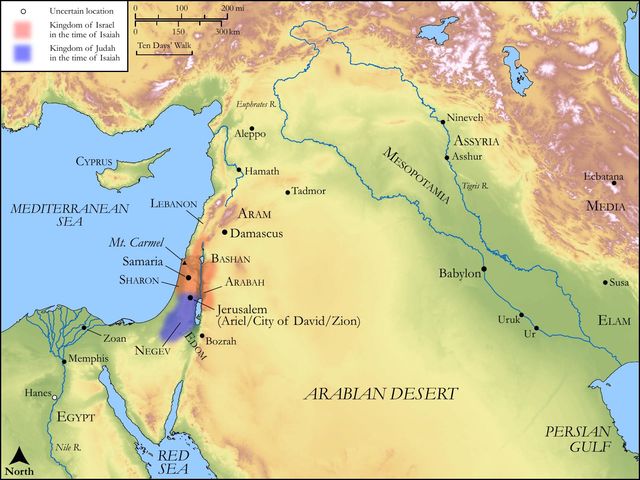
See on the biblical-era map
Study this verse
Public-domain commentary
Matthew Henry
From his Commentary on the Whole Bible. Henry comments on passages, not single verses — this entry covers Isaiah 35:5–10. His two-level outline is real structure in the source text, so it is rendered as structure.
"Then, when your God shall come, even Christ, to set up his kingdom in the world, to which all the prophets bore witness, especially towards the conclusion of their prophecies of the temporal deliverances of the church, and this evangelical prophet especially - then look for great things."
I.Wonders shall be wrought in the kingdoms both of nature and grace, wonders of mercy wrought upon the children of men, sufficient to evince that it is no less than a God that comes to us.
1.Wonders shall be wrought on men's bodies (Isa 35:5, Isa 35:6): The eyes of the blind shall be opened; this was often done by our Lord Jesus when he was here upon earth, with a word's speaking, and one he gave sight to that was born blind, Mat 9:27; Mat 12:22; Mat 20:30; Joh 9:6. By his power the ears of the deaf also were unstopped, with one word. Ephphatha - Be opened, Mar 7:34. Many that were lame had the use of their limbs restored so perfectly that they could not only go, but leap, and with so much joy to them that they could not forbear leaping for joy, as that impotent man, Act 3:8. The dumb also were enabled to speak, and then no marvel that they were disposed to sing for joy, Mat 9:32, Mat 9:33. These miracles Christ wrought to prove that he was sent of God (Joh 3:2), nay, working them by his own power and in his own name, he proved that he was God, the same who at first made man's mouth, the hearing ear, and the seeing eye. When he would prove to John's disciples his divine mission he did it by miracles of this kind, in which this scripture was fulfilled.
2.Wonders, greater wonders, shall be wrought on men's souls. By the word and Spirit of Christ those that were spiritually blind were enlightened (Act 26:18), those that were deaf to the calls of God were made to hear them readily, so Lydia, whose heart the Lord opened, so that she attended, Act 16:14. Those that were impotent to every thing that is good by divine grace are made, not only able for it, but active in it, and run the way of God's commandments. Those also that were dumb, and knew not how to speak of God or to God, having their understandings opened to know him, shall thereby have their lips opened to show forth his praise. The tongue of the dumb shall sing for joy, the joy of God's salvation. Praise shall be perfected out of the mouth of babes and sucklings.
II.The Spirit shall be poured out from on high.
There shall be waters and streams, rivers of living water; when our Saviour spoke of these as the fulfilling of the scripture, and most probably of this scripture, the evangelist tells us, He spoke of the Spirit (Joh 7:38, Joh 7:39), as does also this prophet (ch. 32:15); so here (Isa 35:6), in the wilderness, where one would least expect it, shall waters break out. This was fulfilled when the Holy Ghost fell upon the Gentiles that heard the word (Act 10:44); then were the fountains of life opened, whence streams flowed, that watered the earth abundantly. These waters are said to break out, which denotes a pleasing surprise to the Gentile world, such as brought them, as it were, into a new world. The blessed effect of this shall be that the parched ground shall become a pool, Isa 35:7. Those that laboured and were heavily laden, under the burden of guilt, and were scorched with the sense of divine wrath, found rest, and refreshment, and abundant comforts in the gospel. In the thirsty land, where no water was, nor ordinances (Psa 63:1), there shall be springs of water, a gospel ministry, and by that the administration of all gospel ordinances in their purity and plenty, which are the river that makes glad the city of our God, Psa 46:4. In the habitation of dragons, who chose to dwell in the parched scorched ground (Isa 34:9, Isa 34:13), these waters shall flow, and dispossess them, so that, where each lay shall be grass with reeds and rushes, great plenty of useful productions. Thus it was when Christian churches were planted, and flourished greatly, in the cities of the Gentiles, which, for many ages, had been habitations of dragons, or devils rather, as Babylon (Rev 18:2); when the property of the idols' temples was altered, and they were converted to the service of Christianity, then the habitations of dragons became fruitful fields.
III.The way of religion and godliness shall be laid open:
it is here called the way of holiness (Isa 35:8) the way both of holy worship and a holy conversation. Holiness is the rectitude of the human nature and will, in conformity to the divine nature and will. The way of holiness is that course of religious duties in which men ought to walk and press forward, with an eye to the glory of God and their own felicity in the enjoyment of him. "When our God shall come to save us he shall chalk out to us this way by his gospel, so as it had never been before described." 1. It shall be an appointed way; not a way of sufferance, but a highway, a way into which we are directed by a divine authority and in which we are protected by a divine warrant. It is the King's highway, the King of Kings' highway, in which, though we may be waylaid, we cannot be stopped. The way of holiness is the way of God's commandments; it is (as highways usually are) the good old way, Jer 6:16. 2. It shall be an appropriated way, the way in which God will bring his own chosen to himself, but the unclean shall not pass over it, either to defile it or to disturb those that walk in it. It is a way by itself, distinguished from the way of the world, for it is a way of separation from, and nonconformity to, this world. It shall be for those whom the Lord has set apart for himself (Psa 4:3), shall be reserved for them: The redeemed shall walk there, and the satisfaction they take in these ways of pleasantness shall be out of the reach of molestation from an evil world. The unclean shall not pass over it, for it shall be a fair way; those that walk in it are the undefiled in the way, who escape the pollution that is in the world. 3. It shall be a straight way: The wayfaring men, who choose to travel in it, though fools, of weak capacity in other things, shall have such plain directions from the word and Spirit of God in this way that they shall not err therein; not that they shall be infallible even in their own conduct, or that they shall in nothing mistake, but they shall not be guilty of any fatal misconduct, shall not so miss their way but that they shall recover it again, and get well to their journey's end. Those that are in the narrow way, though some may fall into one path and others into another, not all equally right, but all meeting at last in the same end, shall yet never fall into the broad way again; the Spirit of truth shall lead them into all truth that is necessary for them. Note, The way to heaven is a plain way, and easy to hit. God has chosen the foolish things of the world, and made them wise to salvation. Knowledge is easy to him that understands. 4. It shall be a safe way: No lion shall be there, nor any ravenous beast (Isa 35:9), none to hurt or destroy. Those that keep close to this way keep out of the reach of Satan the roaring lion, that wicked one touches them not. Those that walk in the way of holiness may proceed with a holy security and serenity of mind, knowing that nothing can do them any real hurt; they shall be quiet from the fear of evil. It was in Hezekiah's days, some time after the captivity of the ten tribes, that God, being displeased with the colonies settled there, sent lions among them, Kg2 17:25. But Judah keeps her integrity, and therefore no lions shall be there. Those that walk in the way of holiness must separate themselves from the unclean and the ravenous, must save themselves from an untoward generation; hoping that they themselves are of the redeemed, let them walk with the redeemed who shall walk there.
IV.The end of this way shall be everlasting joy, Isa 35:10.
This precious promise of peace now will end shortly in endless joys and rest for the soul. Here is good news for the citizens of Zion, rest to the weary: The ransomed of the Lord, who therefore ought to follow him wherever he goes (Rev 14:4), shall return and come to Zion,
1.To serve and worship God in the church militant: they shall deliver themselves out of Babylon (Zac 2:7), shall ask the way to Zion (Jer 50:5), and shall find the way Isa 52:12. God will open to them a door of escape out of their captivity, and it shall be an effectual door, though there be many adversaries. They shall join themselves to the gospel church, that Mount Zion, that city of the living God, Heb 12:22. They shall come with songs of joy and praise for their deliverance out of Babylon, where they wept upon every remembrance of Zion, Psa 137:1. Those that by faith are made citizens of the gospel Zion may go on their way rejoicing (Act 8:39); they shall sing in the ways of the Lord, and be still praising him. They rejoice in Christ Jesus, and the sorrows and signs of their convictions are made to flee away by the power of divine consolations. Those that mourn are blessed, for they shall be comforted.
2.To see and enjoy God in the church triumphant; those that walk in the way of holiness, under guidance of their Redeemer, shall come to Zion at last, to the heavenly Zion, shall come in a body, shall all be presented together, faultless, at the coming of Christ's glory with exceeding joy (Jde 1:24; Rev 7:17); they shall come with songs. When God's people returned out of Babylon to Zion they came weeping (Jer 50:4); but they shall come to heaven singing a new song, which no man can learn, Rev 14:3. When they shall enter into the joy of their Lord it shall be what the joys of this world never could be everlasting joy, without mixture, interruption, or period. It shall not only fill their hearts, to their own perfect and perpetual satisfaction, but it shall be upon their heads, as an ornament of grace and a crown of glory, as a garland worn in token of victory. Their joy shall be visible, and no longer a secret thing, as it is here in this world; it shall be proclaimed, to the glory of God and their mutual encouragement. They shall then obtain the joy and gladness which they could never expect on this side heaven; and sorrow and sighing shall flee away for ever, as the shadows of the night before the rising sun. Thus these prophecies, which relate to the Assyrian invasion, conclude, for the support of the people of God under that calamity, and to direct their joy, in their deliverance from it, to something higher. Our joyful hopes and prospects of eternal life should swallow up both all the sorrows and all the joys of this present time.
Historical interpretation
Two Centuries of Reception
6 surviving comments on this verse. Each one is dated, so this reads as a timeline rather than a list.
Select a marker to jump to its quote. Markers stagger vertically where authors wrote within a few decades of each other.
And that it was predicted that our Christ should heal all diseases and raise the dead, hear what was said. There are these words: "At His coming the lame shall leap as an hart, and the tongue of the stammerer shall be clear speaking: the blind shall see, and the lepers shall be cleansed; and the dead shall rise, and walk about." And that He did those things, you can learn from the Acts of Pontius Pilate.
Let me dispel at once the … assertion that the prophets make all their announcements in figures of speech. Now, if this were the case, the figures themselves could not possibly have been distinguished, inasmuch as the verities would not have been declared, out of which the figurative language is stretched. And, indeed, if all are figures, where will be that of which they are the figures? How can you hold up a mirror for your face, if the face nowhere exists? But, in truth, all are not figures, but there are also literal statements; nor are all shadows, but there are bodies too. We have prophecies about the Lord himself even, which are clearer than the day. For it was not figuratively that the Virgin conceived in her womb.… Not even of his mighty works have [the prophets] used parabolic language. Or else, were not the eyes of the blind opened? Did not the tongue of the mute recover speech? Did not the relaxed hands and palsied knees become strong, and the lame leap like a deer? No doubt we are accustomed also to give a spiritual significance to these statements of prophecy, according to the analogy of the physical diseases that were healed by the Lord. But still they were all fulfilled literally, thus showing that the prophets foretold both senses, except that very many of their words can be taken only in a pure and simple signification and free from all allegorical obscurity.
That [Jesus] healed the lame and the blind, and that therefore we hold him to be the Christ and the Son of God, is manifest to us from what is contained in the prophecies: “Then the eyes of the blind shall be opened.”
Isaiah bears witness to him when he sets before us the works of healing that were to be done by him.
Now what can they [i.e., those who deny the incarnation] say to this, or how can they dare to face this at all? For the prophecy not only indicated that God is to sojourn here but also announces the signs and the time of his coming. For they connect the blind recovering their sight, and the lame walking, and the deaf hearing, and the tongue of the one who stammers being made plain, with the divine coming which is to take place. Let them say, then, when such signs have come to pass in Israel, or where in Judah anything of the sort has occurred. Naaman, a leper, was cleansed, but no deaf man heard nor lame walked. Elijah raised a dead man; so did Elisha;64 but none blind from birth regained his sight. For in good truth, to raise a dead man is a great thing, but it is not like the wonder wrought by the Savior. Only, if Scripture has not passed over the case of the leper and of the dead son of the widow, certainly had it come to pass that a lame man also had walked and a blind man recovered his sight, the narrative would not have omitted to mention this also. Since, then, nothing is said in the [Old Testament] Scriptures, it is evident that these things had never taken place before. When, then, have they taken place, save when the Word of God himself came in the body? Or when did he come, if not when lame men walked, and those who stammer were made to speak plainly, and deaf men heard, and men blind from birth regained their sight?
But that these five thousand men are signs of divine power, the Lord himself predicted through the prophet, saying, “Behold, I and the children whom God has given me will be signs in the house of Israel from the Lord of hosts on Mount Zion.” The same prophet later revealed the nature of these future signs when he said, “Then the eyes of the blind will be opened, and the ears of the deaf will hear, and the lame will leap like deer.” We can recognize the fulfillment of this prophecy in the lame man who had been unable to walk since birth.If we look closely, we can also recognize the sacraments prefigured mystically in him, for the lame man received healing while looking toward Peter and John when he was at the Beautiful Gate of the temple. We too were lame prior to coming to the knowledge of Christ, in the sense that we were limping along the way of righteousness. Our halting strides were not those of the body, however, but those of the interior life. Whoever has gone astray from the way of righteousness or from the way of truth is altogether lame, even if his feet and legs are healthy, since he limps with his mind and soul. For the journey of faith and truth is traveled not with bodily steps but with strides of the interior life.
Continue studying Isaiah 35:6 across the web’s major study libraries — every link below opens this exact verse, chapter, or book on the destination site.
Read & Compare
 BibleGatewayThis verse in more than 200 translations and 70 languages.
 Bible.comThe YouVersion reader — hundreds of translations, reading plans, and highlights.
 ESV.orgCrossway's official English Standard Version reader.
 NET BibleThe NET translation with 60,000+ translators' notes on every rendering decision.
 STEP BibleTyndale House's free study tool — original text, vocabulary, and scholarly resources.
 BibliaLogos Bible Software's free web reader.
 USCCBThe New American Bible (Revised Edition) with the U.S. bishops' study notes.
Commentaries
 BibleHub CommentariesDozens of classic commentaries on this verse, gathered on one page.
 StudyLightMore than 100 commentary sets — the largest collection on the web.
 BibleRefPlain-English commentary on what this verse means, verse by verse.
 Enduring WordDavid Guzik's free commentary on this chapter, widely used by Bible teachers.
 Bible Study ToolsVerse commentary alongside Greek and Hebrew study aids.
Original Language & Research
- BibleHub InterlinearThe verse word by word — original language, transliteration, and English.
- BibleHub LexiconEvery word's original-language definition and Strong's entry.
 Blue Letter BibleDeep-study tools — Strong's numbers, concordance, and word studies.
 SefariaThe Hebrew text with Rashi and centuries of Jewish commentary.
Sermons, Hymns & Audio


TrulyRandomVerse is not affiliated with these sites and doesn’t control their content. They’re linked because they’re genuinely useful.
Summary
Isaiah 35:6 presents a breathtaking prophetic vision of profound transformation and divine restoration, depicting a future era where the physically infirm are miraculously healed, and desolate landscapes are dramatically revitalized with life-giving water. This verse serves as a powerful declaration of God's redemptive power, promising a complete reversal of cursed conditions into blessed ones, manifesting as exuberant joy, unhindered praise, and abundant provision in what was once a realm of barrenness and suffering.
Context
ShowHideLiterary Context
Isaiah 35 stands as a glorious and dramatic pivot in the book of Isaiah, following chapters that detail severe judgment and desolation, particularly against nations like Edom in Isaiah 34. While previous prophecies painted a grim picture of divine wrath and the suffering of God's people, chapter 35 shifts abruptly to offer a radiant vision of future glory, restoration, and renewal specifically for Zion and the returning exiles. It functions as a stark and hopeful contrast, promising blessing and flourishing after a period of divine discipline. The immediate preceding verses, Isaiah 35:1-2, vividly describe the wilderness and desert blossoming like a rose and rejoicing, thereby setting the stage for the specific miracles of healing and provision detailed in verse 6. This chapter culminates in the promise of a "Highway of Holiness" for the redeemed (Isaiah 35:8), along which the ransomed will return to Zion with singing.
Historical & Cultural Context
Isaiah prophesied during a period of intense geopolitical turmoil for the kingdom of Judah, marked by the rising threat of the Assyrian Empire and the eventual fall of the Northern Kingdom of Israel. The imagery of a "wilderness" (Hebrew: midbâr) and "desert" (Hebrew: ʻărâbâh) would have resonated profoundly with an ancient Near Eastern audience, who understood such landscapes as potent symbols of desolation, hardship, divine judgment, and exile. Water, in particular, was an exceedingly precious commodity in this arid region, representing life, blessing, prosperity, and God's favor. The promise of water miraculously breaking out in the desert, alongside the healing of the lame and dumb, would have evoked immense hope for a people facing physical, spiritual, and national barrenness. It would have stirred deep longing for a return to a land flowing with milk and honey, reminiscent of God's miraculous provision during the Exodus journey through the wilderness.
Key Themes
ShowHideThis verse powerfully contributes to several overarching themes woven throughout Isaiah and broader biblical prophecy. It fundamentally highlights Miraculous Healing and Restoration, illustrating God's sovereign power to overcome all forms of brokenness and infirmity, bringing wholeness and exuberant joy. This theme is central to Messianic expectations, as vividly demonstrated in Jesus' own ministry where He healed the sick and cast out demons. Another crucial theme is the Transformation of Nature, depicting the desert—typically barren and lifeless—bursting forth with life-giving water. This symbolizes profound spiritual refreshing and renewal in what was once a desolate spiritual landscape, pointing to God's ability to bring life and abundance in the most unexpected and seemingly impossible circumstances. Finally, the verse underscores Divine Provision and Joy, assuring that where there was lack, there will be overflowing abundance, leading to unhindered celebration, praise, and liberation from suffering. This divine provision is a hallmark of God's covenant faithfulness, as seen in His care for Israel in the wilderness (Exodus 17:6).
Exposition and Analysis
ShowHideKey Word Analysis
ShowHideA primitive root, meaning "to spring" or "leap." In this context, it conveys an energetic, unhindered, and joyful movement, standing in stark contrast to the previous state of lameness. It suggests an exuberant, almost dance-like expression of newfound freedom, vitality, and delight, much like a deer bounding freely across a field. This is not merely walking, but an explosion of liberated movement.
This noun refers to the tongue, the organ of speech. Here, it is specifically the "tongue of the dumb" (Hebrew, ʼillêm), implying a profound inability to speak. Its transformation to "sing" signifies not just the restoration of speech, but its elevation to an act of worship, praise, and joyful expression. It represents the overcoming of a significant physical and social limitation, allowing for the outpouring of a heart filled with gladness and thanksgiving.
A primitive root, meaning "to cleave; generally, to rend, break, rip or open; make a breach, break forth (into, out, in pieces, through, up), be ready to burst." This word suggests a sudden, powerful, and spontaneous gushing forth of water, not a mere trickle or slow seepage. It emphasizes the overwhelming, miraculous, and perhaps even violent nature of God's provision, indicating an abundant and unexpected supply in a place of extreme scarcity, defying natural expectations.
Verse Breakdown
ShowHide"Then shall the lame [man] leap as a hart"
This clause vividly portrays a miraculous physical healing and restoration. The "lame man," previously bound by infirmity and unable to move freely, will experience a complete and dynamic transformation, enabling him to move with the agility, strength, and exuberant joy of a deer (hart). This is a picture of profound liberation from physical limitation and the onset of unhindered, joyful movement, symbolizing a new quality of life.
"and the tongue of the dumb sing"
This parallel clause describes another miraculous healing, focusing on the restoration of speech to those who were mute. More than just speaking, the "dumb" will "sing," indicating a transformation that leads to joyful expression, praise, and perhaps even worship. It signifies the removal of a profound barrier to communication and the outpouring of a heart filled with newfound ability and gladness, transforming silence into song.
"for in the wilderness shall waters break out"
This introduces the divine reason or basis for the miraculous human healings: God's transformative power extends to creation itself. The "wilderness" (Hebrew, midbâr), a symbol of barrenness, desolation, and hardship, will suddenly and miraculously yield abundant "waters." This imagery speaks of life-giving provision in the most unexpected and seemingly impossible places, signifying a radical reversal of the natural order by divine intervention.
"and streams in the desert"
This phrase reinforces and amplifies the previous one through synonymous parallelism, emphasizing the comprehensive nature of God's provision. "Streams" (Hebrew, nachal) implies flowing water, often a wadi or seasonal torrent, but here in the "desert" (Hebrew, ʻărâbâh, often referring to the arid Jordan valley), it signifies a permanent and abundant water source. This further emphasizes the overflowing, continuous, and miraculous nature of God's provision, transforming a parched land into one of fertility, refreshment, and life.
Literary Devices
ShowHideIsaiah 35:6 is rich with evocative Imagery, painting vivid and contrasting pictures of transformation: the lame leaping, the dumb singing, and water bursting forth in the desert. These images are highly Symbolic, representing not only literal physical healing and natural renewal but also profound spiritual restoration, exuberant joy, and abundant divine provision. The sharp contrast between the initial state of lameness/dumbness and barrenness versus the resulting agility/song and flowing water creates powerful Juxtaposition, highlighting the miraculous nature of God's intervention. The use of Parallelism ("waters break out, and streams in the desert") reinforces and amplifies the message of abundant, overflowing provision. The comparison "leap as an hart" is a striking Simile, effectively conveying the exuberance, freedom, and newfound vitality of the healed. The entire verse functions as a powerful Prophecy, foretelling a future era of divine intervention, blessing, and the establishment of God's kingdom.
Theological and Thematic Connections
ShowHideIsaiah 35:6 resonates deeply with the overarching biblical narrative of God's redemptive work, demonstrating His sovereign power to reverse the effects of the Fall and bring about a new creation. It speaks to a profound eschatological hope, where physical brokenness, human suffering, and environmental desolation are ultimately overcome by divine grace and miraculous intervention. The promise of healing and abundant life in the wilderness points to God's nature as the ultimate provider, healer, and restorer, who brings life where there is death and joy where there is sorrow. This vision of transformation is not merely physical but encompasses spiritual renewal, leading to a joyful outpouring of praise and an experience of God's overflowing presence. It anticipates the comprehensive restoration of all things under God's righteous rule.
Reflection and Application
ShowHideIsaiah 35:6 offers profound hope and encouragement for believers today, reminding us that God is actively at work, bringing restoration and renewal even in the most desolate and seemingly impossible circumstances of life. It challenges us to look beyond our current limitations—whether physical ailments, emotional wounds, spiritual dryness, or challenging external circumstances—and to trust in God's miraculous power to transform barrenness into abundance, sorrow into singing, and weakness into vibrant strength. This verse invites us to cultivate a posture of expectant hope, knowing that God's ultimate plan involves complete healing and an overflowing provision of life, both now and in the age to come. It calls us to recognize the signs of His kingdom breaking forth in our world and in our lives, prompting us to respond with unhindered joy and praise for His ongoing redemptive work. Furthermore, we are encouraged to be channels of this hope, extending God's healing and life-giving presence to those around us who are in their own "wilderness" experiences, pointing them to the ultimate source of all restoration.
Questions for Reflection
ShowHideFAQ
ShowHideWhat is the significance of the "hart" in this verse?
ShowHideThe "hart" (Hebrew, ʼayâl), which refers to a male deer or stag, is known for its remarkable agility, strength, and graceful leaping ability. When the verse says the lame man will "leap as a hart," it emphasizes a complete and exuberant restoration of movement, far beyond mere walking or basic functionality. It signifies not just healing from lameness, but a joyful, unhindered, and powerful expression of newfound vitality and freedom, contrasting sharply with the previous state of immobility. It paints a picture of boundless energy and delight in movement.
Does this prophecy refer only to physical healing, or is there a deeper meaning?
ShowHideWhile the prophecy certainly includes the promise of literal physical healing, as powerfully demonstrated in Jesus' earthly ministry where He healed countless individuals, it carries a profound deeper and broader meaning. The physical restoration and the miraculous transformation of the barren wilderness into a place of abundant water are potent symbols of spiritual renewal, emotional healing, and the comprehensive restoration of God's people. It speaks to the holistic nature of God's redemptive work, bringing wholeness to individuals, communities, and to creation itself. This prophecy foreshadows the spiritual vitality and joy that come from God's presence, culminating in the new heavens and new earth described in Revelation 21, where all forms of suffering and brokenness will be eternally abolished.
Christ-Centered Fulfillment
ShowHideIsaiah 35:6 finds its ultimate and most profound fulfillment in the person and redemptive work of Jesus Christ. He is the long-awaited Messiah who inaugurated the very age where these glorious prophecies began to be realized. Throughout His earthly ministry, Jesus demonstrated His divine authority and Messianic identity by literally causing the lame to walk (Matthew 15:30), the blind to see (John 9:1-7), and the dumb to speak (Matthew 9:32-33), often leading to immediate praise and rejoicing. His miracles were not merely acts of compassion but concrete, undeniable signs that the kingdom of God had drawn near, fulfilling the very prophetic expectations of Isaiah. Furthermore, Jesus Himself is the "living water" (John 4:10) who brings spiritual life to the barren "wilderness" of the human heart, transforming spiritual desolation into a wellspring of eternal life (John 7:38). The exuberant joy of the physically healed and the promised transformation of the land foreshadow the ultimate joy and complete restoration found in Christ, culminating in the new creation where all sorrow, suffering, and brokenness will be no more (Revelation 21:4). Through His atoning sacrifice and resurrection, Christ provides the spiritual healing and abundant life that Isaiah foresaw, inviting all who believe to leap with joy and sing His praises.