


Isaiah 32:4
Bible text: King James Version (1769 Blayney text) · Public domain
Bible text: King James Version with Strong's numbers · Public domain
Bible text: Berean Standard Bible · Public domain
Bible text: American Standard Version (1901) · Public domain
Bible text: World English Bible, Messianic edition · Public domain
Bible text: Geneva Bible (1599) · Public domain
Bible text: Young's Literal Translation · Public domain
- וּלְבַבu·le·Vavand [the] heart ofH3824Conj-w ¦ N-mscNoun Singular Masculine Constructוּandלְבַב[the] heart of
- נִמְהָרִיםnim·ha·Rimhasty [people]H4116V-Niphal-Prtcpl-mpVerb Niphal Participle Plural Masculine Absolute
- יָבִיןya·Vinit will understandH995V-Qal-Imperf-3msVerb Qal Imperfect 3rd Singular Masculine
- לָדָעַתla·Da·'at<to> knowledgeH1847Prep-l ¦ N-fsNoun Singular Feminine Absoluteלָ<to>דָעַתknowledge
- וּלְשׁוֹןu·le·Shonand [the] tongue ofH3956Conj-w ¦ N-cscNoun Singular common gender Constructוּandלְשׁוֹן[the] tongue of
- עִלְּגִים'i·le·GimstammerersH5926Adj-mpAdjective Plural Masculine Absolute
- תְּמַהֵרte·ma·Herit will hastenH4116V-Piel-Imperf-3fsVerb Piel Imperfect 3rd Singular Feminine
- לְדַבֵּרle·da·Berto speakH1696Prep-l ¦ V-Piel-InfVerb Piel Infinitive Constructלְtoדַבֵּרspeak
- צָחוֹתtza·ChotclearlyH6703Adj-fpAdjective Plural Feminine Absolute
English is a literal word-by-word gloss of the Hebrew, not the KJV's wording. Why?
This is the original text the KJV's translators worked from — each Hebrew word with its own literal English meaning in this verse, prepared by scholars at Tyndale House, Cambridge. The KJV translates whole sentences, not word by word, so its wording differs: one Hebrew word can become several English words, and the KJV may choose “the LORD” where the gloss reads “Yahweh”. Both are faithful — they answer different questions. For the KJV's own rendering, switch to the KJV text.
Details
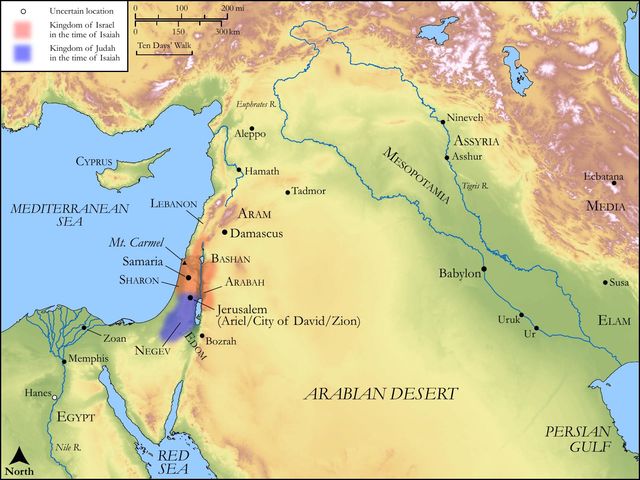
See on the biblical-era map
Study this verse
Public-domain commentary
Matthew Henry
From his Commentary on the Whole Bible. Henry comments on passages, not single verses — this entry covers Isaiah 32:1–8. His four-level outline is real structure in the source text, so it is rendered as structure.
We have here the description of a flourishing kingdom. "Blessed art thou, O land! when it is thus with thee, when kings, princes, and people, are in their places such as they should be." It may be taken as a directory both to magistrates and subjects, what both ought to do, or as a panegyric to Hezekiah, who ruled well and saw something of the happy effects of his good government, and it was designed to make the people sensible how happy they were under his administration and how careful they should be to improve the advantages of it, and withal to direct them to look for the kingdom of Christ, and the times of reformation which that kingdom should introduce. It is here promised and prescribed, for the comfort of the church,
I.That magistrates should do their duty in their places, and the powers answer the great ends for which they were ordained of God, Isa 32:1, Isa 32:2.
1.There shall be a king and princes that shall reign and rule; for it cannot go well when there is no king in Israel. The princes must have a king, a monarch over them as supreme, in whom they may unite; and the king must have princes under him as officers, by whom he may act, Pe1 2:13, Pe1 2:14. They both shall know their place and fill it up. The king shall reign, and yet, without any diminution to his just prerogative, the princes shall rule in a lower sphere, and all for the public good.
2.They shall use their power according to law, and not against it. They shall reign in righteousness and in judgment, with wisdom and equity, protecting the good and punishing the bad; and those kings and princes Christ owns as reigning by him who decree justice, Pro 8:15. Such a King, such a Prince, Christ himself is; he reigns by rule, and in righteousness will he judge the world, Isa 9:7; Isa 11:4.
3.Thus they shall be great blessings to the people (Isa 32:2): A man, that man, that king that reigns in righteousness, shall be as a hiding-place. When princes are as they should be people are as they would be.
(1.)They are sheltered and protected from many mischiefs. This good magistrate is a covert to the subject from the tempest of injury and violence; he defends the poor and fatherless, that they be not made a prey of by the mighty. Whither should oppressed innocency flee, when blasted by reproach or borne down by violence, but to the magistrate as its hiding-place? To him it appeals, and by him it is righted.
(2.)They are refreshed and comforted with many blessings. This good magistrate gives such countenance to those that are poor and in distress, and such encouragement to every thing that is praiseworthy, that he is as rivers of water in a dry place, cooling and cherishing the earth and making it fruitful, and as the shadow of a great rock, under which a poor traveller may shelter himself from the scorching heat of the sun in a weary land. It is a great reviving to a good man, who makes conscience of doing his duty, in the midst of contempt and contradiction, at length to be backed, and favoured, and smiled upon in it by a good magistrate. All this, and much more, the man Christ Jesus is to all the willing faithful subjects of his kingdom. When the greatest evils befal us, not only the wind, but the tempest, when storms of guilt and wrath beset us and beat upon us, they drive us to Christ, and in him we are not only safe, but satisfied that we are so; in him we find rivers of water for those that hunger and thirst after righteousness, all the refreshment and comfort that a needy soul can desire, and the shadow, not of a tree, which sun or rain may beat through, but of a rock, of a great rock, which reaches a great way for the shelter of the traveller. Some observe here that as the covert, and the hiding-place, and the rock, do themselves receive the battering of the wind and storm, to save those from it that take shelter in them, so Christ bore the storm himself to keep it off from us.
II.That subjects should do their duty in their places.
1.They shall be willing to be taught, and to understand things aright. They shall lay aside their prejudices against their rulers and teachers, and submit to the light and power of truth, Isa 32:3. When this blessed work of reformation is set on foot, and men do their parts towards it, God will not be wanting to do his: Then the eyes of those that see, of the prophets, the seers, shall not be dim; but God will bless them with visions, to be by them communicated to the people; and those that read the word written shall no longer have a veil upon their hearts, but shall see things clearly. Then the ears of those that hear the word preached shall hearken diligently and readily receive what they hear, and not be so dull of hearing as they have been. This shall be done by the grace of God, especially gospel-grace; for the hearing ear, and the seeing eyes, the Lord has made, has new-made, even both of them.
2.There shall be a wonderful change wrought in them by that which is taught them, Isa 32:4.
(1.)They shall have a clear head, and be able to discern things that differ, and distinguish concerning them. The heart of those that were hasty and rash, and could not take time to digest and consider things, shall now be cured of their precipitation, and shall understand knowledge; for the Spirit of God will open their understanding. This blessed work Christ wrought in his disciples after his resurrection (Luk 24:45), as a specimen of what he would do for all his people, in giving them an understanding, Jo1 5:20. The pious designs of good princes are likely to take effect when their subjects allow themselves liberty to consider, and to think, so freely as to take things right.
(2.)They shall have a ready utterance: The tongue of the stammerers, that used to blunder whenever they spoke of the things of God, shall now be ready to speak plainly, as those that understand what they speak of, that believe, and therefore speak. There shall be a great increase of such clear, distinct, and methodical knowledge in the things of God, that those from whom one would not have expected it shall speak intelligently of these things, very much to the honour of God and the edification of others. Their hearts being full of this good matter, their tongues shall be as the pen of a ready writer, Psa 45:1.
3.The differences between good and evil, virtue and vice, shall be kept up, and no more confounded by those who put darkness for light and light for darkness (Isa 32:5): The vile shall no more be called liberal.
(1.)Bad men shall no more be preferred by the prince. When a king reigns in justice he will not put those in places of honour and power that are ill-natured, and of base and sordid spirits, and care not what injury or mischief they do so they may but compass their own ends. Such as vile persons (as Antiochus is called, Dan 11:21); when they are advanced they are called liberal and bountiful; they are called benefactors (Luk 22:25): but it shall not always be thus; when the world grows wiser men shall be preferred according to their merit, and honour (which was never thought seemly for a fool, Pro 26:1) shall no longer be thrown away upon such.
(2.)Bad men shall be no more had in reputation among the people, nor vice disguised with the colours of virtue. It shall no more be said to Nabal, Thou art Nadib (so the words are); such a covetous muck-worm as Nabal was, a fool but for his money, shall not be complimented with the title of a gentleman or a prince; nor shall they call a churl, that minds none but himself, does no good with what he has, but is an unprofitable burden of the earth, My lord; or, rather, they shall not say of him, He is rich; for so the word signifies. Those only are to be reckoned rich that are rich in good works; not those that have abundance, but those that use it well. In short, it is well with a people when men are generally valued by their virtue, and usefulness, and beneficence to mankind, and not by their wealth or titles of honour. Whether this was fulfilled in the reign of Hezekiah, and how far it refers to the kingdom of Christ (in which we are sure men are judged of by what they are, not by what they have, nor is any man's character mistaken), we will not say; but it prescribes an excellent rule both to prince and people, to respect men according to their personal merit. To enforce this rule, here is a description both of the vile person and of the liberal; and by it we shall see such a vast difference between them that we must quite forget ourselves if we pay that respect to the vile person and the churl which is due only to the liberal.
[1.]A vile person and a churl will do mischief, and the more if he be preferred and have power in his hand; his honours will make him worse and not better, Isa 32:6, Isa 32:7. See the character of these base ill-conditioned men. First, They are always plotting some unjust thing or other, designing ill either to particular persons or to the public, and contriving how to bring it about; and so many silly piques they have to gratify, and mean revenges, that there appears not in them the least spark of generosity. Their hearts will be still working some iniquity or other. Observe, There is the work of the heart, as well as the work of the hands. As thoughts are words to God, so designs are works in his account. See what pains sinners take in sin. They labour at it; their hearts are intent upon it, and with a great deal of art and application they work iniquity. They devise wicked devices with all the subtlety of the old serpent and a great deal of deliberation, which makes the sin exceedingly sinful; and the more there is of plot and management in a sin the more there is of Satan in it. Secondly, They carry on their plots by trick and dissimulation. When they are meditating iniquity, they practise hypocrisy, feign themselves just men, Luk 20:20. The most abominable mischiefs shall be disguised with the most plausible pretences of devotion to God, regard to man, and concern for some common good. Those are the vilest of men that intend the worst mischiefs when they speak fair. Thirdly, They speak villainy. When they are in a passion you will see what they are by the base ill language they give to those about them, which no way becomes men of rank and honour; or, in giving verdict or judgment, they villainously put false colours upon things, to pervert justice. Fourthly, They affront God, who is a righteous God and loves righteousness: They utter error against the Lord, and therein they practise profaneness; for so the word which we translate hypocrisy signifies. They give an unjust sentence, and then profanely make use of the name of God for the ratification of it; as if, because the judgment is God's (Deu 1:17), therefore their false and unjust judgment was his. This is uttering error against the Lord, under pretence of uttering truth and justice for him; and nothing can be more impudently done against God than to use his name to patronise wickedness. Fifthly, They abuse mankind, those particularly whom they are bound to protect and relieve. 1. Instead of supplying the wants of the poor, they impoverish them, they make empty the souls of the hungry; either taking away the food they have, or, which is almost equivalent, denying the supply which they want and which they have to give. And they cause the drink of the thirsty to fail; they cut off the relief they used to have, though they need it as much as ever. Those are vile persons indeed that rob the spital. 2. Instead of righting the poor, when they appeal to their judgment, they contrive to destroy the poor, to ruin them in their courts of judicature with lying words in favour of the rich, to whom they are plainly partial; yea, though the needy speak right, though the evidence be ever so full for them to make out the equity of their cause, it is the bribe that governs them, not the right. Sixthly, These churls and vile persons have always had instruments about them, that are ready to serve their villainous purposes: All their servants are wicked. There is no design so palpably unjust but there may be found those that would be employed as tools to put it in execution. The instruments of the churl are evil, and one cannot expect otherwise; but this is our comfort, that they can do no more mischief than God permits them.
[2.]One that is truly liberal, and deserves the honour of being called so, makes it his business to do good to every body according as his sphere is, Isa 32:8. Observe, First, The care he takes, and the contrivances he has, to do good. He devises liberal things. As much as the churl or niggard projects how to save and lay up what he has for himself only, so much the good charitable man projects how to use and lay out what he has in the best manner for the good of others. Charity must be directed by wisdom, and liberal things done prudently and with device, that the good intention of them may be answered, that it may not be charity misplaced. The liberal man, when he has done all the liberal things that are in his own power, devises liberal things for others to do according to their power, and puts them upon doing them. Secondly, the comfort he takes, and the advantage he has, in doing good: By liberal things he shall stand, or be established. The providence of God will reward him for his liberality with a settled prosperity and an established reputation. The grace of God will give him abundance of satisfaction and confirmed peace in his own bosom. What disquiets others shall not disturb him; his heart is fixed. This is the recompence of charity, Psa 112:5, Psa 112:6. Some read it, The prince, or honourable man, will take honourable courses; and by such honourable or ingenuous courses he shall stand or be established. It is well with a land when the honourable of it are indeed men of honour and scorn to do a base thing, when its king is thus the son of nobles.
Historical interpretation
Historical reception
1 surviving comment on this verse from the historical church.
(Chapter 32, Verses 1 onwards) Behold, the king shall reign with justice, and princes shall rule with judgment. And a man shall be like one who hides from the wind, and conceals himself from the storm: like streams of water in a dry place, and the shadow of a towering rock in a barren land. The eyes of those who see shall not be dim, and the ears of those who hear shall listen carefully. And the heart of fools shall understand knowledge, and the tongue of stammerers shall speak quickly and clearly. He who is foolish shall no longer be called a ruler, nor shall the deceitful be called great. For the foolish shall speak foolishness, and his heart shall work iniquity, to accomplish deceit and speak deceitfully to the Lord, to empty the soul of the hungry and take away the drink of the thirsty. The vessels of the deceitful are the worst, for he has devised plans to destroy the meek with lies when he speaks in judgment of the poor. The prince will consider those things that are worthy of a prince, and he himself will stand above the leaders. LXX: Behold, a righteous king will reign, and princes will rule with justice. And there will be a man who conceals his words, and he will be hidden like water that is carried away: and he will appear in Zion, like a flowing river, illustrious in a thirsty land, and they will not place their confidence in men: but they will open their ears to hear, and the heart of the weak will attend to their hearing: and the tongues of the stammerers will quickly learn to speak peace: and they will no longer say to the fool, 'Be a prince,' nor will your ministers say, 'Be silent.' For a fool will speak foolishly, and his heart will understand in vain to accomplish wickedness, and to speak error towards the Lord, so as to scatter the souls of the hungry and to make the souls of the thirsty empty. For the counsel of the wicked will think iniquity: to kill the humble with wicked words, and to dissipate the words of the lowly in judgment. But the pious have thought wisdom, and this counsel remains. According to the Septuagint interpreters who said: Behold, for a just king will reign, and princes will preside with judgment, what follows must be joined with the previous, namely, the chapter that has ended: Blessed is the one who has offspring in Zion, and domestics in Jerusalem. According to the completion of the prior prophecy in Hebrew, concerning those who descended into Egypt, now begins the beginning of another prophecy, namely, concerning the coming of Christ and His Apostles. For this king shall reign justly, showing no partiality in judgment, and his princes shall govern with truth, considering causes, not individuals. And whoever is under his protection shall be safe in tribulations and hardships, and in the storms of this world, just as one who, fleeing the wind and whirlwind, safely hides in a place; and one who finds the purest springs in the desert; and one who, in the scorching heat of the sun, finds rest under a projecting rock while everything flows around him. Whereas we have said: as streams of water in a dry place, they have translated: and there shall be seen in Zion as a flowing river. For the Hebrew word, about which we have previously debated, Basaion, which means in thirst, or in dryness, and in barrenness, the Septuagint and Theodotion have translated into Zion: instead of Saion, meaning thirst, they read Zion, which is written with the same letters. Therefore, when Christ reigns, and his princes preside in judgement, the eyes of the believers will not be dimmed, and the ears of the attentive will listen carefully to what was previously deaf, and the heart of the fools will understand knowledge, and the tongue of the stammerers and the mute, which could not pronounce the name of Christ, will confess the Lord in full and clear speech. He who is foolish will no longer be called a prince. For God has made the wisdom of this world foolish. Nor will a deceitful and perverse teacher be called great among the people, namely the scribes and Pharisees, to whom the Lord spoke: Fools and blind ones, what is greater, gold or the temple that sanctifies the gold? For a fool will speak foolishly, as it is written in Hebrew: Nabal Nabala Idabber. This we say, in order to explain the words of Abigail speaking about Nabal in Carmel: 'According to his name, he is foolish.' (1 Samuel 25:25) For truly a fool will speak foolishly, and his heart will devise wickedness; he feared where there was no fear, and he used foolishness as wisdom, saying: 'If this man were from God, he would not break the Sabbath.' (John 9:16) This is what the rulers of the synagogue still do today, in order to perfect their hypocrisy, about which it is written in Hebrew: Oneph, which means 'hypocrisy.' Where it is often said to the Pharisees: Woe to you, scribes and hypocritical Pharisees (Matthew 23:14). And let him speak deceitfully to the Lord: Teacher, we know that you are from God, and it is not your concern about people, although it is lawful to pay taxes to Caesar, isn't it (Ibid., 22:16-17). They empty the souls of the hungry people and take away the drink of the thirsty crowds, neither allowing themselves to enter nor allowing others to enter. For the vessels and weapons of a deceitful teacher and prince are all the worst; who contrives deceit to deceive the simple in the speech of falsehood, saying to the deceived people: Search and see, because the Prophet from Galilee will not rise again (John 7:52). When he spoke to them about the poor judgment, who, though rich, became poor for us (2 Corinthians 8). Truly, Christ is their judgment, and he spoke of righteousness, saying: If I do not do the works of my Father, do not believe me; but if I do, and if you do not want to believe me, believe in the works (John 10:37). This poor man who speaks judgment, the prince and Lord, will think about things that are worthy of a prince, saying: I have come only for the lost sheep of the house of Israel (Matth. XV, 14). And he will be anxious to save the unbelievers, wanting to save those who do not believe; and he will stand above his leaders, the Apostles, to whom he speaks to one: But you, my unanimous man, my leader and my friend (Psal. LIV, 14). These things are according to the Hebrew, from which the Septuagint not only differ in words, but also in meanings in many things. For when a just king reigns and his leaders govern with judgment, the man who is God by nature will conceal his teachings, speaking to them in parables (Matthew 20:21, 23, 24, and 25). He will conceal them like a flowing river hides beneath the surface, away from the people of Judah who are carried back and forth by the will of their leaders. But this man who hides his teachings among the unbelievers will appear in Zion, which is the Church, like a renowned river flowing through a thirsty land. For the people of the Gentiles, who previously suffered from a thirst for truth, will appear; and the river of God will water the thirsty fields as it is written: The rushing waters of a river make the city of God glad (Psalm 46:4). And in another place: The river of God is full of water (Psalm 65:10). For He Himself speaks in the Gospel: Let anyone who is thirsty come to Me, and let them drink. Whoever believes in Me, as Scripture says, rivers of living water will flow from within them (John 7:38). Then they will have no trust in teachers; but they will offer their ears to hear the Lord; and with both heart and tongue they will confess the peace of the Lord, forsaking foolish princes and their ministers, who commanded silence to those who believed in Jesus. The following words contain the same meaning, both in Hebrew and Latin, and can be adapted to heretics. For they speak lies against the Lord, and they pervert the souls of those who hunger and thirst, and they make them empty; so that even if they have anything good by nature, they lose it because of the fault of the teachers, whose every plan is to destroy the humble with unjust words, and to scatter the words of the humble in judgment. Similarly, it should be noted that those who can be deceived by them should be humble and grounded.
Continue studying Isaiah 32:4 across the web’s major study libraries — every link below opens this exact verse, chapter, or book on the destination site.
Read & Compare
 BibleGatewayThis verse in more than 200 translations and 70 languages.
 Bible.comThe YouVersion reader — hundreds of translations, reading plans, and highlights.
 ESV.orgCrossway's official English Standard Version reader.
 NET BibleThe NET translation with 60,000+ translators' notes on every rendering decision.
 STEP BibleTyndale House's free study tool — original text, vocabulary, and scholarly resources.
 BibliaLogos Bible Software's free web reader.
 USCCBThe New American Bible (Revised Edition) with the U.S. bishops' study notes.
Commentaries
 BibleHub CommentariesDozens of classic commentaries on this verse, gathered on one page.
 StudyLightMore than 100 commentary sets — the largest collection on the web.
 BibleRefPlain-English commentary on what this verse means, verse by verse.
 Enduring WordDavid Guzik's free commentary on this chapter, widely used by Bible teachers.
 Bible Study ToolsVerse commentary alongside Greek and Hebrew study aids.
Original Language & Research
- BibleHub InterlinearThe verse word by word — original language, transliteration, and English.
- BibleHub LexiconEvery word's original-language definition and Strong's entry.
 Blue Letter BibleDeep-study tools — Strong's numbers, concordance, and word studies.
 SefariaThe Hebrew text with Rashi and centuries of Jewish commentary.
Sermons, Hymns & Audio


TrulyRandomVerse is not affiliated with these sites and doesn’t control their content. They’re linked because they’re genuinely useful.
Summary
Isaiah 32:4 presents a profound prophetic vision of spiritual and intellectual transformation that will characterize an era of divine blessing and righteous governance. It declares that individuals previously marked by impulsiveness or a lack of discernment will attain deep understanding and knowledge, while those who struggled with unclear or impeded communication will be empowered to speak truth plainly and effectively. This verse anticipates a future time when divine wisdom permeates society, leading to unparalleled clarity of thought and expression, all under the leadership of a just and divinely appointed king.
Context
ShowHideLiterary Context
Isaiah 32 is situated within a significant prophetic section of Isaiah (chapters 28-35), often referred to as the "Book of Woes" or "Book of Comfort," which masterfully interweaves pronouncements of judgment against Judah and surrounding nations with glorious promises of future restoration and divine blessing. Specifically, chapter 32 introduces the reign of a righteous king, frequently understood in Messianic terms, detailing the peace, security, and spiritual clarity that will accompany his rule. The preceding verses (Isaiah 32:1-3) vividly describe this king as a protective refuge and a source of life-giving refreshment, under whom the spiritual senses of the people will be opened: "the eyes of them that see shall not be dim, and the ears of them that hear shall hearken" Isaiah 32:3. Verse 4 seamlessly continues and expands upon this theme of spiritual and intellectual awakening, shifting focus to the internal and external transformations within individuals, moving them from states of spiritual blindness and speech impediment to profound understanding and clear articulation. This comprehensive transformation is presented as a direct and glorious outcome of the righteous king's influence and the resulting just societal order.
Historical & Cultural Context
The prophet Isaiah ministered in Judah during the tumultuous 8th century BC, a period overshadowed by the menacing threat of the Assyrian Empire and marked by significant spiritual and moral decline within Judah itself. The people frequently placed their trust in human alliances and political maneuvering, rather than relying on the Lord, leading to widespread spiritual dullness and moral decay. In this precarious context, prophecies of a future righteous king and an era of divine clarity offered immense and desperately needed hope. Culturally, wisdom (חָכְמָה, chokmah) and discernment were highly esteemed virtues, often regarded as direct gifts from God. Conversely, "rashness" (impulsiveness, a lack of forethought) and "stammering" (unclear or unintelligible speech) could symbolize spiritual immaturity, confusion, or an inability to articulate divine truth effectively. The promise of plain speech would have resonated deeply in a society where prophetic clarity was the undeniable hallmark of true divine communication, standing in stark contrast to the confused or misleading utterances of false prophets.
Key Themes
ShowHideIsaiah 32:4 contributes significantly to several major theological and narrative themes found within the book of Isaiah and broader biblical theology. Foremost among these is the theme of Divine Kingship and Messianic Reign, where the righteous king serves as the divine catalyst for this profound transformation, ultimately pointing to the redemptive work of Jesus Christ. This verse also powerfully highlights Spiritual Transformation and Renewal, emphasizing a radical shift from spiritual dullness and impulsiveness to genuine insight and discernment, echoing the profound themes of a new heart and spirit found in prophetic texts like Ezekiel 36:26-27. Another crucial theme is Clarity of Communication and Understanding, contrasting the previous state of confusion and impediment with a newfound ability to speak truth plainly and effectively. This relates directly to the broader biblical emphasis on wisdom and knowledge as divine gifts, as seen in Proverbs 2:6 where it states that "the Lord gives wisdom; from his mouth come knowledge and understanding." Finally, the verse profoundly underscores God's Restitution, where the establishment of a just and righteous order by God's chosen leader leads to the flourishing of individuals, enabling them to fully participate in and articulate divine truth with confidence and clarity.
Exposition and Analysis
ShowHideKey Word Analysis
ShowHideThis primitive root means "to hurry (in a good or a bad sense); often used (with another verb) adverbially, promptly; be carried headlong, fearful, (cause to make, in, make) haste(-n, -ily), (be) hasty, (fetch, make ready) [idiom] quickly, rash, [idiom] shortly, (be so) [idiom] soon, make speed, [idiom] speedily, [idiom] straightway, [idiom] suddenly, swift." In the context of Isaiah 32:4, "rash" signifies someone who acts impulsively, without proper thought, deliberation, or spiritual discernment, indicating a lack of wisdom and prudence.
Derived from the root יָדַע (yada, to know), this term refers to "knowledge; cunning, (ig-) norantly, know(-ledge), (un-) awares (wittingly)." It denotes a deep, insightful understanding, extending beyond mere factual information to encompass profound spiritual and moral discernment that originates from God.
Derived from צָחַח (tsachach, to be dazzling), this word means "dazzling, i.e. sunny, bright, (figuratively) evident; clear, dry, plainly, white." When applied to speech in this verse, it conveys the idea of clarity, distinctness, and brightness, implying speaking without ambiguity, clearly, and eloquently, in stark contrast to stammering or confused utterance.
Verse Breakdown
ShowHide"The heart also of the rash shall understand knowledge"
This initial clause describes a profound internal transformation. The "heart" (H3824, lêbâb), representing the inner being, intellect, will, and moral center, of those previously characterized as "rash" (H4116, mâhar – impulsive, hasty, lacking forethought) will undergo a radical and divinely-enabled change. They will no longer act on impulse but will "understand knowledge" (H995, bîyn - to discern, perceive, gain insight; H1847, daʻath - deep insight, spiritual discernment). This signifies a decisive shift from spiritual dullness, thoughtlessness, or ignorance to genuine spiritual perception, wisdom, and discernment, implying a divinely-imparted ability to grasp truth and make wise judgments.
"and the tongue of the stammerers shall be ready to speak plainly"
This second clause focuses on an external, communicative transformation. "Stammerers" (H5926, ʻillêg) refers to those whose speech is impeded, unclear, or perhaps even mocking or confused. In a broader, metaphorical sense, it symbolizes those who are unable to articulate spiritual truth effectively, confidently, or understandably. The glorious promise is that their "tongue" (H3956, lâshôwn), the primary instrument of speech, "shall be ready" (H4116, mâhar - here meaning prompt, fluent, prepared, or swift) to "speak plainly" (H1696, dâbar - to speak, declare, arrange words; H6703, tsach - clearly, distinctly, brightly). This signifies a newfound eloquence, clarity, and boldness in expressing truth, moving from confusion, hesitation, or impediment to confident, understandable, and impactful proclamation.
Literary Devices
ShowHideIsaiah 32:4 employs several powerful literary devices to convey its message of profound transformation. Parallelism is a prominent feature, as the verse presents two corresponding clauses that describe similar, complementary transformations: the heart of the rash gaining understanding, and the tongue of the stammerers speaking plainly. This is a form of synthetic parallelism, where the second line builds upon or completes the thought of the first, illustrating a comprehensive change encompassing both internal perception and external expression. Metonymy is also present, where "heart" (lêbâb) stands for the inner person's intellect, will, and moral compass, and "tongue" (lâshôwn) represents the faculty of speech and communication itself. Furthermore, the entire verse functions as Symbolism, where "the rash" and "the stammerers" are not necessarily limited to individuals with literal conditions but powerfully symbolize those who are spiritually undiscerning, impulsive, confused, or unable to clearly articulate divine truth. Their promised transformation signifies a broader spiritual awakening and empowerment that will characterize the Messianic age, where clarity, wisdom, and articulate truth will replace confusion and spiritual dullness.
Theological and Thematic Connections
ShowHideIsaiah 32:4 stands as a powerful testament to God's transformative power, particularly as it is manifested through the establishment of His righteous reign. The prophecy points to an era where spiritual and intellectual impediments are divinely removed, allowing for a profound and unhindered engagement with divine truth. This aligns perfectly with broader biblical themes of spiritual renewal, where God promises to fundamentally change the very nature of His people, moving them from a state of rebellion, ignorance, and spiritual dullness to one of willing obedience and deep understanding. This transformation is consistently presented not as a mere human effort but as a sovereign divine work, often intimately associated with the outpouring of the Holy Spirit, which enables believers to grasp and articulate God's wisdom with clarity and conviction. The verse anticipates a time when God's active presence and righteous rule bring about a clarity that dispels all confusion, empowering His people to live and speak with unparalleled discernment and plainness.
Reflection and Application
ShowHideIsaiah 32:4 offers a compelling and inspiring vision for both personal and communal spiritual growth, serving as a powerful reminder that God passionately desires to transform our inner being and our outward expression. For individuals, it challenges us to move beyond impulsiveness, superficiality, and hasty judgments—the characteristics of "the rash"—towards thoughtful discernment, genuine wisdom, and deep spiritual insight—the ability to "understand knowledge." This requires cultivating a heart that diligently seeks God's truth, patiently considers His ways, and remains open to divine instruction, rather than relying solely on fleeting emotions, worldly opinions, or unexamined assumptions. Furthermore, the glorious promise that "the tongue of the stammerers shall be ready to speak plainly" profoundly encourages us to pray for and actively pursue clarity, confidence, and grace in our communication, especially when sharing our faith, explaining biblical truths, or engaging in spiritual discussions. In a world often characterized by confusion, misinformation, ambiguity, and a hesitant articulation of truth, believers are uniquely called to be those who speak with conviction, clarity, and grace, empowered by the Holy Spirit. This verse inspires us to eagerly anticipate and actively participate in God's ongoing work of transformation, both within ourselves and in the world around us, as we strive to embody the wisdom, discernment, and communicative clarity that are hallmarks of Christ's kingdom.
Questions for Reflection
ShowHideFAQ
ShowHideIs Isaiah 32:4 a literal prophecy about physical speech impediments being cured, or is it primarily spiritual?
ShowHideWhile the language of "stammerers" (Hebrew: ʻillêg) could, in a broader sense, include literal speech impediments, the prophecy in Isaiah 32:4 is primarily understood as a profound spiritual and metaphorical transformation. The immediate literary context of the chapter, which speaks of spiritual clarity ("the eyes of them that see shall not be dim, and the ears of them that hear shall hearken" Isaiah 32:3), strongly suggests that "stammering" represents a spiritual inability to articulate truth, confusion, a lack of confidence in speaking God's word, or even a spiritual dullness that prevents clear expression. Similarly, "the rash" (Hebrew: mâhar) refers to spiritual impulsiveness, thoughtlessness, or a lack of discernment. Therefore, the promise is a comprehensive spiritual awakening and empowerment to understand and communicate divine knowledge clearly, which may indeed have physical manifestations of healing and clarity, but its core meaning is deeply spiritual and intellectual.
How does this prophecy relate to the broader biblical theme of wisdom?
ShowHideIsaiah 32:4 is deeply and intrinsically connected to the broader biblical theme of wisdom, which is consistently presented as a divine gift enabling discernment, righteous living, and effective communication. The transformation from "rashness" to "understanding knowledge" highlights the acquisition of this profound wisdom (Hebrew: chokmah and daʻath). This wisdom is not merely intellectual or academic; it involves a profound moral and spiritual insight that divinely guides one's thoughts, judgments, and actions. The ability to "speak plainly" (Hebrew: tsach) is also a quintessential characteristic of biblical wisdom, as it enables clear, coherent, and effective communication of truth, standing in stark contrast to the folly of unclear, misleading, or confused speech. This aligns perfectly with the wisdom literature, particularly the book of Proverbs, which consistently calls for the diligent pursuit of wisdom and understanding as foundational for a righteous, blessed, and impactful life.
Christ-Centered Fulfillment
ShowHideIsaiah 32:4 finds its ultimate and most profound fulfillment in the person and work of Jesus Christ and the new covenant era inaugurated by His coming. He is the righteous King prophesied throughout Isaiah, the one who establishes a kingdom of justice, righteousness, and unparalleled spiritual clarity. In His earthly ministry, Jesus demonstrated His divine authority and power to open the eyes of the spiritually blind and enable the mute to speak, both literally through miracles and metaphorically through His teaching. He is the very embodiment of divine wisdom, becoming for us "wisdom from God, and righteousness and sanctification and redemption" 1 Corinthians 1:30. Through Him, those who were spiritually "rash" and impulsive, lacking true discernment, are given a new heart and mind by the Holy Spirit to "understand knowledge" of God's truth, transforming their inner being. Furthermore, the outpouring of the Holy Spirit at Pentecost, explicitly promised by Christ, empowered His once-hesitant disciples—who might have been considered "stammerers" in their ability to articulate divine truth—to "speak plainly" and boldly proclaim the Gospel to all nations, transcending linguistic and spiritual barriers Acts 2:4 and Acts 4:13. Thus, Christ's reign brings about the promised transformation: He dispels spiritual confusion, grants profound discernment, and enables His followers to articulate God's truth with clarity, conviction, and power, thereby perfectly fulfilling the vision of a people whose hearts understand and whose tongues speak plainly.