


Isaiah 35:7
Bible text: King James Version (1769 Blayney text) · Public domain
Bible text: King James Version with Strong's numbers · Public domain
Bible text: Berean Standard Bible · Public domain
Bible text: American Standard Version (1901) · Public domain
Bible text: World English Bible, Messianic edition · Public domain
Bible text: Geneva Bible (1599) · Public domain
Bible text: Young's Literal Translation · Public domain
- וְהָיָהve·ha·Yahand it will becomeH1961Conj-w ¦ V-Qal-ConsecPerf-3msVerb Qal Consecutive Perfect 3rd Singular Masculineוְandהָיָהit will become
- הַשָּׁרָבha·sha·Ravthe parched groundH8273Art ¦ N-msNoun Singular Masculine Absoluteהַtheשָּׁרָבparched ground
- לַאֲגַםla·'a·Gam<into> a poolH98Prep-l ¦ N-msNoun Singular Masculine Absoluteלַ<into>אֲגַםa pool
- וְצִמָּאוֹןve·tzi·ma·'onand thirsty groundH6774Conj-w ¦ N-msNoun Singular Masculine Absoluteוְandצִמָּאוֹןthirsty ground
- לְמַבּוּעֵיle·ma·Bu·'ei<into> springs ofH4002Prep-l ¦ N-mpcNoun Plural Masculine Constructלְ<into>מַבּוּעֵיsprings of
- מָיִםMa·yimwaterH4325N-mpNoun Plural Masculine Absolute
- בִּנְוֵהbin·Vehin a habitation ofH5116Prep-b ¦ N-mscNoun Singular Masculine Constructבִּinנְוֵהa habitation of
- תַנִּיםta·NimjackalsH8577N-mpNoun Plural Masculine Absolute
- רִבְצָהּriv·Tzahits resting placeH7258N-msc ¦ 3fsNoun Singular Masculine Constructרִבְצָresting placeהּits
- חָצִירcha·TzirherbageH2682N-msNoun Singular Masculine Absolute
- לְקָנֶהle·ka·Neh<into> reed[s]H7070Prep-l ¦ N-msNoun Singular Masculine Absoluteלְ<into>קָנֶהreed[s]
- וָגֹמֶאva·Go·me'and papyrusH1573Conj-w ¦ N-msNoun Singular Masculine Absoluteוָandגֹמֶאpapyrus
English is a literal word-by-word gloss of the Hebrew, not the KJV's wording. Why?
This is the original text the KJV's translators worked from — each Hebrew word with its own literal English meaning in this verse, prepared by scholars at Tyndale House, Cambridge. The KJV translates whole sentences, not word by word, so its wording differs: one Hebrew word can become several English words, and the KJV may choose “the LORD” where the gloss reads “Yahweh”. Both are faithful — they answer different questions. For the KJV's own rendering, switch to the KJV text.
Details
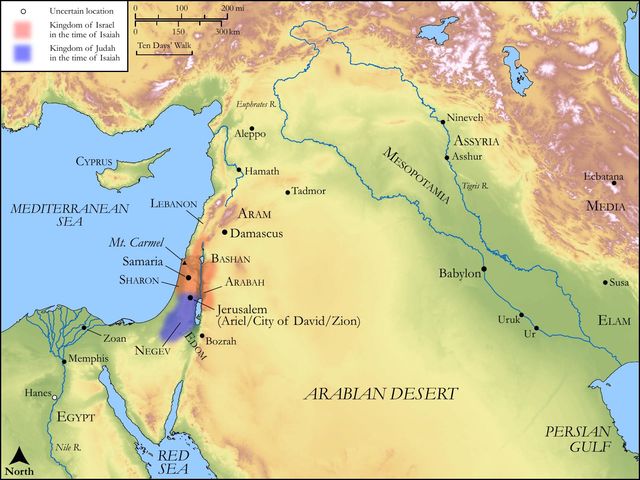
See on the biblical-era map
Study this verse
Public-domain commentary
Matthew Henry
From his Commentary on the Whole Bible. Henry comments on passages, not single verses — this entry covers Isaiah 35:5–10. His two-level outline is real structure in the source text, so it is rendered as structure.
"Then, when your God shall come, even Christ, to set up his kingdom in the world, to which all the prophets bore witness, especially towards the conclusion of their prophecies of the temporal deliverances of the church, and this evangelical prophet especially - then look for great things."
I.Wonders shall be wrought in the kingdoms both of nature and grace, wonders of mercy wrought upon the children of men, sufficient to evince that it is no less than a God that comes to us.
1.Wonders shall be wrought on men's bodies (Isa 35:5, Isa 35:6): The eyes of the blind shall be opened; this was often done by our Lord Jesus when he was here upon earth, with a word's speaking, and one he gave sight to that was born blind, Mat 9:27; Mat 12:22; Mat 20:30; Joh 9:6. By his power the ears of the deaf also were unstopped, with one word. Ephphatha - Be opened, Mar 7:34. Many that were lame had the use of their limbs restored so perfectly that they could not only go, but leap, and with so much joy to them that they could not forbear leaping for joy, as that impotent man, Act 3:8. The dumb also were enabled to speak, and then no marvel that they were disposed to sing for joy, Mat 9:32, Mat 9:33. These miracles Christ wrought to prove that he was sent of God (Joh 3:2), nay, working them by his own power and in his own name, he proved that he was God, the same who at first made man's mouth, the hearing ear, and the seeing eye. When he would prove to John's disciples his divine mission he did it by miracles of this kind, in which this scripture was fulfilled.
2.Wonders, greater wonders, shall be wrought on men's souls. By the word and Spirit of Christ those that were spiritually blind were enlightened (Act 26:18), those that were deaf to the calls of God were made to hear them readily, so Lydia, whose heart the Lord opened, so that she attended, Act 16:14. Those that were impotent to every thing that is good by divine grace are made, not only able for it, but active in it, and run the way of God's commandments. Those also that were dumb, and knew not how to speak of God or to God, having their understandings opened to know him, shall thereby have their lips opened to show forth his praise. The tongue of the dumb shall sing for joy, the joy of God's salvation. Praise shall be perfected out of the mouth of babes and sucklings.
II.The Spirit shall be poured out from on high.
There shall be waters and streams, rivers of living water; when our Saviour spoke of these as the fulfilling of the scripture, and most probably of this scripture, the evangelist tells us, He spoke of the Spirit (Joh 7:38, Joh 7:39), as does also this prophet (ch. 32:15); so here (Isa 35:6), in the wilderness, where one would least expect it, shall waters break out. This was fulfilled when the Holy Ghost fell upon the Gentiles that heard the word (Act 10:44); then were the fountains of life opened, whence streams flowed, that watered the earth abundantly. These waters are said to break out, which denotes a pleasing surprise to the Gentile world, such as brought them, as it were, into a new world. The blessed effect of this shall be that the parched ground shall become a pool, Isa 35:7. Those that laboured and were heavily laden, under the burden of guilt, and were scorched with the sense of divine wrath, found rest, and refreshment, and abundant comforts in the gospel. In the thirsty land, where no water was, nor ordinances (Psa 63:1), there shall be springs of water, a gospel ministry, and by that the administration of all gospel ordinances in their purity and plenty, which are the river that makes glad the city of our God, Psa 46:4. In the habitation of dragons, who chose to dwell in the parched scorched ground (Isa 34:9, Isa 34:13), these waters shall flow, and dispossess them, so that, where each lay shall be grass with reeds and rushes, great plenty of useful productions. Thus it was when Christian churches were planted, and flourished greatly, in the cities of the Gentiles, which, for many ages, had been habitations of dragons, or devils rather, as Babylon (Rev 18:2); when the property of the idols' temples was altered, and they were converted to the service of Christianity, then the habitations of dragons became fruitful fields.
III.The way of religion and godliness shall be laid open:
it is here called the way of holiness (Isa 35:8) the way both of holy worship and a holy conversation. Holiness is the rectitude of the human nature and will, in conformity to the divine nature and will. The way of holiness is that course of religious duties in which men ought to walk and press forward, with an eye to the glory of God and their own felicity in the enjoyment of him. "When our God shall come to save us he shall chalk out to us this way by his gospel, so as it had never been before described." 1. It shall be an appointed way; not a way of sufferance, but a highway, a way into which we are directed by a divine authority and in which we are protected by a divine warrant. It is the King's highway, the King of Kings' highway, in which, though we may be waylaid, we cannot be stopped. The way of holiness is the way of God's commandments; it is (as highways usually are) the good old way, Jer 6:16. 2. It shall be an appropriated way, the way in which God will bring his own chosen to himself, but the unclean shall not pass over it, either to defile it or to disturb those that walk in it. It is a way by itself, distinguished from the way of the world, for it is a way of separation from, and nonconformity to, this world. It shall be for those whom the Lord has set apart for himself (Psa 4:3), shall be reserved for them: The redeemed shall walk there, and the satisfaction they take in these ways of pleasantness shall be out of the reach of molestation from an evil world. The unclean shall not pass over it, for it shall be a fair way; those that walk in it are the undefiled in the way, who escape the pollution that is in the world. 3. It shall be a straight way: The wayfaring men, who choose to travel in it, though fools, of weak capacity in other things, shall have such plain directions from the word and Spirit of God in this way that they shall not err therein; not that they shall be infallible even in their own conduct, or that they shall in nothing mistake, but they shall not be guilty of any fatal misconduct, shall not so miss their way but that they shall recover it again, and get well to their journey's end. Those that are in the narrow way, though some may fall into one path and others into another, not all equally right, but all meeting at last in the same end, shall yet never fall into the broad way again; the Spirit of truth shall lead them into all truth that is necessary for them. Note, The way to heaven is a plain way, and easy to hit. God has chosen the foolish things of the world, and made them wise to salvation. Knowledge is easy to him that understands. 4. It shall be a safe way: No lion shall be there, nor any ravenous beast (Isa 35:9), none to hurt or destroy. Those that keep close to this way keep out of the reach of Satan the roaring lion, that wicked one touches them not. Those that walk in the way of holiness may proceed with a holy security and serenity of mind, knowing that nothing can do them any real hurt; they shall be quiet from the fear of evil. It was in Hezekiah's days, some time after the captivity of the ten tribes, that God, being displeased with the colonies settled there, sent lions among them, Kg2 17:25. But Judah keeps her integrity, and therefore no lions shall be there. Those that walk in the way of holiness must separate themselves from the unclean and the ravenous, must save themselves from an untoward generation; hoping that they themselves are of the redeemed, let them walk with the redeemed who shall walk there.
IV.The end of this way shall be everlasting joy, Isa 35:10.
This precious promise of peace now will end shortly in endless joys and rest for the soul. Here is good news for the citizens of Zion, rest to the weary: The ransomed of the Lord, who therefore ought to follow him wherever he goes (Rev 14:4), shall return and come to Zion,
1.To serve and worship God in the church militant: they shall deliver themselves out of Babylon (Zac 2:7), shall ask the way to Zion (Jer 50:5), and shall find the way Isa 52:12. God will open to them a door of escape out of their captivity, and it shall be an effectual door, though there be many adversaries. They shall join themselves to the gospel church, that Mount Zion, that city of the living God, Heb 12:22. They shall come with songs of joy and praise for their deliverance out of Babylon, where they wept upon every remembrance of Zion, Psa 137:1. Those that by faith are made citizens of the gospel Zion may go on their way rejoicing (Act 8:39); they shall sing in the ways of the Lord, and be still praising him. They rejoice in Christ Jesus, and the sorrows and signs of their convictions are made to flee away by the power of divine consolations. Those that mourn are blessed, for they shall be comforted.
2.To see and enjoy God in the church triumphant; those that walk in the way of holiness, under guidance of their Redeemer, shall come to Zion at last, to the heavenly Zion, shall come in a body, shall all be presented together, faultless, at the coming of Christ's glory with exceeding joy (Jde 1:24; Rev 7:17); they shall come with songs. When God's people returned out of Babylon to Zion they came weeping (Jer 50:4); but they shall come to heaven singing a new song, which no man can learn, Rev 14:3. When they shall enter into the joy of their Lord it shall be what the joys of this world never could be everlasting joy, without mixture, interruption, or period. It shall not only fill their hearts, to their own perfect and perpetual satisfaction, but it shall be upon their heads, as an ornament of grace and a crown of glory, as a garland worn in token of victory. Their joy shall be visible, and no longer a secret thing, as it is here in this world; it shall be proclaimed, to the glory of God and their mutual encouragement. They shall then obtain the joy and gladness which they could never expect on this side heaven; and sorrow and sighing shall flee away for ever, as the shadows of the night before the rising sun. Thus these prophecies, which relate to the Assyrian invasion, conclude, for the support of the people of God under that calamity, and to direct their joy, in their deliverance from it, to something higher. Our joyful hopes and prospects of eternal life should swallow up both all the sorrows and all the joys of this present time.
Historical interpretation
Four Centuries of Reception
2 surviving comments on this verse. Each one is dated, so this reads as a timeline rather than a list.
Select a marker to jump to its quote. Markers stagger vertically where authors wrote within a few decades of each other.
But since I have not quoted to you such Scripture as tells that Christ will do these things, I must necessarily remind you of one such: from which you can understand, how that to those destitute of a knowledge of God, I mean the Gentiles, who, 'having eyes, saw not, and having a heart, understood not,' worshipping the images of wood, [how even to them] Scripture prophesied that they would renounce these [vanities], and hope in this Christ. It is thus written: 'Rejoice, thirsty wilderness: let the wilderness be glad, and blossom as the lily: the deserts of the Jordan shall both blossom and be glad: and the glory of Lebanon was given to it, and the honour of Carmel. And my people shall see the exaltation of the Lord, and the glory of God. Be strong, ye careless hands and enfeebled knees. Be comforted, ye faint in soul: be strong, fear not. Behold, our God gives, and will give, retributive judgment. He shall come and save us. Then the eyes of the blind shall be opened, and the ears of the deaf shall hear. Then the lame shall leap as an hart, and the tongue of the stammerers shall be distinct: for water has broken forth in the wilderness, and a valley in the thirsty land; and the parched ground shall become pools, and a spring of water shall [rise up] in the thirsty land.' The spring of living water which gushed forth from God in the land destitute of the knowledge of God, namely the land of the Gentiles, was this Christ, who also appeared in your nation, and healed those who were maimed, and deaf, and lame in body from their birth, causing them to leap, to hear, and to see, by His word. And having raised the dead, and causing them to live, by His deeds He compelled the men who lived at that time to recognise Him.
The Lord makes a promise about holy church through another prophet, saying, “The reed and the rushes will become green and luscious.” I remember explaining elsewhere that reeds must be interpreted as scribes and rushes surely as hearers. But because both rushes and reeds are apt to grow beside the moisture of water and both benefit from the same water, and a reed is indeed used for writing while it is impossible to write with a bulrush, what must we understand by the bulrush and the reed except that there is one doctrine of truth which nourishes many hearers?
Continue studying Isaiah 35:7 across the web’s major study libraries — every link below opens this exact verse, chapter, or book on the destination site.
Read & Compare
 BibleGatewayThis verse in more than 200 translations and 70 languages.
 Bible.comThe YouVersion reader — hundreds of translations, reading plans, and highlights.
 ESV.orgCrossway's official English Standard Version reader.
 NET BibleThe NET translation with 60,000+ translators' notes on every rendering decision.
 STEP BibleTyndale House's free study tool — original text, vocabulary, and scholarly resources.
 BibliaLogos Bible Software's free web reader.
 USCCBThe New American Bible (Revised Edition) with the U.S. bishops' study notes.
Commentaries
 BibleHub CommentariesDozens of classic commentaries on this verse, gathered on one page.
 StudyLightMore than 100 commentary sets — the largest collection on the web.
 BibleRefPlain-English commentary on what this verse means, verse by verse.
 Enduring WordDavid Guzik's free commentary on this chapter, widely used by Bible teachers.
 Bible Study ToolsVerse commentary alongside Greek and Hebrew study aids.
Original Language & Research
- BibleHub InterlinearThe verse word by word — original language, transliteration, and English.
- BibleHub LexiconEvery word's original-language definition and Strong's entry.
 Blue Letter BibleDeep-study tools — Strong's numbers, concordance, and word studies.
 SefariaThe Hebrew text with Rashi and centuries of Jewish commentary.
Sermons, Hymns & Audio


TrulyRandomVerse is not affiliated with these sites and doesn’t control their content. They’re linked because they’re genuinely useful.
Summary
Isaiah 35:7 is a profound prophetic declaration envisioning a radical transformation and divine restoration, where desolate and dangerous landscapes are miraculously remade into lush, life-sustaining environments. This verse vividly portrays God's sovereign power to reverse barrenness and threat, bringing forth abundant life and flourishing even in the most uninhabitable spiritual and physical realms. It serves as a powerful message of hope, pointing to an ultimate era of divine blessing, redemption, and a new creation.
Context
ShowHideLiterary Context
Isaiah 35 stands as a glorious crescendo within the book of Isaiah, immediately following the stern pronouncements of divine judgment upon the nations, particularly Edom, detailed in chapter 34. This stark juxtaposition powerfully emphasizes the dramatic shift from divine wrath to divine redemption and restoration. Chapter 35 itself is a unified poetic vision, opening with the wilderness rejoicing and blossoming, as seen in Isaiah 35:1, and progressing through themes of healing, strengthening the weak, and the miraculous opening of eyes and ears, articulated in Isaiah 35:5-6. Verse 7 specifically reinforces the miraculous provision of water in the desert, a key element of the promised restoration, leading seamlessly into the description of the "Highway of Holiness" prepared for the redeemed, found in Isaiah 35:8-10.
Historical & Cultural Context
The prophecy in Isaiah 35 speaks to a people facing or having recently endured exile and desolation, most immediately with the Babylonian captivity in view, though its scope extends beyond that particular historical event. The imagery of "parched ground," "thirsty land," and the "habitation of dragons" (more accurately, jackals or wild dogs) evokes the desolate, dangerous, and uninhabitable nature of ruined lands in Judah and its neighbours. Jackals (Hebrew: tannim) were commonly associated with abandoned cities and wilderness areas, symbolizing utter ruin, the absence of human habitation, and a lack of divine blessing. The promise of abundant water, grass, reeds, and rushes directly counters this imagery, depicting a return to fertility and vibrant life, which were absolutely essential for survival and flourishing in an arid climate. This promised transformation would have resonated deeply with a people longing for a return to their homeland and a restoration of their national and spiritual vitality.
Key Themes
ShowHideThis verse powerfully encapsulates several overarching themes found throughout Isaiah and the broader prophetic literature. Divine Transformation and Restoration is paramount, highlighting God's unique ability to reverse seemingly irreversible conditions, turning death into vibrant life. This theme is powerfully echoed in other prophecies of renewal, such as when God promises to make rivers in barren lands in Isaiah 41:18. Abundance in Desolation is another crucial theme; the prophecy speaks not merely of survival but of overflowing provision, where once dangerous and barren places become lush oases. The imagery of water and flourishing vegetation signifies not just physical provision but also profound spiritual refreshment, peace, and security. Finally, the verse contributes significantly to the broader theme of Messianic Hope and Future Glory, pointing beyond a mere physical return from exile to the ultimate spiritual renewal and new creation brought about by God's redemptive work, often understood as culminating in the person and work of the Messiah.
Exposition and Analysis
ShowHideKey Word Analysis
ShowHideThis term (H8273), derived from an unused root meaning "to glare," refers to the shimmering, quivering glow of the air, creating the illusion of water in a desert—a mirage. Its transformation into a "pool" (H98, ʼăgam, a marsh or standing water) signifies a profound and miraculous shift from deceptive emptiness and unfulfilled expectation to tangible, life-giving reality. It underscores the complete and supernatural reversal of a seemingly hopeless situation.
This word (H6774) denotes a place characterized by extreme thirst or drought, a desert. It emphasizes the dire and desperate need for water. The promise that this land will become "springs of water" (H4002, mabbûwaʻ, a fountain or gushing source; H4325, mayim, water) highlights not just the presence of water, but an abundant, self-replenishing, and continuously flowing source, indicating an overflowing provision far beyond mere subsistence.
While the King James Version translates this as "dragons" (H8577), in the context of desolate land, this term more accurately refers to jackals or wild dogs. These animals were commonly associated with ruined, abandoned, and dangerous places, symbolizing utter desolation and the absence of human habitation or divine blessing. The transformation of their "habitation" (H5116, nâveh, a home, den, or pasture; H7258, rêbets, a couch or place of repose) into a place of lush "grass" (H2682, châtsîyr) "with reeds" (H7070, qâneh) "and rushes" (H1573, gômeʼ) signifies the complete vanquishing of danger and desolation, replaced by beauty, safety, and abundant life.
Verse Breakdown
ShowHide"And the parched ground shall become a pool"
This initial clause vividly initiates the miraculous transformation, directly countering the deceptive nature of the mirage (shârâb) with the tangible reality of abundant, standing water (ʼăgam). It signifies the complete reversal of barrenness into fertility and life-sustaining provision, turning an illusion of hope into concrete reality.
"and the thirsty land springs of water"
Building upon the first clause, this phrase further emphasizes the divine provision and its overflowing nature. The "thirsty land" (tsimmâʼôwn), desperately in need of refreshment, will not merely receive water, but "springs of water" (mabbûwaʻ), indicating a continuous, flowing, and abundant source, far beyond what is merely sufficient for survival.
"in the habitation of dragons, where each lay, [shall be] grass with reeds and rushes"
This final clause powerfully portrays the transformation of a place of danger, ruin, and desolation—the lair of wild, unclean animals (tannîyn, jackals)—into a lush, verdant, and safe environment. The specific mention of "grass with reeds and rushes" (châtsîyr, qâneh, gômeʼ) points to a flourishing ecosystem, typically found in wetlands, symbolizing peace, safety, and abundant life where only ruin and threat once existed.
Literary Devices
ShowHideIsaiah 35:7 is rich in Imagery, painting vivid pictures of both extreme desolation and glorious flourishing. The stark contrast between "parched ground" and "pool," "thirsty land" and "springs of water," and the "habitation of dragons" versus "grass with reeds and rushes" creates a powerful sense of Antithesis or Contrast, highlighting the dramatic and supernatural nature of God's redemptive work. The transformation described is so radical and complete that it approaches Hyperbole, emphasizing the extraordinary and miraculous extent of divine intervention. The entire verse functions as a profound Metaphor for spiritual and national restoration, using physical landscape changes to convey deeper theological truths about God's ability to bring life out of spiritual death and hope out of despair.
Theological and Thematic Connections
ShowHideIsaiah 35:7 stands as a powerful testament to God's redemptive character and His ultimate plan for creation and humanity. It underscores the theological truth that God is not content with desolation but actively intervenes to bring about restoration and flourishing. This divine transformation is not merely a return to a former state but an elevation to a new, more glorious reality, where the very nature of the land is changed. The provision of water in the desert is a recurring motif throughout Scripture, symbolizing divine sustenance, spiritual refreshment, and the life-giving power of God's presence and Spirit. This prophecy points to a future where God's glory will be fully revealed, and His people will experience complete peace and abundance, free from the threats of the wilderness.
Reflection and Application
ShowHideIsaiah 35:7 offers profound encouragement for every believer, reminding us that no situation, no matter how barren, perilous, or seemingly hopeless, is beyond the transformative power of God. Just as God promises to turn the shimmering mirage into a tangible pool and the jackal's desolate den into a lush meadow, He can bring life, healing, and hope into the most desolate areas of our lives—be they spiritual dryness, emotional wasteland, challenging circumstances, or even seemingly irreversible brokenness. This verse invites us to cultivate a deep and unwavering trust in God's faithfulness, believing that He is capable of bringing forth beauty and abundance even from ruin and despair. It calls us to look beyond present difficulties and limitations to the promised future, both in our personal journeys of sanctification and in the ultimate fulfillment of God's kingdom, where all things will be made new and abundant, reflecting His glorious presence and power.
Questions for Reflection
ShowHideFAQ
ShowHideWhat is the significance of "dragons" in this verse, and why is it sometimes translated differently?
ShowHideThe King James Version's translation of "dragons" comes from the Hebrew word tannîyn (H8577). While tannîyn can refer to large aquatic or land monsters (like sea-serpents or crocodiles, as seen in Ezekiel 29:3), in contexts describing desolate, uninhabited wildernesses, it is more accurately translated as "jackals" or "wild dogs." These animals were commonly associated with ruins and abandoned places in the prophets' pictures of Babylon and Edom, symbolizing utter desolation, danger, and the absence of human life or divine blessing. The significance in Isaiah 35:7 lies in the complete reversal: a place so desolate that only dangerous wild animals inhabit it will be transformed into a lush, life-filled oasis, signifying God's radical restoration and the banishment of all that represents ruin and threat.
Does this prophecy refer only to a physical transformation of the land?
ShowHideWhile the imagery in Isaiah 35:7 is deeply rooted in physical landscape transformation, biblical prophecy often operates on multiple levels of fulfillment. It certainly speaks to a literal, physical restoration, perhaps in the context of the return from Babylonian exile or the ultimate new creation. However, as a prophetic text within a book rich in spiritual themes, it also carries profound spiritual and metaphorical meaning. It signifies God's ability to transform spiritual barrenness into flourishing life, to bring hope and joy to those in despair, and to establish His kingdom of peace and abundance. Many scholars see it pointing to the spiritual renewal brought by the Messiah and the ultimate new heavens and new earth described in Revelation 21, where all sorrow and suffering are banished, and God's presence brings ultimate flourishing.
Christ-Centered Fulfillment
ShowHideIsaiah 35:7 finds its ultimate and most profound fulfillment in the person and redemptive work of Jesus Christ. He is the one who brings true spiritual transformation, turning the "parched ground" of the human heart, dry and barren from sin and separation from God, into "springs of living water." Just as the prophet describes water gushing forth in the desert, Jesus Himself declared, "If anyone thirsts, let him come to me and drink. Whoever believes in me, as the Scripture has said, 'Out of his heart will flow rivers of living water'" (John 7:37-38). The "habitation of dragons," representing places of spiritual desolation, demonic influence, and the curse of sin, is conquered and transformed by Christ's victorious work on the cross and His resurrection. Through His atoning sacrifice, He triumphs over the powers of darkness, making way for the flourishing of His kingdom, where the "grass with reeds and rushes" symbolizes the abundant life, peace, and spiritual vitality found exclusively in His presence. This verse powerfully foreshadows the new creation inaugurated by Christ, where all things are made new, and the desert of human existence is made to blossom with the life of God's Spirit, culminating in the eternal city where the "river of the water of life" flows freely from the throne of God and of the Lamb (Revelation 22:1-2).