


Joel 3:12
- יֵעוֹרוּye·'o·rulet them be rousedH5782V-Niphal-Imperf-3mpVerb Niphal Imperfect 3rd Plural Masculine
- וְיַעֲלוּve·ya·'a·Luand they may go upH5927Conj-w ¦ V-Qal-ConjImperf-3mpVerb Qal Conjunction+Imperfect 3rd Plural Masculineוְandיַעֲלוּthey may go up
- הַגּוֹיִםha·go·Yimthe nationsH1471Art ¦ N-mpNoun Plural Masculine Absoluteהַtheגּוֹיִםnations
- אֶל'eltoH413PrepPreposition
- עֵמֶק'E·mek[the] valley ofH6010N-mscNoun Singular Masculine Construct
- יְהוֹשָׁפָטye·ho·sha·FatJehoshaphatH3092N-proper-mNoun Proper Masculine
- כִּיkiforH3588PrtParticle Conditional
- שָׁםShamthereH8033AdvAdverb
- אֵשֵׁב'e·ShevI will sitH3427V-Qal-Imperf-1csVerb Qal Imperfect 1st Singular common gender
- לִשְׁפֹּטlish·Potto judgeH8199Prep-l ¦ V-Qal-InfVerb Qal Infinitive Constructלִtoשְׁפֹּטjudge
- אֶת'et<obj.>H853DirObjMParticle Object Indicator
- כָּלkolallH3605N-mscNoun Singular Masculine Construct
- הַגּוֹיִםha·go·Yimthe nationsH1471Art ¦ N-mpNoun Plural Masculine Absoluteהַtheגּוֹיִםnations
- מִסָּבִיבmi·sa·Vivfrom round aboutH5439Prep-m ¦ N-csNoun Singular common gender Absoluteמִfromסָּבִיבround about
English is a literal word-by-word gloss of the Hebrew, not the KJV's wording. Why?
This is the original text the KJV's translators worked from — each Hebrew word with its own literal English meaning in this verse, prepared by scholars at Tyndale House, Cambridge. The KJV translates whole sentences, not word by word, so its wording differs: one Hebrew word can become several English words, and the KJV may choose “the LORD” where the gloss reads “Yahweh”. Both are faithful — they answer different questions. For the KJV's own rendering, switch to the KJV text.
Details
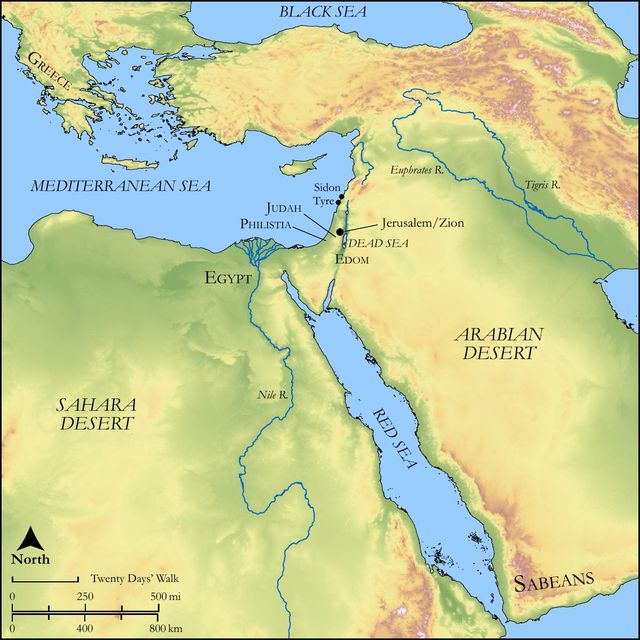
See on the biblical-era map
Study this verse
Public-domain commentary
Matthew Henry
From his Commentary on the Whole Bible. Henry comments on passages, not single verses — this entry covers Joel 3:9–17. His four-level outline is real structure in the source text, so it is rendered as structure.
What the psalmist had long before ordered to be said among the heathen (Psa 96:10) the prophet here will have in like manner to be published to all nations, That the Lord reigns, and that he comes, he comes to judge the earth, as he had long been judging in the earth. The notice here given of God's judging the nations may have reference to the destruction of Sennacherib, Nebuchadnezzar, Antiochus, and to the Antichrist especially, and all the proud enemies of the Christian church; but some of the best interpreters, ancient and modern (particularly the learned Dr. Polock), think the scope of these verses is to set forth the day of the last judgment under the similitude of God's making war upon the enemies of his kingdom, and his gathering in the harvest of the earth, both which similitudes we find used in the Revelation, Rev 19:11; Rev 14:18. Here we have,
I.A challenge given to all the enemies of God's kingdom to do their worst.
To signify to them that God is preparing war against them, they are called upon to prepare war against him, Joe 3:9-11. When the hour of God's judgment shall come effectual methods shall be taken to gather all nations to the battle of that great day of God Almighty, Rev 16:14; Rev 20:8. It seems to be here spoken ironically: "Proclaim you this among the Gentiles; let all the forces of the nations be summoned to join in confederacy against God and his people." It is like that, Isa 7:9, "Associate yourselves, O you people! and gird yourselves, but you shall be broken to pieces. Prepare war; muster up all your strength; wake up the mighty men; call them into your service; excite them to vigilance and resolution; let all the men of war draw near. Let them come and enter the lists with Omnipotence if they dare; let them not complain for want of weapons, but let them beat their ploughshares into swords and their pruning-hooks into spears. Let them resolve, if they will, never to return to their husbandry again, but either to conquer or die; let none plead unfitness to bear arms, but let the weak say, I am strong and will venture into the field of battle." Thus does a God of almighty power bid defiance to all the opposition of the powers of darkness; let the heathen rage, and the kings of the earth take counsel together, against the Lord and his Christ; let them assemble, and come, and gather themselves together; but he that sits in heaven shall laugh at them, and, while he thus calls them, he has them in derision, Psa 2:1, Psa 2:4. The heathen must be wakened, must be raised from the dead, that they may come up to the valley of Jehoshaphat, to receive their doom (Joe 3:12), may come up out of their graves, come up into the air, to meet the Lord there. Jehoshaphat signifies the judgment of the Lord. Let them come to the place of God's judgment, which perhaps is the chief reason for the using of this name here, but it is put together as a proper name for the sake of allusions to the place so called, which we observed before; let them come thither where God will sit to judge the heathen, to that throne of glory before which shall be gathered all nations (Mat 25:32), for before the judgment-seat of Christ we must all appear. The challenge (Joe 3:9) is turned into a summons, Joe 3:12. It is not only, Come if you dare, but You shall come whether you will or no, for there is no escaping the judgments of God.
II.A charge given to the ministers of God's justice to appear and act against these daring enemies of his kingdom among men:
And therefore cause thy mighty ones to come down, O Lord! Joe 3:11. When they bring their forces into the field, let God bring his, let the archangel's trumpet sound a charge, to call together his mighty ones, that is, his angels. Perhaps it is with reference to this that Christ's coming from heaven at the last day is said to be with his mighty angels, Th2 1:7. These are the hosts of the Lord, that shall fight his battles when he shall put down all opposing rule, principality, and power when he shall judge among the heathen, Psa 110:6. Some think these words (Joe 3:9, Joe 3:10), Prepare war, wake up the mighty men, are not a challenge to the enemies' hosts, but a charge to God's hosts; let them draw near, and come up. When God's cause is to be pleaded, either by the law or by the sword, he has those ready that shall please it effectually, witnesses ready to appear for him in the court of judgment, soldiers ready to appear for him in the field of battle. They shall beat ploughshares into swords, if need be. However, it is plain that to them the charge in given (Joe 3:13), Put you in the sickle, for the harvest is ripe; that is, their wickedness is great, the measure of it is full, and they are ripe for ruin. Our Saviour has expounded this, Mat 13:39. The harvest is the end of the world, and the reapers are the angels. And they are commanded to thrust in their sickle. their sharp sickle, and gather in both the harvest and the vintage, Rev 14:15, Rev 14:18. Note, The greatness of men's wickedness makes them ripe for God's judgment.
III.The vast appearance that shall be in that great and solemn day (Joe 3:14):
Multitudes, multitudes, in the valley of decision, the same which before was called the valley of Jehoshaphat, or of the judgment of the Lord, for the day of the Lord is near in that valley. Note,
1.The judgment-day, that day of the Lord, has all along been looked upon, and spoken of, as nigh at hand. Enoch said, Behold, the Lord comes, as if the Judge were then standing before the door, because it is certain that that day will come and will come according to the appointment, and a thousand years with God are but as one day; things are ripening apace for it; we ought always to be ready for it, because our judgment is at hand.
2.The day of judgment will be the day of decision, when every man's eternal state will be determined, and the controversy that has been long depending between the kingdom of Christ and that of Satan shall be finally decided, and an end put to the struggle. The valley of the distribution of judgment (so the Chaldee), when every man shall receive according to the things done in the body. The valley of threshing (so the margin), carrying on the metaphor of the harvest, Joe 3:13. The proud enemies of God's people will then be crushed and broken to pieces, and made as the dust of the summer threshing-floors.
3.Innumerable multitudes will be gathered together to receive their final doom in that day, as in the destruction of Gog we read of the valley of Hamon-Gog, and the city of Hamonah (Eze 39:15, Eze 39:16), both signifying the multitude of the vanquished enemies; it is the word here used, Hamonim, Hamonim, expressed by the way of admiration - O what vast multitudes of sinners will divine justice be glorified in the ruin of at that day! A multitude of living (says one of the rabbin) and a multitude of dead, for Christ shall come to judge both the quick and the dead.
IV.The amazing change that shall then be made in the kingdom of nature (Joe 3:15):
The sun and moon shall be darkened, as before, Joe 2:31. Their glory and lustre shall be eclipsed by the far greater brightness of that glory in which the Judge shall then appear. Nay, they shall themselves be set aside in the dissolution of all things; for the damned sinners in hell shall not be allowed their light, for God himself will be their everlasting light, Isa 60:19. Those that fall under the wrath of God in that day of wrath shall be cut off from all comfort and joy, signified by the darkening not only of sun and moon, but of the stars also.
V.The different impressions which that day will make upon the children of this world and the children of God, according as it will be to them.
1.To the wicked it will be a terrible day. The Lord shall then speak from Zion and Jerusalem, from the throne of his glory, from heaven, where he manifests himself in a peculiar manner, as sometimes he has done in the glorious high throne of his sanctuary, which yet was but a faint resemblance of the glory of that day. He shall speak from heaven, from the midst of his saints and angels (so some understand it), the holy society of which may be called Zion and Jerusalem; for, when we come to the heavenly Jerusalem, we come to the innumerable company of angels; see Heb 12:22, Heb 12:25. Now is speaking in that day will be to the wicked as roaring, terrible as the roaring of a lion (for so the word signifies); he long kept silence, but now our God shall come, and shall not keep silence, Psa 50:3, Psa 50:21. Note, The judgment of the great day will make the ears of those to tingle that continue the implacable enemies of God's kingdom. God's voice will then shake terribly both heaven and earth (Isa 2:21), yet once more, Hag 2:6; Heb 12:26. This denotes that the voice of God will in the great day speak such terror to the wicked as were enough to put even heaven and earth into a consternation. When God comes to pull down and destroy his enemies, and make them all his footstool, though heaven and earth should stand up in defence of them and undertake their protection, it shall be all in vain. Even they shall shake before him and be an insufficient shelter to those whom he comforts forth to contend with. Note, As blessings out of Zion are the sweetest blessings, and enough to make heaven and earth sing, so terrors out of Zion are the sorest terrors, and enough to make heaven and earth shake.
2.To the righteous it will be a joyful day. When the heaven and earth shall tremble, and be dissolved and burnt up, then will the Lord be the hope of his people and the strength of the children of Israel (Joe 3:16), and then shall Jerusalem be holy, Joe 3:17. The saints are the Israel of God; they are his people; the church is his Jerusalem. They are in covenant and communion with him; now in the great day,
(1.)Their longings shall be satisfied: The Lord will be the hope of his people. As he always was the founder and foundation of their hopes, so he then will be the crown of their hopes. He will be the harbour of his people (so the word is), their receptacle, refuge, and home. The saints in the great day shall arrive at the desired haven, shall put to shore after a stormy voyage; they shall go to be for ever at home with God, to their Father's house, the house not made with hands.
(2.)Their happiness shall be confirmed. God will be in that day the strength of the children of Israel, enabling them to bid that day welcome and to bear up under the weight of its glories and joys. In this world, when the judgments of God are abroad, and sinners are falling under them, God is and will be the hope and strength of his people, the strength of their heart, and their portion, when other men's hearts fail them for fear.
(3.)Their holiness shall be completed (Joe 3:17): Then shall Jerusalem be holy, the holy city indeed; such shall the heavenly Jerusalem be, such the glorious church, without spot, or wrinkle, or any such thing. Jerusalem shall be holiness (so the word is); it shall be perfectly holy; there shall be no remainder of sin in it. The gospel-church is a holy society, even in its militant state, but will never be holiness itself till it comes to be triumphant. Then no stranger shall pass through her any more; there shall not enter into the New Jerusalem any thing that defiles or works iniquity; none shall be there but those who have a right to be there, none but its own citizens; for it shall be an unmixed society.
(4.)God shall in all this be manifested and magnified: So shall you know that I am the Lord your God. By the sanctifying and glorifying of the church God will be known in his holiness and glory, as the God that dwells in his holy mountain and makes it holy by dwelling in it; and those that are sanctified and glorified are so through the knowledge of him that called them. The knowledge which true believers have of God is,
[1.]An appropriating knowledge. They know that he is the Lord their God, yet not theirs only, but theirs in common with the whole church, that he is their God, but dwelling in Zion his holy mountain; for, though faith appropriates, it does not engross or monopolize the privileges of the covenant.
[2.]It is an experimental knowledge. They shall find him their hope and strength in the worst of times, and so they shall know that he is the Lord their God. Those know best the goodness of God who have tasted and seen it, and have found him good to them.
Historical interpretation
Four Centuries of Reception
2 surviving comments on this verse. Each one is dated, so this reads as a timeline rather than a list.
Select a marker to jump to its quote. Markers stagger vertically where authors wrote within a few decades of each other.
(Verse 12 and following) Let the nations arise and come up to the Valley of Jehoshaphat, for there I will sit to judge all the surrounding nations. Send in the sickles, for the harvest is ripe. Come and go down, for the winepress is full; the vats overflow, for their wickedness is multiplied. LXX: Let all the nations arise and come up to the Valley of Jehoshaphat, for there I will sit to judge all the surrounding nations. Send in the sickles, for the grape harvest is ripe. Come in and tread, for the winepress is full, and the wine vats overflow, for their evil deeds are abundant. And these things are interpreted in two ways according to a higher meaning. Some people understand that the nations will ascend into the valley of Josaphat, which means the judgment of the Lord, and sit there before God, so that He may judge all the nations that come from every direction in a favorable manner. In this way, the saints will gather against the adversaries of God and send forth their sickles to reap the ripe harvest of the enemies, and they will come and go, treading on the wine vats, because there is a vintage present, and the must is so abundant that the wine vats cannot contain it. And so, in order to understand what the vintage is and what the full winepress signifies, he has introduced the multiplication of their malice, and without a doubt it signifies those who have congregated against the Lord. But others say that the nations will rise up and come together in the Valley of Josaphat and sit before the Lord, so that he may judge all nations. They assert that they will prepare themselves and gather all the weapons of the fighters, and in the valley of Josaphat they will be cut down by the sickles of the Lord. For the time of judgment had come against them, and their evils had grown so much that they overcame God's patience. For the Amorites were expelled then, when their sins were fulfilled. The Jews interpret this place as referring to the fierce nations of Gog and Magog, about which we have spoken above, believing that in the last time, when Jerusalem is restored, they will come against God's people during a thousand-year reign, and in the Valley of Jehoshaphat, which is situated to the east of the temple, they will fall ((another reading: rage)). For the time of their destruction has come, and the time of pouring out blood is imminent.
The words “come up to the valley of Jehoshaphat” will not gather them and bring them down, but he will let them accomplish their plan. In fact, he talks about the people over whom the house of Gog rules. “To the valley of Jehoshaphat,” that is, to the valley of judgment. “Jehoshaphat” is interpreted as judgment and sentence.
Continue studying Joel 3:12 across the web’s major study libraries — every link below opens this exact verse, chapter, or book on the destination site.
Read & Compare
 BibleGatewayThis verse in more than 200 translations and 70 languages.
 Bible.comThe YouVersion reader — hundreds of translations, reading plans, and highlights.
 ESV.orgCrossway's official English Standard Version reader.
 NET BibleThe NET translation with 60,000+ translators' notes on every rendering decision.
 STEP BibleTyndale House's free study tool — original text, vocabulary, and scholarly resources.
 BibliaLogos Bible Software's free web reader.
 USCCBThe New American Bible (Revised Edition) with the U.S. bishops' study notes.
Commentaries
 BibleHub CommentariesDozens of classic commentaries on this verse, gathered on one page.
 StudyLightMore than 100 commentary sets — the largest collection on the web.
 BibleRefPlain-English commentary on what this verse means, verse by verse.
 Enduring WordDavid Guzik's free commentary on this chapter, widely used by Bible teachers.
 Bible Study ToolsVerse commentary alongside Greek and Hebrew study aids.
Original Language & Research
- BibleHub InterlinearThe verse word by word — original language, transliteration, and English.
- BibleHub LexiconEvery word's original-language definition and Strong's entry.
 Blue Letter BibleDeep-study tools — Strong's numbers, concordance, and word studies.
 SefariaThe Hebrew text with Rashi and centuries of Jewish commentary.
Sermons, Hymns & Audio


TrulyRandomVerse is not affiliated with these sites and doesn’t control their content. They’re linked because they’re genuinely useful.
Summary
Joel 3:12 serves as a powerful prophetic declaration, foretelling a climactic future event where God, as the supreme Judge, will summon all Gentile nations to the symbolic "Valley of Jehoshaphat." This assembly is not for diplomacy but for a definitive divine judgment, a global reckoning for their actions, particularly concerning their treatment of God's people and their defiance of His righteous standards. The verse underscores God's ultimate sovereignty and His unwavering commitment to justice in human history.
Context
ShowHideLiterary Context
Joel 3:12 is situated within the latter half of the book of Joel, which transitions from a dire warning to Judah about an impending "Day of the Lord" (initially manifested as a devastating locust plague and drought, as seen in Joel 1) to a broader, eschatological vision of God's judgment upon the nations. Chapters 2 and 3 pivot from Israel's repentance and restoration to God's universal justice. Specifically, Joel 3 describes God's response to the nations that have oppressed His people and plundered His inheritance. Verses 9-11 immediately precede this verse, issuing a challenge to the nations to prepare for war, a war that will ultimately be against God Himself, setting the stage for the divine intervention described in verse 12. The subsequent verses (e.g., Joel 3:13-16) further elaborate on the execution and finality of this judgment.
Historical & Cultural Context
While Joel's exact historical setting is debated (likely post-exilic or early pre-exilic Judah), the concept of divine judgment upon nations was a recurring theme in Israelite prophecy, reflecting God's covenantal relationship with His people and His role as the sovereign ruler of all the earth. In the ancient Near East, valleys often served as natural battlegrounds, making the imagery of a "valley of judgment" particularly potent. The specific mention of the "Valley of Jehoshaphat" evokes the historical King Jehoshaphat, whose name means "Yahweh judges," and his miraculous victory over a coalition of enemies (as recounted in 2 Chronicles 20). This name, therefore, intrinsically links the location to the very act of divine judgment, whether it refers to a literal valley (often associated with the Kidron Valley near Jerusalem) or a symbolic place of God's decisive intervention. The cultural understanding of a powerful deity summoning nations for accountability would have resonated deeply with the original audience.
Key Themes
ShowHideJoel 3:12 contributes significantly to several overarching themes in the book and broader biblical theology. The primary theme is Divine Judgment, emphasizing God's absolute right and intention to hold all nations accountable for their actions, especially their mistreatment of His chosen people and their defiance of His moral order. This judgment is portrayed as both just and inevitable. Closely related is the theme of God's Sovereignty, as He is depicted as the supreme Judge who commands the nations to assemble, demonstrating His ultimate control over all earthly powers and history. The phrase "there will I sit to judge" powerfully conveys His authoritative position. The Accountability of Nations is also prominent; the verse highlights that collective entities, not just individuals, are subject to divine scrutiny and reckoning. Finally, the Symbolism of the Valley of Jehoshaphat is a key thematic element. As mentioned, the name itself signifies "Yahweh judges," making it a fitting, perhaps even archetypal, location for the final divine reckoning. This symbolic nature is reinforced by its parallel in Joel 3:14, where it is called the "valley of decision," underscoring the decisive nature of the events unfolding there.
Exposition and Analysis
ShowHideKey Word Analysis
ShowHideThis term (H1471) refers to a foreign nation, hence a Gentile. In biblical usage, it often denotes nations distinct from Israel, frequently those who are idolatrous or hostile to God's people. Here, it encompasses all non-Israelite nations, indicating the universal scope of God's judgment.
This verb (H5782) means "to wake, arouse, or stir up." It suggests a divine imperative, implying that the nations will be compelled or stirred from their complacency or ignorance to attend this judgment. It is not a voluntary assembly but a divinely orchestrated summons that they cannot resist.
This primitive root (H8199) signifies "to judge, pronounce sentence (for or against)." By implication, it can also mean to vindicate (for the righteous) or to punish (for the wicked). In this context, it clearly refers to God's authoritative act of rendering a verdict and executing justice upon the assembled nations.
Verse Breakdown
ShowHide"Let the heathen be wakened"
This opening clause is a divine imperative, a command from God. It signifies an active, supernatural stirring or arousal of the Gentile nations. They are not coming willingly or by their own initiative, but are being divinely compelled to assemble. This highlights God's absolute sovereignty over all peoples and His power to orchestrate events on a global scale. The "wakening" implies a sudden, perhaps even jarring, realization of their impending encounter with divine justice.
"and come up to the valley of Jehoshaphat"
Following the summons, the nations are commanded to ascend to a specific location. The "valley" (ʻêmeq, H6010) suggests a broad, open depression, often a place of battle or assembly. The name "Jehoshaphat" (Yᵉhôwshâphâṭ, H3092), meaning "Yahweh judges," is profoundly significant. Whether a literal geographical place or a symbolic designation, its name unequivocally declares the purpose of the gathering: it is the place where God will execute judgment. The "coming up" might imply a journey from various parts of the world to this central point of reckoning.
"for there will I sit to judge all the heathen round about"
This final clause provides the divine rationale and assurance of the judgment. The pronouncement "I will sit" (yâshab, H3427) is an anthropomorphic expression of God assuming His judicial throne. It conveys authority, finality, and solemnity. His sitting implies a formal, deliberate, and unchallengeable act of judgment. The phrase "all the heathen round about" emphasizes the comprehensive and universal scope of this judgment, leaving no nation exempt from accountability before the sovereign God.
Literary Devices
ShowHideJoel 3:12 employs several powerful literary devices to convey its message. Anthropomorphism is evident in the phrase "there will I sit to judge," attributing human-like action (sitting on a throne) to God to emphasize His role as a sovereign judge. This makes the concept of divine judgment more relatable and impactful. Symbolism is central to the "Valley of Jehoshaphat," which, as its name ("Yahweh judges") suggests, symbolizes the definitive arena of God's judgment rather than necessarily a specific geographical location. This symbolic naming underscores the theological meaning of the event. The use of Hyperbole or Generalization in "all the heathen round about" emphasizes the universal and comprehensive nature of God's judgment, ensuring that no nation is outside His purview or accountability. The entire verse functions as a Prophetic Oracle, a divine declaration of future events, delivered with authority and certainty, serving both as a warning to the nations and an assurance of justice for God's people.
Theological and Thematic Connections
ShowHideJoel 3:12 stands as a pivotal text for understanding God's ultimate justice and sovereignty over all creation. It reinforces the biblical truth that history is moving towards a divine climax where every nation will be held accountable for its deeds, particularly its treatment of God's people and its adherence to His moral standards. This judgment is not arbitrary but flows from God's righteous character, demonstrating that He is actively involved in the affairs of humanity and will ultimately rectify all wrongs. The promise of this final reckoning offers profound comfort to those who suffer injustice, assuring them that a just God will indeed "sit to judge." Conversely, it serves as a solemn warning to those who defy Him or oppress others, underscoring the inevitability of divine accountability. This theme resonates throughout the prophetic literature, pointing to a future day when God's justice will be fully revealed and established.
Reflection and Application
ShowHideJoel 3:12 offers profound insights for both personal faith and a broader worldview. For the believer, it provides immense comfort and assurance. In a world often marked by injustice, where wickedness seems to prosper and the innocent suffer, this verse reminds us that God is not indifferent. He is sovereign, just, and actively engaged in history, and there will be a final, perfect reckoning. This truth should strengthen our trust in His ultimate plan and encourage us to persevere in righteousness, knowing that our God will indeed "sit to judge." For those who do not acknowledge God or live in defiance of His ways, Joel 3:12 serves as a solemn warning. It underscores the universal accountability of all humanity before a holy God. No nation, no individual, can escape His scrutiny or His judgment. This should prompt a serious introspection about one's standing before God and a call to repentance and reconciliation. Ultimately, the verse challenges us to live lives that reflect God's justice and compassion, actively seeking to align ourselves with His righteous kingdom, knowing that all our actions, individually and collectively, are seen by the Judge of all the earth.
Questions for Reflection
ShowHideFAQ
ShowHideIs the "Valley of Jehoshaphat" a literal place or symbolic?
ShowHideWhile there is a Kidron Valley near Jerusalem that has historically been associated with the "Valley of Jehoshaphat," the consensus among scholars is that in Joel 3:12, it functions primarily as a symbolic location. The name "Jehoshaphat" itself means "Yahweh judges" or "the Lord has judged," making it a highly fitting, divinely named arena for God's ultimate judgment. It is also called the "valley of decision" in Joel 3:14. This symbolic interpretation emphasizes the theological truth of God's universal judgment rather than pinpointing a specific geographical spot for a future event. It represents the place where God's justice will be decisively enacted upon the nations.
Who are "the heathen" mentioned in this verse?
ShowHideThe term "heathen" (Hebrew, gôwy) refers to the Gentile nations, meaning all nations other than Israel. In the context of Joel, it specifically points to those nations that have oppressed God's people, plundered His inheritance, and acted in defiance of His divine will. Joel 3:12 declares that all such nations, regardless of their power or influence, will be summoned and judged by God. This highlights the universal scope of God's authority and His demand for accountability from all peoples.
When will this judgment described in Joel 3:12 take place?
ShowHideJoel 3:12 describes an eschatological event, meaning it pertains to the "last days" or the end times. It is part of the broader prophetic vision of the "Day of the Lord," which encompasses both judgment and salvation. While the exact timing is not specified, it is depicted as a climactic future event that will occur when God definitively intervenes in human history to establish His righteous rule and bring final justice upon the nations. Many theological traditions connect this judgment with the second coming of Christ or the final judgment preceding the eternal state, as described in passages like Matthew 25:31-46 or Revelation 20:11-15.
Christ-Centered Fulfillment
ShowHideJoel 3:12, with its vivid portrayal of God sitting in judgment over all nations, finds its ultimate fulfillment and most profound meaning in the person and work of Jesus Christ. While Joel speaks of Yahweh as the Judge, the New Testament unequivocally reveals that the Father has committed all judgment to the Son (as articulated in John 5:22). Therefore, the "I" who will "sit to judge" in Joel's prophecy is none other than the returning Christ, who will descend with power and great glory to execute divine justice. Passages like Matthew 25:31-32, where Jesus states that "when the Son of Man comes in his glory, and all the angels with him, then he will sit on his glorious throne. Before him will be gathered all the nations," directly echo Joel's imagery of a universal gathering for judgment. Christ, as the righteous King and Lamb of God who takes away the sin of the world (John 1:29), is also the one who will return as the Lion of Judah to judge the living and the dead (Revelation 5:5 and 2 Timothy 4:1). Thus, Joel's vision of a sovereign God bringing all nations to account culminates in the majestic and fearsome return of Jesus, the ultimate Judge, who will perfectly vindicate His people and establish His eternal kingdom of righteousness.